Loading the model
This device cannot show the 3D model. You can read the guide steps below as text.
1 / 24 A game from 1858 plays itself In 1858 Paul Morphy played this game in a box at the Paris opera against the Duke of Brunswick and Count Isouard. Watch it end in checkmate on move 17.
Drag to turn. Scroll or pinch to zoom.
Guide Parts Controls
01 A game from 1858 plays itself In 1858 Paul Morphy played this game in a box at the Paris opera against the Duke of Brunswick and Count Isouard. Watch it end in checkmate on move 17.
02 Setting up the board Turn the board so that each player has a light square in the near right corner. The white queen starts on the light square d1 and the black queen on the dark square d8, each on her own colour.
03 The king moves one square The king steps one square in any direction. Drag it to a lit square. It may never move to a square the other side attacks.
04 The rook moves in straight lines The rook goes any distance along its file or its rank, but it cannot jump over a piece in the way.
05 The bishop moves on diagonals A bishop moves along diagonals and never leaves its colour. That is why each side has one bishop for the light squares and one for the dark.
06 The queen is rook and bishop together From d4 on an empty board the queen reaches 27 squares, more than any other piece. Try a long diagonal and a long file.
07 The knight jumps The knight moves two squares in one direction and then one to the side, an L shape. It jumps over pieces in its way and always lands on the other colour.
08 The pawn moves forward and captures sideways A pawn moves one square forward, or two on its first move, and captures one square diagonally forward. It never moves backwards.
09 Castling moves two pieces at once Once a game, the king goes two squares toward a rook and the rook lands on the square the king crossed. Neither may have moved before.
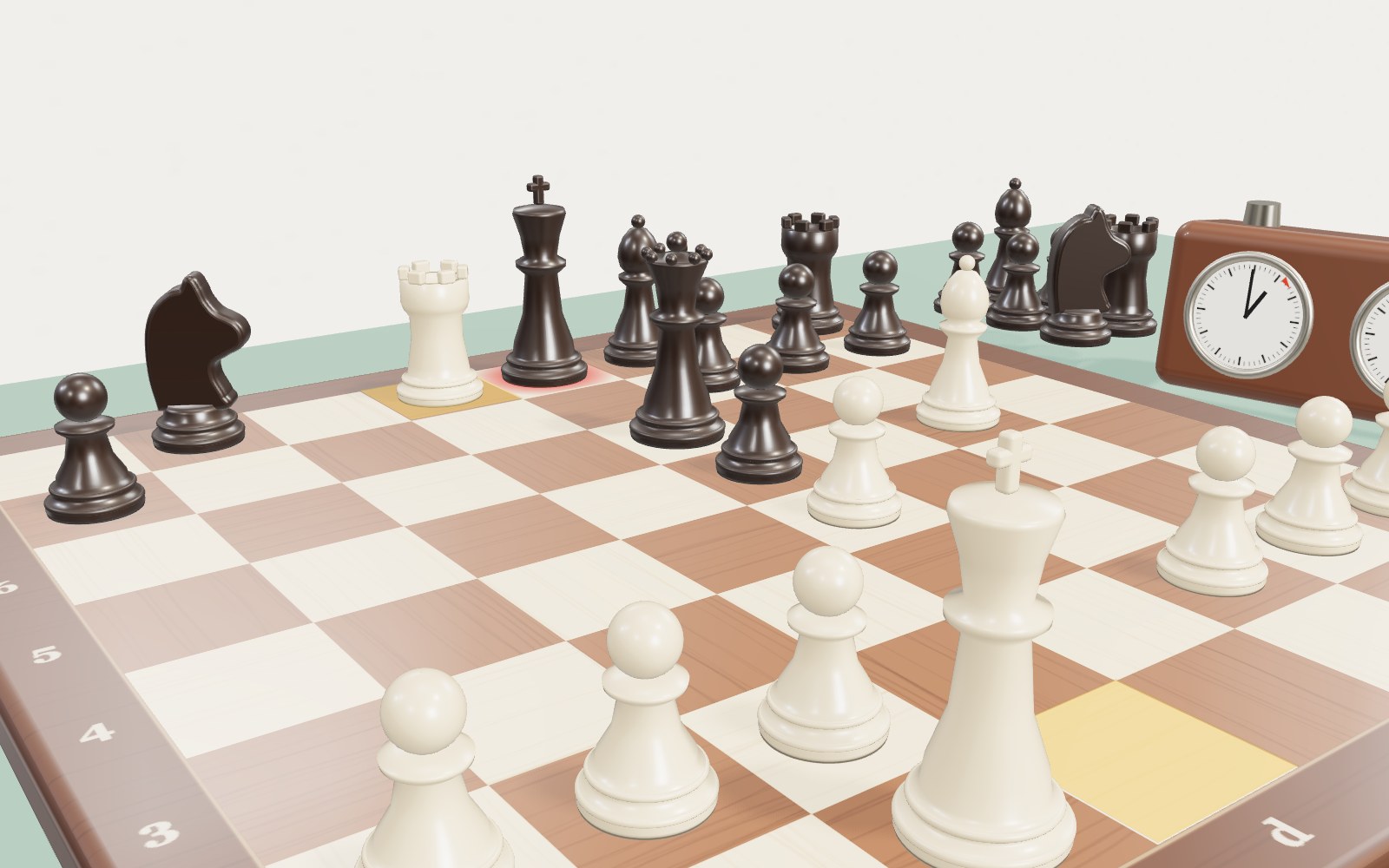
10 No castling through check The king may not castle while in check, across an attacked square or into check. The bishop on b5 watches f1, so castling short is impossible here. Castling long is still allowed.
11 En passant A pawn that has just moved two squares can be captured as if it had moved one, but only straight away. In this game Marache took en passant against Morphy on move 8.
12 Promotion A pawn that reaches the last rank becomes a queen, rook, bishop or knight of its own colour, whichever the player chooses. A second queen is allowed.
13 Check and the three ways out The black rook gives check. White must answer at once by moving the king, putting a piece in between or capturing the rook. Only those moves light up.
14 Back-rank mate The black king is shut in by its own pawns. A single rook move along the back rank is checkmate.
15 Two rooks climb a ladder Each rook check pushes the king back one rank while the other rook guards the rank behind. Four moves are enough here.
16 Queen mate with support The queen goes right next to the king, protected by her own king, and covers every square the black king could run to.
17 King and queen against king The queen boxes the king in and the white king walks up to help. Capablanca wrote that it should take fewer than ten moves; the simple engine in this exhibit needs 12 from here.
18 Careful: stalemate If the side to move has no legal move and is not in check, the game is drawn. Here 1.Qb6 would throw the win away, while 1.Qb7 is mate.
19 Five ideas for the opening This Italian Game follows the five opening ideas from Capablanca and Lasker one after another. The caption names each idea as it is used.
20 Counting every possible game After one move each there are 400 possible positions; after four moves each, 84,998,978,956 possible games. In 1950 Claude Shannon estimated 10¹²⁰ games in all.
21 The knight's tour A knight can visit all 64 squares once each. There are 13,267,364,410,532 closed tours that end a knight's move from the start.
22 Eight queens Place eight queens so that none attacks another. There are 92 ways, or 12 if rotations and mirror images count as the same.
23 Rice on the chessboard One grain on the first square, two on the second, doubling every square up to square 64: 18,446,744,073,709,551,615 grains in all.
24 Before 1500 the queen was weak In the chess book Caxton printed in the 1470s the queen steps one square diagonally and the bishop jumps two. Switch the old rules on and compare.
King Moves one square in any direction. The game is won by trapping it: checkmate. Queen Moves any distance along files, ranks and diagonals. Before about 1500 it stepped only one square diagonally. Rook Moves any distance along a file or rank. It takes part in castling. Bishop Moves any distance along diagonals and stays on one colour for the whole game. Knight Jumps in an L shape and is the only piece that can jump over others. Pawn Moves forward, captures diagonally, and is promoted when it reaches the last rank. Board Sixty-four squares in eight files (a to h) and eight ranks (1 to 8). The near right corner is always light. Corner square h1 The light square on White's right. Setting up with this square in the wrong place is the most common mistake. Chess clock Two clocks, one for each player. Pressing your button after a move stops your clock and starts your opponent's. Captured pieces Pieces taken off the board stand here, so you can count material. Person (1.7 m) A faceless figure for scale. Enter your own height under Me.