Loading the model
This device cannot show the 3D model. You can read the guide steps below as text.
1 / 11 A field on a clear afternoon The sun is 30° up. Every patch of sky you see is sunlight that air molecules have knocked off course. Drag the sun in the sky, or pick a condition along the bottom, and the picture is recalculated. The ring in the middle is measured twice: the screen pixel and the colour of the computed spectrum.
Drag to turn. Scroll or pinch to zoom.
Guide Parts Controls
01 A field on a clear afternoon The sun is 30° up. Every patch of sky you see is sunlight that air molecules have knocked off course. Drag the sun in the sky, or pick a condition along the bottom, and the picture is recalculated. The ring in the middle is measured twice: the screen pixel and the colour of the computed spectrum.
02 Blue light scatters more Air molecules scatter in proportion to 1/λ⁴, so 440 nm blue is scattered about 5.9 times more than 680 nm red. The white line in the chart is the light reaching the centre of the view, rising toward the violet end. The dashed curve is how sensitive the eye is.
03 A low sun shines through more air At 3° the sunlight crosses 847 km of air, 14.7 times as much as from straight overhead. Only 0.3% of 440 nm light gets through, against 12% of 680 nm, so the sun turns orange.
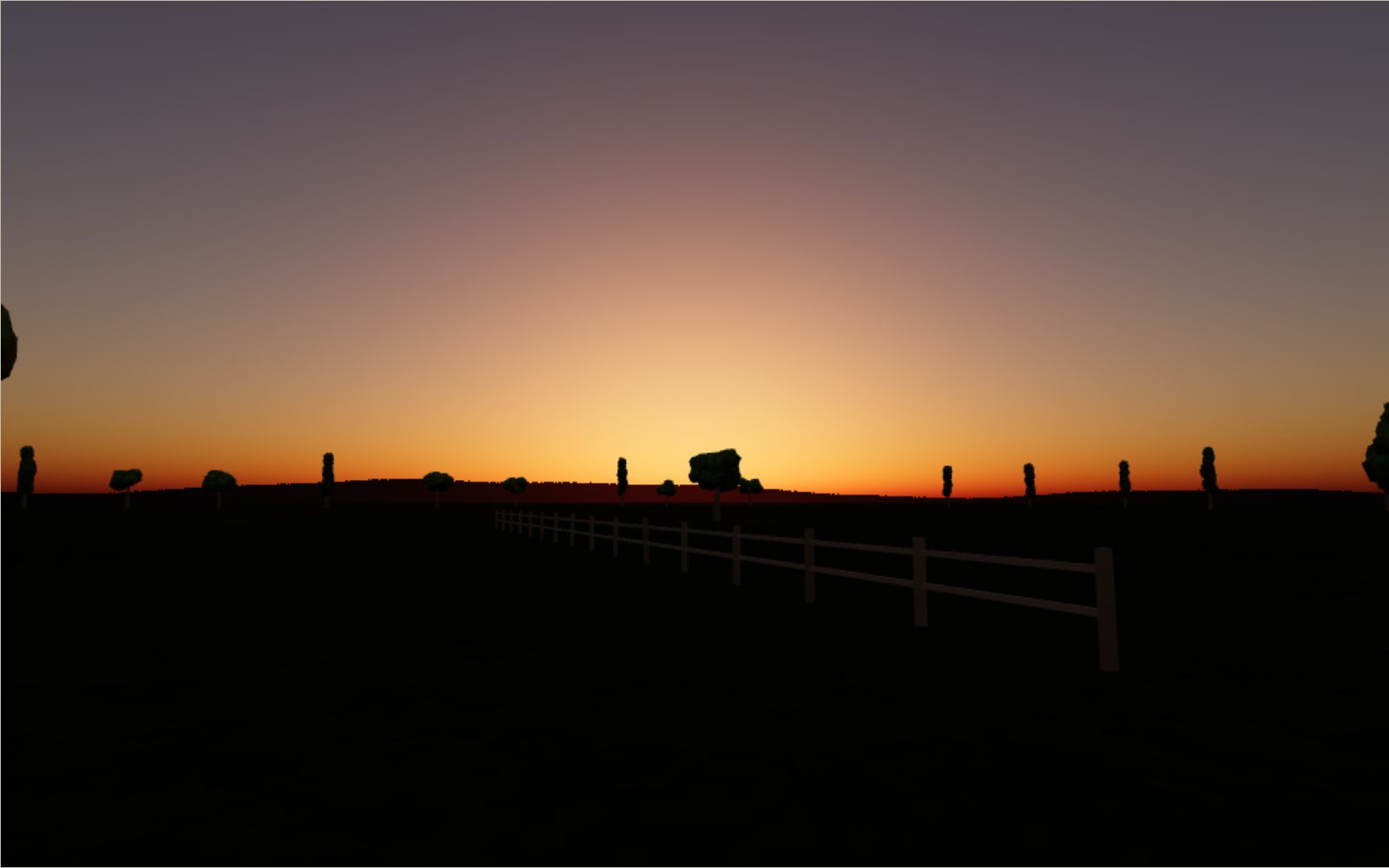
04 After sunset: Earth's shadow The sun is 2.5° below the horizon. Opposite it, a grey-blue band sits on the horizon: the air there is in the planet's shadow. Above it, air still in sunlight glows pink.
05 Haze makes sunsets dull Aerosol optical depth is now 0.6, a hazy day with fine dust. Particles scatter all colours about equally, so at 6° almost nothing gets through and the far hills fade into grey. Try the Haze slider.
06 A volcanic layer high up A big eruption can leave a sulphate haze 20 km up for a year or more. With the sun 3° below the horizon, that layer is still sunlit and adds a purple-pink glow above the afterglow.
07 Higher up, the sky darkens The eye is now at 10,700 m, an airliner's cruising height. Three quarters of the air is below, so there is less of it above to scatter light, and the sky overhead turns navy. Try Eye height in Controls.
08 From orbit: a thin blue line At 400 km, the height of the space station, the sky is black and the whole atmosphere is a bright band on the curved edge of the planet, with clouds and sea below.
09 Mars: yellow-brown by day, blue at sunset Martian air is thin, but its fine dust absorbs blue and scatters red widely. Near the setting sun the dust scatters blue light forward in a narrow cone, so a blue glow hugs the sun. Raise the sun for the butterscotch daytime sky.
10 The Moon: no air, black sky With no air there is nothing to scatter the light, so the sky stays black even with the sun 25° up. The sun is white and the ground is lit only by direct light.
11 Uranus and Neptune No surface here: you float above the methane cloud deck. Hydrogen and helium scatter blue like our air, and methane absorbs red, so the light that comes back is green-blue. Pick Neptune in the bar for the less hazy twin.
Sun Its disc takes the colour of the light that is left after the trip through the air. Drag it up or down in the sky. Bright ring round the sun Haze and dust scatter mostly forward, within a few degrees of the sun, so a white glare forms round it. Clean air keeps it small. Sky overhead Sunlight scattered sideways by air molecules. The short path straight up keeps it a deep blue. Deepest blue About 90° from the sun the sky is darkest and most saturated: little forward-scattered haze light reaches you from there. Horizon sky Light from the horizon has crossed far more air, scattered many times over, so it fades toward white. Earth's shadow Just after sunset a dark blue band rises opposite the sun. It is the planet's own shadow on the air. Belt of Venus The pink band above Earth's shadow: air still lit by the reddened light of the sun that has already set for you. Afterglow After sunset the sky above the sun's position glows yellow and orange, lit by light that skims the planet's edge. Purple light A high glow 15 to 25° above the set sun. It is strongest after big eruptions, when a sulphate layer at 20 km catches red light and the blue sky adds to it. Far hills Wooded hills 2 to 4 km away. The air between you and them adds its own blue glow, more so in haze. Field Grass lit by the direct sun and the whole sky. Its colour shifts with the light that reaches it. Blue shadows The shade under a tree is lit only by the sky, so it is bluer than the sunlit grass beside it. Stars They are there all day. Once the scattered light is gone (night, the Moon, high altitude) the long exposure shows them. Edge of the atmosphere From high up the air is a thin glowing shell on the curved horizon, blue where the sunlight crosses it sideways. Blue glow round the sun On Mars fine dust sends blue light forward in a narrow cone, so the sky next to a low sun turns blue-grey. Cloud deck Uranus and Neptune have no surface. The floor here is the top of the methane cloud deck, near 1.2 bar.