Loading the model
This device cannot show the 3D model. You can read the guide steps below as text.
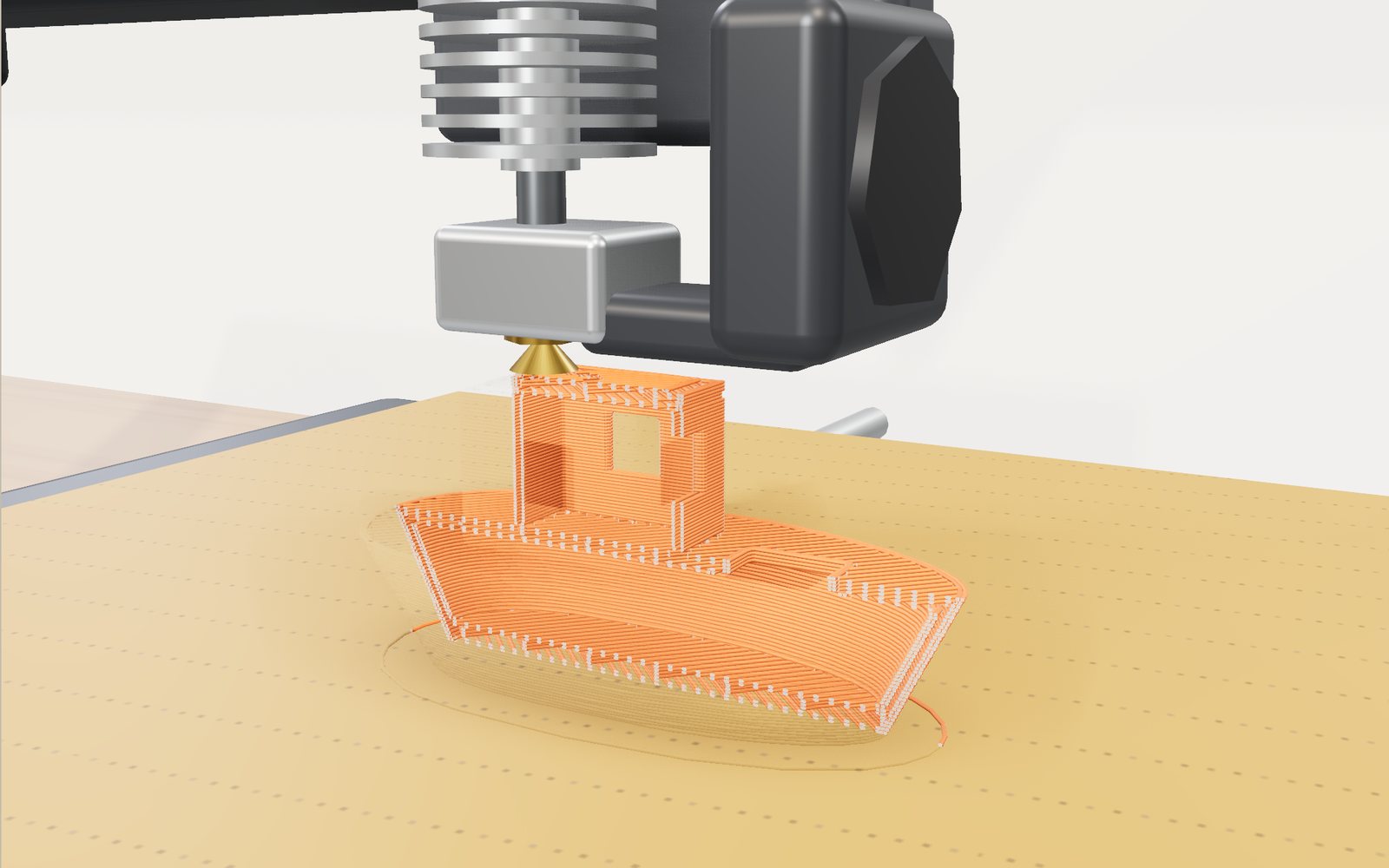
1 / 16 A boat grows layer by layer Melted plastic comes out of a 0.4 mm nozzle and is laid down one line at a time. The front half is cut away so you can watch the infill grow inside the walls.
Drag to turn. Scroll or pinch to zoom.
Guide Parts Controls
01 A boat grows layer by layer Melted plastic comes out of a 0.4 mm nozzle and is laid down one line at a time. The front half is cut away so you can watch the infill grow inside the walls.
02 Pick a shape 14 shapes, from a 20 mm cube to a figure of you. Each is sliced on the spot into layers and nozzle paths.
03 Layer height The 42 mm boat is 210 layers at 0.2 mm. Thinner layers look smoother and take longer; the time on the left is the slicer’s estimate.
04 Walls Every layer starts with loops around its outline. More walls make a stronger part, and in a small part most of the plastic goes into them.
05 Infill Inside the walls the slicer lays a sparse pattern: lines, grid, triangles, gyroid or honeycomb. At 15 % the inside is mostly air.
06 Support The lower half of a ball overhangs more and more toward the bed. With support on, a breakaway scaffold grows under it first.
07 Nozzle path and G-code Every move is one line of G-code. Blue lines are where the nozzle pushes plastic; dashed lines are travel moves.
08 Inside the hot end The extruder pushes the filament into a heated block, and it leaves the nozzle as a molten line. The fan cools it at once.
09 Warping ABS shrinks as it cools. Without a brim, the corners of the small house curl up off the bed.
10 Printing in mid-air An arch with no support: past the overhang limit the lines droop and the region turns into a tangle.
11 Layer shift A motor skipped steps halfway up, so every layer above lands 3 mm to the side.
12 Resin, upside down A resin printer hardens a whole layer at once with light from below; the part hangs from a plate that lifts out of the vat.
13 Powder, no supports A laser melts nylon powder layer by layer. The loose powder holds every overhang, so nothing needs support.
14 A printed boat 7.62 m long The University of Maine printed 3Dirigo in 72 hours in 2019. The person beside it is 1.7 m tall.
15 Back at the bench The desktop printer makes parts up to about 22 cm. Enter your height under “You” to print a figure of yourself.
16 Take it off the bed When the bed cools, the part lets go. The tasks under the controls are waiting: the steepest overhang, a house in under an hour, a light strong gear.
Printed part The shape on the bed, built from extruded lines of plastic one layer at a time. Walls Loops around the outline of every layer. The outer loop is printed at half speed, because it is the surface you see. Infill and skin The sparse pattern inside, and the solid layers that close the top and the bottom. Support Paler lines under overhangs, printed sparse so they break off afterwards. Nozzle A brass tip with a 0.4 mm hole. The plastic leaves it at about 200 °C or more. Heater block An aluminium block holding a heater cartridge and a temperature sensor. Heat sink and heat break Keep the filament solid until it reaches the heater block, so it does not soften too early and jam. Part cooling fan Blows on the fresh line so it sets before the next one lands on it. Overhangs and bridges depend on it. Extruder Two toothed gears grip the filament and push it into the hot end. Filament A plastic wire 1.75 mm thick. One metre of PLA weighs about 3 g. Spool Usually 1 kg of filament, about 335 m of PLA. Heated bed and sheet A textured sheet on a heated plate. The warm surface keeps the first layer stuck down. Gantry The beam that carries the head left and right and climbs one layer height at a time. Lead screw Turns to lift the gantry by exactly one layer. Belt and motor A stepper motor pulls the head along with a toothed belt. Screen Progress, layer and temperatures. Person for scale A figure 1.7 m tall, for the size of the printer and of the big prints.