Loading the model
This device cannot show the 3D model. You can read the guide steps below as text.
1 / 20 One garden, 69 pairs of eyes The same garden is redrawn for each animal. Colour, sharpness, the light an eye needs and how fast it sees all change. Pick an animal in the bar under the picture, or a scene at the top.
Drag to turn. Scroll or pinch to zoom.
Guide Parts Controls
01 One garden, 69 pairs of eyes The same garden is redrawn for each animal. Colour, sharpness, the light an eye needs and how fast it sees all change. Pick an animal in the bar under the picture, or a scene at the top.
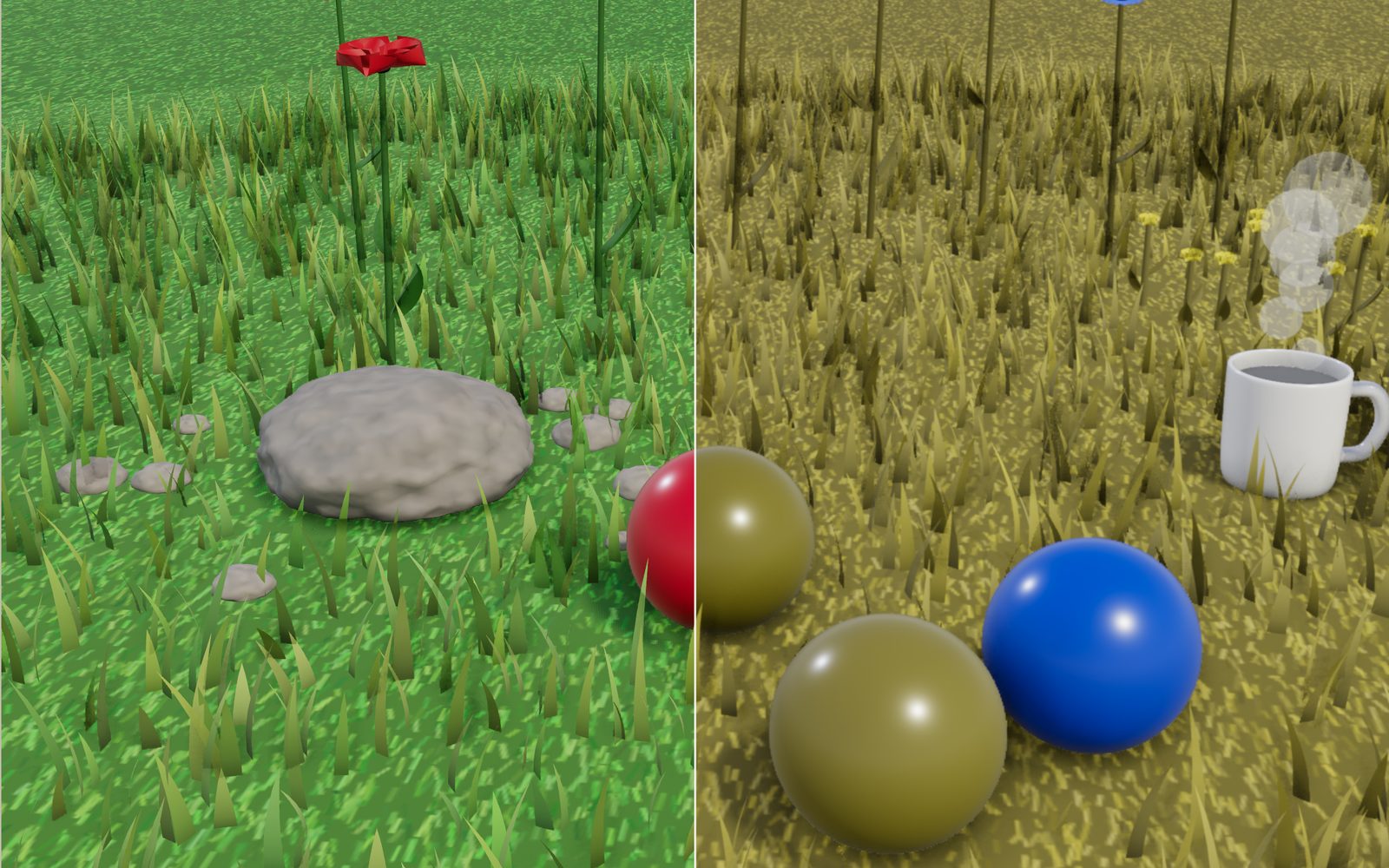
02 Why the dog misses the red ball Dogs have two cone types, near 429 and 555 nm. Red and green land on the same cone, so the red ball and the green ball come out almost the same olive. The left half is your view, the right half the dog's.
03 What a bee sees in a flower Bees see ultraviolet, blue and green, not red. The black-eyed Susans reflect ultraviolet at the petal tips and absorb it near the centre, a ring that only ultraviolet eyes see. No screen emits ultraviolet, so this is a false-colour stand-in.
04 Four cones in a bird A pigeon has four single-cone types, at 409, 453, 507 and 567 nm. A screen has three colours, so the model folds four channels into three. Yellows and reds separate more than in the dog's view.
05 A horse sees almost all the way round The panorama shows the full circle around the camera. A horse covers about 350 degrees; only the hatched strip behind stays unseen. Try a person (180 degrees) for comparison.
06 A lantern that flickers The lantern flickers 100 times a second, like a lamp on 50 Hz mains. A person fuses flicker near 60 Hz and sees steady light. A honeybee fuses between 200 and 300 Hz, so for it the lantern pulses (shown slowed down).
07 A pit viper feels heat Pit vipers have a pit below each eye that senses infrared. Heat cannot be shown on a screen, so warm surfaces are painted in false colour over a dim view. The tea glows, the stone glows faintly.
08 The shape of the pupil A goat's pupil is a horizontal bar. With the pupil blur on, things in front of and behind the focus smear sideways while vertical edges stay sharper. The blur strength is a model; the shape is the goat's.
09 A cat in dim moonlight The forest is lit by dim moonlight, 0.002 cd/m². Your half turns grey and grainy. Cats detect light about 5.5 times dimmer than people, so the right half stays brighter, though colour still fades.
10 Colour by starlight At 0.0001 cd/m², dim starlight, people see no colour. The elephant hawkmoth still chose coloured flowers in tests, so its view keeps colour.
11 Eyeshine With the torch on, the deer's eyes shine back. Behind its retina is a tapetum, a mirror layer that sends light through the receptors a second time. Many night-active mammals have one.
12 15 metres down Water absorbs red light about 37 times more strongly than blue. At 15 m only a few per cent of the red is left along the path from the surface, so the red fish looks grey-brown even to you.
13 An octopus sees polarisation Octopuses have one pigment and are colour-blind, but their receptors detect the polarisation of light. Here strongly polarised light (from silvery fish) shows yellow, unpolarised light blue.
14 Twelve receptors Mantis shrimp have 12 receptor types yet confuse colours 12 to 25 nm apart. The model lets the strongest receptor name the colour, so the reef breaks into flat bands of hue.
15 An eagle's eye from 480 m Through a telescope-like view 4 m tall, the left half shows your limit of 60 cycles per degree and the right half the wedge-tailed eagle's 140. From 480 m a rabbit spans about 3 cycles for you and about 7 for the eagle: a blob for you, still a rabbit for the eagle.
16 Inside a camera eye A human eye cut in half: cornea and lens bend light to a point on the retina, the image upside down. The yellow dot marks the fovea, where cones are densest.
17 A compound eye An insect eye is a dome of facets, each with its own lens and receptors. Fewer facets mean a coarser picture: a bee's sit about a degree apart.
18 At mouse height Eye level puts the camera where the animal's eyes are. A mouse looks out from 3 cm, under the tips of the grass, and sees about 0.5 cycles per degree, so the apples are blurred red shapes. Drag to look around.
19 The bee's nectar guide The same flowers at a bee's height. Silverweed petals are plain yellow to you, but their bases absorb ultraviolet, so the bee view shows a dark centre. Each hexagon is one facet: a worker bee has about 5,432 of them in each eye.
20 Seeing all the way round A mallard's field covers all 360 degrees. In the panorama the grey band marks what an animal cannot see; for the mallard there is none. Horses and woodcocks come close or match it.
Lawn Green background. Most of the colour tests in this scene happen against it. Red poppies Strong red. Dogs and horses see them as a dull olive close to the grass. Black-eyed Susans Yellow to us. In ultraviolet the petal bases are dark, a nectar guide that bees can see and we cannot. The bee view draws that pattern in the blue channel. Cornflowers Blue flowers keep their colour in every mammal view, because all of them have a blue-sensitive cone. Silverweed Low yellow flowers. Their petals carry an ultraviolet bullseye, dark at the base, that bees see and you do not. Turn on Eye level with a bee to look at them from flower height. Apples Red fruit on a white plate. Compare how much they stand out for each animal. Lemon Yellow survives in the dog and horse views, so the lemon stays easy to see. Red ball The classic toy. For a dog it is about as bright as the lawn and nearly the same colour. Green ball The same ball in green. For a dog the red and green balls come out almost the same colour. Blue ball The same ball in blue. For a dog it stands out clearly from the grass. Mug of tea Hot tea. In the pit viper view it is the brightest thing in the garden, while the open sky stays dark. Warm stone Warmed by the sun, cooler than the tea. A dull glow in the heat view. Lantern Flickers at the rate set under Controls. It pulses for animals whose flicker fusion is higher than that rate. Trees Dark conifers around the clearing. In dim light their outlines are what most eyes still find. Moon The light source of the night forest. The Light control sets how bright the night is. Night flowers Pale flowers that moths visit, with red and blue ones beside them. Red is the first colour to vanish as light falls. Deer With the torch on, its eyes shine back from the tapetum behind the retina. Fireflies Small cold lights drifting over the clearing. Lamp post A second lantern for flicker tests in the dark. Sand The reef floor, with moving light patterns from the waves above. Seaweed Green fronds. Green survives deeper than red, so they keep their colour longer. Coral Orange-red branches that lose their colour first as you go down. Silver fish A school of silvery fish. Their scales reflect strongly polarised light. Red fish Bright red at the surface; at 15 m it turns grey-brown because the red light is gone. Blue and yellow fish They keep their colour deeper than the red fish. Jellyfish A transparent bell. Its light is hardly polarised. Farmland A patchwork of fields seen from the air, with roads and hedges. Rabbit About 40 cm long. How many stripes of detail fit across it decides whether an eye can tell it is a rabbit. Person A walker about 1.7 m tall in a red shirt. Car A blue car 4.4 m long by the road. Human eye Cut in half: cornea, iris, lens, retina, fovea and optic nerve, with two rays crossing in the lens. Compound eye A dome of hexagonal facets; part of it is cut away to show the long ommatidia beneath. Tapetum An eye with a mirror layer behind the retina. Light passes the receptors twice, which helps at night and makes eyes shine. Five pupils Round (person), vertical slit (cat), horizontal slit (goat), W (cuttlefish) and a row of pinholes (gecko). Mirror eye A scallop eye: a weak lens in front, a curved mirror at the back, two retinas in between.