Loading the model
This device cannot show the 3D model. You can read the guide steps below as text.
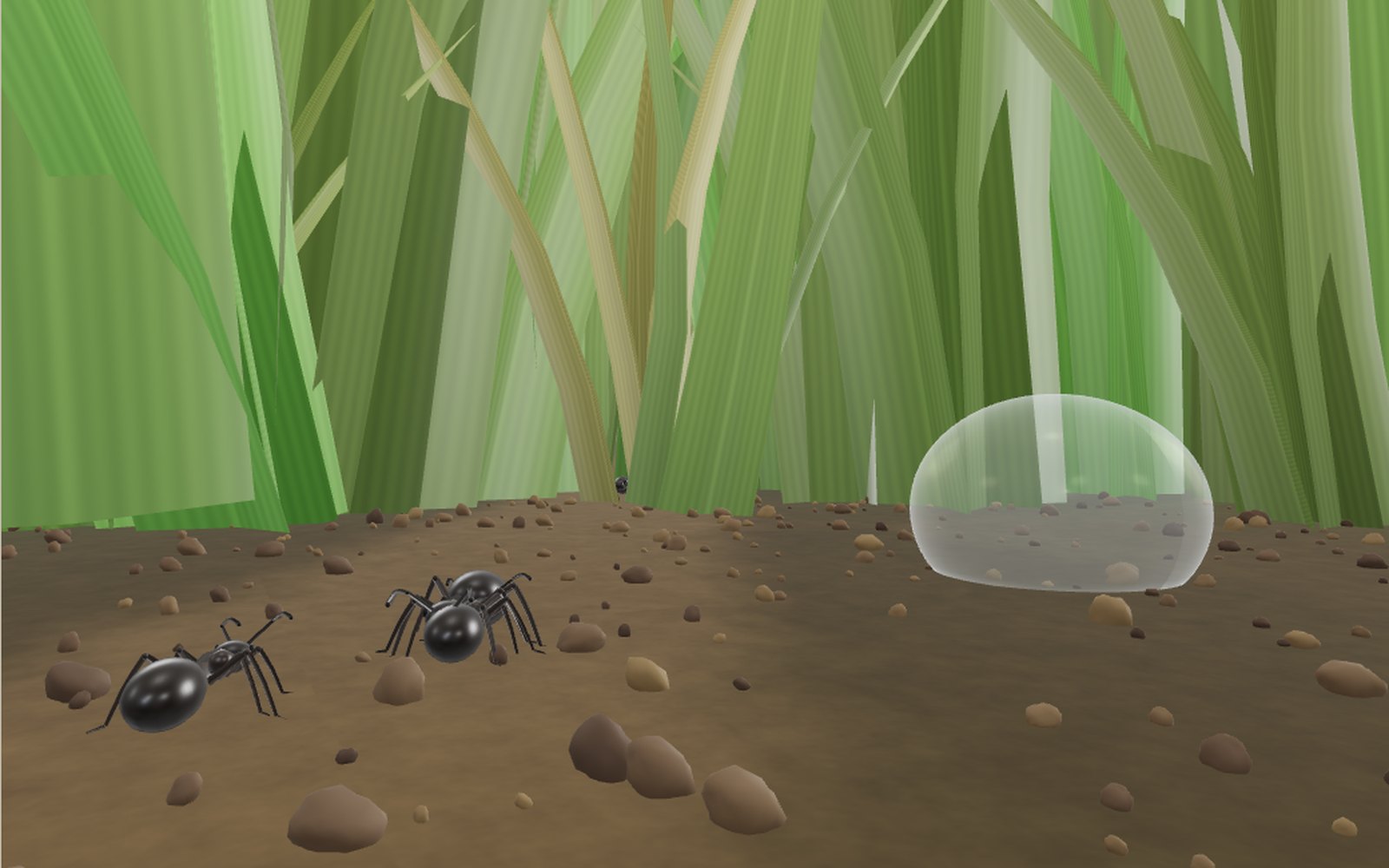
1 / 19 You shrink to 5 mm You shrink from 1.7 m to 5 mm, about the length of a garden ant. Grass blades become trees and an ant walks past at the height of your chest. Walk, look around, and use Smaller and Bigger or the Size slider to change size.
Drag to turn. Scroll or pinch to zoom.
Guide Parts Controls
01 You shrink to 5 mm You shrink from 1.7 m to 5 mm, about the length of a garden ant. Grass blades become trees and an ant walks past at the height of your chest. Walk, look around, and use Smaller and Bigger or the Size slider to change size.
02 A dew drop bigger than you This morning drop is about 9 mm across, nearly twice your height. Water this small holds its round shape because surface tension wins over weight. Move the clock past 9:00 and the drops dry up.
03 Sand grains are rocks Sand means grains between 0.0625 and 2 mm. At 5 mm tall the coarse ones come up to your knee, and a pebble of 2 cm is a boulder four times your height.
04 Ants that keep aphids Black garden ants climb this stem to stroke aphids and drink their honeydew. Grass blades around you are 5 to 15 cm tall: 10 to 30 times your height.
05 Follow the scent Scent is now drawn as coloured dots. The purple trail of the black garden ants forks here; the branches meet at a point that faces the nest. Try the challenge: crumb first, then home.
06 Leaf-cutters carry their harvest Each worker carries a piece of leaf over its head. In a test they managed up to 8.78 times their own weight on average. Open Strength to compare with yourself.
07 The nest mound The mound is soil carried up from below, grain by grain. The hole on top is the way in: walk into it and the tunnel takes you down.
08 The queen The only egg-layer of the nest, about 9 mm long, beside her heap of eggs. A black garden ant queen in a laboratory lived 28 years and 9 months.
09 The nursery Eggs, curled larvae and cocoons are sorted by age. Look for a much bigger pink grub: a butterfly caterpillar that the ants feed as their own.
10 The fungus garden Leaf-cutters chew leaves into a bed for a fungus and eat its swollen white tips. Real Atta nests have up to 7,864 chambers, as deep as 7 m.
11 Living honey jars Honeypot workers hang from the ceiling with gasters swollen with honey. In hard times they give it back to their nestmates.
12 Refuse and the dead Waste goes to its own chamber away from the garden. Ants recognise their dead by smell, not by seeing that they stopped moving.
13 Army ants on the hunt Eciton army ants raid the leaf litter in columns and fans. A colony holds 100,000 to 2,000,000 ants and has no dug nest.
14 A nest made of ants Under the log the colony hangs as a living ball, the bivouac, with the queen and brood inside. Workers also build bridges with their bodies.
15 Up in the shrub You fly like a winged queen. Weaver ants stitch leaves together with silk from their larvae; gliding ants fall and steer back to the trunk.
16 The fastest ant Saharan silver ants run at up to 855 mm a second. Choose Ride an ant to go at that speed.
17 A raft of fire ants On the puddle, fire ants gripping each other float as a raft. Air trapped between their bodies keeps the water out.
18 Back to full size At 1.7 m the whole garden is a few steps across and the ants are specks. Turn on the size line-up and shrink again to compare.
19 The nest from the side The ground turns see-through: chambers and tunnels lie under the mound. Turn See the nest off in Controls to walk again.
Black garden ant The common black ant of gardens in Europe and Asia. Workers live a year or two, but a queen kept in a laboratory lived 28 years and 9 months. It keeps aphids for their sugary honeydew. Japanese carpenter ant One of the biggest ants in parks and gardens in Korea and Japan. Hairs on its antennae tell nestmates from strangers by the wax on their bodies; this was shown with this species in 2005. Red wood ant Heaps pine needles and twigs into mounds that stay warmer than the air around them in spring. Sprays formic acid at enemies. Allegheny mound ant An ordinary mound ant of the eastern United States. Engineers spun these ants in a centrifuge: the neck joint held 3,400 to 5,000 times the body weight before it broke. Pharaoh ant A yellow ant about 2 mm long that lives in heated buildings worldwide. The forks in its trails tell an ant which way is home, and it marks dead-end paths with a "no entry" scent. Argentine ant From South America, now carried around the world. In southern Europe one supercolony runs along about 6,000 km of coast, and ants from its far ends do not fight. Clonal raider ant No queen and no males: workers lay eggs that develop without mating, so a colony is a family of clones. It has no eyes and raids other ants' nests for their brood. Saharan silver ant The fastest ant measured: 855 mm a second, about 108 body lengths a second, on dunes that pass 60 °C at noon. Silver hairs reflect the sun. Desert ant (Cataglyphis fortis) A desert ant that finds home by counting steps and by the sun. Ants on stilts walked past their nest. Red imported fire ant Fire ant from South America, now spread to many countries. In a flood, workers link into a raft that floats with the queen and brood on top. Honeypot ant (Mexico, USA) Honeypot ant of North American deserts. Some workers, the repletes, store nectar in their swollen gasters and hang from the ceiling of the nest. Australian honeypot ant Australian honeypot ant, dug up for its honey by Aboriginal people. Its honey stopped some bacteria and fungi in laboratory tests. Leaf-cutter ant Leaf-cutter ant. Workers cut leaf pieces and carry them home, but they eat the fungus grown on the chewed leaves. In a test they carried up to 8.78 times their own weight on average. Workers range from about 2 mm to over 1 cm. Leaf-cutter ant (Atta laevigata) Builds some of the largest nests of its genus: cement casts in Brazil found 1,149 to 7,864 chambers, as deep as 7 m. Army ant (Eciton) Army ant of Central and South America. A colony of 100,000 to 2,000,000 has no dug nest: it hangs as a living ball and moves on. Workers make bridges and plugs with their own bodies. Driver ant African driver ant. Estimates of a colony run from 10 to 20 million workers under one queen, among the largest insect societies. The queen lays more eggs than any other insect known. Bullet ant A rainforest ant about 2.5 cm long whose sting is among the most painful of any insect. Its main toxin, poneratoxin, acts on the sodium channels of nerves. Trap-jaw ant Trap-jaw ant. Its jaws lock open and snap shut at 35 to 64 m a second. Snapping them against the ground throws the ant into the air. Dracula ant Dracula ant. It presses its jaw tips together until one slides past the other, like snapping fingers, at up to 90 m a second: the fastest animal movement measured. Giant ant (Dinoponera) One of the largest ants, workers about 3 cm long. There is no queen: a mated worker lays the eggs. Matabele ant African ant that hunts termites in columns of a few hundred. Injured workers call for help with a scent and are carried home. Big-eyed jumping ant A rainforest ant with huge eyes that jumps to escape. Twisting its gaster during the jump helps it steer. Red bull ant Australian bull ant up to about 2.5 cm long, hunting by sight. Besides its large compound eyes it has three small simple eyes that can see shapes. Rock ant A whole colony of these 2 to 3 mm ants fits in a crack in a rock. A worker that knows the way leads another in a tandem run and waits for it: the first teaching shown in an animal other than humans. Weaver ant Weaver ant. Chains of workers pull leaves together while others hold larvae that spin silk to glue the edges. Sticky foot pads let it run on smooth leaves. Gliding ant Gliding ant of the rainforest canopy. If it falls, it turns in the air and glides back to the trunk rear end first. Exploding ant Exploding ant of Borneo. Attacked, a small worker squeezes its body until its gaster bursts and sprays sticky yellow poison on the enemy. Grass forest A lawn seen from 5 mm: grass blades taller than a house, clover leaves overhead, aphids on a stem and a cookie crumb at the end of an ant trail. Sand and dew Morning dew drops bigger than you, sand grains the size of rocks, desert ants and a puddle with a fire-ant raft. Nest mound The soil mound over the nest and the mouth where the trails go underground. Queen chamber The queen and her heap of eggs, deep in the nest. Nursery Eggs, larvae and cocoons, nurse ants, and a butterfly caterpillar that fools the ants. Fungus garden The leaf-cutters' fungus garden: a grey sponge of fungus grown on chewed leaves. Honey pantry Honeypot ants hanging from the ceiling with gasters full of honey. Refuse chamber Spent fungus, scraps and dead ants, kept far from the garden. Rainforest floor Rainforest leaf litter: army ants, the bullet ant, trap-jaw and Dracula ants, and a bivouac under a log. Shrub A shrub with a weaver-ant nest of stitched leaves, gliding ants and exploding ants. You (scale figure) Smooth figures at your current size stand at the main scenes so you always have yourself to compare with. Size line-up You, a black garden ant (4 mm), a leaf-cutter soldier (14 mm), a bullet ant (25 mm), a Dinoponera (30 mm) and a 2 mm raindrop, set down in front of you.