FIG. 96Walk-throughs
Shrink to the size of an ant and walk into its nest
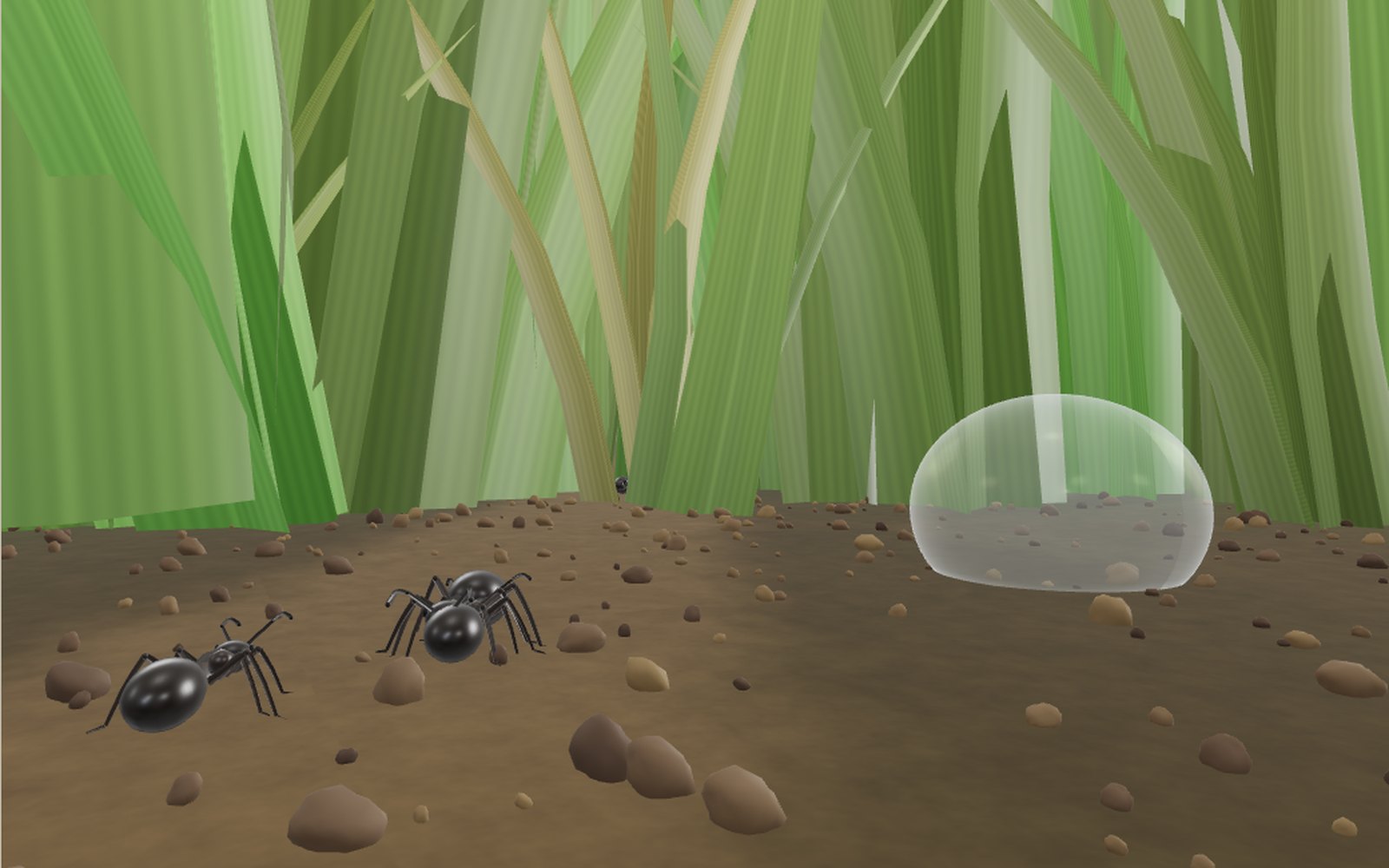
At 5 mm tall, a blade of lawn grass is 20 times your height and a black garden ant walks past at chest height.
This device cannot show the 3D model. You can read the guide steps below as text.
1 / 19 You shrink to 5 mmYou shrink from 1.7 m to 5 mm, about the length of a garden ant. Grass blades become trees and an ant walks past at the height of your chest. Walk, look around, and use Smaller and Bigger or the Size slider to change size.
Drag to turn. Scroll or pinch to zoom.
What you are walking through
Lie down on a lawn, put your cheek on the soil and look along the ground. The grass that you mow every few weeks turns into a dense wall, a drop of dew on a clover leaf catches the sky, and somewhere in the gaps an ant runs past with its antennae tapping. This exhibit takes that view one step further. It shrinks you from 1.7 m to 5 mm, about the length of a black garden ant, and lets you walk through a garden and into the nest under it.
The garden is 4.8 m square, about the size of a small back yard, and it is laid out in four quarters around a nest mound. The north-west quarter is a lawn with clover, a stem covered in aphids and a cookie crumb at the end of an ant trail. The north-east quarter is sand and dew, with desert ants, a honeypot ant crater and a puddle. The south-west is rainforest leaf litter, where army ants raid and a bivouac of living ants hangs beneath a log. The south-east is a shrub, with a weaver ant nest of leaves stitched together high up in the branches.
Under the mound in the middle, six chambers are joined by tunnels: an entrance shaft, a queen chamber, a nursery, a honey pantry, a fungus garden and a refuse chamber. At 5 mm tall you can walk down the mouth on top of the mound and through all of them. A real nest belongs to one species, so this one is a composite, a museum hall rather than a single colony; the section on how the model differs from reality lists what was changed.
27 species of ant live here, from the 2 mm Pharaoh ant to the 3 cm Dinoponera, more than 1,300 ants in all. They walk their own trails, carry leaves, hang from ceilings, float as a raft and cling together in a living nest. A field guide lists all of them with their sizes, food, speed and sources, and a smooth, faceless figure at your current size stands at the main scenes so that you always have yourself to compare with.
The first ten seconds
The exhibit opens at your ordinary height, looking down at a patch of lawn beside the mound. Over seven seconds you shrink 340 times. The camera drops toward the ground, the grass rises past you like a forest growing in fast motion, and when the shrinking stops a black garden ant walks across the trail in front of you at the height of your chest. To your left is a drop of dew about 9 mm across, nearly twice as tall as you are now.
The number 340 comes from 1,700 mm divided by 5 mm. It is the same factor at every point of the exhibit: a blade of grass 10 cm tall becomes, for you, something like a 34 m tower, and a sand grain 1 mm across becomes a 34 cm rock. The readout at the bottom left of the stage shows your height and how many times smaller you are than real size.
You can change size at any time. The Size slider in Controls runs on a log scale from 2 mm to 1.7 m, and the Smaller and Bigger buttons (or the Z and X keys) shrink you to 40 percent or grow you 2.5 times in one step. Underground you cannot grow past 9 mm, because the tunnels are only 15 mm wide.
What size means at 5 mm
Grass
A lawn grass leaf is a few millimetres wide and usually between 5 and 15 cm long. At 5 mm tall that puts the tips 10 to 30 times above your head. The grass here grows in tufts of four curved blades, each folded along its midrib like a real leaf, and the tufts sway in the wind. The Wind slider changes how hard they move. The bases of the tufts are narrow, so you can thread your way between them, but you cannot walk through a blade: at your size it is a solid wall.
Dew
On a cool, clear morning water condenses on leaves and on the ground. The drops in the exhibit are between 2 and 9 mm across. At human size they are pinheads; at ant size they are glass boulders, and on the high quality setting they bend light like lenses, so the grass behind them appears upside down and magnified. Water this small keeps its rounded shape because surface tension, the pull of the water molecules on each other at the surface, matters more than the drop's weight. The clock in Controls changes the time of day. The dew is full until 8:00, shrinks between 8:00 and 11:00 and is gone by late morning.
Sand
Geologists call a grain sand when it is between 0.0625 mm and 2 mm across, on the scale set out by Chester Wentworth in 1922; larger grains are gravel and smaller ones silt. At 5 mm tall a coarse sand grain reaches your knee, and the pebbles of 2 to 3 cm in the sand quarter are boulders four to six times your height. The sand near you is drawn grain by grain in many colours, as real sand is a mix of minerals.
Rain
Rain is the real danger of being small. A raindrop 2 mm across falls at about 6.5 m a second, the value measured by Ross Gunn and Gilbert Kinzer in 1949. At 5 mm tall that drop is two fifths of your height and arrives faster than a sprinting person. Turn on Rain in Controls to see drops strike the ground around you and splash outward in rings. With the sound on, every drop that lands close by thuds.
Checking the sizes against yourself
Open Me in the tools to enter your real height and weight. The exhibit then tells you how many 4 mm garden ants would make a line as long as you are tall (425 for a 1.7 m person) and how many times smaller you are at the moment.
The field guide uses the same numbers. Each species card shows how many of that ant would make up your real height, and how its length compares with your current size. A scale drawing on each card puts a 5 mm person beside the smallest and largest workers of the species and a 1 cm bar.
For a direct comparison in the scene, turn on the Size line-up. It sets down, in front of you, a figure at your current size, a black garden ant (4 mm), a leaf-cutter soldier (14 mm), a bullet ant (25 mm), a Dinoponera (30 mm) and a 2 mm raindrop. Grow to 1.7 m with the line-up on and the whole row shrinks to a few specks beside your feet.
An ant up close
Stand next to a walking ant at 5 mm tall and its body plan is easy to read. Like every insect it has three main parts, but an ant's look different from a beetle's or a fly's. At the front is the head, with a pair of jaws (mandibles) that open sideways like a pair of pliers, two compound eyes and two antennae. The antennae bend sharply near the base, like an elbow: a long first segment, the scape, and then a flexible whip of smaller segments. They are the ant's main sense organs for smell, taste and touch, and they never stop moving.
Behind the head is the mesosoma, the middle part, which carries all six legs. Then comes the narrow waist that gives ants their outline: one small node in ants such as the black garden ant, two in the leaf-cutters, fire ants and Pharaoh ants. Behind the waist is the gaster, the rounded rear part that holds the crop, where food for sharing is stored, and in many species a sting.
An ant walks with a tripod gait. The front and back legs on one side move together with the middle leg on the other side, so three feet are always on the ground in a steady triangle while the other three swing forward. Watch the legs of any ant in the exhibit and you will see the two triangles take turns. The species differ in proportion: desert ants have long legs that lift their bodies off the hot sand, leaf-cutter majors have huge heads full of muscle for cutting, and the honeypot repletes have gasters many times larger than normal.
How strong is an ant, really?
"An ant can lift 50 times its own weight" is one of the most repeated animal facts, but the number changes with every telling, and most versions have no measurement behind them. Here are three numbers that do. The Strength panel in the tools draws them on a bar chart next to you.
The first comes from leaf-cutter ants. In 2019 Pauline Segre and Gavin Taylor gave Atta cephalotes workers heavier and heavier loads and recorded the heaviest one each ant could still carry. On average it was 8.78 times the ant's own weight, and the ratio stayed about the same from small workers to large ones. In the field, though, the larger ants chose leaf pieces that were a smaller share of what they could manage, keeping more strength in reserve.
The second is a guess. Naturalists who watched ants carry leaves and prey often wrote that ants handle a hundred times their weight or more. Ohio State University quoted this when it reported the third number.
The third measures something else. In 2014 engineers at Ohio State glued Allegheny mound ants face down in a centrifuge and spun them faster and faster. The neck joint began to stretch at forces of about 350 times the ant's weight and broke at 3,400 to 5,000 times. This is the source of the "ants can lift 5,000 times their weight" headline, but it is a measure of how much pull the neck can take before it tears, not of lifting.
For a person weighing 60 kg, the leaf-cutter's 8.78 times would mean carrying 527 kg. The neck joint's 3,400 to 5,000 times would mean holding 204 to 300 tonnes.
Why a giant ant would not be strong
The reason small animals seem so strong is geometry. The force a muscle can produce depends on its cross-section, which grows with the square of the animal's length. The animal's weight depends on its volume, which grows with the cube. Double an animal's length and its muscles become four times stronger, but it becomes eight times heavier.
Run this the other way for an ant. Take a worker 6 mm long that can carry 8.78 times its weight, and scale it up to 1.7 m. It becomes 1,700 / 6 = 283 times longer. Its muscles grow 283² = 80,089 times stronger, but its weight grows 283³ = 22.7 million times. Strength divided by weight falls by a factor of 283, from 8.78 to 8.78 / 283 = 0.031. A human-sized ant could carry about 3 percent of its own weight, and would probably have trouble standing up. The Strength panel shows this sum for your own height.
Ants that carry big objects usually manage it by working together. Groups of longhorn crazy ants carry food many times the weight of any one ant, and a 2015 study by Aviram Gelblum and colleagues showed how a few ants that know the way home steer the whole group.
Scent trails
Turn on Scent in Controls and the trails appear as coloured dots: purple for the black garden ants, green for the leaf-cutters, orange for the army ants and so on. This is a picture of something you cannot see in a real garden. Ants lay their trails with pheromones, chemicals released from glands in the body, and follow them by smell with their antennae.
A trail begins when a scout finds food and marks its route home. Other ants follow the mark, and those that find food add their own on the way back. A good food source therefore gets a strong trail and many visitors. When the food runs out no one adds new scent, the old scent evaporates and the trail fades. Nobody plans the route; it is the sum of many small decisions.
Trails also carry direction. Duncan Jackson and his colleagues found in 2004 that the trail networks of Pharaoh ants fork at angles of about 50 to 60 degrees. The two branches meet in a point that faces the nest, so an ant arriving at a fork can tell which way is home from the shape of the fork alone. The following year the same group reported a repellent pheromone that Pharaoh ants place at the start of a branch that leads nowhere: the first "do not enter" signal known in ants.
The challenge Follow the scent asks you to do what a forager does. Turn on Scent, go to the cookie crumb and follow the purple trail back to the mouth of the nest. The trail of the black garden ants forks on the way. Look at which way the fork points.
Ants that keep aphids
At the end of the purple trail stands a stem covered in small green aphids, and black garden ants climb up and down it all day. Aphids suck the sugary sap of plants and release the surplus as honeydew. The ants stroke the aphids with their antennae to collect it and in return chase off ladybirds and other enemies of the aphids. For many garden ants, honeydew is a main source of energy, and the trail from the nest to the aphids is one of the busiest in the garden. Recent research looks at how bacteria living inside the aphids change this partnership.
Counting steps and reading the sun
Not every ant uses scent to get home. Desert ants of the genus Cataglyphis forage alone on hot open sand, where scent would not last. They keep a running total of the direction and distance they have travelled and head straight home when they find food.
The direction comes from the sun and the pattern of polarised light in the sky. The distance comes from counting steps. In 2006 Matthias Wittlinger, Rüdiger Wehner and Harald Wolf trained Cataglyphis fortis ants to walk to a feeder. At the feeder they glued pig bristles to some ants' legs, making them longer, and trimmed the legs of others. On the way home, the ants on stilts walked past their nest and the ants with shortened legs stopped short of it, by about the amount their stride had changed. They were measuring distance by counting steps. A hidden card near the desert ants' nest tells the story.
The fastest ant
In the sand quarter, Saharan silver ants run circuits around their nest at the fastest speed measured for any ant: 855 mm a second, or about 108 of their own body lengths a second. Sarah Pfeffer and her colleagues filmed them on the dunes of Tunisia in 2019. The ants forage at midday, when the sand can pass 60 °C and their predators are sheltering, and they make up for legs that are shorter than those of their relatives by taking up to 47 strides a second.
Their silver colour is part of the same story. In 2015 Norman Shi and his colleagues showed that the ants are covered in hairs with a triangular cross-section. The hairs reflect visible and near-infrared sunlight and help the ant shed heat by radiation, keeping it a few degrees cooler.
Choose Ride an ant in the travel modes and you ride a silver ant at its measured top speed. If 108 body lengths a second were applied to a 1.7 m person, the person would run at 108 × 1.7 = 184 m a second, a little more than half the speed of sound.
The nest mound and the mouth
The mound in the middle of the garden is about 4 cm high and 20 cm across. For you it is a hill eight times your height. It is made of soil that the workers carried up from below, one grain at a time, as they dug the chambers. The hole on top is the way in.
Walk into the hole and the floor slopes down into the entrance tunnel. From there the tunnels branch to the six chambers. A map in the corner of the stage switches to a plan of the nest while you are underground, and you can click a chamber on it to go there. Your lamp lights the walls. A real nest is dark; ants find their way inside it by touch and smell, and many species that live underground have small eyes or none.
The queen chamber
At the end of the deepest branch is the queen of the black garden ants, about 9 mm long, beside a heap of eggs. She mated on a summer flight years ago, stored the sperm and has been laying eggs ever since. Workers feed her, clean her and carry the eggs away.
Queens live a remarkably long time. Laurent Keller and Michel Genoud collected the records in 1997, and the longest is a Lasius niger queen kept in a laboratory that lived 28 years and 9 months. In social insects, queens can live about ten times longer than their workers and up to 500 times longer than males. Workers of the black garden ant usually live a year or two.
The nursery
Ants develop in four stages: egg, larva, pupa and adult. In the nursery the brood is sorted by age. Eggs about half a millimetre long lie in a heap, curled white larvae lie in a wider ring, and pupae wrapped in tan silk cocoons are stacked to one side. Larvae cannot feed themselves; nurse workers bring food to their mouths.
Among them lies something that does not belong: a pink caterpillar much bigger than any ant larva. Caterpillars of Maculinea blue butterflies get carried into Myrmica ant nests by workers that mistake them for their own brood. In 2009 Francesca Barbero and her colleagues recorded the sounds Myrmica queens make by rubbing parts of their bodies together, and found that the caterpillars make similar sounds. The workers treat the caterpillars as royalty, feed them and rescue them first when the nest is disturbed. Our nest is a black garden ant nest rather than a Myrmica one, so the caterpillar is here as a guest from another nest.
Close by, two workers are touching mouths. This is trophallaxis, the passing of liquid food from one ant's crop to another's. In 2016 Adria LeBoeuf and her colleagues analysed the fluid and found proteins, small molecules and juvenile hormone, the kind of signals that help control how larvae grow. The shared food is also a shared channel for chemical messages.
The fungus garden
The largest chamber belongs to the leaf-cutters. A grey, spongy mass fills most of it: a fungus garden. Leaf-cutter workers cut pieces of fresh leaf, carry them home, chew them into a paste and plant it with fungus. The fungus grows through the paste and forms swollen tips called gongylidia, which are the food of the ants and their larvae. The ants do not eat the leaves themselves.
Ants have farmed fungi for about 50 million years, according to Ted Schultz and Seán Brady's 2008 study of fungus-growing ant evolution. The leaf-cutters are the latest and largest of these farmers, and a 2017 study by Michael Branstetter and colleagues suggests that the step to fully domesticated fungi happened in dry habitats, where the fungus could not escape from the ants' gardens.
A garden is a target for pests. Escovopsis, a mould, attacks the fungus. In 1999 Cameron Currie and his colleagues found that leaf-cutter ants carry bacteria on their bodies, visible as a white bloom, which make antibiotics against Escovopsis. One of the workers in the garden carries this bloom.
Real leaf-cutter nests are enormous. Aldenise Moreira and her colleagues filled three Atta laevigata nests in Brazil with cement and dug them out. They counted between 1,149 and 7,864 chambers per nest, some as deep as 7 m, with chambers holding from a few centilitres up to about 50 litres and foraging tunnels running up to 70 m from the mound. A colony moves tonnes of soil over its life. The fungus chamber in this exhibit is about 24 cm across.
The honey pantry
In a smaller chamber, workers of the Australian honeypot ant hang upside down from the ceiling. Their gasters, the rear part of the body, have swollen into amber balls of honey. These ants are called repletes. Foragers bring nectar and honeydew home and feed it to the repletes, whose crops stretch until the gaster is many times its normal size. When food is short outside, the repletes give the honey back.
Honeypot ants of this kind evolved in several groups that live in dry places, including Myrmecocystus in North American deserts and Camponotus inflatus in Australia, where Aboriginal people dig up the repletes as a sweet food. A 2023 study by Andrew Dong and colleagues found that the honey of Camponotus inflatus stops the growth of some bacteria and fungi in the laboratory.
The refuse chamber
The deepest chamber holds the nest's waste: spent fungus, leaf scraps and dead ants. Leaf-cutter ants keep their refuse well away from the fungus garden, and in nests dug out in Brazil the waste chambers were found apart from the fungus chambers, under their own part of the mound.
How does an ant know that a nestmate is dead? Not by seeing it lie still. Ants recognise their dead by smell. In a 1958 experiment, Edward O. Wilson and his colleagues dabbed living ants with oleic acid, a fatty acid that builds up in decaying bodies; their nestmates carried them to the refuse pile, and the living ants walked back, only to be carried out again. Much later, in 2009, Dong-Hwan Choe and his colleagues showed that living Argentine ants carry chemicals on their bodies that stop nestmates from carrying them out, and that these chemicals fade quickly after death. A dead ant is taken away when its scent of life disappears.
Army ants and their living architecture
In the rainforest quarter, a column of Eciton burchellii army ants loops through the leaf litter. A colony of this species holds between 100,000 and 2,000,000 ants and digs no nest. Every few days the whole colony moves on. In between it hangs as a living ball called a bivouac, made of workers that hook their legs together, with the queen and brood inside. One hangs beneath the log in this quarter.
Army ants build with their bodies in other ways too. When the column meets a gap, workers hold on to each other to form a bridge. In 2015 Chris Reid and his colleagues showed that these bridges move toward the narrow part of a gap and stop growing when the number of workers locked in the bridge costs more than the shortcut saves. A small bridge between two twigs in this quarter is a hidden find.
The African driver ants of the genus Dorylus have the largest single-queen insect colonies known. Estimates differ: Daniel Kronauer's 2009 review cites colonies of up to 10 million, and a 2001 study by Graeme Boswell and colleagues gives 20 million workers. Their queens probably lay more eggs than any other insect.
Hunters of the forest floor
Several other hunters share the leaf litter. The bullet ant, Paraponera clavata, is about 2.5 cm long, and its sting is said to be among the most painful of any insect. Its main toxin, poneratoxin, acts on the sodium channels that nerves use to send signals.
Trap-jaw ants hold their long jaws wide open, locked by a latch. Touching a trigger hair releases them, and in 2006 Sheila Patek and her colleagues measured them closing at 35 to 64 m a second. Snapping the jaws against the ground throws the ant into the air, which it uses to escape.
The record belongs to the Dracula ant Mystrium camillae. It presses the tips of its jaws together until one slides across the other, like snapping fingers. In 2018 Fredrick Larabee and his colleagues filmed the tips moving at up to 90 m a second, the fastest animal movement measured.
Among the others are Dinoponera, one of the largest ants at about 3 cm, whose colonies have no queen and in which a mated worker lays the eggs; the Matabele ant, which raids termites in columns and carries its injured nestmates home; the big-eyed jumping ant Gigantiops; the Australian bull ant Myrmecia, which hunts by sight; and the tiny rock ant Temnothorax, whose whole colony fits in a crack in a stone.
The rock ant is famous for teaching. In 2006 Nigel Franks and Tom Richardson showed that a worker that knows the way to food leads a nestmate in a tandem run, slowing down when the follower falls behind and going on when it catches up. The leader pays a cost in time and the follower learns the route faster. It was the first formal demonstration of teaching in an animal other than humans.
Up in the shrub
Switch to Fly and you move like a winged queen on her mating flight. The shrub in the south-east quarter holds three of the strangest ants in the exhibit.
Weaver ants build nests from living leaves. A chain of workers pulls the edges of two leaves together, while other workers hold larvae in their jaws and move them back and forth along the seam. The larvae spin silk that glues the leaves together. Edward O. Wilson and Bert Hölldobler described the larvae's part in 1980. Weaver ants run on smooth leaves with adhesive pads on their feet, which Thomas Endlein and Walter Federle studied in 2015.
Gliding ants live in the rainforest canopy. In 2005 Stephen Yanoviak, Robert Dudley and Michael Kaspari dropped Cephalotes atratus workers from trees and found that they turn in the air and glide back toward the trunk, abdomen first, and most of them land on the same tree. Every few seconds one of the gliding ants on the shrub falls and steers back.
The exploding ants of Borneo defend their tree in a stranger way. A small worker under attack tightens its body until its gaster bursts and sprays sticky yellow poison on the enemy. The worker dies. Alice Laciny and her colleagues described the species Colobopsis explodens in 2018.
High on the trunk a drop of amber holds an ant. Ants are older than they seem: a 2006 study by Corrie Moreau and colleagues dated the origin of ants to between 140 and 168 million years ago, an estimate from DNA and fossils. Ants caught in amber show that they lived among dinosaurs.
How many ants are there?
In 2022 Patrick Schultheiss and his colleagues brought together counts from 489 studies on every continent where ants live. They estimated that about twenty quadrillion ants, 2 × 10¹⁶, are alive at any one time. That is about 2.5 million ants for every person on Earth.
They also estimated the ants' total biomass at about 12 million tonnes of dry carbon. That is more than all wild birds and wild mammals put together, but it is about a fifth of the biomass of people, which a 2018 study by Yinon Bar-On, Rob Phillips and Ron Milo put at about 60 million tonnes of carbon. The often quoted claim that all ants together weigh as much as all people came from earlier rough calculations; the new estimate is the first based on so much field data, and its authors note that it is conservative because some habitats lacked data.
The balance near the mound shows the result: one pan for the ants, the other for people, and the people's side lower. The challenge Ants on the scales asks the question.
Supercolonies
Most ant colonies fight their neighbours. The Argentine ant, carried from South America to the rest of the world, does something unusual in its new homes. In 2002 Tatiana Giraud and her colleagues tested Argentine ants along the Mediterranean and Atlantic coasts of southern Europe and found that ants from nests about 6,000 km apart did not fight each other. They called this a supercolony. The Argentine ants in the lawn quarter run on a trail with no beginning or end.
How the model differs from reality
Several things here are simplified or rearranged so that the exhibit can show more in one place.
- One garden, many places. The ants come from Europe, Asia, the Americas, Africa and Australia. A real garden holds a few species of its own region. The guide card of each ant says where it lives.
- One nest, many species. A nest belongs to one colony of one species. Here a black garden ant queen chamber, an Australian honeypot pantry and a leaf-cutter fungus garden share one set of tunnels.
- Wide tunnels. The tunnels are 15 mm across so that a 5 mm visitor fits. Real tunnels of small ants are only a few millimetres wide.
- Ant sizes and speeds. Worker lengths are given as ranges and many are approximate; the guide marks them. Only the speed of the Saharan silver ant is a measured value; other ants walk at model speeds of a few body lengths a second.
- Ant bodies. The ants are built from smooth tubes and ellipsoids in the species' colours. Hairs, sculpture on the body surface and exact proportions are simplified. Legs and antennae move with a tripod gait drawn by the graphics card.
- Light underground. Your lamp lights the nest so that you can see. Real nests are dark.
- Scent. Pheromone trails are invisible. The Scent view draws them as coloured dots.
- Time. The ants keep walking at real time while you move at speeds suited to your size. The garden has no seasons.
Moving around
Walk with WASD or the arrow keys and drag to look around; on a phone, use your left thumb to walk and the right side of the screen to look. Tap or click the ground to walk there. Bumping into something shows a short note.
There are four ways to travel, numbered 1 to 4 on a keyboard. Walk moves at a pace suited to your size. Run is about four times faster. Ride an ant puts you on a Saharan silver ant at 855 mm a second, which only works when you are 4 cm or smaller. Fly lifts you above the grass like a winged queen; flying is not possible underground.
The map in the top left shows the garden from above with the trails and scenes. Click anywhere on it to jump there. Underground it becomes a plan of the nest. The Guide button opens the field guide, Finds lists the hidden cards and Challenges lists the questions. Photo hides the panels so you can frame a picture and save it. Sound turns on wind, footsteps of ants close by and raindrops. Keys: G guide, M map, T challenges, F finds, P photo, Z smaller, X bigger.
The guided tour
The tour in the panel has 19 steps. It starts with the shrinking and visits a dew drop, sand grains, the aphid farm and the forked scent trail, then the leaf-cutters at work and the mound. It goes underground to the queen, the nursery, the fungus garden, the honey pantry and the refuse chamber. Back above ground it visits the army ants and their bivouac, flies up to the weaver ants, rides with the silver ants, looks at the fire-ant raft, grows back to full size and ends with a see-through view of the whole nest.
Challenges and hidden finds
11 challenges ask questions whose answers are in the garden, the nest or the guide. Some have answer buttons; others are solved by going somewhere: down to the queen, into the honey pantry, along the scent trail from the crumb to the nest, or beside the big dew drop at 5 mm before the sun dries it. Solved challenges get a star and stay saved in your browser.
24 hidden cards are scattered through the garden and the nest. A card opens when you come close and look toward the spot, and only when you are ant-sized. Eight of them are reversal cards: they start from what most people think, such as "leaf-cutters eat leaves" or "ants weigh as much as people", and show what the research found instead. Every card links to its source.
Questions
How many ants are there on Earth?
About twenty quadrillion (2 × 10¹⁶) at any one time, by the 2022 estimate of Schultheiss and colleagues based on 489 studies. That is roughly 2.5 million ants per person.
Do all ants together weigh as much as all people?
No. That was an old rough estimate. The 2022 study puts ants at about 12 million tonnes of dry carbon, about a fifth of the human total, though still more than all wild birds and wild mammals combined.
How much can an ant lift?
It depends on what you measure. Leaf-cutter workers in a 2019 test could carry 8.78 times their own weight on average. The famous 5,000 times comes from a test that pulled an ant's neck joint until it broke, which is not lifting.
Would an ant the size of a person be super strong?
No. Muscle strength grows with the square of length and weight with the cube. A 6 mm ant scaled up to 1.7 m would be 283 times longer and could carry only about 3 percent of its own weight.
Can an ant survive a fall from a tree?
Usually, yes. A small, light animal reaches only a low speed before air resistance balances its weight, so the landing is gentle. Canopy ants of the genus Cephalotes go further: they steer in the air and glide back to the trunk they fell from.
Do leaf-cutter ants eat leaves?
No. They chew the leaves into a bed for a fungus and eat the fungus's swollen tips. Ants began farming fungi about 50 million years ago.
How long does an ant queen live?
The record is a black garden ant queen kept in a laboratory that lived 28 years and 9 months. Ant queens can live about ten times longer than workers.
How do ants find their way home?
Many species follow scent trails. Pharaoh ants can read the direction home from the shape of trail forks. Desert ants, which forage on bare sand, use the sun and count their steps.
What is the fastest ant?
The Saharan silver ant, measured at 855 mm a second, about 108 body lengths a second. The fastest jaws belong to the Dracula ant, whose jaw tips reach 90 m a second.
Which ant is the biggest?
Workers of Dinoponera are about 3 cm long, among the largest. The bullet ant reaches about 2.5 cm, and the queens of African driver ants are bigger than any worker.
How do ants tell a nestmate from a stranger?
By smell. Every colony has its own blend of waxy chemicals on the body surface. In 2005 Mamiko Ozaki and her colleagues found a sensory hair on the antennae of the Japanese carpenter ant that responds to the blend of strangers but not to that of nestmates.
Why do ants carry their dead out of the nest?
Dead ants are recognised by smell. Fatty acids such as oleic acid build up on a dead body, while the chemicals that mark a living ant fade quickly after death. Removing the dead keeps disease away from the colony.
Can ants really float on water?
Fire ants can. In a flood the workers grip each other into a raft that floats, with air trapped between their bodies keeping it dry, and the queen and brood ride on top until they reach land.
Are ants older than dinosaurs?
Not older, but they shared the world with them. DNA and fossil studies date the first ants to between 140 and 168 million years ago, during the age of dinosaurs.
Why is the nest lit here when real nests are dark?
Nests are underground with no light; ants find their way by touch and smell. The lamp in the exhibit lets you see the chambers.
Can I see the whole nest at once?
Yes. See the nest in Controls lifts you above the mound and makes the ground see-through, so the chambers and tunnels appear under the soil. Turn it off to walk again.
Terms
- Worker: a female ant that does the colony's work and in most species lays no eggs.
- Queen: the egg-laying female of a colony.
- Gaster: the rounded rear part of an ant's body, behind the narrow waist.
- Petiole: the narrow waist segment, with one node or two, between the thorax and the gaster.
- Pheromone: a chemical signal released by one animal that changes the behaviour of others of the same species.
- Trophallaxis: passing liquid food mouth to mouth.
- Replete: a honeypot ant worker whose swollen gaster stores food for the colony.
- Bivouac: the living nest of army ants, made of the workers' own bodies.
- Gongylidia: the swollen tips of the leaf-cutters' fungus, eaten by the ants.
- Supercolony: a network of nests whose ants do not fight each other over a large area.
- Square-cube law: when a shape grows, its areas grow with the square of its length and its volume with the cube.
Sources
- Schultheiss, P. et al., The abundance, biomass, and distribution of ants on Earth, PNAS 119: e2201550119 (2022). https://pmc.ncbi.nlm.nih.gov/articles/PMC9546634/ (checked 19 October 2026)
- Bar-On, Y. M., Phillips, R. and Milo, R., The biomass distribution on Earth, PNAS 115: 6506 (2018). https://pmc.ncbi.nlm.nih.gov/articles/PMC6016768/ (checked 19 October 2026)
- Keller, L. and Genoud, M., Extraordinary lifespans in ants: a test of evolutionary theories of ageing, Nature 389: 958 (1997). https://www.nature.com/articles/40130 (checked 19 October 2026)
- Jemielity, S., Chapuisat, M., Parker, J. D. and Keller, L., Long live the queen: studying aging in social insects, Age 27: 241 (2005). https://pmc.ncbi.nlm.nih.gov/articles/PMC3458492/ (checked 19 October 2026)
- Segre, P. S. and Taylor, E. D., Large ants do not carry their fair share: maximal load-carrying performance of leaf-cutter ants (Atta cephalotes), Journal of Experimental Biology 222: jeb199240 (2019). https://pubmed.ncbi.nlm.nih.gov/31138634/ (checked 19 October 2026)
- Nguyen, V., Lilly, B. and Castro, C., The exoskeletal structure and tensile loading behavior of an ant neck joint, Journal of Biomechanics 47: 497 (2014). https://pubmed.ncbi.nlm.nih.gov/24287400/ (checked 19 October 2026)
- The Ohio State University, With their amazing necks, ants don't need "high hopes" to do heavy lifting (2014). https://news.osu.edu/with-their-amazing-necks-ants-dont-need-high-hopes-to-do-heavy-lifting (checked 19 October 2026)
- Gelblum, A. et al., Ant groups optimally amplify the effect of transiently informed individuals, Nature Communications 6: 7729 (2015). https://pubmed.ncbi.nlm.nih.gov/26218613/ (checked 19 October 2026)
- Jackson, D. E., Holcombe, M. and Ratnieks, F. L. W., Trail geometry gives polarity to ant foraging networks, Nature 432: 907 (2004). https://pubmed.ncbi.nlm.nih.gov/15602563/ (checked 19 October 2026)
- Robinson, E. J. H. et al., Insect communication: "no entry" signal in ant foraging, Nature 438: 442 (2005). https://pubmed.ncbi.nlm.nih.gov/16306981/ (checked 19 October 2026)
- Wittlinger, M., Wehner, R. and Wolf, H., The ant odometer: stepping on stilts and stumps, Science 312: 1965 (2006). https://pubmed.ncbi.nlm.nih.gov/16809544/ (checked 19 October 2026)
- Pfeffer, S. E., Wahl, V. L., Wittlinger, M. and Wolf, H., High-speed locomotion in the Saharan silver ant, Cataglyphis bombycina, Journal of Experimental Biology 222: jeb198705 (2019). https://pubmed.ncbi.nlm.nih.gov/31619540/ (checked 19 October 2026)
- Shi, N. N. et al., Keeping cool: enhanced optical reflection and radiative heat dissipation in Saharan silver ants, Science 349: 298 (2015). https://pubmed.ncbi.nlm.nih.gov/26089358/ (checked 19 October 2026)
- Currie, C. R. et al., Fungus-growing ants use antibiotic-producing bacteria to control garden parasites, Nature 398: 701 (1999). https://www.nature.com/articles/19519 (checked 19 October 2026)
- Schultz, T. R. and Brady, S. G., Major evolutionary transitions in ant agriculture, PNAS 105: 5435 (2008). https://pubmed.ncbi.nlm.nih.gov/18362345/ (checked 19 October 2026)
- Branstetter, M. G. et al., Dry habitats were crucibles of domestication in the evolution of agriculture in ants, Proceedings of the Royal Society B 284: 20170095 (2017). https://pubmed.ncbi.nlm.nih.gov/28404776/ (checked 19 October 2026)
- Moreira, A. A. et al., Nest architecture of Atta laevigata, Studies on Neotropical Fauna and Environment 39: 109 (2004), reviewed in Foundation and architecture of leaf-cutting ant nests in the genus Atta, Brazilian Journal of Biology. http://www.scielo.br/j/bjb/a/dbr5BPNvp3gzpSrqJfv7zWq?lang=en (checked 19 October 2026)
- Forti, L. C. et al., Discovering the giant nest architecture of grass-cutting ants, Atta capiguara, Insects 8: 39 (2017). https://pmc.ncbi.nlm.nih.gov/articles/PMC5492053/ (checked 19 October 2026)
- Forti, L. C. et al., Nest architecture and colony growth of Atta bisphaerica grass-cutting ants, Insects 11: 741 (2020). https://pmc.ncbi.nlm.nih.gov/articles/PMC7693648/ (checked 19 October 2026)
- Dong, A. Z. et al., Unique antimicrobial activity in honey from the Australian honeypot ant (Camponotus inflatus), PeerJ 11: e15645 (2023). https://pmc.ncbi.nlm.nih.gov/articles/PMC10386826/ (checked 19 October 2026)
- Islam, M. K. et al., Australian honeypot ant (Camponotus inflatus) honey: a comprehensive analysis of the physiochemical characteristics, Molecules 27: 2154 (2022). https://pmc.ncbi.nlm.nih.gov/articles/PMC9000567/ (checked 19 October 2026)
- van Elst, T. et al., Comprehensive phylogeny of Myrmecocystus honey ants, Molecular Phylogenetics and Evolution 155: 107036 (2021). https://pubmed.ncbi.nlm.nih.gov/33278587/ (checked 19 October 2026)
- Choe, D.-H., Millar, J. G. and Rust, M. K., Chemical signals associated with life inhibit necrophoresis in Argentine ants, PNAS 106: 8251 (2009). https://pubmed.ncbi.nlm.nih.gov/19416815/ (checked 19 October 2026)
- University of Michigan Museum of Zoology, Animal Diversity Web, Eciton burchellii. https://animaldiversity.org/accounts/Eciton_burchellii/ (checked 19 October 2026)
- Reid, C. R. et al., Army ants dynamically adjust living bridges in response to a cost-benefit trade-off, PNAS 112: 15113 (2015). https://pmc.ncbi.nlm.nih.gov/articles/PMC4679032/ (checked 19 October 2026)
- Boswell, G. P., Franks, N. R. and Britton, N. F., Arms races and the evolution of big fierce societies, Proceedings of the Royal Society B 268: 1723 (2001). https://pmc.ncbi.nlm.nih.gov/articles/PMC1088800/ (checked 19 October 2026)
- Kronauer, D. J. C., Recent advances in army ant biology, Myrmecological News 12: 51 (2009). https://myrmecologicalnews.org/cms/index.php?option=com_download&view=download&filename=volume12/mn12_51-65_printable.pdf&format=raw (checked 19 October 2026)
- Johnson, S. R. et al., A reexamination of poneratoxin from the venom of the bullet ant Paraponera clavata, Peptides 98: 51 (2017). https://pubmed.ncbi.nlm.nih.gov/27266841/ (checked 19 October 2026)
- Patek, S. N. et al., Multifunctionality and mechanical origins: ballistic jaw propulsion in trap-jaw ants, PNAS 103: 12787 (2006). https://pubmed.ncbi.nlm.nih.gov/16924120/ (checked 19 October 2026)
- Larabee, F. J., Smith, A. A. and Suarez, A. V., Snap-jaw morphology is specialized for high-speed power amplification in the Dracula ant, Mystrium camillae, Royal Society Open Science 5: 181447 (2018). https://pubmed.ncbi.nlm.nih.gov/30662749/ (checked 19 October 2026)
- Medeiros, S. et al., Central-marginal dynamics in Dinoponera quadriceps, Naturwissenschaften (2026). https://pmc.ncbi.nlm.nih.gov/articles/PMC13246570/ (checked 19 October 2026)
- Frank, E. T. et al., Saving the injured: rescue behavior in the termite-hunting ant Megaponera analis, Science Advances 3: e1602187 (2017). https://pubmed.ncbi.nlm.nih.gov/28439543/ (checked 19 October 2026)
- Franks, N. R. and Richardson, T., Teaching in tandem-running ants, Nature 439: 153 (2006). https://pubmed.ncbi.nlm.nih.gov/16407943/ (checked 19 October 2026)
- Ye, D. et al., Effects of abdominal rotation on jump performance in the ant Gigantiops destructor, Integrative Organismal Biology 2: obz033 (2020). https://pmc.ncbi.nlm.nih.gov/articles/PMC7671114/ (checked 19 October 2026)
- Penmetcha, B. et al., Ocellar spatial vision in Myrmecia ants, Journal of Experimental Biology 224: jeb242948 (2021). https://pmc.ncbi.nlm.nih.gov/articles/PMC8546673/ (checked 19 October 2026)
- Wilson, E. O. and Hölldobler, B., Sex differences in cooperative silk-spinning by weaver ant larvae, PNAS 77: 2343 (1980). https://pmc.ncbi.nlm.nih.gov/articles/PMC348711/ (checked 19 October 2026)
- Endlein, T. and Federle, W., On heels and toes: how ants climb with adhesive pads and tarsal friction hair arrays, PLoS ONE 10: e0141269 (2015). https://pubmed.ncbi.nlm.nih.gov/26559941/ (checked 19 October 2026)
- Yanoviak, S. P., Dudley, R. and Kaspari, M., Directed aerial descent in canopy ants, Nature 433: 624 (2005). https://pubmed.ncbi.nlm.nih.gov/15703745/ (checked 19 October 2026)
- Laciny, A. et al., Colobopsis explodens sp. n., model species for studies on "exploding ants", ZooKeys 751: 1 (2018). https://pubmed.ncbi.nlm.nih.gov/29706783/ (checked 19 October 2026)
- Moreau, C. S. et al., Phylogeny of the ants: diversification in the age of angiosperms, Science 312: 101 (2006). https://pubmed.ncbi.nlm.nih.gov/16601190/ (checked 19 October 2026)
- LeBoeuf, A. C. et al., Oral transfer of chemical cues, growth proteins and hormones in social insects, eLife 5: e20375 (2016). https://pubmed.ncbi.nlm.nih.gov/27894417/ (checked 19 October 2026)
- Barbero, F. et al., Queen ants make distinctive sounds that are mimicked by a butterfly social parasite, Science 323: 782 (2009). https://pubmed.ncbi.nlm.nih.gov/19197065/ (checked 19 October 2026)
- Hughes, D. P. et al., Behavioral mechanisms and morphological symptoms of zombie ants dying from fungal infection, BMC Ecology 11: 13 (2011). https://pmc.ncbi.nlm.nih.gov/articles/PMC3118224/ (checked 19 October 2026)
- Giraud, T., Pedersen, J. S. and Keller, L., Evolution of supercolonies: the Argentine ants of southern Europe, PNAS 99: 6075 (2002). https://pubmed.ncbi.nlm.nih.gov/11959924/ (checked 19 October 2026)
- Mlot, N. J., Tovey, C. A. and Hu, D. L., Fire ants self-assemble into waterproof rafts to survive floods, PNAS 108: 7669 (2011). https://pubmed.ncbi.nlm.nih.gov/21518911/ (checked 19 October 2026)
- Ozaki, M. et al., Ant nestmate and non-nestmate discrimination by a chemosensory sensillum, Science 309: 311 (2005). https://pubmed.ncbi.nlm.nih.gov/15947139/ (checked 19 October 2026)
- Jossart, M. et al., Infected connections: unraveling the impact of a bacterial symbiont on ant-aphid partnership, PLoS ONE (2025). https://pmc.ncbi.nlm.nih.gov/articles/PMC12184899/ (checked 19 October 2026)
- Kadochová, Š. and Frouz, J., Thermoregulation strategies in ants in comparison to other social insects, with a focus on red wood ants, F1000Research 2: 280 (2013). https://pmc.ncbi.nlm.nih.gov/articles/PMC3962001/ (checked 19 October 2026)
- Kronauer, D. J. C., The biology of the clonal raider ant (Ooceraea biroi) and its role as a social insect model system, Annual Review of Entomology (2026). https://pubmed.ncbi.nlm.nih.gov/42868045/ (checked 19 October 2026)
- University of Michigan Museum of Zoology, Animal Diversity Web, species accounts for Solenopsis invicta, Linepithema humile, Monomorium pharaonis, Cataglyphis bombycina, Megaponera analis, Colobopsis explodens and Temnothorax albipennis. https://animaldiversity.org/accounts/Solenopsis_invicta/ (checked 19 October 2026)
- U.S. Geological Survey, Open-File Report 2006-1195, Nomenclature (Wentworth grain-size scale). https://pubs.usgs.gov/of/2006/1195/htmldocs/nomenclature.htm (checked 19 October 2026)
- Gunn, R. and Kinzer, G. D., The terminal velocity of fall for water droplets in stagnant air, Journal of Meteorology 6: 243 (1949). https://doi.org/10.1175/1520-0469(1949)006%3C0243:TTVOFF%3E2.0.CO;2 (checked 19 October 2026)
More exhibits
Giant sequoia forest: walk under the largest trees
Stand at the foot of the General Sherman Tree, 83.8 m tall and about 2,200 years old, then climb its trunk and see how hard the water up there is pulled.
Dinosaur size comparison to humans: 172 life-size animals
A 600 m park of 172 prehistoric animals at their real size, from the first dinosaurs to T. rex, laid out by age.
Walk inside a cell: animal, plant and bacterium
Grown a million times, a mitochondrion is about the size of a sofa, a whole E. coli is 2 m long, and the kinesin towing a vesicle past you walks at 0.8 metres per second.
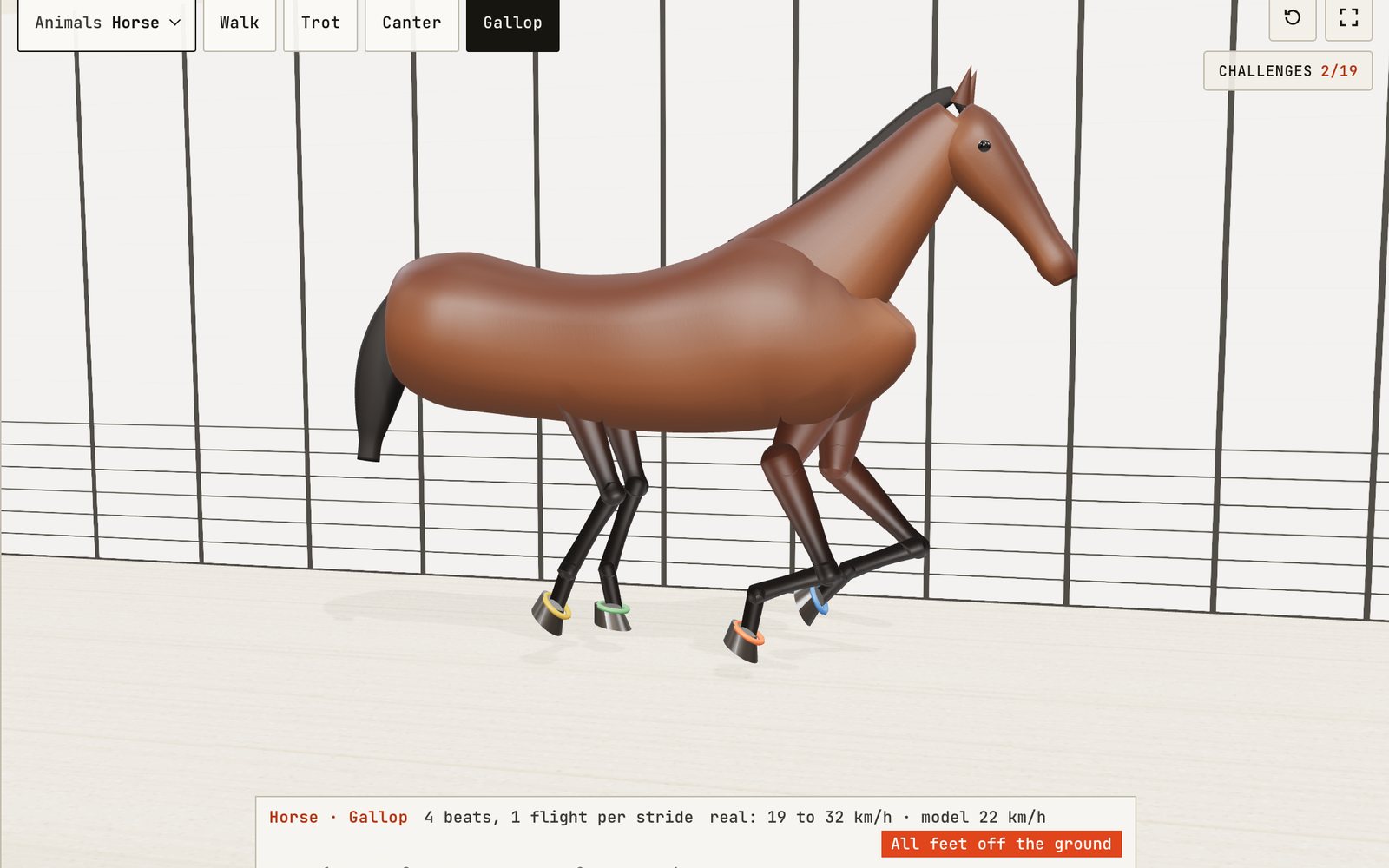
How a horse runs: walk, trot, canter and gallop
In 1878 Muybridge's cameras showed that a galloping horse does lift all four feet at once, but with its legs tucked under it. Some fast animals never leave the ground at all.
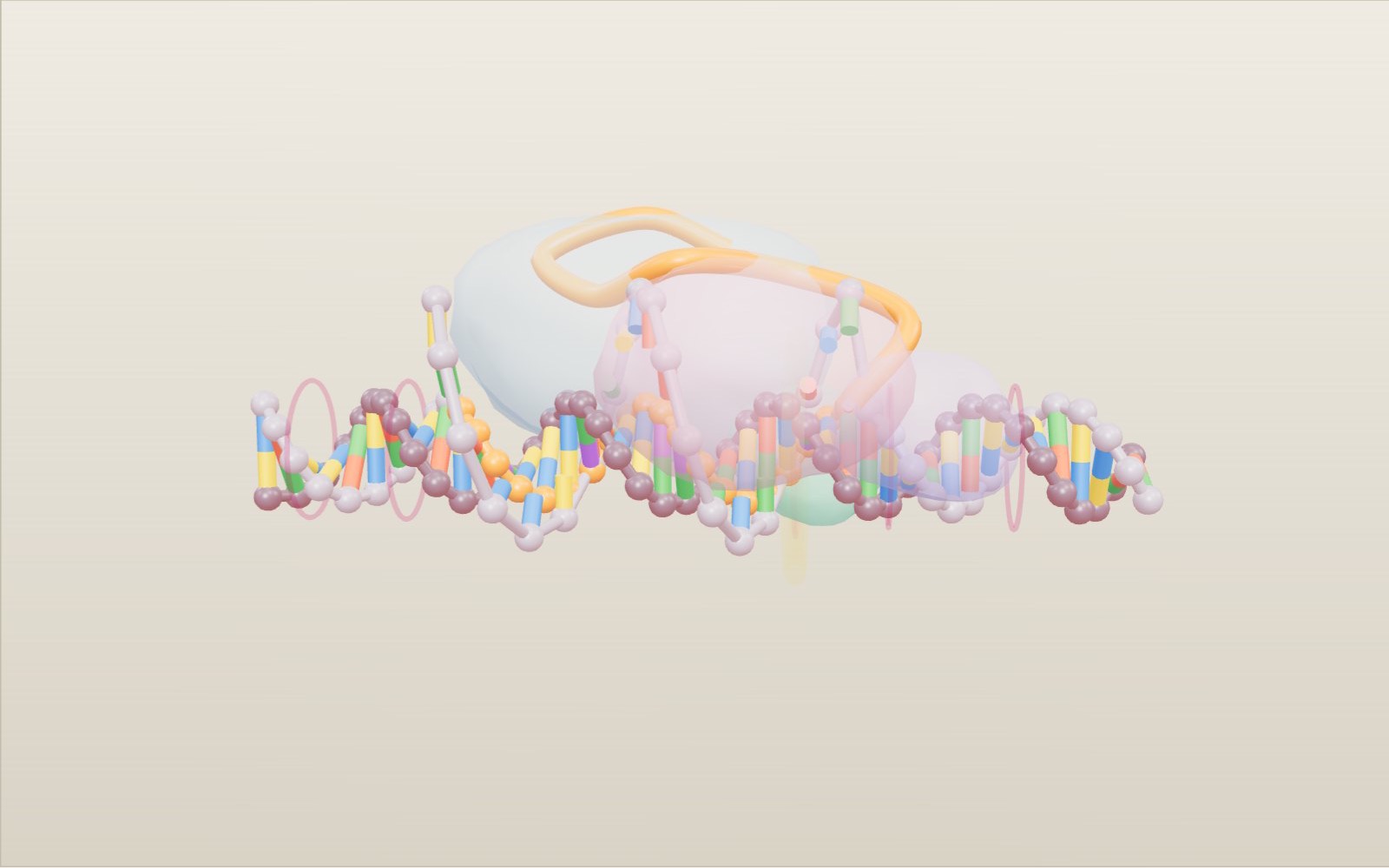
How CRISPR-Cas9 gene editing works
A guide RNA reads just 20 letters of DNA, and that is usually enough to pick out one spot among the 3 billion base pairs of a human genome.
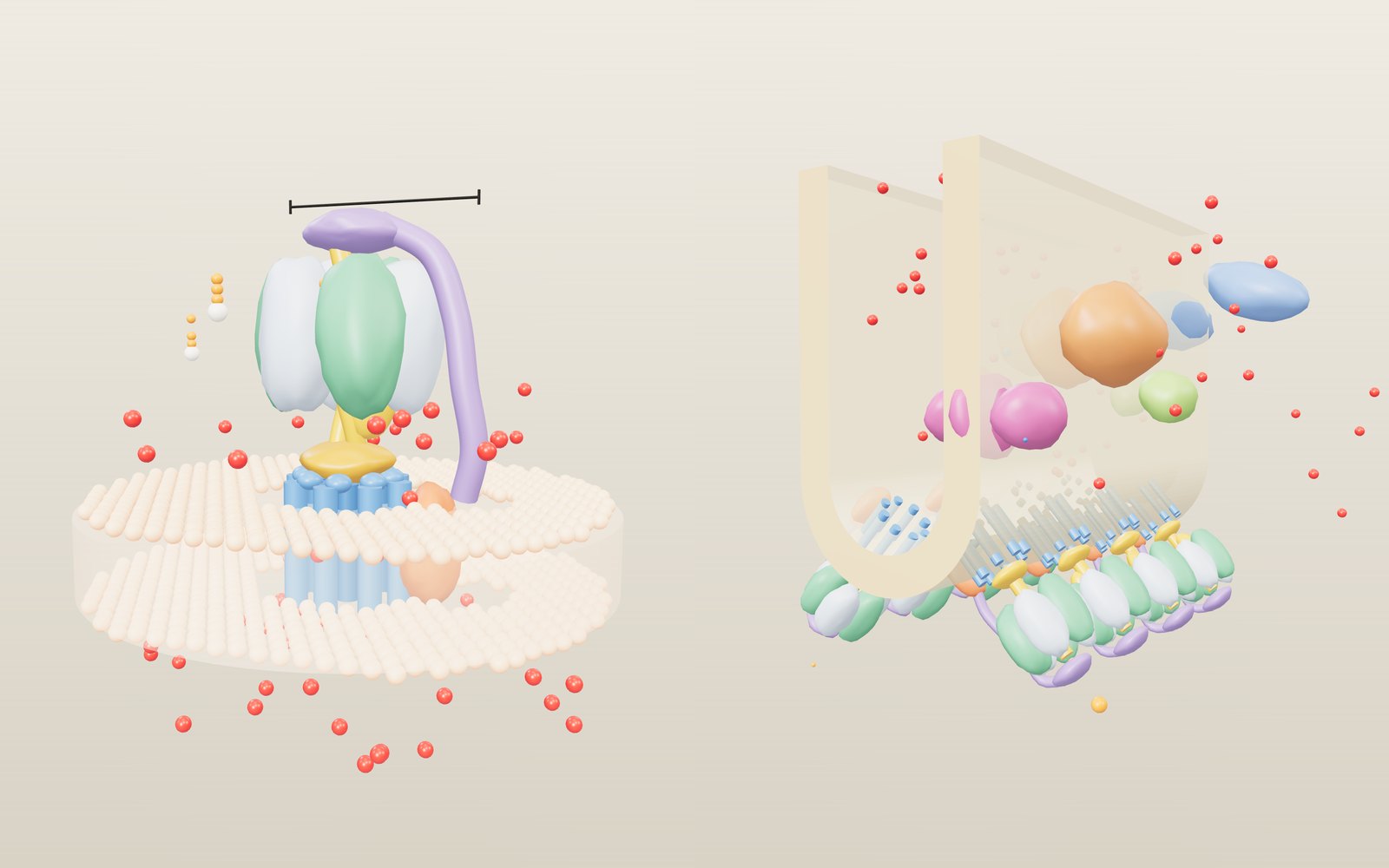
How ATP synthase works
In mitochondria the rotor of ATP synthase turns about 100 times a second, and every full turn releases three molecules of ATP.