FIG. 32How It Works
How a horse runs: walk, trot, canter and gallop
In 1878 Muybridge's cameras showed that a galloping horse does lift all four feet at once, but with its legs tucked under it. Some fast animals never leave the ground at all.
This device cannot show the 3D model. You can read the guide steps below as text.
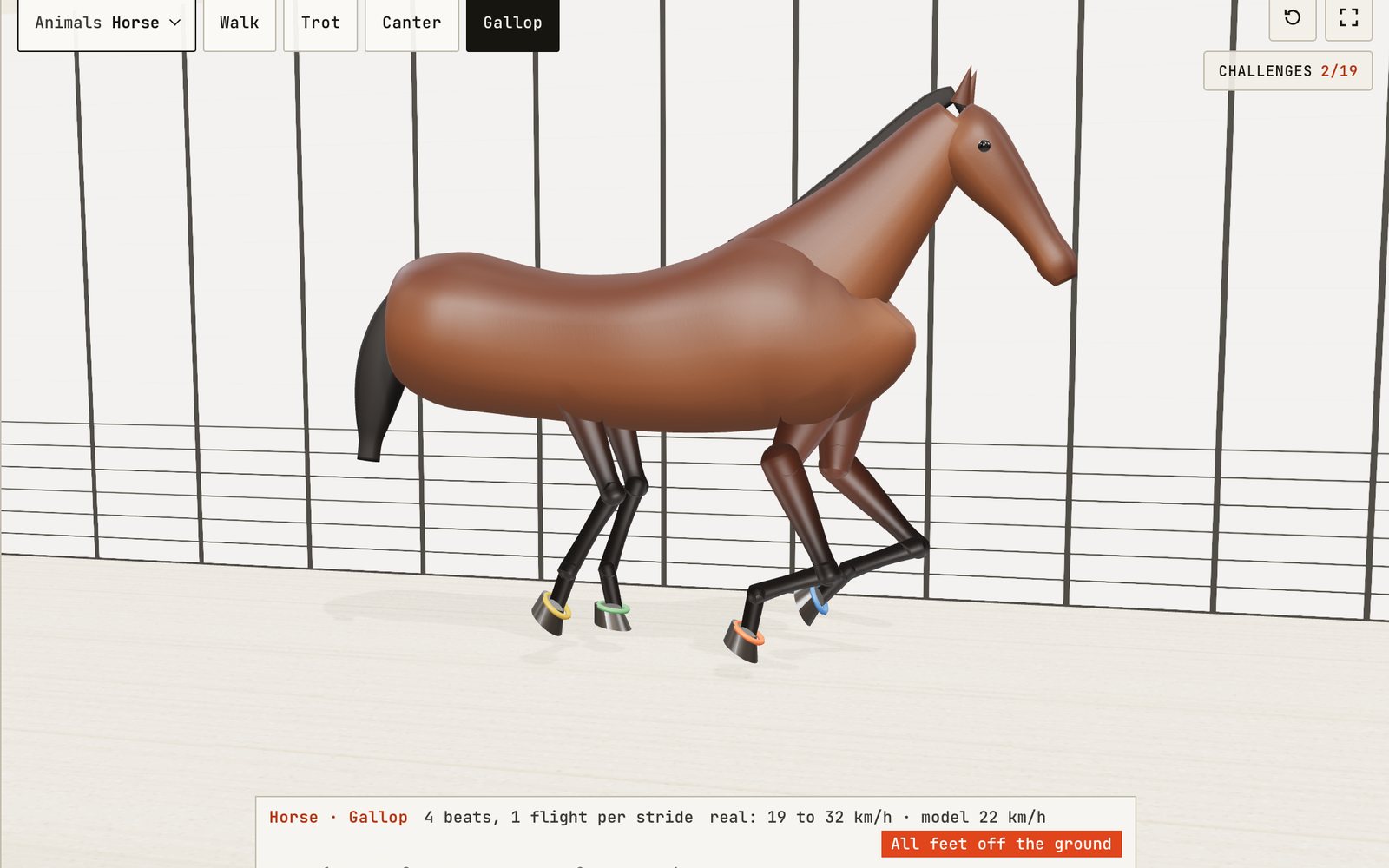
1 / 17 A horse with a body you can see throughThe horse is built in code: a smooth skin over the main muscle masses of the shoulder, barrel and haunch, with the skeleton inside. It opens at a slow gallop and stops for a moment when all four feet are off the ground. It runs on the spot while the ground slides back under it, so a hoof on the ground stays put on the sand. Choose Animals above the horse to pick one of 52 animals.
Drag to turn. Scroll or pinch to zoom.
What the model shows
How does a horse run? A horse has four natural gaits, and the gallop is its fastest way of running. In the gallop the feet land one after another in a four-beat rhythm, and once in every stride all four feet are off the ground, gathered under the body. So when a horse runs flat out, it is galloping.
Watch a horse trot past and the legs turn into a blur. You can hear the rhythm, but you cannot see which foot lands when. For most of history nobody could, and painters guessed. This exhibit slows the four natural gaits of a horse down until each footfall can be followed: the walk, the trot, the canter and the gallop. Then it puts 19 other animals through the same test, from a cat to an elephant, so you can see which gaits are shared and which are rare.
The horse is built in code. A smooth skin is lofted over the main muscle masses of the shoulder, the barrel and the haunch, with a mane, a tail and a skeleton inside. It runs on the spot while the sand and the backdrop slide backwards under it, the way a treadmill works. The visit opens on a slow gallop that stops for a moment when all four feet are off the ground. Choose Animals at the top left of the stage to pick one of 52 animals by silhouette, search or group, and a gait with the buttons beside it. The panel underneath is a footfall diagram: one row per leg, and a coloured bar wherever that foot is on the ground during one stride. The vertical line moving across it is the present moment. Each of the horse's hooves has a coloured band that matches its row, and the readout above the diagram counts the feet on the ground. When the count reaches zero it says so.
The Controls tab has more. Playback speed goes down to a tenth of real time. Stride position stops the animal and lets you drag it through one stride by hand. See inside fades the horse's skin so the skeleton shows. Hoof prints leaves a mark wherever a foot lands, Footfall sound clicks at each landing, and Person 1.75 m stands a person beside the animal for scale. Under the controls you will find 19 tasks, buttons for side, top and front views and for hoof paths, 18 horse breeds with 17 gaits, a gait editor, a table of all 52 animals and 108 gaits, a 100 m race with a record table and a strip of twelve frames in the style of Muybridge's cameras.
Counting beats and feet on the ground
Horse people describe a gait by its beats: how many separate hoof strikes you would hear in one stride. If two feet land at the same instant they make one beat. A stride is one full cycle, from a given foot landing to the same foot landing again.
Two more numbers explain most of what you see in the diagram. The first is how long each foot stays down, as a share of the stride. Biomechanics researchers call this the duty factor. In the model the horse's walk uses 0.62, so each hoof is on the ground for 62% of the stride. The trot and canter use 0.40 and the gallop 0.30. The second is the order of the footfalls and how far apart they are. Milton Hildebrand, who filmed the gaits of many horses in the 1960s, showed that a symmetrical gait such as the walk, trot or pace can be described by just two numbers: the duty factor and how far the fore foot lags behind the hind foot on the same side.
Put these together and you can predict the airborne moments. If every foot is down for more than half the stride, as at the walk, there is never a time with no foot on the ground. Once each foot is down for less than half the stride, gaps can open, and whether they do depends on how the footfalls are spaced. The readout counts the gaps for you: "no flight", "1 flight per stride" or "2 flights per stride".
The walk: always two or three feet down
The walk is a four-beat gait. Each foot lands on its own beat, in the order left hind, left fore, right hind, right fore. Montana State University Extension's guide adds that two or three feet are always on the ground and that there is no moment of suspension. The model shows exactly this: run the walk and the readout flips between two and three feet, never fewer.
Because the beats are evenly spaced, a quarter of a stride apart, the horse always has a triangle or a pair of legs under it. That is why the walk is the most stable gait and the one a horse uses for long distances and rough ground. Montana State gives 3.5 to 5 mph, which is about 5.6 to 8 km/h.
The trot: two diagonal pairs
The trot has two beats. The left fore and right hind land together, then the right fore and left hind. Each diagonal pair works almost like a single leg, so the body is supported along a diagonal line. Watch the trot from the front three-quarter view in the guide and the two pairs swap like the blades of scissors.
Between the two pairs there is a short suspension with no foot on the ground. In the model the trot spends about 20% of each stride in the air, split into two gaps. Montana State notes that the suspension is longest at the extended trot of the Standardbred, and that some breeds, such as the Hackney with its high, collected action, may trot with no suspension at all. Montana State gives an average trotting speed of 7 to 10 mph, about 11 to 16 km/h. The trot is the gait a rider finds bumpy: the body drops a little at each landing and is thrown up again by the next pair.
The canter: three beats and a lead
The canter has three beats. For a horse on the right lead, Montana State lists the sequence as left hind, then right hind and left fore together, then right fore, followed by a period of suspension after the right fore leaves the ground. The leg that lands last, here the right fore, is called the leading leg, because it reaches furthest forward. A horse turning right normally leads with the right legs.
You can see the lead in the diagram. Switch to the canter and look at the third beat: the right fore lands alone, and the gap after it is the only airborne moment in the stride. Montana State says this moment is the best time for a rider to ask for a change of lead, since no foot is on the ground to hold the old pattern. Montana State gives the canter an average speed of 6 to 10 mph, about 10 to 16 km/h, and calls it a collected or restrained gallop.
The gallop: the fourth beat and the airborne moment
The gallop looks like a fast canter, and in many ways it is. The difference is in the middle beat. At the canter the inside hind foot and the outside fore foot land together. At the gallop the hind foot lands a fraction of a second earlier, so one beat becomes two and the gait has four: left hind, right hind, left fore, right fore for a right lead. The suspension comes after the last fore foot leaves the ground.
In the model each hoof is down for only 30% of the stride and the horse is in the air for about a quarter of it. Open step 6 of the guide to see that moment at a tenth of real speed. The front legs have just pushed off and are folding back under the chest, and the hind legs are swinging forward under the belly. All four hooves are bunched under the body. Montana State gives 12 to 20 mph for the gallop, about 19 to 32 km/h. Racehorses go faster than this average, which is why the readout shows it as a typical range rather than a top speed.
How fast each gait goes
These are the figures from Montana State that the readout shows, converted from miles per hour.
| Gait | Beats | Flights per stride | Montana State | In km/h |
|---|---|---|---|---|
| Walk | 4 | 0 | 3.5 to 5 mph | 5.6 to 8 |
| Trot | 2 | 2 | 7 to 10 mph | 11 to 16 |
| Canter | 3 | 1 | 6 to 10 mph | 10 to 16 |
| Gallop | 4 | 1 | 12 to 20 mph | 19 to 32 |
The canter and trot ranges overlap. A horse does not change gait at one fixed speed, and a trained trotter can trot faster than another horse canters.
The model itself moves more slowly. Its ground speeds are 3.5, 9.3, 11.6 and 22.4 km/h for the four gaits, because each hoof sweeps a shorter distance under the body than a real horse's does. The readout shows both numbers, marked "real" and "model". The timing of the footfalls is the part of the model that matters, and the diagram shows it at any speed.
Why a horse changes gait
A horse could in principle walk faster and faster instead of breaking into a trot. In 1981 Donald Hoyt and Richard Taylor trained ponies on a treadmill and measured how much oxygen they used to cover a given distance. Within each gait there was a speed at which the cost of travel was lowest; walking or trotting faster or slower than that cost more. When the same ponies moved freely, they chose speeds close to these lowest-cost points and switched gait between them.
So each gait has a range in which it is cheap, and a horse changes gait roughly where one range hands over to the next. The airborne moments are part of the story. At the trot and gallop the legs work like springs: tendons stretch as the body lands and spring back as it rises, storing energy that would otherwise be lost.
Size, stride and the Froude number
Run the cat and the elephant one after the other and the cat's legs blur while the elephant's seem to move in slow motion. Small animals take more strides per second. Norman Heglund and Richard Taylor compared animals from mice to horses and found that at the speed where each one changes from a trot to a gallop, a small animal takes many more strides per second than a large one. They also found that the energy used in one stride, per kilogram of body, was much the same across sizes at equivalent speeds.
Robert McNeill Alexander and Alan Jayes suggested a way to compare animals of different sizes fairly. Divide the square of the speed by gravity times leg length and you get a number with no units, the Froude number. Animals of different sizes moving at the same Froude number tend to use the same gait with the same proportions, the way a small and a large pendulum swing alike when their lengths are scaled. The model uses this idea: an animal's stride period grows with the square root of its leg length, so the mouse and the giraffe both move at a pace that looks natural for their size.
People change from walking to running at about 2 m/s, which for a person's leg length is a Froude number close to 0.5. Alexander showed that walking becomes mechanically impossible as the Froude number approaches 1, because the body vaulting over a stiff leg would lift off the ground.
Gaits that people teach horses
Montana State lists the walk, trot, pace and gallop as the natural gaits of horses in the wild. Under domestication some have been modified into acquired gaits, among them the slow lope, the running walk, the rack, the stepping pace and the fox trot. Three of these patterns are in the animal menu.
The pace is a two-beat gait like the trot, but the two legs on the same side move together: left hind and left fore, then right hind and right fore. Montana State lists it as a natural gait, and the Standardbred is raced both at the trot and at the pace. Compare the two Standardbred gaits in the diagram: the bars are the same length, only the pairs change.
The Icelandic horse has, in Montana State's description, five natural gaits, including the tölt and a pace said to reach up to 40 mph (64 km/h) over short distances. The tölt keeps the four-beat order of the walk, but each foot spends less time on the ground, so the horse is held by one or two feet at a time and never leaves the ground. A rider sits almost still. The Tennessee Walking Horse's running walk is similar, with longer steps. Robilliard, Pfau and Wilson classified horse gaits, including those of gaited breeds, by the timing of their footfalls, which is the same information the diagram shows.
52 animals, one diagram
The table under the controls lists every animal and gait in the exhibit with its beats, its flights per stride and the speed its source gives, where it gives one. Choose a row to put that animal on the stage. Filter by group (hooves, pads, paws, primates, two legs, sprawling legs or six legs) or search by name. The Animals button above the stage gives the same choice as a row of silhouettes, each drawn from that animal's own leg lengths.
A few patterns stand out once you read many diagrams. Almost every four-legged animal walks in the same order as the horse: left hind, left fore, right hind, right fore. Hildebrand called this a lateral sequence walk, and found it in mammals of very different sizes. The cat in the menu walks this way too. The differences appear at speed, where animals split into trotters, pacers, gallopers and bounders.
The camel paces
Switch to the dromedary camel and the left legs swing forward together, then the right legs. The body rocks from side to side. In Anne Innis Dagg's 1974 study, dromedaries paced routinely and were never seen to trot; they rarely galloped and used the pace to cover distance at speed. One explanation offered for pacing in long-legged animals is that it keeps the hind foot from striking the fore foot on the same side, because the two swing forward together instead of meeting.
Fast without flying: giraffes and elephants
Not every animal leaves the ground when it hurries. Christopher Basu and colleagues filmed free-roaming giraffes in South Africa from a drone. Adult giraffes ran at 3.4 to 6.9 m/s, about 12 to 25 km/h, using a rotary gallop, and none of the adults had all four feet off the ground. Brief airborne moments were seen only in young giraffes. Their walk, measured in an earlier study, is a lateral sequence walk like the horse's.
Elephants are the clearest case. John Hutchinson and colleagues measured Asian elephants moving at up to 6.8 m/s, about 24 km/h, and found that they never had all four feet off the ground. Even so, the way the body rose and fell at those speeds was closer to running than to walking. A later study of Asian and African elephants found that they keep the lateral sequence footfall order across their whole speed range. In the model the elephant's fast walk has a duty factor of 0.52, and the diagram never opens a gap.
Two flights in one stride: dogs, greyhounds and cheetahs
A horse's gallop is a transverse gallop: the footfalls cross from one side to the other, hind left, hind right, fore left, fore right. Many dogs and cats gallop differently. In a rotary gallop the front feet land in the opposite order to the hind feet, so the sequence goes round in a circle: hind left, hind right, fore right, fore left.
Fast runners such as the greyhound and the cheetah add a second flight. After the hind feet push off, the animal flies with its legs stretched out; after the front feet leave, it flies again with the legs gathered under the body. The flexible back stretches and curls with each flight, which lengthens the stride. Choose the cheetah's gallop and look for the two shaded gaps in the diagram. Collars fitted to wild cheetahs in Botswana by Alan Wilson's group recorded a top speed of 25.9 m/s, about 93 km/h. James Usherwood and Wilson found that greyhounds racing round a bend kept their speed even though their legs had to push harder, which suggests that the force a leg can produce does not set their top speed.
Bounds and hops: rabbits, squirrels and kangaroos
Small animals often use gaits in which a pair of legs works together. In a bound the two hind feet land together, then the two front feet land together, giving two beats and two flights. In a half-bound, the rabbit's gait in the menu, the hind feet land together but the front feet land one after the other, giving three beats. Hildebrand described both as asymmetrical gaits, like the gallop, because the left and right legs of a pair do not move half a stride apart.
The red kangaroo takes this to the limit: both hind legs move as one, so a hop has one beat and one flight. Terence Dawson and Richard Taylor put red kangaroos on a treadmill and found that once they were hopping, their energy use per minute did not rise as they went faster. In running animals it climbs with speed. The long tendons of the hind legs store and return energy at each landing.
Two legs: people and ostriches
A walking person always has a foot on the ground, and at the change of feet both are down. Running opens two flights in each stride, one after each foot pushes off. Peter Weyand and colleagues found that faster sprinters do not swing their legs forward faster than slower ones; they push down on the ground harder, which carries them further in each step. The fastest 100 m on record, 9.58 s in Berlin in 2009, works out at an average of 37.58 km/h, and that is the human lane in the race.
Ostriches show that running and flying are separate ideas. Jonas Rubenson and colleagues measured ostriches on a treadmill from 0.8 to 6.7 m/s. At moderate speeds they ran without a flight, bouncing on bent legs with one foot always down, a gait called grounded running. At higher speeds a short flight appeared. The menu has all three ostrich gaits so you can compare them.
Sprawling legs: crocodiles and lizards
Crocodiles and lizards hold their upper legs out to the side. Lizards trot, moving diagonal legs together while the body bends from side to side; Claire Farley and Tim Ko measured the forces on trotting lizards and found the same bouncing pattern of energy as in running mammals. Crocodiles usually walk with the body lifted off the ground in a high walk, but small crocodiles can also gallop, a gait George Zug described in 1974 as almost unknown in reptiles. The model draws their legs in a flat plane like the others, so the sprawl shows only in the wide stance.
Why the legs fold in the swing
Look at a horse's foreleg as it swings forward and the lower half folds back sharply at the joint horse people call the knee. That joint matches our wrist. The hock on the hind leg matches our ankle, and the joint that points forward high on the hind leg, the stifle, matches our knee. Below the knee and hock a horse has almost no muscle: a single long cannon bone, the pastern bones and a hoof, which is the toenail of the one toe the horse stands on.
Keeping the muscle high up makes the lower leg light, so it takes little effort to swing it forward many times a second. Folding the leg in the swing shortens it, which also helps it swing quickly and keeps the hoof clear of the ground. The model does the same: the faster the gait, the more the knee and hock fold. Turn on See inside to watch the bones inside the skin.
The shoulder is unusual too. A horse has no collarbone, so the shoulder blade is held to the trunk by muscle alone. Pick the shoulder blade in the Parts list to see where it sits against the ribs.
Muybridge and the airborne horse
Before photography could freeze motion, artists often painted galloping horses in a pose now called the flying gallop: front legs stretched forward, hind legs stretched back, all four off the ground. Whether a horse ever leaves the ground completely, and in what pose, was a real argument.
According to the Science Museum Group, Leland Stanford, a former governor of California and president of the Central Pacific Railroad, hired the photographer Eadweard Muybridge in 1872 to settle it. In 1877 Muybridge resumed the work at Stanford's farm in Palo Alto with twelve cameras in a row, each tripped electrically as the horse passed. The Science Museum Group's record of the 1882 book The Horse in Motion describes the horses breaking thin threads to fire the shutters.
Stillman's 1882 book describes the 1878 setup. A building was put up on the west side of Leland Stanford's private track at Palo Alto, and twelve cameras were placed in it at intervals of twenty-one inches, each with double shutters. The time taken for each view was put at no more than a five-thousandth of a second. The lines on the model's backdrop are drawn at the same 21-inch spacing, and the strip of frames under the controls splits one stride into twelve pictures in the same spirit.
The pictures showed that a galloping horse does have all four feet off the ground at once, but only when its legs are gathered beneath the body. When the legs are stretched out, at least one foot is still on the ground. Khan Academy's history of the series says the flying gallop then disappeared from art and from illustrations in racing papers.
Muybridge went on to photograph many animals and people in motion and published Animal Locomotion, 781 plates, in 1887. Stanford's friend J. D. B. Stillman wrote the 1882 book on the Palo Alto work, which the Internet Archive holds in full.
Sallie Gardner at a Gallop, 19 June 1878
The best-known card of the series is in the Library of Congress. Its full title is The Horse in motion. "Sallie Gardner," owned by Leland Stanford; running at a 1:40 gait over the Palo Alto track, 19th June 1878. It is an albumen print on card with twelve frames of one race horse, and a description of each frame is printed on the back. The Library's record lists no known restrictions on publication, so the scan can be viewed and reused.
A second card in the Library of Congress shows the same run of 19 June 1878 as two frames with a diagram of the foot movements, and is labelled an electro-photograph by Muybridge, because the shutters were fired electrically. Stanford University Archives holds the Eadweard Muybridge photograph collection, which includes two printed cards from the horse in motion series of 1878. Its notes say the work started with a narrower question: whether all four feet leave the ground during the trot, which Muybridge captured in Sacramento in 1873 with Stanford's horse Occident, before setting up at the Palo Alto Stock Farm in 1878 and 1879.
To see what the twelve frames show, press Sallie Gardner, 1878 above the stage. It puts the horse in the gallop at a tenth of real time, and the frame strip under the controls splits the stride into twelve pictures. Watch for the moment with no feet down: it comes with the legs gathered under the body, as on the card.
Horse breeds and their gaits
Most horses walk, trot, canter and gallop. Some breeds add a gait of their own, and riders call them gaited horses. Andersson and colleagues found in 2012 that a single change in one gene, DMRT3, makes these extra gaits possible, and it also helps trotters in harness racing. Promerová and colleagues then tested 4,396 horses of 141 breeds and found the mutation in 68 of them. In every breed where the mutation's frequency was above 50%, the breed was either gaited or bred for harness racing.
Under Horse breeds and gaits you can choose one of 18 breeds, from the Thoroughbred to the Jeju horse, and then one of its gaits. The horse on the stage takes the breed's coat colour and moves in that gait. The table gives each gait's lateral advanced placement (LAP), the share of the stride between a hind foot landing and the fore foot on the same side landing, its duty factor and the speed range the sources give.
LAP sorts the gaits neatly. In Vincelette's 2023 review of these gaits, the walk sits close to 0.25, so the four feet land at even quarter intervals. The trot sits at 0.5, with diagonal feet landing together. The hard pace is close to zero, with the two feet on one side landing almost together. Everything a gaited horse does lies between.
Singlefoot gaits: the tölt, the rack and the running walk
The tölt of the Icelandic horse, the rack of the American Saddlebred and the Racking Horse, and the running walk of the Tennessee Walking Horse all keep the walk's order of footfalls: left hind, left fore, right hind, right fore. They are even four-beat gaits, sometimes called singlefoot. What changes is speed and how long each foot stays down.
Zips and colleagues measured 23 Icelandic horses ridden at the tölt at 2.9, 3.7 and 4.7 m/s. The tölt alternated between moments on one foot and moments on two, as its definition says, but at the highest speed 60% of the strides had turned into a four-beat pace. In the model the tölt has a LAP of 0.21 and each foot is down for 42% of the stride, so the support count drops to one foot and never to zero.
Vincelette gives the running walk a LAP of 0.23 down to 0.17 and speeds of 2.2 to 4.0 m/s, with stride times of 0.85 to 0.65 s. The rack is faster, 2.5 to 6.0 m/s and up to 10.6 m/s in racing horses, with quicker strides. The Paso Fino's classic fino is a very collected rack: tiny steps, strides of 0.35 to 0.39 s and almost no forward speed. The Peruvian Paso's paso llano is its form of the running walk.
Broken trot and broken pace
Two more gaits split a two-beat gait into four uneven beats. In the fox trot of the Missouri Fox Trotter, the diagonal legs leave the ground together but the fore foot lands just before the hind, so the beats come in close pairs. Vincelette gives a LAP of 0.41 to 0.32 and speeds of 3.2 to 3.7 m/s. In the stepping pace (also called the broken pace or amble), the feet on one side lift together but the hind lands first, with a LAP of 0.18 to 0.13 and speeds of 2.9 to 6.2 m/s. The Peruvian Paso's sobreandando is a broken pace too.
The Mangalarga Marchador of Brazil has two forms of its marcha. In the marcha batida the horse spends more time on diagonal pairs of feet, and in the marcha picada more time on lateral pairs, with moments on three feet in both. Simonato and colleagues measured horses in the marcha batida at 3.34 to 3.85 m/s.
The hard pace itself is a two-beat lateral gait at 3.5 to 8.1 m/s, and the racing or flying pace reaches 10.5 to 14 m/s with a moment in the air. Several East Asian breeds pace, among them the Jeju horse, the Hokkaido horse and the Mongolian horse.
The gait editor and the support area
The gait editor lets you write a gait yourself. Three sliders set when the left fore, right hind and right fore land, as a share of one stride after the left hind, and a fourth sets how long each foot stays down. Run on the stage puts the pattern on the horse at once. The editor names the catalogue gait it matches, or the nearest one.
Beside the sliders is a top view of the feet. The feet on the ground are joined into a support area, and a dot marks the centre of mass, placed a little ahead of the middle of the trunk in this model. When three or more feet are down and the dot lies inside their outline, the horse could stand still in that pose without falling: it is statically stable. With two feet down the horse balances on a line and has to keep moving.
Cartmill, Lemelin and Schmitt used this idea to compare walking gaits. A slow lateral-sequence walk with long stance keeps the centre of mass inside a triangle of three feet for most of the stride. In the editor, a walk with each foot down for 80% of the stride stays stable for about four fifths of it. Shorten the stance and the stable share drops, until the trot and the pace spend no time in a stable pose at all. Faster gaits rely on motion, not on standing balance.
Heavy trotters: hippos and rhinos
Hippos are among the largest land mammals, and their gaits were poorly known. Hutchinson and Pringle studied 169 strides from 32 hippos, using online videos and their own films of two zoo hippos. Every stride was a trot or close to one. At the fastest speeds the hippos had brief moments with all four feet in the air, something that had not been described before. Elephants of similar size never leave the ground, as the elephant in the menu shows.
Primates walk the other way round
Most mammals walk in lateral sequence: after a hind foot lands, the fore foot on the same side follows. Most primates do the opposite. After the left hind lands, the right fore comes next: a diagonal-sequence walk. Hildebrand described it in 1967, and the chimpanzee, gorilla and baboon in the menu use it.
Why primates walk this way is still argued. One idea, from Cartmill and colleagues, is that it puts a hind foot under the body at the moment a fore foot reaches for a new branch, which helps on thin supports. Shapiro and Raichlen tested this on infant baboons, which use more kinds of gaits than adults, and found that the lateral-sequence walk gave as much stability on that measure. Pontzer, Raichlen and Rodman found chimpanzees walking on two legs and on four at a similar energy cost.
Birds: running without a flight
A bird runs on two legs like a person, but it can run without a moment in the air. Gatesy and Biewener compared birds and humans and found birds keep their legs more crouched. The ostrich in the menu runs both ways, as Rubenson and colleagues measured: without a flight at moderate speeds, with a short one at higher speeds. Animal Diversity Web gives emus sustained speeds of up to 13.4 m/s.
Chicks are a good test of how much of this is learned. Muir and colleagues measured chicks over their first two weeks. Newly hatched chicks could already run, but their walk did not yet swap potential and kinetic energy the way an adult's does; by two weeks it did. Penguins waddle, rocking from side to side. Griffin and Kram found the waddle is not wasted motion: it helps recover energy with each step.
Reptiles: sprawled legs, gallops and water running
Lizards hold their legs out to the sides and bend the body as they go. Farley and Ko measured a banded gecko and a skink, and both trotted, with diagonal legs together. The zebra-tailed lizard rises onto two legs at its highest speeds; Irschick and Jayne compared its two-legged and four-legged running.
Crocodylians are a surprise. Hutchinson and colleagues filmed 42 individuals of 15 species at speeds from 0.15 to 4.35 m/s. Crocodiles galloped and bounded, but alligators did not, which suggests the ability was either lost in the alligator line or gained in the crocodile line. Renous and colleagues described the gallop of young Johnston's crocodiles in detail.
The basilisk lizard runs across water on its hind legs. Glasheen and McMahon showed how: each foot slaps the surface, then strokes down and back, opening an air cavity that the foot pulls out before it closes. Hsieh and Lauder measured the forces on juvenile basilisks and found large sideways forces in each step, which may help keep the lizard upright. In the model the basilisk runs on the sand with the same two-legged pattern.
Six legs: the alternating tripod
Insects have six legs, and at most speeds they walk on two tripods: the front and hind legs of one side move with the middle leg of the other side, so three feet are always down. Full and Tu measured American cockroaches using this tripod from 0.44 to 1.0 m/s. Above 1 m/s the vertical force fell close to zero for moments, and at 1.0 to 1.5 m/s, about 50 body lengths a second, the cockroaches ran on four or even two legs.
Desert ants of the genus Cataglyphis are among the fastest. Wahl, Pfeffer and Wittlinger studied walking and running in Cataglyphis fortis, and Pfeffer and colleagues found that the Saharan silver ant, which has shorter legs, makes up for them with more than 40 strides a second, stance phases as short as 7 ms and leg swings of up to 1.4 m/s. The insects are shown enlarged (the readout gives the factor) and the readout divides the model's speed by the same factor. Choose the slowest playback speed to follow the legs.
The race and its record table
Pick up to eight animals and start. Each runs at the top speed its source gives: the upper end of a range, a measured top speed or a record average. The racing Thoroughbred runs at 19 m/s, the top of the 17 to 19 m/s Vincelette gives for horse racing. When a race ends, each animal's 100 m time goes into a record table kept in this browser, and the fastest ten are listed.
Bigger is not always faster. Hirt and colleagues fitted maximum speeds of 474 species, from 30 micrograms to 100 tonnes, and found a hump-shaped curve: speed rises with size, then falls again for the largest animals, because they run out of time to accelerate. That is why the elephant finishes near the back of the race and the cheetah, a medium-sized animal, wins.
Try it yourself
The 19 tasks under the controls check what is on the stage. Some ask you to stop the animal at the right moment: find the instant when all four of the horse's feet are off the ground, or stop the gallop with exactly one foot down. Others ask a question that the stage can answer: which gait the camel uses at speed, which horse gait is fastest, whether a fast elephant ever leaves the ground. One asks you to put any three-beat gait on the stage. Nine tasks use the gait editor: rebuild the walk, the trot and the camel's pace, make a bound or a singlefoot gait, a gait with a flight, one with three feet always down, one that is stable all stride and one with a moment on a single foot and no flight. Others ask you to put a gaited breed or a six-legged walker on the stage, and the last asks you to guess the winner of the race before you start it.
The race uses only figures from the sources: the upper end of a range, a measured top speed, a world-record average or the fastest speed measured in a study. It is not a fair contest, since a treadmill limit for ostriches is not a top speed, and the notes in the table say which kind of figure each lane uses. Animals without a measured speed in the sources are left out of the race rather than given a guess.
How the model differs from real animals
The skeleton is simplified. The horse has 13 pairs of ribs, fewer than a real horse, and each leg has one bone per section where a real leg has several small bones at the knee and hock. The neck and head move with the trunk. A real horse moves its head and neck up and down a little at the walk to help its balance, and at the canter the head rises as the hind legs step under and drops to its lowest point when the leading fore foot lands. The muscles are smooth shapes, not individual muscles.
The other animals are built from the same parts, stretched and recoloured. The primates get a round head and short muzzle in place of the long horse face, the birds and the penguin are scaled versions of one upright body, and the insects are a separate set of smooth body parts with two-segment legs. In the rest: a longer neck for the giraffe and camel, a hump for the camel, a trunk and large ears for the elephant, spots for the cheetah. They have no skeleton inside, and their faces are simple. Their legs use the same two-joint mechanism as the horse's, so a cat's or a dog's paw is drawn more like a small hoof than it really is.
The movement is simplified as well. Stride times, duty factors and the height of each foot in the swing are rounded values chosen to match the gait descriptions in the sources, not measurements of one animal. The legs move in flat planes, the body bobs and rocks by a fixed amount, and a real animal's timing varies from stride to stride. A foot on the ground is held exactly still relative to the sand, which is close to how a real foot behaves for most of its stance. Changing gait in the model blends one pattern into the other in under half a second; a real animal needs a few strides.
Questions
Does a horse ever have all four feet off the ground?
Yes. At the trot there is a short moment between the diagonal pairs, and at the canter and gallop there is one airborne moment in each stride. Muybridge's 1878 photographs showed that at the gallop it happens with the legs gathered under the body.
Why does the walk never leave the ground?
Each foot is down for more than half the stride, and the four footfalls are spaced a quarter of a stride apart, so two or three feet are always on the ground. That gives the walk a stable base on rough ground.
What is a lead at the canter and gallop?
The lead is the side whose fore and hind legs reach further forward. On a right lead the right fore lands last in each stride. Horses usually lead with the inside legs on a curve and can switch leads during the airborne moment.
Is the trot faster than the canter?
Not always. Montana State gives 7 to 10 mph for the trot and 6 to 10 mph for the canter, so the ranges overlap. Harness racers are bred and trained to trot much faster than an average canter.
How fast can a horse gallop?
Montana State gives 12 to 20 mph, about 19 to 32 km/h, for an average gallop. Racing breeds go faster over short distances, and the Icelandic horse's flying pace is said to reach up to 40 mph.
Why did painters get the gallop wrong?
The legs move too quickly for the eye to separate the positions. Painters drew the pose that looked fastest, with all four legs stretched out. Photography in 1878 showed that the stretched pose always has a foot on the ground.
What is the difference between the trot and the pace?
Both have two beats. At the trot the diagonal legs move together; at the pace the two legs on the same side do. Choose the Standardbred to compare them in the diagram.
Which animals pace?
In the exhibit, the camel, the Standardbred and the Icelandic horse. Dagg found that dromedaries paced routinely and never trotted.
Do elephants run?
It depends on what you mean by running. Elephants measured at up to 6.8 m/s never had all four feet off the ground, but at those speeds their bodies bounced the way a runner's does.
Why does a cheetah fly twice in each stride?
In its gallop the hind legs and the front legs each push off as a pair, and there is a flight after each pair. The back bends and straightens with them, which lengthens the stride.
Why do small animals move their legs so fast?
Shorter legs swing in less time, much as a short pendulum swings faster than a long one. Heglund and Taylor found that at equivalent speeds a mouse takes many more strides per second than a horse.
Why do the speeds in the readout differ from the model's speed?
The model's feet sweep a shorter distance under the body than a real animal's, so it covers less ground in each stride. The footfall timing is the part that follows the sources, and the readout shows the real figure beside the model's.
What is a gaited horse?
A horse that has a natural extra gait besides the walk, trot, canter and gallop, usually an even four-beat gait such as the tölt, rack or running walk, or a pace. Most gaited breeds carry a mutation in the DMRT3 gene that Andersson and colleagues identified in 2012.
What is the tölt?
The Icelandic horse's four-beat gait with the walk's order of footfalls. It has no moment in the air: the horse is held by one or two feet at a time, so the rider barely bounces. Zips and colleagues measured it at 2.9 to 4.7 m/s.
What is the difference between a rack and a running walk?
Both are even four-beat gaits in the walk's order. The running walk is an extended walk with long overreaching steps at 2.2 to 4.0 m/s. The rack is quicker and faster, 2.5 to 6.0 m/s, with shorter hind steps and a springier action, according to Vincelette's review.
Can a hippo gallop?
No gallop was seen in the 169 hippo strides Hutchinson and Pringle studied. Hippos trot at all speeds, and at the fastest they have short moments with all four feet off the ground.
Why do primates walk in diagonal sequence?
Nobody is sure. One idea is that it keeps a hind foot planted under the body as a hand reaches for a new branch. Tests on infant baboons have not settled the question.
Do insects run?
Yes. Cockroaches using a tripod have moments with almost no vertical force above 1 m/s, and at 1.0 to 1.5 m/s they switch to running on four or two legs, as Full and Tu measured.
Can I hear the gait?
Turn on Footfall sound. Each landing makes a click, higher for the front feet. At the walk you hear four even clicks, at the trot two, and at the canter three with a pause.
What did Muybridge's Sallie Gardner photographs show?
The card of 19 June 1878, held by the Library of Congress, shows Leland Stanford's horse Sallie Gardner in twelve frames on the Palo Alto track. In some frames all four hooves are off the ground, with the legs folded under the body rather than stretched out as in older paintings. That settled whether a galloping horse is ever fully airborne.
Terms
- Gait: a pattern of leg movement that repeats every stride, such as the walk or the trot.
- Beat: one foot strike, or several that land at the same instant.
- Stride: one full cycle of the legs, from one foot landing to the same foot landing again.
- Duty factor: the share of a stride that a foot spends on the ground.
- Suspension or flight: a moment in the stride when no foot is on the ground.
- Lead: the side whose legs land last and reach furthest forward at the canter and gallop.
- Pace: a two-beat gait in which the two legs on the same side move together.
- Lateral sequence: a footfall order in which a hind foot is followed by the fore foot on the same side, as in the walk.
- Transverse gallop: a gallop in which the footfalls cross from one side to the other, as in the horse.
- Rotary gallop: a gallop in which the front feet land in the opposite order to the hind feet, as in dogs and cheetahs.
- Bound: a gait in which the two hind feet land together and then the two front feet land together.
- Grounded running: a bouncing gait with no flight, used by ostriches at moderate speeds.
- Froude number: speed squared divided by gravity times leg length, used to compare animals of different sizes.
- Footfall diagram: a chart with one row per leg, marking when each foot is on the ground.
- Cannon bone: the long bone between the knee or hock and the fetlock.
- Hock: the joint on the hind leg that matches the human ankle.
- Withers: the highest point of the back, above the shoulder blades.
- Gaited horse: a horse with a natural extra gait, such as the tölt, rack, running walk or pace.
- Lateral advanced placement (LAP): the share of the stride between a hind foot landing and the fore foot on the same side landing; 0.25 for an even four-beat gait, 0.5 for the trot.
- Singlefoot: an even four-beat gait in the walk's order, such as the tölt, rack or running walk.
- Broken trot and broken pace: four-beat gaits in which the diagonal (fox trot) or lateral (stepping pace) pairs land just apart.
- Diagonal sequence: a footfall order in which a hind foot is followed by the fore foot on the other side, as in most primates.
- Alternating tripod: the insect gait in which front and hind legs of one side move with the middle leg of the other side.
- Support area: the outline of the feet on the ground, seen from above.
- Statically stable: a pose in which the centre of mass lies inside the support area, so the animal could stand still in it.
Sources
Montana State University Extension, Horse Locomotion. https://animalrangeextension.montana.edu/equine/locomotion.html (checked 18 October 2026)
Hildebrand, M. (1965). Symmetrical gaits of horses. Science 150, 701-708. https://doi.org/10.1126/science.150.3697.701 (checked 18 October 2026)
Hildebrand, M. (1989). The quadrupedal gaits of vertebrates. BioScience 39, 766-775. https://doi.org/10.2307/1311182 (checked 18 October 2026)
Hoyt, D. F. and Taylor, C. R. (1981). Gait and the energetics of locomotion in horses. Nature 292, 239-240. https://doi.org/10.1038/292239a0 (checked 18 October 2026)
Heglund, N. C. and Taylor, C. R. (1988). Speed, stride frequency and energy cost per stride: how do they change with body size and gait? Journal of Experimental Biology 138, 301-318. https://doi.org/10.1242/jeb.138.1.301 (checked 18 October 2026)
Alexander, R. McN. and Jayes, A. S. (1983). A dynamic similarity hypothesis for the gaits of quadrupedal mammals. Journal of Zoology 201, 135-152. https://doi.org/10.1111/j.1469-7998.1983.tb04266.x (checked 18 October 2026)
Alexander, R. McN. (1989). Optimization and gaits in the locomotion of vertebrates. Physiological Reviews 69, 1199-1227. https://doi.org/10.1152/physrev.1989.69.4.1199 (checked 18 October 2026)
Robilliard, J. J., Pfau, T. and Wilson, A. M. (2007). Gait characterisation and classification in horses. Journal of Experimental Biology 210, 187-197. https://doi.org/10.1242/jeb.02611 (checked 18 October 2026)
Dagg, A. I. (1974). The locomotion of the camel (Camelus dromedarius). Journal of Zoology 174, 67-78. https://doi.org/10.1111/j.1469-7998.1974.tb03144.x (checked 18 October 2026)
Basu, C. K., Deacon, F., Hutchinson, J. R. and Wilson, A. M. (2019). The running kinematics of free-roaming giraffes, measured using a low cost unmanned aerial vehicle (UAV). PeerJ 7, e6312. https://doi.org/10.7717/peerj.6312 (checked 18 October 2026)
Basu, C., Wilson, A. M. and Hutchinson, J. R. (2019). The locomotor kinematics and ground reaction forces of walking giraffes. Journal of Experimental Biology 222, jeb159277. https://doi.org/10.1242/jeb.159277 (checked 18 October 2026)
Hutchinson, J. R., Famini, D., Lair, R. and Kram, R. (2003). Are fast-moving elephants really running? Nature 422, 493-494. https://doi.org/10.1038/422493a (checked 18 October 2026)
Hutchinson, J. R. et al. (2006). The locomotor kinematics of Asian and African elephants: changes with speed and size. Journal of Experimental Biology 209, 3812-3827. https://doi.org/10.1242/jeb.02443 (checked 18 October 2026)
Wilson, A. M. et al. (2013). Locomotion dynamics of hunting in wild cheetahs. Nature 498, 185-189. https://doi.org/10.1038/nature12295 (checked 18 October 2026)
Usherwood, J. R. and Wilson, A. M. (2005). No force limit on greyhound sprint speed. Nature 438, 753-754. https://doi.org/10.1038/438753a (checked 18 October 2026)
Dawson, T. J. and Taylor, C. R. (1973). Energetic cost of locomotion in kangaroos. Nature 246, 313-314. https://doi.org/10.1038/246313a0 (checked 18 October 2026)
Rubenson, J., Heliams, D. B., Lloyd, D. G. and Fournier, P. A. (2004). Gait selection in the ostrich: mechanical and metabolic characteristics of walking and running with and without an aerial phase. Proceedings of the Royal Society B 271, 1091-1099. https://doi.org/10.1098/rspb.2004.2702 (checked 18 October 2026)
Weyand, P. G. et al. (2000). Faster top running speeds are achieved with greater ground forces not more rapid leg movements. Journal of Applied Physiology 89, 1991-1999. https://doi.org/10.1152/jappl.2000.89.5.1991 (checked 18 October 2026)
World Athletics, World records, men's 100 m, 9.58 s (Berlin, 16 August 2009). https://worldathletics.org/records/by-category/world-records (checked 18 October 2026)
Lindstedt, S. L. et al. (1991). Running energetics in the pronghorn antelope. Nature 353, 748-750. https://doi.org/10.1038/353748a0 (checked 18 October 2026)
Herbin, M. et al. (2007). Gait parameters of treadmill versus overground locomotion in mouse. Behavioural Brain Research 181, 173-179. https://doi.org/10.1016/j.bbr.2007.04.001 (checked 18 October 2026)
Zug, G. R. (1974). Crocodilian galloping: an unique gait for reptiles. Copeia 1974, 550-552. https://doi.org/10.2307/1442557 (checked 18 October 2026)
Farley, C. T. and Ko, T. C. (1997). Mechanics of locomotion in lizards. Journal of Experimental Biology 200, 2177-2188. https://doi.org/10.1242/jeb.200.16.2177 (checked 18 October 2026)
Science Museum Group Collection, The Horse in Motion (book by J. D. B. Stillman with photographs by Eadweard Muybridge, 1882). https://collection.sciencemuseumgroup.org.uk/objects/co8452654/the-horse-in-motion (checked 16 October 2026)
Science Museum Group Collection, Eadweard Muybridge. https://collection.sciencemuseumgroup.org.uk/people/ap28178/muybridge-eadweard (checked 16 October 2026)
Khan Academy (Smarthistory), Eadweard Muybridge, The Horse in Motion. https://www.khanacademy.org/humanities/becoming-modern/early-photo/early-photo-france/a/eadweard-muybridge-the-horse-in-motion (checked 16 October 2026)
Internet Archive, J. D. B. Stillman, The Horse in Motion as Shown by Instantaneous Photography (1882). https://archive.org/details/horseinmotionass00stilrich (checked 16 October 2026)
Vincelette, A. (2023). The characteristics, distribution, function, and origin of alternative lateral horse gaits. Animals 13, 2557. https://doi.org/10.3390/ani13162557 (checked 26 October 2026)
Zips, S., Peham, C., Scheidl, M., Licka, T. and Girtler, D. (2001). Motion pattern of the toelt of Icelandic horses at different speeds. Equine Veterinary Journal 33 (S33), 109-111. https://doi.org/10.1111/j.2042-3306.2001.tb05371.x (checked 26 October 2026)
Nicodemus, M. C. and Clayton, H. M. (2003). Temporal variables of four-beat, stepping gaits of gaited horses. Applied Animal Behaviour Science 80, 133-142. https://doi.org/10.1016/S0168-1591(02)00219-8 (checked 26 October 2026)
Nicodemus, M. C. and Slater, J. K. (2009). Forelimb kinematics of the flat walk and fox trot of the Missouri Fox Trotter. Comparative Exercise Physiology 6, 149-156. https://doi.org/10.1017/S1755254010000048 (checked 26 October 2026)
Simonato, S. P. et al. (2021). 3D kinematic of the thoracolumbar spine in Mangalarga Marchador horses performing the marcha batida gait and being led by hand. PLOS ONE 16, e0253697. https://doi.org/10.1371/journal.pone.0253697 (checked 26 October 2026)
Andersson, L. S. et al. (2012). Mutations in DMRT3 affect locomotion in horses and spinal circuit function in mice. Nature 488, 642-646. https://doi.org/10.1038/nature11399 (checked 26 October 2026)
Promerová, M. et al. (2014). Worldwide frequency distribution of the 'Gait keeper' mutation in the DMRT3 gene. Animal Genetics 45, 274-282. https://doi.org/10.1111/age.12120 (checked 26 October 2026)
Paso Fino Horse Association, The gaits. https://pfha.org/the-breed/the-gaits/ (checked 26 October 2026)
Full, R. J. and Tu, M. S. (1991). Mechanics of a rapid running insect: two-, four- and six-legged locomotion. Journal of Experimental Biology 156, 215-231. https://doi.org/10.1242/jeb.156.1.215 (checked 26 October 2026)
Wahl, V., Pfeffer, S. E. and Wittlinger, M. (2015). Walking and running in the desert ant Cataglyphis fortis. Journal of Comparative Physiology A 201, 645-656. https://doi.org/10.1007/s00359-015-0999-2 (checked 26 October 2026)
Pfeffer, S. E., Wahl, V. L., Wittlinger, M. and Wolf, H. (2019). High-speed locomotion in the Saharan silver ant, Cataglyphis bombycina. Journal of Experimental Biology 222, jeb198705. https://doi.org/10.1242/jeb.198705 (checked 26 October 2026)
Hsieh, S. T. and Lauder, G. V. (2004). Running on water: three-dimensional force generation by basilisk lizards. PNAS 101, 16784-16788. https://doi.org/10.1073/pnas.0405736101 (checked 26 October 2026)
Glasheen, J. W. and McMahon, T. A. (1996). A hydrodynamic model of locomotion in the basilisk lizard. Nature 380, 340-342. https://doi.org/10.1038/380340a0 (checked 26 October 2026)
Irschick, D. J. and Jayne, B. C. (1999). Comparative three-dimensional kinematics of the hindlimb for high-speed bipedal and quadrupedal locomotion of lizards. Journal of Experimental Biology 202, 1047-1065. https://doi.org/10.1242/jeb.202.9.1047 (checked 26 October 2026)
Renous, S., Gasc, J.-P., Bels, V. L. and Wicker, R. (2002). Asymmetrical gaits of juvenile Crocodylus johnstoni, galloping Australian crocodiles. Journal of Zoology 256, 311-325. https://doi.org/10.1017/S0952836902000353 (checked 26 October 2026)
Hutchinson, J. R. et al. (2019). Divergent evolution of terrestrial locomotor abilities in extant Crocodylia. Scientific Reports 9, 19302. https://doi.org/10.1038/s41598-019-55768-6 (checked 26 October 2026)
Hutchinson, J. R. and Pringle, E. V. (2024). Footfall patterns and stride parameters of Common hippopotamus (Hippopotamus amphibius) on land. PeerJ 12, e17675. https://doi.org/10.7717/peerj.17675 (checked 26 October 2026)
Gatesy, S. M. and Biewener, A. A. (1991). Bipedal locomotion: effects of speed, size and limb posture in birds and humans. Journal of Zoology 224, 127-147. https://doi.org/10.1111/j.1469-7998.1991.tb04794.x (checked 26 October 2026)
Griffin, T. M. and Kram, R. (2000). Penguin waddling is not wasteful. Nature 408, 929. https://doi.org/10.1038/35050167 (checked 26 October 2026)
Muir, G. D., Gosline, J. M. and Steeves, J. D. (1996). Ontogeny of bipedal locomotion: walking and running in the chick. Journal of Physiology 493, 589-601. https://doi.org/10.1113/jphysiol.1996.sp021406 (checked 26 October 2026)
Pontzer, H., Raichlen, D. A. and Rodman, P. S. (2014). Bipedal and quadrupedal locomotion in chimpanzees. Journal of Human Evolution 66, 64-82. https://doi.org/10.1016/j.jhevol.2013.10.002 (checked 26 October 2026)
Hildebrand, M. (1967). Symmetrical gaits of primates. American Journal of Physical Anthropology 26, 119-130. https://doi.org/10.1002/ajpa.1330260203 (checked 26 October 2026)
Shapiro, L. J. and Raichlen, D. A. (2004). Lateral sequence walking in infant Papio cynocephalus. American Journal of Physical Anthropology 126, 205-213. https://doi.org/10.1002/ajpa.20049 (checked 26 October 2026)
Cartmill, M., Lemelin, P. and Schmitt, D. (2002). Support polygons and symmetrical gaits in mammals. Zoological Journal of the Linnean Society 136, 401-420. https://doi.org/10.1046/j.1096-3642.2002.00038.x (checked 26 October 2026)
Biewener, A. A. (1983). Allometry of quadrupedal locomotion: the scaling of duty factor, bone curvature and limb orientation to body size. Journal of Experimental Biology 105, 147-171. https://doi.org/10.1242/jeb.105.1.147 (checked 26 October 2026)
Garland, T. (1983). The relation between maximal running speed and body mass in terrestrial mammals. Journal of Zoology 199, 157-170. https://doi.org/10.1111/j.1469-7998.1983.tb02087.x (checked 26 October 2026)
Hirt, M. R., Jetz, W., Rall, B. C. and Brose, U. (2017). A general scaling law reveals why the largest animals are not the fastest. Nature Ecology & Evolution 1, 1116-1122. https://doi.org/10.1038/s41559-017-0241-4 (checked 26 October 2026)
Animal Diversity Web, University of Michigan Museum of Zoology, Eudorcas thomsonii (Thomson's gazelle). https://animaldiversity.org/accounts/Eudorcas_thomsonii/ (checked 26 October 2026)
Animal Diversity Web, University of Michigan Museum of Zoology, Odocoileus virginianus (white-tailed deer). https://animaldiversity.org/accounts/Odocoileus_virginianus/ (checked 26 October 2026)
Animal Diversity Web, University of Michigan Museum of Zoology, Alces alces (moose). https://animaldiversity.org/accounts/Alces_alces/ (checked 26 October 2026)
Animal Diversity Web, University of Michigan Museum of Zoology, Bison bison (American bison). https://animaldiversity.org/accounts/Bison_bison/ (checked 26 October 2026)
Animal Diversity Web, University of Michigan Museum of Zoology, Canis lupus (grey wolf). https://animaldiversity.org/accounts/Canis_lupus/ (checked 26 October 2026)
Animal Diversity Web, University of Michigan Museum of Zoology, Vulpes vulpes (red fox). https://animaldiversity.org/accounts/Vulpes_vulpes/ (checked 26 October 2026)
Animal Diversity Web, University of Michigan Museum of Zoology, Lycaon pictus (African wild dog). https://animaldiversity.org/accounts/Lycaon_pictus/ (checked 26 October 2026)
Animal Diversity Web, University of Michigan Museum of Zoology, Crocuta crocuta (spotted hyena). https://animaldiversity.org/accounts/Crocuta_crocuta/ (checked 26 October 2026)
Animal Diversity Web, University of Michigan Museum of Zoology, Procyon lotor (raccoon). https://animaldiversity.org/accounts/Procyon_lotor/ (checked 26 October 2026)
Animal Diversity Web, University of Michigan Museum of Zoology, Dromaius novaehollandiae (emu). https://animaldiversity.org/accounts/Dromaius_novaehollandiae/ (checked 26 October 2026)
Animal Diversity Web, University of Michigan Museum of Zoology, Struthio camelus (ostrich). https://animaldiversity.org/accounts/Struthio_camelus/ (checked 26 October 2026)
Animal Diversity Web, University of Michigan Museum of Zoology, Macropus rufus (red kangaroo). https://animaldiversity.org/accounts/Macropus_rufus/ (checked 26 October 2026)
Library of Congress, The Horse in motion. "Sallie Gardner," owned by Leland Stanford; running at a 1:40 gait over the Palo Alto track, 19th June 1878 (twelve frames, albumen print on card, no known restrictions on publication). https://www.loc.gov/item/97502309/ (checked 27 October 2026)
Library of Congress, The horse in motion, illus. by Muybridge. "Sallie Gardner," … 19 June 1878: 2 frames showing diagram of foot movements (electro-photograph by Muybridge). https://www.loc.gov/item/2007678037/ (checked 27 October 2026)
Stanford University Archives, Eadweard Muybridge photograph collection, 1868-1964 (PC0006: two printed cards from the horse in motion series, 1878; Occident at the trot, Sacramento, 1873). https://archives.stanford.edu/catalog/pc0006 (checked 27 October 2026)
More exhibits
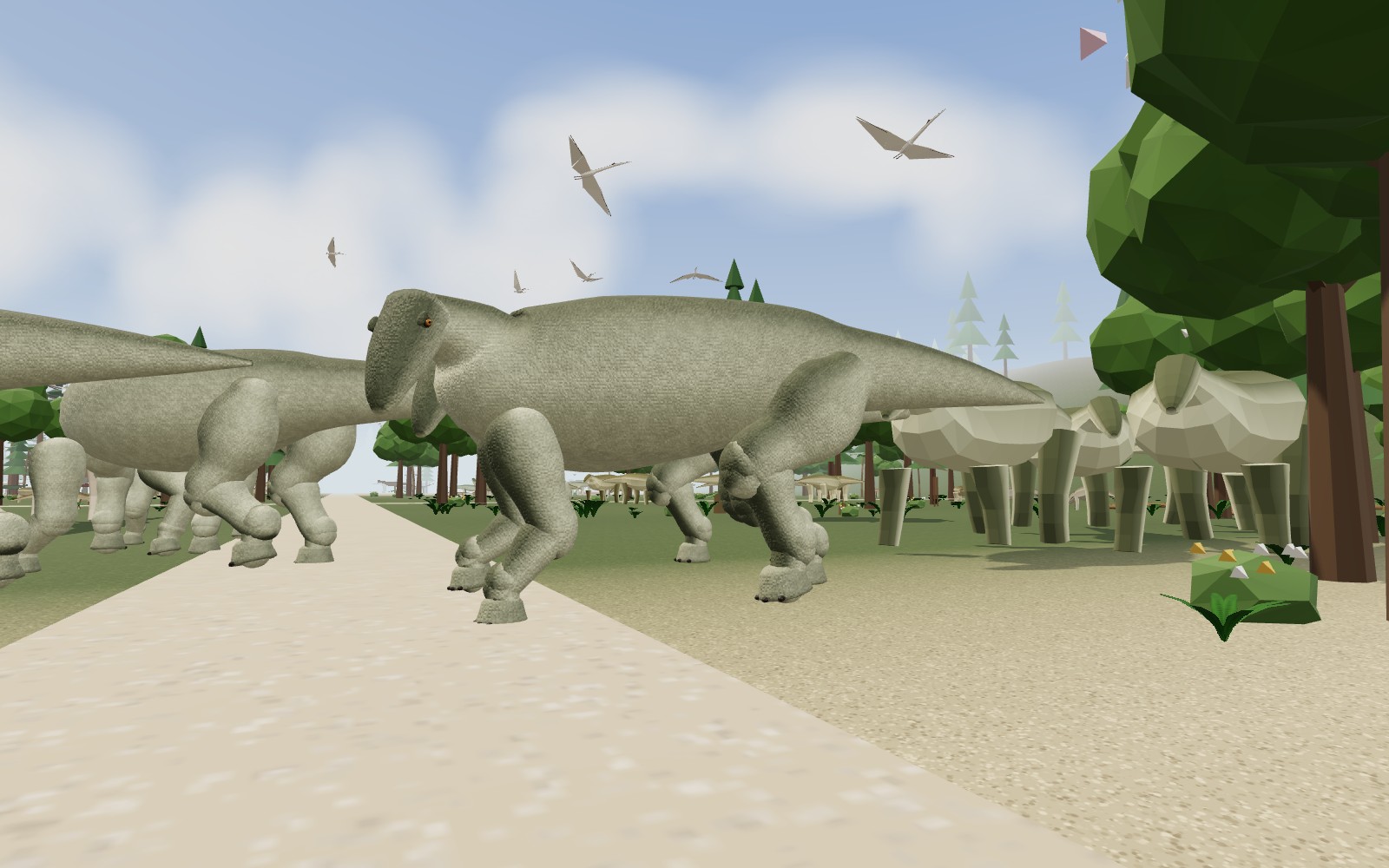
Dinosaur size comparison to humans: 172 life-size animals
A 600 m park of 172 prehistoric animals at their real size, from the first dinosaurs to T. rex, laid out by age.
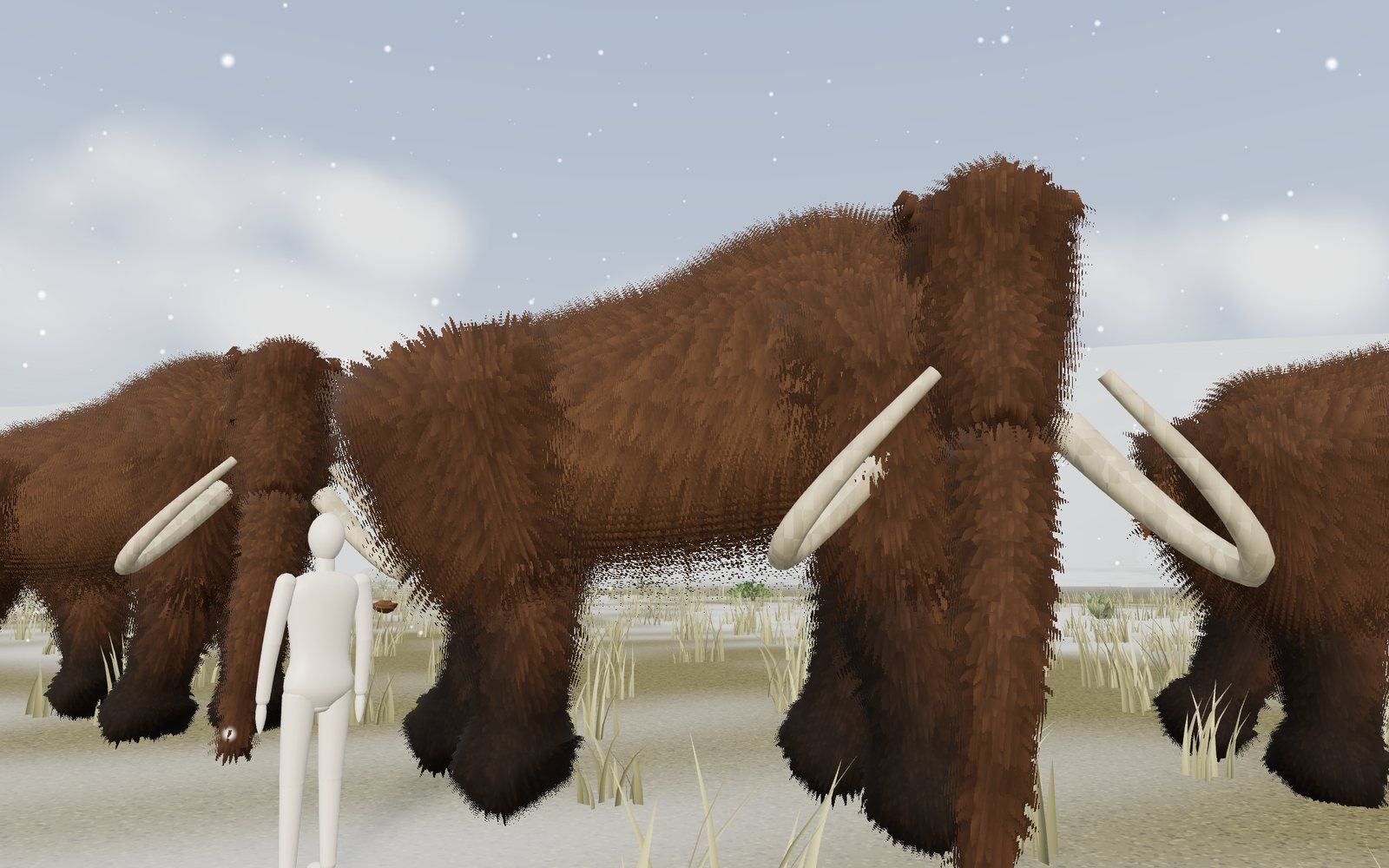
Walk among ice age animals
A 600 m park of 65 animals from the last ice age at their real size, from woolly mammoths to sabre-toothed cats, on a time slider that runs 50,000 years.
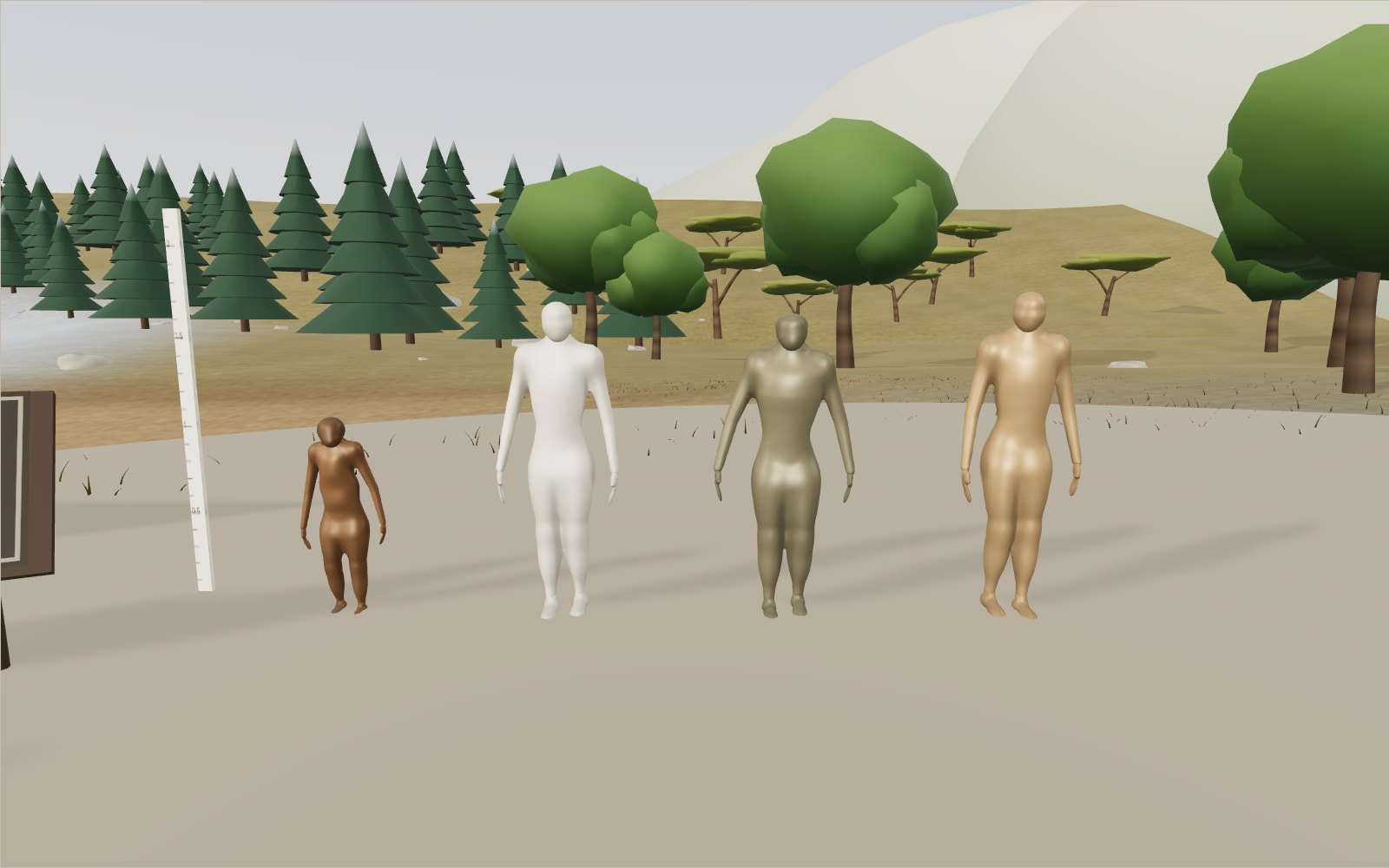
Human evolution walk
Lucy stood about 1.1 m tall. Walk 7 million years of human relatives at their real size, with yourself beside them.
How a pendulum clock works, and why its length sets the time
A pendulum clock counts seconds with one rod 99.4 cm long. Change its length, its temperature and its place on Earth, swap four escapements and see how many seconds a day each costs.
How windmills and watermills work
The sails of a Dutch mill are as wide as an eight-storey building is tall, and at 7 m/s they still take only about a fifth of the wind.
How does a vending machine recognise coins?
A 100 won coin is not attracted to a magnet, yet the magnet inside a vending machine is what tells it from a copper fake.
Fly with life-size pterosaurs
Quetzalcoatlus spanned about 10 m, close to the 11 m wing of a Cessna 172, and standing it was as tall as a giraffe. Watch it pass over a Cretaceous cliff, then fly with 35 pterosaurs from three ages.
Walk down the Grand Canyon rock layers
Walk 1,360 m down the Bright Angel Trail through 13 rock layers, from a 270-million-year-old sea floor on the rim to 1.75-billion-year-old schist by the river.
How a steam locomotive works
Mallard's driving wheels are 2.03 m across, taller than most people, and at its record 126 mph they turned almost nine times a second.
Walk through Machu Picchu
Most of the work that holds Machu Picchu on its ridge, 60 per cent by one estimate, lies under the ground in foundations and drains nobody sees.
Walk through the Terracotta Army
Pit 1 of the Terracotta Army is 230 m long and holds an estimated 6,000 figures and horses, and every one of them was painted once.
How a phonograph works: from tinfoil to cassette and CD
Edison's first phonograph cut a voice into tinfoil in 1877, and the same needle played it back from a groove 2.54 mm apart.