FIG. 92Walk-throughs
Fly with life-size pterosaurs
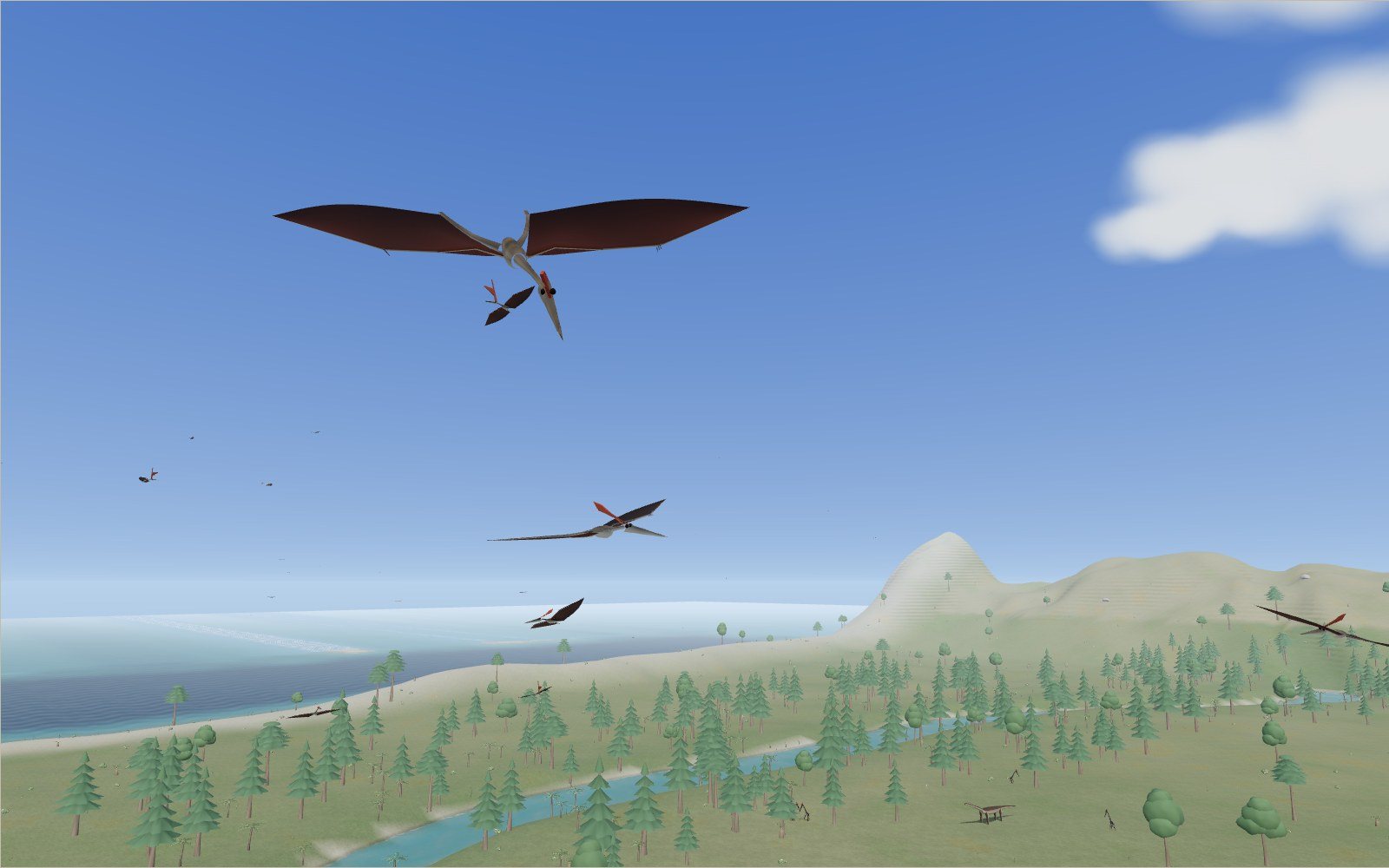
Quetzalcoatlus spanned about 10 m, close to the 11 m wing of a Cessna 172, and standing it was as tall as a giraffe. Watch it pass over a Cretaceous cliff, then fly with 35 pterosaurs from three ages.
This device cannot show the 3D model. You can read the guide steps below as text.
1 / 16 A shadow over the cliffYou stand on a sandstone cliff 70 m above a river plain, late in the Cretaceous. Wait a few seconds and look up: a Quetzalcoatlus glides over your head and its shadow crosses the ground. Walk with WASD, drag to look.
Drag to turn. Scroll or pinch to zoom.
Standing under Quetzalcoatlus
Picture a light aircraft gliding over your head with its engine off, low enough that its shadow runs across the ground at your feet. Now give it a long neck, a beak as long as a person, and skin for wings. That is roughly what a Quetzalcoatlus northropi looked like from below, about 70 million years ago in what is now Texas. Its wingspan was about 10 to 11 m, and a Cessna 172, the most common light aircraft in the world, has a wing of 11.0 m.
This exhibit starts on a sandstone cliff above a river plain at the end of the Cretaceous. Wait a few seconds and one of these animals comes over the cliff behind you, passes about 9 m above your head and glides down into the valley. Its shadow crosses the ground in front of you first. After that the sky is yours: walk along the cliff, look at the animals on the ground, then pick any of 35 pterosaurs and fly with it.
There are three areas, one for each period of the Mesozoic: a Late Triassic shore with the first pterosaurs, a Jurassic lagoon like the one at Solnhofen in Germany, and the Cretaceous cliffs with a sea coast, a lake and the giants. Each area mixes animals from different places to fit them into one landscape, and each animal's card in the field guide gives its real place and age. The ages come from the Paleobiology Database (PBDB), which collects fossil records from the published literature. Every size is an estimate, and where the sources disagree the card says so.
Pterosaurs are not dinosaurs
Museums, films and toy boxes put pterosaurs next to dinosaurs, and many people call them "flying dinosaurs". They were neither dinosaurs nor the ancestors of birds. Pterosaurs and dinosaurs are two separate branches that share a common ancestor, a little like cousins.
Both branches belong to the archosaurs, the group that also includes crocodiles. Early in the Triassic the archosaurs split into two lines. One led to crocodiles and their relatives. The other, often called the bird line, led to dinosaurs (birds included) and to pterosaurs. Inside the bird line, pterosaurs went one way and dinosaurs another.
For a long time nobody knew which animals were the closest relatives of pterosaurs. The oldest pterosaurs, about 215 million years old, already had complete wings, and nothing with half a wing has been found. In 2020 two studies pointed to the lagerpetids, small and lightly built Triassic reptiles that ran on their hind legs. Ezcurra and colleagues compared skulls, braincases and limbs and found that lagerpetids share many features with pterosaurs, including some in the brain and inner ear that had been thought to come with flight. The same year Kammerer and colleagues described Kongonaphon kely from Madagascar, a lagerpetid about 10 cm tall. Lagerpetids could not fly. The new idea is that the pterosaur body plan started on the ground, in small, agile animals.
In the exhibit Kongonaphon stands on a rock in the Triassic wood. The family tree in the field guide shows where each group sits. Archaeopteryx walks on a Jurassic island among the pterosaurs: it is a bird, and birds are dinosaurs, so it is closer to Tyrannosaurus than to any pterosaur.
A wing on one finger
Bats and pterosaurs both fly on skin, but they hold it up in different ways. A bat spreads four long fingers through its wing like the ribs of an umbrella. A pterosaur hung each wing from a single finger, the fourth, which was enormously long. The Natural History Museum in London notes that this finger could be longer than the bones of the forearm. The other three fingers stayed short, with claws, and made a usable hand for walking and climbing.
The main wing membrane, the brachiopatagium, ran from the tip of the wing finger back to the body and down to the ankle. In front of the arm, a smaller membrane, the propatagium, stretched from the shoulder to the wrist. A small bone found only in pterosaurs, the pteroid, braced its front edge. In long-tailed early forms another membrane spread between the legs and the base of the tail.
Skin alone would flutter like a flag. The membranes were stiffened by thin fibres called actinofibrils. In 2010 Kellner and colleagues studied a Jeholopterus from China whose wing membrane is unusually well kept, and found at least three layers of actinofibrils. The fibres in each layer run parallel to each other, but each layer runs in its own direction. In the exhibit you can see the fibres as fine lines in the membranes on the highest quality setting, and they glow when the sun is behind the wing, because thin skin lets light through.
Pterosaur bones were mostly hollow and filled with air, like the bones of birds, so a large animal could stay light. The walls were thin and the bones wide, which made them stiff for their weight.
How big were they?
Pterosaurs came in a range of sizes that no other flying group has matched. The University of California Museum of Paleontology describes them as ranging "from the size of a sparrow to the size of an airplane". In this exhibit the smallest are the early pterosaurs of the Triassic and the insect hunters such as Anurognathus, about the size of a crow or smaller. The largest are the azhdarchids of the Late Cretaceous.
Here are some wingspans from the field guide, all estimates, each with the source that gives it:
- Dimorphodon and its family: 0.6 to 1.3 m (Witton and Habib 2010).
- Kryptodrakon: about 1.4 m (Andres and colleagues 2014).
- Rhamphorhynchus: up to 1.8 m, the largest specimen at the Natural History Museum.
- Caiuajara: 0.65 to 2.35 m, from young to adult (Manzig and colleagues 2014).
- Alanqa: mostly 3 to 4 m, perhaps up to 6 m (Ibrahim and colleagues 2010).
- Hamipterus: over 3.5 m for adults (Wang and colleagues 2017, as reported by CORDIS).
- Pteranodon: some 20 to 25 feet, about 6.1 to 7.6 m (UCMP).
- Tropeognathus: about 8.3 m, the largest known from the southern continents (Kellner and colleagues 2013).
- Quetzalcoatlus northropi: about 10 to 11 m (Witton and Habib 2010).
For the smaller species without a published figure in these sources, the card marks the wingspan as a model value.
Why "about"? Because no giant pterosaur is known from a complete skeleton. Quetzalcoatlus northropi is known from little more than one wing: a complete upper arm bone 544 mm long and pieces of the rest of the wing. Its size comes from scaling it to Quetzalcoatlus lawsoni, a smaller species from the same rocks known from many bones. Hatzegopteryx from Romania was given a wingspan of 10 to 12 m from a broken upper arm bone, but Witton and Habib (2010) showed that the bone had been crushed, which made it look wider than it was. Arambourgiania from Jordan is known mainly from one neck bone almost a metre long, and published estimates of its wingspan range from 7 to 13 m.
Weight is even harder. Over the years the largest pterosaurs have been given masses from under 100 kg to over 500 kg. Witton and Habib reviewed the methods and concluded that wingspans of 10 to 11 m and masses of 200 to 250 kg are the most reliable upper estimates. For a Pteranodon with a 7 m wingspan they give 25 to 50 kg. For most of the smaller species in the field guide, the sources used here do not give a mass at all, and the cards say so instead of inventing a number.
As tall as a giraffe
On the ground the giants looked very different from their flying silhouettes. The Natural History Museum gives the shoulder height of Quetzalcoatlus as about 2.5 m, against 2.75 m for an adult giraffe, and adds that with the long neck and large head raised the two were practically the same height. The African Wildlife Foundation gives a giraffe's height to the tip of its horns as 5.7 m. The pterosaur, though, weighed around a quarter of a tonne, against more than a tonne for a giraffe.
The line-up on the cliff top puts four things side by side at real size: a plain mannequin 1.7 m tall, with no face so that it reads as a size marker, a flat giraffe board 5.7 m tall, a standing pterosaur (Quetzalcoatlus unless you choose another in the Sizes panel) and a Cessna 172, which Textron Aviation lists as 11.0 m across the wing, 8.3 m long and 2.7 m high. Walk between them. The pterosaur's head sits higher than the aircraft's wing.
The Sizes panel also asks for your height. Type it in and the person in the line-up changes to your height, and the panel works out how many times your height the wingspan is. For a visitor 1.7 m tall, a 10.5 m wing is 10.5 / 1.7 = 6.2 times as wide. Since a person's arm span is close to their height, that is about six people standing in a row with their arms out.
How the giants took off
A bird takes off with its legs: it jumps, or runs, and then flaps. For a long time people assumed pterosaurs did the same. If they did, the giants had a problem. Take-off gets harder as birds get heavier, and the heaviest flying birds struggle to get airborne. Some studies used that comparison to argue that the largest pterosaurs must have been extremely light, or must have needed downhill runs and headwinds, or could not fly at all.
Habib (2008) looked at the bones instead. In birds, which launch on their hind legs, the thigh bone is relatively strong. In pterosaurs the upper arm bone is far stronger than the thigh bone, much more than in any bird. He proposed that pterosaurs vaulted into the air on all fours: crouch on the folded wings and the feet, push off hard with the arms, and open the wings at the top of the jump. Vampire bats take off from the ground this way. Witton and Habib (2010) argued that with this launch a 200 to 250 kg animal with a 10 m wingspan could take off from a standing start without a slope or a headwind.
In 2021 a set of studies of the Quetzalcoatlus fossils, published by the Society of Vertebrate Paleontology, proposed something different. According to the University of Texas, the authors think the giant leaped with its hind legs, jumping at least 8 ft (about 2.4 m) into the air, and then swept its wings down. The two ideas disagree on which limbs did the work, but both reject the old picture of a giant running along the ground like an albatross.
Nobody has watched a pterosaur take off, so all three are hypotheses, and researchers still disagree. When you open the Take-off panel, a Quetzalcoatlus on the cliff top acts out the first one in 3D. It crouches on its folded wings and feet, pushes off mostly with its arms, opens its wings at the top of the jump and flaps out over the valley. The panel names each phase as it happens, replays it in slow motion and labels the scene as a hypothesis. The timings and heights of the animation are model values, not measurements; a rod 3 m tall, striped every 50 cm, stands beside the animal for scale. The other two ideas are described in the panel.
Riding warm air and wind up the cliffs
Large flying animals today rarely flap for long. Vultures, storks and eagles climb in thermals, columns of warm air that rise over sunlit ground, and glide from one column to the next. Seabirds and gliders use the wind deflected upwards by cliffs and slopes. Big pterosaurs very probably did the same. Witton and Habib (2010) modelled the flight of Quetzalcoatlus and found that a short burst of flapping after take-off would carry it about a kilometre to the nearest source of rising air, after which it could soar.
In the exhibit you can try it. Choose a pterosaur, take off from where you stand, and fly. A and D bank and turn, W dives, S pulls up and Space flaps. Flapping uses up a strength bar that refills slowly while you glide, so you cannot flap forever. On the Cretaceous map, thermals rise over the plain, the lake shore and the dunes, and each one has a cumulus cloud on top, as real thermals often do. Turn on Show warm air to see them as pale orange columns. Wind blowing against the cliff gives lift along the cliff face too, and the Wind slider changes how strong it is.
The flight is a simple glider model, and the numbers in the readout are model values. Gliding always loses height: the faster a glider flies, the more drag it has, and the slower it flies, the more lift it needs. A standard way to write this is a sink rate s that depends on air speed V:
s = aV³ + c / V
The first term grows with speed (drag), the second grows as the glider slows down (the effort of holding itself up). The lowest sink rate comes at a speed V_ms where the two balance, and at that point s is four times the first term. The model sets V_ms and the lowest sink rate from the wingspan: for a 10.5 m Quetzalcoatlus, V_ms = 6.5 + 1.05 × 10.5 = 17.5 m/s and the lowest sink rate is 0.5 + 0.05 × 10.5 = 1.0 m/s. For a 6.5 m Pteranodon the same formulas give 13.3 m/s and 0.83 m/s.
These are reasonable shapes, not measurements. Witton and Habib calculated a best glide speed of 24.9 m/s and a minimum sink speed of 16.3 m/s for Quetzalcoatlus with a broad wing, and 13.3 m/s and 8.80 m/s with a narrow wing. The model sits inside that range. Banking costs height (the sink rate divides by the cosine of the bank angle), speed can be traded for height (a dive builds speed, a pull-up turns it back into height), and the Wing sweep slider folds the wings back for a faster, steeper glide.
A challenge asks you to gain 100 m in a thermal without much flapping. Circle tightly inside the column and watch the climb figure turn positive.
Three ages in one exhibit
Pterosaurs lived for about 150 million years, from the Late Triassic to the end of the Cretaceous, 66 million years ago. That is long enough for the sky to change completely, so the exhibit has one area for each period.
The Triassic shore. The Natural History Museum puts the first pterosaurs in the fossil record about 215 million years ago. All the Triassic pterosaurs in the field guide come from the Alps region: Eudimorphodon, Peteinosaurus, Preondactylus and Carniadactylus from northern Italy, Austriadactylus from Austria and Raeticodactylus from Switzerland. PBDB dates them to the Norian and Rhaetian stages, about 215 to 201 million years ago. They are small, with long tails, short necks and big heads. Eudimorphodon had teeth with several points each, and Austriadactylus and Raeticodactylus already had crests. Plateosaurus and Procompsognathus, two early dinosaurs, walk on the shore.
The Jurassic lagoon. At Solnhofen in Bavaria, about 150 million years ago, a warm and shallow lagoon laid down limestone so fine that it kept the outlines of wing membranes. The Jurassic area is modelled on it, with low islands and turquoise water. Rhamphorhynchus catches fish over the water, Pterodactylus and Germanodactylus walk on the islands, Ctenochasma wades and sieves, and tiny Anurognathus hunts insects. Older Jurassic species are shown here too: Dimorphodon from Lyme Regis in England, about 200 million years old, and Dorygnathus from Germany. Darwinopterus, Kryptodrakon and Jeholopterus come from China.
The Cretaceous. By the Cretaceous the long-tailed forms had gone, and the short-tailed pterodactyloids had spread into every kind of habitat. Kryptodrakon, from rocks about 161 million years old in China, is the oldest pterodactyloid known, and Andres, Clark and Xu (2014) used it to argue that the group began inland, not at sea. The Cretaceous area is the largest in the exhibit: a cliff over a river plain with Quetzalcoatlus and Alamosaurus, a sea coast with Pteranodon and Nyctosaurus, a lake with a Hamipterus colony and the Haenam tracksite, a lagoon with the crested pterosaurs of Brazil, and dunes in the far south-west.
Crests
Crests appear early, and by the Cretaceous they had become spectacular. The Natural History Museum explains that a short bony crest often carried a much larger crest of soft tissue, which rarely fossilises.
- Pteranodon had a long, backswept bony crest. In Hamipterus, known from hundreds of individuals, the crests differ between males and females (Wang and colleagues 2014), which supports the idea that crests were signals. The Natural History Museum adds that pigment cells have been reported in crests, although scientists are not sure the colours can be read reliably.
- Nyctosaurus adults could carry a crest shaped like a pair of antlers, much taller than the skull.
- Tupandactylus had a sail of soft tissue far bigger than its skull. Its smaller relative Tapejara had a tall crest too.
- Thalassodromeus carried a crest from the tip of its snout over the back of its head.
- Anhanguera and Tropeognathus had rounded crests at the tips of their jaws, which may have helped them cut through the water while fishing.
- Ikrandraco had a blade-like crest under its lower jaw, with a hook at the back.
The challenge "Largest crest" asks which pterosaur had the biggest crest for the size of its head.
What they ate
Pterosaur jaws are as varied as bird beaks, and their diets were as varied.
Many caught fish. Rhamphorhynchus had long, forward-pointing teeth for grabbing slippery prey, and the Natural History Museum describes the toothy jaws of Anhanguera in the same way. Fish-eaters did not need teeth: Pteranodon was toothless (the name means "wing without teeth"), and specimens have been found with fish remains in the stomach.
Some filtered their food. Pterodaustro from Argentina had about a thousand bristle-like teeth in its lower jaw and probably fed like a flamingo, sweeping the jaws through the water. Ctenochasma had a comb of fine teeth for the same job. Dsungaripterus had jaws that turned up at the tip like tweezers and blunt teeth further back, perhaps for crushing shellfish. Anurognathus and its relatives, with short wide heads and big eyes, probably caught insects in flight.
The diet of the tapejarids is debated. Their short, toothless, downturned beaks have led some researchers to suggest they ate fruit, which would make them unusual among pterosaurs. The field guide lists them as "mixed, perhaps fruit".
The azhdarchids, including Quetzalcoatlus, were once pictured skimming fish from the surface of the sea with the lower jaw, like the bird called a skimmer. Witton and Naish (2008) argued against it: the neck could not bend enough, and the jaws lack the shock-absorbing build that skimmers need. They suggested the azhdarchids were "terrestrial stalkers", walking on all fours and picking up small animals from the ground, rather like storks and ground hornbills. The 2021 studies of Quetzalcoatlus compare it with herons. In the exhibit the azhdarchids walk about the plain on all four limbs, and only one of each kind is in the air. Walk up to a group and they take off with the same four-limbed vault, fly a round and land again.
Fuzz, feathers and colour
Many pterosaur fossils show a covering of short, hair-like fibres called pycnofibres. UCMP notes that such a covering could mean pterosaurs made their own body heat, as birds and mammals do. What the fibres were is a live question.
In 2019 Yang and colleagues described pterosaur fibres from China with several kinds of branching, some similar to simple feathers, and argued that feathers began in the common ancestor of dinosaurs and pterosaurs. In 2020 Unwin and Martill replied that the branching could come from fibres lying on top of each other in the rock, and that pterosaurs had no feathers. In 2022 Cincotta and colleagues described a Tupandactylus head from Brazil with branched fibres on the crest that hold melanosomes, the tiny bodies that carry pigment, in several different shapes. Since melanosome shape is linked to colour in living birds, they suggested the crest was coloured for display.
The exhibit gives its pterosaurs short fuzz on the high-quality setting (a soft sheen on the body), and leaves the question open in the card called Fuzz. The colours themselves are guesses: no fossil gives the colour of a whole pterosaur.
Eggs, colonies and babies
For a long time pterosaur eggs were almost unknown. Then two sites changed that.
In 2004 Chiappe and colleagues described an egg of Pterodaustro from Argentina with an embryo still folded inside. Its wing bones were already long.
In 2014 Wang and colleagues described Hamipterus tianshanensis from the Turpan-Hami Basin in Xinjiang, China: many males and females preserved in three dimensions, and five eggs. A later study, published in Science in 2017 and summarised by the European Commission's CORDIS service, reported 215 eggs, 16 of them with parts of embryos, and adults with wingspans over 3.5 m. The researchers called the site "Pterosaur Eden" and estimated that up to 300 eggs might be there. The eggs were soft-shelled, probably buried in sand, and the embryos' legs were further developed than their wings. The researchers concluded that hatchlings could walk but not fly, and needed care. A 2021 study by Naish, Witton and Martin-Silverstone came to the opposite conclusion from the bones of hatchlings of other species: their wing bones were strong enough for powered flight. The two results may apply to different species, and the question is open.
Pterosaurs that lived in groups also turn up in Brazil. Manzig and colleagues (2014) found a bone bed in rocks that formed in an ancient desert with at least 47 individuals of Caiuajara, with wingspans from 0.65 to 2.35 m. Young animals and adults died together by a desert lake, which suggests they lived in colonies.
In the exhibit the Hamipterus colony stands on the north shore of the lake, with a clutch of eggs half buried in the sand. A Caiuajara bone bed lies in the dunes.
Footprints at Haenam
Bones show what a pterosaur looked like. Footprints show how it moved. One of the most important pterosaur tracksites in the world is on the south-west coast of Korea, at Uhangri in Haenam.
In 2002 Hwang and colleagues described pterosaur tracks from the Late Cretaceous Uhangri Formation and named them Haenamichnus uhangriensis. A name like this belongs to the footprints, not to a species of animal; it is called an ichnotaxon. These were the first pterosaur tracks reported from Asia, and they are the largest pterosaur tracks known, five to six times larger than those of the common track type Pteraichnus. One trackway runs 7.3 m with 14 pairs of prints, the longest pterosaur trackway known from any site.
The prints show a three-fingered hand placed outside the long, narrow print of the foot, which tells us the animal walked on all four limbs with its wings folded up. The foot left the whole sole on the ground. Witton and Naish (2008) note that the hind foot prints reach 35 cm and that no other pterosaurs of that time were large enough to make them, so the trackmaker was very probably an azhdarchid. Using Zhejiangopterus as a template, they estimate it stood almost 3 m at the shoulder and had a wingspan of over 10 m.
At Uhangri the pterosaur tracks lie on the same rock surface as dinosaur tracks and the tracks of web-footed birds. That was the first time all three had been found together, and it shows they used the same lake shore. The exhibit puts a copy of the long trackway on the mudflat by the lake. Another Korean site, Hwasun Seoyuri, has many small pterosaur prints of different sizes in one place; Jung and colleagues (2022) estimate wingspans of 0.54 to 1.48 m and read the site as a group of young and adult animals together.
Living beside dinosaurs
Pterosaurs shared their world with dinosaurs, marine reptiles and early birds, and the exhibit puts several of them on the ground or in the water.
In Big Bend National Park in Texas, the U.S. National Park Service describes both Quetzalcoatlus and the long-necked sauropod Alamosaurus from the same Cretaceous floodplains. In the exhibit two Alamosaurus walk on the plain near a pair of Quetzalcoatlus. Pteranodon fished over the sea that covered the middle of North America, where mosasaurs such as Tylosaurus and long-necked plesiosaurs such as Elasmosaurus lived; both swim off the coast in the exhibit.
In the Solnhofen lagoon, Archaeopteryx and the small dinosaur Compsognathus lived with Rhamphorhynchus and Pterodactylus. Not every meeting was friendly. Frey and Tischlinger (2012) describe five Solnhofen fossils in which a Rhamphorhynchus lies against the snout of a large fish, Aspidorhynchus. In one the pterosaur still has a small fish in its throat. They think the fish grabbed the pterosaur as it dipped for food, the wing membrane snagged on the fish's teeth, and both died. A slab with this scene lies on the Jurassic beach.
How pterosaurs were found
The Natural History Museum tells the story. In 1784 a small skeleton from the Solnhofen limestone was described, the first pterosaur known to science. It was later named Ptéro-dactyle, "wing finger", and that is why pterosaurs are still often called pterodactyls. PBDB credits the name Pterodactylus to Cuvier in 1809.
In December 1828 Mary Anning, the fossil collector of Lyme Regis, dug a jumble of bones with wings and a long tail out of the cliffs. It is now called Dimorphodon, and it was the first pterosaur found outside Germany. The museum still displays it.
The giants came much later. Pteranodon was named in 1876. Quetzalcoatlus was found in 1971 by Douglas Lawson, then a 22-year-old geology student at the University of Texas, in Big Bend National Park, and named in 1975. Some of the most important discoveries are very recent: the Hamipterus eggs (2014 and 2017), the lagerpetid link (2020) and the feathered crest of Tupandactylus (2022).
Brains built for flying
Witmer and colleagues (2003) made digital casts of the inside of two pterosaur skulls with CT scans. The brains were smaller for the body than those of birds, but the parts linked to balance and vision were well developed. The semicircular canals of the inner ear were large, and the flocculus, a part of the brain that steadies the eyes and the neck, was enormous. The authors suggest it may have handled signals from the wing membrane. A Pteranodon skull cast on the cliff top near the start opens this card.
The end of the pterosaurs
Pterosaurs lived until the end of the Cretaceous, 66 million years ago. The Natural History Museum notes that their extinction coincides with the asteroid impact that also ended the non-bird dinosaurs. Birds were small at the time and do not seem to have competed with the largest pterosaurs, so birds probably did not drive them out. After the extinction, birds were left as the only flying vertebrates apart from bats, which appeared later.
How the model differs from real pterosaurs
The exhibit is a reconstruction, and several parts of it are choices rather than facts:
- Places are mixed. Each area combines animals from different countries and from several million years. The cards give the real place and age.
- Ages come from PBDB as first and last appearance in the fossil record, at the level of the species or, where PBDB has no species record, the genus. Some ranges are wide because the age of the rock is uncertain: PBDB dates Caiuajara to 121.4 to 72.2 million years ago.
- Sizes are estimates. Each model is built at the middle of its wingspan range, except Pteranodon (6.5 m), Hatzegopteryx (10 m) and Arambourgiania (10 m), whose upper estimates are disputed. Where none of these sources gives a wingspan, the card calls the figure a model value.
- Colours and patterns are invented. So are the exact crest shapes of the species known only from fragments.
- No sounds were invented. No fossil preserves a pterosaur's voice, so the model plays only wind and wing beats, and only after you switch sound on.
- The flight is a glider model. It is tuned so that big pterosaurs glide fast and sink slowly and small ones turn tightly. Its numbers are model values.
- The standing pose follows the trackways (all four limbs on the ground, wing finger folded up and back), but the exact angles of the neck and legs are simplified.
- The landscape is invented. The Cretaceous cliff is not a real place in Big Bend, and the lagoon is not a map of Solnhofen.
Questions
Are pterosaurs dinosaurs?
No. Pterosaurs and dinosaurs are separate branches of the bird line of archosaurs. Their closest relatives are the lagerpetids, small Triassic reptiles that ran on two legs. Birds are dinosaurs; pterosaurs are not.
Is "pterodactyl" the right name?
Pterodactylus is one genus, the first pterosaur ever described. "Pterodactyl" is an everyday word for any pterosaur, but scientists use "pterosaur" for the whole group.
What was the largest pterosaur?
The largest well-supported estimate is for Quetzalcoatlus northropi, with a wingspan of about 10 to 11 m. Hatzegopteryx and Arambourgiania may have been similar, but their remains are too incomplete to be sure.
How heavy was Quetzalcoatlus?
Witton and Habib (2010) give 200 to 250 kg as the most reliable upper estimate. Older estimates ranged from under 100 kg to over 500 kg.
Could the giants really fly?
Yes, according to most researchers. Their bones were strong enough, and a launch using the powerful forelimbs would have lifted them from a standing start. Studies that concluded they were flightless assumed they took off like birds.
Was Quetzalcoatlus really as tall as a giraffe?
Roughly. The Natural History Museum gives its shoulder height as about 2.5 m and an adult giraffe's as 2.75 m, and with their necks raised the two were practically the same height.
How did pterosaurs walk?
On all four limbs. Trackways such as the one at Haenam in Korea show the hand placed outside the foot and the wing finger folded out of the way. In the exhibit every pterosaur on the ground walks like this, moving left hind, left fore, right hind and right fore a quarter of a stride apart. That order is a model: the trackways show where hands and feet landed, not the timing.
Did pterosaurs have feathers?
That is debated. Many had a covering of hair-like pycnofibres. Some fibres are branched, and a Tupandactylus crest has fibres with pigment granules, which some researchers read as feathers. Others argue they are not feathers.
What colour were pterosaurs?
Nobody knows the colours of a whole pterosaur. The pigment granules in the Tupandactylus crest suggest it was coloured for display, but the colours in this exhibit are invented.
Did pterosaurs lay eggs?
Yes. Eggs with embryos are known from Argentina (Pterodaustro) and China (Hamipterus), where 215 eggs were found. They were soft-shelled and probably buried.
Could baby pterosaurs fly?
Opinions differ. The Hamipterus embryos had legs further developed than their wings, which suggests the young walked first. Hatchlings of other species had wing bones strong enough for flight.
Are there pterosaur fossils in Korea?
Yes, and they are footprints. The Uhangri Formation at Haenam has the largest pterosaur tracks known and the longest pterosaur trackway, 7.3 m with 14 pairs of prints. Hwasun Seoyuri has many smaller prints.
What did pterosaurs eat?
It depended on the species: fish, insects, small animals on the ground, food filtered out of water, and perhaps fruit for the tapejarids.
Why did pterosaurs die out?
They disappear from the fossil record 66 million years ago, at the same time as the asteroid impact that ended the non-bird dinosaurs.
What did pterosaurs sound like?
Nobody knows. Sound leaves no fossil, so the exhibit does not invent a call.
Did pterosaurs carry people or prey in their feet?
There is no evidence for it. Their feet were made for walking flat on the ground, not for grasping, and azhdarchids caught food with the beak.
Terms
- Pterosaur: a flying reptile of the Mesozoic, with wings of skin held up by one long finger.
- Pterodactyloid: a short-tailed pterosaur with a long hand bone; the group that includes all the Cretaceous giants.
- Azhdarchid: a family of pterodactyloids with long, stiff necks and long beaks, including Quetzalcoatlus.
- Lagerpetid: a small Triassic reptile that ran on its hind legs; the closest known relatives of pterosaurs.
- Archosaur: the group that includes crocodiles, dinosaurs (with birds) and pterosaurs.
- Brachiopatagium: the main wing membrane, from the tip of the wing finger to the body and the ankle.
- Propatagium: the membrane in front of the arm, from the shoulder to the wrist.
- Pteroid: a small bone found only in pterosaurs that braced the propatagium.
- Actinofibrils: thin stiffening fibres inside the wing membrane, arranged in layers.
- Pycnofibres: short, hair-like fibres covering the bodies of many pterosaurs.
- Ichnotaxon: a scientific name for a kind of trace fossil, such as a footprint.
- Thermal: a column of warm air rising over sunlit ground.
- Ridge lift: wind deflected upwards where it meets a slope or cliff.
- Sink rate: how fast a glider loses height in still air.
- PBDB: the Paleobiology Database, which collects fossil occurrences and ages from the published literature.
Sources
- The Paleobiology Database (PBDB), taxon records and first and last appearances for each animal in the field guide. https://paleobiodb.org/navigator/ (checked 19 October 2026)
- Witton, M. P. & Habib, M. B. (2010). On the size and flight diversity of giant pterosaurs. PLoS ONE 5: e13982. https://doi.org/10.1371/journal.pone.0013982 (checked 19 October 2026)
- Witton, M. P. & Naish, D. (2008). A reappraisal of azhdarchid pterosaur functional morphology and paleoecology. PLoS ONE 3: e2271. https://doi.org/10.1371/journal.pone.0002271 (checked 19 October 2026)
- Natural History Museum, London. Pterosaurs: the truth about these flying dinosaurs. https://www.nhm.ac.uk/discover/the-truth-about-pterosaurs.html (checked 19 October 2026)
- Natural History Museum, London. Mary Anning: the unsung hero. https://www.nhm.ac.uk/discover/mary-anning-unsung-hero.html (checked 19 October 2026)
- UC Museum of Paleontology. Introduction to the Pterosauria. https://ucmp.berkeley.edu/diapsids/pterosauria.php (checked 19 October 2026)
- Hwang, K.-G., Huh, M., Lockley, M. G., Unwin, D. M. & Wright, J. L. (2002). New pterosaur tracks (Pteraichnidae) from the Late Cretaceous Uhangri Formation, southwestern Korea. Geological Magazine 139: 421-435. https://doi.org/10.1017/S0016756802006647 (checked 19 October 2026)
- Hwang et al. (2002), open copy at Humboldt University Berlin. https://edoc.hu-berlin.de/items/91332efe-c34a-43b8-931f-4df156ab5824 (checked 19 October 2026)
- Jung, J. et al. (2022). Evidence for a mixed-age group in a pterosaur footprint assemblage from the early Upper Cretaceous of Korea. Scientific Reports 12: 10707. https://doi.org/10.1038/s41598-022-14966-5 (checked 19 October 2026)
- Wang, X. et al. (2014). Sexually dimorphic tridimensionally preserved pterosaurs and their eggs from China. Current Biology 24: 1323-1330. https://doi.org/10.1016/j.cub.2014.04.054 (checked 19 October 2026)
- European Commission, CORDIS (2017). Spectacular egg fossil find helps to unlock the secrets of the ancient pterosaurs. https://cordis.europa.eu/article/id/122704-trending-science-spectacular-egg-fossil-find-helps-to-unlock-the-secrets-of-the-ancient-ptero (checked 19 October 2026)
- Chiappe, L. M. et al. (2004). Argentinian unhatched pterosaur fossil. Nature 432: 571-572. https://doi.org/10.1038/432571a (checked 19 October 2026)
- Manzig, P. C. et al. (2014). Discovery of a rare pterosaur bone bed in a Cretaceous desert with insights on ontogeny and behavior of flying reptiles. PLoS ONE 9: e100005. https://doi.org/10.1371/journal.pone.0100005 (checked 19 October 2026)
- Naish, D., Witton, M. P. & Martin-Silverstone, E. (2021). Powered flight in hatchling pterosaurs: evidence from wing form and bone strength. Scientific Reports 11: 13130. https://doi.org/10.1038/s41598-021-92499-z (checked 19 October 2026)
- Yang, Z. et al. (2019). Pterosaur integumentary structures with complex feather-like branching. Nature Ecology & Evolution 3: 24-30. https://doi.org/10.1038/s41559-018-0728-7 (checked 19 October 2026)
- Unwin, D. M. & Martill, D. M. (2020). No protofeathers on pterosaurs. Nature Ecology & Evolution 4: 1590-1591. https://doi.org/10.1038/s41559-020-01308-9 (checked 19 October 2026)
- Cincotta, A. et al. (2022). Pterosaur melanosomes support signalling functions for early feathers. Nature 604: 684-688. https://doi.org/10.1038/s41586-022-04622-3 (checked 19 October 2026)
- Ezcurra, M. D. et al. (2020). Enigmatic dinosaur precursors bridge the gap to the origin of Pterosauria. Nature 588: 445-449. https://doi.org/10.1038/s41586-020-3011-4 (checked 19 October 2026)
- Kammerer, C. F. et al. (2020). A tiny ornithodiran archosaur from the Triassic of Madagascar and the role of miniaturization in dinosaur and pterosaur ancestry. PNAS 117: 17932-17936. PubMed Central copy: https://pmc.ncbi.nlm.nih.gov/articles/PMC7395432/ (checked 19 October 2026)
- Kellner, A. W. A. et al. (2010). The soft tissue of Jeholopterus (Pterosauria, Anurognathidae, Batrachognathinae) and the structure of the pterosaur wing membrane. Proceedings of the Royal Society B 277: 321-329. PubMed Central copy: https://pmc.ncbi.nlm.nih.gov/articles/PMC2842671/ (checked 19 October 2026)
- Habib, M. B. (2008). Comparative evidence for quadrupedal launch in pterosaurs. Zitteliana B28: 159-166 (summarised with figure in Witton & Habib 2010). https://doi.org/10.1371/journal.pone.0013982 (checked 19 October 2026)
- Jackson School of Geosciences, University of Texas at Austin (2021). World's largest pterosaur leaped aloft to fly. https://www.jsg.utexas.edu/news/2021/12/worlds-largest-pterosaur-leaped-aloft-to-fly/ (checked 19 October 2026)
- U.S. National Park Service. Big Bend National Park: Fossils. https://www.nps.gov/bibe/learn/nature/fossils.htm (checked 19 October 2026)
- Andres, B., Clark, J. & Xu, X. (2014). The earliest pterodactyloid and the origin of the group. Current Biology 24: 1011-1016. https://doi.org/10.1016/j.cub.2014.03.030 (checked 19 October 2026)
- Sci.News (2014). Kryptodrakon progenitor: earliest pterodactyloid pterosaur discovered in China. https://www.sci.news/paleontology/science-kryptodrakon-progenitor-earliest-pterodactyloid-pterosaur-china-01879.html (checked 19 October 2026)
- Kellner, A. W. A. et al. (2013). The largest flying reptile from Gondwana: a new specimen of Tropeognathus cf. T. mesembrinus. Anais da Academia Brasileira de Ciências 85: 113-135. https://doi.org/10.1590/S0001-37652013000100009 (checked 19 October 2026)
- Wang, X. et al. (2014). An Early Cretaceous pterosaur with an unusual mandibular crest from China and a potential novel feeding strategy. Scientific Reports 4: 6329. https://doi.org/10.1038/srep06329 (checked 19 October 2026)
- Ibrahim, N. et al. (2010). A new pterosaur (Pterodactyloidea: Azhdarchidae) from the Upper Cretaceous of Morocco. PLoS ONE 5: e10875. https://doi.org/10.1371/journal.pone.0010875 (checked 19 October 2026)
- Frey, E. & Tischlinger, H. (2012). The Late Jurassic pterosaur Rhamphorhynchus, a frequent victim of the ganoid fish Aspidorhynchus? PLoS ONE 7: e31945. https://doi.org/10.1371/journal.pone.0031945 (checked 19 October 2026)
- Witmer, L. M. et al. (2003). Neuroanatomy of flying reptiles and implications for flight, posture and behaviour. Nature 425: 950-953. https://doi.org/10.1038/nature02048 (checked 19 October 2026)
- African Wildlife Foundation. Giraffe. https://www.awf.org/wildlife-conservation/giraffe (checked 19 October 2026)
- San Diego Zoo Wildlife Alliance. Giraffe. https://animals.sandiegozoo.org/animals/giraffe (checked 19 October 2026)
- Textron Aviation. Cessna Skyhawk specifications. https://cessna.txtav.com/en/piston/cessna-skyhawk (checked 19 October 2026)
More exhibits
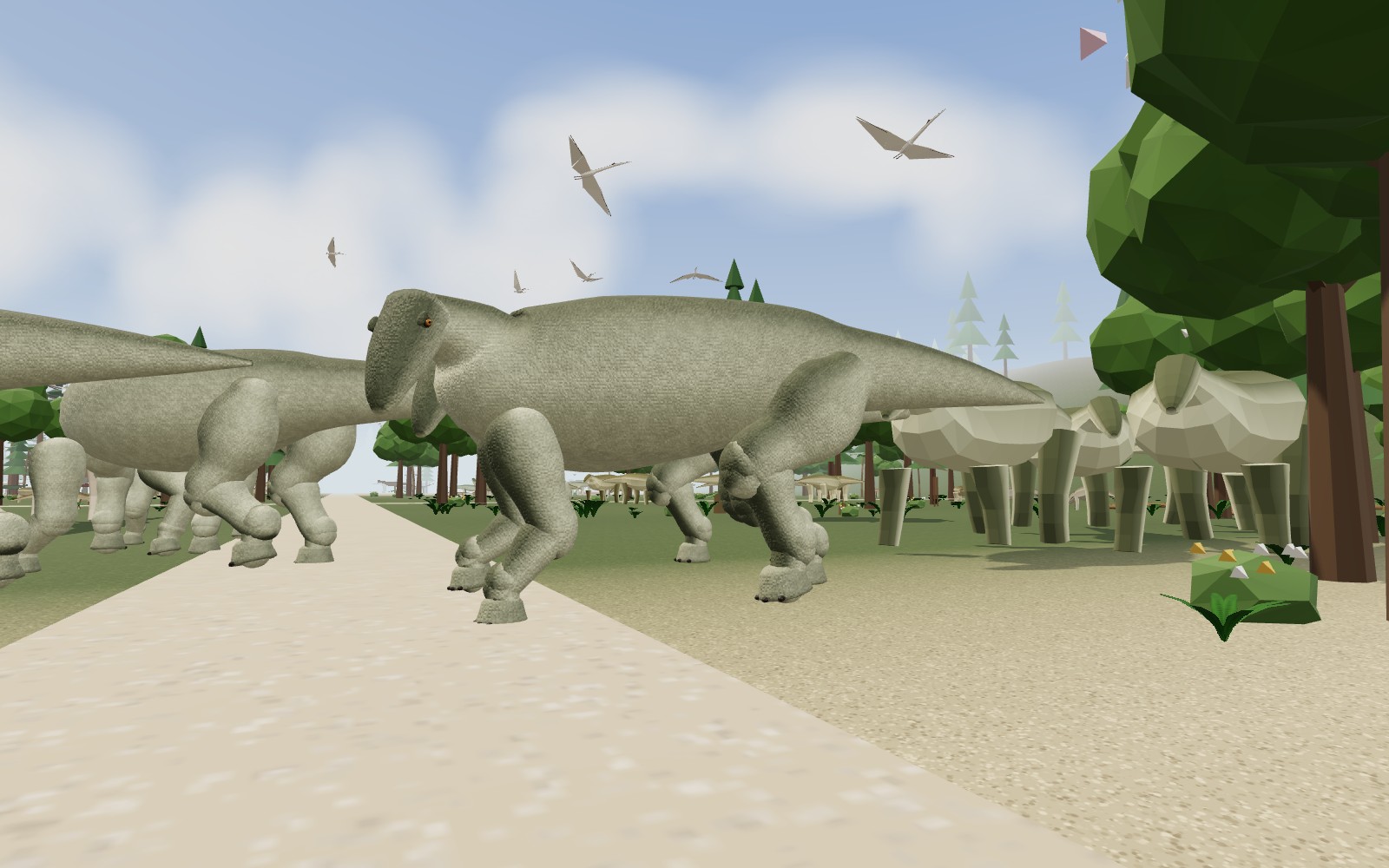
Dinosaur size comparison to humans: 172 life-size animals
A 600 m park of 172 prehistoric animals at their real size, from the first dinosaurs to T. rex, laid out by age.
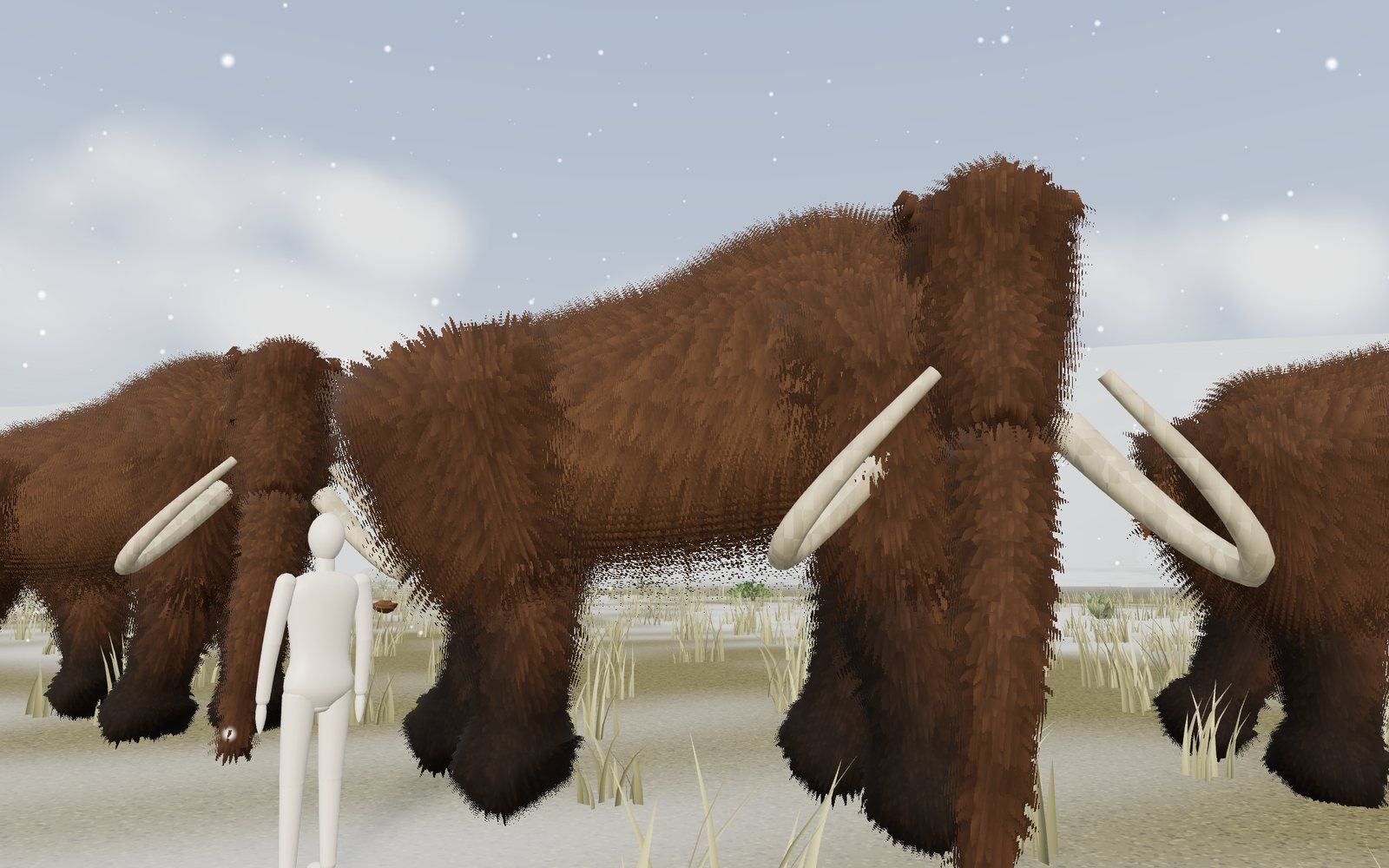
Walk among ice age animals
A 600 m park of 65 animals from the last ice age at their real size, from woolly mammoths to sabre-toothed cats, on a time slider that runs 50,000 years.
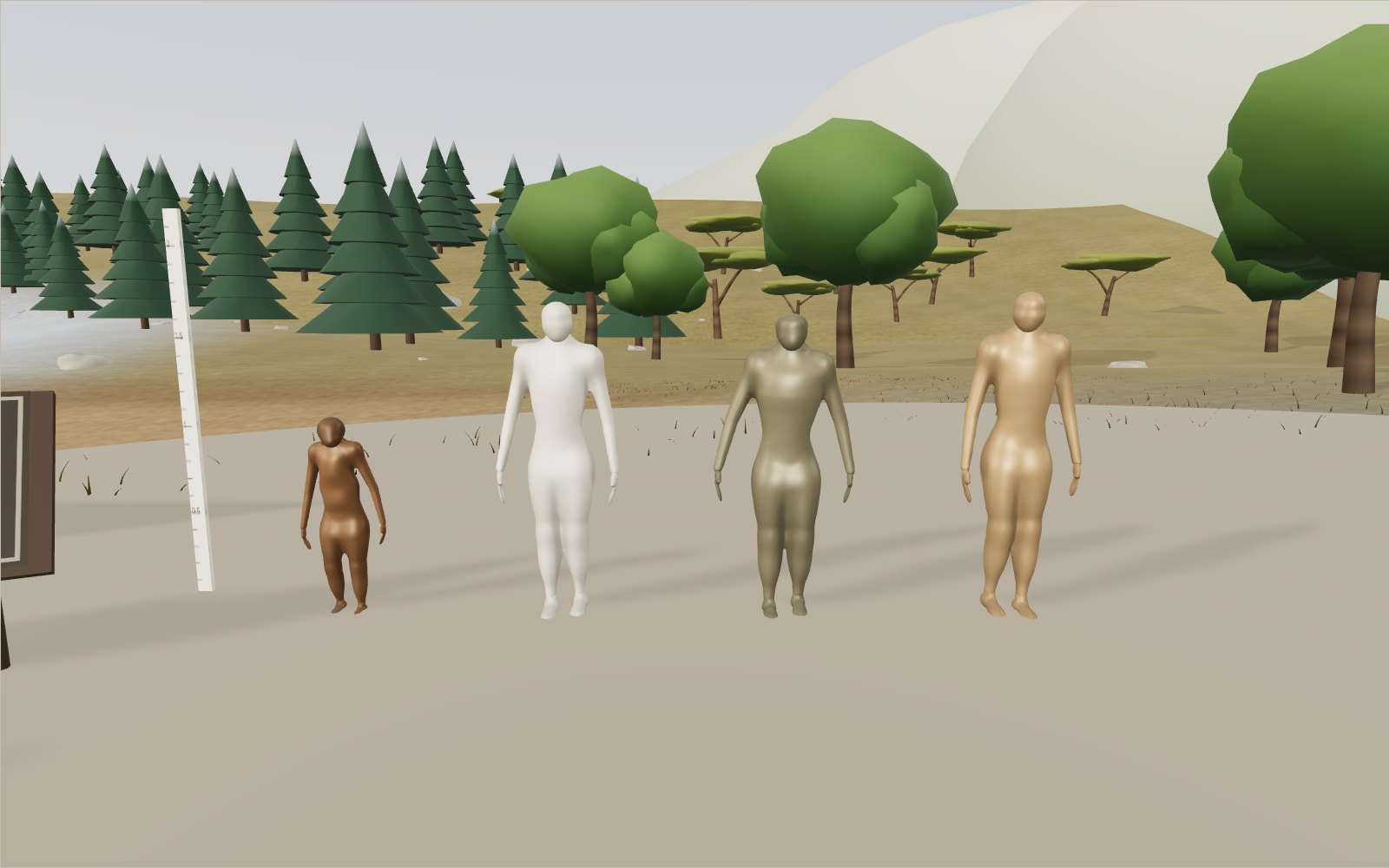
Human evolution walk
Lucy stood about 1.1 m tall. Walk 7 million years of human relatives at their real size, with yourself beside them.
How a horse runs: walk, trot, canter and gallop
In 1878 Muybridge's cameras showed that a galloping horse does lift all four feet at once, but with its legs tucked under it. Some fast animals never leave the ground at all.
How CRISPR-Cas9 gene editing works
A guide RNA reads just 20 letters of DNA, and that is usually enough to pick out one spot among the 3 billion base pairs of a human genome.
How ATP synthase works
In mitochondria the rotor of ATP synthase turns about 100 times a second, and every full turn releases three molecules of ATP.