FIG. 91Walk-throughs
Human evolution walk
Lucy stood about 1.1 m tall. Walk 7 million years of human relatives at their real size, with yourself beside them.
This device cannot show the 3D model. You can read the guide steps below as text.
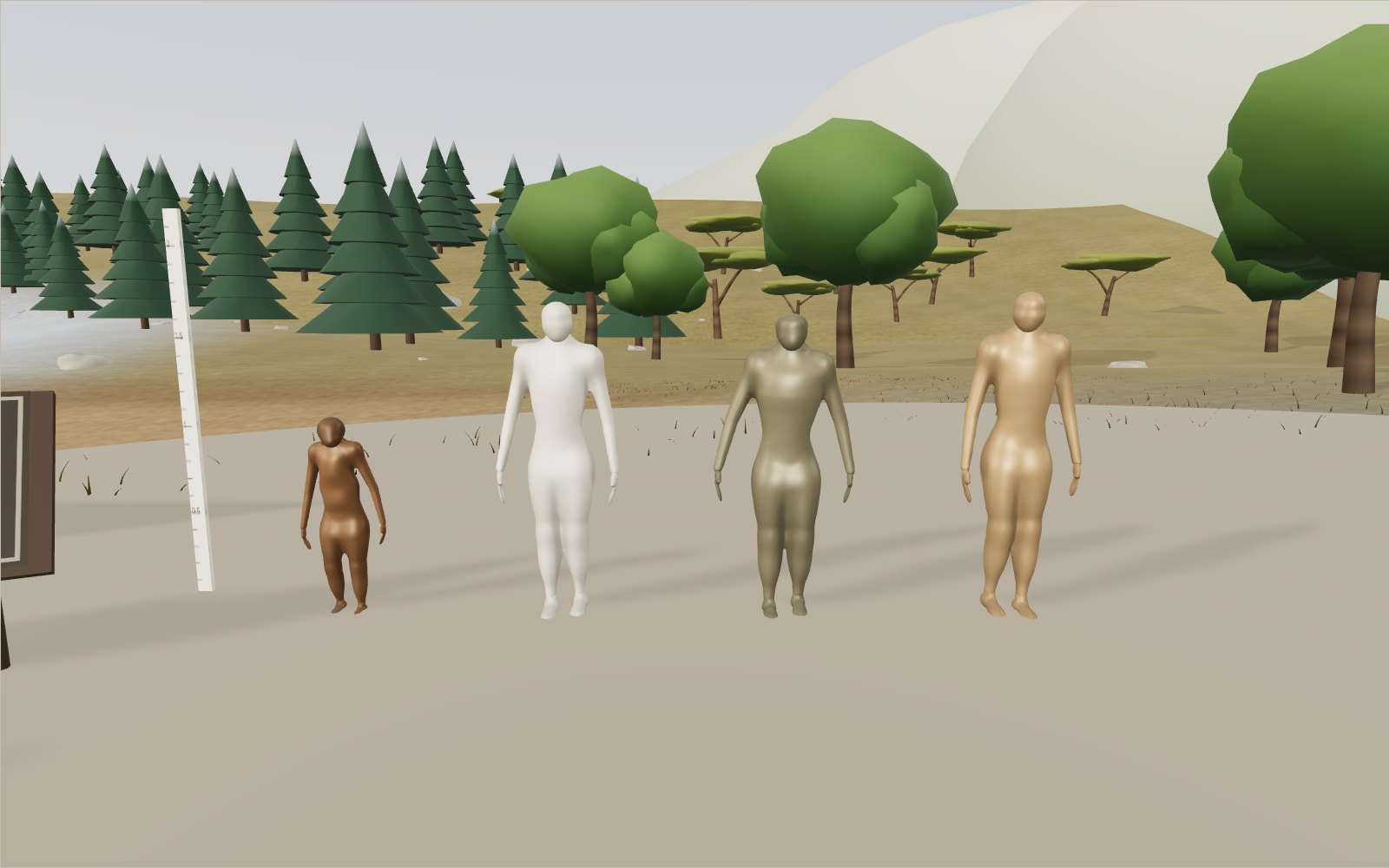
1 / 13 Lucy, you and a NeanderthalThree figures stand at today's end of the time road at their real heights: Lucy at about 1.1 m, you at the height you set, and a Neanderthal man at 1.64 m. The ruler beside them is marked every 10 cm. Walk with WASD or the joystick, look by dragging.
Drag to turn. Scroll or pinch to zoom.
What you are walking through
Museum halls usually show early humans as skulls in glass cases. A skull on a shelf tells you very little about how big its owner was, and almost nothing about how it felt to stand next to them. This exhibit puts 26 species and close relatives of our family on open ground at their real height, and lets you walk past them in the order they lived, from about 7 million years ago to today.
The first thing you see is a line-up at the plaza. Lucy, the best known Australopithecus afarensis skeleton, stands about 1.1 m tall. Beside her is a figure built at your own height (set it in the controls; the page remembers it on this browser), then a Neanderthal man at 1.64 m and a Homo sapiens at 1.75 m. A ruler marked every 10 cm stands at the end of the row. Most visitors are surprised by how small Lucy is and how solid the Neanderthal looks next to them.
From the plaza a road runs west through time. Beside it are thirteen places, each built where and when the fossils were found: the forests of the first upright apes, the East African Rift with the Laetoli footprints, Olduvai Gorge, the South African caves, Asia, Atapuerca in Spain, Jebel Irhoud in Morocco, the Rising Star cave, Denisova Cave in Siberia, the islands of Flores and Luzon, Ice Age Europe and the Bering land bridge.
The figures are sculpted from the proportions of the skeletons: leg length, arm length, the shape of the rib cage, the width of the hips, the size of the braincase. Faces, skin and hair do not fossilise, so the figures are finished as smooth mannequin statues in bronze or plaster, without facial features, and each carries a "reconstruction (estimate)" label. Where a species is known only from a skull or a few teeth, the figure is built at the size of a close relative and its card says so.
How the time road is laid out
Seven million years is hard to picture, and most of the species crowd into the last few hundred thousand of them. If the road used one metre for every 10,000 years, everything from the first Neanderthals to today would fit into 40 m at the end of a 700 m walk. So the scale is uneven. A point on the road sits at a distance of 600 m times the square root of its age divided by 7 million years. Today is at the plaza; 100,000 years ago is 72 m away; 1 million years ago is 227 m away; Lucy's time, 3.2 million years ago, is 406 m away; 7 million years ago is the far end at 600 m.
Posts along the road mark round numbers of years, and the panel in the top left corner tells you where you are and when. On the road it shows the age under your feet; in a place it shows the span of that place. The minimap at the bottom shows the whole road; tap or click it to jump.
Walk with WASD or the arrow keys on a computer, or the joystick on a phone. Drag to look around. Shift runs. The road is long, so the field guide and the minimap both take you straight to a species or a place.
Meeting Lucy at your own height
Lucy was found at Hadar, Ethiopia, in 1974 by Donald Johanson and Maurice Taieb. She lived about 3.2 million years ago and was a grown woman when she died, about 1.1 m tall. The team named her the night she was found, while a Beatles song, "Lucy in the Sky with Diamonds", was playing at their camp. In Ethiopia she is Dinknesh, which means "you are marvelous" in Amharic.
Her species, Australopithecus afarensis, is one of the best known early humans: remains of more than 300 individuals have been found, and it lasted from about 3.85 to 2.95 million years ago, roughly three times as long as our own species has existed so far. The Smithsonian gives average heights of 1.05 m for females and 1.51 m for males, and average weights of 29 kg and 42 kg. That size difference between the sexes is larger than in people today.
Lucy's skeleton shows two ways of living at once. Her short, broad pelvis and her thigh bones, angled in toward the knees, kept her weight over her feet when she walked upright. Her long arms, the strong crest where chest muscles attached to her upper arm and her long, curved toe bones are those of a good climber. The figure here has the funnel-shaped rib cage of australopiths, wider at the bottom than at the top, a short neck and long arms.
Set your height in the controls and the figure beside her changes. Open her card in the field guide and it tells you how much taller or shorter you are than the average for her species, and how many lifetimes the length of your age it would take to reach back to her.
The species, oldest first
Here is every species in the park. Heights are the averages that the Smithsonian or the Australian Museum give, female first where they differ. Brain sizes come from the same sources or from individual skulls, named on each card. Where a source gives no figure the table says "not known" rather than inventing one.
| Species | Lived | Found in | Average height (female–male) | Brain |
|---|---|---|---|---|
| Sahelanthropus (Sahelanthropus tchadensis) | 7 to 6 million years ago | Chad | not known | 350 cm³ |
| Orrorin (Orrorin tugenensis) | 6.2 to 5.8 million years ago | Kenya | not known | not known |
| Ardipithecus kadabba (Ardipithecus kadabba) | 5.8 to 5.2 million years ago | Ethiopia | not known | not known |
| Ardipithecus ramidus (Ardipithecus ramidus) | about 4.4 million years ago | Ethiopia | 1.20 m | 325 cm³ |
| Australopithecus anamensis (Australopithecus anamensis) | 4.2 to 3.8 million years ago | Kenya, Ethiopia | not known | 370 cm³ |
| Australopithecus afarensis (Australopithecus afarensis) | 3.85 to 2.95 million years ago | Ethiopia, Kenya, Tanzania | 1.05–1.51 m | 430 cm³ |
| Kenyanthropus (Kenyanthropus platyops) | 3.5 to 3.2 million years ago | Kenya | not known | 430 cm³ |
| Australopithecus africanus (Australopithecus africanus) | 3.3 to 2.1 million years ago | South Africa | 1.15–1.38 m | 480 cm³ |
| Australopithecus garhi (Australopithecus garhi) | about 2.5 million years ago | Ethiopia | not known | 450 cm³ |
| Australopithecus sediba (Australopithecus sediba) | about 1.98 million years ago | South Africa | 1.30 m | 420 cm³ |
| Paranthropus aethiopicus (Paranthropus aethiopicus) | 2.7 to 2.3 million years ago | Kenya, Ethiopia | not known | 410 cm³ |
| Paranthropus boisei (Paranthropus boisei) | 2.3 to 1.2 million years ago | Ethiopia, Kenya, Tanzania, Malawi | 1.24–1.37 m | 505 cm³ |
| Paranthropus robustus (Paranthropus robustus) | 1.8 to 1.2 million years ago | South Africa | 1.00–1.20 m | not known |
| Homo habilis (Homo habilis) | 2.4 to 1.4 million years ago | Tanzania, Kenya, South Africa | 1.00–1.35 m | 610 cm³ |
| Homo rudolfensis (Homo rudolfensis) | 1.9 to 1.8 million years ago | Kenya | not known | 775 cm³ |
| Homo ergaster (Homo ergaster) | 1.9 to 1.5 million years ago | Kenya | 1.60–1.80 m | 860 cm³ |
| Homo erectus (Homo erectus) | 1.89 million years to 110,000 years ago | Java, China, Kenya, Georgia | 1.45–1.85 m | 1,050 cm³ |
| Homo antecessor (Homo antecessor) | 1.2 million years to 800,000 years ago | Spain | 1.60–1.80 m | 1,000 cm³ |
| Homo heidelbergensis (Homo heidelbergensis) | 700,000 to 200,000 years ago | Germany, Zambia, Europe | 1.57–1.75 m | 1,300 cm³ |
| Neanderthal (Homo neanderthalensis) | 400,000 to 40,000 years ago | Europe, Western Asia, Siberia, Germany, France, Spain | 1.55–1.64 m | 1,500 cm³ |
| Denisovan (Denisovans (no species name yet)) | 500,000 to 30,000 years ago | Siberia, Tibet | not known | not known |
| Homo naledi (Homo naledi) | 335,000 to 236,000 years ago | South Africa | 1.44 m | 560 cm³ |
| Homo floresiensis (Homo floresiensis) | 100,000 to 50,000 years ago | Flores | 1.06 m | 400 cm³ |
| Homo luzonensis (Homo luzonensis) | 67,000 to 50,000 years ago | Luzon | not known | not known |
| Early Homo sapiens (Homo sapiens (Jebel Irhoud)) | 315,000 to 300,000 years ago | Morocco | varies | not known |
| Homo sapiens (Homo sapiens) | 300,000 years ago to today | everywhere | varies | 1,300 cm³ |
Two entries need a note. Homo ergaster is listed apart because the Australian Museum describes it as its own species, while the Smithsonian files the same fossils, including Turkana Boy, under Homo erectus. Denisovans have no species name at all yet: there are too few bones to describe one.
The first upright apes
The oldest part of the road is a forest. Sahelanthropus tchadensis, from the Djurab desert of Chad, is known mainly from one distorted skull, dated to between 7 and 6 million years ago. It had a small brain and a sloping face, like a chimpanzee; the Australian Museum estimates the brain at 320 to 380 cm³. Whether it walked upright is argued. A 2022 study of a thigh bone and two forearm bones from the same site concluded that it did; other researchers read the same bones as those of a climbing ape. The figure here stands upright because that is the claim being tested, and its card carries the disagreement.
Orrorin tugenensis, from the Tugen Hills of Kenya, lived between 6.2 and 5.8 million years ago. Its thigh bones point to walking on two legs, and they are about 1.5 times the size of Lucy's, so the Smithsonian estimates a body of 30 to 50 kg, the size of a female chimpanzee.
Ardipithecus kadabba is known from teeth and a few bones from the Middle Awash of Ethiopia, 5.8 to 5.2 million years old. Its younger relative Ardipithecus ramidus is far better known thanks to "Ardi", a partial female skeleton 4.4 million years old. She stood about 1.2 m and weighed about 50 kg. Ardi walked upright on the ground, but her big toe stood out to the side like a thumb, so she could still grip branches with her feet. Look at the feet of her figure: it is the only one in the park with that toe.
A plaster statue at the edge of this forest is there for a different reason. People often say that humans evolved from chimpanzees. They did not. Chimpanzees and bonobos, gorillas and humans share a common ancestor that lived, according to the Smithsonian, between 8 and 6 million years ago. Since then each line has changed in its own way. Chimpanzees are our closest living relatives, not our ancestors.
Lucy's species and the Laetoli footprints
The East African Rift area holds Lucy's species, its probable ancestor Australopithecus anamensis and Kenyanthropus platyops. A 3.8 million year old skull of anamensis found at Woranso-Mille in Ethiopia in 2016 gave that species a face for the first time. Kenyanthropus, from West Turkana in Kenya, is a flat-faced skull 3.5 to 3.2 million years old; its name means "flat-faced man from Kenya". Its finders see it as a possible ancestor of Homo rudolfensis; other researchers are not convinced.
On a patch of dark ash, three figures walk back and forth. 3.6 million years ago at Laetoli in Tanzania, three early humans crossed a layer of wet volcanic ash. A later eruption covered their tracks and preserved them. Mary Leakey's team found animal tracks there in 1976, and in 1978 Paul Abell found the human trail: almost 27 m long with about 70 prints. The prints show a big toe in line with the others, as in our feet, and a heel that strikes first and toes that push off last. The steps are short, which fits short legs. The only early human known from that place and time is Australopithecus afarensis, whose fossils lie in the same layer.
New prints found at a second Laetoli site in 2016 came from a much larger individual, which suggests that body size varied a great deal within the species.
Switch on "Leave footprints" and walk across the ash. Your own prints appear behind you at a length and spacing set by your height, so you can compare your stride with the trail.
A crowded family: Paranthropus and early Homo
Between about 2.7 and 1.2 million years ago, eastern and southern Africa held several kinds of early human at the same time. Three of them belong to Paranthropus, the "robust" australopiths. They had enormous cheek teeth, thick jaws, flaring cheekbones and, on the males, a crest along the top of the skull where large chewing muscles attached.
The oldest, Paranthropus aethiopicus, is known best from the "Black Skull" found at West Turkana in 1985. It was white in life, like any bone; minerals in the ground stained it black. Its brain held about 410 cm³. Paranthropus boisei, first found at Olduvai Gorge in 1959, had the largest cheek teeth of any early human. Skulls from Koobi Fora in Kenya hold about 500 and 510 cm³. Paranthropus robustus lived in the caves of South Africa from about 1.8 to 1.2 million years ago, alongside early Homo.
At the same time the first members of our own genus appear. Homo habilis, the "handy man", was first found at Olduvai Gorge in 1960, with stone tools nearby. It stood 1.0 to 1.35 m and weighed about 32 kg. The skull KNM-ER 1813 holds only 510 cm³, while the Australian Museum gives an average of about 610 cm³ for the species. Homo rudolfensis, from the shores of Lake Turkana, has a bigger braincase: KNM-ER 1470 holds about 775 cm³ on the Smithsonian's figure. Whether rudolfensis and habilis are really two species is still argued.
Australopithecus sediba, from the Malapa pit in South Africa, is younger than the first Homo and mixes old and new features: a small brain of about 420 cm³ with hands and a pelvis that look closer to ours. The skeleton of a boy, MH1, aged 12 or 13, was at most 1.3 m tall.
Stone tools from Lomekwi to Levallois
The slab at Olduvai Gorge holds four kinds of stone tool, and the core in front of you can be knapped. Choose a technique with the Stone tools slider and press Strike to knock flakes off.
The oldest known stone tools come from Lomekwi 3 in West Turkana, Kenya, and are about 3.3 million years old. That is older than any Homo fossil found so far, so someone other than our genus, perhaps an australopith or Kenyanthropus, made them. They are large and simple: stones struck against an anvil.
The Oldowan toolkit, named after Olduvai, appears by about 2.6 million years ago (the Gona sites in Ethiopia have tools about 2.5 to 2.6 million years old). It has hammerstones, cores with flake scars along one or more edges, and the sharp flakes themselves, which make good cutting edges.
About 1.76 million years ago, at Kokiselei in Kenya, a new shape appears: the handaxe, worked on both faces into a teardrop with a point and long cutting edges. Handaxes of this Acheulean kind were made for more than a million years across Africa, Europe and Asia.
From about 400,000 years ago toolmaking changed faster. By at least 285,000 years ago in parts of Africa, and 250,000 to 200,000 years ago in Europe and western Asia, toolmakers prepared a core first so that one strike removed a flake of a planned shape, such as a point. This is the Levallois or prepared core technique, used by Neanderthals and early Homo sapiens.
Homo erectus leaves Africa
Homo erectus lasted from about 1.89 million to 110,000 years ago, longer than any other human species in the park. Its fossils come from northern, eastern and southern Africa, from Dmanisi in Georgia, and from China and Indonesia. When a skull cap was found on Java in 1891, it was the first early human fossil recognised outside Europe. The Smithsonian estimates that early humans first left Africa for Asia between 2 and 1.8 million years ago and reached Europe between 1.5 and 1 million years ago.
Its body was close to ours in proportion: long legs, a barrel-shaped chest and narrower hips than the australopiths. Sizes vary a great deal, from 1.45 to 1.85 m and 40 to 68 kg. Turkana Boy, a nearly complete skeleton from Nariokotome in Kenya, was about 1.6 m tall and 48 kg when he died. His teeth suggest he was about eight years old. His brain held 880 cm³ and would have reached about 909 cm³ in adulthood. The skull OH 9 from Olduvai, about 1.4 million years old, is the oldest early human fossil known with a brain over 1000 cm³, and Asian Homo erectus averaged about 1050 cm³.
Fire
The fires in the park mark places where people kept hearths. The oldest firm evidence of fire under control comes from Wonderwerk Cave in South Africa: burnt bone and ash from plants inside the cave, in layers about 1 million years old. Because the burning happened deep inside a cave, it is hard to explain as a wildfire. Later hearths are common at Neanderthal sites and in the caves of Ice Age Europe. Switch off Fires to see the places without them.
Brains at real size
Turn on "Brains at real size" and every figure becomes see-through with a brain inside its head at the size its card gives. On the plaza, a shelf holds one brain for every species with a measured size, oldest on the left.
Brain size is measured from the inside of the braincase. Scientists either take a cast of the inside (an endocast) and measure its volume, or they scan the skull and measure the space on the computer. A brain never fossilises itself, but the braincase records its size and even some of its shape.
The numbers grow over time, but not in a smooth line. The earliest species had brains of 300 to 400 cm³, about the size of a chimpanzee's. Lucy's species averaged about 430 cm³. Homo habilis reached about 610 cm³, Homo erectus about 1050 cm³, and our species averages about 1300 cm³. The Smithsonian notes that brain size grew fastest between about 800,000 and 200,000 years ago, a time of strong swings in climate.
Two exceptions break the trend. Neanderthal brains averaged about 1500 cm³, larger than ours; one skull from Amud in Israel holds about 1740 cm³. And two late species had small brains: Homo naledi at about 465 to 560 cm³ and Homo floresiensis at about 400 cm³. Brain size alone does not measure how a species thought. Body size, the shape of the brain and how it was organised all matter.
Small humans on islands
On Flores in Indonesia, the skeleton LB1 was found at Liang Bua cave in 2003. She was an adult woman about 1.06 m tall, weighing about 30 kg, with a brain of about 400 cm³. Homo floresiensis had short legs, shoulders that sat forward, no chin and relatively large feet. The species lived on Flores from about 100,000 to 50,000 years ago, at a time when our own species was already living elsewhere in Asia.
Homo luzonensis, from Callao Cave on Luzon in the Philippines, was named in 2019 from teeth and bones of the hands and feet, at least 50,000 to 67,000 years old. Its finger and toe bones are curved, like those of much older species. Nothing tells us its height, so its figure is built at the size of Homo floresiensis and its tag says so.
The cave at this place carries a painted wall. On Sulawesi, not far from Flores, a painting of people and a pig in Leang Karampuang is at least 51,200 years old, the oldest known painted scene. The painting here is drawn in that spirit, not copied.
Rising Star and Homo naledi
In 2013 cavers exploring the Rising Star cave system in South Africa found bones in a chamber that can only be reached through a narrow vertical chute. About 1,550 bone specimens from at least 15 individuals have since been recovered, and the species was named Homo naledi in 2015.
Homo naledi stood about 1.44 m and weighed about 40 to 56 kg. Its hands had a modern wrist and thumb but curved fingers; its shoulders were set for climbing, its feet for walking. The surprise came with the dating: the bones are only 335,000 to 236,000 years old. A species with a brain of 465 to 560 cm³ was alive in Africa when early Homo sapiens was too.
How the bodies got so deep into the cave is argued. The team that found them proposes that they were placed there on purpose; other researchers are not convinced and point to other ways bones can collect in a cave.
Neanderthals
The Ice Age Europe place has a painted cave, a hearth and a Neanderthal crouching by it. Neanderthals lived in Europe and south-western to central Asia from about 400,000 to 40,000 years ago. Their bodies were short and strong, with thick bones, wide hips and a deep chest, which helps hold heat in cold climates. The Smithsonian gives averages of 1.64 m and 65 kg for males and 1.55 m and 54 kg for females.
Their skulls are long and low with a large brow ridge above the eyes, a big nose, no chin and an "occipital bun" at the back. The first Neanderthal fossils were found in 1829 at Engis in Belgium and in 1848 in Gibraltar, but nobody recognised them until after the 1856 find in the Neander Valley in Germany gave the species its name.
Neanderthals and modern humans met and had children together. People whose ancestors lived outside Africa carry up to 1 to 4% of their genomes from Neanderthals, depending on which region their ancestors came from. Modern humans who lived about 40,000 years ago have been found with up to 6 to 9%. The figure of 2% that is often quoted is a rough middle value.
A hand stencil in Maltravieso Cave in Spain has been dated to more than 64,000 years ago, before Homo sapiens reached Europe. If that date holds, Neanderthals made it. Some researchers question the dating method, so the find card says so.
Denisovans: known from DNA
Denisova Cave lies in the Altai Mountains of Siberia. In 2010 DNA taken from a small finger bone there showed that it belonged to a group of humans nobody had described before. A full genome followed the same year. These people are called Denisovans. Their genes show they were cousins of Neanderthals; the Australian Museum puts the split between the two at about 400,000 to 500,000 years ago.
Very few Denisovan bones are known: teeth, the finger bone and a few fragments from Denisova Cave, a jaw from Baishiya Karst Cave on the Tibetan Plateau, 3,280 m above sea level, and a tooth from Laos. That is why they still have no species name and why their figure is built at the size of a Neanderthal. Some skulls from China may turn out to be Denisovan, but without matching fossils and DNA it is hard to be sure.
One bone fragment from Denisova Cave belonged to a girl who was at least 13 years old when she died. Her mother was a Neanderthal and her father a Denisovan. Denisovan DNA also survives in living people: up to 4 to 6% in some populations of South-East Asia and the Pacific.
Homo sapiens: Jebel Irhoud, out of Africa and into the Americas
The Smithsonian dates Homo sapiens from about 300,000 years ago. Skulls and tools from Jebel Irhoud in Morocco, about 315,000 years old, show a face much like ours with a longer, lower braincase. Fossils from opposite ends of Africa suggest that our species took shape across the continent rather than in one spot.
Modern humans left Africa more than once. A jaw from Misliya Cave in Israel, 177,000 to 194,000 years old, is among the oldest Homo sapiens fossils outside Africa. Most people living outside Africa today descend from a later wave. The Smithsonian estimates that people reached Australia within the last 60,000 years and the Americas within the last 30,000 or so.
At the Beringia place, two arms of sea frame a strip of dry land. During the cold peaks of the last ice age the sea stood much lower, and a wide plain joined Siberia and Alaska. The footprints here stand for the ones at White Sands, New Mexico, dated to about 23,000 to 21,000 years ago. Those dates were challenged because they rest on seeds of a water plant; in 2023 two other methods gave the same ages.
The Homo sapiens figure at the plaza stands for Cro-Magnon 1, found in France in 1868 and about 30,000 years old. Its tag gives a model height of 1.75 m, because height varies too much between people and populations to give one average for the species.
How the ages are known
The dates in this park come from rock layers, not from the bones alone. Two kinds of method are used together.
Relative dating puts things in order. Layers of sediment are laid down one on top of another, so lower layers are older. Fossils of animals that lived only during a known span of time, called index fossils, let scientists match layers far apart. When Lucy was found, her skeleton lay with the remains of three extinct kinds of pig, each with a known range. The only time when all three lived was between 3.5 and 2.9 million years ago, so Lucy had to be that old.
Absolute dating gives a number of years. Many East African sites lie between layers of volcanic ash. Ash contains potassium, and one form of potassium slowly turns into argon gas, which stays trapped in the crystals once the ash has cooled. Measuring how much argon has built up gives the time since the eruption. With these methods Lucy's skeleton is now dated to about 3.18 million years, inside the range the pig fossils predicted.
Younger sites need other clocks. Radiocarbon, with a half-life of 5,730 years, works for remains up to about 50,000 years old. Luminescence methods measure how much energy has built up in buried grains of sand or burnt flint since they were last heated or exposed to sunlight; they date sediments and hearths beyond the reach of radiocarbon. The White Sands footprints were dated with seeds, then checked with pollen and with luminescence on quartz grains.
That is why many ages in the park are ranges. A fossil is usually dated by the layers above and below it, and the true age lies somewhere between.
Bodies and climate
Body shape follows climate as well as ancestry. The tall, lean bodies of Homo erectus suited hot, open country, where a large skin surface sheds heat. As early humans such as Homo heidelbergensis moved into colder regions, their bodies became more compact, which reduces skin surface and holds heat in. Neanderthals take this furthest: short forearms and shins, a wide chest and a heavy build. Stand your own figure beside the Neanderthal and the erectus in the park and the difference shows at a glance, even at the same height.
Living at the same time
Move the Time slider and a light marks that moment on the road. Figures of species alive at that moment stay bright; the rest dim, and the panel counts how many human species were alive.
For most of the last 2 million years the count is more than one. At 1.8 million years ago, Paranthropus boisei and robustus, Homo habilis, Homo rudolfensis, Homo ergaster and Homo erectus overlap in the data. At 300,000 years ago Homo erectus, Homo heidelbergensis, Neanderthals, Denisovans, Homo naledi and early Homo sapiens all overlap. Even 50,000 years ago there were five: Homo sapiens, Neanderthals, Denisovans, Homo floresiensis and Homo luzonensis. We have been the only human species for a short part of the story.
The ranges are what the sources give for the fossils found so far. A species may have appeared earlier or lasted longer than its known fossils, so the counts can change with every new find.
Common misunderstandings
Evolution is not a ladder. Pictures that show a line of figures walking from ape to human suggest that each species turned into the next. The real pattern is a bush: many branches, most of which ended without descendants. The Smithsonian says that most early human species left no living descendants, and that scientists recognise some 15 to 20 species while disagreeing about how they are related.
Humans did not evolve from chimpanzees. Both lines descend from a common ancestor that lived between 8 and 6 million years ago.
Walking came first, big brains much later. Walking on two legs was established over 4 million years ago. The large brain came later, and art, complex symbols and elaborate culture appear mainly in the last 100,000 years.
Neanderthals were not a failed first draft of us. They were a separate lineage that lived for hundreds of thousands of years in hard climates, made fire and prepared-core tools, and left part of their DNA in us.
How the figures are made
The figures are built in code when the page loads, without downloaded models. Each species has a list of proportions: height, the height of the hip joint, the length of the arm, the width of the shoulders and hips, the shape of the rib cage, the girth of the limbs. Its head has its own list: brain volume, how long, wide and high the vault is, the size of the brow ridge, how far the face projects, the width of the cheekbones, whether there is a chin, a crest or an occipital bun.
From those numbers the program writes a smooth three-dimensional shape as a distance field and turns it into a surface. The body, head, hands and feet are sampled at different levels of detail and joined into one mesh with 16 bones, so a figure can walk, look at you or crouch by a fire while costing a single draw on the graphics card. The braincase is sized so that the space inside it matches the species' brain volume, and the see-through brain is drawn to the same number.
Bones show proportions; they do not show lips, ears, skin colour or how much body hair a species had. Museum artists reconstruct faces by building muscle and tissue onto a skull, and different artists reach different results. This exhibit does not attempt it. The figures are finished like smooth mannequins: the head is a plain egg shape with no eyes, nose, mouth or ears, and only its proportions change from species to species (a low or high vault, a gentle swell at the brow, a face that projects forward). Hands and feet are simple smooth masses. The bronze is toned by group, darker for the earliest species and lighter towards Homo sapiens; with the plaster finish it stays clear that these are statues, not portraits. Where the species gives no height, the figure takes the size of a close relative and its tag says "model".
Where scientists disagree
The cards mark the open questions. The main ones in this park are:
- Whether Sahelanthropus walked upright.
- Whether Kenyanthropus is its own genus.
- Whether Homo rudolfensis is a species apart from Homo habilis.
- Whether Homo ergaster is a separate species or African Homo erectus.
- Where Homo antecessor and Homo heidelbergensis sit in the family tree.
- What the Denisovans looked like, and which fossils are theirs.
- How the Homo naledi bodies came to be deep inside Rising Star.
- How old the oldest cave art in Europe is, and who made it.
Disagreement here is normal science, not a sign that the evidence is weak. Each new fossil can confirm, move or break a branch.
Challenges and hidden finds
The Challenges button opens ten questions whose answers are computed from the same numbers as the species cards: which species had a larger brain than yours, which was the smallest, which lived at the same time 50,000 years ago, which stone tool is oldest, who left the Laetoli prints, who could have made the hand stencil in Spain, which species was tallest, which was the first with a brain over 1000 cm³, how many species were alive 100,000 years ago, and which species is closest to your height. Solved challenges keep their star on this browser.
Nineteen small things are hidden around the park: a radio near Lucy, a bone fragment in Denisova Cave, an eagle near the Taung Child, a hand on a cave wall and others. Walk up to one to open its card. The Finds panel also collects eight "In fact" cards that open the first time you enter the place they belong to.
Doors at the east end of the plaza lead to the Dinosaur walk and the other walks in this wing.
Questions
Did humans evolve from chimpanzees?
No. Humans, chimpanzees and bonobos, and gorillas share a common ancestor that lived between 8 and 6 million years ago. Chimpanzees are our closest living relatives, not our ancestors.
How tall was Lucy?
About 1.1 m. She was a grown woman. The Smithsonian gives an average of 1.05 m for females of her species and 1.51 m for males.
Why is she called Lucy?
Her team named her on the night she was found, while the Beatles song "Lucy in the Sky with Diamonds" was playing at the camp. In Ethiopia she is called Dinknesh, "you are marvelous" in Amharic.
Did Neanderthals and Homo sapiens live at the same time?
Yes. They overlapped for tens of thousands of years in Europe and western Asia, and they had children together. People with ancestors outside Africa carry up to 1 to 4% Neanderthal DNA.
Were Neanderthal brains bigger than ours?
On average, yes: about 1500 cm³ against about 1300 cm³ for modern humans. Brain size alone does not tell us how a species thought.
What was the smallest human species?
Of the species with a height estimate, Homo floresiensis: the skeleton LB1 stood about 1.06 m.
How many human species lived at the same time?
It depends on the moment. About 50,000 years ago there were at least five: Homo sapiens, Neanderthals, Denisovans, Homo floresiensis and Homo luzonensis. Move the Time slider to see the count at any time.
Who made the oldest stone tools?
We do not know. The Lomekwi 3 tools, about 3.3 million years old, are older than any Homo fossil, so another early human, such as an australopith or Kenyanthropus, probably made them.
When did people first use fire?
The oldest firm evidence is about 1 million years old, from Wonderwerk Cave in South Africa. Older claims exist but are harder to separate from natural fires.
Who were the Denisovans?
A group of humans related to Neanderthals, first recognised in 2010 from DNA in a finger bone from Denisova Cave in Siberia. Few bones are known, so they have no species name. Some living people in South-East Asia and the Pacific carry up to 4 to 6% Denisovan DNA.
Why do some figures have no height on their tag?
Some species are known only from a skull, a jaw or teeth, so no source gives a height. Those figures are built at the size of a close relative, and their tags and cards say "model".
Are the faces real?
No. Faces, skin and hair are reconstruction estimates. The figures are smooth mannequins in bronze or plaster with no facial features, so they show the proportions of the body and head without pretending to show a portrait.
Is evolution a straight line from ape to human?
No. It is a branching bush, and most branches ended. Several human species lived side by side for long stretches.
When did people reach the Americas?
The footprints at White Sands, New Mexico, are about 23,000 to 21,000 years old. The Smithsonian's general estimate is within the last 30,000 years or so.
Why is the time road uneven?
Most species lived in the last few hundred thousand years. An even scale would squeeze them into a few dozen metres, so the road uses the square root of age: recent times are spread out, older ones packed closer.
Terms
- Hominin: a member of the human branch of the family tree, after it split from the line leading to chimpanzees.
- Bipedal: walking upright on two legs.
- Australopith: a member of Australopithecus or a close relative, small-brained and upright, living about 4.2 to 1.2 million years ago.
- Paranthropus: robust relatives with very large cheek teeth and jaws.
- Endocast: a cast of the inside of a braincase, used to measure brain size.
- Oldowan: the toolkit of hammerstones, cores and flakes that appears by about 2.6 million years ago.
- Acheulean: the toolkit of handaxes and other large tools shaped on both faces, from about 1.76 million years ago.
- Levallois: a technique of preparing a core so that one strike removes a flake of a planned shape.
- Occipital bun: a bulge at the back of the skull, typical of Neanderthals.
- Introgression: DNA passing from one population into another through interbreeding.
Sources
- Smithsonian Human Origins, Sahelanthropus tchadensis. https://humanorigins.si.edu/evidence/human-fossils/species/sahelanthropus-tchadensis (checked 19 October 2026)
- Smithsonian Human Origins, Orrorin tugenensis. https://humanorigins.si.edu/evidence/human-fossils/species/orrorin-tugenensis (checked 19 October 2026)
- Smithsonian Human Origins, Ardipithecus kadabba. https://humanorigins.si.edu/evidence/human-fossils/species/ardipithecus-kadabba (checked 19 October 2026)
- Smithsonian Human Origins, Ardipithecus ramidus. https://humanorigins.si.edu/evidence/human-fossils/species/ardipithecus-ramidus (checked 19 October 2026)
- Smithsonian Human Origins, ARA-VP-6/500 "Ardi". https://humanorigins.si.edu/evidence/human-fossils/fossils/ara-vp-6500 (checked 19 October 2026)
- Smithsonian Human Origins, Australopithecus anamensis. https://humanorigins.si.edu/evidence/human-fossils/species/australopithecus-anamensis (checked 19 October 2026)
- Smithsonian Human Origins, Australopithecus afarensis. https://humanorigins.si.edu/evidence/human-fossils/species/australopithecus-afarensis (checked 19 October 2026)
- Smithsonian Human Origins, AL 288-1 "Lucy". https://humanorigins.si.edu/evidence/human-fossils/fossils/al-288-1 (checked 19 October 2026)
- Smithsonian Human Origins, Laetoli Footprint Trails. https://humanorigins.si.edu/evidence/behavior/footprints/laetoli-footprint-trails (checked 19 October 2026)
- Smithsonian Human Origins, Kenyanthropus platyops. https://humanorigins.si.edu/evidence/human-fossils/species/kenyanthropus-platyops (checked 19 October 2026)
- Smithsonian Human Origins, Australopithecus africanus. https://humanorigins.si.edu/evidence/human-fossils/species/australopithecus-africanus (checked 19 October 2026)
- Smithsonian Human Origins, Taung Child. https://humanorigins.si.edu/evidence/human-fossils/fossils/taung-child (checked 19 October 2026)
- Smithsonian Human Origins, Australopithecus garhi. https://humanorigins.si.edu/evidence/human-fossils/species/australopithecus-garhi (checked 19 October 2026)
- Smithsonian Human Origins, BOU-VP-12/1. https://humanorigins.si.edu/evidence/human-fossils/fossils/bou-vp-121 (checked 19 October 2026)
- Smithsonian Human Origins, Australopithecus sediba. https://humanorigins.si.edu/evidence/human-fossils/species/australopithecus-sediba (checked 19 October 2026)
- Smithsonian Human Origins, Paranthropus aethiopicus. https://humanorigins.si.edu/evidence/human-fossils/species/paranthropus-aethiopicus (checked 19 October 2026)
- Smithsonian Human Origins, KNM-WT 17000 "Black Skull". https://humanorigins.si.edu/evidence/human-fossils/fossils/knm-wt-17000 (checked 19 October 2026)
- Smithsonian Human Origins, Paranthropus boisei. https://humanorigins.si.edu/evidence/human-fossils/species/paranthropus-boisei (checked 19 October 2026)
- Smithsonian Human Origins, KNM-ER 406. https://humanorigins.si.edu/evidence/human-fossils/fossils/knm-er-406 (checked 19 October 2026)
- Smithsonian Human Origins, Paranthropus robustus. https://humanorigins.si.edu/evidence/human-fossils/species/paranthropus-robustus (checked 19 October 2026)
- Smithsonian Human Origins, Homo habilis. https://humanorigins.si.edu/evidence/human-fossils/species/homo-habilis (checked 19 October 2026)
- Smithsonian Human Origins, KNM-ER 1813. https://humanorigins.si.edu/evidence/human-fossils/fossils/knm-er-1813 (checked 19 October 2026)
- Smithsonian Human Origins, Homo rudolfensis. https://humanorigins.si.edu/evidence/human-fossils/species/homo-rudolfensis (checked 19 October 2026)
- Smithsonian Human Origins, Homo erectus. https://humanorigins.si.edu/evidence/human-fossils/species/homo-erectus (checked 19 October 2026)
- Smithsonian Human Origins, KNM-WT 15000 "Turkana Boy". https://humanorigins.si.edu/evidence/human-fossils/fossils/knm-wt-15000 (checked 19 October 2026)
- Smithsonian Human Origins, Homo heidelbergensis. https://humanorigins.si.edu/evidence/human-fossils/species/homo-heidelbergensis (checked 19 October 2026)
- Smithsonian Human Origins, Kabwe 1. https://humanorigins.si.edu/evidence/human-fossils/fossils/kabwe-1 (checked 19 October 2026)
- Smithsonian Human Origins, Homo neanderthalensis. https://humanorigins.si.edu/evidence/human-fossils/species/homo-neanderthalensis (checked 19 October 2026)
- Smithsonian Human Origins, Homo naledi. https://humanorigins.si.edu/evidence/human-fossils/species/homo-naledi (checked 19 October 2026)
- Smithsonian Human Origins, Homo floresiensis. https://humanorigins.si.edu/evidence/human-fossils/species/homo-floresiensis (checked 19 October 2026)
- Smithsonian Human Origins, LB1. https://humanorigins.si.edu/evidence/human-fossils/fossils/lb-1 (checked 19 October 2026)
- Smithsonian Human Origins, Homo sapiens. https://humanorigins.si.edu/evidence/human-fossils/species/homo-sapiens (checked 19 October 2026)
- Smithsonian Human Origins, Cro-Magnon 1. https://humanorigins.si.edu/evidence/human-fossils/fossils/cro-magnon-1 (checked 19 October 2026)
- Smithsonian Human Origins, Ancient DNA and Neanderthals. https://humanorigins.si.edu/evidence/genetics/ancient-dna-and-neanderthals (checked 19 October 2026)
- Smithsonian Human Origins, Introduction to Human Evolution. https://humanorigins.si.edu/education/introduction-human-evolution (checked 19 October 2026)
- Smithsonian Human Origins, Early Stone Age Tools. https://humanorigins.si.edu/evidence/behavior/stone-tools/early-stone-age-tools (checked 19 October 2026)
- Smithsonian Human Origins, Middle Stone Age Tools. https://humanorigins.si.edu/evidence/behavior/stone-tools/middle-stone-age-tools (checked 19 October 2026)
- Smithsonian Human Origins, Humans Change the World. https://humanorigins.si.edu/human-characteristics/humans-change-world (checked 19 October 2026)
- Smithsonian Human Origins, Dating. https://humanorigins.si.edu/evidence/dating (checked 19 October 2026)
- Smithsonian Human Origins, Brains. https://humanorigins.si.edu/human-characteristics/brains (checked 19 October 2026)
- Australian Museum, Sahelanthropus tchadensis. https://australian.museum/learn/science/human-evolution/sahelanthropus-tchadensis/ (checked 19 October 2026)
- Australian Museum, Ardipithecus ramidus. https://australian.museum/learn/science/human-evolution/ardipithecus-ramidus/ (checked 19 October 2026)
- Australian Museum, Australopithecus anamensis. https://australian.museum/learn/science/human-evolution/australopithecus-anamensis/ (checked 19 October 2026)
- Australian Museum, Australopithecus afarensis. https://australian.museum/learn/science/human-evolution/australopithecus-afarensis/ (checked 19 October 2026)
- Australian Museum, Kenyanthropus platyops. https://australian.museum/learn/science/human-evolution/kenyanthropus-platyops/ (checked 19 October 2026)
- Australian Museum, Australopithecus africanus. https://australian.museum/learn/science/human-evolution/australopithecus-africanus/ (checked 19 October 2026)
- Australian Museum, Australopithecus garhi. https://australian.museum/learn/science/human-evolution/australopithecus-garhi/ (checked 19 October 2026)
- Australian Museum, Australopithecus sediba. https://australian.museum/learn/science/human-evolution/australopithecus-sediba/ (checked 19 October 2026)
- Australian Museum, Homo habilis. https://australian.museum/learn/science/human-evolution/homo-habilis/ (checked 19 October 2026)
- Australian Museum, Homo rudolfensis. https://australian.museum/learn/science/human-evolution/homo-rudolfensis/ (checked 19 October 2026)
- Australian Museum, Homo ergaster. https://australian.museum/learn/science/human-evolution/homo-ergaster/ (checked 19 October 2026)
- Australian Museum, Homo erectus. https://australian.museum/learn/science/human-evolution/homo-erectus/ (checked 19 October 2026)
- Australian Museum, Homo antecessor. https://australian.museum/learn/science/human-evolution/homo-antecessor/ (checked 19 October 2026)
- Australian Museum, Homo heidelbergensis. https://australian.museum/learn/science/human-evolution/homo-heidelbergensis/ (checked 19 October 2026)
- Australian Museum, Homo neanderthalensis. https://australian.museum/learn/science/human-evolution/homo-neanderthalensis/ (checked 19 October 2026)
- Australian Museum, Homo floresiensis. https://australian.museum/learn/science/human-evolution/homo-floresiensis/ (checked 19 October 2026)
- Australian Museum, Homo naledi. https://australian.museum/learn/science/human-evolution/homo-naledi/ (checked 19 October 2026)
- Australian Museum, The Denisovans. https://australian.museum/learn/science/human-evolution/the-denisovans/ (checked 19 October 2026)
- Détroit, F. et al., A new species of Homo from the Late Pleistocene of the Philippines, Nature (2019). https://doi.org/10.1038/s41586-019-1067-9 (checked 19 October 2026)
- Hublin, J.-J. et al., New fossils from Jebel Irhoud, Morocco and the pan-African origin of Homo sapiens, Nature (2017). https://doi.org/10.1038/nature22336 (checked 19 October 2026)
- Richter, D. et al., The age of the hominin fossils from Jebel Irhoud, Morocco, Nature (2017). https://doi.org/10.1038/nature22335 (checked 19 October 2026)
- Reich, D. et al., Genetic history of an archaic hominin group from Denisova Cave in Siberia, Nature (2010). https://doi.org/10.1038/nature09710 (checked 19 October 2026)
- Krause, J. et al., The complete mitochondrial DNA genome of an unknown hominin from southern Siberia, Nature (2010). https://doi.org/10.1038/nature08976 (checked 19 October 2026)
- Slon, V. et al., The genome of the offspring of a Neanderthal mother and a Denisovan father, Nature (2018). https://doi.org/10.1038/s41586-018-0455-x (checked 19 October 2026)
- Chen, F. et al., A late Middle Pleistocene Denisovan mandible from the Tibetan Plateau, Nature (2019). https://doi.org/10.1038/s41586-019-1139-x (checked 19 October 2026)
- Bennett, M. R. et al., Evidence of humans in North America during the Last Glacial Maximum, Science (2021). https://doi.org/10.1126/science.abg7586 (checked 19 October 2026)
- Pigati, J. S. et al., Independent age estimates resolve the controversy of ancient human footprints at White Sands, Science (2023). https://doi.org/10.1126/science.adh5007 (checked 19 October 2026)
- Harmand, S. et al., 3.3-million-year-old stone tools from Lomekwi 3, West Turkana, Kenya, Nature (2015). https://doi.org/10.1038/nature14464 (checked 19 October 2026)
- Semaw, S. et al., 2.5-million-year-old stone tools from Gona, Ethiopia, Nature (1997). https://doi.org/10.1038/385333a0 (checked 19 October 2026)
- Lepre, C. J. et al., An earlier origin for the Acheulian, Nature (2011). https://doi.org/10.1038/nature10372 (checked 19 October 2026)
- Berna, F. et al., Microstratigraphic evidence of in situ fire in the Acheulean strata of Wonderwerk Cave, PNAS (2012). https://doi.org/10.1073/pnas.1117620109 (checked 19 October 2026)
- Oktaviana, A. A. et al., Narrative cave art in Indonesia by 51,200 years ago, Nature (2024). https://doi.org/10.1038/s41586-024-07541-7 (checked 19 October 2026)
- Aubert, M. et al., Pleistocene cave art from Sulawesi, Indonesia, Nature (2014). https://doi.org/10.1038/nature13422 (checked 19 October 2026)
- Hoffmann, D. L. et al., U-Th dating of carbonate crusts reveals Neandertal origin of Iberian cave art, Science (2018). https://doi.org/10.1126/science.aap7778 (checked 19 October 2026)
- White, T. D. et al., Ardipithecus ramidus and the paleobiology of early hominids, Science (2009). https://doi.org/10.1126/science.1175802 (checked 19 October 2026)
- Daver, G. et al., Postcranial evidence of late Miocene hominin bipedalism in Chad, Nature (2022). https://doi.org/10.1038/s41586-022-04901-z (checked 19 October 2026)
- Haile-Selassie, Y. et al., A 3.8-million-year-old hominin cranium from Woranso-Mille, Ethiopia, Nature (2019). https://doi.org/10.1038/s41586-019-1513-8 (checked 19 October 2026)
- Berger, L. R. et al., Homo naledi, a new species of the genus Homo from the Dinaledi Chamber, South Africa, eLife (2015). https://elifesciences.org/articles/09560 (checked 19 October 2026)
- Dirks, P. H. G. M. et al., The age of Homo naledi and associated sediments in the Rising Star Cave, South Africa, eLife (2017). https://elifesciences.org/articles/24231 (checked 19 October 2026)
- Hershkovitz, I. et al., The earliest modern humans outside Africa, Science (2018). https://doi.org/10.1126/science.aap8369 (checked 19 October 2026)
- Masao, F. T. et al., New footprints from Laetoli (Tanzania) provide evidence for marked body size variation in early hominins, eLife (2016). https://elifesciences.org/articles/19568 (checked 19 October 2026)
- Dean, M. C. and Smith, B. H., Growth and development of the Nariokotome youth, KNM-WT 15000, in The First Humans (2009). https://doi.org/10.1007/978-1-4020-9980-9_10 (checked 19 October 2026)
- Berger, L. R. and Clarke, R. J., Eagle involvement in accumulation of the Taung child fauna, Journal of Human Evolution (1995). https://doi.org/10.1006/jhev.1995.1068 (checked 19 October 2026)
- Chimpanzee Sequencing and Analysis Consortium, Initial sequence of the chimpanzee genome and comparison with the human genome, Nature (2005). https://doi.org/10.1038/nature04072 (checked 19 October 2026)
- Green, R. E. et al., A draft sequence of the Neandertal genome, Science (2010). https://doi.org/10.1126/science.1188021 (checked 19 October 2026)
- Natural Earth 1:110m land (public domain), base of the migration map. https://www.naturalearthdata.com/ (checked 19 October 2026)
More exhibits
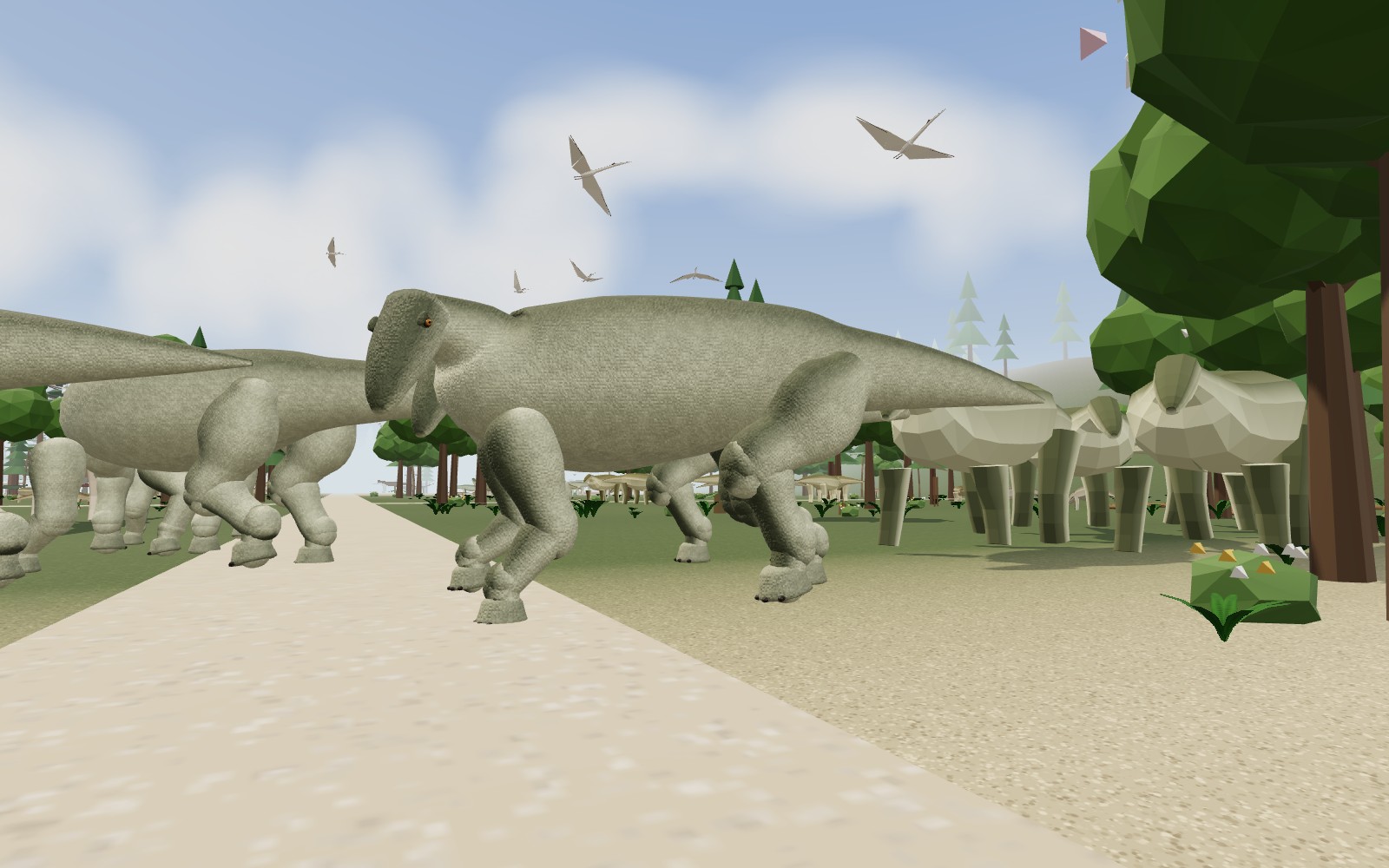
Dinosaur size comparison to humans: 172 life-size animals
A 600 m park of 172 prehistoric animals at their real size, from the first dinosaurs to T. rex, laid out by age.
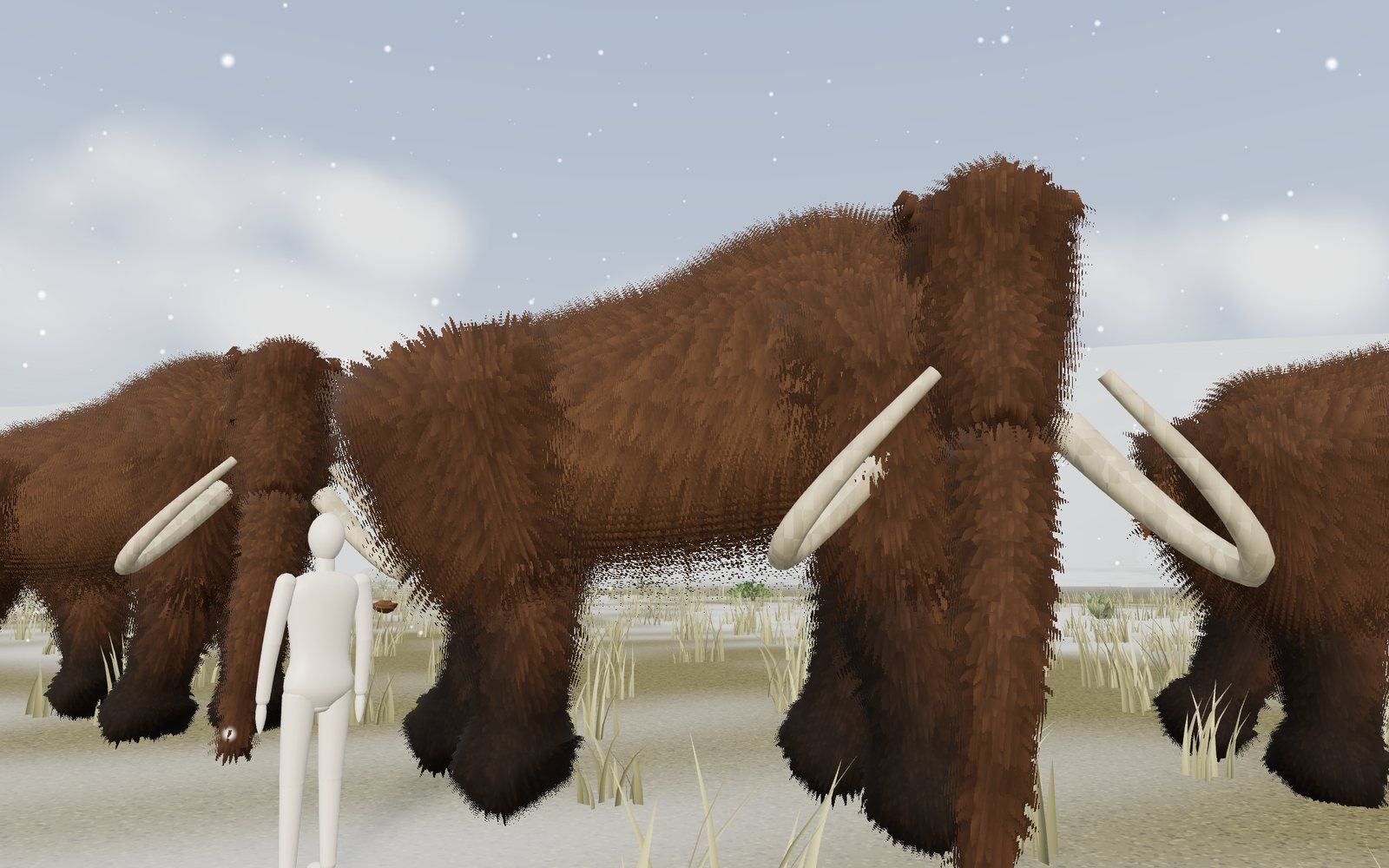
Walk among ice age animals
A 600 m park of 65 animals from the last ice age at their real size, from woolly mammoths to sabre-toothed cats, on a time slider that runs 50,000 years.
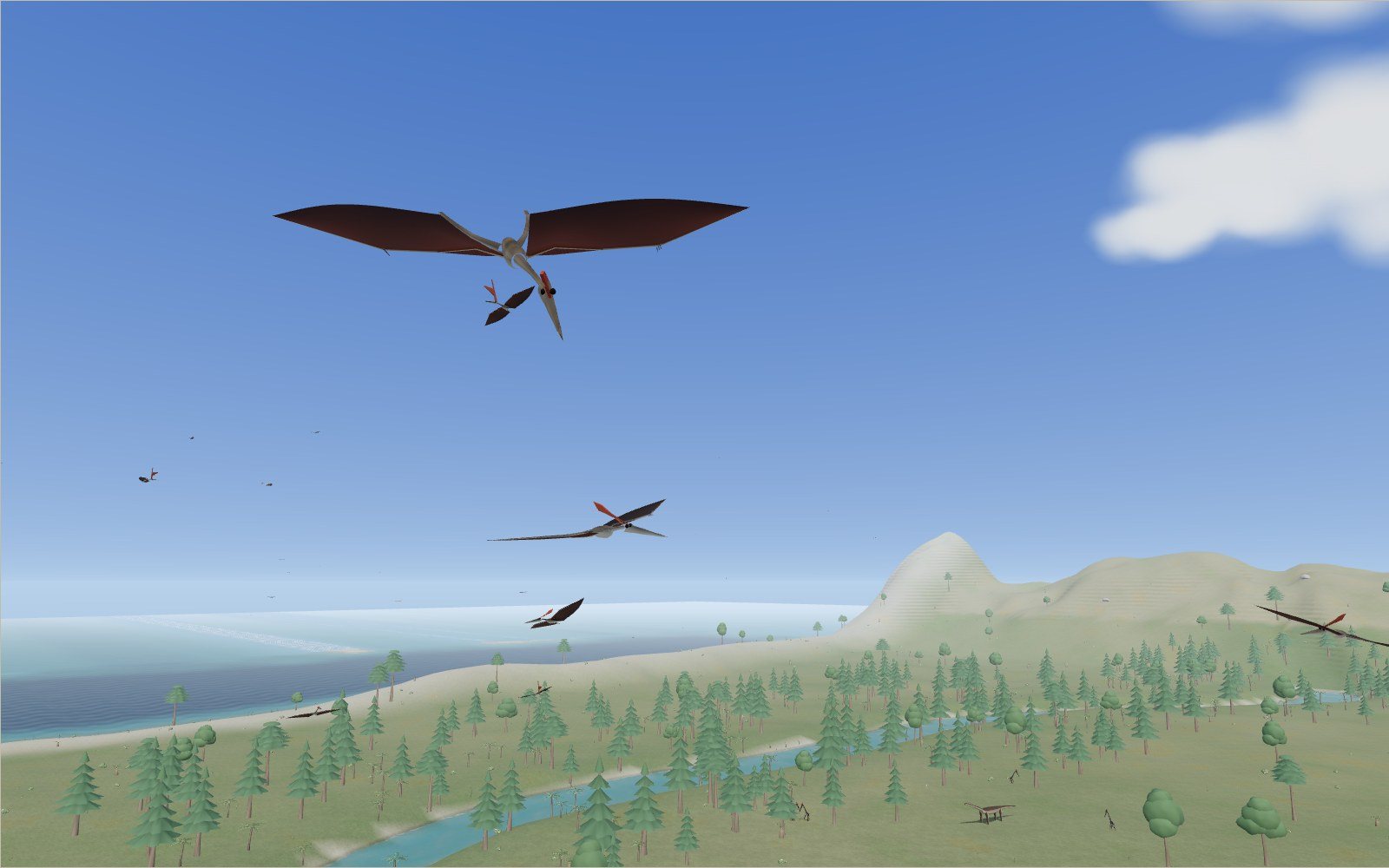
Fly with life-size pterosaurs
Quetzalcoatlus spanned about 10 m, close to the 11 m wing of a Cessna 172, and standing it was as tall as a giraffe. Watch it pass over a Cretaceous cliff, then fly with 35 pterosaurs from three ages.
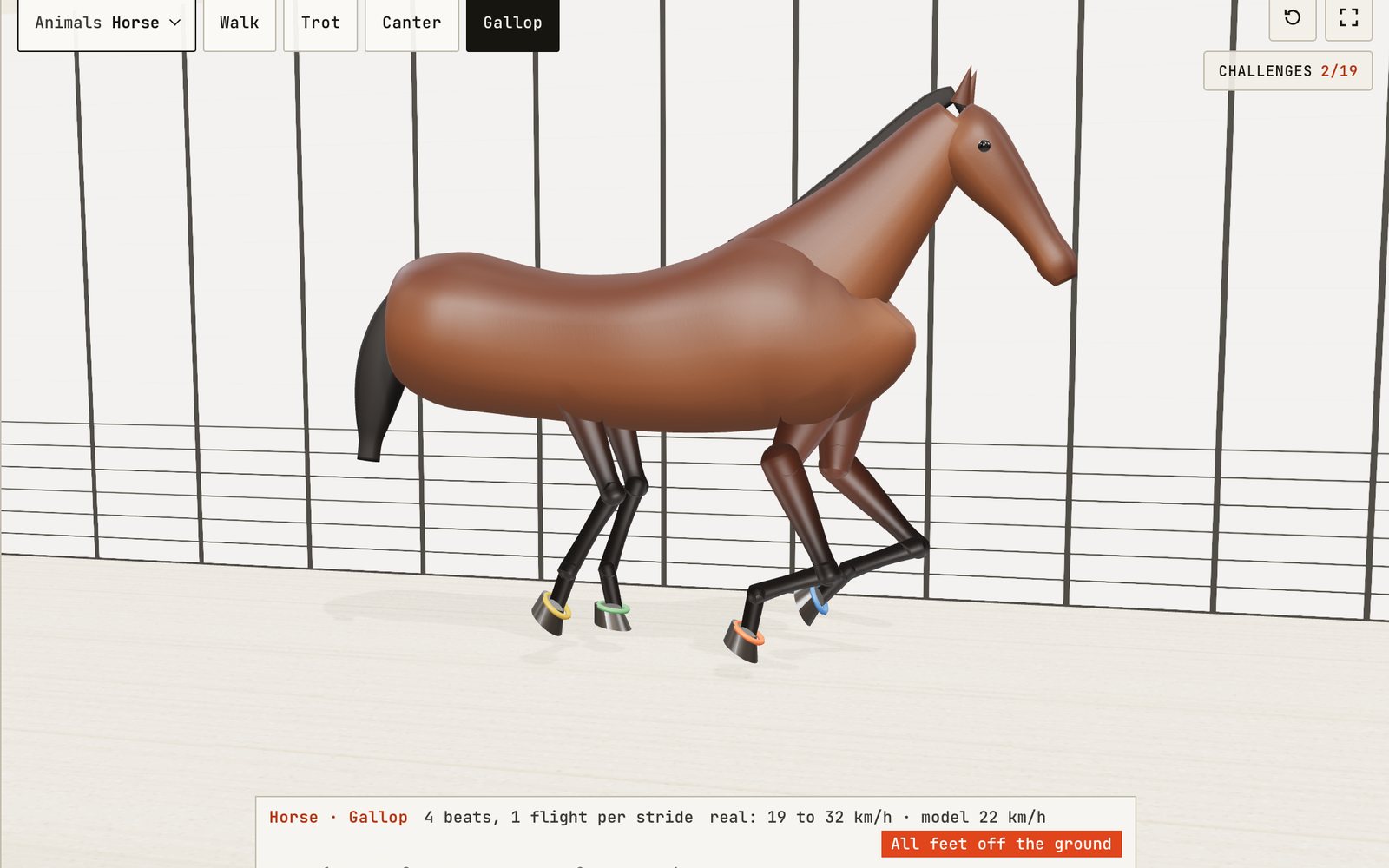
How a horse runs: walk, trot, canter and gallop
In 1878 Muybridge's cameras showed that a galloping horse does lift all four feet at once, but with its legs tucked under it. Some fast animals never leave the ground at all.
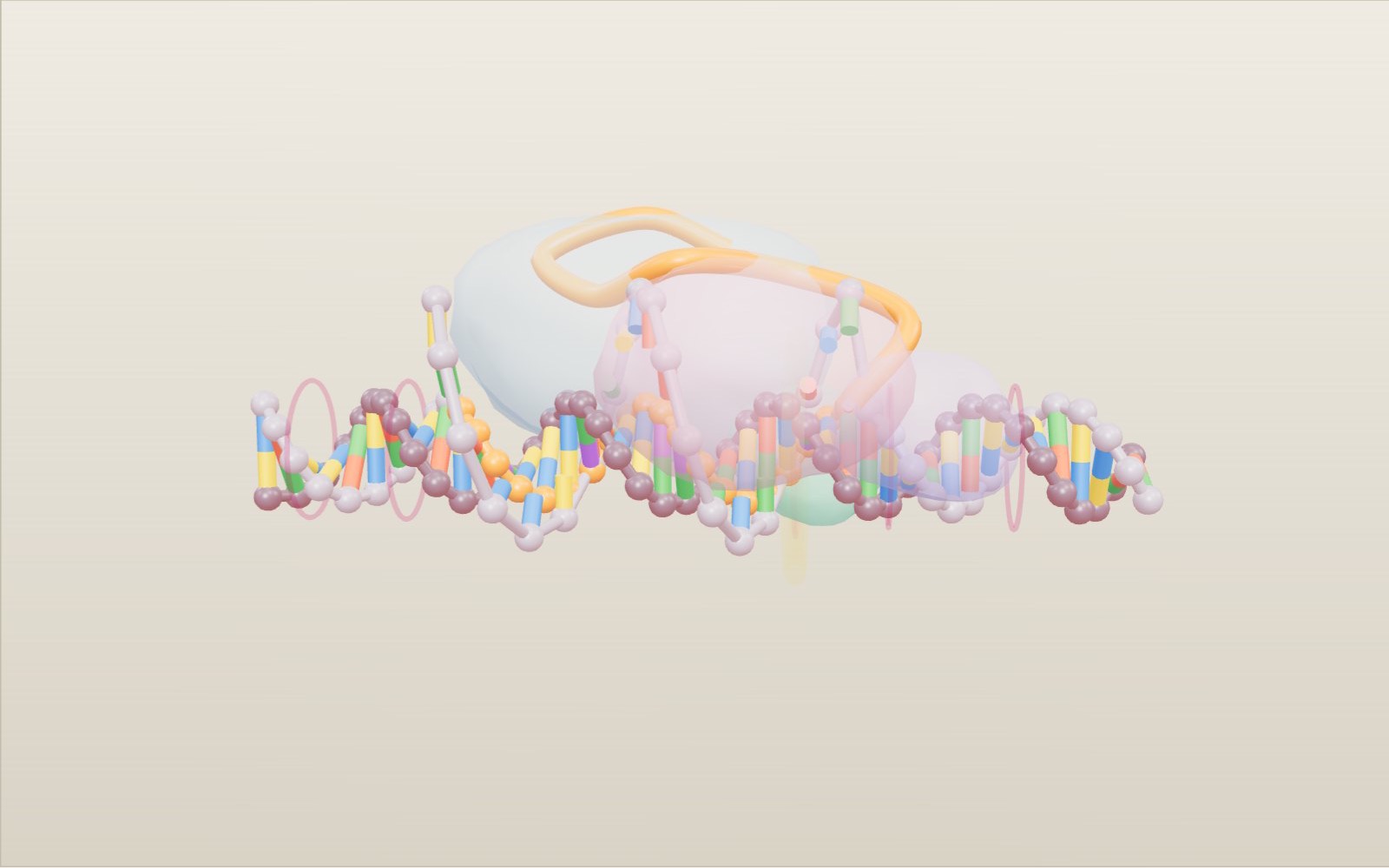
How CRISPR-Cas9 gene editing works
A guide RNA reads just 20 letters of DNA, and that is usually enough to pick out one spot among the 3 billion base pairs of a human genome.
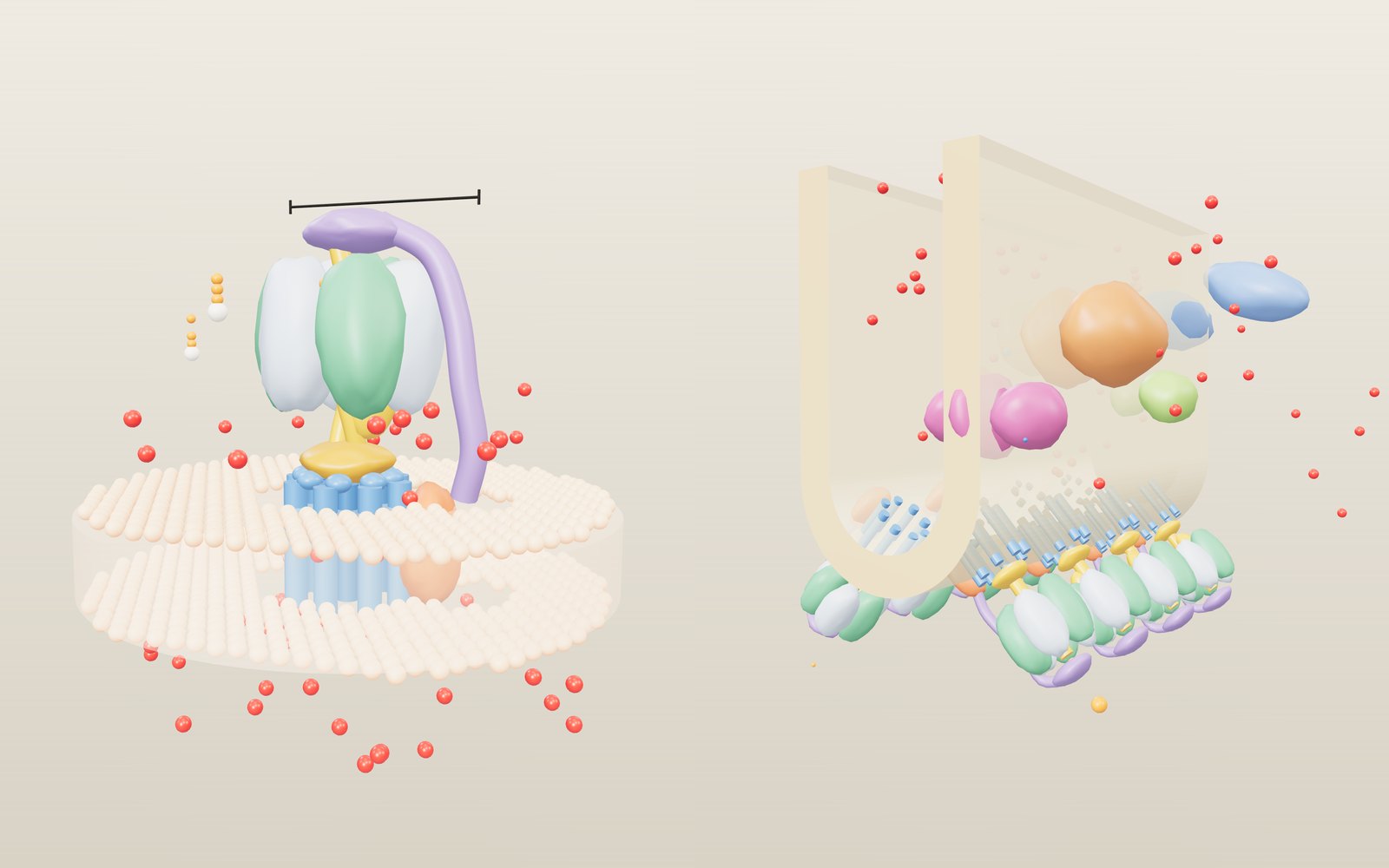
How ATP synthase works
In mitochondria the rotor of ATP synthase turns about 100 times a second, and every full turn releases three molecules of ATP.