FIG. 42How It Works
How CRISPR-Cas9 gene editing works
A guide RNA reads just 20 letters of DNA, and that is usually enough to pick out one spot among the 3 billion base pairs of a human genome.
This device cannot show the 3D model. You can read the guide steps below as text.
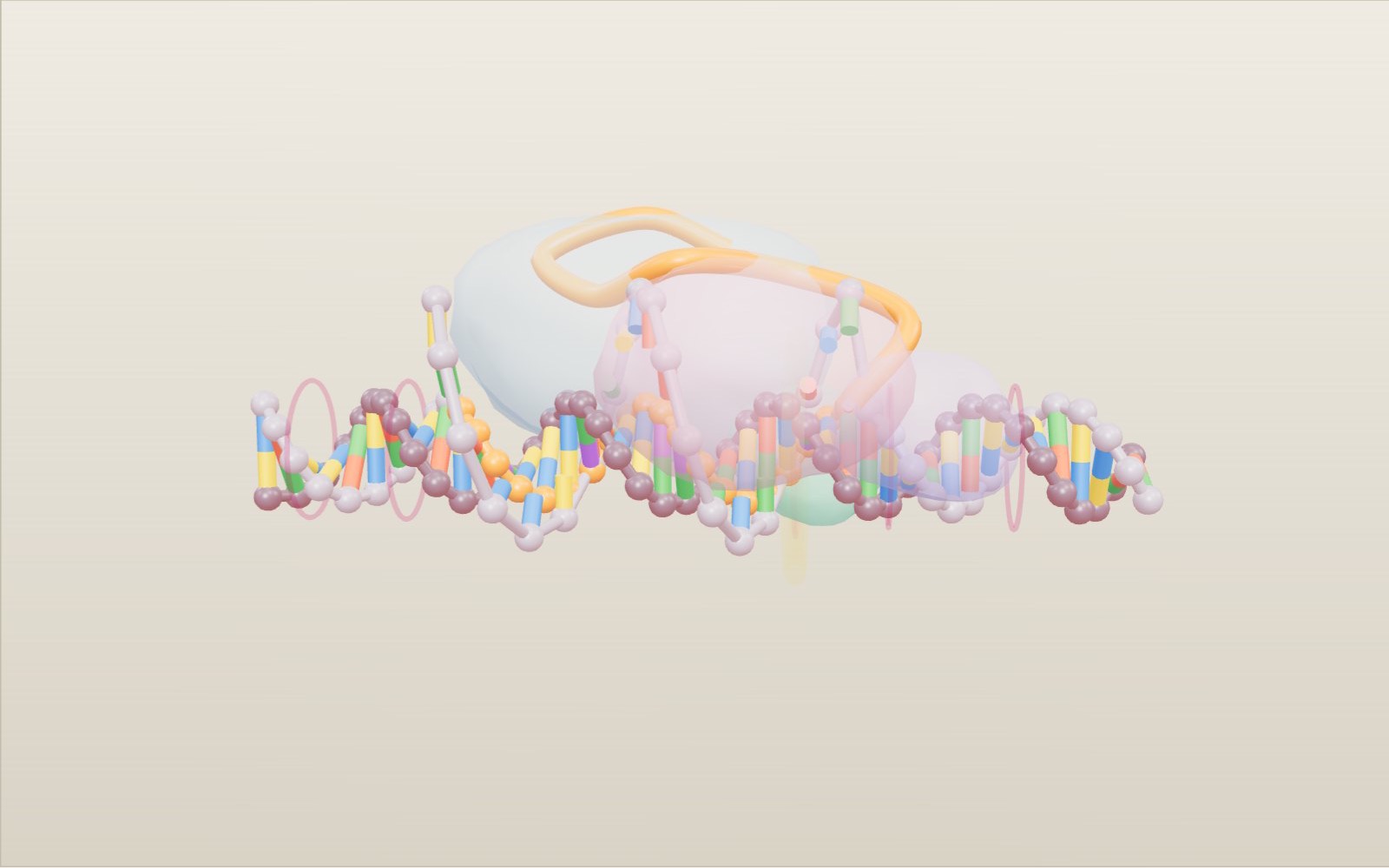
1 / 8 A stretch of DNA, to scaleThis is 44 base pairs of DNA, about 15 nm long. The black bars give the scale: the helix is 2 nm wide and turns once every 3.4 nm. The sequence is an example made up for the model.
Drag to turn. Scroll or pinch to zoom.
How does a protein find one spot in a whole genome?
One copy of the human genome holds about 3 billion base pairs. Suppose you want to change a single gene. You need a tool that can read the DNA, recognise one short stretch and cut it there, while leaving every other stretch alone. Earlier tools, zinc finger nucleases and TALENs, needed a newly designed protein for each target, and protein design is slow and difficult. CRISPR-Cas9 changed that. The protein stays the same, and only a short RNA guide is rewritten.
This exhibit builds the system at molecular scale. A short piece of DNA lies across the stage, and Cas9 comes in holding its guide RNA. You can follow it as it finds a PAM, pairs the guide with 20 bases of DNA, cuts both strands and leaves the cell to repair the break. Above the model there is a box where you can type your own guide. If the letters do not match, the guide stops pairing and nothing is cut. The numbers come from the Nobel Committee for Chemistry, OpenStax, the RCSB Protein Data Bank and the US National Human Genome Research Institute. The sources are listed at the end.
DNA at the scale of the model
DNA is two strands wound round each other. Each strand is a chain of sugars and phosphates, and each sugar carries one of four bases: A, C, G or T. A on one strand pairs with T on the other, and C pairs with G, so either strand can be read off from its partner. In the model the bases are coloured A green, T red, G yellow and C blue. The RNA base U, which takes the place of T in RNA, is purple.
The common form of DNA, B-DNA, has fixed dimensions. The double helix is 2 nm wide. Neighbouring base pairs are 0.34 nm apart, and the helix makes one full turn every 3.4 nm, which is 10 base pairs. The black bars at the left end of the model show the 2 nm width and one 3.4 nm turn. The model has 44 base pairs, so it is 44 × 0.34 = 15 nm long.
The two strands run in opposite directions. Chemists label the ends 5′ and 3′, and sequences are written from 5′ to 3′. In the model the grey strand runs 5′ to 3′ from left to right and the dark strand runs the other way. The grey strand has the same letters as the guide (with T where the guide has U), and the dark strand is the one the guide pairs with.
A bacterial memory of viruses
CRISPR began as a puzzle in bacterial genomes. In 1987 researchers noticed an odd pattern in the DNA of Escherichia coli: five copies of a 29 base pair sequence, separated by 32 base pairs of sequence that differed each time. Similar arrays turned up in many bacteria and archaea, and the name CRISPR, for clustered regularly interspaced short palindromic repeats, was coined for them. Next to the arrays sat a group of genes, named cas for CRISPR-associated, that coded for proteins resembling enzymes that unwind and cut nucleic acids.
In 2005 three groups reported that the spacers between the repeats matched the DNA of viruses and plasmids. Bacteria that carried a given spacer were rarely infected by a virus with the matching sequence. In 2007 an experiment with Streptococcus thermophilus showed the link directly. Bacteria that survived an attack by a virus had gained new spacers copied from that virus, and these bacteria now resisted it. Removing the spacer removed the resistance.
So the CRISPR array works as a record of past infections. The array is copied into a long RNA, which is cut into short CRISPR RNAs, one per spacer. Each short RNA joins Cas proteins and leads them to DNA with the matching sequence. The Streptococcus system needs only one protein to do the cutting, Cas9, together with a second small RNA, the tracrRNA, which Emmanuelle Charpentier's group described in 2011.
Cas9 and its guide RNA
Cas9 from Streptococcus pyogenes is a large protein. The chain in the crystal structure 4OO8 in the Protein Data Bank has 1,372 amino acids and weighs about 159 kilodaltons. That structure, solved at 2.5 Å resolution in 2014, showed two lobes. The recognition lobe (REC) holds the guide RNA and the RNA-DNA pair. The nuclease lobe holds the two cutting domains, HNH and RuvC, and a PAM-interacting domain near its far end.
In the model the protein is drawn as four soft blobs in those positions. The shapes are invented, and they are see-through so you can follow the RNA and DNA inside. Switch on See inside in the Controls tab to make them fainter still.
In bacteria, Cas9 carries two RNAs, the crRNA with the spacer and the tracrRNA that holds it in place. In 2012 Charpentier, Jennifer Doudna and their colleagues joined the two into a single guide RNA. The guide has two parts. The first 20 letters, the spacer, choose the target. The rest folds into a scaffold that sits inside the protein, drawn as an orange tube in the model. Change the 20 letters and the same protein goes to a different place.
Step one: find a PAM
Cas9 does not test every stretch of DNA against its guide. First it looks for a protospacer adjacent motif, or PAM. For Cas9 from S. pyogenes this is NGG on the grey strand, right after the target: any base, then two Gs. Two arginines in the PAM-interacting domain recognise the GG through hydrogen bonds. Only when the protein has found a PAM does it bend the DNA next to it and start to pull the strands apart.
The PAM also answers a question about bacteria. If the spacer matches the virus DNA, it also matches its own copy in the CRISPR array. The bacterium avoids cutting its own genome because the spacers in the array do not sit next to a PAM, while the matching sequence in the virus does.
In the model the PAM is TGG. Turn PAM (NGG) off in the Controls tab and it becomes TGA. Cas9 then hovers over the DNA and drifts away without opening it, even though the guide still matches all 20 bases.
Step two: twenty letters, starting from the seed
Next to the PAM, the DNA opens one base pair at a time and the guide RNA pairs with the dark strand. The grey strand is pushed aside into a loop. This structure of RNA paired with one DNA strand and the other strand displaced is called an R-loop. Pairing starts at the PAM end, and the 10 bases of the guide nearest the PAM, the seed, matter most. A mismatch in the seed usually stops recognition.
The box above the model shows the target on the grey strand, from 5′ to 3′, with the PAM at the end. The 10 seed positions are tinted. Under it is the guide. Type in the box or use the four buttons:
- Match: all 20 letters pair. The R-loop reaches the far end and Cas9 cuts.
- Seed mismatch: position 17 is changed. The R-loop opens 3 base pairs and stops.
- Far mismatch: position 3 is changed. The R-loop opens 17 base pairs, then closes again.
- Other gene: a guide written for some other sequence. Nothing pairs.
Letters that do not pair are shown in black. In the model, any mismatch stops pairing at that letter, the DNA closes and Cas9 lets go. Real Cas9 is less strict, as the next sections explain.
Step three: two domains, two cuts
When the guide has paired along all 20 bases, the HNH domain changes shape and swings into place against the dark strand. Each nuclease domain cuts one strand. HNH cuts the strand paired with the guide, and RuvC cuts the displaced grey strand. Both cuts fall 3 base pairs before the PAM, at the same position on both strands, so the two ends are usually blunt rather than staggered.
In the model the cut lands between base pairs 27 and 28, counting from the left, with three base pairs of target left on the PAM side. A yellow ring flashes at the cut. Then Cas9 lifts away and the two ends move apart.
If one of the two domains is disabled, Cas9 cuts only one strand. Such a nickase is used with two guides that target opposite strands close together, which makes a break only where both guides match.
What the cell does with a broken chromosome
Cas9 only makes the break. The edit itself is done by the cell's own repair systems, which deal with broken DNA all the time. There are two main routes.
The first is non-homologous end joining, or NHEJ. The cell glues the two ends back together. This usually adds or loses a few bases at the joint. Inside a gene, a change of one or two bases shifts the reading frame of every codon after it, and the gene often stops making its protein. Use the Progress slider or step 7 of the guide to see the model join the ends with one extra base pair, marked by a ring.
The second is homology-directed repair, or HDR. If a piece of DNA that matches both sides of the break is present, the cell can use it as a template and copy it across the gap. By supplying a template with changed letters in the middle, researchers can write a chosen change into the genome. Turn Repair template on and the green template appears beside the break; when the ends join, three base pairs at the cut take the template's letters.
Checking the numbers
Why is 20 letters enough? There are 4 choices at each position, so there are 4^20 = 1,099,511,627,776 different 20-letter sequences, about 1.1 × 10^12. A human genome has about 3 × 10^9 base pairs, and a sequence can sit on either strand, so there are about 6 × 10^9 places to look. If the genome were random, a given 20-letter sequence would turn up by chance about 6 × 10^9 ÷ 1.1 × 10^12 ≈ 0.005 times. Under this random model, an additional exact copy of the chosen target is unlikely; this is not a guarantee for a real genome.
The seed tells a different story. Ten seed letters plus the two Gs of the PAM fix 12 letters, and 4^12 = 16,777,216. Random sequence would contain that pattern about 6 × 10^9 ÷ 1.7 × 10^7 ≈ 360 times. Cas9 can sometimes cut sites like these even when the far end of the guide does not match well, which is why guide sequences are checked against the whole genome before use. Real genomes are also full of repeated sequence, so the true numbers are worse than the random estimate.
In the model, the target is 20 × 0.34 = 6.8 nm long, two full turns of the helix. The cut is 3 base pairs, about 1 nm, from the PAM.
Trying it on the screen
The model opens with the search. Cas9 slides along a short, made-up piece of DNA, stops at each NGG mark, and only where the guide matches does the double helix open and get cut. The letters are invented for the picture: it shows the idea, not a method for the lab.
- Press an NGG mark in the strip of letters on the stage. Cas9 goes there, and where the guide does not pair it lets go and moves on.
- Drag Cas9 itself along the DNA and drop it on an NGG mark.
- Pick a guide with one wrong letter near the PAM, or turn the PAM off, and watch Cas9 fail to cut.
- Press the parts of the protein to read what the HNH and RuvC domains, the REC lobe and the PAM-interacting domain do.
- Open the bacteria story to see how a bacterium stores a piece of virus DNA and uses it the next time the virus attacks.
- Under the controls there are challenges, hidden things, a size comparison with a hair and a cell, and a history of CRISPR from 1987 to the first approved medicine.
What the model leaves out
The protein is four blobs, not the measured surface, and the HNH domain simply slides from one spot to another. The DNA is a straight, regular helix with exactly 10 base pairs per turn, while real DNA is kinked where Cas9 grips it next to the PAM. The R-loop opens neatly one base pair at a time; the real process also grows in steps, but not at an even pace. Cas9 lifts away after cutting so you can see the ends, and the model does not show how long the real protein stays bound.
The rule for mismatches is also simpler than the real one. Real Cas9 tolerates some mismatches far from the PAM and can cut such off-target sites. The repair shows only one example of each route: one extra base pair for NHEJ and three changed base pairs for HDR. In cells, NHEJ gives a mix of small insertions and deletions rather than one fixed result. The sequence in the model was made up and does not belong to a real gene.
From a bacterial puzzle to a lab tool
Charpentier studied Streptococcus pyogenes and found the tracrRNA, published in March 2011. That spring she met Doudna, a biochemist at the University of California, Berkeley, at a conference in Puerto Rico, and they decided to work on Cas9 together. In test tubes, Cas9 with crRNA alone did not cut DNA. When they added tracrRNA, the DNA was cut. They then fused the two RNAs into a single guide and showed that by changing its sequence they could cut DNA at sites of their choosing. The paper appeared in 2012. Early in 2013 other groups showed that the system edits genomes in human and mouse cells.
The Royal Swedish Academy of Sciences awarded the Nobel Prize in Chemistry 2020 to Emmanuelle Charpentier and Jennifer A. Doudna "for the development of a method for genome editing".
Where it is used
According to the Nobel Committee, CRISPR-Cas9 is now a standard tool in basic research, where it is used to change genes in cells and laboratory animals to find out what they do. It is also used in plant breeding; the committee's summary gives the example of rice varieties edited to take up less cadmium and arsenic from soil. MedlinePlus, from the US National Library of Medicine, notes that genome editing is being studied in research and clinical trials for many diseases, and that editing egg cells, sperm cells or embryos is currently illegal in the United States and many other countries.
One medicine made with CRISPR-Cas9 has been authorised in the European Union. The European Medicines Agency gave Casgevy (exagamglogene autotemcel) a conditional marketing authorisation on 9 February 2024 for people aged 12 and over with transfusion-dependent beta thalassaemia or severe sickle cell disease. It is made from the patient's own blood stem cells, edited outside the body so that they make more fetal haemoglobin. A conditional authorisation means the company must provide further evidence after approval. This exhibit makes no claim about how well or how safely any treatment works; the agency's page has the details.
Why a unique address can still produce off-target cuts
The random-sequence calculation above counts exact matches, not everything the enzyme might accept. Suppose we allow one wrong letter in a 20-base guide. There are 20 positions to change, with 3 alternative letters at each position, giving 20 × 3 = 60 one-mismatch neighbours. Including the exact sequence gives 61 possible strings. For an illustrative genome of 3,200,000,000 base pairs, counting both strands gives about 6,400,000,000 candidate starting positions. Under the deliberately unrealistic assumption of independent, equally frequent bases, the expected number of exact matches to a specified guide is 6,400,000,000 ÷ 4^20 ≈ 0.0058. Counting the exact sequence and those 60 neighbours raises the expectation to about 0.36 before requiring a PAM.
For NGG, N can be any base and the two Gs each have probability 1/4 in this toy genome. Requiring NGG therefore multiplies those expectations by 1/16. The result for the 61 strings is about 0.022. These are expected counts of accidental sequence patterns, not clinical risk percentages or measured cutting rates. They do not include the intended target, which was selected because it exists. Nor do they say that every allowed mismatch is cut. Repeats, unequal base frequencies, DNA packaging, the patient's variants and the positions of mismatches all break the simple assumptions. A duplicated gene can supply an almost identical target even when a random model predicts very few matches.
Guide design therefore starts with a search against the relevant genome and continues with experimental measurements. A predicted off-target site is a place to investigate, not proof of damage; failure to detect a cut is also limited by the assay's sensitivity. In 2016 Kleinstiver and colleagues reported SpCas9-HF1, engineered to weaken non-specific contacts with DNA. It retained strong activity for many tested guides while reducing detectable off-target activity. The title's phrase “no detectable” belongs to those tests, not to every cell and every guide. A high-fidelity enzyme can lose useful activity at some targets, so specificity and efficiency must be checked together. The exhibit's rule that any mismatch stops cutting is a teaching simplification, not a simulation of this engineered protein.
Changing letters without a double-strand break
The repair-template switch in this exhibit represents HDR after a break. It does not represent every kind of precise editing. In 2016 Komor and colleagues described a base editor combining a DNA-targeting Cas9 component with a cytidine deaminase. The deaminase changes cytidine into uridine in exposed DNA; subsequent processing can produce a C-to-T substitution, or G-to-A when described from the opposite strand. Later designs use a nickase, which cuts one strand, to favour the desired outcome. Avoiding a deliberate double-strand break does not mean that the DNA is never nicked or that unwanted products are impossible.
A base editor operates within an editing window, rather than changing any chosen letter anywhere beside the guide. Other editable bases in that window can also change, producing bystander edits. PAM availability still restricts where the targeting machinery can bind. Delivery to the correct cells, unwanted editing elsewhere and the fraction of cells receiving the desired change remain experimental questions. A base editor is useful when its chemical conversion matches the needed change; it is not an unrestricted spelling corrector for the genome.
Prime editing, described by Anzalone and colleagues in 2019, uses a Cas9 nickase linked to a reverse transcriptase. Its extended prime-editing guide RNA, or pegRNA, both addresses the target and carries a template encoding the proposed change. The enzyme copies information from that RNA into DNA, after which the cell must resolve the edited intermediate. This can support substitutions and small insertions or deletions without supplying a separate donor DNA or deliberately making a double-strand break. It still depends on cell repair, and efficiency and unintended products depend on the target and design. Neither base editing nor prime editing is animated here. The green donor shown by Repair template is DNA supplied for HDR, not a pegRNA, and the two-strand cut belongs to conventional Cas9 editing.
What Casgevy changes in a patient's cells
Casgevy provides a concrete example of editing outside the body. The UK MHRA announced its authorisation on 16 November 2023; its announcement records the authorisation itself on 15 November. On 8 December 2023 the US FDA approved Casgevy for patients aged 12 and older with sickle cell disease and recurrent vaso-occlusive crises. The indications and access conditions must be read from each regulator rather than assumed identical across countries. These dates describe initial decisions, not a complete list of later approvals.
Sickle cell disease involves abnormal adult haemoglobin, which can make red blood cells stiffen into sickle shapes and obstruct blood flow. Casgevy does not directly replace the sickle mutation in every cell of the body. Blood-forming stem cells are collected from the patient, edited with CRISPR-Cas9 outside the body, and returned by infusion. The edit acts on regulation of fetal haemoglobin, allowing red-cell descendants of the treated stem cells to produce more of that haemoglobin. Fetal haemoglobin can reduce sickling despite the persistence of the original inherited mutation. Changing a regulator can therefore compensate for a disease without repairing its original DNA spelling.
The infusion is only one part of a demanding treatment pathway. The FDA explains that patients first receive high-dose chemotherapy to prepare the bone marrow for the modified cells. Collection, manufacture, conditioning, engraftment and follow-up all matter to the result; the guide sequence alone is not the treatment. The patient's own cells are used, but that does not remove the risks of chemotherapy or the need to monitor edited cells over time. This is somatic treatment: the edited blood-forming cells do not become eggs or sperm, and the treatment is not intended to pass an edit to children. The model shows recognition, cutting and repair at one invented DNA target. It does not model the Casgevy target, clinical manufacture, patient eligibility or the likelihood of benefit for an individual.
What the screen cannot decide about inherited editing
Editing a blood stem cell and editing an embryo raise different questions. An embryo edit might reach tissues throughout a developing person, including cells that later produce eggs or sperm. Changes could then be inherited by descendants who could not consent. If only some early cells are edited, the individual may be a mosaic with different DNA changes in different cell populations. A clean-looking sequence from one sample would not establish that every tissue carries the same edit. Even a perfectly placed change cannot establish that a proposed use is medically justified or fairly accessible.
The WHO's 2021 recommendations distinguish somatic, germline and heritable editing and call for governance, registries, international cooperation and ways to report illegal, unregistered, unethical or unsafe research. These recommendations are a framework for oversight, not an international permission slip or a law that automatically replaces national rules. The 2020 Nobel Prize recognised Charpentier and Doudna's development of a genome-editing method; a scientific prize does not approve every possible application of that method.
Use the screen to separate a molecular observation from a broader claim. Start with Match and PAM (NGG) enabled, then move Progress through the cut and repair. Repeat with PAM (NGG) disabled while keeping the guide unchanged: a matching address alone is insufficient. Restore the PAM and compare Seed mismatch with Far mismatch. Both stop cutting here, but at different points in pairing, so this is not evidence that their biological risks are equal. Finally compare repair with and without Repair template. The displayed products illustrate two repair routes, not their frequencies in cells. For each run write down whether the PAM was present, where pairing stopped and which repair product appeared. None of those observations measures treatment safety, embryo viability or consent.
Questions
What does CRISPR stand for?
Clustered regularly interspaced short palindromic repeats. The name describes the arrays in bacterial genomes where short repeats alternate with spacers. The editing tool is named after them, and Cas9 is the CRISPR-associated protein number 9.
Why does Cas9 need a PAM?
It lets the bacterium tell virus DNA from its own CRISPR array. The array holds the same spacer sequences but no PAM next to them, so Cas9 leaves it alone. For the tool, it means a target has to sit next to NGG.
What happens if the guide has one wrong letter?
It depends on where the letter is. A mismatch in the 10 seed bases next to the PAM usually stops recognition. Mismatches further away are sometimes tolerated, and that is one source of cuts at unintended sites. The model applies a simpler rule: any mismatch stops the pairing.
Does Cas9 change the DNA sequence itself?
No. Cas9 only cuts both strands. The change comes from the cell's repair: end joining tends to add or remove a few bases, and repair from a template copies a sequence that researchers supply.
Why do the HNH and RuvC domains cut different strands?
They sit on different sides of the opened DNA. HNH faces the strand paired with the guide and RuvC faces the displaced strand. Both cut 3 base pairs from the PAM, so the break is clean across both strands.
How big is Cas9 compared with DNA?
The chain in the PDB structure 4OO8 has 1,372 amino acids, about 159 kilodaltons. It holds the guide RNA and the 20 base pair RNA-DNA pair in a groove between its two lobes. That pair is two turns of helix, about 6.8 nm long, while DNA itself is 2 nm wide.
Who discovered CRISPR?
Many groups contributed. The repeats were first reported in 1987, their link to viruses in 2005 and their role in immunity in 2007. Charpentier and Doudna showed in 2012 that Cas9 can be programmed with a single guide RNA to cut DNA at a chosen site, and they shared the 2020 Nobel Prize in Chemistry.
Does a high-fidelity Cas9 guarantee no off-target edits?
No. Reduced activity in an assay is conditional on the guide, cell type and detection limit. SpCas9-HF1 improves specificity but still needs testing with the intended target and delivery method.
Is the green repair template a prime-editing guide?
No. It is donor DNA for HDR after the model's double-strand break. A pegRNA is RNA carrying both a targeting sequence and information to write a change with a reverse transcriptase.
Does Casgevy pass an edit to a patient's children?
It edits blood-forming stem cells, not eggs or sperm. It is a somatic treatment intended to increase fetal haemoglobin, not an inherited correction of the sickle mutation.
Terms
- CRISPR array: a stretch of a bacterial genome where short repeats alternate with spacers taken from viruses and plasmids.
- Cas9: the CRISPR-associated protein that cuts DNA in type II systems such as that of Streptococcus pyogenes.
- Guide RNA: a single RNA that holds a 20-letter spacer and a scaffold; it joins the crRNA and tracrRNA of the bacterial system.
- Protospacer: the 20 base pairs of target DNA that match the spacer.
- PAM: protospacer adjacent motif, a short sequence next to the target (NGG for this Cas9) that Cas9 must find before it opens the DNA.
- Seed: the 10 guide bases nearest the PAM, where a mismatch most easily stops recognition.
- R-loop: the structure in which RNA pairs with one strand of DNA and the other strand is pushed aside.
- NHEJ: non-homologous end joining, repair that joins broken ends directly, often with small insertions or deletions.
- HDR: homology-directed repair, repair that copies a matching DNA template across the break.
Sources
- Nobel Committee for Chemistry, Scientific Background on the Nobel Prize in Chemistry 2020: A tool for genome editing (repeats in 1987, spacers in 2005 and 2007, PAM, seed, HNH and RuvC, cut 3 bp from the PAM, NHEJ and HDR). https://www.nobelprize.org/uploads/2020/10/advanced-chemistryprize2020.pdf (checked 16 October 2026)
- NobelPrize.org, The Nobel Prize in Chemistry 2020, summary. https://www.nobelprize.org/prizes/chemistry/2020/summary/ (checked 16 October 2026)
- NobelPrize.org, The Nobel Prize in Chemistry 2020, press release. https://www.nobelprize.org/prizes/chemistry/2020/press-release/ (checked 16 October 2026)
- NobelPrize.org, Popular science background: Genetic scissors, a tool for rewriting the code of life (2011 meeting, tracrRNA, uses in research and plant breeding). https://www.nobelprize.org/prizes/chemistry/2020/popular-information/ (checked 16 October 2026)
- OpenStax, Biology 2e, 14.2 DNA Structure and Sequencing (2 nm width, 0.34 nm per base pair, 3.4 nm per turn). https://openstax.org/books/biology-2e/pages/14-2-dna-structure-and-sequencing (checked 16 October 2026)
- National Human Genome Research Institute, Talking Glossary: Base Pair (about 3 billion base pairs in the human genome). https://www.genome.gov/genetics-glossary/Base-Pair (checked 16 October 2026)
- National Human Genome Research Institute, Talking Glossary: Double Helix. https://www.genome.gov/genetics-glossary/Double-Helix (checked 16 October 2026)
- National Human Genome Research Institute, Talking Glossary: CRISPR. https://www.genome.gov/genetics-glossary/CRISPR (checked 16 October 2026)
- RCSB Protein Data Bank, entry 4OO8: Crystal structure of Streptococcus pyogenes Cas9 in complex with guide RNA and target DNA (Nishimasu et al., Cell, 2014). https://www.rcsb.org/structure/4OO8 (checked 16 October 2026)
- RCSB PDB-101, Molecule of the Month: Cascade and CRISPR. https://pdb101.rcsb.org/motm/181 (checked 16 October 2026)
- MedlinePlus, US National Library of Medicine, What are genome editing and CRISPR-Cas9? https://medlineplus.gov/genetics/understanding/genomicresearch/genomeediting/ (checked 16 October 2026)
- European Medicines Agency, Casgevy: EPAR (conditional marketing authorisation, 9 February 2024). https://www.ema.europa.eu/en/medicines/human/EPAR/casgevy (checked 16 October 2026)
- FDA: initial Casgevy approval, 8 December 2023. https://www.fda.gov/news-events/press-announcements/fda-approves-first-gene-therapies-treat-patients-sickle-cell-disease (2026-10-23)
- MHRA: Casgevy authorisation announcement, 16 November 2023. https://www.gov.uk/government/news/mhra-authorises-world-first-gene-therapy-that-aims-to-cure-sickle-cell-disease-and-transfusion-dependent-thalassemia (2026-10-23)
- WHO: human genome editing recommendations, 2021. https://www.who.int/news/item/12-07-2021-who-issues-new-recommendations-on-human-genome-editing-for-the-advancement-of-public-health (2026-10-23)
- Komor et al.: base editing, 2016. https://www.nature.com/articles/nature17946 (2026-10-23)
- Anzalone et al.: prime editing, 2019. https://www.nature.com/articles/s41586-019-1711-4 (2026-10-23)
- Kleinstiver et al.: SpCas9-HF1, 2016. https://www.nature.com/articles/nature16526 (2026-10-23)
More exhibits
How ATP synthase works
In mitochondria the rotor of ATP synthase turns about 100 times a second, and every full turn releases three molecules of ATP.
Walk inside a cell: animal, plant and bacterium
Grown a million times, a mitochondrion is about the size of a sofa, a whole E. coli is 2 m long, and the kinesin towing a vesicle past you walks at 0.8 metres per second.
How DNA replication works, step by step: Okazaki fragments in 3D
A DNA polymerase can only add to one end of a strand, so at every replication fork one new strand grows in a single piece and the other in short fragments.
How nerve signals travel
A nerve cell sits at about −70 mV, and when a stimulus lifts it to about −55 mV it fires a spike that is always the same size.
Giant sequoia forest: walk under the largest trees
Stand at the foot of the General Sherman Tree, 83.8 m tall and about 2,200 years old, then climb its trunk and see how hard the water up there is pulled.
Dinosaur size comparison to humans: 172 life-size animals
A 600 m park of 172 prehistoric animals at their real size, from the first dinosaurs to T. rex, laid out by age.
How photosynthesis works
A leaf in full sun pulls carbon dioxide out of air that holds only about 426 parts per million of it, and builds sugar from it.
Coral bleaching causes: why warmer water turns reefs white
Corals get most of their food from algae living in their tissue, and when the sea stays more than 1 °C above its usual summer high for weeks, they lose those algae and turn white.
How do bats see with sound? Echolocation explained
An echo from a moth 1 m away comes back to a bat in under 6 thousandths of a second, and that delay is how the bat knows the distance.
What happens to your body in space without a suit
Without a suit you would have about 10 seconds of useful consciousness, and if air came back within a minute or so you might well recover. You would not explode.
Fly with life-size pterosaurs
Quetzalcoatlus spanned about 10 m, close to the 11 m wing of a Cessna 172, and standing it was as tall as a giraffe. Watch it pass over a Cretaceous cliff, then fly with 35 pterosaurs from three ages.
Giants of the sea: megalodon and the blue whale
Swim beside 48 sea giants at their real size, from a 28 m blue whale to megalodon, Livyatan and Mosasaurus, in eight seas from today back to the Triassic.