FIG. 117Walk-throughs
Giant sequoia forest: walk under the largest trees
Stand at the foot of the General Sherman Tree, 83.8 m tall and about 2,200 years old, then climb its trunk and see how hard the water up there is pulled.
This device cannot show the 3D model. You can read the guide steps below as text.
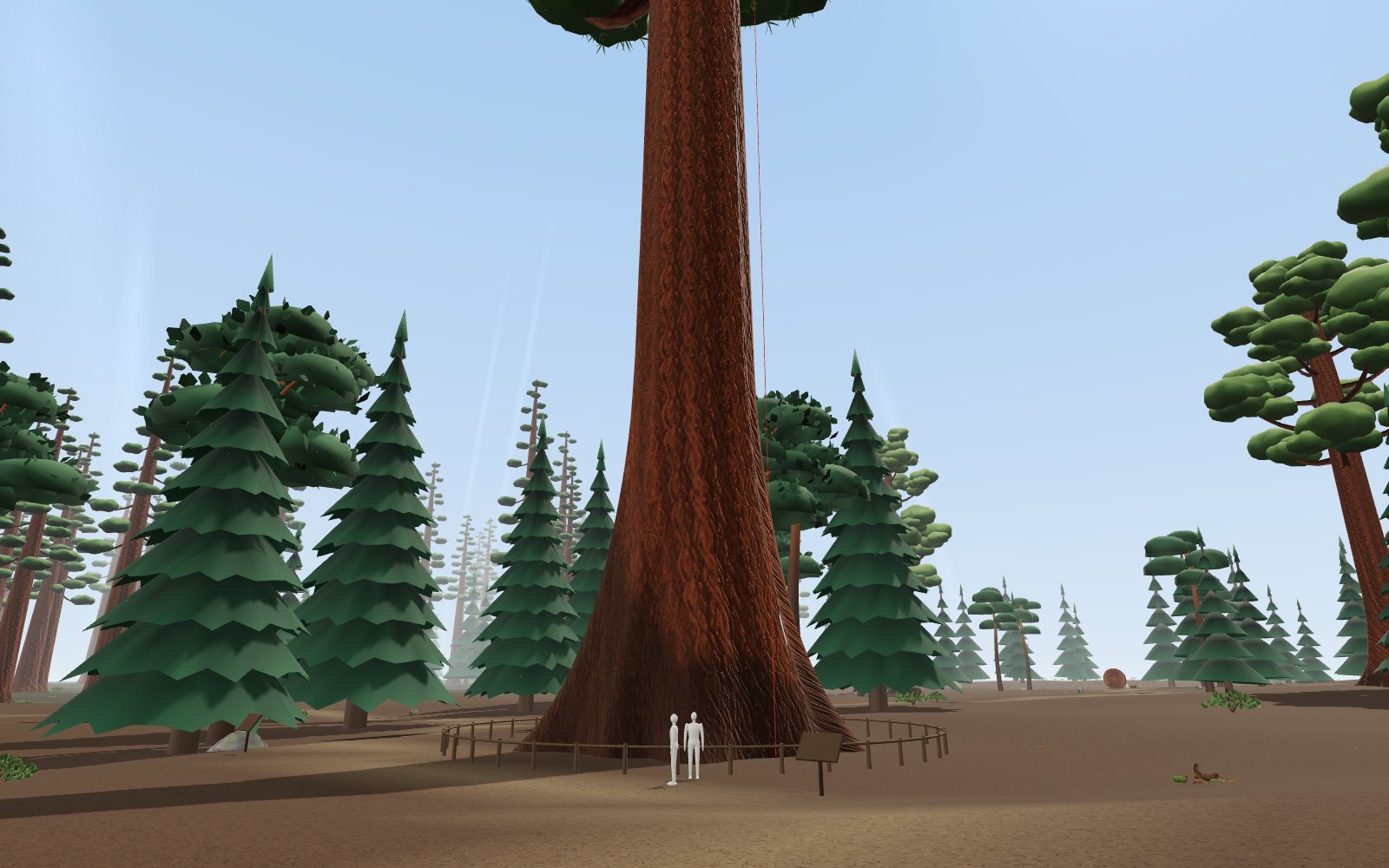
1 / 17 Look upYou are at the foot of the General Sherman Tree. The trunk goes up 83.8 m, and the first big limb only starts at 39.6 m. Drag to look around; the pale figures are people 1.7 m tall.
Drag to turn. Scroll or pinch to zoom.
What you are walking through
Photographs of giant sequoias have a problem: the tree never fits. Either you see the base and a few metres of trunk, or you see the whole tree from far away and it looks like any other conifer. The only way to feel the size is to stand at the foot of one and look up, with a person next to it for scale. That is where this exhibit starts.
You begin beside the General Sherman Tree, the largest tree on Earth by trunk volume. From there you can walk through a grove of giant sequoias modelled on Giant Forest in Sequoia National Park, climb Sherman's trunk on a researcher's rope, walk through a hollow fallen giant, set a stand of sequoias on fire and watch what the fire does for them, and turn a cross-section of a trunk back to any year since 1000 BC. A short path and a sign lead to a second forest: coast redwoods on the foggy Pacific coast, where a model tree stands as tall as Hyperion, the tallest tree known.
The numbers on the stage come from the people who look after these trees. Heights, diameters and volumes are the ones the National Park Service publishes. Facts about cones, seeds, roots and growth come from the U.S. Forest Service's Silvics of North America and its Fire Effects Information System. The water physics follows a 2004 paper in Nature by George Koch and colleagues, who climbed the tallest redwoods and measured how hard the water at the top is pulled. Where a number is an estimate, the stage says so.
The first ten seconds
The first view is from the trail, about 30 m from the tree, looking up. The trunk fills the middle of the screen and keeps going past the top edge. At its foot, just outside the fence, stands a pale figure. It is 1.7 m tall. About 49 of those figures, each standing on the next one's head, would reach the top.
High on the trunk, at 58 m, a second figure hangs on a red rope. Canopy researchers really do climb these trees on fixed ropes, and that figure is the one you can follow when you press Climb. Below it the first big limbs begin at 39.6 m, and the crown spreads 32.5 m wide.
How big is the General Sherman Tree?
The park measures the tree in feet and gives metres beside them. The model uses those numbers directly.
| Measure | Feet | Metres |
|---|---|---|
| Height above the base | 274.9 | 83.8 |
| Circumference at the ground | 102.6 | 31.1 |
| Greatest diameter at the base | 36.5 | 11.1 |
| Diameter 60 ft (18.3 m) up | 17.5 | 5.3 |
| Diameter 180 ft (54.9 m) up | 14.0 | 4.3 |
| Diameter of the largest branch | 6.8 | 2.1 |
| Height of the first large branch | 130.0 | 39.6 |
| Average crown spread | 106.5 | 32.5 |
One small slip: 102.6 ft is 31.27 m, not 31.1 m. The exhibit keeps the park's printed value and notes the difference in its data check.
The trunk volume is 52,508 cubic feet, or 1,487 m³. In lumber terms the park says that is about 630,000 board feet, and that the trunk alone weighs nearly 1,400 tons, about as much as 15 adult blue whales. The latest age estimate is about 2,200 years. Earlier estimates were higher, and you will still find them on old signs and in books.
The modelled trunk passes through each published diameter. Between them it tapers smoothly, flares into buttresses at the foot and is fluted with deep vertical ridges. Its volume, worked out from the model's radius, comes to about 1,650 m³, a little more than the park's figure, because the model's foot is round where the real one is uneven and partly burned away.
Largest, tallest, oldest
These are three different records, held by three different trees.
The largest by volume is the General Sherman Tree. The second is the General Grant Tree in Kings Canyon National Park: 268.1 ft (81.7 m) tall, 107.5 ft (32.8 m) around at the ground and 46,608 cubic feet (1,320 m³) of trunk. Its foot is wider than Sherman's, but its trunk narrows faster. (The park's own pages print its height as 88.7 m, which does not match 268.1 ft; the exhibit uses 81.7 m.) When scientists measured the President Tree branch by branch in 2011 and 2012 and counted the branches too, the President moved into second place and the Grant dropped to third.
The tallest is a coast redwood. Hyperion was 379.1 ft (115.55 m) when Stephen Sillett climbed it in 2006 and lowered a tape from the top. It is about 31.75 m taller than Sherman but has a far slimmer trunk.
The oldest is neither. Giant sequoias can pass 3,000 years; the oldest one counted had 3,266 rings. The Grizzly Giant in Yosemite was dated in 2019 at 2,995 years, give or take 250. Coast redwoods reach 2,000 years. But a Great Basin bristlecone pine called Methuselah was already 4,789 years old when it was cored in 1957, and the oldest bristlecone counted reached 4,844 years.
If you count a whole connected living thing rather than one trunk, an aspen clone in Utah called Pando beats them all for weight: about 40,000 trunks on one root system, spread over 106 acres and weighing nearly 13 million pounds.
Two kinds of redwood
Giant sequoia (Sequoiadendron giganteum) and coast redwood (Sequoia sempervirens) are close relatives with very different lives.
Giant sequoias grow only on the west slope of the Sierra Nevada in California, in about 75 groves scattered along a belt 420 km long and nowhere more than about 24 km wide. All the groves together cover 14,410 ha. Most stand between 1,400 and 2,150 m above the sea, where winters bring deep snow (2 m or more is common in midwinter) and summers are dry. They are wide, heavy trees with thick, spongy bark.
Coast redwoods grow on a coastal strip about 724 km long and 8 to 56 km wide, from two groves in the far southwest of Oregon south through California. What limits them is fog. In summer, when inland valleys heat up, cool fog is drawn in from the ocean and keeps the forest damp. Coast redwoods are taller and slimmer, and they can sprout from stumps and roots, which giant sequoias cannot.
In this exhibit the two forests are joined by a short path. In reality they are about 700 km apart, measured in a straight line from the Giant Forest area to the redwood parks' visitor centre near the coast. The sign between them says so.
How water gets to the top
Every living leaf at the top of the General Sherman Tree needs water, and that water starts in the soil 83.8 m below. The tree has no pump. It lifts the water by pulling it.
Leaves have tiny pores called stomata. To make sugar, a leaf has to open them to let carbon dioxide in, and whenever they are open, water evaporates out. As water leaves the cell walls inside the leaf, it pulls on the water behind it. That water sits in thin wooden pipes, the xylem, which run without a break from the leaf down through the branch, the trunk and the roots into the soil. Water molecules cling to each other strongly, so the whole thread of water is pulled up as one piece, like a rope. This is called the cohesion-tension theory, and the measurements in tall redwoods agree with it closely.
The surprise is that the water in a tall tree is under tension: its pressure is below zero. A suction pump cannot do that. A pump at the top of a pipe only removes the air above the water; it is the air pressure outside that pushes the water up, and air pressure can only push it about 10.3 m high (101,325 Pa divided by the weight of a 1 m column of water, 9,810 Pa). Above that, the water in the pipe simply boils away into vapour. Trees lift water more than ten times higher because nothing is pushing it. It is being pulled.
Turn on "Water in the trunk" and beads of light rise in a slow spiral inside the bark. Their colour shows how hard the water at that height is being pulled, from blue at the foot to red at the top.
The pull, metre by metre
Holding a column of water against gravity takes 0.0098 MPa of extra pull for every metre of height (the density of water times g). So gravity alone needs:
| Height | Pull for gravity alone |
|---|---|
| 10.3 m (a suction pump's limit) | 0.10 MPa |
| 42 m | 0.41 MPa |
| 83.8 m (top of Sherman) | 0.82 MPa |
| 115.55 m (Hyperion in 2006) | 1.13 MPa |
When the panel on the stage shows "for gravity alone", it is this number, with a minus sign because it is a pull.
Koch and colleagues measured the real values in five redwoods more than 110 m tall. Before dawn, when the leaves are not losing water, the pressure fell by 0.0096 MPa per metre, almost exactly the gravity value. At midday, when water was rushing through, it fell a little faster, and the whole line sat lower because of friction in the pipes and the pull of the drying leaves. Their fitted line for midday was a pressure of −0.00973 × height − 0.712 MPa. The second number on the panel uses that line. At 115.55 m it gives about −1.84 MPa.
These are big numbers. A pull of 1 MPa is about ten times the pressure of the air around you.
Why trees stop growing taller
If water can be pulled, why not to 200 m? The same study gives an answer. Higher in the tree the water is pulled harder, the leaves cannot swell as much while they grow, and they come out smaller and thicker. Their pores stay more closed, so they take in less carbon dioxide and make less sugar. At some height a new leaf would cost more than it earns.
There is also a breaking point. If the pull gets too strong, air is drawn into a pipe through its wall, a bubble forms and that pipe stops carrying water. This is cavitation. In branches taken from 109 m up, it began when the pressure fell to about −1.9 MPa, a little lower than the lowest pressure measured at the tops of the tallest trees.
Putting these together, Koch and colleagues estimated a maximum height for redwoods of 122 to 130 m, barring damage from wind or lightning. Their midday line reaches −1.9 MPa at about 122 m. The gauge on the stage shows this band in red, above Hyperion's gold bar and Sherman's brown one. The tallest redwoods they measured were still growing up to 0.25 m a year.
Fog: water from the air
Summer is the dry season on the redwood coast. Fog is what carries the forest through it.
Fog drifts through the crowns, and its droplets collect on the needles until they drip. In a three-year study in northern California, Todd Dawson found that fog drip from the redwoods made up 34 % of all the water reaching the ground in a year. Where there were no trees to catch it, fog gave only 17 %. The trees were doubling their own water supply.
Using the natural mix of hydrogen and oxygen isotopes, which differs between fog and rain, he could also tell where the water inside each plant came from. In summer about 19 % of the water inside the redwoods came from fog, and about 66 % of the water in the plants below them. For the redwoods this was between 13 % and 45 % of the water they transpired in a year.
Fog also helps in two quieter ways. It almost stops leaves from losing water, because the air around them is already saturated. And redwood leaves can take up a little fog water directly. In wet fog Stephen Burgess and Todd Dawson even measured sap flowing backward in some branches, into the tree. Turn on Fog and walk into the coast redwoods to see the grove grey over.
Bark, roots and fallen giants
Giant sequoia bark can be 46 cm thick. It is fibrous and soft enough to press your fingers into, and it does not burn easily. A passing ground fire heats the outside, but the living layer underneath stays cool enough to survive. When fire does get through, the tree heals the wound from the edges; over many fires those wounds become the black scars you see on old trunks.
The roots are shallow. Neither species has a taproot. Coast redwood roots go down only 3 to 4 m and then spread 20 to 27 m outward. Giant sequoia roots also spread wide and tangle with the roots of their neighbours, which helps the trees hold each other up. This is why the park fences the General Sherman Tree: trampling packs the soil over those roots. When a giant falls, it lifts a wide plate of roots and soil that is only a few metres thick, like the one standing at the end of the fallen log in this exhibit.
Sequoia wood is slow to rot, so a fallen giant can lie whole for a very long time. In Grant Grove visitors walk inside one, the Fallen Monarch. The model log is about 56 m long and hollow, with an opening at each end. Walk through it from end to end to complete one of the challenges.
A tree that needs fire
Fire shapes the life of a giant sequoia more than anything except the seasons. Fire scars dated in tree rings show that, over the last 2,000 years, wide fires burned through Giant Forest every 6 to 35 years. These were mostly surface fires: they crept along the ground, burned dead needles and small trees, and passed under the giants. Fires came most often from 800 to 1300, a warm and dry stretch.
Each fire helped the sequoias in several ways. It burned off the thick layer of needles and twigs, leaving bare mineral soil, which is the only seedbed in which sequoia seeds succeed. It killed some of the small firs and cedars competing for light. And its hot air rose into the crowns and dried the cones.
Set the Fire control to "Burning" in the burned stand. Flames run along the ground, embers glow in the ash and smoke rises. The old giants have blackened bases; one has a cave burned into its foot, big enough to step into, yet it is alive. Move to "A week later" and the seeds come down. Move to "Five years later" and young sequoias stand in the open patches.
Cones that stay green for twenty years
A giant sequoia cone is egg-shaped and 5 to 9 cm long, and holds about 200 seeds. The seeds are flat and winged, 3 to 6 mm long, and so light that about 91,000 of them weigh a pound (200,000 to the kilogram). The seed of the largest tree on Earth weighs about 5 mg.
Most conifers drop their seeds the autumn the cones ripen. Giant sequoia cones can stay closed, green and alive on the tree for 20 years or more. Their stalks grow a ring each year, so a cone can be aged; the oldest green cone found was 22 years old. A big tree carries 10,000 to 30,000 cones at once, two thirds of them green and closed, and adds about 1,500 new ones a year.
Three things open them. The first is a small long-horned beetle, Phymatodes nitidus, whose larvae tunnel through the cone scales; the cut scales dry and shrink, and seeds fall out over six months to a year. The second is the Douglas squirrel, or chickaree, which eats the green flesh of the scales. A single squirrel may cut 3,000 to 3,500 cones a year, and one was seen cutting 537 cones in 30 minutes. The seeds are too small to be worth eating, so they are shaken loose. The third, and the one that releases the most seeds at once, is fire. Hot air rising from a locally intense fire can dry a whole crown of cones, and seedfall of 20 million seeds per hectare has been measured over small areas after fire.
The seeds fall at 1.2 to 1.8 m a second, slowly enough for a winter storm to carry them more than 0.4 km from a tall crown.
From seed to giant
A giant sequoia's life is a long bet on a few lucky seeds. Seeds taken from green cones germinate at only about 20 to 40 % in tests, and the share changes with the age of the cone: in one trial it rose from 20 % for 2-year-old cones to 52 % for 5-year-old cones, then fell to 27 % at 8 years. Seeds from trees on rocky ground did better than those from deep bottomland soil, and bigger seeds did better than small ones.
A seed that lands in thick litter almost always fails. The litter dries out too fast for it to sprout, and the few seedlings that do start die before their roots reach mineral soil. A seed that lands on loose, moist mineral soil, covered by about 1 cm, has a chance. Partial shade helps it through the first summer. Seedlings that put down roots early in the season, while the soil is still wet, are the ones most likely to survive the dry months.
After three years a surviving seedling's roots reach about 36 cm down, deep enough to find water through the summer. For the first few years it grows slowly in height, held back by the big trees around it competing for light and water. Fertile cones have been found on trees only 10 years old, but the big cone crops of a mature tree usually wait until it is 150 or 200 years old. Then, unlike most living things, it keeps reproducing at full strength into old age. The largest giants, which are not always the oldest, carry heavy crops of cones with seeds that can grow.
The park puts the arithmetic simply: over a lifespan of thousands of years, a giant sequoia only needs one of its seeds to become a mature tree.
A century without fire
After about 1860 the fires stopped. Large flocks of sheep grazed the mountains and ate the plants that carried ground fire, fewer fires were set by Native Americans, and later government agencies put fires out.
For a long-lived tree, a century is a short time, but it showed. Researchers took pencil-thin cores from 659 giant sequoias in Giant Forest, Atwell Grove and Mariposa Grove and counted the rings. The groves had been stable or growing up to the 1800s. In the 1900s, almost no young sequoias took hold. Meanwhile fuel built up: dead wood, needles and dense young firs.
The same cores corrected an old rule of thumb, that a sequoia adds one foot of diameter every 100 years. Small sequoias turned out to be much older than the rule said. Of 201 sequoias less than 30 cm across, only 54 were under 100 years old, and one 30 cm tree was nearly 300 years old. One of the hidden finds is such a tree.
Once park managers understood how much the groves depended on fire, they began to bring it back on purpose, with prescribed burns. Where burns have opened sunny gaps, young sequoias are taking root again.
The new fires
The fires of 2020 and 2021 were different. Lightning started the Castle Fire in August 2020. It burned through groves with no recent fire on warm, dry slopes, and killed an estimated 7,500 to 10,600 large sequoias, trees more than 1.2 m across: 10 to 14 % of all the large sequoias in the Sierra Nevada. In 2021 the KNP Complex Fire burned 16 sequoia groves and the Windy Fire burned more to the south. Together those two killed, or will kill, an estimated 2,261 to 3,637 large sequoias. Taken together, the fires of those two years killed an estimated 13 to 19 % of all large giant sequoias.
Where groves had been burned on purpose in recent decades, the wildfires came in calmer. In September 2021, as the KNP Complex Fire climbed toward Giant Forest, firefighters wrapped the lower 10 to 15 feet of the General Sherman Tree and other famous trees in a fire-resistant foil to keep flames out of old fire scars. One wrapped tree stands beside the burned stand in this exhibit.
Before those fires came a hot drought from 2012 to 2016. Heat made the dry years worse; sequoia foliage died back, and scientists found 33 giant sequoias that had died standing, killed by native bark beetles together with fire damage at their bases. Sequoias had rarely been seen to die that way before.
Reading the rings
Each year a tree adds a band of light wood in spring and dark wood in late summer. Count the bands and you have the age. Match the pattern of wide and narrow bands between many trees, and you can give each ring an exact calendar year. This is cross-dating. Once a ring is dated, so is everything in it, including a fire scar.
The ring section in this exhibit is a model, not a slice of a real tree. It stands for a giant sequoia that sprouted after a fire in 1000 BC and has 3,026 rings. The ring widths follow a simple rule: wide while the tree is young, then about half a millimetre a year, with wet and dry spells, a stretch of narrower rings from 800 to 1300 when fires came most often, and very narrow rings in the drought of 2012 to 2016. Its fire scars come every 6 to 35 years until 1860, then stop, then come back with a prescribed burn and the 2021 fire.
Drag the "Ring year" slider and the section changes: the part not grown yet turns grey, and the chosen ring turns red. The box above tells you how old the tree was, how wide it was then, and how far in from the bark that ring lies. Some years carry an event. In AD 79, when Vesuvius buried Pompeii, this tree was already over 1,000 years old. When the Colosseum opened in AD 80, when Gyeongbokgung was built in 1395, when Machu Picchu was built around 1450 and when people walked on the Moon in 1969, it was there. Those events link to their own exhibits, such as the last day of Pompeii and the Moon landing.
Your ring
Open "Me" and enter your height and the year you were born. Your birth-year ring appears in blue on the section, a few centimetres in from the bark. The panel also tells you how many of you would stack up to Sherman and to Hyperion, how many of you lying head to toe would go round Sherman's foot, how old Sherman was when you were born (from the park's estimate of about 2,200 years) and roughly how much wood the largest sequoias have each added since then.
That last number comes from the park's figure of about one cubic metre of new wood a year for the biggest sequoias, about the volume of a tree 15 m tall and 30 cm thick. A large study of tree growth worldwide by Nathan Stephenson and colleagues found the same pattern across hundreds of species: the biggest, oldest trees keep adding more wood each year, not less.
Giants side by side
The meadow next to Giant Forest holds a line of other giants at their real sizes.
A city bus is about 12 m long. A blue whale, the largest animal, reaches about 33 m. Patagotitan mayorum, one of the largest dinosaurs, was about 37 m long; that length is an estimate from its bones. A 26-storey block stands 83.2 m tall at 3.2 m a storey, because the park describes the largest sequoias as being as tall as an average 26-storey building. A green gauge shows the Statue of Liberty from the ground to the tip of the torch, 305 ft 1 in (93 m). A gold gauge shows Hyperion's 115.55 m, about 22 m above the torch.
Lying down, the whale and the dinosaur look long. Standing up next to the trees, they would reach less than halfway up Sherman. For weight, the park compares Sherman's trunk to about 15 adult blue whales. You can meet the whale in Giants of the sea and the dinosaurs in Walk with dinosaurs.
Coast redwoods: sprouts, burls and fairy rings
Coast redwoods have a trick giant sequoias do not: they sprout. When a redwood is cut or killed, shoots come up from its stump and root crown within weeks; a stump is often circled by more than 100 of them. Each sprout grows its own roots, and the strongest become trees. Decades later a ring of trees stands where one tree was. People call these fairy rings. There is one in the redwood grove of this exhibit.
Redwoods also grow burls, hard knotty swellings at the foot of the trunk full of dormant buds. If the trunk is killed by fire or broken, a burl can sprout a new tree. The wood is rich in tannin, which keeps away most insects and diseases, and the thick bark protects the trunk from all but the hottest fires.
Under the redwoods grow sword ferns, redwood sorrel, rhododendrons that flower purple and pink in spring, and huckleberries and salmonberries that black bears eat. Douglas-fir, western hemlock, tanoak and Pacific madrone grow among the redwoods.
Hyperion, and why there is no map
Hyperion grows off trail, through thick undergrowth, in an area of Redwood National Park that is closed to the public. The park asks visitors not to look for it. People who went there trampled and killed the plants around its base, left trash, and packed the soil over shallow roots. The park also points out that the trip is disappointing: Hyperion's trunk is not especially wide, its height cannot be seen from the ground, and hundreds of trees beside the trails are more impressive to stand under. Entering the closed area can mean a fine or jail.
This exhibit respects that. The redwood standing 115.55 m tall here is a model built to Hyperion's measured height. It is placed in an invented grove, and no map, sign or text in the exhibit says where the real tree grows.
The title of tallest tree also moves. Redwoods often lose the tops of their crowns to wind and lightning, and a top that regrows may never reach the old height. The tall model has a dead spike where its top once broke.
Who measures the giants
From the ground, a laser rangefinder can estimate a tree's height, but it is hard to hit the highest twig. The surest method is a tape drop: climb to the top and lower a tape measure to the ground. That is how Hyperion's 115.55 m was confirmed in 2006, after the climb was delayed until a protected seabird, the marbled murrelet, had finished nesting.
Scientists climb these trees on fixed ropes to measure trunks and branches, collect leaves and take water readings. In Redwood National Park climbing a tree needs a research permit, and flying drones is not allowed either. The climbers in this exhibit are there to show the scale and the method, not as an invitation.
Shrinking down
The size buttons change your eye height. "Squirrel" puts your eyes about 12 cm off the ground, the height of a Douglas squirrel; the cones on the forest floor become the size of your head and the trunk becomes a red cliff. "Beetle" puts them about 1 cm up. At that size a single seed is as long as you are tall, and the litter of needles is a field of logs. Walking speed shrinks with you.
How the model differs from reality
- The two forests are about 700 km apart in reality and in different climates. Here they share one park and one sky, joined by a short path.
- Sherman's trunk follows the park's diameters, but the flared, fluted foot is drawn as a regular shape. Its volume comes out about 11 % higher than the park's figure.
- The other giant sequoias and redwoods are built from three shapes each, scaled to different sizes, so neighbours look alike.
- Leaves are drawn as clumps and sprays, not as individual scale-like leaves.
- The tall redwood has Hyperion's measured height but not its trunk, its crown or its place.
- The ring section is a model with ring widths following a simple rule; real rings vary much more from year to year.
- Fire is shown in three stages; a real fire's effects take years to sort out, and the seedlings shown five years after would really be smaller and patchier.
- The water pull on the panel uses gravity alone and the Koch line measured in coast redwoods at midday; Sherman is a giant sequoia, whose values were not measured in that study.
- The height of the building (3.2 m a storey) is an assumption and the dinosaur's length is an estimate; both are marked as such.
Moving around
On a computer, walk with W, A, S and D or the arrow keys, drag to look and click the ground to walk there. Shift makes you hurry. Press 1 to walk, 2 to climb the nearest climbable tree (Sherman, Grant or the tall redwood) and 3 to fly 150 m above the forest. While climbing, W or ▲ goes up, S or ▼ goes down, and A and D move you round the trunk; "To the top" takes you straight up.
On a phone, use the left thumb to walk and the right side to look, and tap the ground to go there. The map at the top left takes you anywhere with a click or tap. G opens the field guide, T the challenges, F the hidden finds, M the large map, P the photo mode and Z cycles your size.
Challenges and hidden finds
There are 13 challenges. Some ask a question whose answer is on the stage (which of four giants is tallest, how many people stacked reach Sherman's top, how much suction a 115.55 m tree needs, how tall a tree can grow). Others ask you to do something: make the seeds fall, find your own ring, reach the top of Sherman and of the tall redwood, walk through the log, walk into the fog. Each finished challenge earns a star that stays in your browser.
There are 20 hidden finds: a squirrel and its pile of cut cones, the red ring around one seed, a cone that has stayed green for years, a beetle-bored cone, a cave in a living tree, a foil-wrapped trunk, seedlings, a hand pump with a 10.3 m pipe, a fairy ring, burls, a fog-drip puddle, a broken top high in the tall redwood and more. Six of them are "Actually…" cards that turn a common idea around. The field guide lists 72 entries, from trees and animals to fires, places and the other giants, and marks each one you have opened.
Questions
What is the largest tree in the world?
By trunk volume, the General Sherman Tree in Sequoia National Park: 1,487 m³ (52,508 cubic feet). If branches are counted too, it still ranks first.
What is the tallest tree in the world?
A coast redwood called Hyperion, measured at 115.55 m (379.1 ft) by tape drop in 2006. The park does not publish its location and asks visitors not to look for it.
How old is the General Sherman Tree?
The park's latest estimate is about 2,200 years. Older signs and books gave higher figures.
How old can giant sequoias get?
More than 3,000 years. The oldest one counted had 3,266 rings. The park says they can reach up to 3,400 years.
Are giant sequoias and coast redwoods the same tree?
No. They are related but different species. Giant sequoias are wider and grow in the Sierra Nevada; coast redwoods are taller and grow in the fog belt on the coast, about 700 km away. Coast redwoods sprout from stumps; giant sequoias do not.
How does water get to the top of a 100 m tree?
It is pulled. Leaves lose water through their pores, and that pulls on a continuous thread of water in the wood running down to the roots. The water is under tension, which is why it can go far higher than the 10.3 m a suction pump can lift.
How tall can a tree grow?
Measurements up the tallest redwoods suggest about 122 to 130 m, unless wind or lightning breaks the top first. Above that the leaves at the top would be too short of water to grow and make enough sugar.
Why do giant sequoias need fire?
Fire clears the thick litter so seeds can reach bare mineral soil, opens sunny gaps for seedlings, kills competing trees and dries the cones so they open and release their seeds.
Do giant sequoias die in fires?
Moderate fires rarely kill big trees, thanks to their thick bark. But the severe fires of 2020 and 2021 killed an estimated 13 to 19 % of all large giant sequoias.
Why was the General Sherman Tree wrapped in foil?
In September 2021 the KNP Complex Fire was approaching Giant Forest. Firefighters wrapped the lower 10 to 15 feet of the tree in a fire-resistant material to keep flames from entering old fire scars. The tree survived.
How big is a giant sequoia seed?
About 3 to 6 mm long, flat and winged. About 91,000 weigh a pound, so each weighs about 5 mg.
Why do cones stay closed for so long?
Giant sequoia cones are serotinous: they can stay closed and green on the tree for 20 years or more, holding their seeds until heat, a beetle or a squirrel opens them.
Where is Hyperion?
In a closed area of Redwood National Park. The park asks people not to go there, because visitors damaged the plants and soil around it. This exhibit does not show its location.
Can I walk inside a fallen sequoia?
Yes, in Grant Grove in Kings Canyon National Park, where a paved trail passes the Fallen Monarch.
Why are giant sequoias so big?
They grow fast for a very long time. The largest add about one cubic metre of wood a year, and old trees keep adding more wood each year rather than less.
Is it true that redwood leaves drink fog?
Partly. Redwood leaves can absorb small amounts of fog water directly, but the bigger effects are fog dripping into the soil and fog stopping leaves from losing water.
Terms
- Cohesion-tension: the way water rises in trees, pulled up as a continuous thread from the leaves.
- Xylem: the wood's water-carrying pipes; in a trunk, the living outer wood called sapwood.
- MPa (megapascal): a unit of pressure; 1 MPa is about ten times the air pressure at sea level.
- Cavitation: an air bubble breaking the water column in a pipe of the xylem.
- Serotinous cone: a cone that stays closed and holds its seeds until something such as heat opens it.
- Prescribed fire: a fire set on purpose under planned conditions.
- Cross-dating: matching ring patterns between trees to give each ring an exact year.
- Tape drop: measuring a tree's height by lowering a tape from the top.
- Fairy ring: a circle of coast redwoods that sprouted round an old stump.
- Burl: a hard swelling full of dormant buds at the foot of a redwood.
Sources
- National Park Service, Sequoia and Kings Canyon, The General Sherman Tree. https://www.nps.gov/seki/learn/nature/sherman.htm (checked 20 October 2026)
- National Park Service, General Sherman Tree (place page, age estimate). https://www.nps.gov/places/000/general-sherman-tree.htm (checked 20 October 2026)
- National Park Service, The General Sherman Tree (things to do). https://www.nps.gov/thingstodo/the-general-sherman-tree-summer.htm (checked 20 October 2026)
- National Park Service, Sequoia and Kings Canyon, The Largest Trees in the World. https://www.nps.gov/seki/learn/nature/largest-trees-in-world.htm (checked 20 October 2026)
- National Park Service, General Grant Tree (place page, tree facts). https://www.nps.gov/places/000/general-grant-tree.htm (checked 20 October 2026)
- National Park Service, Sequoia and Kings Canyon, The General Grant Tree. https://www.nps.gov/seki/learn/nature/grant.htm (checked 20 October 2026)
- National Park Service, Sequoia and Kings Canyon, Giant Sequoias. https://www.nps.gov/seki/learn/nature/bigtrees.htm (checked 20 October 2026)
- National Park Service, Sequoia and Kings Canyon, Giant Sequoias and Fire. https://www.nps.gov/seki/learn/nature/giant-sequoias-and-fire.htm (checked 20 October 2026)
- National Park Service, Sequoia and Kings Canyon, KNP Complex Fire. https://www.nps.gov/seki/learn/nature/knp-complex-fire.htm (checked 20 October 2026)
- National Park Service, Giant Sequoias Face New Threats. https://www.nps.gov/articles/000/giant-sequoias-face-new-threats.htm (checked 20 October 2026)
- National Park Service, Sequoia and Kings Canyon, Long-Term Dynamics of Giant Sequoia Populations. https://www.nps.gov/seki/learn/nature/fic_dynamics.htm (checked 20 October 2026)
- National Park Service, Sequoia and Kings Canyon, History and Culture. https://www.nps.gov/seki/learn/historyculture/index.htm (checked 20 October 2026)
- National Park Service, Yosemite, Sequoia Research. https://www.nps.gov/yose/learn/nature/sequoia-research.htm (checked 20 October 2026)
- National Park Service, Redwood, About the Trees. https://www.nps.gov/redw/learn/nature/about-the-trees.htm (checked 20 October 2026)
- National Park Service, Redwood, Should I Hike to Hyperion? https://www.nps.gov/redw/planyourvisit/hyperion.htm (checked 20 October 2026)
- National Park Service, Statue of Liberty, Statue Statistics. https://www.nps.gov/stli/learn/historyculture/statue-statistics.htm (checked 20 October 2026)
- Weatherspoon, C. P. (1990). Sequoiadendron giganteum, giant sequoia. In Silvics of North America, Vol. 1. USDA Forest Service. https://research.fs.usda.gov/silvics/giant-sequoia (checked 20 October 2026)
- Olson, D. F., Roy, D. F., Walters, G. A. (1990). Sequoia sempervirens, redwood. In Silvics of North America, Vol. 1. USDA Forest Service. https://research.fs.usda.gov/silvics/redwood (checked 20 October 2026)
- USDA Forest Service, Fire Effects Information System, Sequoiadendron giganteum. https://research.fs.usda.gov/feis/species-reviews/seqgig (checked 20 October 2026)
- USDA Forest Service, Woody Plant Seed Manual, Sequoiadendron giganteum. https://www.fs.usda.gov/nsl/Wpsm/Sequoiadendron.pdf (checked 20 October 2026)
- USDA Forest Service, Fishlake National Forest, Pando. https://www.fs.usda.gov/r04/fishlake/recreation/explore-forest/pando (checked 20 October 2026)
- USDA, Methuselah, a Bristlecone Pine, Is Thought to Be the Oldest Living Organism on Earth. https://www.usda.gov/about-usda/news/blog/methuselah-bristlecone-pine-thought-be-oldest-living-organism-earth (checked 20 October 2026)
- Koch, G. W., Sillett, S. C., Jennings, G. M., Davis, S. D. (2004). The limits to tree height. Nature 428: 851-854. https://doi.org/10.1038/nature02417 (checked 20 October 2026)
- Dawson, T. E. (1998). Fog in the California redwood forest: ecosystem inputs and use by plants. Oecologia 117: 476-485. https://doi.org/10.1007/s004420050683 (checked 20 October 2026)
- Burgess, S. S. O., Dawson, T. E. (2004). The contribution of fog to the water relations of Sequoia sempervirens: foliar uptake and prevention of dehydration. Plant, Cell and Environment 27: 1023-1034. https://doi.org/10.1111/j.1365-3040.2004.01207.x (checked 20 October 2026)
- Tyree, M. T., Sperry, J. S. (1989). Vulnerability of xylem to cavitation and embolism. Annual Review of Plant Physiology and Plant Molecular Biology 40: 19-38. https://doi.org/10.1146/annurev.pp.40.060189.001315 (checked 20 October 2026)
- Swetnam, T. W. (1993). Fire history and climate change in giant sequoia groves. Science 262: 885-889. https://doi.org/10.1126/science.262.5135.885 (checked 20 October 2026)
- Stephenson, N. L. and others (2014). Rate of tree carbon accumulation increases continuously with tree size. Nature 507: 90-93. https://doi.org/10.1038/nature12914 (checked 20 October 2026)
- McClain, C. R. and others (2015). Sizing ocean giants: patterns of intraspecific size variation in marine megafauna. PeerJ 3: e715. https://doi.org/10.7717/peerj.715 (checked 20 October 2026)
- Carballido, J. L. and others (2017). A new giant titanosaur sheds light on body mass evolution among sauropod dinosaurs. Proceedings of the Royal Society B 284: 20171219. https://doi.org/10.1098/rspb.2017.1219 (checked 20 October 2026)
- Humboldt State University (2006). HSU Prof Confirms World's Tallest Tree. https://now.humboldt.edu/news/hsu-prof-confirms-worlds-tallest-tree (checked 20 October 2026)
More exhibits
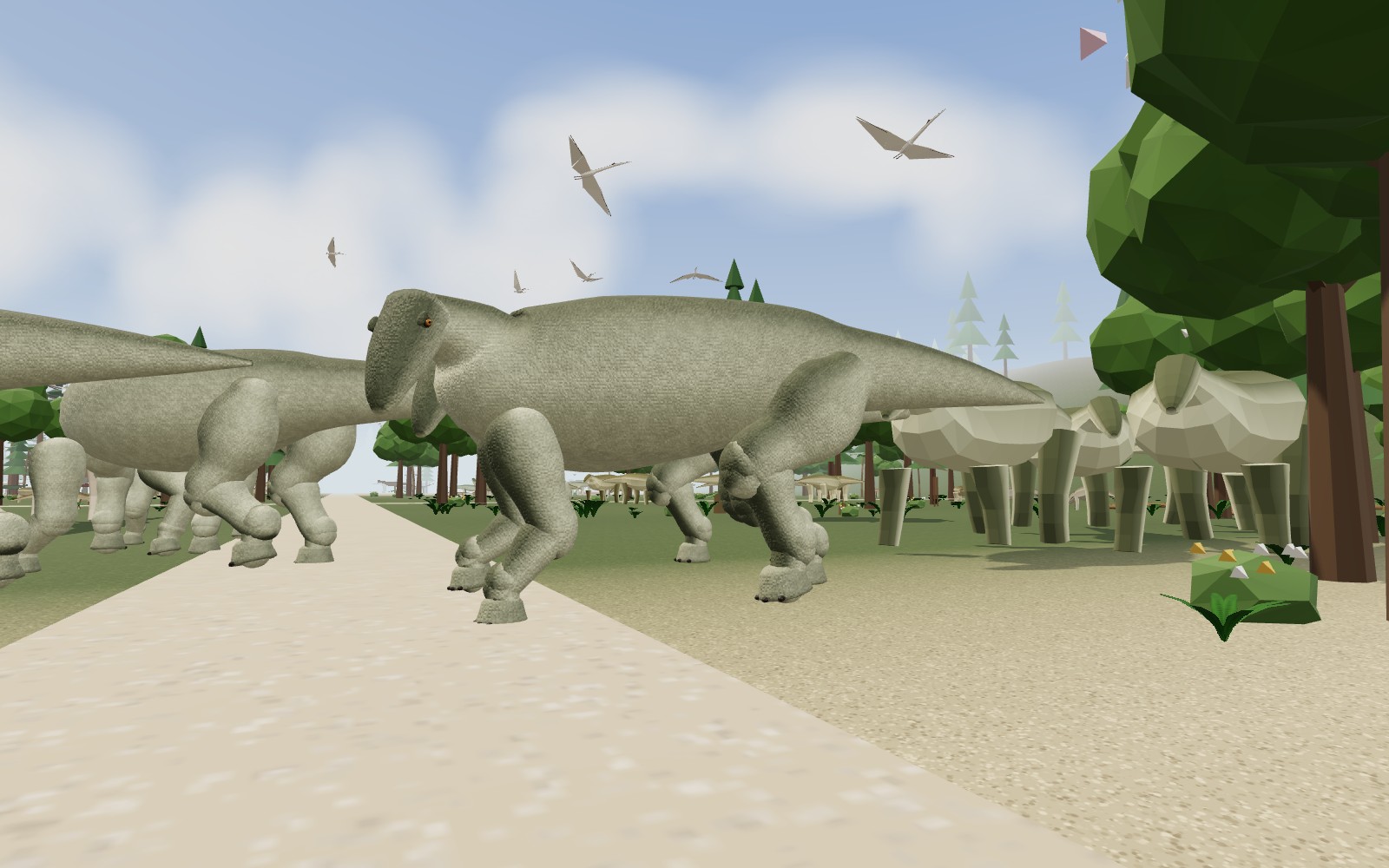
Dinosaur size comparison to humans: 172 life-size animals
A 600 m park of 172 prehistoric animals at their real size, from the first dinosaurs to T. rex, laid out by age.
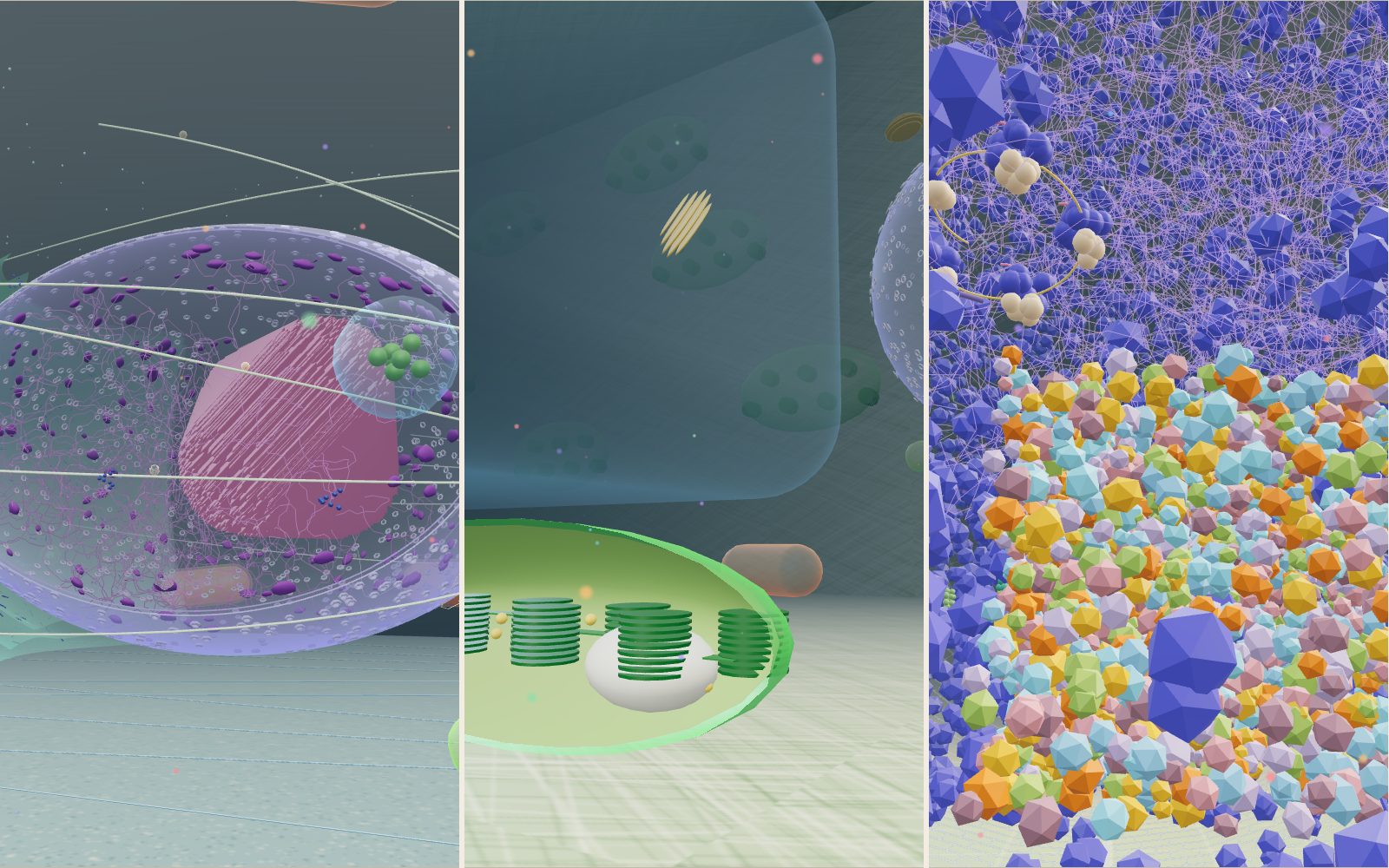
Walk inside a cell: animal, plant and bacterium
Grown a million times, a mitochondrion is about the size of a sofa, a whole E. coli is 2 m long, and the kinesin towing a vesicle past you walks at 0.8 metres per second.
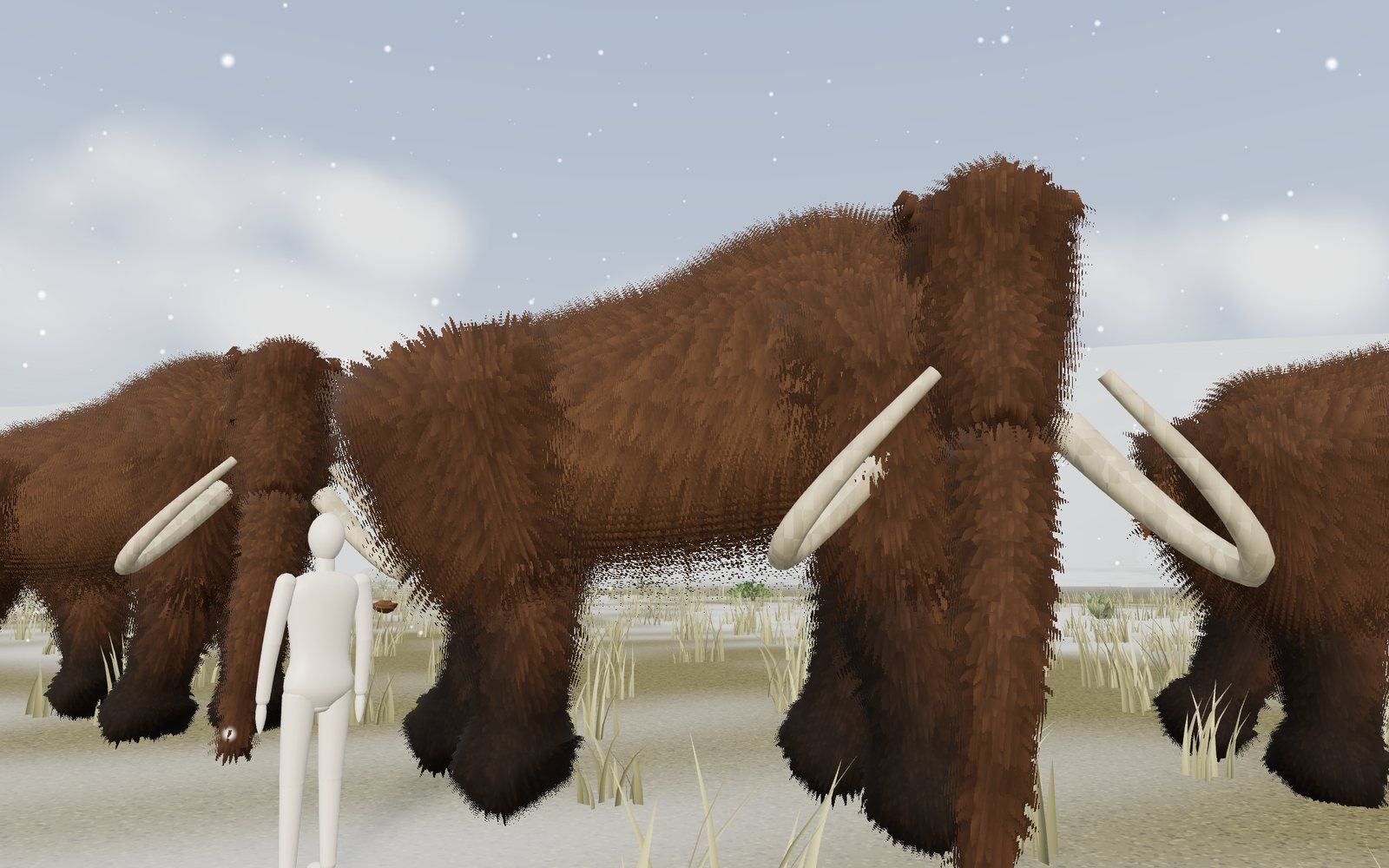
Walk among ice age animals
A 600 m park of 65 animals from the last ice age at their real size, from woolly mammoths to sabre-toothed cats, on a time slider that runs 50,000 years.
Why salt forms cubes: crystal structure and unit cells
A grain of table salt is a stack of cubes 0.564 nm on a side, with sodium and chlorine alternating along every edge.
How a horse runs: walk, trot, canter and gallop
In 1878 Muybridge's cameras showed that a galloping horse does lift all four feet at once, but with its legs tucked under it. Some fast animals never leave the ground at all.
How CRISPR-Cas9 gene editing works
A guide RNA reads just 20 letters of DNA, and that is usually enough to pick out one spot among the 3 billion base pairs of a human genome.