FIG. 52Walk-throughs
Dinosaur size comparison to humans: 172 life-size animals
A 600 m park of 172 prehistoric animals at their real size, from the first dinosaurs to T. rex, laid out by age.
This device cannot show the 3D model. You can read the guide steps below as text.
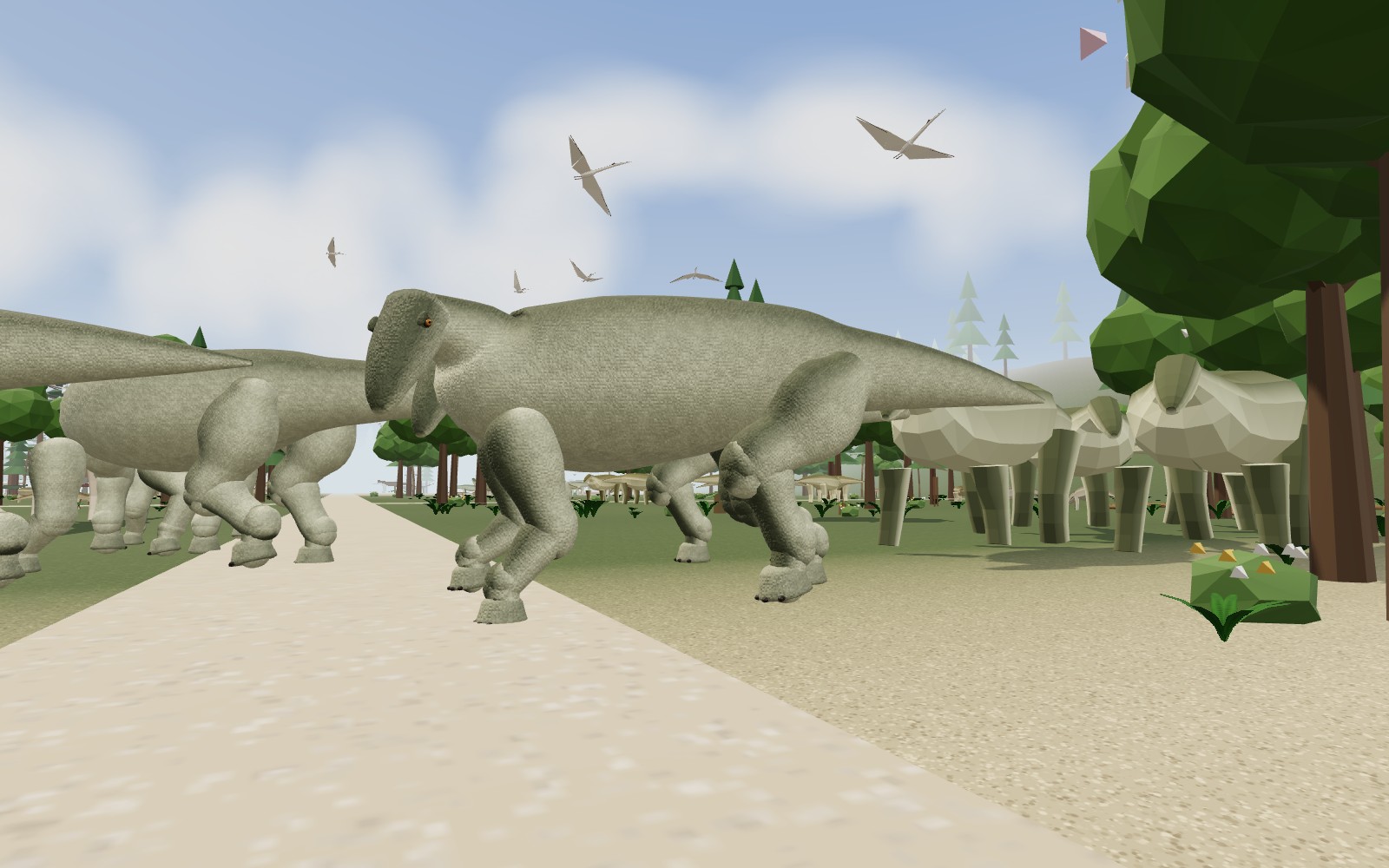
1 / 11 A park at life sizeYou start in the Late Jurassic, next to Brachiosaurus. Your eyes are 1.6 m above the ground and the person by its front legs is 1.7 m tall. On a computer you walk with WASD and run with Shift; on a phone you push the joystick, and all the way to run. The field guide button jumps to any of the 172 animals.
Drag to turn. Scroll or pinch to zoom.
What you are walking through
How big were dinosaurs beside a person? This dinosaur size comparison puts 172 prehistoric animals at real size beside a visitor at an eye height of 1.6 m. Most people first meet dinosaurs as skeletons in a museum hall, standing on a plinth and lit from below. It is hard to judge their size that way. A plinth adds a metre, the hall is huge, and you look up at the bones from a few steps away. This exhibit puts 172 prehistoric animals on open ground at their real size and lets you walk up to them at an ordinary eye height of 1.6 m.
The park is about 600 m across, roughly the size of 80 football pitches. It is laid out by age. The ground gets younger as you go east: a small Permian corner, then the Triassic, two Jurassic areas, and four Cretaceous areas split by continent. Along the south edge runs a beach and a sea, split by age in the same way, and pterosaurs fly over the areas where they lived. Fences with gates separate the ages, and a sign at each gate gives the dates.
Of the 172 animals, 137 are dinosaurs and 35 are not: pterosaurs, sea reptiles, crocodile relatives, Dimetrodon and other relatives of mammals, and a few early mammals. Most plant-eaters live in herds of two to five, and the park holds about 350 animals in all. Faceless figures 1.7 m tall stand beside the animals the guide visits, so you always have a person to compare with.
Every body is built in code from a list of measurements. There are no scanned or downloaded models. Lengths and masses come mostly from the Natural History Museum in London, and the article explains where the other numbers come from and where scientists still disagree.
How big they really were
Here is every animal in the park, oldest first. Length runs from the nose to the tip of the tail; for pterosaurs the figure is the wingspan. A range means the sources disagree or the fossils are too incomplete to give one number. Where the sources give no mass, the table says so rather than inventing one.
| Animal | Dinosaur | Length | Mass | Lived |
|---|---|---|---|---|
| Dimetrodon (Dimetrodon) | no | 3.5 m | not given | Early Permian, 286–270 million years ago |
| Eoraptor (Eoraptor lunensis) | yes | 1.7 m | 10 kg | Late Triassic, about 228 million years ago |
| Herrerasaurus (Herrerasaurus ischigualastensis) | yes | 3 m | not given | Late Triassic, about 228 million years ago |
| Thecodontosaurus (Thecodontosaurus antiquus) | yes | 2.5 m | not given | Late Triassic, 227–205 million years ago |
| Coelophysis (Coelophysis bauri) | yes | 2 m | 27 kg | Late Triassic, 225–190 million years ago |
| Riojasaurus (Riojasaurus incertus) | yes | 5.2 m | not given | Late Triassic, 221–210 million years ago |
| Plateosaurus (Plateosaurus engelhardti) | yes | 7 m | 4 t | Late Triassic, about 210 million years ago |
| Massospondylus (Massospondylus carinatus) | yes | 4 m | 70 kg | Early Jurassic, 208–204 million years ago |
| Scelidosaurus (Scelidosaurus harrisonii) | yes | 4 m | not given | Early Jurassic, 208–194 million years ago |
| Heterodontosaurus (Heterodontosaurus tucki) | yes | 1.2 m | not given | Early Jurassic, about 205 million years ago |
| Ichthyotitan (Ichthyotitan severnensis) | no | 20–26 m | not given | Late Triassic, about 202 million years ago |
| Dimorphodon (Dimorphodon macronyx) | no | 1.4 m (wingspan) | not given | Early Jurassic, about 200 million years ago |
| Plesiosaurus (Plesiosaurus dolichodeirus) | no | 3.5 m | not given | Early Jurassic, 199–191 million years ago |
| Dilophosaurus (Dilophosaurus wetherilli) | yes | 7 m | 400 kg | Early Jurassic, about 184 million years ago |
| Huayangosaurus (Huayangosaurus taibaii) | yes | 4.5 m | not given | Middle Jurassic, 170–160 million years ago |
| Megalosaurus (Megalosaurus bucklandii) | yes | 6 m | not given | Middle Jurassic, about 166 million years ago |
| Liopleurodon (Liopleurodon ferox) | no | 10 m | not given | Middle Jurassic, 166–160 million years ago |
| Kentrosaurus (Kentrosaurus aethiopicus) | yes | 5 m | not given | Late Jurassic, 155–150 million years ago |
| Camptosaurus (Camptosaurus dispar) | yes | 5 m | 1 t | Late Jurassic, 155–145 million years ago |
| Mamenchisaurus (Mamenchisaurus constructus) | yes | 22 m | not given | Late Jurassic, 155–145 million years ago |
| Dryosaurus (Dryosaurus altus) | yes | 4 m | not given | Late Jurassic, 155–140 million years ago |
| Stegosaurus (Stegosaurus stenops) | yes | 5.6–9 m | 1.6 t | Late Jurassic, 152–145 million years ago |
| Brachiosaurus (Brachiosaurus altithorax) | yes | 22 m | 47 t | Late Jurassic, 152–145 million years ago |
| Allosaurus (Allosaurus fragilis) | yes | 9.7 m | 2.7 t | Late Jurassic, 152–145 million years ago |
| Diplodocus (Diplodocus carnegii) | yes | 26 m | 15 t | Late Jurassic, 152–145 million years ago |
| Apatosaurus (Apatosaurus ajax) | yes | 21 m | not given | Late Jurassic, 152–145 million years ago |
| Ceratosaurus (Ceratosaurus nasicornis) | yes | 7 m | 980 kg | Late Jurassic, 152–145 million years ago |
| Rhamphorhynchus (Rhamphorhynchus muensteri) | no | 1.8 m (wingspan) | not given | Late Jurassic, 150–148 million years ago |
| Pterodactylus (Pterodactylus antiquus) | no | 1.5 m (wingspan) | not given | Late Jurassic, 150–148 million years ago |
| Camarasaurus (Camarasaurus supremus) | yes | 23 m | 20 t | Late Jurassic, 150–140 million years ago |
| Archaeopteryx (Archaeopteryx lithographica) | yes | 0.5 m | not given | Late Jurassic, 149–145 million years ago |
| Compsognathus (Compsognathus longipes) | yes | 0.7 m | 3 kg | Late Jurassic, 145–140 million years ago |
| Iguanodon (Iguanodon bernissartensis) | yes | 10 m | 4 t | Early Cretaceous, 140–110 million years ago |
| Utahraptor (Utahraptor ostrommaysi) | yes | 5.5 m | 350 kg | Early Cretaceous, 139–135 million years ago |
| Hypsilophodon (Hypsilophodon foxii) | yes | 2 m | 20 kg | Early Cretaceous, 130–125 million years ago |
| Baryonyx (Baryonyx walkeri) | yes | 10 m | 2 t | Early Cretaceous, about 125 million years ago |
| Polacanthus (Polacanthus foxii) | yes | 5 m | not given | Early Cretaceous, about 125 million years ago |
| Sauropelta (Sauropelta edwardsorum) | yes | 6.5 m | not given | Early Cretaceous, 121–94 million years ago |
| Microraptor (Microraptor gui) | yes | 0.8 m | 1 kg | Early Cretaceous, about 120 million years ago |
| Psittacosaurus (Psittacosaurus mongoliensis) | yes | 2 m | 50 kg | Early Cretaceous, 120–100 million years ago |
| Deinonychus (Deinonychus antirrhopus) | yes | 3.4 m | 100 kg | Early Cretaceous, 115–108 million years ago |
| Giganotosaurus (Giganotosaurus carolinii) | yes | 12–13 m | 14 t | Late Cretaceous, 100–95 million years ago |
| Spinosaurus (Spinosaurus aegyptiacus) | yes | 12–15 m | 7.4 t | Late Cretaceous, 99–94 million years ago |
| Argentinosaurus (Argentinosaurus huinculensis) | yes | 30–35 m | 70 t | Late Cretaceous, about 90 million years ago |
| Pteranodon (Pteranodon longiceps) | no | 6–7.6 m (wingspan) | 9 kg–11 kg | Late Cretaceous, 86–84 million years ago |
| Oviraptor (Oviraptor philoceratops) | yes | 2 m | 20 kg | Late Cretaceous, 85–75 million years ago |
| Deinosuchus (Deinosuchus riograndensis) | no | 8–11 m | 2.5 t–7 t | Late Cretaceous, 83–72 million years ago |
| Maiasaura (Maiasaura peeblesorum) | yes | 9 m | 2.5 t | Late Cretaceous, 80–75 million years ago |
| Parasaurolophus (Parasaurolophus walkeri) | yes | 9 m | 5 t | Late Cretaceous, 77–73 million years ago |
| Styracosaurus (Styracosaurus albertensis) | yes | 5.5 m | 2.7 t | Late Cretaceous, 76–75 million years ago |
| Corythosaurus (Corythosaurus casuarius) | yes | 10 m | not given | Late Cretaceous, 76–74 million years ago |
| Euoplocephalus (Euoplocephalus tutus) | yes | 7 m | 2 t | Late Cretaceous, 76–70 million years ago |
| Edmontosaurus (Edmontosaurus regalis) | yes | 13 m | 3.4 t | Late Cretaceous, 76–66 million years ago |
| Velociraptor (Velociraptor mongoliensis) | yes | 1.8 m | 7 kg | Late Cretaceous, 74–70 million years ago |
| Protoceratops (Protoceratops andrewsi) | yes | 1.8 m | 400 kg | Late Cretaceous, 74–70 million years ago |
| Tarbosaurus (Tarbosaurus bataar) | yes | 10 m | not given | Late Cretaceous, 74–70 million years ago |
| Mosasaurus (Mosasaurus hoffmannii) | no | 11–18 m | not given | Late Cretaceous, 72–66 million years ago |
| Carnotaurus (Carnotaurus sastrei) | yes | 8 m | not given | Late Cretaceous, 71–69 million years ago |
| Gallimimus (Gallimimus bullatus) | yes | 6 m | 490 kg | Late Cretaceous, about 70 million years ago |
| Therizinosaurus (Therizinosaurus cheloniformis) | yes | 10 m | not given | Late Cretaceous, about 70 million years ago |
| Saltasaurus (Saltasaurus loricatus) | yes | 12 m | not given | Late Cretaceous, 70–66 million years ago |
| Pachycephalosaurus (Pachycephalosaurus wyomingensis) | yes | 3 m | 450 kg | Late Cretaceous, 69–66 million years ago |
| Tyrannosaurus rex (Tyrannosaurus rex) | yes | 12 m | 7 t | Late Cretaceous, 68–66 million years ago |
| Triceratops (Triceratops horridus) | yes | 9 m | 10 t | Late Cretaceous, 68–66 million years ago |
| Ankylosaurus (Ankylosaurus magniventris) | yes | 8 m | 8 t | Late Cretaceous, 68–66 million years ago |
| Quetzalcoatlus (Quetzalcoatlus northropi) | no | 10–11 m (wingspan) | 200 kg–250 kg | Late Cretaceous, 68–66 million years ago |
A few of these numbers need a word of explanation. The Stegosaurus model follows Sophie, the most complete Stegosaurus skeleton, a young adult 5.6 m long whose mass the museum worked out in 2015. Larger Stegosaurus specimens reached about 9 m. The T. rex hip height of 4.0 m follows the Field Museum in Chicago, which gives SUE, the largest T. rex skeleton found, as 13 feet tall at the hip.
Checking the sizes against a person
The person figures make the numbers easier to feel. A 1.7 m person standing next to the T. rex reaches a little above its knee. The hips are at 4.0 m, which is 4.0 / 1.7 = 2.4 people.
Brachiosaurus changes the scale of the whole Jurassic area. Its back slopes up from the hips to the shoulders because the front legs are longer than the back legs, and the neck rises from there. The model's head is 12.6 m above the ground, which is 12.6 / 1.7 = 7.4 people standing on each other's heads, or the roof of a four-storey building.
Mass grows faster than length. If you scale a body up while keeping its shape, mass goes up with the cube of the length. Try it with the T. rex and the Velociraptor. Velociraptor is 1.8 / 12 = 0.15 times as long, so a T. rex shrunk to that length would weigh 7,000 × 0.15³ = 7,000 × 0.003375 ≈ 24 kg. The museum gives Velociraptor 7 kg, about a third of that, because it was a slim animal with a long thin tail, while T. rex had a deep chest and a heavy head.
Diplodocus and Brachiosaurus show the same thing from the other side. Diplodocus is longer, 26 m against 22 m, but the museum puts it at 15 tonnes against almost 47. Most of a Diplodocus is neck and a long, thin tail. The field guide draws each animal beside a 1.7 m person and a 12 m bus, all at one scale, so you can compare any two.
Why the park is split by time
The fences are not there to keep the animals from fighting. They separate animals that never lived at the same time.
The dinosaur age lasted about 165 million years, from roughly 230 to 66 million years ago. That is so long that the first and last dinosaurs are further apart in time than the last dinosaurs are from us. Stegosaurus and T. rex lived at least 145 − 68 = 77 million years apart. Using the middle of each range, the gap is close to 80 million years, more than the 66 million years since the asteroid impact that ended the age of dinosaurs. The board on the road at the edge of the Jurassic area draws all of this on one line.
The Cretaceous alone lasted about 79 million years, so even that area is split. Spinosaurus, Giganotosaurus and Argentinosaurus lived in South America and Africa roughly 100 to 90 million years ago and never met T. rex. The Gobi area holds the animals of Mongolia from about 85 to 70 million years ago. The North American area holds the last dinosaurs, including T. rex and Triceratops, which lived side by side until 66 million years ago. Even within one area the dates do not all overlap, so read the dates on each name tag.
Not every animal here is a dinosaur
Dinosaurs are one group of reptiles with a particular build: legs held straight under the body, and a hip socket that is open in the middle. Many animals that people call dinosaurs are something else.
Pterosaurs, such as Pteranodon and Quetzalcoatlus, were flying reptiles. They were close cousins of dinosaurs, sharing an ancestor in the Triassic, but they are a separate branch. Their wings were skin stretched from one hugely long finger to the body and legs. The sea reptiles, plesiosaurs, ichthyosaurs and mosasaurs, are not dinosaurs either. Mosasaurus was a giant lizard, related to today's monitor lizards and snakes. Deinosuchus belongs to the crocodile line.
Dimetrodon is the most surprising. It is not a reptile in the everyday sense at all. It belongs to the synapsids, the group that includes mammals, and it died out about 40 million years before the first dinosaurs appeared. It sits in its own Permian corner for that reason. In the field guide and on the name tags, every animal that is not a dinosaur says so.
Birds, on the other hand, are dinosaurs. Archaeopteryx, in the Late Jurassic area, is a small feathered dinosaur with wings, teeth and a bony tail, one of the earliest birds or bird relatives known.
Why size estimates disagree
Many of the ranges in the table are wide, and the reason is usually the fossils themselves.
Argentinosaurus is known from a few back bones, part of the hip and a piece of a leg bone. Its length of 30 to 35 m and mass of about 70 tonnes come from scaling up its relatives. Mosasaurus is mostly known from skulls, so its length is worked out from the length of the jaw, and estimates run from about 11 m to 18 m. Ichthyotitan is known from two pieces of jawbone, and the 25 m estimate depends on which relative is used to scale it.
Mass is harder than length. Scientists either scale from the thickness of leg bones, which carried the weight, or build a model of the body and work out its volume. The two methods can disagree by half. Even well-known animals like Brachiosaurus have published masses ranging from under 30 to over 50 tonnes. The park uses one source per animal where it can, and shows a range where the sources it uses disagree.
Feathers and skin
Feathers have been found with fossils of many small meat-eating dinosaurs. In the park, the animals with feathers fall into two groups, and the field guide says which is which.
The first group has direct evidence. Archaeopteryx and Microraptor are preserved with feathers in fine-grained rock, and fossil pigment shows that Microraptor's feathers were black with a glossy sheen. Velociraptor has quill knobs on a forearm bone, where long wing feathers attach in birds.
The second group has feathers because their close relatives do. No feathers have been found with Deinonychus, Utahraptor, Oviraptor, Gallimimus or Therizinosaurus, but feathers are known in close relatives of each, so the models give them feathers too.
T. rex is covered in scales. In 2017 a team led by Phil Bell described small patches of fossil skin from T. rex and its close relatives from the neck, hips and tail, and all of them show small scales. Carnotaurus is also known from skin impressions with rows of scales. Edmontosaurus mummies keep large areas of scaly skin. The large plant-eaters in the park are all scaly.
Plants of each age
The plants change from area to area because plants changed too. There are no flowering plants in the Triassic or Jurassic areas. Flowering plants first appear clearly in the Cretaceous fossil record, and early ones were small and rare; a few disputed fossils may push them back into the Jurassic. So the Jurassic forest is conifers, monkey-puzzle-like Araucaria trees, ginkgos, cycads, tree ferns and horsetails, with a thick layer of ferns on the ground.
The Early Cretaceous area looks much the same, with a few small flowering shrubs. In the North American area at the end of the Cretaceous, flowering trees and shrubs are common, along with palms and conifers. Grass is almost absent everywhere. The oldest grass fossils known are from the very end of the Cretaceous in India, found in fossil dung of plant-eating dinosaurs, so grass existed but was not the lawn it is today.
How the model walks
Each walking animal is built from a row of oval cross-sections along the body, from the tail tip to the neck, plus a head, legs and arms. The cross-sections are joined into one smooth skin bent by a chain of bones. The legs are separate jointed chains, with the joint angles worked out every frame so that each foot lands on the ground and stays planted while the body moves over it.
Two-legged animals swing their legs half a stride apart. Four-legged ones move their legs one after another: a hind leg, the front leg on the same side, the other hind leg, then the other front leg, the pattern elephants use at a walk. The speeds are relaxed, from about 0.7 to 1.6 m/s depending on leg length. They are walking speeds for the display, not top speeds.
Animals stop to look around, turn their heads towards you when you come close, and stop if you stand in the way. Plant-eaters whose path crosses the river or the beach stop there to drink. Herds follow a leader along a loop, each on a slightly wider or narrower path. There are no sounds: nobody knows what these animals sounded like, and the park does not guess.
How a park this big stays fast
A model this large would be slow if every animal were drawn in full. Only the few animals closest to you are full jointed models. Animals further away are drawn as one simple statue per species, all copies of a species in a single drawing call, and the ones at the edge of view are flat cut-outs painted from the same outline. Plants are grouped in 100 m squares and only built when you first come near, and small plants such as ferns are only drawn close to you. On slow devices the park pulls in the horizon and turns off shadows after a few slow seconds.
How the model differs from the real animals
The animals are simplified. The 61 walking animals share a handful of body templates (big two-legged hunters, small feathered ones, long-necked sauropods, plated, horned, armoured, duck-billed and dome-headed dinosaurs, a crocodile and a sail-backed synapsid) stretched to each species' length and proportions and given its crests, horns, plates or sails. The proportions match skeletal reconstructions in outline, not bone by bone. The colours are guesses, since colour is known for only a handful of small feathered dinosaurs. The animals never run, eat, fight or lie down.
Moving around the park
On a computer, walk with WASD or the arrow keys, turn with Q and E, and drag with the mouse to look around. Walking is 3 m/s; hold Shift to run at 8 m/s. Clicking the ground makes you walk to that spot. On a phone, push the joystick at the bottom left, all the way to run, and drag on the right half to look around.
The travel buttons, or keys 1 to 4, change how you move: walking, running, a park jeep at 15 m/s with your eyes 2.4 m up, and flying at 25 m/s about 45 m above the ground, where nothing blocks you. Crossing the whole park takes about three minutes on foot, 75 seconds running, and under half a minute flying.
The map in the top left shows every animal as a dot and you as a red arrow. Click anywhere on it to go there; the corner button makes it bigger, and M does the same. The field guide (button or G) lists all 172 animals with a search box, filters by age, food, size and kind, and sorting. Choosing an animal opens a card with its dates, where it was found, its size beside a person and a bus, and the sources, and "Go there" takes you to it. Animals you have seen close up get a tick.
Version 4: 172 animals from every continent
The park now holds 172 kinds of prehistoric animal: 137 dinosaurs and 35 that are not. Among the 35 are 11 pterosaurs, 12 sea reptiles (ichthyosaurs, plesiosaurs and mosasaurs), and 12 synapsids and crocodile relatives, from the tusked Placerias to Repenomamus, a mammal that ate young dinosaurs. The fossils come from 28 countries, including Australia, India, Madagascar, Niger and South Korea.
For the 82 new dinosaurs, length, age, place and food are copied from the Natural History Museum's Dino Directory page for each animal, and the weight is shown only when that page gives one. For the 24 new animals that are not dinosaurs, and for the two Korean dinosaurs, the ages are the range of rock stages listed in the Paleobiology Database, a research database run by universities. When none of the cited pages gives a length, the field guide says "no figure in these sources" and shows the length the model was built at, marked as a model value. Colour is a guess for every animal except the few where fossil pigment has been studied.
The new animals also bring new head shapes to the models. Lambeosaurus has a hatchet-shaped crest, Saurolophus a solid spike, Tsintaosaurus a crest pointing forward, Guanlong a thin blade along its snout and Citipati a tall casque. Sauropods now carry their necks at different angles: Giraffatitan high, Dicraeosaurus low. These are model choices that follow published skeletons in outline; the angle a living sauropod held its neck is still argued over.
Korea's dinosaur coast
The south coast of South Korea is one of the richest places in the world for dinosaur footprints and eggs. In 2002 Korea put five sites on its list for World Heritage: Haenam, Boseong, Yeosu, Hwasun and Goseong. Goseong alone has more than 4,000 dinosaur footprints in about 420 trackways, in layers about 120 million years old. Hwasun has meat-eater trackways up to 52 m long, and on the Yeosu islands one trackway runs for 84 m.
The footprint bed in the Early Cretaceous area is modelled on these sites. Four kinds of trail cross it. Big round prints in pairs were left by a sauropod: the small front foot lands just ahead of the large back foot. Three blunt toes, in three trails walking side by side, belong to ornithopods moving as a group. A single narrow trail with long steps and sharp, slim toes was made by a theropod. Small three-toed marks near the edge are bird tracks, which Korea's coast is known for.
Boseong is famous for eggs. Clutches of round eggs lie in red rock, and some nests are about 1.5 m across. The egg site in the East Asia area is a model of that kind of find. Bones are much rarer in Korea than footprints and eggs. Two dinosaurs in the guide are named after Korean places: Koreaceratops, a small horned dinosaur from Hwaseong described in 2011, and Koreanosaurus, a small plant-eater found near the Boseong egg site.
Nests, eggs and parents
Maiasaura means "good mother lizard". In Montana, its nests were found close together, bowls of mud with eggs and young inside, and the young in the nests had worn teeth. They had been eating for some time while still in the nest, which suggests that the adults brought them food. The nesting ground in the North America area shows seven nests with clutches of eggs beside a Maiasaura herd.
Other finds point the same way. Citipati skeletons have been found sitting on nests with their arms spread over the eggs, the way birds brood. Hypacrosaurus nests have embryos inside the eggs, and Massospondylus eggs from South Africa hold some of the oldest dinosaur embryos known. Not every dinosaur looked after its young, but some clearly did.
Reading the rocks at the fossil dig
At the fossil dig in the Late Jurassic area, a cut through the ground shows the layers that hold dinosaur fossils. From the bottom up the model shows red Triassic sandstone, grey-green Jurassic mudstone, yellow Cretaceous sandstone, a thin dark clay and then later soil. Lower layers were laid down first, so they are older. That simple rule is how a fossil hunter knows which age a bone comes from before any laboratory dates it.
In front of the cut a skeleton lies half out of the ground inside a string grid. Diggers use the grid to record where each bone lay before it is lifted, because the position of the bones tells how the animal died and was buried. No real quarry shows all these layers in one wall; the model puts them together so you can see the order.
The last day of the Cretaceous
About 66 million years ago an asteroid between 10 and 15 km wide hit the Earth near what is now the Yucatán Peninsula in Mexico. The thin dark clay at the top of the dig stands for the layer laid down worldwide after the impact; in many places it is rich in iridium, a metal that is rare in the Earth's crust and more common in asteroids. In the North America area and over the Cretaceous sea the sky shows the asteroid just before it struck. About three quarters of all animals died out after the impact, including every dinosaur except the birds.
Challenges
The challenge panel (button or T) has fourteen questions answered from the park and the guide. The first eight ask for the biggest meat-eater, three dinosaurs with feathers in their fossils, an animal that did not live in the Jurassic, the owner of a set of footprints, dinosaurs shorter than a person is tall, who lived closer in time to T. rex, a dinosaur found in Korea, and an animal that is not a dinosaur. Six more come from the hidden finds and the moving animals: find five finds, feel the ground shake beside a walking T. rex, name the owner of a fossil dropping, pick the two Korean egg sites, name the dinosaur found with 34 young, and pick the meat-eater with a tail built for swimming. The first two check themselves as you walk. The answers are worked out from the same data as the field guide, so if a number changes, the answer changes with it. Solved challenges get a star in the panel and on the matching animals in the guide, and they are remembered on your device. The panel also lists the five scenes in the park, with a button to go to each.
Hidden finds around the park
Twenty-one small fossil sites are hidden around the park, away from the roads and the animals' paths. They have no marker on the map. Walk up to one and a card opens with what it is, a link to the animal in the field guide and the source; the find gets a red star on the map and a star in the challenge panel, where the ones still missing are listed with the area they are in. Each find is modelled on a real discovery:
- In the Triassic area: logs of petrified wood like those of Arizona's Petrified Forest, buried in a river more than 200 million years ago, and on the Triassic beach a slab with an ichthyosaur embryo in birth position, after a Chaohusaurus fossil from China about 248 million years old.
- In the Late Jurassic area: a sloping rock face with bones in it, after the wall of about 1,500 bones at Dinosaur National Monument; a slab of Solnhofen limestone like the one that held the first Archaeopteryx in 1861; a heap of polished stomach stones beside a sauropod's ribs; and at the fossil dig, a flag on the thin dark clay that Luis and Walter Alvarez found to be rich in iridium.
- In the Early Cretaceous area: one adult Psittacosaurus with 34 young inside half a square metre; a feathered dinosaur tail in amber from Myanmar; a Sinosauropteryx with a dark back, pale belly and banded tail; long filament feathers beside a Yutyrannus skull; and on the footprint bed, a survey frame for the Goseong trackways and a pterosaur trail like those of Uhang-ri in Haenam.
- In the East Asia area: a broken egg at the Boseong egg site, a clutch of eggs like those of Gojeong-ri in Hwaseong, and an oviraptorid sitting on its nest with its arms spread over the eggs.
- In the South America and Africa area: a field of sauropod eggs like Auca Mahuevo in Patagonia, where some eggs hold embryos with fossil skin, and the deep paddle of a Spinosaurus tail from Morocco.
- In the North America area: a Maiasaura nest with young, a giant coprolite from Saskatchewan that is 30 to 50 percent broken bone, SUE's skull, and on the beach a rock with the same dark layer under the asteroid in the sky.
The models are simplified: sizes are close to the real finds where the source gives a size and otherwise drawn to read well, and no real site has all of these things in one place.
Animals that move, footsteps and the size photo
Animals in the middle distance used to stand still as statues. Now their tails swing, their heads and necks turn slowly, and their legs swing in step when the herd walks. This is done on the graphics card by bending the statue's points according to where they sit along the body, so it costs no extra drawing. Two herds are on the move: ten Edmontosaurus and ten Centrosaurus walk two abreast around their loops and stop only to drink. Both are known from bonebeds that hold many animals of one kind.
The Footsteps button turns on sound and a shaking ground. Near a walking animal heavier than about four tonnes you hear each step, louder the closer and heavier it is, and the view shakes a little. Nothing plays until you turn it on.
In the field guide, each animal that walks has a Size photo button. It draws the animal side on, with a 1.7 m person and a 12 m bus on the same ground and a 5 m scale bar, using a camera without perspective so every length in the picture is to the same scale. You can save the picture as an image.
Questions
Did T. rex and Stegosaurus ever meet?
No. Stegosaurus lived 152 to 145 million years ago and T. rex 68 to 66 million years ago. At least 77 million years separate them, which is more than the 66 million years between T. rex and us.
Did Velociraptor live alongside T. rex?
No. Velociraptor lived 74 to 70 million years ago in what is now Mongolia. T. rex lived later, in western North America. The park keeps them in separate areas for that reason.
Is a pterosaur a dinosaur?
No. Pterosaurs were flying reptiles that shared an ancestor with dinosaurs in the Triassic but form a separate branch. The same goes for plesiosaurs, ichthyosaurs and mosasaurs in the sea. Birds, though, are dinosaurs.
Is Dimetrodon a dinosaur?
No. Dimetrodon belongs to the synapsids, the group that includes mammals, and it died out about 40 million years before the first dinosaurs. It has its own Permian corner in the park.
Which animal in the park is the biggest?
The longest is Argentinosaurus at 30 to 35 m, also the heaviest at about 70 tonnes. In the sea, Ichthyotitan may have reached about 25 m, but it is known from only two jawbones.
Was Velociraptor really this small?
Yes. The Natural History Museum gives it a length of 1.8 m and a mass of 7 kg. Most of the length is tail. The large "raptors" in films are closer in size to Deinonychus or Utahraptor, both in the Early Cretaceous area.
Why do some animals show a range instead of one number?
Because the sources disagree or the fossils are incomplete. Mosasaurus length is worked out from skulls and runs from 11 to 18 m. Argentinosaurus is known from a few bones. The park shows the range rather than picking one value.
Why do some animals have no weight?
The sources cited for those animals give a length but no mass. Rather than add a figure from nowhere, the field guide says the sources give none.
Did T. rex have feathers?
Fossil skin from T. rex and its close relatives shows small scales on the neck, hips and tail. Some smaller tyrannosaur relatives had feathers. Whether an adult T. rex had any feathers at all is not settled, and the model shows scales.
What colour were these dinosaurs?
Nobody knows for most of them. Colour has been worked out for a few small feathered dinosaurs from fossil pigment structures, including Microraptor, which the park shows black. The other colours are muted guesses.
Did dinosaurs eat grass?
Hardly any. The oldest grass fossils are from the very end of the Cretaceous in India, found in dinosaur dung. Grass was rare, and the park has none.
Were there dinosaurs in Korea?
Yes. The south coast has thousands of footprints and many egg sites from the Cretaceous, and two named dinosaurs come from Korean rocks: Koreaceratops from Hwaseong and Koreanosaurus from Boseong. Bones are rare there compared with footprints and eggs.
How can you tell who made a footprint?
From its shape and the trail it is part of. Sauropods leave big round prints with a smaller front-foot print ahead; ornithopods leave three broad, blunt toes; theropods leave three slim toes with sharp tips and walk in a narrow line. The exact species is almost never known, so trackways get their own names.
Did dinosaurs look after their young?
Some did. Maiasaura young with worn teeth were found in the nests, and Citipati adults were found sitting on their eggs like brooding birds. Others may have left their eggs once they were laid.
What happened 66 million years ago?
An asteroid between 10 and 15 km wide hit the Earth near what is now Mexico. The dust, fires and cold that followed ended the age of dinosaurs. Birds, which are dinosaurs, survived.
What is a coprolite?
A coprolite is fossil dung. Most are hard to pin on one animal, but a coprolite from Saskatchewan in Canada is so large and so full of bone, 30 to 50 percent by volume, that only a tyrannosaur living there could have left it. It shows that this meat eater crushed and swallowed bone.
Why are there stones inside some sauropod skeletons?
Polished pebbles found among sauropod ribs are probably stomach stones. Birds such as ostriches grind food with stones in the gizzard, but the stones found with sauropods weigh far less than 0.1 percent of the body, about a tenth of what an ostrich carries, and ostrich stones wear rough rather than polished. So sauropods most likely did not grind their food that way.
Where can I see dinosaur fossils in Korea?
The south coast has several sites protected as Natural Monuments: footprints of dinosaurs and birds at Deogmyeong-ri in Goseong; footprints of dinosaurs, pterosaurs and birds at Uhang-ri in Haenam; and egg sites at Bibong-ri in Boseong and Gojeong-ri in Hwaseong. The park has a hidden find for each of them.
Terms
- Permian, Triassic, Jurassic, Cretaceous: periods of geological time. The Triassic ran from about 252 to 201 million years ago, the Jurassic from 201 to 145, and the Cretaceous from 145 to 66.
- Formation: a named body of rock layers laid down in one region over a span of time. Fossils are dated by the formation they come from.
- Morrison Formation: Late Jurassic rocks in the western United States that hold Stegosaurus, Brachiosaurus, Diplodocus, Allosaurus and many other dinosaurs.
- Sauropod: a long-necked, four-legged plant-eating dinosaur such as Brachiosaurus or Argentinosaurus.
- Theropod: a mostly meat-eating dinosaur that walked on two legs, such as T. rex and Velociraptor. Birds are theropods.
- Pterosaur: a flying reptile, a close cousin of the dinosaurs but not one of them.
- Plesiosaur: a sea reptile with four flippers, either long-necked like Plesiosaurus or short-necked with a big head like Liopleurodon.
- Synapsid: the group of animals that includes mammals and their extinct relatives such as Dimetrodon.
- Quill knob: a small bump on a bird's forearm bone where a large wing feather attaches.
- Hip height: the height of the hip joint above the ground, a common way to compare body size.
- Coprolite: fossil dung.
- Gastrolith: a stone swallowed by an animal and kept in the gut.
- Embryo: a young animal still inside the egg or the mother.
Sources
- American Museum of Natural History, Dimetrodon. https://www.amnh.org/exhibitions/permanent/primitive-mammals/dimetrodon (checked 17 October 2026)
- University of California Museum of Paleontology, Introduction to the Pelycosaurs (Dimetrodon as a Permian synapsid). https://ucmp.berkeley.edu/synapsids/pelycosaurs.html (checked 17 October 2026)
- University of California Museum of Paleontology, Introduction to the Synapsida. https://ucmp.berkeley.edu/synapsids/synapsida.html (checked 17 October 2026)
- Natural History Museum, London, Dino Directory: Eoraptor. https://www.nhm.ac.uk/discover/dino-directory/eoraptor.html (checked 17 October 2026)
- Natural History Museum, London, Dino Directory: Herrerasaurus. https://www.nhm.ac.uk/discover/dino-directory/herrerasaurus.html (checked 17 October 2026)
- Natural History Museum, London, Dino Directory: Thecodontosaurus. https://www.nhm.ac.uk/discover/dino-directory/thecodontosaurus.html (checked 17 October 2026)
- Natural History Museum, London, Dino Directory: Coelophysis. https://www.nhm.ac.uk/discover/dino-directory/coelophysis.html (checked 17 October 2026)
- Natural History Museum, London, Dino Directory: Riojasaurus. https://www.nhm.ac.uk/discover/dino-directory/riojasaurus.html (checked 17 October 2026)
- Natural History Museum, London, Dino Directory: Plateosaurus. https://www.nhm.ac.uk/discover/dino-directory/plateosaurus.html (checked 17 October 2026)
- Natural History Museum, London, Dino Directory: Massospondylus. https://www.nhm.ac.uk/discover/dino-directory/massospondylus.html (checked 17 October 2026)
- Natural History Museum, London, Dino Directory: Scelidosaurus. https://www.nhm.ac.uk/discover/dino-directory/scelidosaurus.html (checked 17 October 2026)
- Natural History Museum, London, Dino Directory: Heterodontosaurus. https://www.nhm.ac.uk/discover/dino-directory/heterodontosaurus.html (checked 17 October 2026)
- Lomax, D. R. et al., The last giants: New evidence for giant Late Triassic (Rhaetian) ichthyosaurs from the UK, PLOS ONE (2024). https://pmc.ncbi.nlm.nih.gov/articles/PMC11023487/ (checked 17 October 2026)
- Natural History Museum, London, Giant marine reptile found in UK could be largest ever discovered (2024). https://www.nhm.ac.uk/discover/news/2024/april/giant-marine-reptile-found-in-uk-could-be-largest-ever-discovered.html (checked 17 October 2026)
- American Museum of Natural History, Tuesday's Pterosaur: Dimorphodon (2014). https://www.amnh.org/explore/news-blogs/dimorphodon-pterosaur (checked 17 October 2026)
- Natural History Museum, London, Pterosaurs: The truth about these 'flying dinosaurs'. https://www.nhm.ac.uk/discover/the-truth-about-pterosaurs.html (checked 17 October 2026)
- Natural History Museum, London, What is a plesiosaur?. https://www.nhm.ac.uk/discover/what-is-a-plesiosaur.html (checked 17 October 2026)
- Natural History Museum, London, Dino Directory: Dilophosaurus. https://www.nhm.ac.uk/discover/dino-directory/dilophosaurus.html (checked 17 October 2026)
- Natural History Museum, London, Dino Directory: Huayangosaurus. https://www.nhm.ac.uk/discover/dino-directory/huayangosaurus.html (checked 17 October 2026)
- Natural History Museum, London, Dino Directory: Megalosaurus. https://www.nhm.ac.uk/discover/dino-directory/megalosaurus.html (checked 17 October 2026)
- Natural History Museum, London, How dinosaurs got their name. https://www.nhm.ac.uk/discover/how-dinosaurs-got-their-name.html (checked 17 October 2026)
- Natural History Museum, London, Dino Directory: Kentrosaurus. https://www.nhm.ac.uk/discover/dino-directory/kentrosaurus.html (checked 17 October 2026)
- Natural History Museum, London, Dino Directory: Camptosaurus. https://www.nhm.ac.uk/discover/dino-directory/camptosaurus.html (checked 17 October 2026)
- Natural History Museum, London, Dino Directory: Mamenchisaurus. https://www.nhm.ac.uk/discover/dino-directory/mamenchisaurus.html (checked 17 October 2026)
- Natural History Museum, London, Dino Directory: Dryosaurus. https://www.nhm.ac.uk/discover/dino-directory/dryosaurus.html (checked 17 October 2026)
- Natural History Museum, London, Dino Directory: Stegosaurus. https://www.nhm.ac.uk/discover/dino-directory/stegosaurus.html (checked 17 October 2026)
- Natural History Museum, London, Weight of the world's most complete Stegosaurus revealed (2015). https://www.nhm.ac.uk/discover/news/2015/march/weight-of-the-worlds-most-complete-stegosaurus-revealed.html (checked 17 October 2026)
- Natural History Museum, London, Dino Directory: Brachiosaurus. https://www.nhm.ac.uk/discover/dino-directory/brachiosaurus.html (checked 17 October 2026)
- Natural History Museum, London, Dino Directory: Allosaurus. https://www.nhm.ac.uk/discover/dino-directory/allosaurus.html (checked 17 October 2026)
- Natural History Museum, London, Dino Directory: Diplodocus. https://www.nhm.ac.uk/discover/dino-directory/diplodocus.html (checked 17 October 2026)
- Natural History Museum, London, Dino Directory: Apatosaurus. https://www.nhm.ac.uk/discover/dino-directory/apatosaurus.html (checked 17 October 2026)
- Natural History Museum, London, Dino Directory: Ceratosaurus. https://www.nhm.ac.uk/discover/dino-directory/ceratosaurus.html (checked 17 October 2026)
- American Museum of Natural History, Meet the Pterosaurs!. https://www.amnh.org/explore/ology/paleontology/pterosaurs-the-card-game/meet-the-pterosaurs (checked 17 October 2026)
- University of California Museum of Paleontology, Pterosauria. https://ucmp.berkeley.edu/diapsids/pterosauria.php (checked 17 October 2026)
- Natural History Museum, London, Dino Directory: Camarasaurus. https://www.nhm.ac.uk/discover/dino-directory/camarasaurus.html (checked 17 October 2026)
- Natural History Museum, London, Dino Directory: Archaeopteryx. https://www.nhm.ac.uk/discover/dino-directory/archaeopteryx.html (checked 17 October 2026)
- Natural History Museum, London, Dino Directory: Compsognathus. https://www.nhm.ac.uk/discover/dino-directory/compsognathus.html (checked 17 October 2026)
- Natural History Museum, London, Dino Directory: Iguanodon. https://www.nhm.ac.uk/discover/dino-directory/iguanodon.html (checked 17 October 2026)
- Natural History Museum, London, Dino Directory: Utahraptor. https://www.nhm.ac.uk/discover/dino-directory/utahraptor.html (checked 17 October 2026)
- Natural History Museum, London, Dino Directory: Hypsilophodon. https://www.nhm.ac.uk/discover/dino-directory/hypsilophodon.html (checked 17 October 2026)
- Natural History Museum, London, Dino Directory: Baryonyx. https://www.nhm.ac.uk/discover/dino-directory/baryonyx.html (checked 17 October 2026)
- Natural History Museum, London, Dino Directory: Polacanthus. https://www.nhm.ac.uk/discover/dino-directory/polacanthus.html (checked 17 October 2026)
- Natural History Museum, London, Dino Directory: Sauropelta. https://www.nhm.ac.uk/discover/dino-directory/sauropelta.html (checked 17 October 2026)
- Natural History Museum, London, Dino Directory: Microraptor. https://www.nhm.ac.uk/discover/dino-directory/microraptor.html (checked 17 October 2026)
- Natural History Museum, London, Dino Directory: Psittacosaurus. https://www.nhm.ac.uk/discover/dino-directory/psittacosaurus.html (checked 17 October 2026)
- Natural History Museum, London, Dino Directory: Deinonychus. https://www.nhm.ac.uk/discover/dino-directory/deinonychus.html (checked 17 October 2026)
- Natural History Museum, London, Dino Directory: Giganotosaurus. https://www.nhm.ac.uk/discover/dino-directory/giganotosaurus.html (checked 17 October 2026)
- Natural History Museum, London, Dino Directory: Spinosaurus. https://www.nhm.ac.uk/discover/dino-directory/spinosaurus.html (checked 17 October 2026)
- Natural History Museum, London, Dino Directory: Argentinosaurus. https://www.nhm.ac.uk/discover/dino-directory/argentinosaurus.html (checked 17 October 2026)
- University of California Museum of Paleontology, Pteranodon ingens display information. https://ucmp.berkeley.edu/museum/public/ingensmount.html (checked 17 October 2026)
- Natural History Museum, London, Dino Directory: Oviraptor. https://www.nhm.ac.uk/discover/dino-directory/oviraptor.html (checked 17 October 2026)
- Western Australian Museum, Deinosuchus. https://museum.wa.gov.au/explore/dinosaur-discovery/deinosuchus (checked 17 October 2026)
- Erickson, G. M. and Brochu, C. A., How the 'terror crocodile' grew so big, Nature (1999). https://www.nature.com/articles/18343 (checked 17 October 2026)
- Natural History Museum, London, Dino Directory: Maiasaura. https://www.nhm.ac.uk/discover/dino-directory/maiasaura.html (checked 17 October 2026)
- Natural History Museum, London, Dino Directory: Parasaurolophus. https://www.nhm.ac.uk/discover/dino-directory/parasaurolophus.html (checked 17 October 2026)
- Natural History Museum, London, Dino Directory: Styracosaurus. https://www.nhm.ac.uk/discover/dino-directory/styracosaurus.html (checked 17 October 2026)
- Natural History Museum, London, Dino Directory: Corythosaurus. https://www.nhm.ac.uk/discover/dino-directory/corythosaurus.html (checked 17 October 2026)
- Natural History Museum, London, Dino Directory: Euoplocephalus. https://www.nhm.ac.uk/discover/dino-directory/euoplocephalus.html (checked 17 October 2026)
- Natural History Museum, London, Dino Directory: Edmontosaurus. https://www.nhm.ac.uk/discover/dino-directory/edmontosaurus.html (checked 17 October 2026)
- Natural History Museum, London, Dino Directory: Velociraptor. https://www.nhm.ac.uk/discover/dino-directory/velociraptor.html (checked 17 October 2026)
- Natural History Museum, London, Dino Directory: Protoceratops. https://www.nhm.ac.uk/discover/dino-directory/protoceratops.html (checked 17 October 2026)
- Natural History Museum, London, Dino Directory: Tarbosaurus. https://www.nhm.ac.uk/discover/dino-directory/tarbosaurus.html (checked 17 October 2026)
- Natural History Museum, London, What is a mosasaur?. https://www.nhm.ac.uk/discover/what-is-a-mosasaur.html (checked 17 October 2026)
- Natural History Museum, London, Dino Directory: Carnotaurus. https://www.nhm.ac.uk/discover/dino-directory/carnotaurus.html (checked 17 October 2026)
- Natural History Museum, London, Dino Directory: Gallimimus. https://www.nhm.ac.uk/discover/dino-directory/gallimimus.html (checked 17 October 2026)
- Natural History Museum, London, Dino Directory: Therizinosaurus. https://www.nhm.ac.uk/discover/dino-directory/therizinosaurus.html (checked 17 October 2026)
- Natural History Museum, London, Dino Directory: Saltasaurus. https://www.nhm.ac.uk/discover/dino-directory/saltasaurus.html (checked 17 October 2026)
- Natural History Museum, London, Dino Directory: Pachycephalosaurus. https://www.nhm.ac.uk/discover/dino-directory/pachycephalosaurus.html (checked 17 October 2026)
- Natural History Museum, London, Dino Directory: Tyrannosaurus. https://www.nhm.ac.uk/discover/dino-directory/tyrannosaurus.html (checked 17 October 2026)
- Field Museum, SUE the T. rex. https://www.fieldmuseum.org/blog/sue-t-rex (checked 17 October 2026)
- Natural History Museum, London, Dino Directory: Triceratops. https://www.nhm.ac.uk/discover/dino-directory/triceratops.html (checked 17 October 2026)
- Natural History Museum, London, Dino Directory: Ankylosaurus. https://www.nhm.ac.uk/discover/dino-directory/ankylosaurus.html (checked 17 October 2026)
- Witton, M. P. and Habib, M. B., On the size and flight diversity of giant pterosaurs, PLOS ONE (2010). https://journals.plos.org/plosone/article?id=10.1371/journal.pone.0013982 (checked 17 October 2026)
- Bell, P. R. et al., Tyrannosauroid integument reveals conflicting patterns of gigantism and feather evolution, Biology Letters (2017). https://pmc.ncbi.nlm.nih.gov/articles/PMC5493735/ (checked 17 October 2026)
- U.S. Geological Survey, What did dinosaurs eat?. https://pubs.usgs.gov/gip/dinosaurs/food.html (checked 17 October 2026)
- Cal Poly Humboldt Natural History Museum, Cretaceous Period. https://natmus.humboldt.edu/exhibits/life-through-time/visual-timeline/cretaceous-period (checked 17 October 2026)
- Prasad, V. et al., Dinosaur coprolites and the early evolution of grasses and grazers, Science (2005). https://pubmed.ncbi.nlm.nih.gov/16293759/ (checked 17 October 2026)
- International Commission on Stratigraphy, International Chronostratigraphic Chart. https://stratigraphy.org/chart (checked 17 October 2026)
- Korea Heritage Service, Sites of fossilized dinosaurs throughout the Southern seacoast (World Heritage tentative list, 2002). https://english.cha.go.kr/html/HtmlPage.do?mn=EN_03_01&pg=%2Fwh%2FWH_tentative_3.jsp (checked 18 October 2026)
- UNESCO World Heritage Centre, Sites of fossilized dinosaurs throughout the Southern seacoast. https://whc.unesco.org/en/tentativelists/1640 (checked 18 October 2026)
- Korea Heritage Service, Tracksite of Dinosaurs and Birds in Deokmyeong-ri, Goseong (Natural Monument). https://www.heritage.go.kr/heri/cul/culSelectDetail.do?ccbaCpno=1363804110000 (checked 18 October 2026)
- Natural History Museum, London, How an asteroid ended the age of the dinosaurs. https://www.nhm.ac.uk/discover/how-an-asteroid-caused-extinction-of-dinosaurs.html (checked 18 October 2026)
- Natural History Museum, London, Dino Directory: Maiasaura. https://www.nhm.ac.uk/discover/dino-directory/maiasaura.html (checked 18 October 2026)
- Natural History Museum, London, What is an ichthyosaur?. https://www.nhm.ac.uk/discover/what-is-an-ichthyosaur.html (checked 18 October 2026)
- Paleobiology Database (ages of the 24 new animals that are not dinosaurs and of the Korean dinosaurs). https://paleobiodb.org/ (checked 18 October 2026)
- Lee, Y.-N., Ryan, M. J. and Kobayashi, Y., The first ceratopsian dinosaur from South Korea, Naturwissenschaften (2011). https://link.springer.com/article/10.1007/s00114-010-0739-y (checked 18 October 2026)
- Huh, M. et al., A new basal ornithopod dinosaur from the Upper Cretaceous of South Korea, Neues Jahrbuch für Geologie und Paläontologie (2011). https://doi.org/10.1127/0077-7749/2010/0102 (checked 18 October 2026)
- Zhang, F. et al., Fossilized melanosomes and the colour of Cretaceous dinosaurs and birds, Nature (2010). https://www.nature.com/articles/nature08740 (checked 18 October 2026)
- Li, Q. et al., Plumage color patterns of an extinct dinosaur, Science (2010). https://www.science.org/doi/10.1126/science.1186290 (checked 18 October 2026)
- Xu, X. et al., A gigantic feathered dinosaur from the Lower Cretaceous of China, Nature (2012). https://www.nature.com/articles/nature10906 (checked 18 October 2026)
- Lee, Y.-N. et al., Resolving the long-standing enigmas of a giant ornithomimosaur Deinocheirus mirificus, Nature (2014). https://www.nature.com/articles/nature13874 (checked 18 October 2026)
- Hu, Y. et al., Large Mesozoic mammals fed on young dinosaurs, Nature (2005). https://www.nature.com/articles/nature03102 (checked 18 October 2026)
- Academy of Natural Sciences of Drexel University, Dinosaur Hall (Hadrosaurus foulkii). https://ansp.org/exhibits/dinosaur-hall (checked 18 October 2026)
- Natural History Museum, London, Dino Directory (one page per new dinosaur, for example Lambeosaurus). https://www.nhm.ac.uk/discover/dino-directory/lambeosaurus.html (checked 18 October 2026)
- Horner, J. R. and Makela, R., Nest of juveniles provides evidence of family structure among dinosaurs, Nature (1979). https://www.nature.com/articles/282296a0 (checked 18 October 2026)
- U.S. National Park Service, Petrified Forest National Park, Petrified Wood. https://www.nps.gov/pefo/learn/nature/petrified-wood.htm (checked 26 October 2026)
- Motani, R. et al., Terrestrial Origin of Viviparity in Mesozoic Marine Reptiles Indicated by Early Triassic Embryonic Fossils, PLOS ONE (2014). https://journals.plos.org/plosone/article?id=10.1371/journal.pone.0088640 (checked 26 October 2026)
- U.S. National Park Service, Dinosaur National Monument, Quarry Exhibit Hall. https://www.nps.gov/dino/planyourvisit/quarry-exhibit-hall.htm (checked 26 October 2026)
- Wings, O. and Sander, P. M., No gastric mill in sauropod dinosaurs: new evidence from analysis of gastrolith mass and function in ostriches, Proceedings of the Royal Society B (2007). https://pmc.ncbi.nlm.nih.gov/articles/PMC2093978/ (checked 26 October 2026)
- Meng, Q. et al., Parental care in an ornithischian dinosaur, Nature (2004). https://www.nature.com/articles/431145a (checked 26 October 2026)
- Xing, L. et al., A Feathered Dinosaur Tail with Primitive Plumage Trapped in Mid-Cretaceous Amber, Current Biology (2016). https://doi.org/10.1016/j.cub.2016.10.008 (checked 26 October 2026)
- Smithwick, F. M. et al., Countershading and Stripes in the Theropod Dinosaur Sinosauropteryx Reveal Heterogeneous Habitats in the Early Cretaceous Jehol Biota, Current Biology (2017). https://doi.org/10.1016/j.cub.2017.09.032 (checked 26 October 2026)
- Korea Heritage Service, Fossil site of dinosaur, pterosaur and bird footprints in Uhang-ri, Haenam (Natural Monument). https://www.heritage.go.kr/heri/cul/culSelectDetail.do?VdkVgwKey=16,03940000,36 (checked 26 October 2026)
- Korea Heritage Service, Fossil site of dinosaur eggs in Bibong-ri, Boseong (Natural Monument). https://www.heritage.go.kr/heri/cul/culSelectDetail.do?VdkVgwKey=16,04180000,36 (checked 26 October 2026)
- Korea Heritage Service, Fossil site of dinosaur eggs in Gojeong-ri, Hwaseong (Natural Monument). https://www.heritage.go.kr/heri/cul/culSelectDetail.do?VdkVgwKey=16,04140000,31 (checked 26 October 2026)
- Norell, M. A. et al., A nesting dinosaur, Nature (1995). https://www.nature.com/articles/378774a0 (checked 26 October 2026)
- Natural History Museum, London, Dino Directory: Citipati. https://www.nhm.ac.uk/discover/dino-directory/citipati.html (checked 26 October 2026)
- Chiappe, L. M. et al., Sauropod dinosaur embryos from the Late Cretaceous of Patagonia, Nature (1998). https://www.nature.com/articles/24370 (checked 26 October 2026)
- Ibrahim, N. et al., Tail-propelled aquatic locomotion in a theropod dinosaur, Nature (2020). https://www.nature.com/articles/s41586-020-2190-3 (checked 26 October 2026)
- Chin, K. et al., A king-sized theropod coprolite, Nature (1998). https://www.nature.com/articles/31461 (checked 26 October 2026)
More exhibits
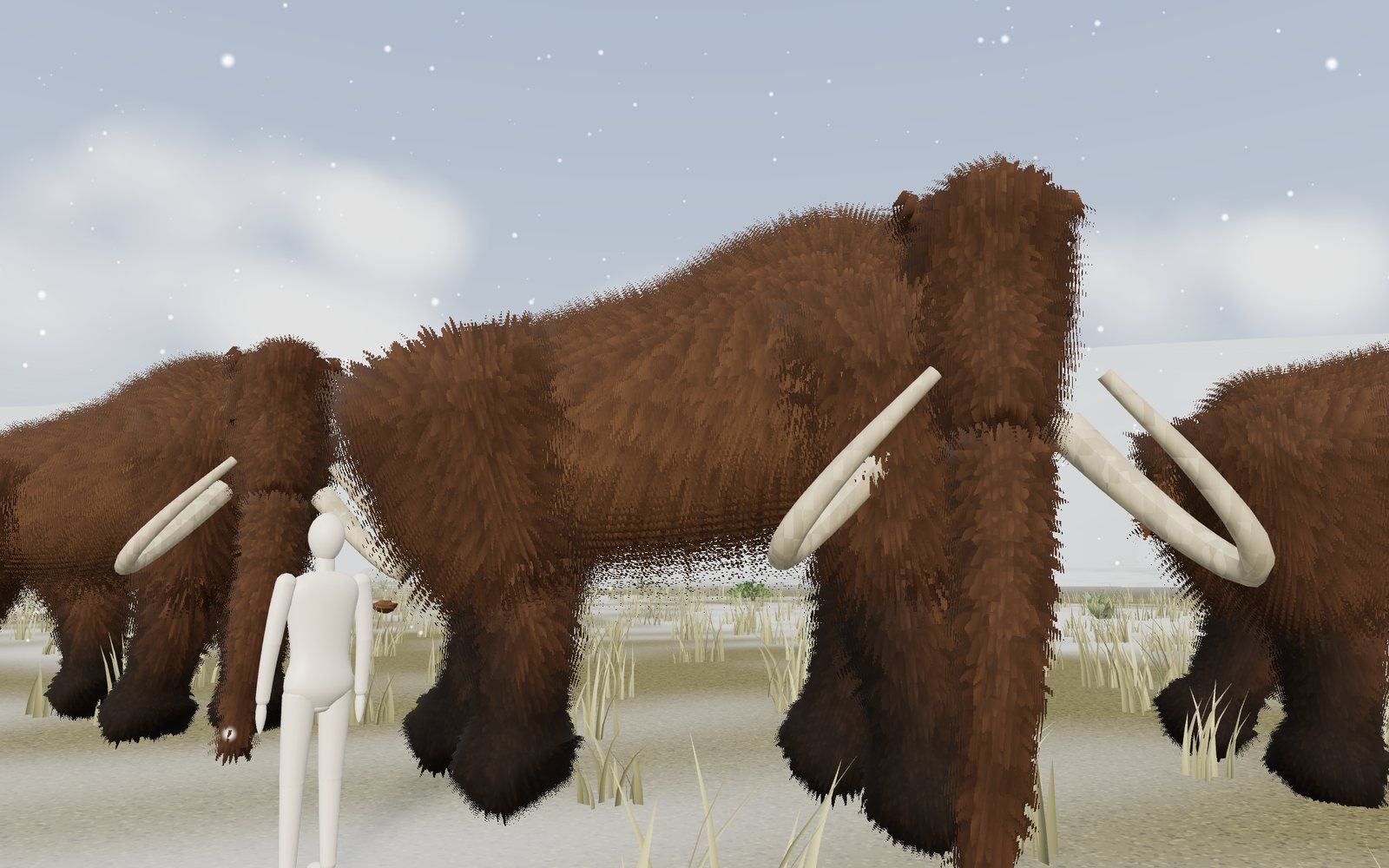
Walk among ice age animals
A 600 m park of 65 animals from the last ice age at their real size, from woolly mammoths to sabre-toothed cats, on a time slider that runs 50,000 years.
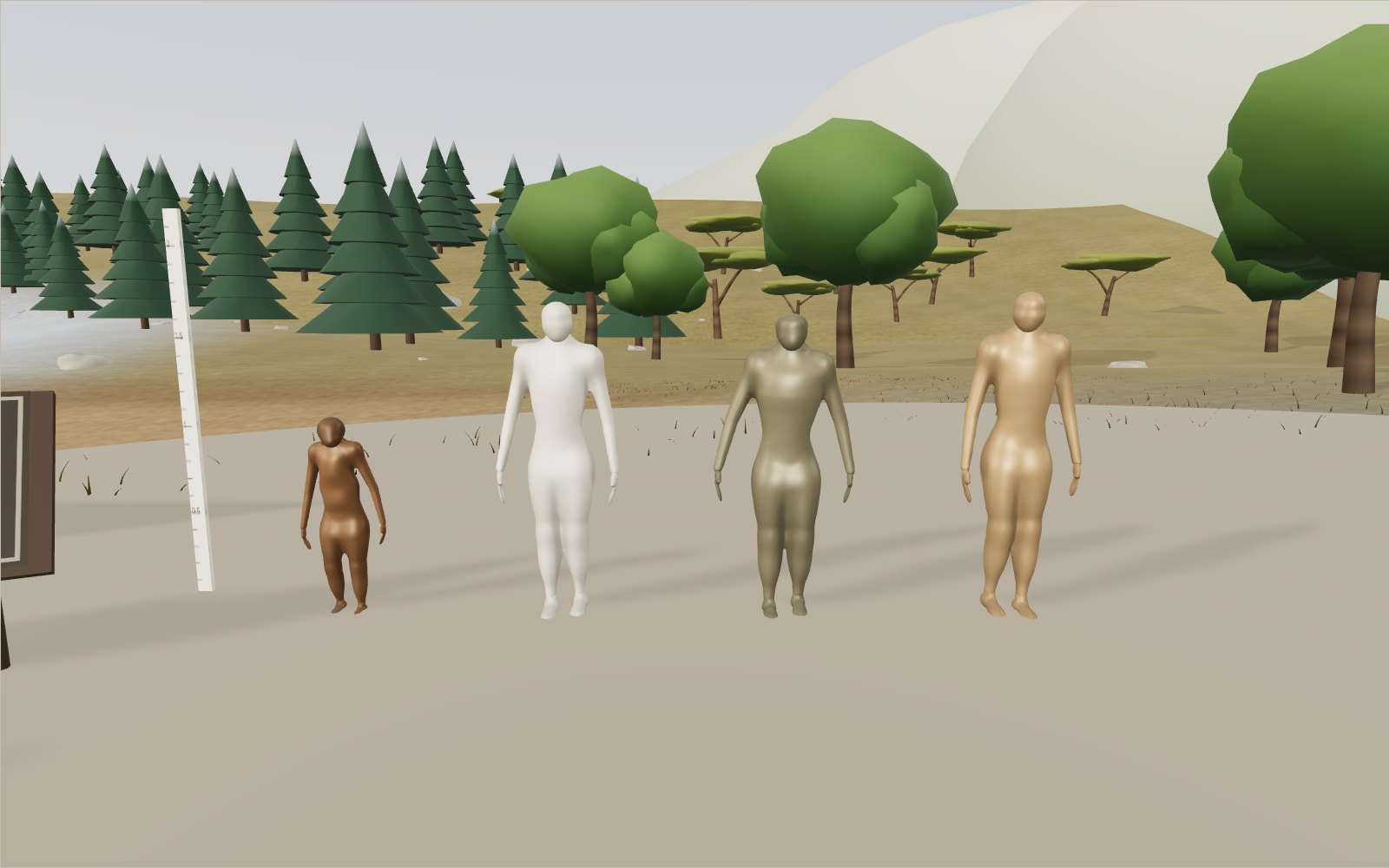
Human evolution walk
Lucy stood about 1.1 m tall. Walk 7 million years of human relatives at their real size, with yourself beside them.
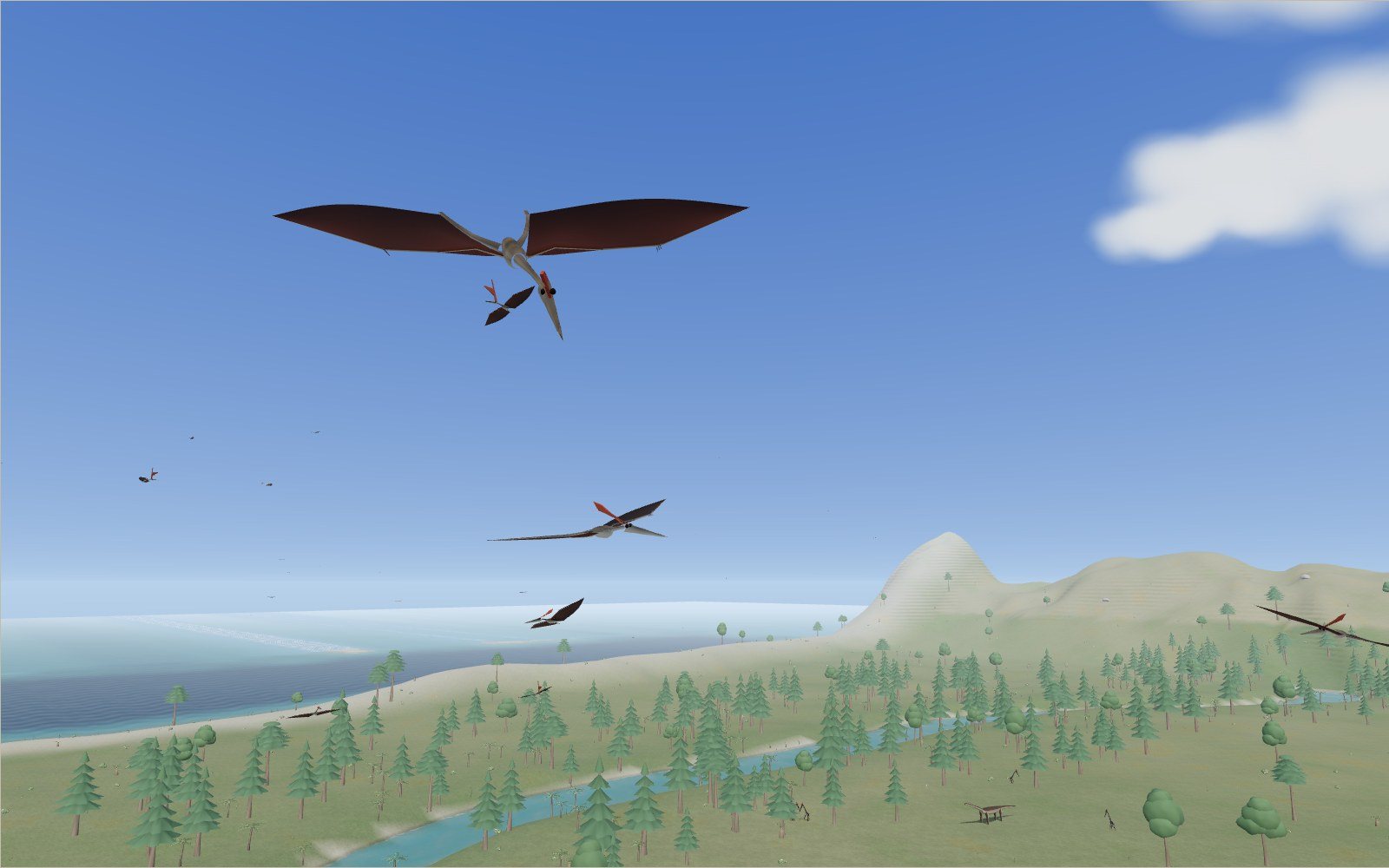
Fly with life-size pterosaurs
Quetzalcoatlus spanned about 10 m, close to the 11 m wing of a Cessna 172, and standing it was as tall as a giraffe. Watch it pass over a Cretaceous cliff, then fly with 35 pterosaurs from three ages.
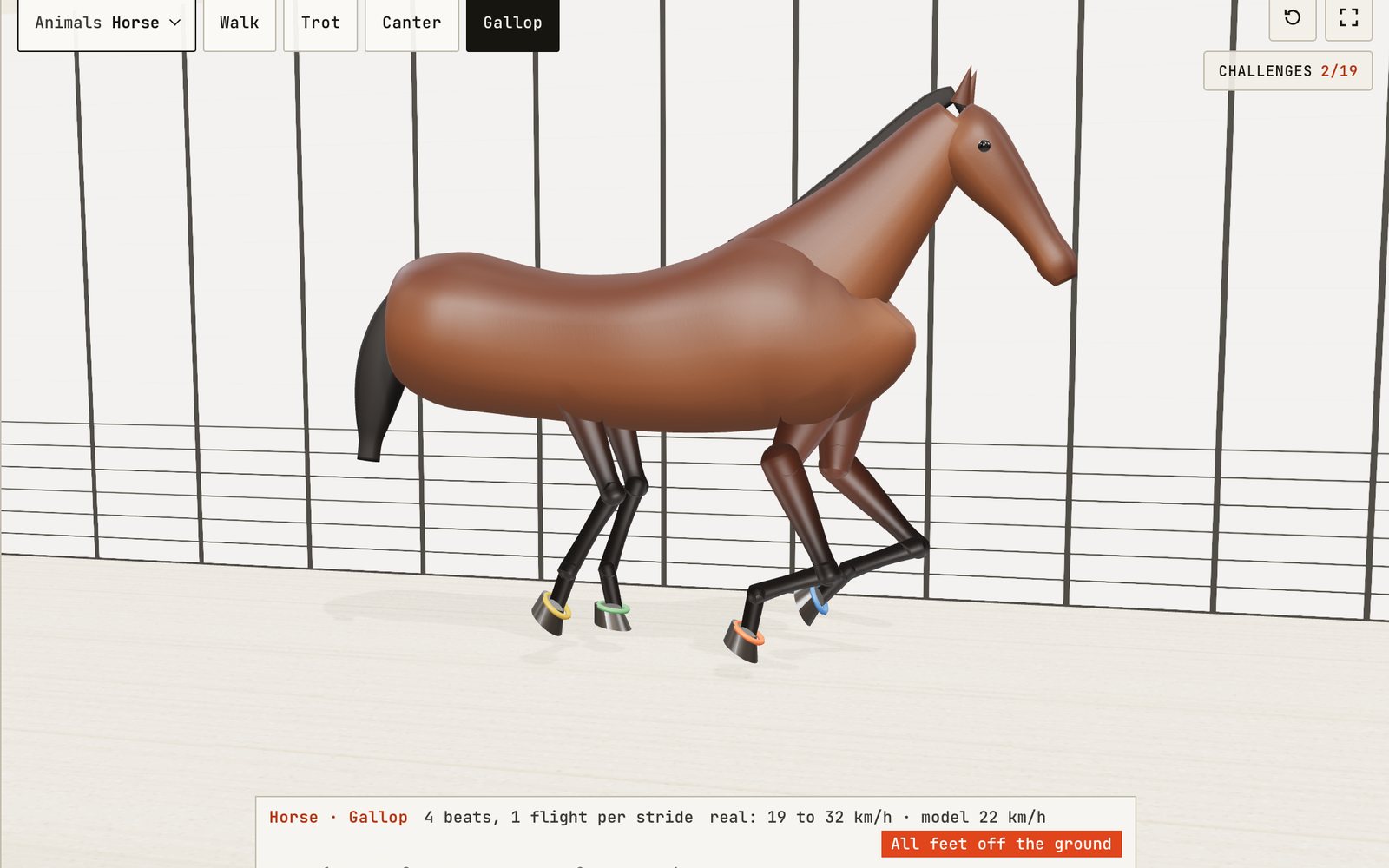
How a horse runs: walk, trot, canter and gallop
In 1878 Muybridge's cameras showed that a galloping horse does lift all four feet at once, but with its legs tucked under it. Some fast animals never leave the ground at all.
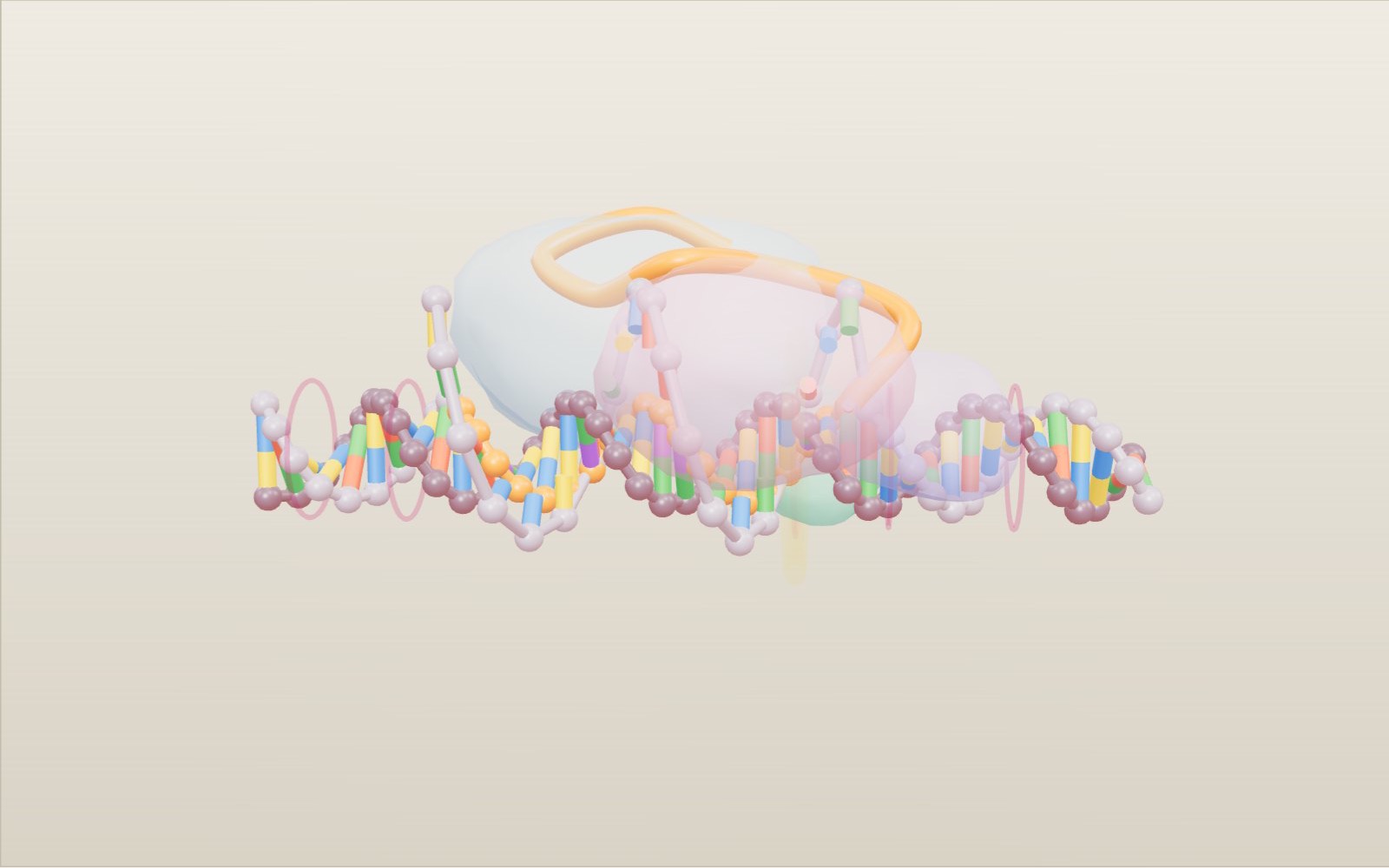
How CRISPR-Cas9 gene editing works
A guide RNA reads just 20 letters of DNA, and that is usually enough to pick out one spot among the 3 billion base pairs of a human genome.
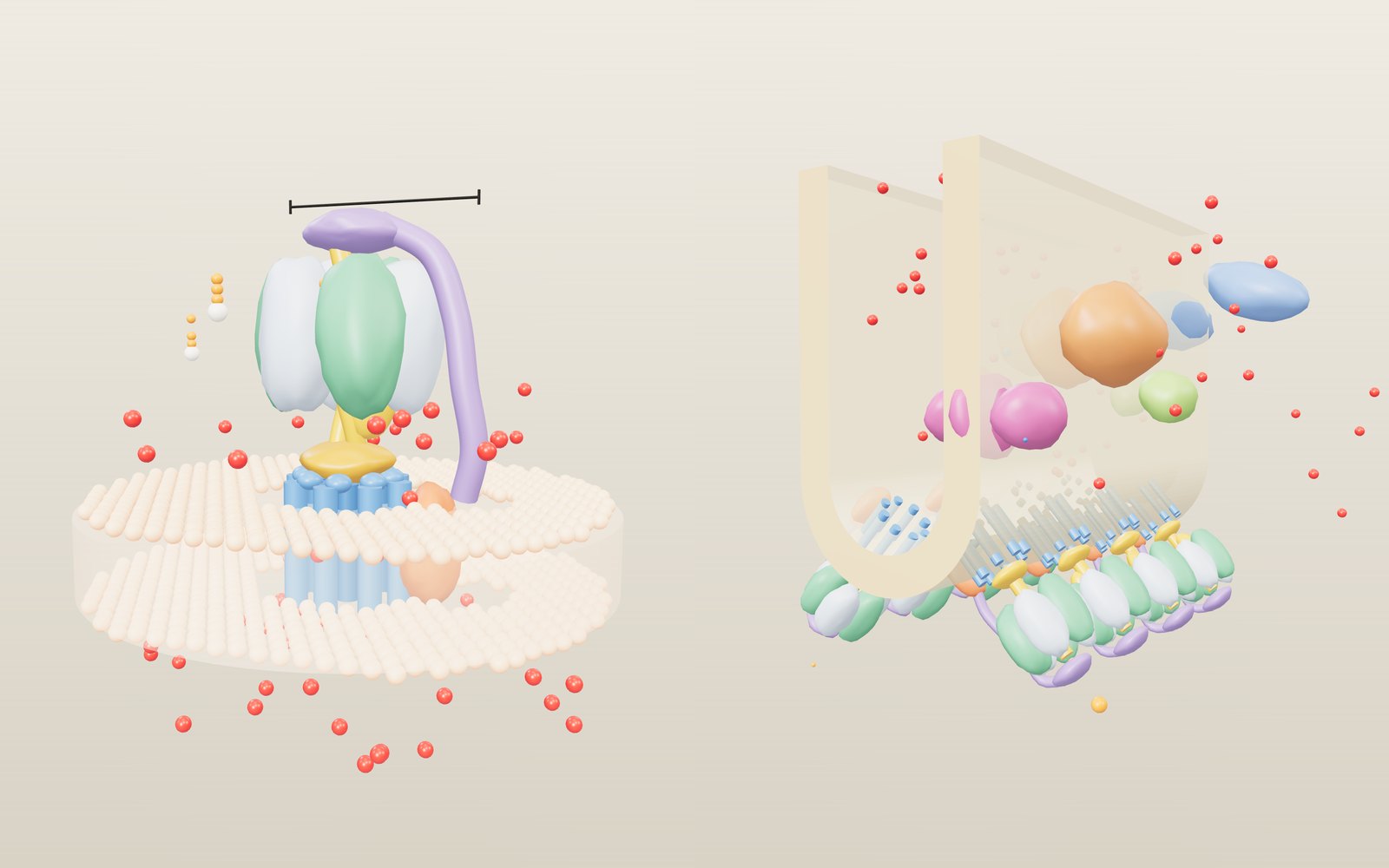
How ATP synthase works
In mitochondria the rotor of ATP synthase turns about 100 times a second, and every full turn releases three molecules of ATP.
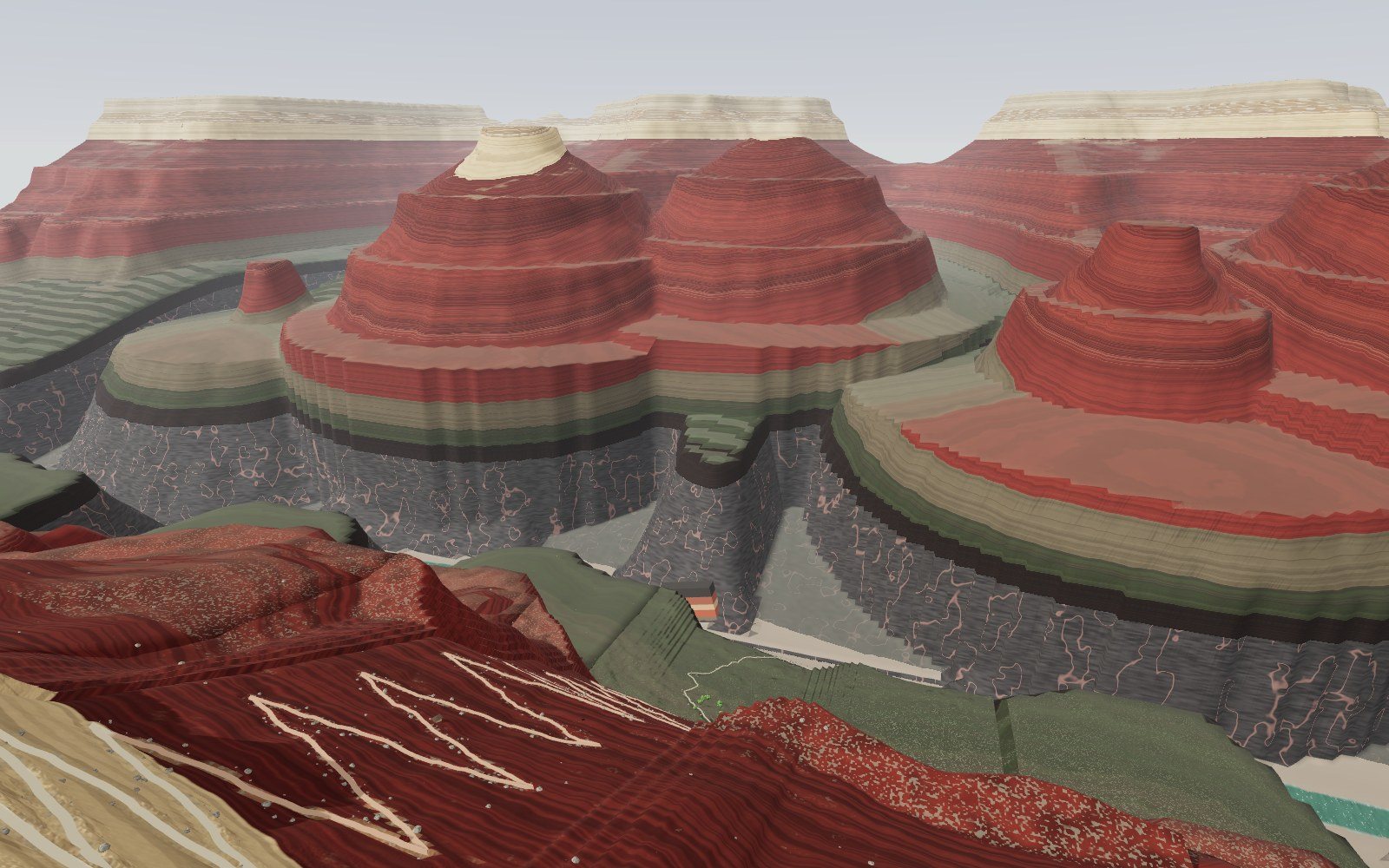
Walk down the Grand Canyon rock layers
Walk 1,360 m down the Bright Angel Trail through 13 rock layers, from a 270-million-year-old sea floor on the rim to 1.75-billion-year-old schist by the river.
Walk through the Terracotta Army
Pit 1 of the Terracotta Army is 230 m long and holds an estimated 6,000 figures and horses, and every one of them was painted once.
Giants of the sea: megalodon and the blue whale
Swim beside 48 sea giants at their real size, from a 28 m blue whale to megalodon, Livyatan and Mosasaurus, in eight seas from today back to the Triassic.
Shrink to the size of an ant and walk into its nest
At 5 mm tall, a blade of lawn grass is 20 times your height and a black garden ant walks past at chest height.
How a steam locomotive works
Mallard's driving wheels are 2.03 m across, taller than most people, and at its record 126 mph they turned almost nine times a second.
Travelling at the speed of light
Light goes round the equator 7.5 times in a second, yet the same light needs 2.5 million years to reach the Andromeda galaxy.