FIG. 93Walk-throughs
Giants of the sea: megalodon and the blue whale
Swim beside 48 sea giants at their real size, from a 28 m blue whale to megalodon, Livyatan and Mosasaurus, in eight seas from today back to the Triassic.
This device cannot show the 3D model. You can read the guide steps below as text.
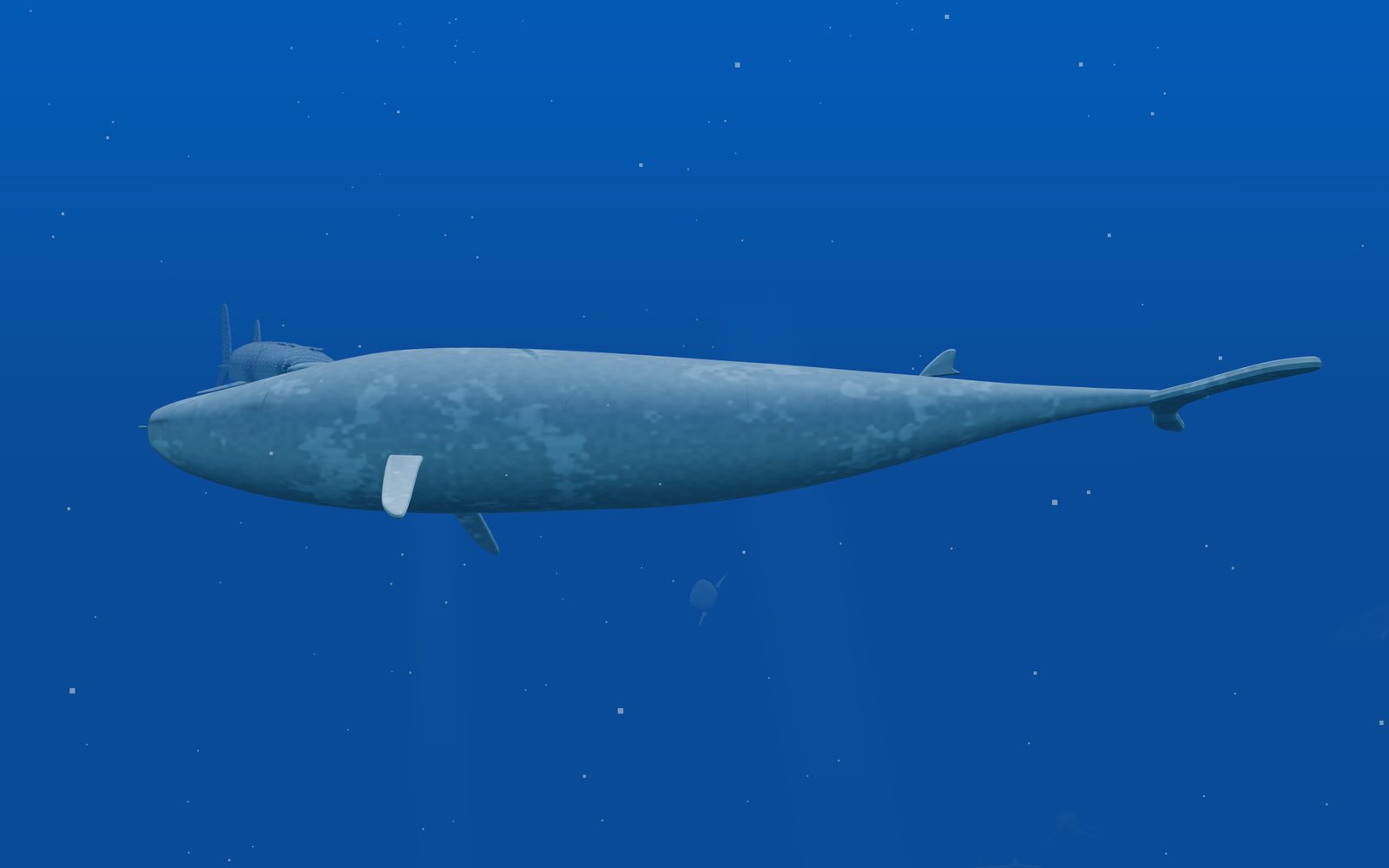
1 / 18 A blue whale passesYou start 14 m down in the open ocean, and a blue whale swims right past you. It is the largest animal known to have lived. Turn on the sound to hear a whale song, made the way NOAA plays its recordings: 10 times faster.
Drag to turn. Scroll or pinch to zoom.
Which was bigger, megalodon or the blue whale?
It is the question people ask most about the giants of the sea, and the answer is the blue whale. NOAA calls it the largest animal ever to live on our planet. The biggest Antarctic blue whales reach about 33.5 m and more than 150 tonnes. Megalodon, the giant shark of the Miocene, may have reached about 24 m at most, and that number is an estimate from a few vertebrae.
This exhibit puts the giants in the water at their real size. You swim through a 900 by 900 m sea in eight parts: the open ocean of today, a cold coast with icebergs, the deep edge where sperm whales hunt squid, a whale fall on the floor at about 1,700 m, and four seas of the past: the Miocene, the Eocene, the Cretaceous, and the Late Triassic and Jurassic. There are 48 animals in it, from a 6 cm krill to a 25 m ichthyosaur known from two jaw bones. Every length and weight in the field guide comes from a museum, NOAA, the Paleobiology Database or a paper with a DOI, and the guide marks which ones are estimates.
The first ten seconds
You start 14 m down in the open ocean. Before you have time to move, a blue whale swims past about 8 m in front of you, from right to left. Its head comes into view at once, and the rest of it keeps going for several seconds: at 28 m it is more than twice as long as a city bus. The pale figure behind it is a person 1.7 m tall, set there for scale. Turn on the sound and you hear a whale song; it is a synthesized imitation, explained below.
How big is a blue whale?
NOAA gives blue whales in the Antarctic up to about 110 feet (33.5 m) and more than 330,000 pounds (about 150 tonnes). In the North Atlantic and North Pacific they are smaller, up to about 90 feet (27 m). A heart-rate study in 2019 assumed an average adult of 23 m and about 70,000 kg, which is closer to the whales you are likely to meet.
The model in this exhibit is 28 m long, the middle of the 23 to 33.5 m range. Its shape follows a rorqual: a flat, broad head, a long body, a small dorsal fin far back, narrow flippers and flukes about a quarter of the body wide. Underneath, from the chin to the belly, run grooves that let the throat stretch like a pleated bag. The mottled blue-grey skin is the reason for the name; it can look almost light blue under water.
Blue whales are not the only ones in the open ocean here. Fin whales, 23 to 26 m, are the second longest; their lower jaw is dark on the left and white on the right. Sei whales, 12 to 18 m, often carry oval scars, which NOAA puts down to cookie-cutter sharks and lampreys.
The heart of a blue whale
A well-known line says a blue whale's heart is as big as a small car. The one heart that has been preserved tells a different story. In March 2014 nine blue whales died in sea ice in the Gulf of St Lawrence, and two washed ashore in Newfoundland. The Royal Ontario Museum took the heart of a 23 m female. It weighed 175 kg. After it was preserved by plastination it measured 106.2 cm long and 96.3 cm wide.
Turn on Blue whale heart and the model of that heart appears in front of you, next to a figure of your own height and a 3.6 m car made for the comparison. The heart is about as tall as a child and far shorter than the car. It beats slowly: a blue whale tagged off California in 2019 had a heart rate of 4 to 8 beats a minute on feeding dives, as low as 2, and 25 to 37 beats a minute at the surface as it recovered.
One gulp
Blue whales feed by lunging. A whale speeds up, opens its mouth wide, and the pleated throat balloons out around a mass of water and krill. Then it pushes the water out through its baleen and swallows what stays behind. The 2019 heart-rate study describes the gulp as a volume of water larger than the whale's own body.
Turn on One gulp to see a balloon of about 68 cubic metres. That is the body volume of a 23 m blue whale of about 70,000 kg (70,000 kg of whale divided by 1,025 kg per cubic metre of seawater). Since a real gulp is larger than the body, the balloon is the smallest gulp the study allows, and the exhibit calls it an estimate. The note under the stage tells you how many people of your weight would fill the same volume.
How much a blue whale eats
The krill swarm on the coast is what all this is for. NOAA writes that the biggest blue whales may eat up to 6 tonnes of krill a day. A 2021 study in Nature combined tags on whales with echo sounders that measured the krill they fed on, and estimated about 16 tonnes a day for blue whales in the North Pacific during the feeding season. The two numbers come from different methods and different years, and both are estimates; the exhibit gives both.
Antarctic krill are about 6 cm long. A 2009 study estimated their total weight in the Southern Ocean at about 379 million tonnes, which makes them one of the largest masses of a single animal species on Earth.
Songs you cannot hear
Many blue whale calls are lower than people hear well. NOAA's acoustics laboratory publishes its blue whale recordings sped up ten times so that they can be heard. The song you hear in the exhibit is made the same way, but it is synthesized: a pulsed call followed by a long tone that drops slightly in pitch, played as if sped up. It is an imitation, not a recording.
Near the humpbacks on the coast the sound changes to rising and falling moans and whoops, also synthesized. In the deep zone you hear clicks, the sound sperm whales make when they hunt by echo. The hydrophone hanging from a yellow float in the open ocean is the kind of instrument such recordings come from.
Measuring a shark that left no skeleton
Shark skeletons are made of cartilage, which rarely fossilizes. Megalodon is known from teeth, vertebrae and scales, and its size has to be worked out from them. The Florida Museum puts most megalodon teeth at 4 to 5 inches (10 to 13 cm) and the shark at up to about 60 feet (18 m).
For a long time the method was simple: take a modern great white shark, scale it up until its teeth match megalodon's, and read off the length. A 2020 study refined this by using five living relatives instead of one and reconstructed a 16 m megalodon with a body like an oversized lamnid shark.
Slim or stocky?
In 2024 a team led by Phillip Sternes looked at the best megalodon fossil there is, a vertebral column from Belgium about 11 m long. An earlier study had estimated the whole animal at only 9.2 m from the size of its vertebrae, which cannot be right if the column alone is 11 m. The way out is a slimmer body than a white shark's.
A 2025 study by Kenshu Shimada and 28 colleagues went further. They measured the proportions of the head, trunk and tail in 145 living and 20 extinct sharks. If megalodon followed the usual shark plan, its head was about 16.6 % and its tail about 32.6 % of its length, which makes the Belgian animal about 16.4 m long. The largest megalodon vertebrae known, 23 cm across from Denmark, would then belong to an animal of about 24.3 m, which the authors call the largest reasonable estimate. At that size it would have weighed about 94 tonnes. They compare its build to a lemon shark, which is slimmer than a white shark, and note that the largest living fish, the whale shark and the basking shark, are also slim.
In the field guide card you can switch megalodon between the slender 2024 to 2025 build and the older white-shark build. The difference shows why the estimates moved. The exhibit's megalodon is 20 m long, the middle of 16.4 and 24.3 m. In the size line-up it is drawn at 16.4 m with a faint outline of the 24.3 m estimate behind it.
Megalodon teeth and young
The teeth are the most common megalodon fossils. On the Miocene floor you can find a few among scattered whale bones. Growth rings in the Belgian vertebrae also suggest how big megalodon was at birth: about 3.6 to 3.9 m, possibly the largest newborn of any fish. The 2025 study reads this as a sign that the embryos fed on eggs inside the mother, as some living sharks do.
Megalodon lived from about 15 to 3.6 million years ago. Why it disappeared is not settled. The 2025 study points to the rise of the great white shark, about 5 million years ago, as one likely cause through competition for food. A cooling ocean and changes in the whales it ate are also discussed.
Livyatan, the whale that ate whales
Megalodon was not the only giant hunter in the Miocene sea. In 2008 a team found the skull of a sperm whale in the desert of Peru, in rocks about 12 to 13 million years old. Its head was 3 m long, and it had teeth in both jaws more than 36 cm long and 12 cm across. The authors called it the biggest bite of any four-limbed animal ever found and named it after the biblical monster and Herman Melville. They estimated its length at 13.5 to 17.5 m, about the size of a modern male sperm whale.
Today's sperm whale has teeth only in its lower jaw and catches squid by suction. Livyatan was built to grab and tear, and the authors suggested it fed mostly on medium-sized baleen whales. It shared the sea with megalodon, and both probably hunted whales.
Other Miocene animals in the exhibit are just as odd. Thalassocnus was a ground sloth that went into the sea off Peru; later species had denser bones, which helped them stay on the bottom while they grazed. Odobenocetops was a small whale with a walrus-like face and two tusks pointing backwards, one much longer than the other. Above the surface flies Pelagornis, a seabird with spikes like teeth on its beak and a wingspan estimated at about 5.2 m.
Whales began on land
The Eocene sea takes you back about 50 to 37 million years, when whales were still changing from land animals. At the beach on the west edge of the zone, Pakicetus paddles in the shallows. It is one of the oldest whales known: a long-legged animal that lived on land at the water's edge. Its ankle bones are like those of hoofed mammals, which links whales to the group that includes hippos.
A little deeper swims Ambulocetus, an early whale with big feet that probably hunted at the water's edge like a crocodile. Out in open water are the whales of the late Eocene. Dorudon, about 5 m long, already had the shape of a modern whale and a tail fluke. Basilosaurus was longer and slimmer, with tiny hind legs that stayed on its body long after they stopped being useful on land.
At Wadi Al Hitan in Egypt, the "valley of whales", a Basilosaurus skeleton was found with bones of young Dorudon and large fish where its stomach had been. It is direct evidence of a whale eating whales 37 million years ago. You can find a Dorudon skull with tooth marks on the Eocene floor.
The heaviest animal? Perucetus
In 2023 a team described Perucetus colossus from Peru, a whale of about 39 million years ago known from 13 huge vertebrae, four ribs and a hip bone. Its bones were extremely dense. From the bones they estimated a weight of 85 to 340 tonnes, which would put it at or above the blue whale.
The claim was tested quickly. In 2024 Ryosuke Motani and Nicholas Pyenson concluded that Perucetus probably weighed 60 to 70 tonnes for a length of 17 m, and at most about 98 to 114 tonnes if it was 20 m long. Another study in 2025 arrived at 35 to 40 tonnes. In the exhibit Perucetus is a stout, slow whale, and its guide card gives the whole range with the word estimate. As far as anyone can tell, the blue whale still holds the record.
Why the sea grows giants
The largest animals of every age have lived in water: the blue whale today, Perucetus and Basilosaurus in the Eocene, megalodon and Livyatan in the Miocene, Shonisaurus and Ichthyotitan in the Triassic. Three things help.
The first is that water carries the weight. A whale's body is about as dense as seawater, so its skeleton does not have to hold it up against gravity the way an elephant's legs must. Perucetus pushed this to an extreme: its describers suggest that its very heavy skeleton worked as ballast in shallow coastal water.
The second is food. The biggest living animals, the blue whale, the whale shark and the basking shark, eat the smallest food: krill, plankton and small fish strained from huge volumes of water. The 2021 krill study found that baleen whales eat far more than earlier estimates assumed, and argues that the nutrients they release help feed the plankton in turn.
The third is shape. A large body pays for its size in drag. The 2025 megalodon study points out that the truly gigantic swimmers, from whale sharks to rorquals, are slim, while a stocky body such as the white shark's runs into hydrodynamic limits before it gets very large; the authors put the white shark's ceiling at about 7 m. A slower heart helps too: the tagged blue whale's heart dropped to 2 beats a minute on a dive, saving oxygen for the next lunge.
None of this makes size free. A blue whale has to find dense patches of krill, and the lunges that feed it cost so much energy that its dives are short. Size in the sea is a balance, and the giants in this exhibit show several ways of striking it.
The sea reptiles of the dinosaur age
The animals in the two Mesozoic zones are not dinosaurs. Ichthyosaurs, plesiosaurs and mosasaurs were separate groups of reptiles that returned to the sea, and they lived alongside the dinosaurs on land. If you have walked through the dinosaur exhibit, these are the animals that swam off its coasts.
Ichthyosaurs, from Shonisaurus to Ichthyotitan
Ichthyosaurs had bodies like dolphins: a long snout, flippers, a fin on the back and a crescent-shaped tail they beat from side to side. The earliest giants appeared in the Late Triassic, more than 200 million years ago.
Shonisaurus, about 15 m long, swims in a group in this exhibit. At one site in Nevada dozens of Shonisaurus skeletons lie together, along with embryos and newborns. A 2022 study reads the site as a place where adults gathered to give birth, the way some whales gather today.
Ichthyotitan is the largest of them and the least known. It was named in 2024 from two jaw bones found on the coast of Somerset, England, 10 km apart. The better one would have been more than 2 m long when complete, and the authors estimate the whole animal at about 25 m. In the exhibit it is drawn as a 22.5 m ichthyosaur, 90 % of that estimate, and its card says that only the jaw is known.
Eyes like plates
Ichthyosaurs had some of the largest eyes of any animal with a backbone. A 1999 study measured the rings of bone that supported them. Temnodontosaurus had eyes more than 25 cm across; Ophthalmosaurus, only about 4 m long, had eyes more than 20 cm across. Large eyes gather more light, so the study suggested they could hunt in dim, deep water. In the exhibit the eyes of these two species are made to that scale; swim close to an Ophthalmosaurus to see them.
Long necks and big heads
Plesiosaurs rowed with four long flippers. Some had small heads on very long necks, others had big heads on short necks; the second kind are called pliosaurs.
Elasmosaurus, from the Cretaceous of Kansas, has the longest neck of all. When researchers re-counted the original skeleton in 2013 they found a vertebra that had been lost and arrived at 72 neck vertebrae, more than any other known animal with a backbone. A giraffe has seven.
Pliosaurs were the big predators. Kronosaurus, from the inland sea that once covered much of Australia, had a skull at least 2.4 m long. The Australian Museum puts the whole animal at no more than about 10 m and points out that the famous skeleton at Harvard, nicknamed "Plasterosaurus", is about one third plaster and about 3 m too long.
The 25 m Liopleurodon
In 1999 a television series showed Liopleurodon as a 25 m monster. A 2026 study gathered 37 Liopleurodon specimens and estimated each animal's length from them. Most came out at about 5 to 6 m and the largest at about 8 m; the more complete skeletons averaged about 4.8 m. The study also found the skull was about a quarter of the skeleton's length, larger than earlier reconstructions showed.
In the exhibit Liopleurodon is 6.5 m long. Find it in the Jurassic zone to open the card that sets the record straight.
Mosasaurs
Mosasaurs were sea lizards, related to monitor lizards and snakes, and they ruled the Late Cretaceous seas. The skull of the first one known came from a quarry near Maastricht in the Netherlands in the 18th century. The Natural History Museum in London notes that estimates for the largest, Mosasaurus hoffmannii, run from 11 or 12 m to 17 or 18 m, because most fossils are skulls and the body has to be estimated from them. An adult may have weighed about 10 tonnes.
The museum in Maastricht shows an 11 m skeleton of a related mosasaur, Prognathodon saturator, nicknamed Bèr, with heavy jaws suited to crushing. Mosasaur tails ended in a fin shaped like a downturned crescent, and the models in the exhibit have one.
Fish, turtles and ammonites of the Cretaceous
The Cretaceous floor holds two finds. One is a slab like the famous fossil collected in Kansas in 1952: a 4 m Xiphactinus with a 2 m fish, Gillicus, inside it. The Xiphactinus probably died soon after swallowing a fish too big for it.
The other is a giant ammonite. Ammonites were relatives of squid and octopus with coiled shells. Parapuzosia seppenradensis, from about 84 to 81 million years ago, grew shells about 1.5 to 1.8 m across. The specimen found near Seppenrade in Germany in 1895 measures 1.74 m even though its last chamber is missing.
Archelon, a sea turtle about 4 m long, swims nearby. It lived in the same inland sea in North America as Elasmosaurus and Xiphactinus.
Today's giants of open water
Back in the open ocean of today there are giants that are not whales. The whale shark is the largest living fish. The Florida Museum gives its maximum size as about 20 m and notes that one tagged whale shark dived to 1,928 m. In 1995 a female 11 m long caught off Taiwan carried about 300 young inside her.
The basking shark, the second largest fish, reaches about 12 m. It swims with its mouth wide open and, according to the Florida Museum, can strain about 2,000 tons of seawater an hour for small food. The giant manta ray spans up to about 8 m and, NOAA says, has been tracked diving deeper than 1,000 m.
The ocean sunfish family holds the record for the heaviest bony fish: a bump-head sunfish 2.72 m long weighed 2,300 kg. The leatherback is the largest living turtle, with a leathery shell, and NOAA records dives to nearly 4,000 ft (about 1,200 m). The Atlantic bluefin tuna, the largest tuna, has been recorded at 4.58 m and 684 kg. And the white shark, about 6 m at most, is the one most people picture when they think of megalodon, although the new studies argue that its stocky build is exactly what kept it from growing that large.
The coast: humpbacks, right whales and bowheads
The cold coast is the busiest part of the sea. Humpback whales, up to about 18 m, feed round the krill swarm. Their tail flukes are up to 18 ft (5.5 m) wide, and NOAA notes that the pattern under them differs from whale to whale, which is how researchers recognize individuals. Every 30 seconds or so one humpback leaps out of the water and falls back with a splash. You see it best from the surface.
North Atlantic right whales, up to about 16 m, have no dorsal fin. The white patches on their heads are rough skin covered in whale lice. Bowhead whales, up to about 19 m, live in Arctic ice. Their skull is about a third of their length and strong enough to break through ice 8 inches thick, and their blubber is 17 to 19 inches (43 to 48 cm) thick, the thickest of any whale. Stone harpoon tips found in bowheads show that they live well over 100 years, and newer methods suggest some pass 200.
Gray whales, killer whales and elephant seals also live here. Killer whales are the largest dolphins; females can live at least 90 years. Male northern elephant seals grow an inflatable nose and dive to 1,000 to 2,500 ft (300 to 760 m) for 20 to 30 minutes at a time.
Light, colour and pressure as you go down
Watch the readout at the bottom left as you sink. Water absorbs red light first, then green, and blue goes deepest. In the exhibit the share of red light left falls below 1 % at about 14 m; that number comes from the light model of the deep-sea walk, and it is an estimate for clear ocean water. The water changes colour with it, from blue-green near the top to dark blue and then black.
NOAA puts the limit of significant light at about 200 m; faint light can reach about 1,000 m. Below about 150 m the exhibit switches on a lamp in front of you, like the light of a submersible, so you can see the animals of the deep edge.
Pressure grows by one atmosphere for every 33 feet (10.06 m) of depth, NOAA writes. At the start, 14 m down, the readout shows 2.4 atmospheres; at the whale fall, about 1,700 m down, it shows about 169.
To keep the deep zones within reach, the exhibit squeezes depth: near the surface one metre of swimming is about one metre of depth, but further down each metre of swimming covers more. The animals keep their real size, and the readout always shows the true depth. The Depth slider takes you straight to a depth.
The deep edge: sperm whales and giant squid
Sperm whales are the largest toothed whales: males up to about 16 m and 41 tonnes, females up to about 12 m. Their head is about a third of the body, and they have a single blowhole on the left side of it. NOAA writes that they routinely dive to about 2,000 ft (610 m) and stay down about 45 minutes, hunting mostly squid.
Giant squid live at the same depths. The longest measured was almost 13 m including its two long feeding tentacles, according to the Smithsonian. A camera on a NOAA-funded expedition filmed one in the Gulf of Mexico in 2019 at 759 m, only the second time one had been filmed in its deep home. Nobody has watched a sperm whale fight a giant squid, but many sperm whales carry round scars from squid suckers, and giant squid beaks turn up in sperm whale stomachs, never the other way round.
In the exhibit the two meet at about 700 m. One challenge asks you to name that depth.
Colossal squid
Further down the slope drifts the colossal squid. Te Papa in New Zealand, which keeps the only one on display, describes it as slightly shorter than the giant squid but heavier: its specimen weighs 490 kg, while giant squid reach about 275 kg. Its eyes are the largest of any animal studied, and its tentacles carry swivelling hooks. Its length in the guide is an estimate.
Cuvier's beaked whale, the deepest diver
The record for deep diving does not belong to the sperm whale. Cuvier's beaked whales, only 4.6 to 7 m long, were tracked off southern California diving to 2,992 m, and NOAA reports a dive that lasted 222 minutes. Both are records for any mammal.
Whale fall: one meal for decades
When a whale dies, its body usually sinks. A 2015 review describes what happens next on the deep floor as a series of stages. Hagfish, sleeper sharks and other scavengers strip the flesh in months. Worms, snails and crustaceans then move into the bones and the enriched mud around them. After that, bacteria break down the fats inside the bones and make hydrogen sulphide, which feeds mussels, clams and other animals for years to decades. NOAA's Ocean Service puts the life of a whale fall at years to decades; time-series studies off California suggest some may last about a century.
The skeleton in the exhibit lies at about 1,700 m. On the bones grow bone-eating worms, Osedax, discovered in 2002 on a gray whale skeleton in Monterey Canyon. They have no mouth or gut: roots grown into the bone hold bacteria that digest it. The females are a few centimetres long, and microscopic males live inside them. The Monterey Bay Aquarium notes that the bones of a 90-ton whale can hold about 5 tons of oil, which is why one skeleton feeds so many animals for so long.
Greenland shark and old age in the cold
The slow shark circling the skeleton is a Greenland shark. In 2016 researchers dated the eye lenses of 28 Greenland sharks with radiocarbon. The largest, about 5 m long, came out at about 392 years, give or take 120, which would make the species the longest-lived animal with a backbone known. The same study suggested females do not mature until they are about 150 years old.
Icebergs
The coast has four icebergs. NOAA classes floating ice as an iceberg when it stands more than 16 feet (about 5 m) above the sea and is 98 to 164 feet (30 to 50 m) thick; smaller pieces are bergy bits and growlers. Swim under one to see how far down the ice reaches.
Sonar and the surface
Two views change how you see the sea. Sonar view draws only what sends back an echo, in green, with a ring sweeping outward from you, and a round display shows the animals around you from above. It is a simplified picture of how a sperm whale or a beaked whale finds its prey with clicks. One challenge asks you to find a giant squid this way.
Surface view lifts you above the water. From there you see the icebergs, the sky, whales close to the surface and the humpbacks leaping on the coast. In the Miocene zone Pelagornis glides overhead. Turn it off to go back under.
Checking sizes against yourself
Open Me and enter your height and weight. The figures for scale in each zone, the figure in the size line-up and the figure next to the heart all take your height. The panel also works out how many times your height a 28 m blue whale is, and how many people of your weight it equals. Each guide card does the same for its animal, and draws you, the animal and a 12 m bus side by side.
The size line-up stands in front of you in rows: you, a 12 m bus, a white shark, a giant squid with its tentacles, a sperm whale, megalodon at 16.4 m with the 24.3 m estimate behind it, and a 28 m blue whale. A ruler with marks every 5 m runs under them.
How the animals are built
Every animal is built from numbers rather than drawn. A body is a smooth tube whose thickness changes along its length; fins and flippers are rounded shapes with bevelled edges; eyes, jaws and teeth are added where the species has them. The patterns on the skin, such as the blue whale's mottling, the whale shark's spots and the scars on sperm whale heads, are painted in the shader so they stay sharp up close.
The bodies move with one wave that runs from head to tail. Whales and other mammals bend up and down; fish, sharks and reptiles bend from side to side; rays, turtles and plesiosaurs beat their flippers. Close to you, an animal has a finer body; further away it uses a simpler one. Sunlight from above makes rippling patterns, called caustics, on the floor and on the animals' backs on fast computers.
How the model differs from reality
The sea is crowded. Real whales are rarely this close together, and the eight zones sit next to each other although they are separated by tens of millions of years and thousands of kilometres. Each animal swims a loop near its home and moves aside if you get in its way.
Depth is squeezed below the surface, as explained above. Lengths are real; distances between the zones are not.
The colours of extinct animals are unknown. The exhibit gives them the countershading most living sea animals have: darker above and paler below. The shapes of megalodon, Livyatan, Perucetus, Ichthyotitan and the other fossil animals rest on incomplete skeletons, and their guide cards say so.
The whale songs are synthesized. The lamp in the deep zones, the sonar picture and the speed of the animals are choices made so that you can see them.
Moving around
On a computer, use WASD or the arrow keys to swim, drag to look, R or Space to rise and F or C to sink. Hold Shift to hurry. Moving forward while you look up or down also takes you up or down. On a phone, use your left thumb to swim, your right thumb to look and the two buttons on the right to go up and down. The Swim speed slider makes everything faster, and the map at the top left takes you anywhere with one click. The Time slider jumps between today, the Miocene, the Eocene, the Cretaceous and the Triassic and Jurassic.
The guided tour
The tour in the panel has 18 steps. It starts with the passing blue whale, stands you next to the size line-up, the heart and one gulp, visits the krill, the leaping humpbacks and the icebergs, goes down to the sperm whales and the whale fall, and then back in time to megalodon, Livyatan, Basilosaurus, the first whales, Mosasaurus, Elasmosaurus, Shonisaurus and Liopleurodon.
Challenges and hidden finds
Ten challenges ask you to find the largest animal, guess the length of a megalodon tooth, pick the five giants still alive, name the depth where sperm whales meet giant squid, choose the three sea reptiles, guess the size of the blue whale heart and of Liopleurodon, visit the whale fall, watch the humpbacks from the surface and find a squid by sonar. Solved challenges stay marked in your browser.
There are 25 hidden finds around the sea: swim close to one and look at it to open its card. Seven of them, marked "Actually", turn a common belief around, such as the car-sized heart, the 25 m Liopleurodon or the megalodon drawn as a giant white shark. Each card links to its sources.
Questions
Was megalodon bigger than a blue whale?
No. The largest reasonable estimate for megalodon is about 24.3 m and 94 tonnes, from a 2025 study. Blue whales reach about 33.5 m and more than 150 tonnes, according to NOAA.
How big was megalodon really?
It is uncertain, because no complete skeleton exists. The best fossil, a vertebral column from Belgium, came from an animal of about 16.4 m by a 2025 estimate. The largest vertebrae known suggest about 24.3 m at most. Older estimates based on teeth often gave 15 to 18 m.
Did megalodon look like a giant great white shark?
Probably not. Studies in 2024 and 2025 conclude that its body was slimmer than a white shark's, closer to a lemon shark in proportion. Its exact outline is unknown.
Is megalodon still alive?
No. Its youngest fossils are about 3.6 million years old. A shark that large would leave teeth on the sea floor and be seen at the surface.
Is the blue whale the largest animal that ever lived?
As far as is known, yes. Perucetus, an Eocene whale, was proposed in 2023 as possibly heavier, but later studies put its weight well below the blue whale's.
How big is a blue whale's heart?
The only preserved one, at the Royal Ontario Museum, weighed 175 kg and measured 106 by 96 cm. It came from a 23 m whale. It is much smaller than a car.
Can a person fit inside a blue whale's mouth?
By volume, many people could. One gulp is more water than the whale's own body volume, at least about 68 cubic metres for a 23 m whale. But a blue whale feeds on small food such as krill and does not swallow large animals.
How deep do sperm whales dive?
NOAA says they routinely dive to about 2,000 ft (610 m) for about 45 minutes, and deeper on occasion. The deepest diving mammal is Cuvier's beaked whale, recorded at 2,992 m.
Do sperm whales really fight giant squid?
Nobody has seen it, but sperm whales carry scars from squid suckers, and giant squid beaks are found in their stomachs. The sperm whale is almost certainly the hunter.
Which is bigger, the giant squid or the colossal squid?
The giant squid is longer, up to almost 13 m with its tentacles. The colossal squid is heavier: the one at Te Papa weighs 490 kg against about 275 kg for the heaviest giant squid.
Was Liopleurodon 25 m long?
No. That length came from a television series in 1999. A 2026 study of 37 specimens puts most at about 5 to 6 m and the largest at about 8 m.
Are ichthyosaurs, plesiosaurs and mosasaurs dinosaurs?
No. They are separate groups of reptiles that lived in the sea at the same time as the dinosaurs lived on land.
What is a whale fall?
The body of a whale on the deep sea floor. Scavengers eat the flesh in months, and the bones feed bacteria, worms and clams for years to decades.
How old can whales and sharks get?
Bowhead whales may live more than 200 years, according to NOAA. Greenland sharks have been dated at about 390 years, give or take 120.
Why is the whale song in the exhibit so high?
Many blue whale calls are too low for people to hear well, so NOAA plays its recordings ten times faster. The exhibit's synthesized song imitates that sped-up sound.
Where did whales come from?
From land mammals related to hippos. Pakicetus, about 50 million years ago, had long legs and lived at the water's edge; within about 10 million years whales like Dorudon and Basilosaurus lived entirely in the sea.
Terms
- Baleen: plates of keratin in the mouths of baleen whales that strain small food from the water.
- Rorqual: a baleen whale with throat grooves, such as the blue, fin, sei and humpback whales.
- Lunge feeding: how rorquals feed, by speeding up and engulfing a large mass of water and food at once.
- Countershading: a darker back and paler belly, common in sea animals.
- Ichthyosaur: a Mesozoic sea reptile shaped like a dolphin.
- Plesiosaur: a Mesozoic sea reptile with four flippers; pliosaurs are the short-necked, big-headed kind.
- Mosasaur: a Late Cretaceous sea lizard related to monitor lizards and snakes.
- Ammonite: an extinct relative of squid with a coiled shell.
- Whale fall: a whale carcass on the deep sea floor and the community that lives on it.
- Caustics: the rippling pattern of light that waves at the surface throw onto the sea floor.
- Euphotic zone: the top layer of the ocean, down to about 200 m, with enough light for plants to grow.
- Miocene, Eocene: periods of the Cenozoic era, about 23 to 5.3 and about 56 to 34 million years ago.
Sources
- NOAA Fisheries, Blue whale. https://www.fisheries.noaa.gov/species/blue-whale (checked 19 October 2026)
- NOAA Fisheries, Fin whale, Sei whale, Humpback whale, Sperm whale, Killer whale, Gray whale, North Atlantic right whale, Bowhead whale. https://www.fisheries.noaa.gov/species/fin-whale (and the other species pages, checked 19 October 2026)
- NOAA Fisheries, Cuvier's beaked whale. https://www.fisheries.noaa.gov/species/cuviers-beaked-whale (checked 19 October 2026)
- NOAA Fisheries, Giant manta ray, Leatherback turtle, Northern elephant seal, White shark, Western Atlantic bluefin tuna. https://www.fisheries.noaa.gov/species/giant-manta-ray (and the other species pages, checked 19 October 2026)
- NOAA Ocean Service, How far does light travel in the ocean? https://oceanservice.noaa.gov/facts/light_travel.html (checked 19 October 2026)
- NOAA Ocean Service, How does pressure change with ocean depth? https://oceanservice.noaa.gov/facts/pressure.html (checked 19 October 2026)
- NOAA Ocean Service, What is a whale fall? https://oceanservice.noaa.gov/facts/whale-fall.html (checked 19 October 2026)
- NOAA Ocean Service, How are icebergs classified? https://oceanservice.noaa.gov/facts/iceberg.html (checked 19 October 2026)
- NOAA Pacific Marine Environmental Laboratory, Blue whale sounds. https://www.pmel.noaa.gov/acoustics/whales/sounds/sounds_whales_blue.html (checked 19 October 2026)
- NOAA Research, NOAA-funded expedition captures rare footage of giant squid in the Gulf of Mexico (2020). https://research.noaa.gov/noaa-funded-expedition-captures-rare-footage-of-giant-squid-in-the-gulf-of-mexico (checked 19 October 2026)
- NOAA Ocean Exploration, Giant isopod. https://oceanexplorer.noaa.gov/facts/isopod.html (checked 19 October 2026)
- C. R. Smith, Whale falls, wood, or kelp: a bonanza for life in the deep sea (NOAA Ocean Exploration). https://archive.oceanexplorer.noaa.gov/edu/oceanage/04baco_taylor/media/smithwhalefalls.pdf (checked 19 October 2026)
- Goldbogen, J. A. et al. (2019). Extreme bradycardia and tachycardia in the world's largest animal. PNAS 116, 25329. https://doi.org/10.1073/pnas.1914273116
- Miller, J. R. et al. (2017). The challenges of plastinating a blue whale heart. Journal of Plastination 29(2). https://doi.org/10.56507/SJTL1096
- Savoca, M. S. et al. (2021). Baleen whale prey consumption based on high-resolution foraging measurements. Nature 599, 85. https://doi.org/10.1038/s41586-021-03991-5
- Atkinson, A. et al. (2009). A re-appraisal of the total biomass and annual production of Antarctic krill. Deep-Sea Research I 56, 727. https://doi.org/10.1016/j.dsr.2008.12.007
- Shimada, K. et al. (2025). Reassessment of the possible size, form, weight, cruising speed, and growth parameters of the extinct megatooth shark, Otodus megalodon. Palaeontologia Electronica. https://doi.org/10.26879/1502
- Sternes, P. C. et al. (2024). White shark comparison reveals a slender body for the extinct megatooth shark, Otodus megalodon. Palaeontologia Electronica 27(1):a7. https://doi.org/10.26879/1345
- Cooper, J. A. et al. (2020). Body dimensions of the extinct giant shark Otodus megalodon: a 2D reconstruction. Scientific Reports 10, 14596. https://doi.org/10.1038/s41598-020-71387-y
- Florida Museum of Natural History, Five facts: megalodon. https://www.floridamuseum.ufl.edu/science/five-facts-megalodon/ (checked 19 October 2026)
- Florida Museum of Natural History, Discover Fishes species profiles: Rhincodon typus, Cetorhinus maximus, Carcharodon carcharias, Thunnus thynnus, Regalecus glesne, Somniosus microcephalus. https://www.floridamuseum.ufl.edu/discover-fish/species-profiles/rhincodon-typus/ (and the other profiles, checked 19 October 2026)
- Lambert, O. et al. (2010). The giant bite of a new raptorial sperm whale from the Miocene epoch of Peru. Nature 466, 105. https://doi.org/10.1038/nature09067
- Mayr, G. and Rubilar-Rogers, D. (2010). Osteology of a new giant bony-toothed bird from the Miocene of Chile. Journal of Vertebrate Paleontology 30, 1313. https://doi.org/10.1080/02724634.2010.501465
- Amson, E. et al. (2014). Gradual adaptation of bone structure to aquatic lifestyle in extinct sloths from Peru. Proceedings of the Royal Society B 281, 20140192. https://doi.org/10.1098/rspb.2014.0192
- de Muizon, C. (1993). Walrus-like feeding adaptation in a new cetacean from the Pliocene of Peru. Nature 365, 745. https://doi.org/10.1038/365745a0
- Voss, M. et al. (2019). Stomach contents of the archaeocete Basilosaurus isis: apex predator in oceans of the late Eocene. PLOS ONE 14, e0209021. https://doi.org/10.1371/journal.pone.0209021
- Thewissen, J. G. M. et al. (2001). Skeletons of terrestrial cetaceans and the relationship of whales to artiodactyls. Nature 413, 277. https://doi.org/10.1038/35095005
- Thewissen, J. G. M. et al. (1994). Fossil evidence for the origin of aquatic locomotion in archaeocete whales. Science 263, 210. https://doi.org/10.1126/science.263.5144.210
- Bianucci, G. et al. (2023). A heavyweight early whale pushes the boundaries of vertebrate morphology. Nature 620, 824. https://doi.org/10.1038/s41586-023-06381-1
- Motani, R. and Pyenson, N. D. (2024). Downsizing a heavyweight: factors and methods that revise weight estimates of the giant fossil whale Perucetus colossus. PeerJ 12, e16978. https://doi.org/10.7717/peerj.16978
- Kelley, N. P. et al. (2022). Grouping behavior in a Triassic marine apex predator. Current Biology 32, 5398. https://doi.org/10.1016/j.cub.2022.11.005
- Lomax, D. R. et al. (2024). The last giants: new evidence for giant Late Triassic (Rhaetian) ichthyosaurs from the UK. PLOS ONE 19, e0300289. https://doi.org/10.1371/journal.pone.0300289
- Motani, R., Rothschild, B. M. and Wahl, W. (1999). Large eyeballs in diving ichthyosaurs. Nature 402, 747. https://doi.org/10.1038/45435
- Sachs, S., Kear, B. P. and Everhart, M. J. (2013). Revised vertebral count in the "longest-necked vertebrate" Elasmosaurus platyurus. PLOS ONE 8, e70877. https://doi.org/10.1371/journal.pone.0070877
- Bartlett, N. et al. (2026). Re-evaluating body size in the Middle Jurassic pliosaur Liopleurodon ferox. Journal of Vertebrate Paleontology. https://doi.org/10.1080/02724634.2026.2691149
- Australian Museum, Kronosaurus queenslandicus. https://australian.museum/learn/australia-over-time/extinct-animals/kronosaurus-queenslandicus (checked 19 October 2026)
- Natural History Museum, London, What is a mosasaur? https://www.nhm.ac.uk/discover/what-is-a-mosasaur.html (checked 19 October 2026)
- Natuurhistorisch Museum Maastricht, 11 meter lang Mosasaurus skelet (2025). https://www.nhmmaastricht.nl/nieuws/natuurhistorisch-museum-maastricht-krijgt-11-meter-lang-mosasaurus-skelet (checked 19 October 2026)
- Sternberg Museum of Natural History, Fish within a fish. https://scholars.fhsu.edu/sternberg_photos/52 (checked 19 October 2026)
- Kennedy, W. J. et al. (2021). Ontogeny, evolution and palaeogeographic distribution of the world's largest ammonite Parapuzosia (P.) seppenradensis. PLOS ONE 16, e0258510. https://doi.org/10.1371/journal.pone.0258510
- Smithsonian Ocean, How big is the giant squid? and Giant squid sucker marks. https://ocean.si.edu/ocean-life/invertebrates/giant-squid (checked 19 October 2026)
- Smithsonian National Museum of Natural History, The giant squid. https://naturalhistory.si.edu/explore/giant-squid (checked 19 October 2026)
- Paxton, C. G. M. (2016). Unleashing the Kraken: on the maximum length in giant squid. Journal of Zoology 300, 82. https://doi.org/10.1111/jzo.12347
- Te Papa, The difference between colossal squid, giant squid, and octopus and The anatomy of the colossal squid. https://www.tepapa.govt.nz/digital-museum/explore-digital-museum/colossal-squid/difference-between-colossal-squid-giant-squid (checked 19 October 2026)
- Schorr, G. S. et al. (2014). First long-term behavioral records from Cuvier's beaked whales reveal record-breaking dives. PLOS ONE 9, e92633. https://doi.org/10.1371/journal.pone.0092633
- Smith, C. R. et al. (2015). Whale-fall ecosystems: recent insights into ecology, paleoecology, and evolution. Annual Review of Marine Science 7, 571. https://doi.org/10.1146/annurev-marine-010213-135144
- Rouse, G. W., Goffredi, S. K. and Vrijenhoek, R. C. (2004). Osedax: bone-eating marine worms with dwarf males. Science 305, 668. https://doi.org/10.1126/science.1098650
- Monterey Bay Aquarium, Bone-eating worm. https://www.montereybayaquarium.org/animals-the-ocean/animals-a-to-z/whale-worm (checked 19 October 2026)
- Nielsen, J. et al. (2016). Eye lens radiocarbon reveals centuries of longevity in the Greenland shark. Science 353, 702. https://doi.org/10.1126/science.aaf1703
- George, J. C. et al. (1999). Age and growth estimates of bowhead whales via aspartic acid racemization. Canadian Journal of Zoology 77, 571. https://doi.org/10.1139/z99-015
- Sawai, E. et al. (2018). Redescription of the bump-head sunfish Mola alexandrini. Ichthyological Research 65, 142. https://doi.org/10.1007/s10228-017-0603-6
- Zintzen, V. et al. (2011). Hagfish predatory behaviour and slime defence mechanism. Scientific Reports 1, 131. https://doi.org/10.1038/srep00131
- Paleobiology Database, taxon pages for Livyatan, Pelagornis, Thalassocnus, Odobenocetops, Basilosaurus, Dorudon, Ambulocetus, Pakicetus, Shonisaurus, Temnodontosaurus, Ophthalmosaurus, Liopleurodon, Mosasaurus, Prognathodon, Elasmosaurus, Kronosaurus, Archelon and Xiphactinus. https://paleobiodb.org/ (checked 19 October 2026)
More exhibits
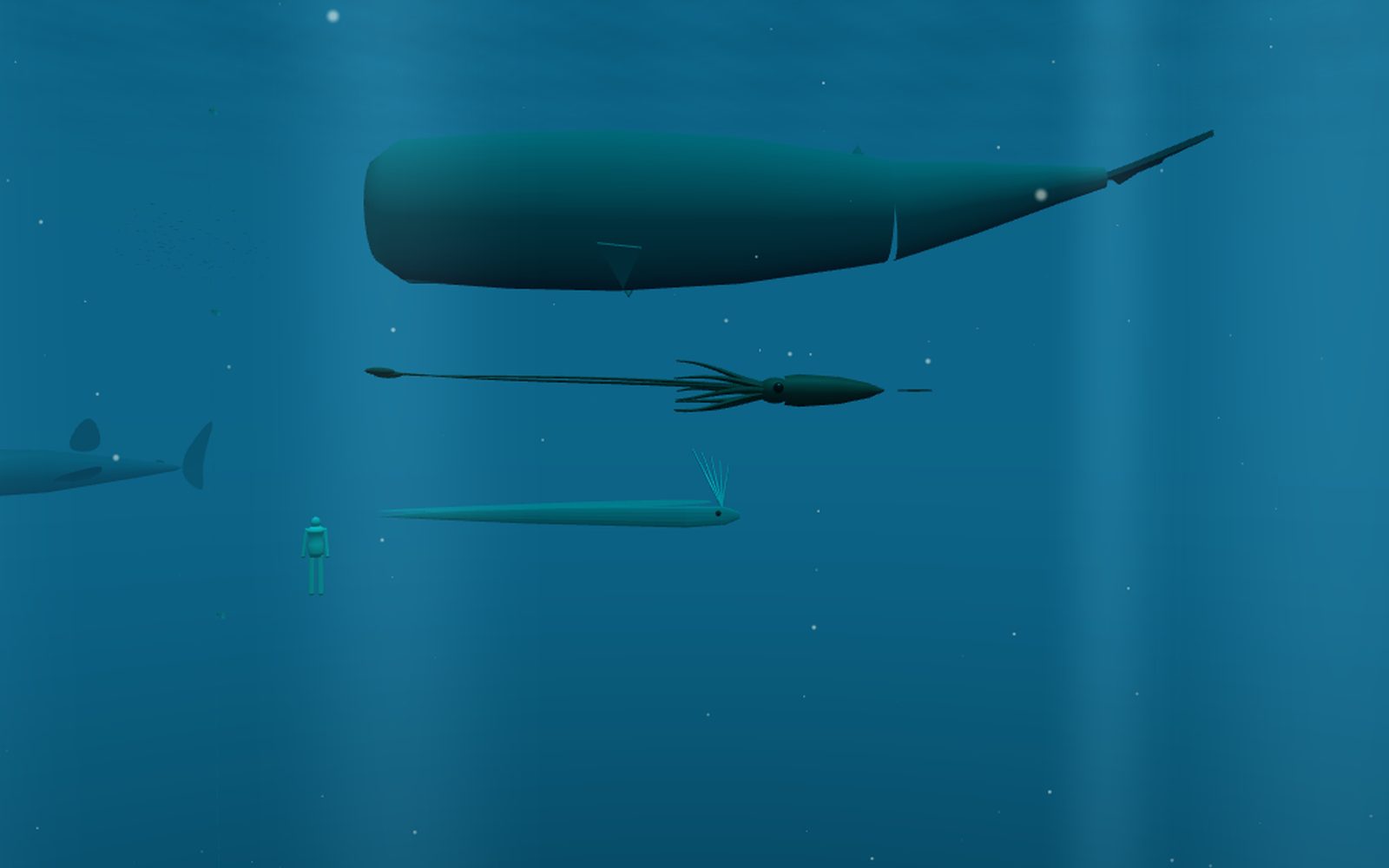
Swim to the bottom of the Mariana Trench in a 3D ocean
By 20 m down, almost all the red in sunlight has gone, and the Challenger Deep is another 10,900 m below that.
Coral bleaching causes: why warmer water turns reefs white
Corals get most of their food from algae living in their tissue, and when the sea stays more than 1 °C above its usual summer high for weeks, they lose those algae and turn white.
Giant sequoia forest: walk under the largest trees
Stand at the foot of the General Sherman Tree, 83.8 m tall and about 2,200 years old, then climb its trunk and see how hard the water up there is pulled.
How tides work
The Moon raises the sea on the side of the Earth facing it, so why is there a second high tide on the side facing away?
Why do ships float?
A 1,900-tonne steel ship floats, yet the same 1,900 tonnes of steel pressed into a cube goes straight to the bottom.
How a water treatment plant turns muddy water clear
A grain of clay two micrometres across would take eleven days to sink through a settling basin, but stuck into a floc by a coagulant it reaches the floor in about two hours.