Loading the model
This device cannot show the 3D model. You can read the guide steps below as text.
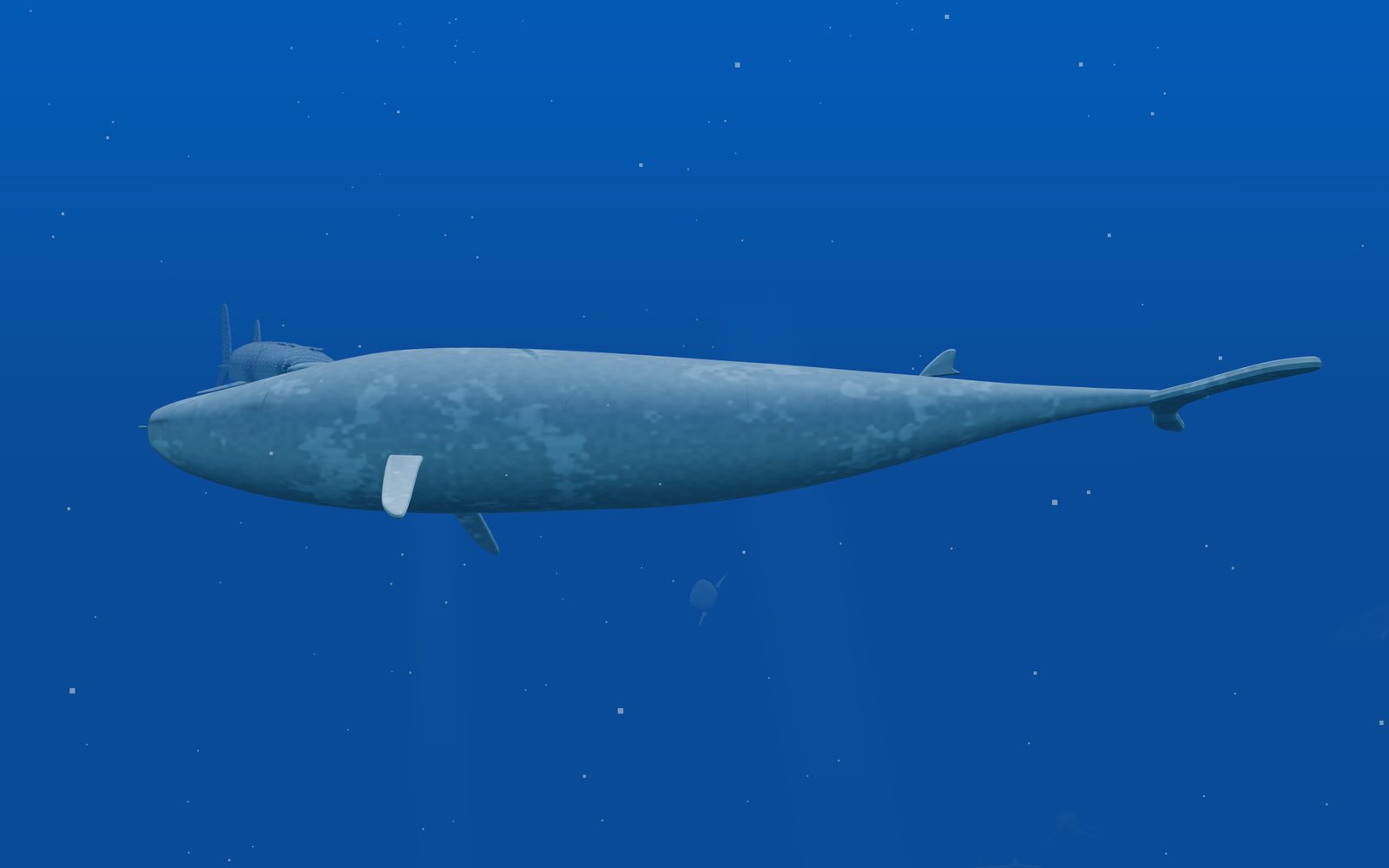
1 / 18 A blue whale passes You start 14 m down in the open ocean, and a blue whale swims right past you. It is the largest animal known to have lived. Turn on the sound to hear a whale song, made the way NOAA plays its recordings: 10 times faster.
Drag to turn. Scroll or pinch to zoom.
Guide Parts Controls
01 A blue whale passes You start 14 m down in the open ocean, and a blue whale swims right past you. It is the largest animal known to have lived. Turn on the sound to hear a whale song, made the way NOAA plays its recordings: 10 times faster.
02 You, a bus and the giants The size line-up puts you next to a 12 m bus, a white shark, a giant squid, a sperm whale, megalodon and a 28 m blue whale. The faint shape behind megalodon is its largest estimate, 24.3 m.
03 Not as big as a car This is the blue whale heart kept at the Royal Ontario Museum: 106 by 96 cm and 175 kg, from a 23 m whale. On a feeding dive a blue whale heart can slow to 2 beats a minute.
04 One gulp A lunging blue whale takes in more water than its own body volume. The balloon shows about 68 cubic metres, the body volume of a 23 m whale, as the smallest such gulp.
05 Krill Blue and humpback whales feed on krill like these. NOAA writes that the biggest blue whales may eat up to 6 tonnes a day; a 2021 study estimated about 16 tonnes in the feeding season.
06 From the surface Surface view lifts you above the water. Watch the humpbacks on the coast: every 30 seconds or so one leaps clear and falls back with a splash.
07 Under the icebergs Back under water, the icebergs show how much ice hangs below the line. NOAA calls floating ice an iceberg when it stands more than about 5 m above the sea.
08 Sperm whale and giant squid At about 700 m the light is almost gone. Sperm whales routinely hunt this deep, and a giant squid was filmed at 759 m. Many sperm whales carry round scars from squid suckers.
09 Seeing by sound Sonar view draws only what sends back an echo, the way a sperm whale clicks to find its prey. The round display shows the animals around you from above.
10 Whale fall At about 1,700 m a whale skeleton feeds the deep for years to decades. Hagfish and Greenland sharks eat the flesh; bone-eating worms with no mouths live on the bones.
11 Megalodon In the Miocene sea megalodon hunted whales. It is known from teeth, vertebrae and scales; recent studies give it a slimmer body than a white shark and a length of up to about 24 m.
12 Livyatan Livyatan, a sperm whale with teeth more than 36 cm long in both jaws, lived in the same sea as megalodon off Peru about 12 to 13 million years ago.
13 Basilosaurus In the Eocene sea of Egypt, Basilosaurus ate young Dorudon. Its tiny hind legs show that whales came from land animals.
14 The first whales At the beach, Pakicetus paddles in shallow water. One of the oldest whales, it had long legs and lived on land at the water's edge.
15 Mosasaurus In the Cretaceous sea, Mosasaurus was a sea lizard 11 to 17 m long by different estimates. Look on the floor for a fish inside a fish and a giant ammonite.
16 Elasmosaurus Elasmosaurus had 72 neck vertebrae, more than any other known animal with a backbone. It rowed with four long flippers.
17 Shonisaurus In the Triassic sea, Shonisaurus gathered in groups. Beyond them swims Ichthyotitan, known from two jaw bones and estimated at about 25 m.
18 Liopleurodon Television once showed Liopleurodon 25 m long. A 2026 study of 37 specimens puts most at about 5 to 6 m and the largest at about 8 m.
Blue whale The largest animal known to have lived. A tagged blue whale's heart slowed to 2 beats a minute on feeding dives and rose to 37 at the surface. Fin whale The second longest whale. Its lower jaw is dark on the left side and white on the right. Sei whale Often covered in oval scars, probably from bites of cookie-cutter sharks and lampreys. Whale shark The largest living fish, thought to reach about 20 m. It strains plankton and small fish from the water. Giant manta ray The largest ray, with a disc up to about 8 m across. Tagged mantas have dived deeper than 1,000 m. Bump-head sunfish The heaviest bony fish on record: a 2.72 m female caught off Japan weighed 2,300 kg. Leatherback turtle The largest living turtle. Its shell is leathery skin over small bones, and it dives to about 1,200 m. Atlantic bluefin tuna The largest tuna. The biggest on record was 4.58 m long and weighed 684 kg. White shark Grows to about 6 m. A 2025 study argues that its stocky build is one reason it cannot become a giant. Humpback whale Known for leaping clear of the water. Its tail flukes are up to 5.5 m wide, and the pattern under them differs from whale to whale. North Atlantic right whale Has no dorsal fin. The white patches on its head are rough skin covered by whale lice. Bowhead whale Its blubber is up to about 48 cm thick, and studies suggest some bowheads live more than 200 years. Gray whale Its tail flukes are nearly 3 m wide, with an S-shaped trailing edge. Killer whale The largest member of the dolphin family. Females can live at least 90 years. Basking shark The second largest fish. Swimming with its mouth open, it strains up to 2,000 tons of seawater an hour. Northern elephant seal Males grow an inflatable nose. Dives to 300 to 760 m last 20 to 30 minutes. Antarctic krill A 6 cm shrimp-like animal. All Antarctic krill together are estimated at about 379 million tonnes. Sperm whale Its head is about a third of its body. Routine hunting dives reach about 600 m and last about 45 minutes. Giant squid The longest one measured was almost 13 m with its two long tentacles. In 2019 a camera filmed one at 759 m in the Gulf of Mexico. Colossal squid Shorter than the giant squid but heavier: the one at Te Papa weighs 490 kg. Its eyes are the largest of any animal studied. Cuvier's beaked whale Holds the mammal dive records: 2,992 m deep, and one dive of 222 minutes. Giant oarfish A ribbon of a fish up to 11 m long, usually about 3 m. It may be one source of sea serpent stories. Greenland shark Radiocarbon in the eye lenses gave the largest one studied an age of about 390 years, give or take 120. Broadgilled hagfish Releases slime that clogs the gills of a fish that bites it. Hagfish come early to a dead whale. Bone-eating worm Has no mouth or gut. Roots grown into the bone hold bacteria that digest it. Giant deep-sea isopod A deep-sea relative of the pill bug. The one NOAA filmed in 2017 was nearly 30 cm long. Megalodon Known only from teeth, vertebrae and scales. A 2025 study estimates 16.4 m for its best vertebral column and at most about 24.3 m. Livyatan A sperm whale with a 3 m head and teeth more than 36 cm long in both jaws: the biggest bite of any known four-limbed animal. Pelagornis A seabird with bony spikes like teeth on its beak. The skeleton from Chile suggests a wingspan of about 5.2 m. Thalassocnus (sea sloth) A ground sloth that took to the sea off Peru. Later species had denser bones, which helped them graze on the bottom. Odobenocetops A small whale with a walrus-like face and two tusks pointing backwards, one much longer than the other. Basilosaurus A long, slim early whale with tiny hind legs. Its stomach contents show it ate young Dorudon and large fish. Dorudon An early whale about 5 m long, already shaped like a modern one. Young Dorudon were prey for Basilosaurus. Perucetus Known from huge, very dense vertebrae, ribs and a hip bone. Weight estimates run from 35 to 340 tonnes. Ambulocetus An early whale with big feet that lived at the water's edge, probably hunting like a crocodile. Pakicetus One of the oldest whales: a long-legged animal that lived on land at the water's edge. Shonisaurus A 15 m ichthyosaur. The many skeletons at one site in Nevada are read as a gathering place for giving birth. Ichthyotitan Known from two lower jaw bones found in Somerset, England. The animal is estimated at about 25 m. Temnodontosaurus Its eyes were among the largest of any backboned animal, more than 25 cm across. Ophthalmosaurus A 4 m ichthyosaur with eyes more than 20 cm across, suited to dim, deep water. Liopleurodon Shown as 25 m long on television in 1999. A 2026 study of 37 specimens puts most at about 5 to 6 m. Mosasaurus A sea lizard. Estimates for the largest Mosasaurus hoffmannii run from 11 to 18 m. Prognathodon A mosasaur with heavy jaws. The museum in Maastricht shows an 11 m skeleton of one called Bèr. Elasmosaurus Its neck has 72 vertebrae, more than any other known animal with a backbone. Kronosaurus A pliosaur with a skull at least 2.4 m long. The famous skeleton at Harvard is about 3 m too long. Archelon One of the largest sea turtles known, from the inland sea that once covered central North America. Xiphactinus A big-mouthed Cretaceous fish. A fossil from Kansas holds a 2 m fish inside a 4 m Xiphactinus. Parapuzosia (ammonite) The largest known ammonite. The shell in Münster is 1.74 m across even though its last chamber is missing. Blue whale passing Where the first blue whale swims by, 14 m down in the open ocean. Krill swarm A cloud of Antarctic krill on the coast, the food of blue and humpback whales. Humpback leap (surface) From the surface, a humpback leaps clear of the water every 30 seconds or so. Under the icebergs Under the icebergs: most of the ice lies below the water line. Sperm whale and giant squid At about 700 m on the deep edge, sperm whales circle giant squid. Whale fall A whale skeleton at about 1,700 m with hagfish, sleeper sharks and bone-eating worms. Megalodon Megalodon in the Miocene sea, with megalodon teeth on the floor. Basilosaurus Basilosaurus and Dorudon in the Eocene sea of Egypt. The first whales The beach where the oldest whales paddled in shallow water. Shonisaurus group A group of 15 m Shonisaurus in the Triassic sea. Mosasaurus Mosasaurus and other mosasaurs in the Cretaceous sea. Elasmosaurus Elasmosaurus with its 72 neck vertebrae. Livyatan Livyatan, the sperm whale with teeth in both jaws, in the Miocene sea. Liopleurodon Liopleurodon in the Jurassic sea, at its measured size. People for scale Smooth figures 1.7 m tall float or stand beside the main animals. Enter your own height under Me and they take your height. Size line-up You, a 12 m bus, a white shark, a giant squid, a sperm whale, megalodon and a blue whale in rows, with 5 m marks. Blue whale heart The heart kept at the Royal Ontario Museum, 106 by 96 cm and 175 kg, next to you and a small car. One gulp A blue whale gulps more water than its own body volume: at least about 68 cubic metres for a 23 m whale.