FIG. 36How It Works
Why do ships float?
A 1,900-tonne steel ship floats, yet the same 1,900 tonnes of steel pressed into a cube goes straight to the bottom.
This device cannot show the 3D model. You can read the guide steps below as text.
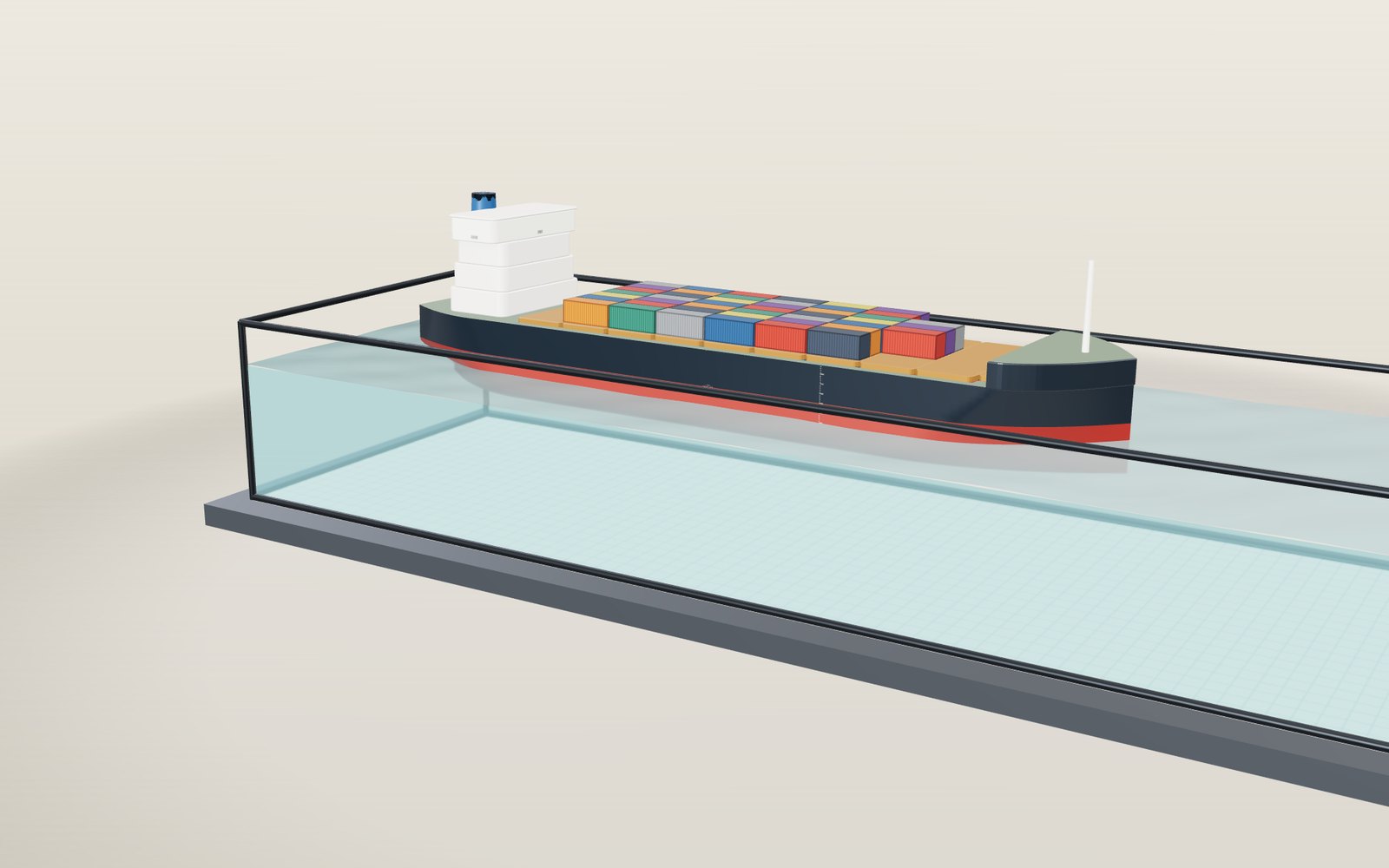
1 / 11 A ship in a tankA container ship floats in a glass tank, drawn at 1:50. The numbers in the corner are worked out from the curved hull itself and change as you load it. Drag to look around; the ship is tipped 15° and let go at regular intervals.
Drag to turn. Scroll or pinch to zoom.
What the model shows
Drop a steel bolt into a bath and it sinks at once. A container ship is made of the same steel, weighs thousands of tonnes, and sits on the water with its deck several metres in the air. This exhibit puts one such ship in a glass tank so you can load it, change the water and push it over to see what keeps it up and what keeps it the right way up.
The ship is drawn at 1:50. Its hull is 84 m long, 20 m wide and 9 m deep, with a rounded bilge, a bow that narrows to a sharp stem and a stern that closes to a skeg below a flat transom. There is a wheelhouse aft and room for 20-tonne containers in the hold and on the hatch covers. The "Cargo" slider loads up to 6,000 t, "Share stowed on deck" decides how much of it goes above the hatches, and "Water density" runs from 990 to 1,035 kg/m³. "Heel before letting go" tips the ship over and releases it. "Cut through midship" slices the model in half so you can see the centre of gravity G, the centre of buoyancy B and the metacentre M, and "Steel lump" drops a cube of steel into the tank for comparison. The panel in the corner shows the numbers for whatever you set.
Below the controls there is more: a hull bench where you change the hull form, the beam and the bilge radius, add ballast and leave a tank half full; a water panel that works out the density from temperature and salt; the load line and the deadweight; a catalogue of 37 real ships and stability accidents; eight challenges; and four hidden facts.
Why a steel ship floats
Water presses on anything placed in it, and the pressure grows with depth. On a floating hull the pressure on the sides cancels out, left against right, but the pressure on the bottom pushes up. Add that push over the whole bottom and you get the buoyant force. Archimedes' principle, as NASA's Glenn Research Center puts it, says that this force equals the weight of the fluid the object displaces.
So a ship floats when it can push aside its own weight of water before the water reaches the top of its sides. The empty ship in the model weighs 1,900 t. Sea water has a density of 1,025 kg/m³, so the ship has to push aside 1,900 ÷ 1.025 = 1,854 m³ of it. The model finds the draught (the depth of the bottom below the waterline) by trying waterlines until the volume below one of them is exactly 1,854 m³. That happens at 1.40 m. The sides are 9 m tall, which leaves 7.60 m of freeboard above the water.
Turn on "Cut through midship", as the second step does, and the dark blue area in the cut is the displaced water at that section. B, the centre of all the displaced water, sits 0.72 m above the keel. In a box it would be at exactly half the draught, 0.70 m; the rounded bilge removes a little volume near the bottom, so B sits a touch higher. The weight of the ship acts down through G and the buoyancy acts up through B. When the ship is upright the two are on the same vertical line, they are equal, and nothing moves.
The same steel as a lump
The third step drops a steel cube into the tank. It holds exactly the steel of the empty ship, 1,900 t, at a density of 7,850 kg/m³. That is 1,900,000 ÷ 7,850 = 242 m³, a cube 6.23 m on a side. Fully under water it pushes aside 242 m³ of sea water, which weighs 248 t. The water holds up 248 t and the other 1,652 t rest on the tank floor.
The steel did not change. What changed is the volume it encloses. Spread into this hull, the same steel wraps around 13,455 m³ of space below the deck, and the ship only needs to sink into 1,854 m³ of it to be held up. A ship is mostly a large, light, watertight space with steel around it.
How the model measures a curved hull
A real hull has no single formula for its volume. Naval architects cut it into thin slices called stations, measure the half-breadth of each slice at a series of heights, and add the slices up. The model does the same. Its hull is defined by a half-breadth at every point along the ship and every height above the keel: a flat bottom that turns up through a circular bilge of radius 2.2 m, straight sides through the middle, a waterline that narrows toward the stem and a stern whose lower part closes in to a skeg while the upper part ends in a transom. The 3D surface you see is drawn from exactly those half-breadths.
For the numbers the hull is cut into 41 stations 2.1 m apart and each section into 18 heights, closer together in the bilge. Simpson's rule adds the stations: the end stations count once, the others alternately four times and twice, all multiplied by a third of the spacing. Volume, the height of B, the waterplane area and the second moment of the waterplane all come out of the same sum. To check the method, the program also runs with the hull set to a plain box. It then reproduces the box formulas (T = W ÷ ρLB, KB = T ÷ 2, BM = B² ÷ 12T) to six decimal places.
The result for this hull: at 3,000 t of cargo it floats at 3.40 m and its block coefficient, the share of the surrounding box 84 × 20 × 3.40 m that is actually under water, is 0.838. The waterplane fills 0.892 of its 84 × 20 m rectangle. A box of the same length, beam and depth would float at 2.85 m with the same load.
Loading the ship: draught and displacement in numbers
Each tonne of cargo has to be held up by another tonne of water. The ship's total weight, hull plus cargo, is called its displacement, because it equals the weight of water displaced. With 4,500 t of containers on board the displacement is 6,400 t, the displaced volume 6,244 m³ and the draught 4.36 m.
The tonnes needed for one more centimetre of draught, TPC, equal the waterplane area times one centimetre times the density. On a box this is the same at every draught. On a curved hull it is not: the waterplane grows as the water climbs past the bilge and the narrow ends. The model's TPC is 14.53 t at the empty draught of 1.40 m, 15.37 t at 3.40 m and 15.78 t at the summer draught of 5.10 m. A box hull of the same plan would need 17.22 t for every centimetre.
Sea water and river water
Salt makes sea water denser. Using the usual round figures, a cubic metre of sea water has a mass of 1,025 kg and a cubic metre of fresh water 1,000 kg. To be held up by the same weight of water in a river, the ship has to push aside 2.5% more volume, so it sinks deeper.
Set the cargo to 3,000 t and the draught is 3.40 m in sea water. Slide the density to 1,000 kg/m³ and it becomes 3.48 m, 8 cm deeper. Near the summer load line the gap is larger. Loaded to 5.10 m in sea water the ship displaces 7,559 t. In fresh water the same 7,559 t needs a draught of 5.22 m, 120 mm more. That 120 mm is the fresh water allowance for this hull. It is usually written as the displacement divided by 40 times the TPC: 7,559 ÷ (40 × 15.78) = 12.0 cm.
Water temperature and salt
The round figures hide a range. The density of sea water depends on its salt, its temperature and the pressure, and oceanographers compute it from the international equation of state of sea water, EOS-80, published by UNESCO in 1981. The algorithms and their check values are in UNESCO's Technical Papers in Marine Science number 44 by Fofonoff and Millard (1983). At the surface the equation reads as a polynomial in temperature for pure water, plus terms in the salinity S, S to the power 1.5 and S squared.
The water panel uses that surface equation. The model reproduces the report's own check values: 999.96675 kg/m³ for fresh water at 5 °C, 1,027.67547 kg/m³ for salinity 35 at 5 °C and 1,023.34306 kg/m³ for salinity 35 at 25 °C. Some results for this ship with 5,600 t of cargo:
- Salinity 35 at 0 °C: 1,028.1 kg/m³, draught 5.05 m.
- Salinity 35 at 15 °C: 1,026.0 kg/m³, draught 5.06 m.
- Salinity 35 at 30 °C: 1,021.7 kg/m³, draught 5.08 m.
- Fresh water at 4 °C: 999.97 kg/m³, draught 5.18 m.
- Fresh water at 25 °C: 997.05 kg/m³, draught 5.20 m.
Going from cold to warm sea water costs this ship 3 cm. Going from salt to fresh costs 13 cm. Salt matters far more than heat, which is why the load line rules have one fresh water line but treat temperature through the seasonal zones instead.
The load line mark
A ship that sinks too deep has too little hull left above the water. Waves come over the deck more easily, and there is less spare volume to keep it afloat if water gets in. That spare volume is called reserve buoyancy, and the height of hull above the water is the freeboard.
The mark on the side of the model follows the UK Merchant Shipping (Load Line) Regulations 1998. A ring 300 mm across is crossed by a bar 450 mm long whose upper edge passes through the centre of the ring, and the centre sits at the summer load line. 540 mm forward of the centre, a vertical line carries short lines 230 mm long: S for summer, W for winter, T for tropical, F for fresh water and TF for tropical fresh water. The upper edge of each line is the deepest the ship may float in those conditions, and the deck line above marks the freeboard deck. In the model S is at 5.10 m and F at 5.22 m. W and T are drawn 1/48 of the summer draught below and above S as an illustration.
In step five the ship carries 5,600 t in sea water and the water stands 5.06 m up the hull, 4 cm below S. Step six moves the same ship to fresh water. She sinks 12 cm to 5.18 m, past the S line but still under F. That is what the F line is for: a ship loaded in a river port may float deeper there, because she will rise when she reaches the sea.
Deadweight and the Plimsoll line
The load line limits a draught, and the draught fixes a displacement. At the S line this ship displaces 7,559 t. Take away the light ship, the 1,900 t of hull, engine and fittings, and 5,659 t is left. That figure is the deadweight: everything the ship may carry at her summer marks, cargo, ballast, fuel, water and stores together. Ship sales and charters quote deadweight because it is what earns money.
In the panel "Load to the S line" finds the largest cargo, in 100 t steps, that keeps the waterline at or below the line for the water you have chosen. In sea water with no ballast that is 5,600 t, 280 containers. Add 500 t of ballast and the cargo that fits drops by the same 500 t. In the catalogue the shipbuilders' figures show the same idea at full scale: a Handysize bulk carrier designed for 38,800 t of deadweight on a summer draught of 10.50 m, a Valemax ore carrier for 400,000 t on 23.0 m.
G, B and M: why a ship comes back upright
Floating is one problem. Staying upright is another. When a wave tips the ship, the shape of the underwater hull changes. The low side goes deeper and the high side comes up, so the centre of the displaced water, B, moves toward the low side. G does not move, because the cargo is fixed in the ship.
Now the weight acts down through G and the buoyancy acts up through B, and the two forces are no longer on the same line. They form a couple. If B has moved further out than G, the couple turns the ship back. The horizontal distance between the two lines is the righting arm GZ, and the righting moment is the displacement times GZ.
For small angles there is a neat test. Draw the vertical line up through the shifted B. It crosses the ship's centreline at a point called the metacentre, M. If G is below M the ship comes back; if G is above M it does not. The distance between them is the metacentric height, GM.
The numbers for this ship
The height of M above B is BM = I ÷ V, where I is the second moment of area of the waterplane about the centreline and V the displaced volume. For a rectangle I = L × B³ ÷ 12. For the curved hull the model adds two thirds of the cube of the half-breadth at the waterline, station by station. Then KM = KB + BM and GM = KM − KG, where K is the keel.
With 3,000 t of cargo, 30% of it on deck, the ship displaces 4,900 t and floats at 3.40 m. The waterplane's I is 45,319 m⁴ and the displaced volume 4,780 m³, so BM is 9.48 m. KB is 1.75 m, so KM is 11.23 m. The 150 containers have their combined centre 5.71 m above the keel; together with the empty ship's 4.4 m that puts KG at 5.20 m. GM is 6.03 m. A box of the same length, beam and depth with the same KG would have BM 11.71 m and GM 7.94 m: the fine ends of a real hull take waterplane away where it counts.
At small angles GZ is close to GM × sin θ. For a wall-sided hull a better formula holds until the bilge lifts out of the water or the deck edge goes under: GZ = sin θ × (GM + ½ × BM × tan² θ). At 10° it gives 1.073 m, and the model's own calculation, which rotates every station, cuts it at a common waterline and finds the centre of the part below, gives 1.072 m. At larger angles only the cut-section calculation is used. The small chart in the corner and the large one in the hull bench are GZ from 0° to 90° for the load you have set. This load has its largest righting arm, 3.00 m, at 36°.
The roll after you let go comes from that curve. The model takes the radius of gyration as 0.4 times the beam, 8 m, which gives a small-angle roll period of 2π × 8 ÷ √(9.81 × 6.03) = 6.5 s. On screen the roll runs three times faster so you don't have to wait.
Stacking too high
G rises when weight goes up. Put 5,000 t of containers all on deck, four tiers high in the middle bays, and their centre is 14.38 m above the keel. KG becomes 11.63 m. The draught is 4.68 m, so KM is 2.41 + 7.01 = 9.42 m and GM is −2.21 m. G is above M.
In the eighth step the ship is tipped only 10° and let go. GZ is negative at every angle from 0° to 90°, so instead of a righting moment there is an upsetting one, and she rolls over. The model does not stop her, because nothing in the physics would.
A smaller negative GM can end differently. With 6,000 t loaded and 70% of it on deck, GM is −0.08 m, and the ship leans until B has moved far enough out to sit under G again, at about 10°. She then floats at that angle and rolls about it, with a largest righting arm of only 0.12 m at 22°. This is called an angle of loll, and it is easy to mistake for a list caused by uneven cargo. The cure is different too: shifting weight across to correct a loll can make the ship flop over to the other side. Adding 600 t of ballast low in the double bottom brings GM back to +0.30 m, at the price of a draught of 5.69 m, deeper than the S line.
A positive GM is not the whole story either. With 3,500 t all on deck, GM is +0.64 m and the ship comes back from small tips, but GZ falls back to zero at about 38°. Set the heel to 40°, let go, and she goes over. How far the curve stays positive matters as much as how steeply it starts.
Changing the hull
The hull bench lets you change the shape itself. Four forms share the same length, beam and depth: the container feeder of the default model, a full tanker form whose waterline narrows only in the last 11 m, a fine fast form that narrows over 36 m at the bow, and a barge with rounded chines. With the same 3,000 t of cargo:
- Full form: draught 3.12 m, block coefficient 0.91, GM 6.97 m.
- Feeder: draught 3.40 m, block coefficient 0.84, GM 6.03 m.
- Fine form: draught 3.88 m, block coefficient 0.73, GM 4.94 m.
- Barge: draught 2.93 m, block coefficient 0.97, GM 7.67 m.
The fuller the hull, the shallower it floats and the stiffer it is, because a wide waterplane carried far toward the ends gives a large I. Fine ships pay for their speed with a smaller GM.
The beam matters most of all. BM = I ÷ V, and I grows with the cube of the beam while V grows only in proportion to it. At 3,000 t, a beam of 16 m gives BM 4.99 m and GM 1.46 m; 24 m gives BM 16.09 m and GM 12.45 m. The bilge radius matters less. Going from a 3.5 m to a 5 m bilge at 3,000 t moves GM from 6.11 m to 5.68 m, because the hull gets deeper while its waterline stays the same width.
Ballast and a slack tank
Ballast is sea water pumped into tanks low in the ship. The model's ballast sits in the double bottom with its centre 0.6 m above the keel, up to 1,500 t. It does two things at once: it adds displacement, so the ship floats deeper and BM falls, and it pulls G down. Low weight nearly always wins.
A tank that is pressed full behaves like solid weight. A tank that is only partly full does not. When the ship heels, the water runs to the low side, its centre moves outward, and the effect on the righting arm is the same as raising G by GG′ = ρ × i ÷ Δ, where i is the second moment of area of the free surface about its own centreline and Δ the displacement. The US Naval Academy's course notes give this as the free surface correction. For a rectangular surface i = l × b³ ÷ 12.
The model's slack tank is 20 m long and 16 m wide, so i = 20 × 16³ ÷ 12 = 6,827 m⁴. In step ten the ship carries 4,000 t, 60% on deck, and 900 t of ballast, a displacement of 6,800 t. Pressed full, GM is 3.24 m. Leave the tank slack and GG′ = 1.025 × 6,827 ÷ 6,800 = 1.03 m, so GM drops to 2.21 m. A centreline bulkhead turns one 16 m tank into two 8 m tanks; because the width counts as its cube, i falls to a quarter and the loss to 0.26 m. That is why the Naval Academy notes list subdivision and baffles among the ways to limit the effect, and why MIT's ocean-systems notes put minimising partly filled tanks among the design aims for a floating platform.
What the rules ask of GM and GZ
A positive GM is not enough to be allowed to sail. The general criteria of the IMO intact stability code, as the UK Maritime and Coastguard Agency prints them in its notice MSIS43, ask for six things: areas under the GZ curve of at least 0.055 m·rad up to 30°, 0.09 m·rad up to 40° and 0.03 m·rad between 30° and 40°; a righting lever of at least 0.20 m at 30° or more; the largest righting lever at 25° or more; and an initial GM of at least 0.15 m. For vessels under 100 m that the Coast Guard asks to show it, 46 CFR 170.173 gives the same figures in other units. The hull bench shows all six as a table that updates with every change.
Put the model's loadings against them. With 6,000 t and 60% on deck, GM is 0.78 m, GZ at 30° is 0.41 m, the largest GZ comes at 26°, and the areas are 0.135, 0.175 and 0.040 m·rad, so all six pass. Move to 70% on deck and GM is −0.08 m: none of the six pass. Widen the hull to 22 m on the bench and the same 6,000 t with 70% on deck floats at 4.85 m with GM 1.72 m, and all six pass again. With 3,500 t entirely on deck, five pass but the area between 30° and 40° is only 0.014 m·rad, because the curve is already sinking toward zero at 38°.
The roll period tells you how GM feels on board. In the naval architecture notes of the US Naval Academy, a ship whose righting arm grows quickly with heel is called stiff: it rolls fast, and if it is too stiff the sharp accelerations can damage structure and people. A ship whose righting arm grows slowly is tender: it rolls slowly and has little margin before it capsizes. The empty model at 3.7 s is the stiff end; 6,000 t with 60% on deck at 18.2 s is the tender end.
Worked example: three loadings side by side
Here are three loadings in sea water, taken from the model's own calculation.
- Empty, 1,900 t. T = 1.40 m, freeboard 7.60 m. BM is 22.14 m, so KM is 22.86 m, KG is the empty ship's 4.40 m and GM is 18.46 m. The small-angle roll period is 3.7 s. An empty hull floats very stiffly and snaps back.
- 3,000 t of cargo, 30% on deck. W = 4,900 t, T = 3.40 m, freeboard 5.60 m. BM falls to 9.48 m, KM to 11.23 m, KG rises to 5.20 m and GM is 6.03 m. Roll period 6.5 s.
- 6,000 t of cargo, 50% on deck. W = 7,900 t, T = 5.32 m, freeboard 3.68 m. BM is only 6.18 m, KM is 8.92 m, KG is 7.87 m and GM is 1.06 m. The roll period stretches to 15.6 s, and the largest righting arm is 0.59 m at 26°.
Two things work against GM as the ship fills up. The deeper hull has a smaller BM, because V grows faster than the waterplane's I, and the cargo raises KG. Moving from empty to 6,000 t takes KM from 22.9 m down to 8.9 m. Where the cargo sits then decides what is left: with 6,000 t, 60% on deck leaves GM at 0.78 m, and 70% leaves −0.08 m. Each 10% of the cargo moved from the hold to the deck costs 0.3 to 0.9 m of GM.
At 6,000 t the hold, which takes 130 containers of 20 t, cannot hold all 300 containers. At least 170 of them, about 57%, must go on deck. This is why the "Share stowed on deck" slider changes nothing at 6,000 t until it passes 57%.
Real ships in the catalogue
The catalogue holds 37 entries: container ships, roll on roll off ships, bulk carriers, tankers, a gas carrier, warships, submarines, icebreakers, sailing ships, a sea kayak and the ships of five stability accidents. Each card gives the figures as the source prints them, with the source linked below. Where the source uses feet or long tons the card converts them (1 ft = 0.3048 m, 1 long ton = 1.016047 t) and marks the value as calculated.
Where to look depends on the ship. The container ships come from the Port of Hamburg's pages on large callers, which list length, breadth, draught and container capacity: HMM Algeciras, for example, is 399.9 m long and 61 m wide, draws 16.52 m and carries 23,964 TEU. The bulk carriers, tankers and gas carrier are design particulars published by the shipbuilder CSSC. The warships and submarines are from the US Navy's fact files, the icebreakers and the training barque Eagle from the US Coast Guard, the Vasa from the Vasa Museum, Cutty Sark from Royal Museums Greenwich and the kayak from its maker.
When a card has length, beam, draught and displacement, the panel works out the block coefficient, Cb = Δ ÷ (1.025 × L × B × T). The icebreaker Healy (128 m, 25 m, 8.9 m, 16,419 long tons at full load) gives 0.57; the car carrier Golden Ray at departure gives 0.51; Sewol at her summer draught gives 0.48. These are lower than the true values, because the length on the card is the overall length, stem to stern above the water, while Cb is defined on the length at the waterline or between perpendiculars. The card says so.
Opening a card changes the model too. The hull takes the ship's length to beam ratio on its own 84 m length and the closest hull form: a full form for tankers and bulk carriers, a fine form for warships, submarines and the kayak. The model's numbers are then the model's, not the real ship's.
Stability accident reports
The accident cards keep to what the official investigations wrote. Where a card also changes the model's loading, it is to show the same kind of problem on the model ship, and the card says that these are not the real ship's figures.
Herald of Free Enterprise, 1987. The roll on roll off ferry was 131.9 m long overall and 22.7 m in breadth. The formal investigation by the UK Department of Transport found that she capsized because she went to sea with her inner and outer bow doors open. Water flooded onto the vehicle deck, and she capsized about four minutes after passing the outer mole at Zeebrugge. The report records the loss of 188 lives: not less than 150 passengers and 38 members of the crew.
Sewol, 2014. The special investigation report of the Korea Maritime Safety Tribunal (December 2014) gives her as 145.61 m overall, 22.00 m in breadth and 6,825 gross tonnage. After she was bought, cabins were added on the upper decks; the report says this raised the ship's own centre of gravity by about 0.51 m, from 11.27 m to 11.78 m. To meet the stability standard after the refit she was approved on condition that she carry at least about 1,703 t of ballast and at most 987 t of cargo. On her last departure from Incheon the report finds about 761.2 t of ballast and 2,142.7 t of cargo, poorly secured. In a turn off Byeongpungdo on 16 April 2014 she heeled heavily to port, the cargo shifted, and she lost her ability to right herself. The report puts the cause in the combination of these factors. The Central Maritime Safety Tribunal ruled on the case on appeal in 2026 (No. 2026-001) and reached the same cause: a ship with less stability than the standard required, carrying more cargo than approved, heeled in the turn because her righting arm was smaller than the heeling moment, and poorly stowed and lashed cargo shifted. The ruling presumed that a stuck steering gear valve had some effect on the turn to starboard but found it hard to conclude that it started the turn; it held that the helmsman's large rudder angle was possible under the ship's design and stability rules and within his duties in an emergency, so he could not be held responsible or blamed for it; and it did not accept the claim of an outside force. The ruling records 304 people lost.
Hoegh Osaka, 2015. The car carrier, 179.9 m overall, is described in detail in the next section.
Golden Ray, 2019. The car carrier was 200 m long with a beam of 35.4 m. On her departure from Jacksonville she displaced 35,044 t at a midship draught of 9.4 m. The National Transportation Safety Board determined that the probable cause of the capsizing at Brunswick was the chief officer's error in entering ballast quantities into the stability calculation program, which led to his incorrect determination of the ship's stability, so that she had an insufficient righting arm for the forces of the turn. The NTSB also found that she did not meet international stability standards at departure, and that open watertight doors allowed flooding after the capsize. All 24 people on board were rescued.
In each case the numbers that mattered were known or knowable before departure. GM and the GZ curve are not exotic quantities; they are what a loading computer or a stability booklet works out every time a ship sails.
The Vasa, 1628
The Vasa Museum in Stockholm keeps a warship that shows the problem in real life. On 10 August 1628 the new Vasa set sail in Stockholm harbour. A gust heeled her to port and she slowly recovered; a stronger gust pushed her so far over that water poured in through the open gunports on the lower gundeck, and within minutes she lay on the bottom at 32 m. According to the museum, the upperworks were too tall and too heavily built for the small amount of hull below the waterline, which put the centre of gravity too high.
Who decides how deep a ship may float
According to Royal Museums Greenwich, ships from Venice were marked with a cross as early as the 12th century. In Britain the MP Samuel Plimsoll began to investigate unseaworthy ships in 1870 and a Royal Commission followed in 1872. The Merchant Shipping Act of 1876 made load lines compulsory, the position of the line was fixed by law in 1894, and from 1906 foreign ships visiting British ports had to carry one too.
The International Maritime Organization records the first international load line convention in 1930. The current International Convention on Load Lines was adopted on 5 April 1966 and came into force on 21 July 1968. It requires all assigned load lines to be marked amidships on each side together with the deck line, and its rules allow for different zones and seasons, which is why a single ship carries several lines. A 1988 Protocol, in force since 3 February 2000, revised parts of the technical annexes.
Other cases: a submarine, the Vasa, the Hoegh Osaka in detail
A submarine. A surface ship has a waterplane, and M and BM come from it. A submerged submarine has none: its displaced volume is the whole hull, and it is the same at every heel. B stays fixed in the hull, so the submarine stays upright only if B is above G. The Naval Academy's notes put it as GZ = BG × sin φ, a curve that peaks at BG when the boat is on its side. A boat with BG of 0.30 m has a righting arm of 0.052 m at 10° (0.30 × sin 10°) and never more than 0.30 m. This is a made-up figure for scale, not data on a real submarine.
The same notes describe how a submarine changes between floating and diving. Archimedes' principle still applies, with the whole hull volume under water. The main ballast tanks are the largest tanks aboard. Empty, they keep the boat positively buoyant on the surface; flooded, the boat is close to neutral. They are "soft tanks" with no need to withstand the sea's pressure, because when they are flooded the pressure is equal inside and out. Smaller variable ballast tanks make the fine adjustments. The model's hull is the surface case only.
The Vasa. Before she was launched, the ship was put through a rough stability test, described in a case study posted by the University of Portland: thirty men ran from side to side across the deck, and after three crossings the test was stopped because she rolled so far that she seemed likely to go over. The same account says the shallow keel left no room for the extra ballast she needed, that she carried about 120 tons, and that more than twice that would have been needed. Raising ballast would have put the lowest gunports near the water. In the model's terms, the Vasa had too small a GM and a righting arm that disappeared at a small angle. The Vasa Museum puts the end of this on 10 August 1628, when a gust heeled her, water came in at the gunports and she sank in about 32 m.
The Hoegh Osaka. On 3 January 2015 this vehicle carrier left Southampton for Bremerhaven and developed a list in The Solent. The Marine Accident Investigation Branch (MAIB) reports that the list exceeded 40°, cargo shifted, the ship lost steering and power and she grounded on Bramble Bank at 2115. All the crew were saved. Before departure the chief officer's loading computer gave GM = 1.46 m. The requirement was 1.34 m, so the number looked acceptable. When MAIB rebuilt the loading from the final cargo tally, it got 1.29 m, which marginally fails, and it says the real figure was significantly worse, because the ballast quantities were unverified, cargo weights disagreed between records and there was no data for the height of the cargo's centre of gravity. MAIB also notes that, unlike Cougar Ace in 2006, no ballast was being moved when the accident happened. The chief officer's figure cleared the minimum by 0.12 m, and MAIB's rebuild fell short of it by 0.05 m. In the model at 6,000 t, moving 10% of the cargo from the hold to the deck changes GM by 0.3 to 0.9 m, so margins of this size are easily eaten by errors in where and how heavy the cargo really is.
Common misunderstandings
- "Steel floats because it is light." Steel is about 7.7 times denser than sea water. A hull floats because of the volume it encloses. Fill the hull with water and it goes down, which is what a flooded compartment does.
- "The load line marks the maximum weight." It marks the deepest draught allowed in given water, which is a freeboard rule. A ship can be below her mark and still be in trouble: in the model, 5,500 t with 90% on deck floats at 5.00 m, 10 cm below S, and has a GM of −1.77 m.
- "A bigger GM is always better." It makes the ship return more strongly and also roll faster. At the stiff extreme, the empty model snaps back in 3.7 s. Ships carry cargo and passengers that do not enjoy accelerations like that.
- "M is a fixed point." M is where the line through B crosses the centreline for a small heel. It moves with draught, because BM = I ÷ V changes as the ship sinks, and it loses meaning at large angles. That is why the large-angle curve is calculated from the actual heeled hull.
- "Load it low and the stability takes care of itself." Cargo in the hold keeps G low, but any cargo also deepens the hull and lowers KM. With 3,000 t almost all in the hold the model's GM is 6.62 m, already far down from 18.46 m when empty.
- "The centre of buoyancy is a point on the ship." It belongs to the water that is displaced. It moves each time the shape of the underwater hull changes.
- "Warm water does not matter." It does, a little. This ship floats 3 cm deeper in 30 °C sea water than in 0 °C sea water with the same load. Salt matters about four times as much.
Try it on the screen
- Set "Cargo" to 0 and switch on "Cut through midship". The panel shows T = 1.40 m and KB 0.72 m. Turn on "Part names" and find G, B and M.
- Switch on "Steel lump". The cube sinks, and the panel gives 242 m³ and 248 t, against 1,900 t of steel.
- Set "Cargo" to 5,600. At "Water density" 1,025 the draught is 5.06 m. Slide the density to 1,000 and it becomes 5.18 m. Read the 12 cm difference from the marks on the side.
- Set "Cargo" to 6,000 and "Share stowed on deck" to 60, with "Heel before letting go" at 15. Let go and count the roll: on screen it is about three times faster than 18.2 s. Then raise the share to 70 and set the heel to 0: the ship leans over to about 10° and stays.
- Keep 6,000 t and 70% on deck and open the hull bench. Widen the beam to 22 m and watch the rule table turn to six passes.
- Put 900 t of ballast in, switch on "Slack ballast tank" and watch GM fall by about a metre. Switch on "Centreline bulkhead" and most of it comes back.
- In the water panel, pick "Fresh, 4 °C" and then "Salt 35 g/kg, 0 °C", and read the draught change.
Where the model is simpler than a real ship
The hull is curved, but it comes from a formula, not from the lines plan of a real ship. It has no bulbous bow, no propeller aperture and no shaped stern frame, and the bow is a sharp stem rather than a raked one. The ship floats on an even keel: the model assumes the centre of gravity is always right above the centre of buoyancy along the length, so the ship never trims by the head or stern, as real loading makes it do.
The deck is treated as watertight, so at large angles the calculation keeps counting the hull volume that goes under. Real ships have hatches, vents and doors, and water getting in through openings is how the Vasa and the Herald of Free Enterprise were lost. The deck containers, the forecastle and the wheelhouse add weight but no buoyancy. Each container weighs exactly 20 t, the cargo is spread evenly across the ship so G stays on the centreline, and only one ballast tank can be slack. The roll uses a fixed radius of gyration and a simple damping term, and the water in the tank does not rise when the ship or the cube goes in.
How the numbers were checked
A separate check program runs every calculation against an independent one. With the hull set to a box, the station integration reproduces T = W ÷ ρLB, KB = T ÷ 2, BM = B² ÷ 12T, TPC and the wall-sided GZ formula to six decimal places, and its large-angle GZ matches a plain 2D cut of the box section at 30°, 60°, 90° and 120°. For the curved hull, volume, KB and BM are worked out again by slicing the hull into 1,680 by 400 small strips; they agree to within 0.3%. The small-angle GZ divided by sin 1° equals GM to within 0.03%. KG is recomputed container by container, the free surface correction and the fresh water allowance by hand, the sea water density against the UNESCO check values, every number quoted in the guide steps, and one solution for each challenge.
Questions
Why does a steel ship float when a steel bolt sinks?
The bolt is solid, so it can only push aside its own small volume of water, which weighs far less than the bolt. A ship wraps its steel around a large volume of air. It sinks until the water it pushes aside weighs as much as the whole ship, and for the empty model ship that happens at 1.40 m.
What is displacement?
The weight of the ship and everything on it. A floating ship pushes aside its own weight of water, so the two numbers are the same, which is where the name comes from. The model ranges from 1,900 t empty to 9,400 t with 6,000 t of cargo and 1,500 t of ballast.
Why does a ship sit lower in fresh water?
Fresh water is about 2.5% less dense than sea water, so the ship has to push aside 2.5% more volume to be held up. For this hull at its summer draught of 5.10 m that is 120 mm, the gap between the S and F lines.
What is GM?
The metacentric height: the distance from the centre of gravity G up to the metacentre M. A positive GM means a small tip is followed by a righting moment. A large GM gives a quick, stiff roll and a small one a slow, gentle roll. A negative GM means the ship will not stay upright.
Why did the ship lean over and stay there?
That is an angle of loll. With a slightly negative GM the upright position is unstable, so the ship falls to one side until B has moved out far enough to sit under G again. With 6,000 t, 70% of it on deck, that happens at about 10°.
Can a ship with positive GM still capsize?
Yes. GM only describes small angles. With 3,500 t all on deck the model has a GM of +0.64 m, but its righting arm drops to zero at about 38°, so a 40° heel sends it over.
Do the containers on deck help it float?
In the model they don't, because the calculation ignores anything above the deck. Real containers are not watertight either, and a ship that rolls far enough to put them under water is already in serious trouble.
What do the letters next to the ring mean?
They identify the body that assigned the load line. The UK regulations allow up to four initials about 115 mm high beside the ring. The model shows K R as an example.
How do you measure GM on a real ship?
With an inclining experiment, described in the US Naval Academy's course notes. A known weight is moved a known distance across the deck while the ship lies in calm water, and the angle of list is measured. In the model, moving one 20 t container 10 m across the 4,900 t loading gives tan φ = 20 × 10 ÷ (4,900 × 6.03) = 0.0068, a list of 0.39°. Because the angle is so small, the test is repeated with several weights and the slope of the plotted data is used.
What is a free surface, and why does it matter?
It is liquid with room to move, such as water in a tank that is not full. When the ship heels, the liquid runs to the low side and acts like a rise in G. The correction is ρ × i ÷ Δ, where i is the second moment of area of the liquid's surface. Because i grows with the cube of the tank width, the model's 16 m wide slack tank costs 1.03 m of GM at 6,800 t, and a centreline bulkhead cuts that to 0.26 m.
Why is a submarine stable only when B is above G?
A submerged submarine has no waterplane, so its centre of buoyancy stays fixed in the hull however it heels. The only restoring couple comes from the gap between B and G, and the righting arm is BG × sin φ. If G were above B the boat would turn over. On the surface the submarine behaves like a ship again, with a waterplane and a metacentre.
Is sea water the same density everywhere?
No. It depends on salt and temperature, and the international equation of state gives it for any mix. At the surface, water with 35 g/kg of salt is 1,028.1 kg/m³ at 0 °C and 1,021.7 kg/m³ at 30 °C. The US Naval Academy notes point out that salinity changes near river mouths and the polar ice, and that the Mediterranean is saltier than the oceans because of evaporation.
Why do ships carry ballast?
To lower G and to put the hull deep enough in the water. The Naval Academy notes say an empty commercial tanker can have its centre of gravity high enough for a negative GM, so that it lolls, and that taking on ballast low in the ship cures it. The Sewol and Golden Ray reports both turn on ballast that was less than the stability calculation needed.
What is the block coefficient?
The share of the box around the underwater hull that the hull actually fills: Cb = V ÷ (L × B × T). A barge is close to 1, full tankers and bulk carriers are around 0.8 to 0.85, fast ships and warships much lower. The model's default hull has 0.84 at 3,000 t and the fine form 0.73.
What is deadweight?
Everything a ship may carry when loaded to her summer marks: cargo, ballast, fuel, fresh water, stores and people. It is the summer displacement minus the light ship. For the model that is 7,559 − 1,900 = 5,659 t.
Does warm water make a ship float lower?
Yes, because warm water is less dense. For this ship with 5,600 t of cargo, sea water with 35 g/kg of salt at 30 °C gives a draught 3 cm deeper than at 0 °C. Going from sea water to fresh water makes a difference about four times as large.
Terms
- Buoyant force: the upward push of the water on a submerged or floating object, equal to the weight of the water displaced.
- Displacement: the total weight of the ship, equal to the weight of water it pushes aside.
- Draught (draft): the depth of the bottom of the hull below the waterline.
- Freeboard: the height of the deck edge above the waterline.
- TPC: tonnes per centimetre immersion, the load that sinks the ship by one more centimetre.
- K, G, B, M: the keel, the centre of gravity, the centre of buoyancy and the metacentre. Heights above the keel are written KG, KB and KM.
- BM: the height of the metacentre above B, equal to the waterplane's second moment of area divided by the displaced volume.
- GM: the metacentric height, KM − KG.
- Free surface: liquid in a partly filled tank that can run to the low side when the ship heels.
- Stiff and tender: a stiff ship has a large GM and rolls quickly; a tender one has a small GM and rolls slowly.
- Reserve buoyancy: the volume of the watertight hull above the waterline.
- GZ: the righting arm, the horizontal distance between the lines of weight and buoyancy when the ship is heeled.
- Angle of loll: the angle at which a ship with negative GM comes to rest.
- Load line mark: the ring, bar and lines amidships that show how deep the ship may be loaded.
- Fresh water allowance: how much deeper the ship floats in fresh water than in sea water at the same displacement.
- Block coefficient (Cb): the underwater volume divided by length × beam × draught.
- Station: one of the cross sections at which a hull is measured and its volume added up.
- Deadweight: everything a ship may carry at her summer load line; summer displacement minus light ship.
- Light ship: the weight of the ship itself, with hull, machinery and fittings but nothing loaded.
- Ballast: water pumped into tanks low in the ship to lower G and deepen the hull.
- Inclining experiment: moving known weights across the deck and measuring the list to find GM, and from it KG.
- EOS-80: the international equation of state of sea water adopted through UNESCO in 1981.
Sources
- NASA Glenn Research Center, Buoyancy: Archimedes Principle. https://www.grc.nasa.gov/www/k-12/WindTunnel/Activities/buoy_Archimedes.html (checked 16 October 2026)
- International Maritime Organization, International Convention on Load Lines. https://www.imo.org/en/About/Conventions/Pages/International-Convention-on-Load-Lines.aspx (checked 16 October 2026)
- legislation.gov.uk, The Merchant Shipping (Load Line) Regulations 1998, SI 1998/2241, regulations 16 to 18 and 24. https://www.legislation.gov.uk/uksi/1998/2241/contents/made (checked 16 October 2026)
- Royal Museums Greenwich, Samuel Plimsoll and ship safety. https://www.rmg.co.uk/stories/maritime-history/samuel-plimsoll-ship-safety (checked 16 October 2026)
- Vasa Museum (Swedish National Maritime and Transport Museums), The Disaster. https://www.vasamuseet.se/en/explore/vasa-history/disaster (checked 16 October 2026)
- Korea Ministry of Government Legislation, National Law Information Center, 선박만재흘수선기준 (Korean load line standard). https://www.law.go.kr/%ED%96%89%EC%A0%95%EA%B7%9C%EC%B9%99/%EC%84%A0%EB%B0%95%EB%A7%8C%EC%9E%AC%ED%9D%98%EC%88%98%EC%84%A0%EA%B8%B0%EC%A4%80 (checked 16 October 2026)
- Massachusetts Institute of Technology, OpenCourseWare 2.019, Ship Hydrostatics and Structures (lecture slides on righting arm, metacentric height and free surface). https://ocw.mit.edu/courses/2-019-design-of-ocean-systems-spring-2011/f0cc4e483a7d4b78760f9b0908f51c44_MIT2_019S11_HydStr1.pdf (checked 22 October 2026)
- Massachusetts Institute of Technology, 13.012 Hydrodynamics for Ocean Engineers, Lecture 4: Archimedes's Principle and Static Stability (A. H. Techet, 2002). https://web.mit.edu/13.012/www/handouts/2002/Lecture4.pdf (checked 22 October 2026)
- United States Naval Academy, EN400 Principles of Ship Performance, course notes (hydrostatics, inclining experiment, stiffness and tenderness, free surface, negative GM and loll, salinity). https://www.usna.edu/NAOE/_files/documents/Courses/EN400/EN400_Course_Notes_Fall_AY2021_July2020.pdf (checked 22 October 2026)
- United States Naval Academy, EN400 chapter 10, Submarines and Submersibles (main ballast tanks, submerged stability GZ = BG sin φ). https://www.usna.edu/NAOE/_files/documents/Courses/EN400/02.10_Chapter_10_July20_.pdf (checked 22 October 2026)
- UK Maritime and Coastguard Agency, MSIS43 Intact Stability (general intact stability criteria, paragraphs 2.2.1 to 2.2.4). https://assets.publishing.service.gov.uk/media/6441189f22ef3b000f66f5dc/MSIS43_Intact_Stability_R05.23.pdf (checked 22 October 2026)
- United States Coast Guard, 46 CFR Part 170 Subpart E, Intact Stability Criteria, section 170.173. https://www.ecfr.gov/current/title-46/part-170/subpart-E (checked 22 October 2026)
- Marine Accident Investigation Branch, Report on the investigation into the listing, flooding and grounding of Hoegh Osaka, Report 6/2016. https://assets.publishing.service.gov.uk/media/56e9a7afe5274a14d9000000/MAIBInvReport6_2016.pdf (checked 22 October 2026)
- Marine Accident Investigation Branch, Listing, flooding and grounding of vehicle carrier Hoegh Osaka, summary page. https://www.gov.uk/maib-reports/listing-flooding-and-grounding-of-vehicle-carrier-hoegh-osaka (checked 22 October 2026)
- University of Portland, Vasa case study (stability test, ballast and gunports). http://faculty.up.edu/lulay/failure/Vasacasestudy.pdf (checked 22 October 2026)
- Fofonoff, N. P. and Millard, R. C. (1983), Algorithms for computation of fundamental properties of seawater, UNESCO Technical Papers in Marine Science 44 (EOS-80, check values). https://repository.oceanbestpractices.org/handle/11329/109 (checked 27 October 2026)
- Korea Maritime Safety Tribunal, 여객선 세월호 전복사고 특별조사 보고서 (Sewol special investigation report), December 2014. https://www.kmst.go.kr/boardFileDown.do?file_idx=100618 (checked 27 October 2026)
- Central Maritime Safety Tribunal, 중앙해심 제2026-001호 여객선 세월호 전복사건 (ruling on the Sewol capsizing, 2026). https://www.kmst.go.kr/web/atch/atchFileDownload.do?atchId=102396&fileSn=1 (checked 27 October 2026)
- National Transportation Safety Board, Capsizing of Roll-on/Roll-off Vehicle Carrier Golden Ray, Marine Accident Report NTSB/MAR-21/03. https://www.ntsb.gov/investigations/AccidentReports/Reports/MAR2103.pdf (checked 27 October 2026)
- National Transportation Safety Board, NTSB Determines Inaccurate Stability Calculations Caused Capsizing of Vehicle Carrier Golden Ray, news release, 14 September 2021. https://www.ntsb.gov/news/press-releases/Pages/NR20210914b.aspx (checked 27 October 2026)
- UK Department of Transport, mv Herald of Free Enterprise, Report of Court No. 8074, Formal Investigation, 1987. https://assets.publishing.service.gov.uk/media/54c1704ce5274a15b6000025/FormalInvestigation_HeraldofFreeEnterprise-MSA1894.pdf (checked 27 October 2026)
- Port of Hamburg, Ship specials (HMM Algeciras, OOCL Spain, Ever Alot, Ever Ace, ONE Innovation, CMA CGM Jacques Saadé, MSC Aaya, Afif, Ane Maersk, Pottersgracht, Atlantic Star, Great Antwerp, Höegh Aurora). https://www.hafen-hamburg.de/en/all-vessels/ship-specials/ (checked 27 October 2026)
- China State Shipbuilding Corporation, product pages for bulk carriers, oil and chemical tankers and liquefied gas carriers. https://www.chinaships.com/product_details/1223316252974010368.html (checked 27 October 2026)
- Vale, Vale adopts wind power on world's largest ore carrier (Valemax 362 m, 65 m, 400,000 t). https://www.vale.com/w/vale-adopts-wind-power-on-worlds-largest-ore-carrier (checked 27 October 2026)
- US Navy, All Hands, Gerald R. Ford (CVN 78). https://allhands.navy.mil/Features/Ford (checked 27 October 2026)
- US Navy fact file, Destroyers (DDG 51). https://www.navy.mil/Resources/Fact-Files/Display-FactFiles/Article/2169871/destroyers-ddg-51/ (checked 27 October 2026)
- US Navy fact file, Attack Submarines (SSN). https://www.navy.mil/Resources/Fact-Files/Display-FactFiles/Article/2169558/attack-submarines-ssn/ (checked 27 October 2026)
- US Navy fact file, Fleet Ballistic Missile Submarines (SSBN). https://www.navy.mil/Resources/Fact-Files/Display-FactFiles/Article/2169580/fleet-ballistic-missile-submarines-ssbn/ (checked 27 October 2026)
- US Coast Guard Pacific Area, CGC Healy ship's characteristics. https://www.pacificarea.uscg.mil/Our-Organization/Area-Cutters/CGC-Healy/Ship/ (checked 27 October 2026)
- US Coast Guard, The Cutters, Boats, and Aircraft of the U.S. Coast Guard, 2015 to 2016 edition (Polar Star, Mackinaw, Eagle). https://media.defense.gov/2017/Feb/02/2001693707/-1/-1/0/CG_CUTTERS-BOATS-AIRCRAFT_2015-2016_EDITION.PDF (checked 27 October 2026)
- Vasa Museum, Timeline (69 m, over 1,200 t, 120 tonnes of ballast). https://www.vasamuseet.se/en/explore/vasa-history/timeline (checked 27 October 2026)
- Royal Museums Greenwich, Cutty Sark Facts Pack. https://www.rmg.co.uk/sites/default/files/Cutty_Sark_Facts_Pack.pdf (checked 27 October 2026)
- Confluence Outdoor, Wilderness Systems Tsunami 145 specifications. https://www.confluenceoutdoor.com/products/wilderness-systems-tsunami-145-day-touring-kayak-9720458179 (checked 27 October 2026)
- Calculations on this page: the hull's half-breadth is integrated over 41 stations by Simpson's rule (volume, KB, waterplane area and I); BM = I ÷ V; GM = KB + BM − KG; TPC = ρ × waterplane area ÷ 100; fresh water allowance = W ÷ (40 TPC); free surface GG′ = ρ × l × b³ ÷ 12 ÷ Δ; heeled GZ by rotating every station and cutting it at the waterline that keeps the volume; Cb = Δ ÷ (1.025 × L × B × T); sea water density by the one-atmosphere EOS-80 equation; roll period 2πk ÷ √(g GM) with k = 0.4B.
More exhibits
Bicycle gears: which gear makes climbing a hill easier
In a 50 by 11 gear one turn of the pedals moves a road bike 9.57 metres; in 34 by 32 it moves 2.24 metres.
How does a differential work in a car? A 3D gear model
Round a 10 m bend at 50 km/h and the outer rear wheel turns 17% faster than the inner one, yet both are driven from the same shaft.
How a wing makes lift, and what changes as the angle grows
Air over the top of a wing reaches the trailing edge first. It does not wait for the air underneath.
How windmills and watermills work
The sails of a Dutch mill are as wide as an eight-storey building is tall, and at 7 m/s they still take only about a fifth of the wind.
Roller coaster physics: how roller coasters work
A train that creeps over a 42 m lift hill at 3 m/s is doing 99 km/h at the bottom, and nothing but gravity has pushed it.
Swim to the bottom of the Mariana Trench in a 3D ocean
By 20 m down, almost all the red in sunlight has gone, and the Challenger Deep is another 10,900 m below that.