Loading the model
This device cannot show the 3D model. You can read the guide steps below as text.
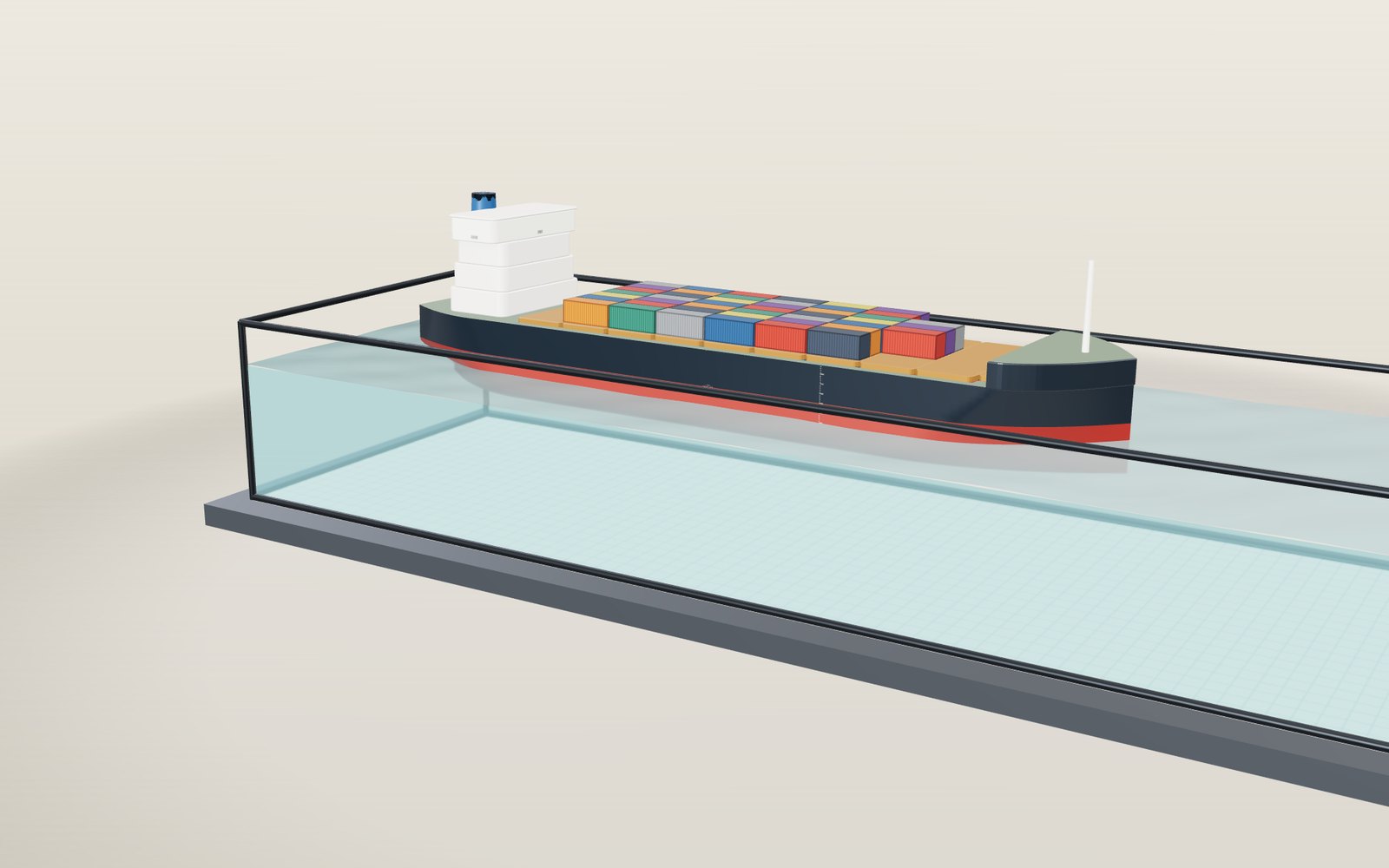
1 / 11 A ship in a tank A container ship floats in a glass tank, drawn at 1:50. The numbers in the corner are worked out from the curved hull itself and change as you load it. Drag to look around; the ship is tipped 15° and let go at regular intervals.
Drag to turn. Scroll or pinch to zoom.
Guide Parts Controls
01 A ship in a tank A container ship floats in a glass tank, drawn at 1:50. The numbers in the corner are worked out from the curved hull itself and change as you load it. Drag to look around; the ship is tipped 15° and let go at regular intervals.
02 Buoyancy is the weight of water pushed aside Cut through the middle and the dark blue area is the water the empty ship pushes aside: 1,854 m³ of sea water, weighing 1,900 t, exactly the weight of the ship. She floats at 1.40 m, and B, the centre of that water, is 0.72 m above the keel.
03 The same steel as a lump The cube is the same 1,900 t of steel. It can only push aside its own volume, 242 m³, so the water holds up 248 t and the rest of its weight presses on the tank floor.
04 Loading sinks the hull deeper 4,500 t of containers add 4,500 t to the displacement. The draught grows from 1.40 m to 4.36 m. One centimetre of extra draught here takes about 16 t.
05 The load line mark With 5,600 t on board in sea water the waterline is 5.06 m up the hull, 4 cm below the S line. The ring and the short lines beside it are drawn at their real size.
06 Fresh water lets her sink further Same ship and cargo, now in river water at 1,000 kg/m³. She has to push aside 2.5% more volume to make the same weight, so she settles 12 cm deeper: past S, still under F.
07 G, B and M Tip the ship and B moves to the low side. Weight acts down through G, buoyancy up through B, and the pair turns her back. Here GM is 6.03 m and she rolls back within seconds.
08 Too much on deck Put 5,000 t all on deck and G climbs to 11.63 m, above M at 9.42 m. GM is −2.21 m and the righting arm is negative at every angle, so a 10° tip is enough to roll her over.
09 A finer hull The same 3,000 t in a fine fast hull. With less volume near the ends she floats at 3.88 m instead of 3.40 m, her block coefficient drops from 0.84 to 0.73, and GM falls from 6.03 m to 4.94 m.
10 A slack tank 4,000 t, 60% on deck, and 900 t of ballast with one double-bottom tank only partly full. Its water runs to the low side when she heels, which costs 1.03 m of GM: 3.24 m becomes 2.21 m. A centreline bulkhead cuts the loss to 0.26 m.
11 Warm sea water The 5,600 t loading again, now in sea water of 35 g/kg salt at 30 °C. The density falls to 1,021.7 kg/m³ and the ship sinks to 5.08 m, 2 cm deeper than at 15 °C. The water panel works the density out from temperature and salt.
Hull A steel hull 84 m long, 20 m wide and 9 m deep, with a rounded bilge, a bow that narrows to the stem and a stern that closes to a skeg. The numbers in the panel are worked out from this exact shape, slice by slice. Hatch covers Steel lids over the hold, standing 0.6 m above the deck. Deck containers sit on them, so the bottom of a deck stack is 9.6 m above the keel. Wheelhouse and funnel Part of the 1,900 t light ship. With the hull and the engine, the empty ship has its centre of gravity 4.4 m above the keel. Containers in the hold Up to 130 containers of 20 t in two tiers, standing on the tank top 1.2 m above the keel. The rows get fewer toward the bow, where the hull narrows. Weight stowed here pulls G down. Deck stack Containers on the hatch covers. Each tier adds 2.59 m of height. With 5,000 t all on deck the centre of the cargo is 14.38 m above the keel. Load line mark A 300 mm ring with a bar through it, and the lines S, W, T, F and TF 540 mm forward of the ring's centre. In the model S is at 5.10 m draught and F is 120 mm higher. Draught marks Figures on both sides, 14 m forward of midship, every 0.2 m from 2 m up, with whole metres marked M. The bottom edge of each figure is at the depth it states. Water 16 m of water in a glass tank. Sea water is about 1,025 kg/m³ and fresh water 1,000 kg/m³; the slider takes any value from 990 to 1,035, and the water panel works it out from temperature and salt. Steel lump 1,900 t of steel pressed into a cube 6.23 m on a side. It pushes aside only 242 m³ of water, which weighs 248 t, so it sinks. Centre of gravity G The point where the weight of ship and cargo acts. It moves when cargo moves, but stays put inside the ship when she heels. Centre of buoyancy B The centre of the underwater volume. Upright it sits a little above half the draught, because the rounded bilge takes volume away low down; when the ship heels it swings toward the low side. Metacentre M For small heels, the vertical line through B crosses the centreline here. KM = KB + BM, and the ship comes back upright as long as G is below M.