FIG. 115Old Machines
How windmills and watermills work
The sails of a Dutch mill are as wide as an eight-storey building is tall, and at 7 m/s they still take only about a fifth of the wind.
This device cannot show the 3D model. You can read the guide steps below as text.
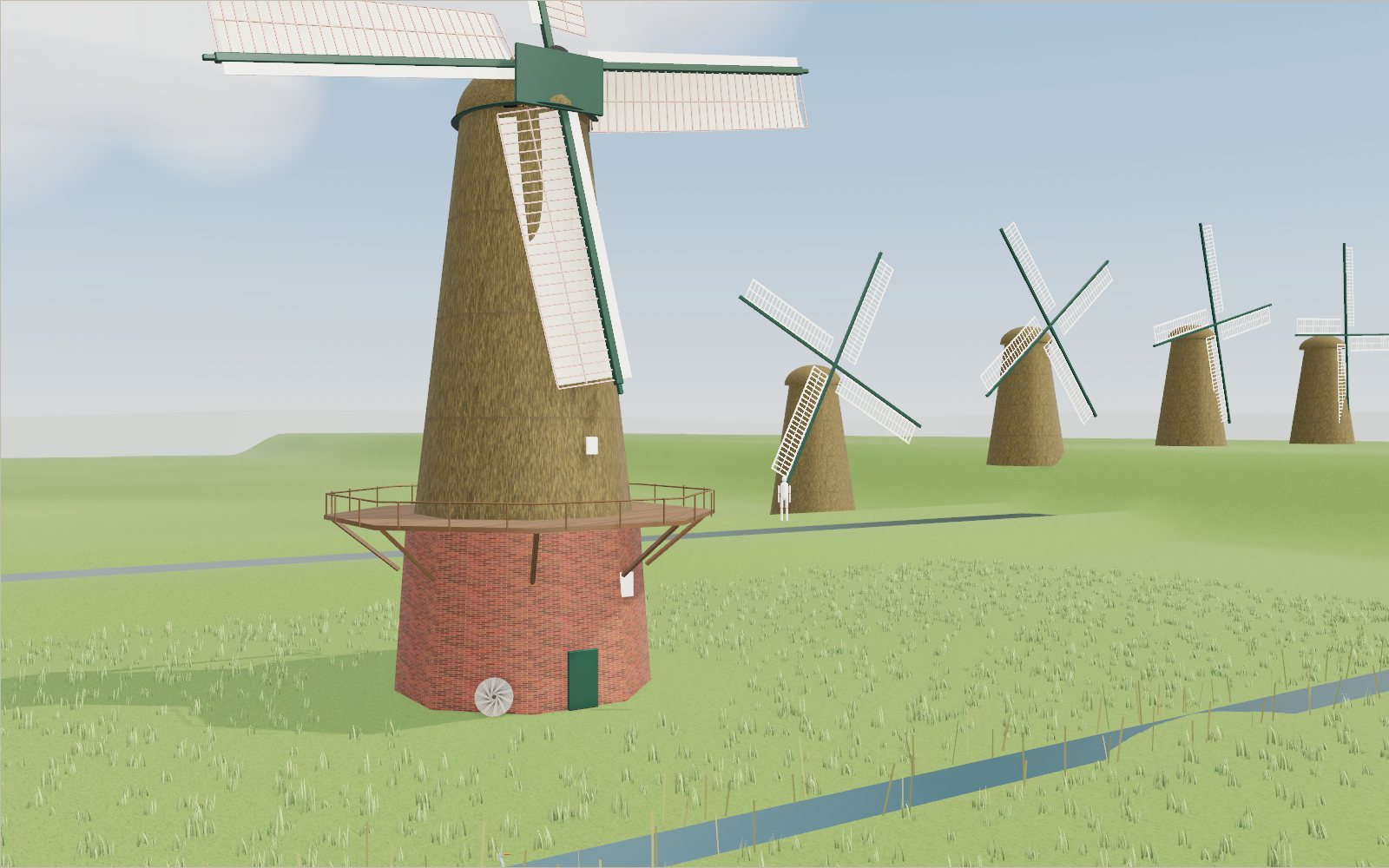
1 / 15 A breeze comes upA 7 m/s breeze blows on a Dutch smock mill. The sails, 26 m from tip to tip, start to turn, and the small window shows the millstones inside turning with them. The mannequin is your height.
Drag to turn. Scroll or pinch to zoom.
A breeze comes up
The exhibit opens on a Dutch smock mill standing in flat green polder land, with a raised canal behind it and a row of drainage mills along the canal. A breeze of 7 m/s is blowing, about 25 km/h, the kind of wind that keeps small branches moving. The four sails, 26 m from tip to tip, are at rest for a moment, then start to turn. Within a few seconds they are going round about once every four seconds, and the small window in the corner of the stage shows what is happening inside at the same moment: a pair of millstones on the stone floor, the upper one turning about eight times for every turn of the sails.
The mannequin standing on the stage is drawn at your height. Next to it the brick base of the mill is two storeys tall, and the thatched body rises another 16 m above the stage. When a sail sweeps down past the stage its tip clears the planks by about five metres. Millers worked on that stage every day, setting cloth on the sails and turning the cap into the wind, so the size you see is the size they lived with.
Ten machines share this exhibit, in three places you can move between. By the canal stand five windmills: the Dutch smock mill, a Kinderdijk-type drainage mill with its scoop wheel, an English post mill, an English tower mill with a fantail and patent sails, and a Mediterranean tower mill with triangular jib sails. By a stream under an earth bank stand three water mills: an overshot wheel fed from a flume, an undershot wheel pushed by the current, and the Korean water mill, the mullebanga, with its two pestles. In a Korean farmyard stand two machines driven by people and animals: the didilbanga, a treadle pestle worked by two people, and the yeonjabanga, a stone wheel pulled round by an ox.
All of them are driven by the same few numbers. Wind speed and the size of the sails decide how much power the wind brings; the load on the millstones decides how fast the sails turn; flow and head decide how much power the water brings. The panels under the stage show the sums, and the rest of this page explains what you are looking at, where the numbers come from, and where the model has to guess.
What the sails are catching
Moving air carries energy. Each second a column of air passes through the circle the sails sweep, and the power it carries is half the air density times the area times the cube of the wind speed: P = ½ρAv³. Air at sea level weighs about 1.225 kg per cubic metre. The smock mill's sails are 13 m long, so they sweep a circle of π × 13² = 531 m². At 7 m/s the wind through that circle carries ½ × 1.225 × 531 × 7³ = 111.5 kW.
The cube is what makes millers watch the sky. Double the wind to 14 m/s and the power is eight times as much, 892 kW, far more than the mill could use or survive. Halve it to 3.5 m/s and only an eighth is left, about 14 kW, and once friction and the stones have taken their share the sails stop. The power graph on the stage and the curve in the lab under the controls both show this: the line for the wind rises gently at first and then very steeply.
John Smeaton found the same thing by experiment. He mounted model windmill sails on the end of a whirling arm, so that they moved through still air at a known speed, and measured how heavy a weight they could lift and how fast. He reported in 1759 that the most work the sails could do rose nearly as the cube of the wind speed, and that the speed at which they lifted their greatest load rose in step with the wind. The Royal Society gave him its Copley Medal for these experiments and his tests on water wheels.
Why no windmill can take all the wind
If the sails took every bit of energy out of the wind, the air behind them would stop dead, and the air arriving next would have nowhere to go. If they took nothing, the air would pass straight through. Somewhere between the two is a best amount to slow the wind down. Albert Betz worked this out in 1920 (Nikolai Joukowsky did the same in Russia), treating the rotor as a disc that slows the air passing through it. The best the disc can do is slow the wind at the disc to two-thirds of its speed far upstream and to one-third far downstream. It then takes 16/27 of the power, about 59 %, of the air that would have passed through its area. That is the Betz limit, and it holds for a rotor of any design.
Real rotors fall short of it. Cloth sails on a wooden lattice are crude wings. The model gives the smock mill a best share, called the power coefficient Cp, of 0.22: just over a fifth of the wind's power, a bit over a third of what Betz allows. That figure is an estimate for this exhibit, not a measured value for any one mill, and it is marked as such on the stage. At 7 m/s it means the smock mill gives about 24.5 kW at its shaft when the load is right, against 66 kW for a perfect Betz rotor of the same size and 111.5 kW in the wind.
Tip speed and load: where the sails settle
How fast should the sails turn? That depends on how hard the millstones push back. If the miller lets very little grain run between the stones, the stones are easy to turn and the sails race round; the wind slips through them without doing much work. If the miller feeds in a lot of grain and sets the stones close together, the stones are hard to turn, the sails slow down, and the wind pushes on sails that are hardly moving. Neither does useful work. The best is in between.
Engineers describe this with the tip-speed ratio, written λ: how fast the tip of a sail moves divided by the speed of the wind. The model gives the smock mill its best share of the wind at λ = 2.4, so at 7 m/s the best tip speed is 16.8 m/s and the sails make 12.3 turns a minute. Above or below that the share falls away along a curve shaped like an upside-down bowl. That curve is the power graph on the stage, and the dot shows where the mill is now.
The Millstone load control sets how hard the stones push back. In the model that push is a steady torque. The wind's turning force on the sails is strongest when they are still and falls in a straight line as they speed up, so the sails settle where the two lines cross. At the start the load is half the best value for a 7 m/s wind, and the sails settle at λ = 3.6, 18.5 turns a minute: too fast, wasting wind. The status line under the readout says so. Raise the load until the dot sits on top of the curve and the sails slow to about 12 turns a minute while the power at the shaft rises. One of the tasks asks you to do this at 8 m/s.
Wind and load have to move together. Because the wind's turning force rises with the square of its speed, the same load that is right at 7 m/s is far too light at 10 m/s, and the sails run away. A miller felt this through the floor and heard it in the stones. In the model you see it in the graph, where the dot slides down the right-hand side of the curve.
Cloth, shutters and storms
A windmill has no throttle on the wind, so the miller controls the sails themselves. On a common sail the frame is a lattice of wooden bars, and the miller spreads canvas over it. In a light wind the whole lattice is covered. As the wind rises the cloth is taken in, in steps, until in a gale the sails run bare or are stopped. The Sail cloth control has five settings, from furled to full cloth. The bare lattice still catches some wind, so the model gives it about an eighth of the full-cloth share.
Taking in cloth meant stopping the mill and walking round to each sail, which is why later sails were made adjustable while turning. In 1772 Andrew Meikle replaced the cloth with hinged wooden shutters held shut by a spring; a strong gust pushed them open like a Venetian blind and spilled the wind. In 1804 William Cubitt joined all the shutters on all four sails to one rod running through the middle of the windshaft, worked by a chain from the ground, so the miller could set the sails without stopping the mill. Later, weights hung on the chain held the shutters shut until the wind grew strong enough to push them open. The English tower mill in this exhibit has these patent sails, and on it the same control sets how far the shutters are shut.
Too much wind is dangerous. At 15 m/s with full cloth and an ordinary load the model's sail tips pass 60 m/s, far beyond what the wooden frames and the brake were built for. The stage warns above 32 m/s, a model value. The storm task asks you to keep the sails turning in a wind of 14 m/s or more with the tips below 30 m/s: take in cloth, add load, or both. The Brake control clamps a band brake round the brake wheel on the windshaft and holds the sails still.
Turning the mill into the wind
Sails only work with the wind square on them. If the wind comes from the side, only the part blowing along the windshaft drives the sails, and the power falls roughly as the cube of the cosine of the angle between them: at 60° off, an eighth is left. The Wind direction control swings the wind round, and the readout says how far off the sails are.
The European windmills solve this in three ways. The post mill is the oldest: its whole wooden body, with the sails, the stones and the miller inside, sits on one great upright post, and the miller pushes a long tailpole at the back to turn it. On a smock or tower mill only the cap at the top turns. On the Dutch mill the cap has a long tail of timbers reaching down to the stage, with a winch wheel at its foot; the miller chains it to posts round the stage and winds the cap round. Press "Turn to the wind" on the stage and the model turns the mill at a steady hand-winding rate.
In 1745 Edmund Lee invented the fantail. It is a small windmill with about six vanes, mounted at the back of the cap at right angles to the main sails. While the main sails face the wind, the fantail meets it edge on and stays still. When the wind shifts, the side wind turns the fantail, and gearing from its shaft turns the cap round until the main sails face the wind again and the fantail stops. On the English tower mill in the exhibit, swing the wind round and watch the fan spin and the cap follow. The rate is a model value; real caps turned slowly, through heavy reduction gearing.
From the sails to the stones
The sails turn slowly, around 12 times a minute. A pair of millstones grinds best much faster. A train of wooden gears steps the speed up, and the See inside control turns the walls of the current mill transparent so you can follow it.
On the smock mill the sails are fixed to the windshaft, which runs into the cap at a slight upward tilt. On the windshaft sits the brake wheel, the largest gear in the mill, with 60 cogs set into its face in the model. Below it, on top of the upright shaft that runs down the middle of the mill, is the wallower, with 32. Near the bottom of the upright shaft the great spur wheel, with 88 cogs, drives the stone nut, a small gear on the spindle of the runner stone, with 20. Each meshing multiplies the speed by the teeth of the driving wheel divided by the teeth of the driven one: (60/32) × (88/20) = 8.25. At 12.3 turns a minute of the sails, the runner stone turns at about 102.
The Stone nut control changes the number of teeth on that last gear. Fewer teeth, faster stones; with 16 teeth instead of 20 the stones run at 127 turns a minute for the same sail speed. One of the tasks asks you to get the runner stone between 100 and 130 turns a minute at 7 m/s, which you can do with the load, the stone nut, or both. The post mill and the Mediterranean mill have shorter trains: the brake wheel drives the stone nut directly, 56 to 12 in the post mill. All tooth counts in the exhibit are model values chosen to give typical speeds, not counts from one surveyed mill.
The idea is old. Vitruvius, writing about 25 BCE, describes a water mill in which a toothed drum on the axle of the water wheel turns a horizontal toothed wheel whose axle carries the millstone, with a hopper hanging above to feed in the grain. His translators do not agree on the sizes: Morgan's translation makes the horizontal drum smaller, so that the stone turns faster than the wheel, while Gwilt's makes it larger.
Inside a millstone
Grain is not crushed between two flat stones; it is cut. The face of each millstone is dressed with a pattern of grooves called furrows, laid out in groups called harps, with flat lands between them. The furrows on the runner and on the bed stone are cut the same way, so when the runner turns face down over the bed, its furrows cross those of the bed like the blades of many pairs of scissors. The grain enters through the eye in the middle of the runner, is sheared and rubbed as it works outward, and leaves at the rim as meal.
The model uses a ten-harp dress with four furrows to a harp, 40 furrows on each stone. Every furrow on the runner crosses every furrow on the bed once a turn, so the number of crossings each second is 40 × 40 times the turns per second. At 102 turns a minute that is 2,720 crossings a second; at 120 it is 3,200. The lab under the controls draws the two stones with the runner turning over the bed, and the Lift the runner stone control raises the runner on the stage so you can see its dressed face. Stones wore down and had to be dressed again. The Science Museum Group's working model of Sprowston post mill near Norwich, which stood from 1780 to 1934, includes its French millstone.
Post mills: the oldest European windmills
Windmills with sails on a horizontal shaft appear in Europe suddenly, late in the 12th century. Historians accept as the earliest reliable records a small group of mills from about 1180 to 1190, and Holt puts the earliest proven dates at about 1185. They were post mills. The whole body was built round a single great post, braced at the foot by four quarter bars standing on two cross-trees, and turned to the wind by hand.
The design lasted for centuries because it worked and could be built with carpentry alone. The Science Museum Group keeps a 1:16 model of the post mill at Bourn in Cambridgeshire, shown as it may have looked around 1636, and a 1:36 model of the same mill made in 1928 to 1930 for the museum's Children's Gallery. The post mill in this exhibit has a white weatherboarded body, a ladder and tailpole at the back, and its stones inside the body. Its sails are 19 m across. Turn the wind with the Wind direction control and press "Turn to the wind" to watch the whole body swing round on its post.
Tower and smock mills
The tower mill seems to have come in during the 14th century; the earliest known picture is dated 1390, and a traveller's sketch of 1420 shows several in the Byzantine town of Gallipoli. Only the cap turns, so the body can be built of brick or stone and made much taller and wider than a post mill, with room for several pairs of stones, stores and even the miller's family. A wooden tower mill, eight-sided and clad in boards or thatch, is called a smock mill. The Dutch built many with a brick base, a thatched body and a stage round the middle at the height the sails reach down to.
The Netherlands had more windmills for its area than anywhere else. At their peak Holland may have had about 9,000, England about 10,000, Belgium 3,000 and Anjou in France 650, by the rough figures Shepherd quotes from Notebaart; the density in Holland was perhaps three times that of England. In the Zaan district near Amsterdam between 800 and 1,000 windmills worked in a few square miles, sawing timber, pressing oil and grinding pigments and spices brought in by ship. They were, as Shepherd puts it, the electric motors of their day. From 1600 the Dutch also sawed timber by wind: in the paltrok the brake wheel turned a crankshaft whose connecting rods drove saw frames up and down. A patent granted to Cornelius Muys in 1589 may be the first patent ever given for a windmill.
Draining a country: polder mills and Kinderdijk
Much of the western Netherlands lies below the level of the sea and the rivers. Land enclosed by dikes and drained is a polder. Rain and seepage fill its ditches, so the water has to be lifted out again and again into a reservoir channel, the boezem, which runs higher than the fields and empties into the river through sluices. On the wind site in this exhibit the canal behind the mills is the boezem: its water stands above the level of the fields in front.
A drainage mill does not grind. Its upright shaft drives a scoop wheel, a big paddle wheel turning in a close-fitting curved race. The paddles sweep water from the ditch side up over a sill into the higher channel. The Lift to the canal control sets how high it has to go. Because the load on the sails is the weight of water raised each turn times the height, a higher lift is a heavier load and the sails turn more slowly. As the mill pumps, the ditch level falls, so the lift grows; on the stage the ditch drops where you can see it. The drainage task asks you to lower it by 10 cm. The model polder is only 2 ha of ditch and field, and the time control runs 30 times faster, so it takes a minute or so.
The Dutch engineers who designed these systems worked the numbers out. Simon Stevin (1548 to 1620) calculated mill outputs from the numbers of gear teeth and the water raised by the scoop wheel; his specification for a drainage mill of 1589 survives. Leeghwater (1575 to 1650) drained the Beemster, a lake averaging about 3 m deep, in one year with 26 windmills. In another scheme he used 51 drainage mills that together pumped 1,000 m³ of water a minute. That is about 20 m³ a minute per mill; lifted 1.5 m it is 4.8 kW in the water, about 6.4 horsepower, close to the average of about 7 horsepower a mill that Shepherd works out. Leeghwater planned to drain the much larger Haarlemmermeer with 160 windmills and published the plan in 1641; it was reprinted 17 times. When the lake was finally drained, in 1848, steam engines did the work.
The best-known drainage mills stand at Kinderdijk-Elshout in the Alblasserwaard, on the World Heritage List since 1997. UNESCO lists 19 drainage mills, 3 pumping stations, 2 sluices and 2 water-board assembly houses. The mills are of three kinds: 8 round brick ground-sailers, 10 thatched eight-sided smock mills and one hollow post mill. The 16 mills of De Nederwaard and De Overwaard were built in 1738 and 1740, and the lower reservoir of De Overwaard dates back to 1365 and that of De Nederwaard to 1369. The mills were taken out of service in 1950, but all of them still work and stand in reserve in case the modern pumps fail. A restoration led by the Cultural Heritage Agency of the Netherlands, from 2008 to 2011, used the techniques of the time the mills were built. Within 400 m of the mills the height of new buildings and trees is restricted so that the sails keep their wind. In 1924 the Wisboom pumping station changed from steam to electricity; it opened as a visitor centre in 2011.
The drainage mill in this exhibit is a ground-sailer: the sails sweep down to within about 2 m of the ground, and the miller sets cloth standing on the grass. Its sails are 28 m across.
Sails that send messages
A mill that is standing still can still say something. Dutch millers park the sails in set positions, which De Hollandsche Molen, the Dutch mill society, still explains. With the sails upright and level like a plus sign, the mill is resting for a short time. With them set diagonally like a cross, it is stopped for longer, perhaps for repairs. For a wedding or a birth the sails are stopped with the lowest sail a little before the bottom, to the left seen from the front: the joy position. For a death the lowest sail stops a little past the bottom, to the right: mourning. In the south-east of the Netherlands the two are the other way round.
The sails of a Dutch mill turn anticlockwise seen from the front, which is why "before" and "past" the bottom read as left and right. In the exhibit the sails turn the same way. One of the distant mills along the canal has stopped in the mourning position; it is one of the things to find.
Mediterranean sails and the windmills of Iran
Round the Mediterranean a different kind of sail spread in the 12th and 13th centuries, according to Spain's entry on the UNESCO Tentative List for the region's sail mills. A round stone tower carries a conical cap, and from the hub radiate eight or more spars, each carrying a triangular cloth sail like a ship's jib, with ropes from the spar tips to a bowsprit sticking out in front. The miller takes in sail by rolling the cloth round the spar. The Spanish entry records 8 sails in Lower Andalusia and 4 in Portugal, and on the Campo de Cartagena mills with 8 sails were adapted to drive norias and lift water, still pumping late in the 20th century by local accounts. Mykonos had 16 windmills, many built by Venetians in the 16th century to grind wheat; they stopped in the middle of the 20th century.
Further east, windmills of a quite different design were at work long before the European kind. In eastern Iran the asbads turn on a vertical shaft. The rotor stands inside walls that shield half of it from the wind, so the wind pushes on one side only; the millstones sit on the ground floor and the sails on the floor above, with stones of up to 900 kg. Wulff found 50 of these mills still working at Neh in 1963, each grinding about a ton of grain a day. Iran put its asbads, among them the mills of Nashtifan, on the UNESCO Tentative List in 2017. Its dossier says they have worked since the 2nd century. Shepherd, reviewing the historians, puts the first accepted records in the 10th century, in Sistan in eastern Persia, where al-Mas'udi wrote around 956 that the wind drives mills and raises water. How the European mill came about is still argued.
The power in falling water
Falling water carries energy the same way a falling weight does. A flow of Q cubic metres a second falling a height h, the head, can give at most ρgQh watts, where ρ is 1,000 kg per cubic metre for water and g is 9.81 m/s². At the start the overshot wheel has 60 litres a second falling 4.3 m: 1,000 × 9.81 × 0.06 × 4.3 = 2,531 W, about 2.5 kW in the water.
An overshot wheel catches the water at the top in buckets and lets its weight carry the wheel down the far side, emptying the buckets near the bottom. Done well this loses little. Müller and Kauppert, reviewing tests made between 1850 and 1935, found that a properly designed overshot wheel reaches about 85 % efficiency, and keeps it from a fifth of its design flow up to full flow. The model gives the overshot wheel 80 % at slow speeds, falling as it speeds up because water spills from the buckets before it has gone all the way down; at the start the wheel gives about 2 kW. The task asks for 3 kW, which needs more water, more head, or both, and the right load. The Head control sets the height of the flume, and the wheel grows or shrinks to fit it: an overshot wheel's diameter is roughly its head.
Smeaton tested model water wheels on a rig built in 1752. A full-size copy of it is in the Science Museum Group collection, and one stands on a bench beside the mill in the exhibit. He showed that wheels turned by the weight of water, overshot or breastshot, were almost three times as efficient as wheels pushed by the current, and millwrights then replaced many undershot wheels with breastshot ones. At the Carron ironworks in Falkirk, changes Smeaton made led to the first iron water-wheel axle, in 1769.
Undershot wheels and half the water's speed
An undershot wheel stands in the stream with flat paddles at the bottom, and the current pushes it round. Its power comes from the speed of the water, not its weight. Water let through a sluice under a head h comes out at √(2gh): at 1.2 m that is 4.85 m/s. If the paddles stood still they would feel the full push but move nothing; if they ran as fast as the water they would feel no push. The most work comes in between, when the paddles move at half the speed of the water. In the model the power is the best value times 4x(1 − x), where x is the rim speed divided by the water speed, so it peaks at x = ½.
Even at its best a plain undershot wheel wastes most of what the water could give, because the water leaves still moving and splashes about. The model gives it 30 %, about a third of a good overshot wheel, in line with Smeaton's result. Later undershot designs with curved blades did much better; Müller and Kauppert quote about 75 % for well-made modern ones. Undershot wheels had one big advantage: they needed almost no fall, so they could stand in any flowing river. The half-speed task asks you to load the wheel until the dot in the graph sits on the dashed line.
Water mills in history
Vitruvius described a water mill around 25 BCE, and the remains of Roman mills have turned up across the empire. At Barbegal in southern France 16 water wheels worked in the 2nd century CE. The wood has rotted away, but limescale deposited by the water while the mills ran survives as casts of the wheels and channels. A study published in 2018 found that the mills stopped for months at a time, and suggested that they made ship's biscuit for the nearby harbours rather than bread flour for a city.
When William the Conqueror's commissioners made the Domesday survey of England in 1086, they counted mills as taxable property. In the counties they covered, Domesday Book lists 6,082 mills, placed according to where the water was rather than where the people lived. Water wheels remained a main source of power for industry for centuries: around 1850 England may have had 25,000 to 30,000 at work, and Germany still recorded 33,500 as late as 1925.
The Great Laxey Wheel on the Isle of Man is 72 ft 6 in across, over 22 m. Designed by Robert Casement, it was built in 1854 to pump water out of the Glen Mooar part of the Great Laxey Mines. At Hama in Syria 17 norias still stand on the Orontes. They are water-lifting wheels: the current turns them, and boxes on the rim scoop up water and empty it into an aqueduct at the top. The Muhammadiyya, dated 1361, is the oldest dated and the largest, 22 m across; the Ma'muriyya of 1453 is 21 m across and carries 120 wooden boxes. A mosaic of 469 CE from Apamea shows a noria very like them.
The Korean water mill, mullebanga
In Korea a water mill hulls grain by pounding, not grinding. The National Folk Museum of Korea defines the mullebanga as a mill that pounds grain with the power of water falling onto a wheel from a channel or flowing under it. The name joins mul (water), re (a round wheel) and banga, a pounding mill. Where water falls onto the wheel it is called dongchae-banga in Eumseong; where it pushes boards at the bottom, milchae-mullebanga. The mill in this exhibit is of the first kind, fed from a hollowed log on forked props.
The oldest record is in Goryeosa: on 3 September 1277 King Chungnyeol and the princess went to look at a water mill. The museum reads this as a copy of a Chinese mill made to be looked at, not used. Taejong sillok records that on 11 June 1412 the king ordered water mills and water pestles to be made, probably also for show, and a working water mill was discussed under King Sejong on 3 June 1431, but it went no further.
The wheel turns a long pine shaft that runs into the mill house. On the shaft are cams, short pegs called nullimdae. Each cam presses down the near end of a pestle beam that rests on a pivot; the far end, carrying the pestle, rises; when the cam slips past, the pestle drops into a stone mortar set in the floor and pounds the grain. Where water is plentiful there are two pestle frames, one each side, called yangbanga or ssangbanga, and the cams sit on opposite sides of the shaft so the pestles take turns. The museum gives the speed: depending on the water, the wheel usually turns about 23 times a minute and the pestles rise and fall 46 times.
Millet was pounded most, then barley and rice: about ten sacks of millet a day, a sack of rice in about an hour, because rice needs three or four passes. Red pine of 6 to 8 years with many knots made the best wheel, because it is hard and does not rot in water. Pestles were birch or oak, held with oak pegs that swell when wet, and had no iron tip. In Lee Chun-nyeong's survey of 1986 Korea had 114 water mills, 56 of them in South Gyeongsang; the oldest was built in Namwon, North Jeolla, in 1850. Villages usually built a mill together and charged outsiders a fee. The bark-roofed houses of Sinri in Samcheok, with their folk objects including a water mill, became National Folklore Cultural Heritage no. 33 in 1975.
Setting up a mill had its own customs. Three heaps of red earth were placed either side of the door, because red was believed to keep evil spirits away; a paper reading "the mill set by Gang Taegong" was stuck upside down on the frame; and some of the first grain pounded was kept in a small jar on a shelf as the mill's share, replaced with new grain each year. All three are hidden in the mill house in the exhibit.
In the model the wheel is 2.4 m across and each pestle weighs 75 kg and rises 0.36 m, so a stroke takes 265 J and a turn of the wheel, lifting both pestles, 530 J. At 23 turns a minute that is about 200 W, plus friction. The water to supply it, falling 2.7 m, comes to about 25 litres a second. The start is 15 litres a second, about 17 turns a minute; the pestle task asks you to bring it to the museum's 23. All of these are model values.
The treadle pestle, didilbanga
The didilbanga is the same pounding mill worked by feet. A thick beam rests on a pivot bar through two short posts; a pestle is fixed in one end, and at the other end the people working it step down. When they step off, the pestle falls into the mortar. Across the world the treadle pestle had a single leg for one person. The Korean two-legged kind, made from a forked tree so that two people tread at once, was used only in Korea, according to the Academy of Korean Studies encyclopaedia entry by a National Folk Museum curator.
The one-legged kind was in use in Korea by the 4th century: the mural in Anak Tomb No. 3 of Goguryeo shows one person treading and another winnowing grain, and a 5.9 cm clay figure of a treadle pestle from tomb 1 at Hwangnam-ri in Gyeongju, of the 5th to 6th century, is in the Gyeongju National Museum. Pak Ji-won in 1798 and Seo Ho-su in 1799 wrote that the Chinese treadle pestle had one leg for one person and the Korean two legs for two. Pak Ji-won listed nine faults in the Korean kind and praised the Chinese. The curator who wrote the entry argues that he was mostly wrong: the forked beam lasts, a mortar made to fit the pestle does not scatter the grain, and a village treadle pestle was a place to work and sing together. Seven or eight women in Eumseong pounded two seom of rice a day on one. The treaders hold ropes hanging from the roof to keep their balance.
The treadle pestle carried customs too. When one was set up, "Gang Taegong made this, in the year, month, day and hour of gyeongsin" was written on it to ward off misfortune. Until about the 1950s, when an epidemic came near, village women would steal a treadle pestle from another village at night and stand it upside down at their own village entrance to keep the disease out.
On the stage, two treaders work the beam in a steady rhythm. Press and hold Tread, or the large pad in the lab, to take over: holding pushes the legs down and lifts the pestle, letting go drops it. Your weight sets how far it rises. At 60 kg one tread puts in about 188 J. The rhythm task asks for 12 even strokes between 24 and 72 a minute; the lab shows the gaps between your strokes.
The edge-runner mill, yeonjabanga
In the yeonjabanga an ox or horse pulls a heavy stone wheel, standing on its edge, round and round on a round bed stone. The upper stone turns about a post fixed in the middle of the bed and rolls over the grain spread on it. The first record, in Goryeosa, says King Chunghye, who reigned from 1330 to 1332, had many treadle pestles and edge-runner mills set up while building a new palace. Jeong Yak-yong later complained that Koreans hardly knew the horse mill and water mill that China had used for so long, and a 19th-century encyclopaedia says the edge-runner was used only in Pyeongan province. It was expensive, so villages usually built and ran one together.
The National Folk Museum points out that it does not pound but rolls and rubs, like a quern, so yeonjamae is the better name. On Jeju, where barley and millet were the staple foods, villages kept about one horse mill for every 30 households; in 1974 Hagari had nine, of which five were in use. Hulling a sack of rice takes over two hours: about 20 minutes a pass, winnowing out the husks between passes, four times over. A second person, the kkekkikkun, follows the stone and turns the grain back under it with a stub broom. The animal's eyes are covered so that it does not look about. Kim Jeong-hui's poem on the horse mill begins: one horse does what ten people do.
The runner stone in the exhibit is 1.3 m across and rolls round a circle of 2.1 m radius, so it turns on its own axle about 3.2 times for each walk round. The ox walks 1 m further out at about 0.75 m/s and pulls with about 480 N, roughly 360 W. A person working steadily for hours gives about 75 W, so in the model the ox does the work of about five; a horse can give a good deal more for short spells. These are model figures.
How the model differs from real mills
The machines in the exhibit are built from typical figures, not surveyed from one mill. The power coefficients of the sails, their best tip-speed ratios, the inertia of the sails and wheels, the gear tooth counts, the millstone dress, the scoop wheel's depth and leakage, the size of the polder, the overshot wheel's spill speed, the Korean mill's pestle weight and friction, and the ox's pull are estimates chosen to give speeds and powers of the right size. They are labelled as model values on the stage and in the lab.
The aerodynamics are simplified. The share of the wind follows a single smooth curve for each mill instead of being worked out sail section by sail section. Turning the mill into the wind is shown much faster than it really happened. Water flow and level changes are drawn, not computed as fluid flow. The scoop wheel's lifting is a steady load rather than the push of each paddle. People and the ox are smooth figures with no faces.
What is not estimated: the formulas ½ρAv³ and ρgQh, the Betz limit of 16/27, the best undershot speed at half the water speed, the gear ratios worked out from the tooth counts shown, and every historical fact on the page and in the case list, each of which has its source.
Questions
How does a windmill work?
The wind pushes on sails set at an angle, so they turn a windshaft. Gears in the cap and down the mill speed the motion up and turn a pair of millstones, a pump or a saw. The miller turns the sails to face the wind, sets the cloth for the strength of the wind and controls the load on the stones.
How much power did a windmill produce?
It depends on the wind and the size of the sails. In this model a Dutch mill with 26 m sails gives about 24 kW at 7 m/s with the right load, out of 111.5 kW in the wind. Shepherd's figure for Leeghwater's drainage mills is about 7 horsepower each, on average.
What is the Betz limit?
The most any rotor can take out of the wind passing through its area: 16/27, about 59 %. Betz showed it in 1920; Joukowsky reached the same result in Russia.
Why do windmill sails turn so slowly?
Because there is a best ratio between the speed of the sail tips and the speed of the wind, about 2 to 3 for cloth sails in this model. With 13 m sails in a 7 m/s wind that means tips at about 17 m/s and about 12 turns a minute. Gears make the stones turn eight or more times faster.
Which way do windmill sails turn?
Dutch mill sails turn anticlockwise seen from the front. Millers use the direction when they park the sails to send a message.
What do the positions of stopped windmill sails mean?
A plus sign means a short rest, a cross a long one. The lowest sail stopped just before the bottom (to the left from the front) means joy; just past it (to the right) means mourning. In the south-east of the Netherlands the last two are reversed.
What is the difference between a post mill and a tower mill?
In a post mill the whole body turns on one upright post. In a tower or smock mill the body stays still and only the cap with the sails turns. Tower mills appeared in the 14th century and could be built much larger.
What is a fantail?
A small windmill at the back of the cap, at right angles to the sails, invented by Edmund Lee in 1745. When the wind shifts it starts to turn and, through gears, swings the cap round until the sails face the wind again.
How were the polders drained?
Drainage mills drove scoop wheels that lifted water from the polder ditches into higher reservoir channels, which emptied into the rivers through sluices. Large lakes needed groups of mills: Leeghwater drained the Beemster with 26. From the 19th century steam pumping stations took over.
Do the windmills at Kinderdijk still work?
Yes. They were taken out of service in 1950, but all 19 still work and are kept as reserves in case the modern pumps fail.
Which is better, an overshot or an undershot water wheel?
Where there is enough fall, the overshot wheel: it uses the weight of the water and can reach about 85 %. A plain undershot wheel gives much less, about a third as much by Smeaton's tests, but needs almost no fall.
How do you calculate the power of a water wheel?
Multiply the water density (1,000 kg/m³), gravity (9.81 m/s²), the flow in cubic metres a second and the head in metres. That is the power in the water. Multiply by the wheel's efficiency to get the power at the shaft.
How fast does a Korean water mill turn?
The National Folk Museum gives about 23 turns a minute for the wheel, with the pestles rising and falling 46 times, depending on the water.
What is the difference between a banga and a maetdol?
A banga pounds, with a pestle moving up and down; a maetdol (quern) grinds, with one stone rubbing on another. The ox-pulled yeonjabanga works by rolling and rubbing, so the National Folk Museum says yeonjamae is the better name.
Where can I see these mills?
Kinderdijk-Elshout in the Netherlands, the Great Laxey Wheel on the Isle of Man, and the Science Museum Group's mill models in Britain. In Korea, water mills and treadle pestles are kept in folk villages and museums, and the bark-roofed houses of Sinri in Samcheok keep a water mill among their folk objects.
Terms
- Brake wheel: the large gear on the windshaft, with a band brake round its rim.
- Wallower: the gear at the top of the upright shaft, driven by the brake wheel.
- Great spur wheel: the large gear low on the upright shaft that drives the stone nuts.
- Stone nut: the small gear on the spindle of a runner stone.
- Runner and bed stone: the turning upper millstone and the fixed lower one.
- Dress: the pattern of furrows and lands cut in a millstone's face, in groups called harps.
- Tip-speed ratio: the speed of the sail tips divided by the speed of the wind.
- Power coefficient (Cp): the share of the wind's power that the sails take.
- Betz limit: 16/27, the largest share any rotor can take.
- Fantail: a small windmill that turns the cap into the wind by itself.
- Patent sail: a sail of hinged shutters opened and closed together while the mill runs.
- Polder: low land enclosed by dikes and kept dry by pumping.
- Boezem: the raised reservoir channel into which a polder is pumped.
- Scoop wheel: a paddle wheel that lifts water up a close-fitting race.
- Head: the height through which water falls.
- Overshot, undershot: a wheel fed at the top, a wheel pushed at the bottom.
- Noria: a water-lifting wheel turned by the current.
- Mullebanga, didilbanga, yeonjabanga: the Korean water mill, treadle pestle and edge-runner mill.
- Nullimdae: the cam on the shaft of a mullebanga that presses down the pestle beam.
Sources
- UNESCO World Heritage Centre, Mill Network at Kinderdijk-Elshout (818). https://whc.unesco.org/en/list/818 (checked 20 October 2026)
- UNESCO World Heritage Centre, Tentative Lists: Asbads (windmill) of Iran (6192). https://whc.unesco.org/en/tentativelists/6192/ (checked 20 October 2026)
- UNESCO World Heritage Centre, Tentative Lists: Noréas de Hama (1291). https://whc.unesco.org/en/tentativelists/1291/ (checked 20 October 2026)
- UNESCO World Heritage Centre, Tentative Lists: Mediterranean Wind Mills (1030). https://whc.unesco.org/en/tentativelists/1030/ (checked 20 October 2026)
- De Hollandsche Molen, Wat zegt een molen? https://www.molenmaatjes.nl/www.molens.nl/kinderpagina/wat-zegt-een-molen/index.html (checked 20 October 2026)
- D. G. Shepherd, Historical Development of the Windmill, NASA CR-4337, DOE/NASA/5266-2, 1990. https://ntrs.nasa.gov/citations/19910012312 (checked 20 October 2026)
- J. Smeaton, An experimental enquiry concerning the natural powers of water and wind to turn mills, Philosophical Transactions of the Royal Society 51, 100–174, 1759. https://royalsocietypublishing.org/doi/10.1098/rstl.1759.0019 (checked 20 October 2026)
- Engineering and technology of industrial water power at Castleford Mills, Notes and Records of the Royal Society 70, 2016. https://pmc.ncbi.nlm.nih.gov/articles/PMC4759717/ (checked 20 October 2026)
- G. Müller and K. Kauppert, Performance characteristics of water wheels, Journal of Hydraulic Research 42 (5), 2004. https://doi.org/10.1080/00221686.2004.9641215 (checked 20 October 2026)
- V. L. Okulov and G. A. M. van Kuik, The Betz–Joukowsky limit, Wind Energy 15 (2), 335–344, 2012. https://orbit.dtu.dk/files/7634625/text_II_of_WE_10_135.pdf (checked 20 October 2026)
- G. Sürmelihindi et al., The second century CE Roman watermills of Barbegal, Science Advances 4, eaar3620, 2018. https://www.science.org/doi/10.1126/sciadv.aar3620 (checked 20 October 2026)
- R. Holt, Mills in medieval England. https://www.medievalists.net/files/07042802.pdf (checked 20 October 2026)
- The National Archives (UK), Domesday Book research guide. https://www.nationalarchives.gov.uk/help-with-your-research/research-guides/domesday-book/ (checked 20 October 2026)
- Manx National Heritage, The Great Laxey Wheel. https://manxnationalheritage.im/our-sites/laxey-wheel (checked 20 October 2026)
- Manx National Heritage, Access Guide to The Great Laxey Wheel and Mines Trail. https://manxnationalheritage.im/wp-content/uploads/2026/07/Laxey-Wheel-Access-Guide-2026.pdf (checked 20 October 2026)
- Science Museum Group Collection, Model of Bourn Windmill, Cambridgeshire, 1601–1625 (1981-993). https://collection.sciencemuseumgroup.org.uk/objects/co68067/ (checked 20 October 2026)
- Science Museum Group Collection, Smeaton's Apparatus for Determining the Efficiency of Water Wheels (1988-597). https://collection.sciencemuseumgroup.org.uk/objects/co50744/smeatons-apparatus-for-determining-the-efficiency-of-water-wheels (checked 20 October 2026)
- Science Museum Group Collection, Post Windmill, early 19th Century (1945-112). https://collection.sciencemuseumgroup.org.uk/objects/co50774/post-windmill-early-19th-century (checked 20 October 2026)
- Science Museum Group Collection, Model of Post Windmill (1930-656). https://collection.sciencemuseumgroup.org.uk/objects/co48303/model-of-post-windmill (checked 20 October 2026)
- National Folk Museum of Korea, Encyclopedia of Korean Folk Culture, Mullebanga (Kim Kwang-eon). https://folkency.nfm.go.kr/topic/%EB%AC%BC%EB%A0%88%EB%B0%A9%EC%95%84 (checked 20 October 2026)
- National Folk Museum of Korea, Encyclopedia of Korean Folk Culture, Yeonjabanga (Kim Kwang-eon). https://folkency.nfm.go.kr/topic/detail/8931 (checked 20 October 2026)
- National Folk Museum of Korea, Encyclopedia of Korean Folk Culture, Maetdol (Jeong Yeon-hak). https://folkency.nfm.go.kr/topic/%EB%A7%B7%EB%8F%8C (checked 20 October 2026)
- National Folk Museum of Korea, Encyclopedia of Korean Folk Culture, Didilbanga (Lee Han-gil). https://folkency.nfm.go.kr/topic/%EB%94%94%EB%94%9C%EB%B0%A9%EC%95%84 (checked 20 October 2026)
- Academy of Korean Studies, Encyclopedia of Korean Culture, Didilbanga (Jeong Yeon-hak, 2024). https://encykorea.aks.ac.kr/Article/E0017162 (checked 20 October 2026)
- Vitruvius, De Architectura X.5, translated by J. Gwilt, LacusCurtius, University of Chicago. https://penelope.uchicago.edu/Thayer/E/Roman/Texts/Vitruvius/10*.html (checked 20 October 2026)
- Vitruvius, The Ten Books on Architecture X.5, translated by M. H. Morgan, Project Gutenberg. https://www.gutenberg.org/files/20239/20239-h/20239-h.htm (checked 20 October 2026)
- Korea Heritage Service, Samcheok Sinri bark-roofed houses and folk objects. https://www.heritage.go.kr/heri/cul/culSelectDetail.do?ccbaKdcd=18&ccbaAsno=0000330000000&ccbaCtcd=32 (checked 20 October 2026)
More exhibits
How does a vending machine recognise coins?
A 100 won coin is not attracted to a magnet, yet the magnet inside a vending machine is what tells it from a copper fake.
How a pendulum clock works, and why its length sets the time
A pendulum clock counts seconds with one rod 99.4 cm long. Change its length, its temperature and its place on Earth, swap four escapements and see how many seconds a day each costs.
Stone arch bridge: load it and watch how it carries weight
A stone arch has no glue between its blocks, yet it stands on its own once the last stone is set at the top.
How a horse runs: walk, trot, canter and gallop
In 1878 Muybridge's cameras showed that a galloping horse does lift all four feet at once, but with its legs tucked under it. Some fast animals never leave the ground at all.
How the Jagyeokru water clock works
In 1434 a float rising in a bronze vessel in Seoul began to drop small balls that set wooden figures striking a bell, a drum and a gong.
Walk through Gyeongbokgung Palace
In the courtyard of the throne hall, 24 stones told each official where to stand, from the first grade by the hall to the ninth by the gate.