Loading the model
This device cannot show the 3D model. You can read the guide steps below as text.
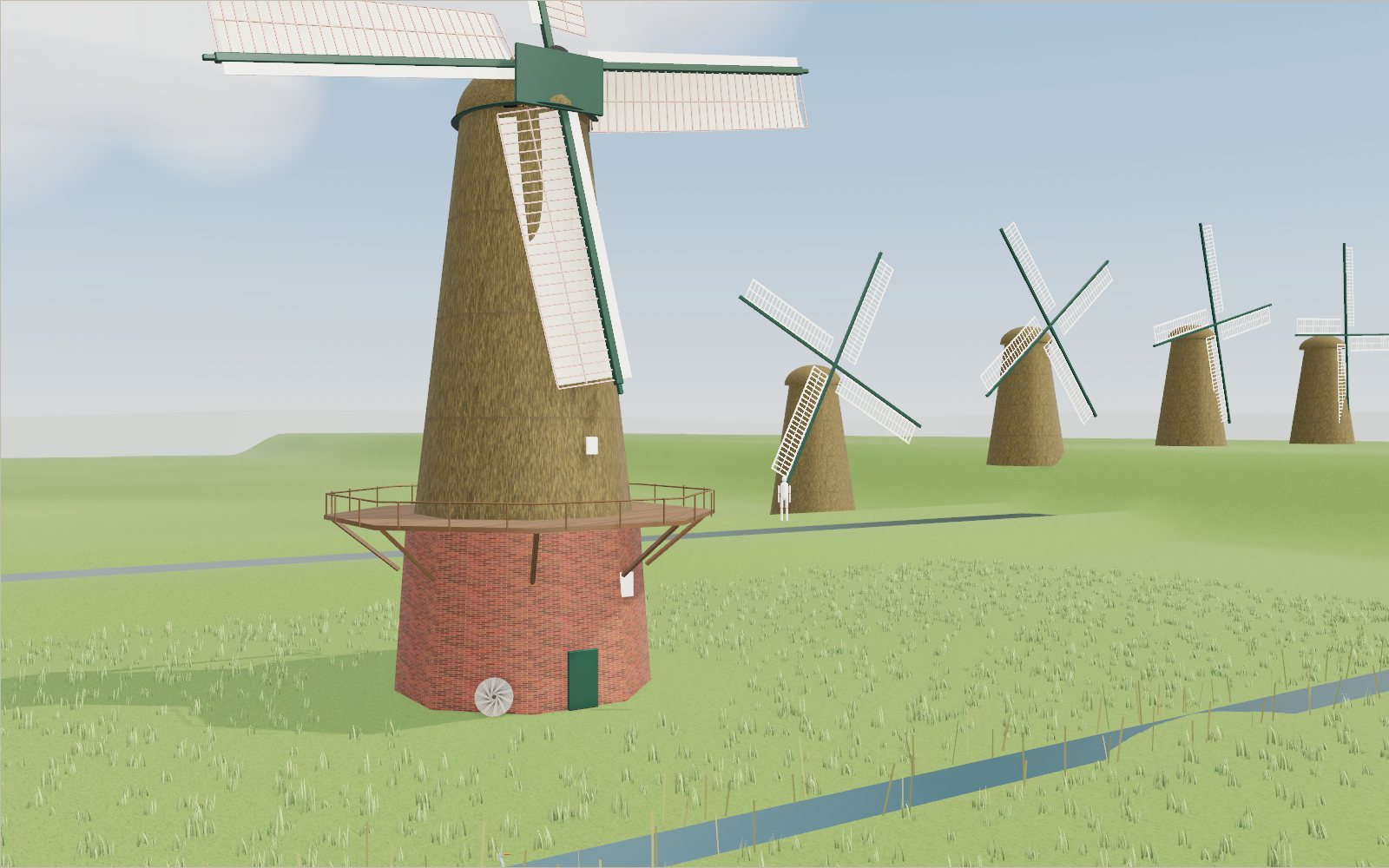
1 / 15 A breeze comes up A 7 m/s breeze blows on a Dutch smock mill. The sails, 26 m from tip to tip, start to turn, and the small window shows the millstones inside turning with them. The mannequin is your height.
Drag to turn. Scroll or pinch to zoom.
Guide Parts Controls
01 A breeze comes up A 7 m/s breeze blows on a Dutch smock mill. The sails, 26 m from tip to tip, start to turn, and the small window shows the millstones inside turning with them. The mannequin is your height.
02 Cloth on a lattice Each sail is a lattice of wooden bars. The miller spreads cloth over it in light winds and takes it in as the wind rises. Try the Sail cloth control.
03 From the sails to the stones Behind the sails, the brake wheel on the windshaft drives the wallower, which turns the upright shaft running down through the mill.
04 The millstones On the stone floor the great spur wheel turns the small stone nut, so the runner stone turns about eight times for every turn of the sails. Lift the runner to see the grooves cut in its face.
05 Load and wind More wind needs more load. When the dot in the graph sits on top of the curve the mill takes the largest share of the wind it can, still well under the Betz limit of 59 %.
06 A fan that steers The wind has swung round 45°. On this English tower mill a small fantail at the back spins in the side wind and turns the cap until the sails face the wind again. Edmund Lee invented it in 1745.
07 The whole mill turns A post mill is older and simpler: the whole wooden body sits on one post, and the miller pushes the tailpole to turn it into the wind.
08 Lifting water out of the polder This drainage mill drives a scoop wheel that lifts water from the ditch into the canal, which runs higher than the fields. Time runs 4 times faster.
09 Kinderdijk Along the canal stand more drainage mills, like the 19 at Kinderdijk-Elshout that kept the Alblasserwaard dry from 1738 and 1740. One far mill is parked in a message.
10 Mediterranean sails Round the Mediterranean mills had triangular jib sails on eight or more spars, rolled round the spars to take in sail.
11 The weight of water On an overshot wheel the water fills the buckets at the top and its weight carries the wheel round. Power is ρgQh times the efficiency, up to about 85 %.
12 The push of the current An undershot wheel is pushed at the bottom. It gives most when its rim moves at half the speed of the water, and even then far less than an overshot wheel.
13 Mullebanga In a Korean water mill two cams on the shaft press two pestle beams in turn. Each pestle rises, slips off and falls into its stone mortar to hull the grain.
14 Didilbanga Two people tread the forked legs of the beam, the pestle rises, and drops when they step off. Hold the Tread button to try it.
15 Yeonjabanga An ox pulls a stone wheel round on a bed stone. Kim Jeong-hui wrote that one horse does the work of ten people.
Sails Four sails, each a whip carrying a lattice of sail bars. Seen from the front they turn anticlockwise. Sail cloth Spread over the lattice in strong light winds, taken in when the wind rises. Cap Carries the windshaft and the brake wheel; on a smock or tower mill only this part turns to the wind. Tail and winch Long struts down to the stage; the miller winds the cap round with the wheel at the foot. Stage A gallery round the mill from which the miller sets the cloth and winds the cap. Brake wheel The big gear on the windshaft; a band brake round its rim stops the sails. Wallower The gear at the top of the upright shaft, driven by the brake wheel. Upright shaft Carries the drive from the cap down through the mill. Great spur wheel Turns the small stone nut and through it the runner stone. Stone nut The small gear on the stone spindle; fewer teeth, faster stones. Millstones The runner turns over the fixed bed stone; grain falls through the eye and leaves as meal. Hopper Holds the grain and feeds it into the eye of the runner. Scoop wheel Paddles sweep water up a curved race from the ditch into the higher canal. Main post The single post the whole body of a post mill turns on. Tailpole and ladder Pushed round to turn the body and sails into the wind. Fantail A small windmill at right angles to the sails; it turns the cap until the wind is square on the sails. Patent sails Hinged shutters that open and shut together, set from the ground while the mill runs. Jib sails Triangular cloths on eight spars, rolled round the spars to take in sail. Overshot wheel Buckets filled at the top; the weight of water turns it. Flume The wooden trough that brings water to the top of the wheel. Pit wheel The gear on the wheel's axle inside the mill. Undershot wheel Flat paddles pushed by the current at the bottom. Sluice gate Raised and lowered to let water through under a head. Mullebanga wheel A wooden wheel fed from a hollowed log. Cam (nullimdae) A peg on the shaft that presses the near end of a pestle beam. Pestle beam A beam on a pivot; pressed at one end, it lifts the pestle at the other. Pestle Falls into the stone mortar and hulls the grain. Stone mortar (hwak) A hollowed stone set in the floor under the pestle. Treadle beam A forked beam: two people tread its legs. Runner stone A stone wheel standing on edge, rolled round the bed. Bed stone The round lower stone the grain is spread on. Ox Pulls the pole round and round.