FIG. 24How It Works
Stone arch bridge: load it and watch how it carries weight
A stone arch has no glue between its blocks, yet it stands on its own once the last stone is set at the top.
This device cannot show the 3D model. You can read the guide steps below as text.
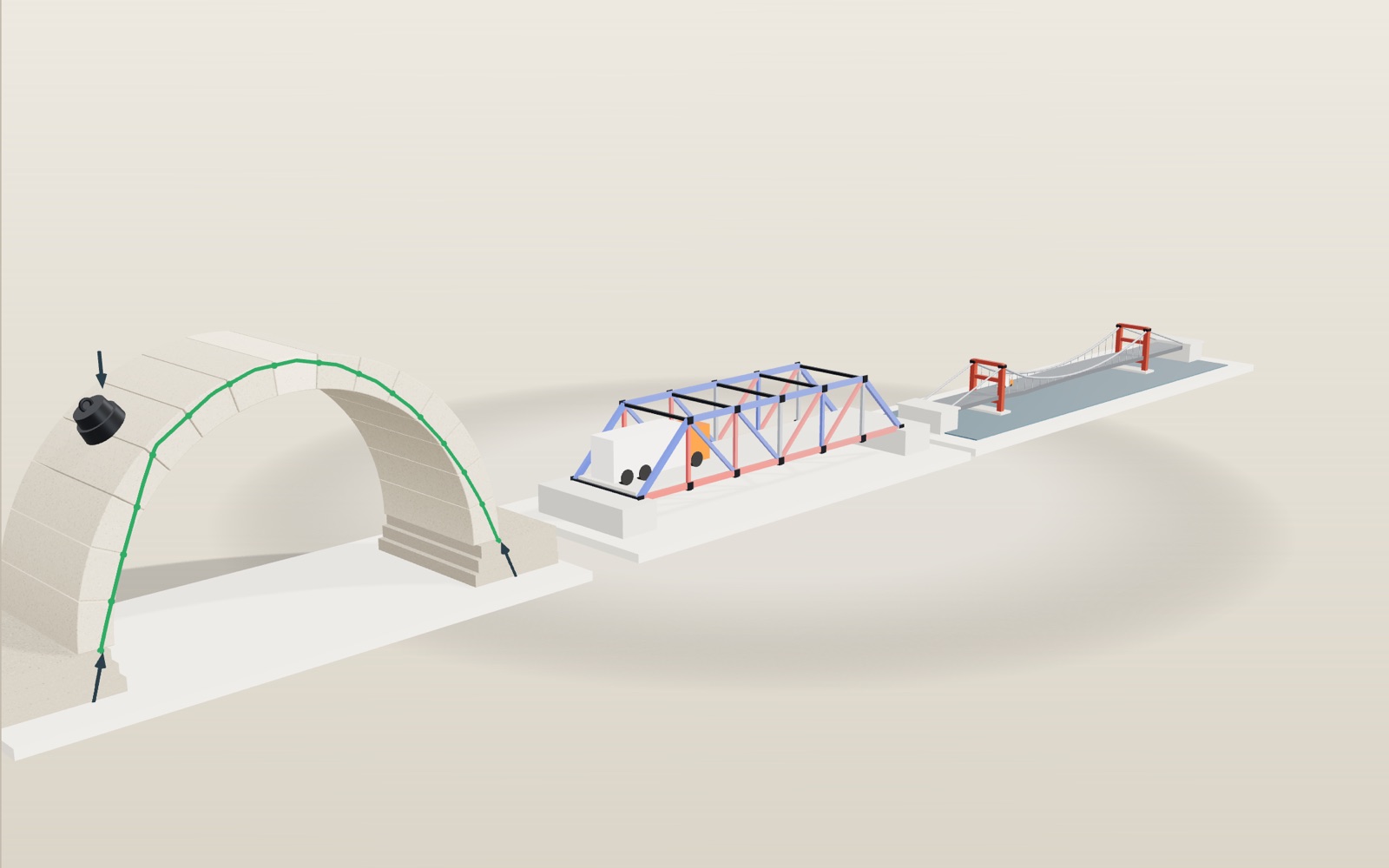
1 / 11 A load crosses a stone archOne stone arch fills the stage while a cast-iron weight rolls over it. The green line is the path of the push through the stones, and the dots running down it show the force travelling to the abutments. Drag the weight yourself to move it.
Drag to turn. Scroll or pinch to zoom.
What the model shows
Walk under an old stone bridge and look up. No mortar is strong enough to glue the stones together against gravity, and yet the arch has stood for centuries. A steel railway bridge nearby looks completely different, a lattice of thin bars, and a suspension bridge further along the coast hangs its road from two cables. All three solve the same problem: carrying a load across a gap and down into the ground on either side.
The model puts the three side by side. On the left is a semicircular stone arch, in the middle a Pratt truss, and on the right a suspension bridge with two towers and two anchorages. Each is drawn to its own scale, so the arch is about 8 m across, the truss 30 m and the suspension bridge 160 m between its towers. The "Load position" and "Load" sliders move a weight across all three at once, and the panel in the corner reports the forces worked out for that position. The "Stones laid" slider and the "Centring" switch let you build the arch and take away its timber support.
Why stone can only push
Stone is very strong when it is squeezed and very weak when it is pulled. A stack of blocks with no mortar cannot carry any tension at all: the joints simply open. So a stone bridge has to be shaped so that every joint is pressed together and none is pulled apart.
An arch does that by turning the downward weight of the stones and the traffic into a sloping push. Each wedge-shaped stone, called a voussoir, leans on its neighbours, and the push travels round the curve and down into the abutments. Because the push slopes, the abutments have to resist two things: the weight coming down and a sideways shove called the thrust. Take away the sideways support and the feet of the arch spread while the crown drops.
Robert Hooke described the right shape in 1675 with a Latin anagram. Decoded, it says that a hanging chain, turned upside down, gives the shape of a rigid arch. A chain can only be in tension, so it hangs in whatever shape puts every link in pure tension. Flip that shape over and every link would be in pure compression instead, which is exactly what stone wants.
Building on centring, and why the keystone matters
Half an arch cannot stand. Each stone leans inward, and with nothing on the other side to lean against, it would rotate and fall. So builders first put up a timber frame called centring, with its top shaped like the underside of the arch, and lay the stones on it from both springings toward the middle.
The last stone at the crown is the keystone. Once it is pushed in, the two halves lean on each other and the ring is closed. The builders then knock out wedges at the tops of the centring posts, the frame drops a few centimetres, and the arch takes its own weight for the first time. This is called striking the centring. In the model, set "Stones laid" below 15 and turn the centring off: the stones fall. Lay all 15 first and the same switch leaves the arch standing.
The keystone's shape is nothing special here. In the model it is the same size and weight as the other fourteen stones. What makes it the keystone is that it goes in last.
The thrust line, in numbers
The model ring has a centreline radius of 4 m, a thickness of 0.6 m and a width of 3 m. With granite at 23.5 kN per cubic metre, the whole ring weighs π × 4 × 0.6 × 3 × 23.5 = 532 kN, about 54 tonnes, split into 15 stones of 35 kN each.
Treat each stone as a single weight acting at its centre of gravity and pick a horizontal thrust H. Starting at one springing, the push runs in a straight line until it meets the first weight, then bends downward by an amount set by that weight, then runs straight to the next one, and so on. The bent line that results is the thrust line. Its slope on each stretch is the vertical force still to be carried divided by H, which is the same rule that sets the shape of a hanging chain.
The arch can settle on its own H within limits. A small thrust gives a deep, pointed thrust line, and a large thrust gives a flatter one. Jacques Heyman's safe theorem says that if any one of these lines can be drawn inside the stonework at every joint, the arch will not collapse under those loads, provided the stones neither crush nor slide. The model searches all possible lines and draws the one that keeps furthest from the edges. The percentage in the panel is how far that line strays from the middle of the ring at its worst joint, as a fraction of half the thickness. Under its own weight the model ring reaches 71%, so there is room to spare. Each abutment then pushes back with H = 104 kN sideways and 266 kN upward, half the ring's weight.
Put a load on the ring and the line has to bend sharply under it. A load of about 100 kN at the crown uses up all the room: no line fits any more. The worst place in this model is just beside the crown, at 45% of the span, where 72 kN is enough. At a quarter of the span the limit is 129 kN, and close to the springings it is more than 500 kN, because the load there goes almost straight down into the abutment. The joints where the line touches the edge are where the arch would crack open and turn like a hinge; four such hinges turn the ring into a mechanism and it falls. In the model those joints turn red.
A bare ring is the worst case. Real stone bridges carry earth fill and a road above the ring. That fill adds weight, which helps hold the thrust line in place, and it spreads a wheel load over a wide part of the ring.
How a truss turns bending into push and pull
A truss replaces a solid beam with triangles of straight bars joined at their ends. If the joints are treated as pins and the loads arrive only at the joints, each bar carries a single force along its length: compression, shown in blue, or tension, shown in red.
The forces come from the method of joints. At each pin, the forces from the bars and any load or support reaction must add up to zero, both horizontally and vertically. The model truss has 12 joints, so it gives 24 equations, and it has 21 bars plus three support reactions, so there are exactly 24 unknowns. Solving them together gives all the forces at once.
Put a 200 kN truck in the middle. Each of the two trusses takes half, 100 kN, and each support pushes up with 50 kN. Cut the truss through the middle panel and take moments: the bending moment at midspan is 50 kN × 15 m = 750 kN·m, and with the chords 5 m apart, the top chord carries 750 ÷ 5 = 150 kN of compression. The bottom chord in the same panel carries 100 kN of tension, and each diagonal carries 50 ÷ sin 45° = 71 kN of tension. The panel shows these same values.
Why diagonals change sign under a moving truck
In a Pratt truss the diagonals slope down toward the middle. That arrangement keeps them in tension under a symmetric load, which suited 19th-century builders who could make long iron bars cheaply but feared that slender bars in compression would buckle. Thomas and Caleb Pratt designed it in 1844.
A truck does not stay in the middle, though. Drive it to one third of the span and the shear in the middle panel reverses direction. Diagonal U2L3, which carried 71 kN of tension, now carries 47 kN of compression. Engineers handle this with an influence line, a plot of one bar's force as the load moves across, and check each bar for the worst value in both directions. Older Pratt trusses with tension-only diagonals added crossing counters in the middle panels for this reason.
Why a hanging cable makes a parabola
A suspension bridge deck hangs from vertical hangers, and in the model there is one every 8 m. The deck's weight, 40 kN per metre for each cable, arrives at the cable as equal loads at equal spacing, 320 kN at each hanger.
A cable cannot resist bending, so its sag at any point must equal the bending moment that a simple beam of the same span would have under the same loads, divided by the horizontal pull H. For a uniform load the moment diagram is a parabola, so the cable is a parabola too. At midspan the moment is wL² ÷ 8, and since the sag there is f, H = wL² ÷ (8f) = 40 × 160² ÷ (8 × 16) = 8,000 kN. Near the towers the cable also carries the vertical share of the deck weight, so the tension there rises to 8,558 kN.
A chain hanging under its own weight forms a catenary instead, because its weight is spread along the curved length rather than evenly along the span. For a 160 m span with 16 m of sag, the two curves differ by 52 mm at most. A real cable carries both its own weight and the deck, so its shape lies between the two.
A truck breaks the pattern. With no stiffening girder in the model, a 300 kN truck (150 kN per cable) at a quarter of the span pulls a kink into the cable. Because the cable does not stretch, the rest of it rises a little, H climbs to 8,213 kN, and the cable under the truck drops by 0.24 m. The model draws that movement ten times larger so you can see it. Real suspension bridges use a stiff deck girder to spread such loads over many hangers.
Towers and anchorages
The cable runs over a saddle on each tower and down the back span to an anchorage. If the saddle can roll, the horizontal pull is the same on both sides, so the towers mostly carry a vertical load. In the model each backstay drops 16 m over a 50 m back span. Its tension is H divided by the cosine of that slope, 8,400 kN under the deck alone, and it pulls upward on the anchorage with 2,560 kN. That is why anchorages are such large blocks: their weight holds the cable end down.
Korean bridges built on these ideas
Korea's surviving stone arch bridges are called hongyegyo or hongyo, which means rainbow bridge. Seungseongyo at Seonamsa temple in Suncheon is a single semicircular arch of about 140 stones. According to the National Heritage Service it was first built in 1707 and repaired after a flood in 1713, and it was designated a Treasure in 1963. Beolgyo Hongyo in Boseong was built in 1729 and rebuilt with three arches in 1737; it is the largest of the stone rainbow bridges still standing. Both have a carved dragon head projecting under the crown.
Among suspension bridges, Namhae Bridge, opened on 22 June 1973 with a total length of 660 m, was Korea's first suspension bridge. Yi Sun-sin Bridge between Yeosu and Gwangyang has a main span of 1,545 m between its towers; it opened temporarily in May 2012 and fully on 8 February 2013.
Worked example: how a flatter arch pushes harder
Take the model arch between its springings: a span of L = 8 m and a rise of f = 4 m, which is the 4 m radius. Put 100 kN on the crown and treat the arch as three-hinged, with a hinge at each springing and one at the crown. By symmetry each abutment carries 50 kN upward. Now cut the arch at the crown hinge and take moments about it for the left half: the 50 kN reaction acts 4 m from the crown, and the horizontal thrust H acts 4 m below it. So 50 × 4 = H × 4, and H = 50 kN. In general H = PL ÷ (4f) = 100 × 8 ÷ 16 = 50 kN.
Keep the span and the load but flatten the arch. At f = 2 m the same formula gives H = 100 kN, and at f = 1 m it gives 200 kN. The vertical reaction stays at 50 kN every time. Only the sideways push changes, and it is inversely proportional to the rise. A flat arch does not need stronger stone so much as stronger abutments.
The same rule holds for a uniform load w. A parabolic arch carrying w per metre has H = wL² ÷ (8f), which is exactly the cable formula turned upside down. The Zhaozhou Bridge in Hebei, completed in 605, makes the contrast concrete. The American Society of Civil Engineers gives it a span of 37 m and a rise of only 23.9 ft, about 7.3 m. Treating both it and a semicircular arch of the same span as parabolas under a uniform load (an idealisation), the thrust per unit of total load is L ÷ (8f). For Zhaozhou that is 37 ÷ (8 × 7.3) = 0.63. For a semicircle, whose rise is half the span, it is 0.25. The low arch pushes sideways about 2.5 times harder for each kilonewton it carries, which is the price of a gentle road profile.
Centring, ring by ring
The "Stones laid" slider counts from 0 to 15, and each stone in the model weighs about 35 kN. At 10 stones the timber centring is carrying roughly 350 kN of masonry that has nothing else to lean on. Turn "Centring" off at that point and the stones fall, because an incomplete ring is not a closed structure and no thrust line can be drawn from one springing to the other.
At 15 stones the situation changes completely. The ring is closed, the model finds a thrust line inside it, and the centring carries nothing useful. Builders lower it in stages rather than knocking it away. The Brick Industry Association's technical note on masonry arches treats easing the centering as a step that comes only after the keystone is placed.
When that happens the arch does not jump to one fixed state. The horizontal thrust can settle anywhere in a range. Block, DeJong and Ochsendorf report, for a semicircular arch with a ring thickness of 18% of its radius, a minimum thrust of about 16% of the arch's weight and a maximum of about 24%. The model ring is slightly thinner, 0.6 m on a 4 m radius or 15%, so its range is somewhat narrower. The thrust the model draws, 104 kN against a ring weight of 532 kN, is 19.5% of the weight and sits comfortably in the middle of that kind of range. If an abutment spreads a little, the thrust moves toward the lower end of its range, and the arch keeps standing as long as some line still fits inside the ring.
Arch, truss and cable compared
The three structures answer the same question in three different ways, and the clearest difference is what each one does to its supports.
- Stone arch. The ring is always in compression. Each abutment is pushed down and outward. In the model: 266 kN down and 104 kN out under the ring's own weight.
- Pratt truss. The truss only presses straight down on its supports. Its bars take compression or tension depending on where the load stands, and the chords supply the bending resistance. In the model the chord force for a 100 kN load is the midspan moment divided by the depth: 750 ÷ 5 = 150 kN. A truss of half the depth, 2.5 m, would need chords carrying 300 kN for the same load.
- Suspension bridge. The cable is always in tension and pulls the supports inward and upward. Its horizontal pull is H = wL² ÷ (8f), so halving the sag doubles it: the model's 8,000 kN would become 16,000 kN at 8 m of sag.
For a uniform load, compare the horizontal force with the load carried. The model cable has H ÷ (wL) = 160 ÷ (8 × 16) = 1.25, because its sag is a tenth (1/10) of its span. A semicircular arch has a ratio of 0.25 in the same idealisation, because its rise is half the span. A cable that sags a tenth (1/10) of its span pulls five times as hard sideways as the arch pushes, which is why anchorages and backstays are so massive.
The materials follow the same logic. Stone and cast iron are strong when squeezed and brittle when pulled, so they suit arches. Steel can take both, so it suits trusses. A cable of steel wire is useless in compression but excellent in tension, so it suits a suspension bridge. The Iron Bridge at Coalbrookdale in Shropshire shows how habits carry over: English Heritage describes a single cast-iron span of 30 m made of five semicircular ribs, joined with dovetail and shouldered joints borrowed from carpentry.
Real bridges and what they test
Pont du Gard, France. UNESCO describes a Roman aqueduct bridge of three tiers of arches, rising to nearly 48.77 m, with the lower two levels built of large stone blocks. In a row of equal arches each one pushes sideways on its neighbours, and the pushes cancel at every pier except the last. Only the two end abutments have to resist a net thrust.
Zhaozhou Bridge, China, 605. The ASCE landmark record calls it the world's oldest open-spandrel arch bridge. It was built by Li Chun from 28 thin curved limestone slabs joined with iron dovetails, and small arches at the ends of the deck pass part of the load to the main arch and let flood water through. Its low rise follows from the thrust calculation above.
Iron Bridge, England, 1779. English Heritage records 378 tons of iron and a cost of about £6,000 against a first estimate of £3,200. The BBC's history page counts 482 main castings and says the first arch spanned the river on 2 July 1779. English Heritage adds that 70% of the components were cast individually to fit, so no two are quite the same. The BBC page adds that the south abutment moved severely and was demolished in 1802, a reminder that an arch is only as reliable as the ground that takes its thrust.
Golden Gate Bridge, 1937. The ASCE landmark page gives a main span of 4,200 ft (about 1,280 m), the longest single span in the world when it was built, with construction starting in November 1932. That is eight times the model's 160 m. As an illustration of scaling only, keep the model's sag ratio of 1/10 and its load of 40 kN per metre of cable. The horizontal pull would then grow in proportion to the span, from 8,000 kN to 64,000 kN. The real bridge has different loads and a different sag, so this is a scaling check, not a figure for the bridge.
Tacoma Narrows Bridge, 1940. The original design had 25 ft stiffening trusses. A cheaper design with 8 ft solid plate girders replaced it, and the bridge opened on 1 July 1940. ASCE records that it failed on 7 November 1940 in a wind of only 42 mph, four months after opening. The cause was aerodynamic, which the model does not include at all. The deck was extremely shallow for its width, a depth-to-width ratio of 1 to 72, so it twisted easily. The 1950 replacement used a 33 ft stiffening truss and openings for wind to pass through the deck.
Common misconceptions
- "The keystone holds the whole arch up." Every stone is squeezed by its neighbours, and the keystone is one of them. In the model it has the same size and weight as the other 14. What matters is that it closes the ring.
- "A load at the crown is the worst case." In the model it is not. The ring tolerates about 100 kN at the crown but only 72 kN at 45% of the span, and 129 kN at a quarter. The worst position is where the load forces the thrust line furthest from the middle of the ring.
- "More bars make a truss stronger." Bars only help if they carry force. In the model the verticals nearest the ends carry zero force unless the load stands on their joint, and a diagonal can swap from tension to compression as the truck moves.
- "A hanging cable is a catenary." Only when the cable's own weight dominates. With a deck much heavier than the cable, the shape is a parabola, and in the model the two curves differ by at most 52 mm over 160 m.
- "Tacoma Narrows was resonance." The American Physical Society points out that this textbook explanation is incorrect. The Federal Works Administration found resonance an improbable cause, and the accepted explanation is torsional flutter, a self-excited twisting in which the deck's own motion drew more energy from the wind.
Things to try on the screen
- Use the scene buttons at the top of the stage: stone arch, truss, suspension bridge, real bridges, or all three side by side. Each bridge fills the stage on its own.
- On the stone arch, drag the cast-iron weight along the ring. The green line follows it, and the dots running down the line show the push travelling to the abutments. Around 45% of the span, 75 kN is already enough to push the line out of the ring.
- Tap any stone in the ring. It slides out and the whole ring falls, the keystone included. Press "Put the stones back" to rebuild it.
- Set "Stones laid" to 10 with the centring on, then switch "Centring" off. The stones fall. Lay all 15 and switch it off again: the arch stands.
- With no load, lower "Ring thickness" from 0.60 m. Below about 0.43 m no thrust line fits inside the ring any more.
- On the truss, drag the truck. With 200 kN in the middle the top chord carries 150 kN of compression. Move it to one third of the span and diagonal U2L3 turns from red to blue.
- On the suspension bridge, set "Load" to 300 and drag the truck to a quarter of the span. The cable kinks and drops 0.24 m, drawn ten times larger.
- Open the real bridges: Zhaozhou, Brooklyn, Golden Gate and Akashi Kaikyō, each drawn to its measured span and height.
- The Controls tab lists 11 challenges, from breaking the arch with 100 kN or less to finding the 7 hidden things in the scenes.
Where the model is simpler than a real bridge
- The arch is a bare ring with no fill, no spandrel walls and no road. Joints are radial, the stones are rigid, and crushing and sliding are ignored, as in Heyman's assumptions.
- The arch load is a single vertical point load resting on one stone.
- The truss has pin joints, ignores its own weight and the deck's, and treats the truck as one point load shared between the two nearest floor beams.
- The suspension deck has no bending stiffness, the cable does not stretch, the backstays are straight and the tower saddles roll freely. Cable and deck movements are drawn ten times larger.
How the numbers were checked
The statics were also worked through by hand. For the truss with 100 kN at midspan the hand values match the reactions, the 150 kN top chord, the 100 kN bottom chord, the 70.7 kN end posts and diagonals, and the zero force in the verticals next to the ends, and it confirms that all 12 joints balance for 61 truck positions. For the arch they match H = PL ÷ (4f) for a three-hinged arch with a crown load, and for a semicircular arch with t/R = 18% the thrust range comes out of 16% to 24% of the arch's weight, against 16% and 25% reported by Block, DeJong and Ochsendorf. For the cable they confirm that the hanger points lie on y = 4fx(L − x) ÷ L² and that H = wL² ÷ (8f).
Questions
Why doesn't a stone arch need mortar?
In a working arch each joint is pressed together. As long as the thrust line stays inside the stones, no joint is asked to resist pulling, so mortar has no structural job. It mainly fills gaps and keeps water out.
What does the keystone actually do?
It closes the ring. Before it is in, each half leans on the centring; after it is in, the halves lean on each other. In the model it is the same size as the other stones, which shows that its role comes from its position rather than its shape.
What is the thrust line?
The path the compressive force follows from stone to stone. You can draw many such lines for the same loads by choosing different horizontal thrusts. If at least one fits inside the stonework, the arch is safe under those loads.
Where is a load most dangerous for this arch?
Just beside the crown. In the model 72 kN at 45% of the span leaves no thrust line inside the ring, while the crown itself takes about 100 kN and the quarter point 129 kN. All of these are far below the ring's own weight of 532 kN, which is why real arches rely on fill to keep the thrust line central.
Why are some truss members blue and others red?
Blue members are being squeezed and red members are being pulled. With the load in the middle, the top chord is in compression and the bottom chord in tension, like the top and bottom of a bent beam.
Why does a diagonal change from tension to compression?
The diagonals carry the shear in their panel. When the truck moves past a panel, the direction of the shear there reverses, and so does the force in its diagonal.
Is a suspension cable a parabola or a catenary?
A cable carrying a deck much heavier than itself hangs very close to a parabola. A cable carrying only its own weight hangs as a catenary. For the 160 m span in the model the two shapes differ by 52 mm at most.
Why does a suspension bridge need huge anchorages?
Each cable pulls on its anchorage with thousands of kilonewtons, about 8,400 kN in the model, and part of that pull is upward. The anchorage has to be heavy and well founded to hold the cable end in place.
Why does a flatter arch push harder on its abutments?
For the same span and load, the horizontal thrust is H = PL ÷ (4f) for a crown load, so it is inversely proportional to the rise f. Halving the rise doubles the sideways push while the vertical reaction stays the same.
Did resonance bring down the Tacoma Narrows Bridge?
No. The American Physical Society calls the classroom resonance explanation incorrect. The bridge failed in a 42 mph wind through torsional flutter, a self-excited twisting of a very shallow deck.
Why did the Iron Bridge copy the shape of a stone arch?
English Heritage describes a 30 m cast-iron span made of five semicircular ribs. Cast iron, like stone, is far stronger squeezed than pulled, so the arch form that keeps every part in compression suited it, and its joints were borrowed from carpentry.
Terms
Voussoir: one wedge-shaped stone of an arch.
Keystone: the voussoir at the crown, laid last.
Centring: the temporary timber frame that supports an arch while it is built.
Abutment: the support at each end of an arch that resists both its weight and its thrust.
Thrust (H): the horizontal force with which an arch pushes outward, or a cable pulls inward.
Thrust line: the path of the compressive force through an arch.
Chord: a top or bottom member running the length of a truss.
Method of joints: solving a truss by balancing the forces at each pin.
Influence line: a graph of one member's force as a load moves along the span.
Sag (f): how far a cable hangs below the line joining its supports, measured at midspan.
Anchorage: the heavy block that holds the end of a suspension cable.
Rise (f): the height of an arch above the line joining its springings.
Spandrel: the space between the arch ring and the deck above it; in an open-spandrel bridge it is pierced by small arches.
Torsional flutter: a self-excited twisting vibration in which the structure's own motion draws energy from the wind.
Sources
- Philippe Block, Matt DeJong and John Ochsendorf, As Hangs the Flexible Line: Equilibrium of Masonry Arches, Nexus Network Journal 8(2), 2006 (thrust lines, minimum and maximum thrust of a semicircular arch with t/R 18%). https://ballarini.cive.uh.edu/wp-content/uploads/2014/10/as-hangs-the-flexible-line.pdf (checked 16 October 2026)
- Arizona State University, Ask A Biologist, What is a Keystone? (a temporary wooden frame holds the voussoirs until the keystone goes in, then is removed). https://askabiologist.asu.edu/what-keystone (checked 17 October 2026)
- Brick Industry Association, Technical Notes 31: Brick Masonry Arches (centering, keystone, easing the centering after the keystone is placed). https://www.gobrick.com/media/file/31-brick-masonry-arches.pdf (checked 17 October 2026)
- Google Patents, US 3,523, Thomas and Caleb Pratt, truss for bridges and roofs (4 April 1844). https://patents.google.com/patent/US3523A/en (checked 17 October 2026)
- National Heritage Service, 순천 선암사 승선교 description (first built in 1707, repaired after a flood in 1713, about 140 arch stones, dragon head; Treasure, 2 September 1963). https://www.heritage.go.kr/DATA1/heritage/hub_img/html/cul_1123604000000.html (checked 17 October 2026)
- Korea Heritage Service, National Heritage Portal, 순천 선암사 승선교 listing. https://www.heritage.go.kr/heri/cul/culSelectDetail.do?ccbaKdcd=12&ccbaAsno=04000000&ccbaCtcd=36 (checked 16 October 2026)
- National Heritage Service, 보성 벌교 홍교 description (stone bridge 1729, three arches from 1737, the largest surviving hongyo, dragon heads). https://www.heritage.go.kr/DATA1/heritage/hub_img/html/cul_1123603040000.html (checked 17 October 2026)
- National Archives of Korea, Today's records: 22 June (Namhae Bridge, Korea's first suspension bridge, opened 22 June 1973). https://theme.archives.go.kr/next/daily/viewMain.do?selectDay=20120622 (checked 17 October 2026)
- National Museum of Korean Contemporary History archive, 1973년 남해대교 전경 (660 m long). http://archive.much.go.kr/data/01/folderView.do?jobdirSeq=1028&idnbr=2018021636 (checked 17 October 2026)
- Yeosu City, 이순신대교 (main span 1,545 m; temporary opening 10 May to 12 August 2012, full opening 8 February 2013). https://www.yeosu.go.kr/tour/leisure/bridge/yisunsin_bridge (checked 17 October 2026)
- American Society of Civil Engineers, Zhaozhou Bridge, historic civil engineering landmark (completed 605; span 37 m; rise 23.9 ft; 28 limestone slabs with iron dovetails). https://www.asce.org/about-civil-engineering/history-and-heritage/historic-landmarks/zhaozhou-bridge (checked 22 October 2026)
- UNESCO World Heritage Centre, Pont du Gard (Roman Aqueduct) (three tiers of arches, height of about 48.77 m, large stone blocks in the lower levels). https://whc.unesco.org/en/list/344 (checked 22 October 2026)
- English Heritage, History of Iron Bridge (30 m cast-iron span, five semicircular ribs, 378 tons, about £6,000 against £3,200 estimated, carpentry joints, 70% individually fitted parts). https://www.english-heritage.org.uk/visit/places/iron-bridge/history (checked 22 October 2026)
- BBC History, The Iron Bridge: How was it Built? (482 main castings, first arch across the Severn on 2 July 1779, south abutment demolished in 1802). https://www.bbc.co.uk/history/british/victorians/iron_bridge_01.shtml (checked 22 October 2026)
- American Society of Civil Engineers, Golden Gate Bridge, historic civil engineering landmark (completed 1937; longest single span in the world at 4,200 ft; construction began November 1932). https://www.asce.org/about-civil-engineering/history-and-heritage/historic-landmarks/golden-gate-bridge (checked 22 October 2026)
- American Society of Civil Engineers, Tacoma Narrows Bridges, historic civil engineering landmark (failure on 7 November 1940 in a 42 mph wind; 1950 replacement with a deeper truss). https://www.asce.org/about-civil-engineering/history-and-heritage/historic-landmarks/tacoma-narrows-bridges/ (checked 22 October 2026)
- American Physical Society, November 7, 1940: Collapse of the Tacoma Narrows Bridge, APS News, November 2016 (resonance explanation incorrect; 8 ft plate girders instead of 25 ft trusses; depth-to-width 1 to 72; torsional flutter). https://www.aps.org/publications/apsnews/201611/physicshistory.cfm (checked 22 October 2026)
- NYC Department of Transportation, Brooklyn Bridge (main span 1,595.5 feet; clearance at center 135 feet; completed 1883; longest suspension bridge in the world at the time). https://www.nyc.gov/html/dot/html/infrastructure/brooklyn-bridge.shtml (checked 26 October 2026)
- Washington State University Libraries, newspaper of 1883 describing the Brooklyn Bridge at its opening (height above high water 271 ft 6 in; land spans 930 ft; 5,434 wires in each cable). https://content.libraries.wsu.edu/digital/api/collection/clarknews/id/54930/download (checked 26 October 2026)
- Golden Gate Bridge Highway and Transportation District, Design & Construction Stats (main span 4,200 ft or 1,280 m; side span 343 m; towers 227 m above water; clearance 67 m above mean higher high water; main cable 36 3/8 in across). https://www.goldengate.org/bridge/history-research/statistics-data/design-construction-stats (checked 26 October 2026)
- Encyclopaedia Britannica, Akashi Kaikyo Bridge (central span 1,991 m, side spans 960 m, towers 297 m above the strait; the 1995 Kobe earthquake moved the towers apart, see the Honshu-Shikoku Bridge Authority report below). https://www.britannica.com/topic/Akashi-Kaikyo-Bridge (checked 26 October 2026)
- Calculations on this page: ring weight πRtbγ; thrust line slope (V − ΣW) ÷ H; three-hinged arch H = PL ÷ (4f); truss joint equilibrium ΣFx = 0 and ΣFy = 0 at 12 joints; cable H = wL² ÷ (8f), T = √(H² + V²); backstay tension H ÷ cos(arctan(16 ÷ 50)).
- S. Nasu and M. Tatsumi, Honshu-Shikoku Bridge Authority, Effect of the Southern Hyogo Earthquake on the Akashi-Kaikyo Bridge (centre span 1,990 m → about 1,990.8 m, Awaji side span 960 m → about 960.3 m). https://www-group.slac.stanford.edu/met/iwaa/toc_s/papers/snasu95.pdf
More exhibits
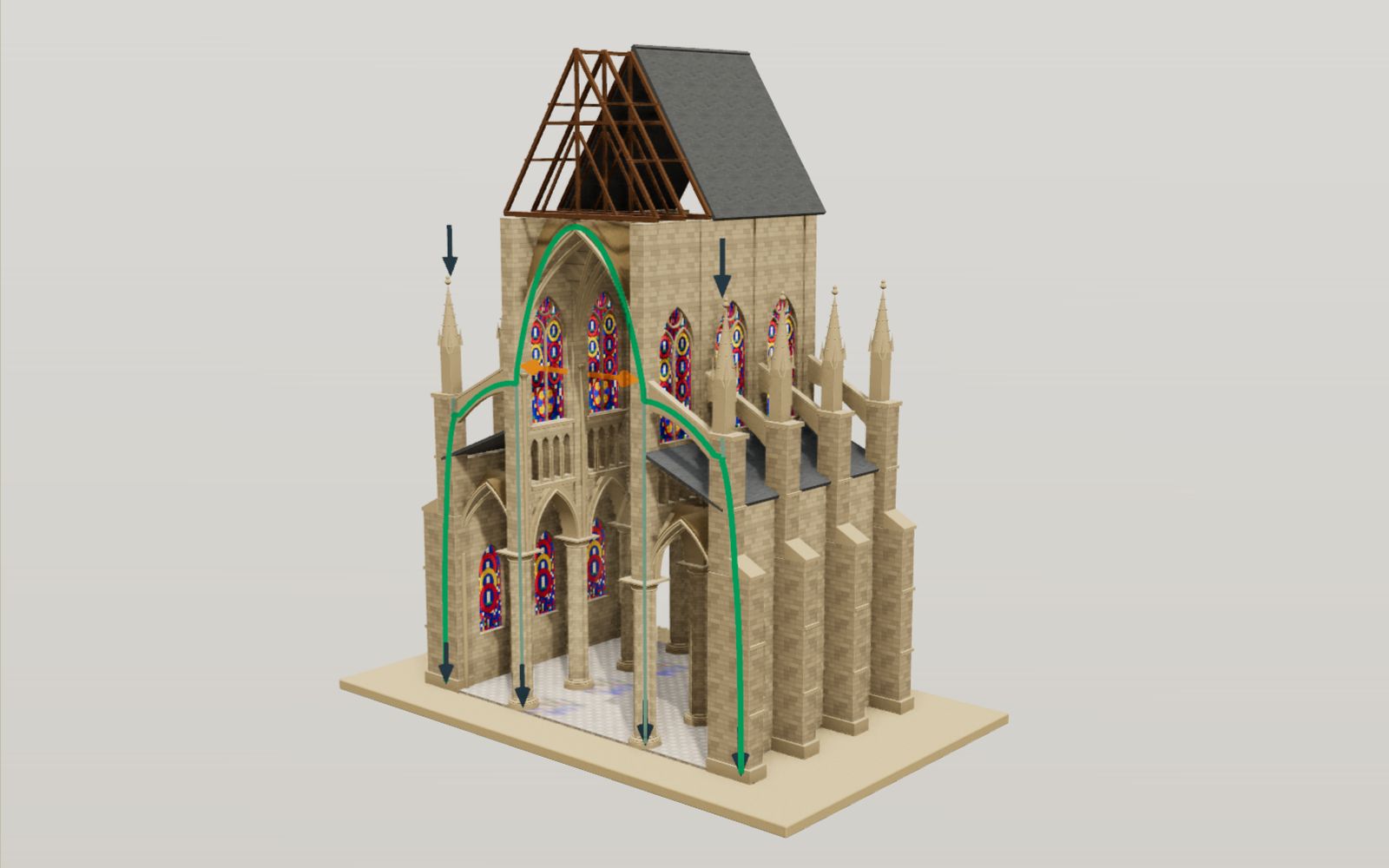
Gothic cathedral: flying buttresses, interactive model
The stone vault of Amiens Cathedral hangs 42.3 metres above the floor, and the walls under it are mostly glass.
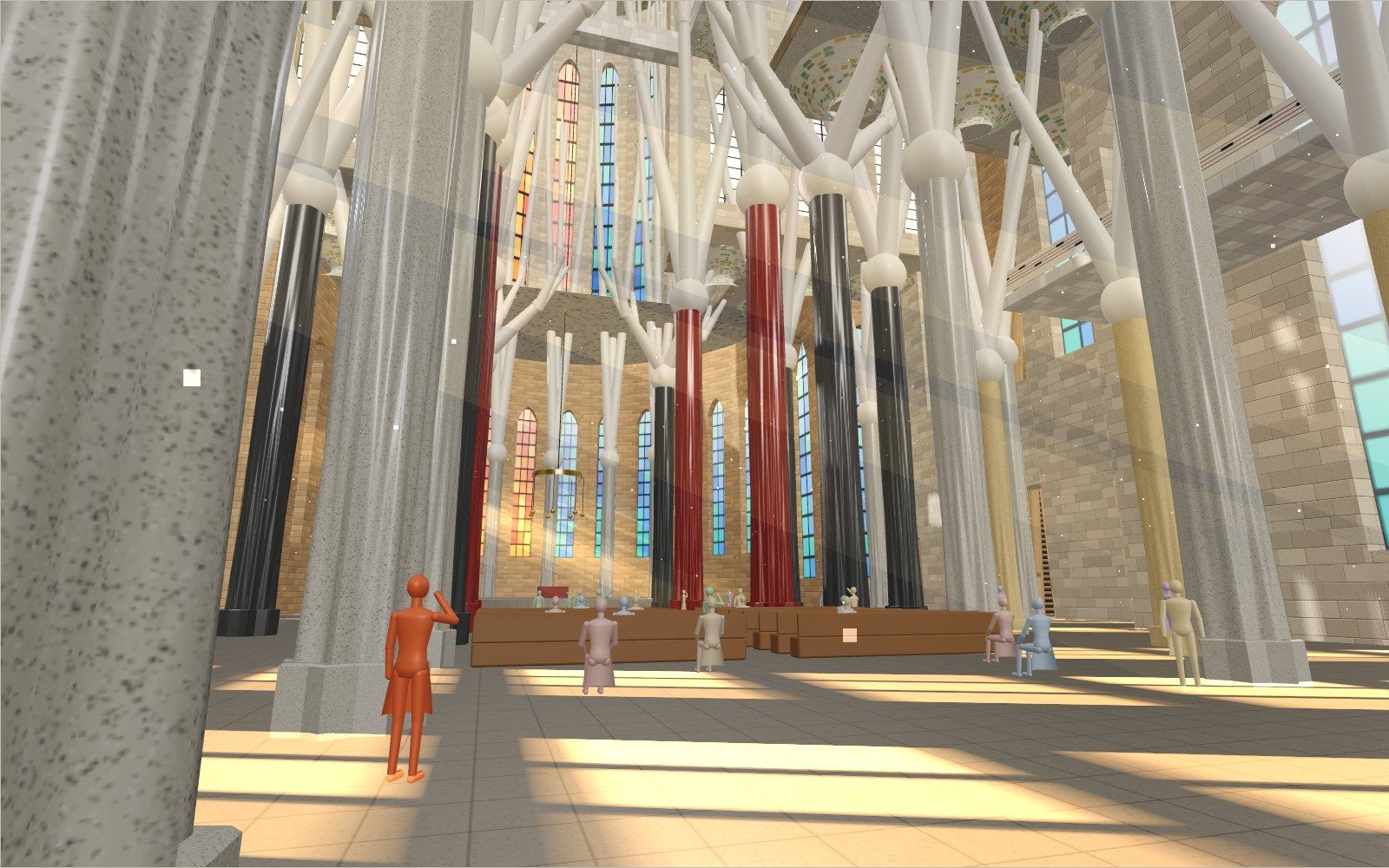
Walk through the Sagrada Família
Inside the Sagrada Família the columns branch like trees 45 m up, and the sun moves blue and orange light across the floor.
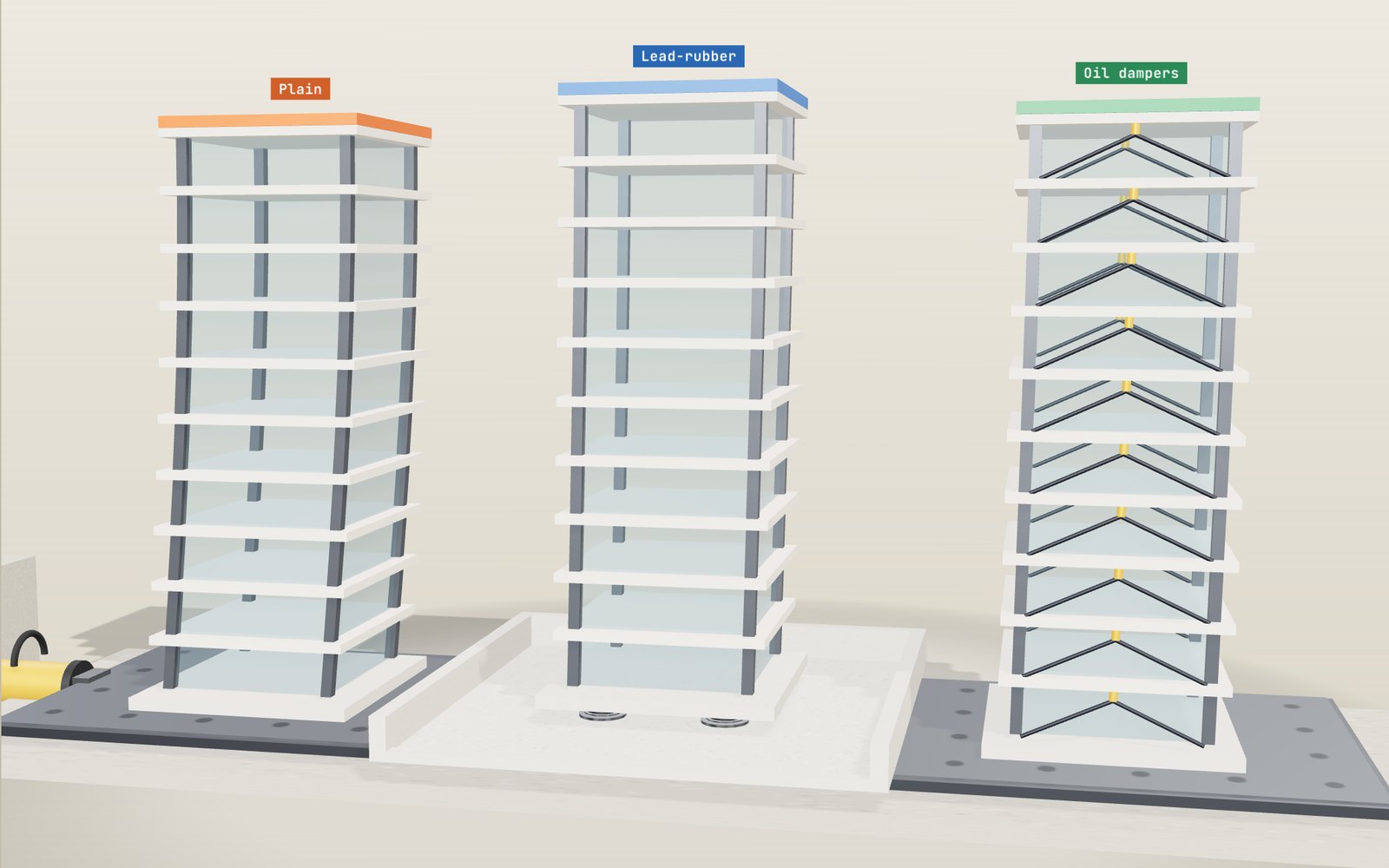
How buildings resist earthquakes
Shake a six-storey model at 0.6 seconds, its own period, and its floors bend about 14 times more than at one second. Rubber bearings, dampers and braces each answer that in a different way.
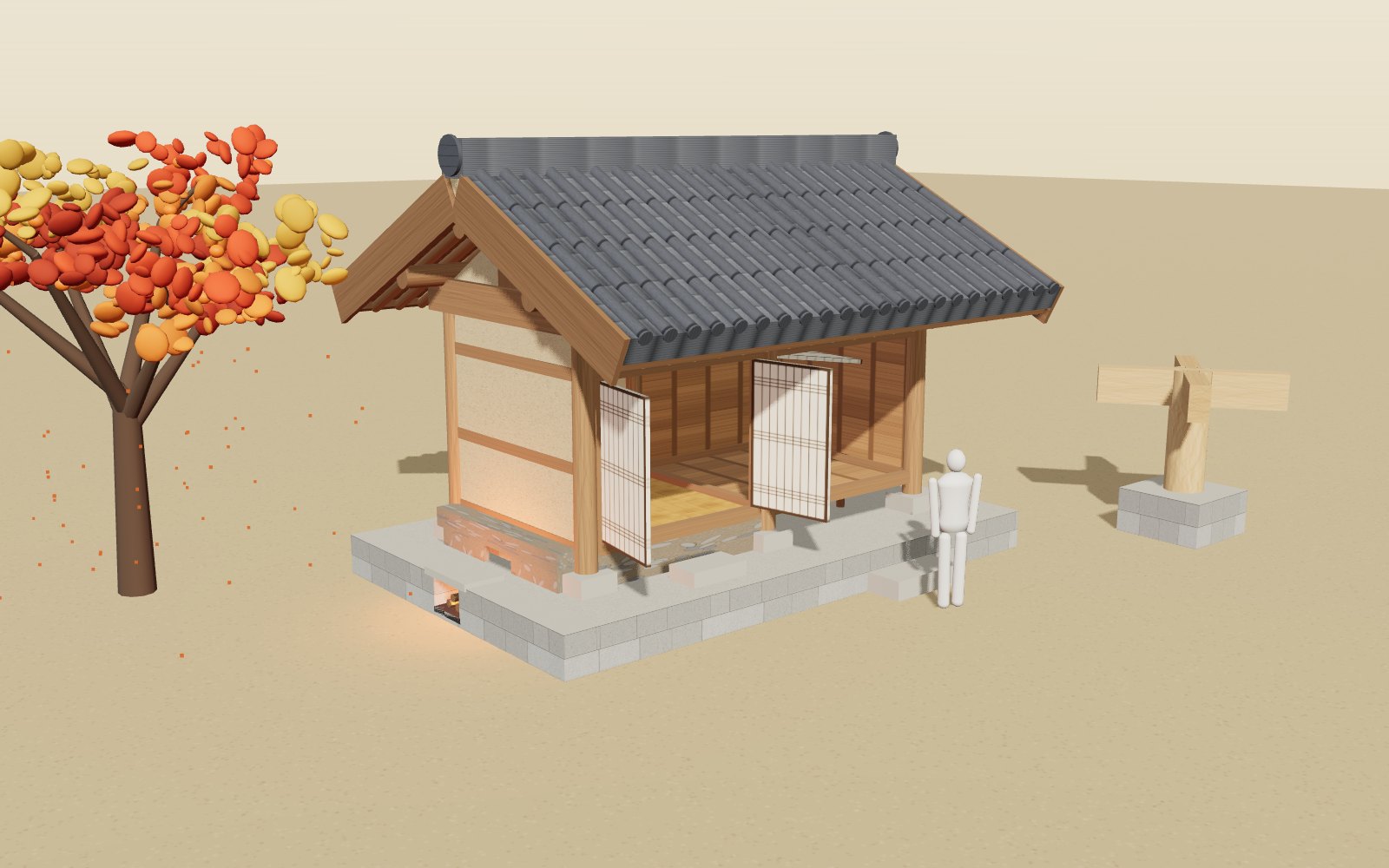
How a hanok is put together and heated by ondol
The frame of a hanok locks together with carved wooden joints, and under its warm room the smoke from one small fire runs through stone flues to the chimney.
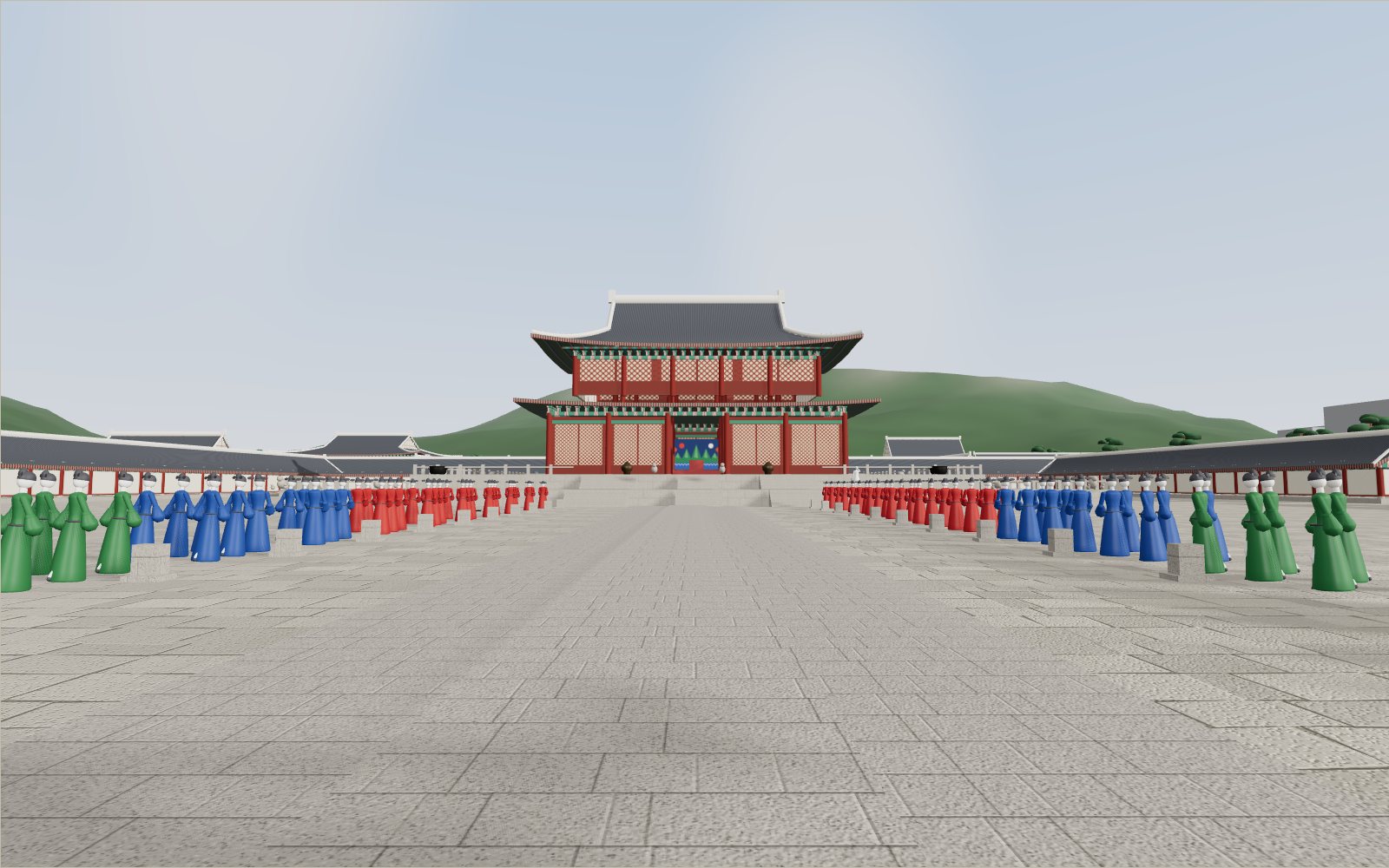
Walk through Gyeongbokgung Palace
In the courtyard of the throne hall, 24 stones told each official where to stand, from the first grade by the hall to the ninth by the gate.
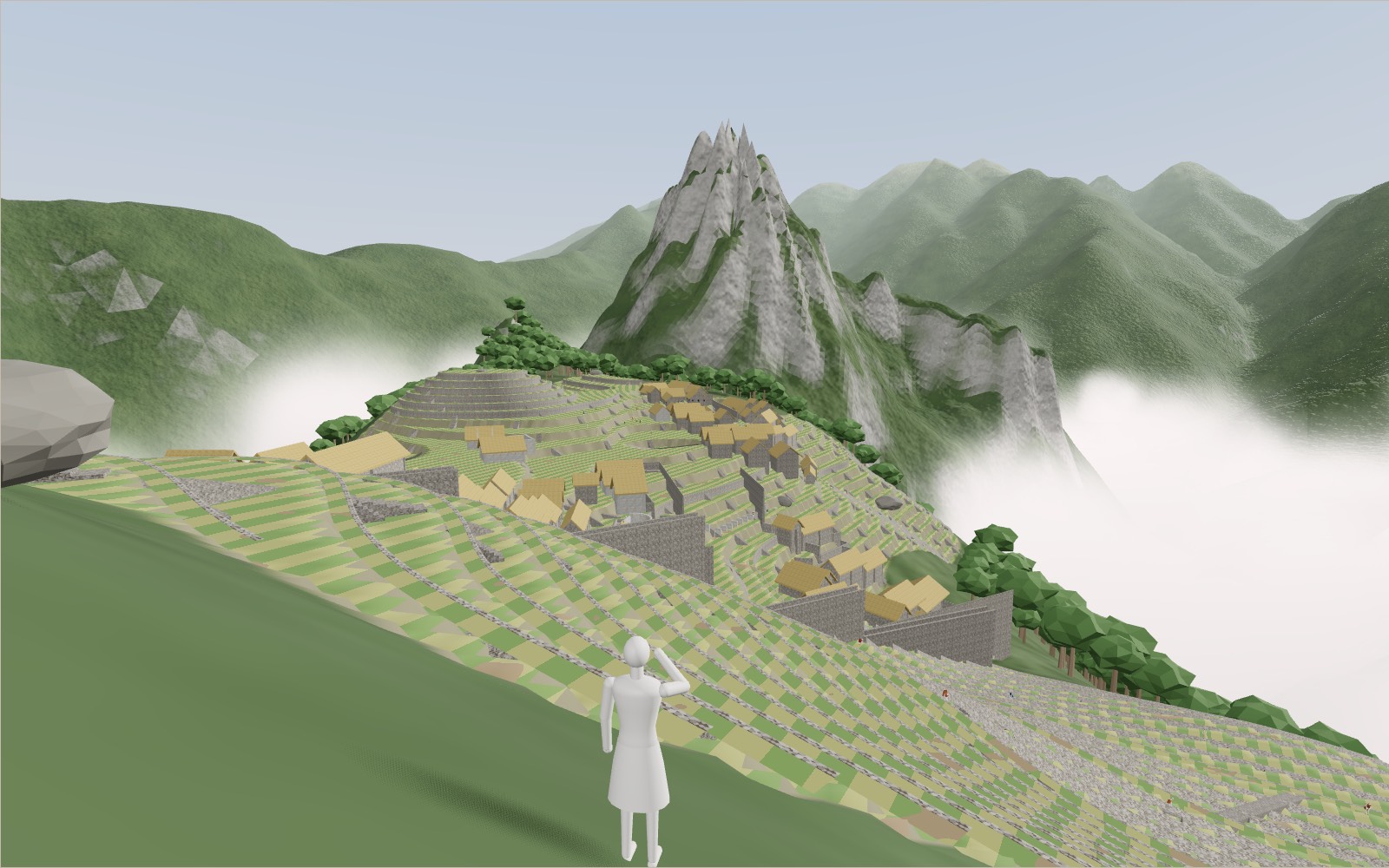
Walk through Machu Picchu
Most of the work that holds Machu Picchu on its ridge, 60 per cent by one estimate, lies under the ground in foundations and drains nobody sees.