FIG. 48How It Works
How buildings resist earthquakes
Shake a six-storey model at 0.6 seconds, its own period, and its floors bend about 14 times more than at one second. Rubber bearings, dampers and braces each answer that in a different way.
This device cannot show the 3D model. You can read the guide steps below as text.
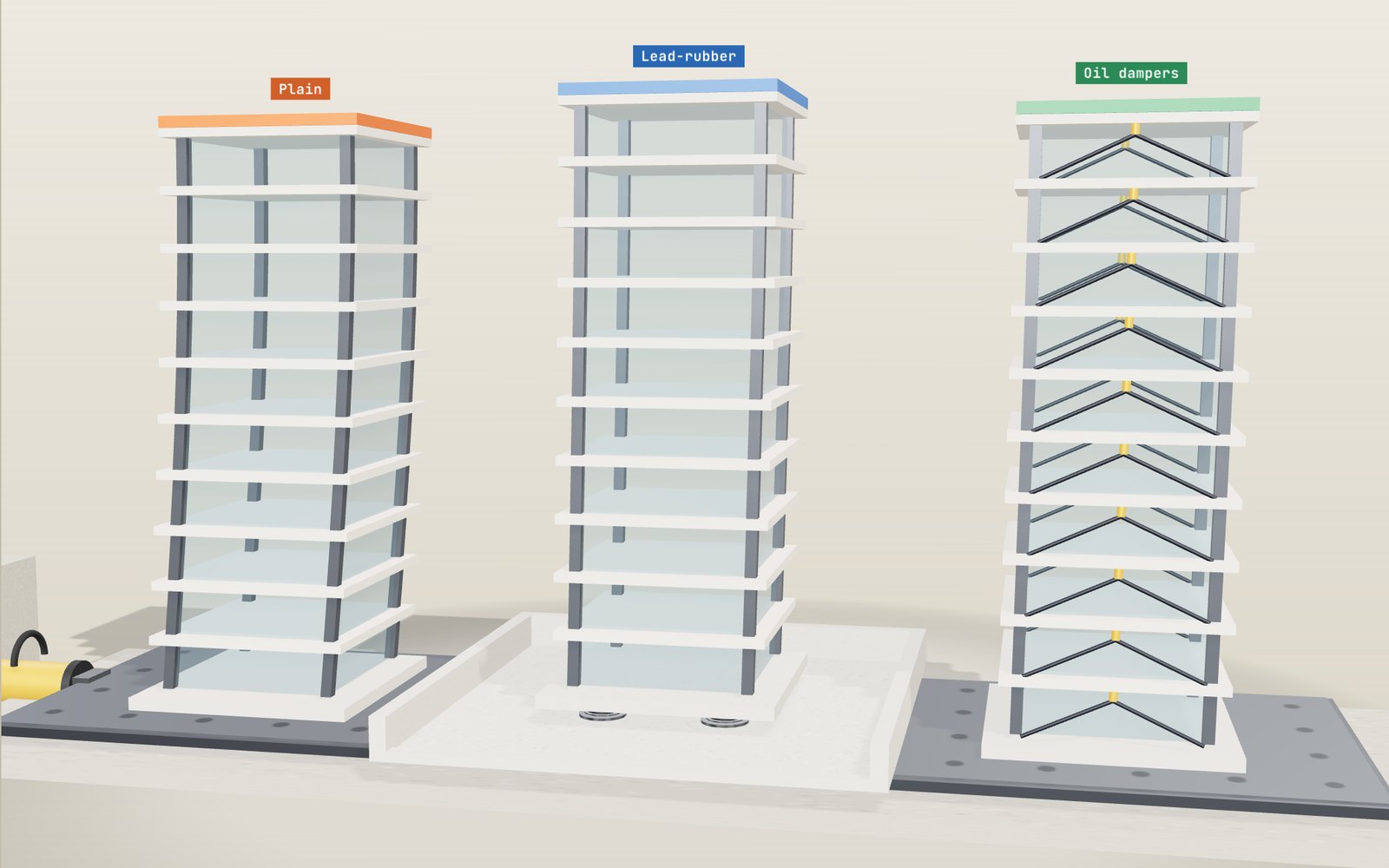
1 / 17 Three buildings on one tableThe same floors and columns three times over. The left one is plain, the middle one sits on rubber bearings and the right one has a tuned mass on its roof. The table shakes once a second at 0.05 g. Drag to look around.
Drag to turn. Scroll or pinch to zoom.
Three buildings on one shake table
Why can one building ride out an earthquake that cracks the building next door, even when both were built to the same standard? Part of the answer is timing. Every building has a rhythm of its own, and the ground shakes with a rhythm too. When the two match, a modest shake can do a great deal of damage. The rest of the answer is what engineers put under, inside or on top of a building to change that rhythm or to soak up the energy.
The model puts three buildings on one steel shake table, so each gets exactly the same ground motion. They share the same floors and the same columns and can be 3, 6, 10, 15, 20, 30, 45 or 60 floors tall. The left one is always plain and bolted straight to the table. The middle and right ones can carry any of eleven devices: four kinds of bearing under the building, four kinds of damper or brace in every storey, and three kinds of moving mass on the roof.
The ground can move in eight ways. A sine wave keeps one period and one strength, which is the clearest way to see resonance. One real record, the ground motion measured at El Centro in California in 1940, shows what an earthquake actually looks like. Six synthetic waves are made to match the peak, the main period and the length of other well-known earthquakes: Kobe 1995, Northridge 1994, the long-period motion that reached Osaka in 2011, Gyeongju 2016, Pohang 2017 and Mexico City 1985. A soil layer can be placed under the table to show how soft ground changes the shaking.
The panel in the corner gives each building's period, its worst storey drift and its roof acceleration, and one more number that depends on the device: how far the bearings slide, how far the roof damper travels or how much energy the yielding parts have taken out. The graphs plot the largest storey drift and the roof acceleration over the last ten seconds. The third graph shows either the worst drift for every shaking period (for a sine) or the response spectrum of the earthquake, with a dot at each building's period.
Six more scenes open from the bar at the bottom of the stage: the devices close up, a box of wet sand that liquefies, a row of pendulums that shows resonance, Taipei 101 and its damper, the inside of an isolation floor, and a bridge on bearings.
Why a building has a period of its own
A building is heavy, and its columns bend a little and spring back. That is the same pair of ingredients as a mass on a spring. Push the top of the building sideways and let go, and it swings back and forth at a rate set by those two things alone. The time for one swing is its natural period. A stiffer building swings faster and a heavier one swings slower: for a single mass on a spring, T = 2π√(m/k).
Each floor of the model is one lumped mass of 400 t. The columns of each storey together act as a sideways spring. The stiffness is chosen so that the plain building's first period is 0.1 s per floor, a common rule of thumb: 0.3 s for 3 floors, 0.6 s for 6 and 6.0 s for 60. For N equal masses on N equal springs the periods have an exact formula, ω = 2√(k/m) sin((2j − 1)π/(2(2N + 1))) for mode j. For 6 floors that gives a storey stiffness of 755 MN/m and periods of 0.600 s, 0.204 s and 0.127 s for the first three modes.
Tour step 2 shows this directly. Every building is pushed into its first-mode shape and released while the table stands still. The plain building swings every 0.60 s and the building on rubber bearings every 2.55 s. With 2% damping the plain building's swing shrinks by a factor of e^(−2π × 0.02) = 0.88 each cycle, so it takes about five and a half cycles to halve. The building with the roof damper stops in a handful of swings.
Pushing a swing at the right moment
A playground swing shows what happens next. Push at random and not much happens. Push each time it reaches you, and it goes higher and higher. The ground does the same to a building. If it shakes once every 0.6 s, each push arrives just as the floors come back, and the motion keeps growing. It stops growing only when the damping takes out as much energy in each cycle as the ground puts in. This is resonance.
The size of that final motion depends mostly on the damping. For a single mode the peak displacement at resonance is 1/(2ζ) times the displacement the same acceleration would cause if it were applied slowly. With ζ = 0.02 that factor is 25. So at only 0.05 g the roof of the 6-floor plain building moves 14.1 cm relative to the ground, while the same 0.05 g at a one-second period moves it less than a centimetre. The worst storey drift at 0.6 s is about 14 times the drift at 1 s, which is the number in the title of this page.
The Resonance scene shows the same thing with eight pendulums hanging from one bar. The bar shakes back and forth with the period you choose. Each pendulum has its own period, 2π√(L/g), from 1.0 s for a 25 cm string to 3.17 s for a 2.5 m playground swing. Only the pendulum whose period matches the shaking builds up a large swing; the others jiggle a little and stay put. The bar chart under the readout shows all eight swings at once, so the peak moves along as you change the period. Engineers call this arrangement Barton's pendulums, and it is the clearest picture of why a building cares about the period of the ground.
Why the bottom storey bends the most
Watch the plain building at resonance and the bottom storey leans the most. The columns of storey 1 must hold back the inertia of all the floors above them. The columns of the top storey only hold back the roof. With the same stiffness in every storey, the lowest one deforms the most.
Engineers measure this as storey drift, the sideways movement of one floor relative to the floor below, often given as a fraction of the storey height. At 0.6 s and 0.05 g the 6-floor model's first storey drifts 3.4 cm over a 3.5 m storey, which is 0.97%. Large drift is what cracks walls, breaks glass and, in the end, damages the columns. Push the strength slider to 0.08 g at 0.6 s and the drift goes past 1.5%, the limit the Korean code sets for buildings of importance class I.
Three ways to answer resonance
Once the problem is clear, there are three broad ways to answer it, and the eleven devices in the model fall into them.
The first is to move the building's period away from the periods at which the ground usually shakes hardest. Bearings that are soft sideways do this. They make the whole building swing slowly, so the quick jolts of most earthquakes pass underneath it.
The second is to add damping, so that energy leaves the building quickly and resonance cannot build up. Oil dampers, yielding steel plates and braces that are allowed to yield all do this inside the storeys. A tuned mass on the roof does it by swinging against the building.
The third is to make the building stiffer and stronger, with shear walls or braces. This is the oldest answer. It reduces drift, but it also shortens the period, which often moves the building towards the strongest part of the shaking, and it adds no damping at all.
The devices scene shows each of the eleven devices moving back and forth, with a loop beside it: the force in the device plotted against how far it moves. A slim line means the device stores energy and gives it back, as a spring does. A fat loop means it turns energy into heat on every cycle. The area inside the loop is the energy taken out in one cycle.
Moving the period away with rubber bearings
Rubber bearings are the simplest way to move the period. Each bearing is a stack of thin rubber layers bonded to steel plates. The plates stop the rubber from bulging out under the weight, so the bearing is very stiff when pressed from above. Sideways, the rubber layers can shear easily.
In the model the bearings together are given the stiffness that would make the building swing with the isolation period you choose, if it were perfectly rigid. At the starting value of 2.5 s that is 17.7 MN/m under the 6-floor building, and because the building above still bends a little, its first period comes out at 2.55 s. The bearings are also given 10% damping, which stands in for the extra damping that high-damping rubber provides.
Shake the table at 0.6 s again and the middle building barely moves. Its storey drift is under 0.01% and its roof acceleration is about an eighth of the ground's. Almost all the movement happens in the bearings, and even that is under half a centimetre. The ground goes back and forth too quickly for a building with a 2.55 s period to follow.
Lead plugs, curved dishes and sliders
A plain rubber bearing has two weaknesses. It is soft enough that wind can make the building drift, and its own damping is modest. The lead-rubber bearing fixes both. In 1975 Bill Robinson, at New Zealand's Department of Scientific and Industrial Research, had the idea of pressing a lead plug through the middle of a laminated rubber bearing. Lead is stiff until it yields, then flows with almost no hardening, and it recovers its properties at room temperature. So the plug holds the building still in wind, then yields in an earthquake and turns each swing into heat. In the model the lead yields at 5% of the building's weight after 1 cm of movement. Its loop in the devices scene is a fat parallelogram; the rubber gives the slope and the lead gives the width.
The friction pendulum takes a different route. The building rides on articulated sliders that sit in curved steel dishes. When the ground moves, the sliders run up the curve and gravity pulls them back, exactly as a pendulum swings. The period of a pendulum depends only on its length, so the period of this bearing depends only on the radius of the dish, T = 2π√(R/g). A dish of 2.24 m gives 3.0 s whether the building weighs 1,000 t or 100,000 t, which is the practical advantage: the period does not change when the floors fill up with people and furniture. Friction between slider and dish, 5% of the weight in the model, takes out energy. Victor Zayas and colleagues described the system in 1990.
Flat sliders are simpler still: PTFE pads on polished stainless steel. Nothing moves until the force reaches the friction, 10% of the weight in the model; above that the building simply slides. Flat sliders have no way of coming back to the middle, so they are paired with soft rubber bearings that pull the building back.
The model treats the lead and the friction in the same way, as an element that is stiff up to a set force and then slides at that force. That is a simplification. Real lead heats up during long shaking and loses some of its strength, and real friction changes with speed and pressure.
The weak spot of isolation is long, slow shaking
Isolation does not remove resonance. It moves it. Set the period slider to 2.5 s and the ground now matches the isolated 6-floor building instead. The building above the bearings still drifts much less than the plain building at its own resonance, but the base slides 39.5 cm on the bearings at only 0.05 g. Real isolated buildings sit in a pit with a gap round them, the moat, and the gap must be wider than the largest movement the bearings are expected to make. In the tasks of this exhibit the gap is 80 cm.
That is why isolation is chosen mostly for stiff, low and mid-rise buildings on firm ground. The Canterbury Earthquakes Royal Commission in New Zealand put it plainly: lead-rubber bearings work best for stiff, relatively low-rise structures on firm soils and are ineffective for high-rise buildings on deep soft soils. Soft soil can shake with long periods, and tall buildings already have long periods, so moving the period further does little.
Try the synthetic Tohoku wave on 60 floors. The ground acceleration is only 0.03 g, but the waves arrive every 6.5 s for minutes. The plain 60-floor building, with a period of 6.0 s, sways 2.09 m at the roof. Put it on rubber bearings and the roof moves 2.58 m, more than without them.
Dampers in every storey
The second way, adding damping, works for tall buildings too. Oil dampers are cylinders of oil with a piston that pushes the oil through small holes. The force depends on how fast the piston moves rather than how far, so the damper pushes hardest when the building passes through the middle of its swing at full speed. In the model, oil dampers set in chevron braces in every storey add 15% damping to the first mode. Their loop is an ellipse: force and movement are a quarter of a cycle apart.
Steel dampers use metal that yields. Shaped steel plates sit between the top of a chevron brace and the beam above. They bend in double curvature and yield at a small storey drift, 0.2% in the model, long before the main frame is damaged, and each cycle beyond that turns energy into heat. Buckling-restrained braces do the same with a long steel core inside a steel tube filled with mortar. An ordinary brace buckles sideways when it is pushed and loses its strength; here the mortar stops the core from buckling, so the brace yields in compression as well as in tension. Nippon Steel's unbonded brace of this kind was approved as an earthquake-resistant member by the Building Center of Japan in December 1991.
The difference shows on the Tohoku wave. With oil dampers in every storey the 60-floor roof moves 79 cm instead of 2.09 m; with steel dampers 65 cm; with buckling-restrained braces 45 cm. That is the kind of answer Osaka Prefecture chose for its 256 m Sakishima building after 2011: steel dampers fitted in the long direction of the tower, with work going on around the clock from 2012 to 2013.
Stiffer is not always better
Shear walls or braces that triple the storey stiffness are the most familiar answer. In the model the period falls by √3, from 0.60 s to 0.35 s for 6 floors, and the drift falls with it: on El Centro the 6-floor drift drops from 0.77% to 0.20%. But nothing in a wall takes energy out, and the roof acceleration hardly changes, 1.14 g against 1.26 g. For a building whose contents matter, a hospital or a data centre, shaking the floors less is often more important than bending the columns less. On the Gyeongju wave, which has most of its energy at short periods, a 3-floor building with stiff walls has its roof shaken at 1.24 g, more than the plain building's 0.73 g; on lead-rubber bearings the roof feels 0.11 g.
A second mass on the roof
A tuned mass damper leaves the building's stiffness alone and adds a small second oscillator on the roof, tuned to nearly the same period. When the building starts to swing, the block lags about a quarter of a cycle behind the roof. Its springs then pull the roof back at the moment the roof is moving outward, and its dashpot turns the block's movement into heat.
On the 6-floor building the block is 66 t, which is 5% of the building's first-mode mass of 1,319 t (the mass that takes part in the first mode, with the mode scaled to 1 at the roof). The tuning follows a rule published by G. B. Warburton in 1982 for structures shaken at the base: the damper's frequency should be √(1 − μ/2)/(1 + μ) times the building's, and its damping ratio √(3μ / (8(1 + μ)(1 − μ/2))). With μ = 0.05 that gives a frequency ratio of 0.940, a damper period of 0.638 s and 13.5% damping. An older rule by J. P. Den Hartog, for a machine pushed by a force rather than shaken at its base, gives 1/(1 + μ) and √(3μ / (8(1 + μ)³)); with it the response peaks are √(1 + 2/μ) times the static deflection, about 6.4 for a 5% mass. Both rules were confirmed numerically.
The single tall spike splits into two low humps near the building's two new periods, 0.694 s and 0.554 s. Across every shaking period the right building's worst drift at 0.05 g is 0.21%, against 0.97% for the plain one. Lock the damper and the block becomes 66 t of dead weight on the roof. The period grows a little, to 0.615 s, and the spike comes back.
The damper mass and tuning sliders let you see why tuning matters. A heavier block makes the two humps lower and wider. A block tuned too fast or too slow leaves one hump much taller than the other. On real earthquakes a tuned mass helps less than on a sine, because it needs a few cycles to build up its own swing and an earthquake's strongest jolts may be over by then. On Kobe it brings the 10-floor drift from 2.08% to 1.34%.
Water tanks and active mass drivers
Water can be the moving mass. A shallow tank sloshes back and forth with a period that depends on its length and depth, ω² = (πg/L) tanh(πh/L). Screens in the water break up the waves and give the damping. The model sizes the tanks so that the water's depth is 0.15 of the tank length; the sloshing water then makes up about 76% of the water's mass, and the model uses 2% of the building's first-mode mass of sloshing water. For a 1.1 s building the tanks are short, 36 cm long and 5 cm deep, so a real building would have many of them; for a 6.5 s building one tank 13 m long and 2 m deep would do. Philadelphia's 58-storey Comcast Center uses a related device, a U-shaped column of more than 1,300 tons of water.
An active mass damper uses power. A small mass sits on soft springs and an actuator pushes it in step with the speed of the roof, so the reaction on the building opposes its motion. The first full-scale use in a building was in 1989, in the 11-storey, 33.1 m Kyobashi Seiwa building in Tokyo, with two active mass drivers of 4 t and 1 t. In the model the mass is 2% of the first-mode mass on springs at half the building's frequency, which keeps the control stable at every height; pushed by the roof speed, it adds a few per cent of damping. Lock it and it stands for an active damper with the power cut: just extra weight.
Taipei 101 and its damper
The best-known damper in a building hangs inside Taipei 101. The structural engineers' paper describes a 101-storey, 508 m tower with an anticipated sway period of about 7 s, short for its height because the frame is unusually stiff. Its main damper is a pendulum: a 660 t sphere built up from stacked steel plates, equal to 0.24% of the total building mass, hanging from the 92nd floor with its equator 1 m above level 88. Engineers tune it by moving blocks that restrain the suspension cables, much as a guitarist presses a string against a fret. The dashpots under the sphere resist with a force that grows with the square of its speed, so slow wind sway meets little resistance while a sudden jolt locks the sphere down. Two small spring dampers in the pinnacle deal with its own vibration.
The operator describes the damper's main purpose as reducing sway in strong wind for comfort. In August 2015 Typhoon Soudelor made it swing more than 100 cm, its largest movement at the time.
The Taipei 101 scene puts a model tower with a 7 s period next to a large cut-away of the damper room. The model treats the tower as its first mode with 1% damping and the sphere as a pendulum tuned by Warburton's rule; with the sphere at 0.7% of the first-mode mass, the pendulum length comes out at 12.4 m. Gusts are random and filtered near the tower's period. Watch the top acceleration in thousandths of g, then lock the damper and watch it grow.
Real earthquakes are not sine waves
A sine wave is the clearest way to see resonance, but no earthquake keeps one period. A real record jumps between periods, strong and weak, for seconds or minutes. The El Centro record of 1940 is the north-south component recorded at the Imperial Valley Irrigation District building during the Mw 6.9 Imperial Valley earthquake. The corrected record, distributed by the US National Geophysical Data Center and in the public domain, runs 53.7 s at 0.02 s steps with a peak of 341.7 cm/s², 0.35 g, at 2.12 s. The exhibit plays its first 30 s.
How hard a record shakes a building depends on the building's period, and the response spectrum sums this up. For every period, imagine a single-storey building with that period and 5% damping, run the record under it and note its largest acceleration. Plot those peaks against period and you have the spectrum. When a record plays, the third graph shows its spectrum with a dot at each building's period. On El Centro the 6-floor plain building sits near the top of the curve at 0.60 s; the isolated one sits at 2.55 s, where the curve is low. The numbers follow: the plain building's drift is 0.77%, the one on rubber bearings 0.13%, with 21 cm of bearing movement.
The other six waves are synthetic, and the exhibit marks them so everywhere. Each starts as random noise, is shaped by a filter that gives it the main period and spread of the ground (the Kanai-Tajimi model), has its slowest drift removed (the Clough-Penzien filter), is given an envelope that rises, holds and fades, and for the near-fault events gets a velocity pulse added. Then it is scaled to the peak acceleration given by a source for that earthquake. The seeds are fixed, so the same wave comes out every time. These waves share the character of each event; they are not copies of any record.
Near the fault: Kobe and Northridge
Close to a fault the ground often moves in one large push, a velocity pulse lasting about a second, as the rupture runs towards the site. Kobe Marine Observatory recorded 818 gal, 0.82 g, in the 1995 Hyogo-ken Nanbu earthquake, and the worst damage lay a few kilometres from the fault. In the 1994 Northridge earthquake a hilltop site in Tarzana reached 1.78 g. The synthetic Kobe wave has a 0.82 g peak and a pulse of 1.0 s; the synthetic Northridge wave a 1.0 g peak and a pulse of 1.4 s.
Pulses are hard on isolation, because their energy sits at long periods. On Kobe the 10-floor plain building drifts 2.08%, far past any code limit. Lead-rubber bearings bring the drift to 0.66%, but the base moves 56 cm. That is why isolated buildings near faults need wide moats, and why the first task asks for both: drift under 1% and bearings inside 80 cm.
Isolation has a record of keeping hospitals working. In Northridge the 8-storey USC University Hospital, on 149 isolators, saw the motion fed into its base cut by about two-thirds and suffered no damage. After Kobe the WEST computer centre, an isolated building near the city, performed so well that seismic isolation became widely known in Japan and the number of isolated buildings rose sharply.
Far away: Mexico City 1985 and Osaka 2011
Distance does not always mean safety. The M8.0 Michoacán earthquake of 1985 struck off the Pacific coast, about 380 km from Mexico City. The city stands partly on the clay of an old lakebed, and that layer of soft soil resonates near 2 s. At the SCT station on the lakebed the peak east-west acceleration was 168 gal, and at periods of about 2 s the lakebed shook 7 to 10 times as hard as a hill-zone station in the city. Buildings with periods near 2 s suffered most.
The synthetic Mexico City wave has a 0.17 g peak and long, regular waves of about 2 s. Try it under plain buildings of different heights. The 20-floor building, with a 2.0 s period, drifts 3.03%; the 6-floor building only 0.17% and the 10-floor 0.40%. That is the fourth task.
In 2011 the M9.0 Tohoku earthquake sent long-period waves hundreds of kilometres. Tall buildings in Tokyo and in Osaka, 770 km away, shook for more than 10 minutes. None collapsed, but many could not be used for days, and one Osaka building reached a drift ratio near 0.5% from ground motion of about 3% g. At the 55-storey Sakishima building the top floor moved up to 137 cm one way across the short side; 360 places inside were damaged and people were trapped in 4 lifts.
Short and sharp: Gyeongju and Pohang
Korea's two largest recent earthquakes were the opposite: short, sharp and rich in high frequencies. Near the epicentre of the ML 5.8 Gyeongju earthquake of 12 September 2016, the largest since instrumental observation began in Korea in 1978, the ground reached 0.26 to 0.28 g on rock and 0.35 to 0.4 g on soil, and most of the energy was above 5 Hz. Damage fell mostly on low, stiff buildings. The Mw 5.4 Pohang earthquake of 15 November 2017 reached about 0.58 g at a station 9.3 km away.
Run the synthetic Gyeongju wave under 3, 10 and 60 floors and the pattern is clear: the plain 3-floor building drifts 0.22% with 0.73 g at the roof, the 10-floor building 0.11% and the 60-floor building 0.09%, while the tall building's roof barely accelerates at all. Short-period shaking finds short-period buildings. On the Pohang wave the plain 3-floor building's roof feels 2.19 g; on lead-rubber bearings 0.17 g.
Soft ground amplifies
The soil control places a layer between the bedrock and the table. The model treats the layer as one more oscillator with its own period: 0.3 s for firm soil, 1.0 s for soft soil and 2.0 s for a lakebed, with damping of 15%, 12% and 8%. Shaking near the layer's period is amplified on the way up; shaking well away from it is reduced. Put El Centro under the 10-floor plain building, whose period is 1.0 s. On rock it drifts 0.95%. On the soft soil, whose period matches the building, the drift reaches 3.07%. On the lakebed the high frequencies are filtered out and the peak ground acceleration falls to 0.16 g, but an isolated 6-floor building's bearings now move 59 cm instead of 21. Soft ground is not always worse, but it always changes which buildings are at risk.
When the ground turns to liquid
Loose, wet sand can lose its strength altogether. Each cycle of shaking makes the grains try to settle into a denser packing. The water between them cannot escape fast enough, so it takes the load instead, and its pressure rises. When the water pressure equals the weight of the sand above, the grains no longer press on each other and the sand flows like a heavy liquid. Buildings on it sink and tilt, buried tanks and manholes float up, and sand and water burst out at the surface as sand boils.
The liquefaction scene puts 10 m of sand in a glass box, drawn in ten slices. The model follows the simplified procedure that engineers have used since Seed and Idriss's work on Niigata. The load is the cyclic stress ratio, CSR = 0.65 (a_max/g) (σv/σ'v) r_d, which rises below the water table because the water carries part of the weight. The resistance, CRR, comes from the sand's blow count in the standard penetration test, (N1)60, through the formula of Youd and colleagues (2001); the blow count is estimated from the relative density as 46 Dr². The number of cycles the sand can take at a given load follows from CSR being proportional to N^−0.34, and the pore pressure rises with the count of cycles as r_u = (2/π) arcsin((N/N_L)^(1/1.4)). All of these are model values meant to show the trend.
The trend is strong. Loose sand with the water table 0.5 m down liquefies after a few cycles at 0.15 g. Medium sand survives 20 cycles only if the water table is 4.5 m or deeper. Dense sand survives at any water level. That is the seventh task, and it is why engineers compact sand or drain it before building.
Liquefaction has a long record. In the M7.5 Niigata earthquake of 1964 the Kawagishi-cho apartment buildings tilted steeply on liquefied sand, yet the buildings themselves were hardly damaged; a hollow concrete sewer box floated up to the surface. In 1989 Loma Prieta tore apart a marine biology building at Moss Landing by lateral spreading. After the 2017 Pohang earthquake numerous sand boils appeared around the epicentre, the first widely seen liquefaction in Korea. In Ishinomaki in 2011 the ground under the isolated Red Cross Hospital had been improved with sand piles and did not liquefy.
Inside an isolation floor
An isolated building needs more than bearings. Everything that crosses the gap has to stretch, bend or slide: water and gas pipes in flexible loops, cables with slack, a steel plate that covers the gap at each entrance and slides over it, lifts and stairs that do not tie the building to the ground. The isolation floor scene shows a concept of a 5-floor hospital on 12 lead-rubber bearings and 4 oil dampers, with these details, shaken by the chosen earthquake.
Hospitals are where isolation pays most, because they must work right after the earthquake. The 8-storey USC University Hospital came through Northridge undamaged. The Ishinomaki Red Cross Hospital was the only facility in its area that kept working right after the 2011 earthquake. The isolation layer of the Aso Medical Center moved 46 cm one way, about 90 cm in all, in the 2016 Kumamoto earthquake, on 45 lead-rubber and 27 rubber bearings. Christchurch Women's Hospital came through the Christchurch earthquakes with no significant damage. Wellington's Te Papa museum, six storeys and 50,000 t, stands on 152 lead-rubber isolators with a 400 mm gap; in the M7.8 Kaikōura earthquake it moved 15 to 20 mm and only nine objects were damaged. After the 2023 earthquakes in Türkiye, Adana City Hospital kept working; the company that designed its isolation reported about 75% less shaking than in neighbouring buildings.
Bridges on bearings
Bridges use the same ideas. A girder deck usually rests on bearings on top of its piers. If the bearings are fixed, the deck's whole inertia pushes on the piers, which must be strong enough to take it. If the bearings are soft sideways, the deck swings slowly and the piers stay calm, but the deck moves more and must not slide off its seat at the abutments. The bridge scene compares the two with a 2,000 t deck on two piers. Lock the bearings and watch the pier tops; unlock them and watch the deck instead.
The Rion-Antirion bridge in Greece goes further: viscous dampers of a size never built before join its suspended deck to the pylons, and its approach viaducts sit on elastomeric isolators with more dampers. People can drive resonance too. When London's Millennium Bridge opened, crowds fell into step with its sideways sway and it moved up to 75 mm each way. Arup fitted 37 viscous dampers and some tuned mass dampers for about £5 million; in the test 700 staff walked across and the sway stayed at a few millimetres.
What the Korean building code asks for
In Korea, seismic design of buildings follows KDS 41 17 00, published through the Korea Construction Standards Center. It limits the design storey drift to 1.0% of the storey height for buildings of the special seismic grade, 1.5% for grade I and 2.0% for grade II. It takes the largest earthquake considered in design to be the one with a 2,400-year return period, and its chapters 16 and 17 cover isolated buildings and buildings with added damping systems.
The code also gives quick estimates of a building's period. For a reinforced concrete moment frame it is T = 0.0466 h^0.9, with h the height in metres. For the 6-floor model's 21 m height that is 0.0466 × 21^0.9 = 0.72 s, in the same range as the model's 0.60 s.
The list of buildings that must be designed for earthquakes has grown over time. According to the Ministry of Land, Infrastructure and Transport, the requirement started in 1988 with buildings of six storeys or more. The Korea Authority of Land and Infrastructure Safety lists the later steps, including three storeys from 2005, two storeys or 500 m² from February 2017, and two storeys or 200 m² from October 2017.
Numbers you can check
- Plain 6-floor building, first period: 2π / (2 × √(754.8 × 10⁶ / 400 × 10³) × sin(π/26)) = 0.600 s.
- Static drift of storey 1 under 0.05 g: 6 × 400,000 kg × 0.4905 m/s² / 754.8 MN/m = 1.56 mm.
- Roof at resonance, one-mode estimate: Γ A / (2ζω²) = 1.258 × 0.4905 / (2 × 0.02 × 10.47²) = 0.141 m. The full calculation gives the same 14.1 cm.
- Isolation, rigid building: k = M(2π/T)² = 2,800,000 kg × (2π/2.5)² = 17.7 MN/m.
- Friction pendulum: R = g (T/2π)² = 9.81 × (3.0/2π)² = 2.24 m.
- Tuned mass for 6 floors: 0.05 × 1,319 t = 66 t; springs 66,000 kg × (2π/0.638)² = 6.40 MN/m.
- Den Hartog's peak for a 5% mass: √(1 + 2/0.05) = 6.40.
- Swing of 2.5 m: 2π√(2.5/9.81) = 3.17 s.
- Taipei 101 pendulum for 7 s: g (T/(2π f))² with f = 0.991 gives 12.4 m.
- Lead-rubber bearing: energy per cycle = 4 Q_d (D − d_y); the model is within 0.01% of this.
How the model is computed
Each building is a chain of masses: an isolation slab if there is one, then the floors, then a roof damper if there is one. Each mass is tied to the one below by a spring, a dashpot and, for yielding or sliding devices, an element that is stiff up to a force and slides at that force. Because every mass touches only its neighbours, the equations form a tridiagonal matrix, and each solve takes time in proportion to the number of floors, not its square.
The motion is stepped forward 240 times a second with Newmark's average acceleration method, which treats the acceleration as constant at its average over each step and never blows up however large the step. When a device yields or slides, each step is repeated a few times (Newton iterations) until the forces agree. The frequency-response curve and the period in the readout use effective properties for the yielding devices: their secant stiffness and the damping that takes out the same energy per cycle at a design movement of 25 cm for bearings and 1% drift for storey dampers.
All of this was tested. A single storey in free vibration, under a sudden constant load and under a long sine agrees with the exact formulas to within 0.2% to 0.5%. Ten combinations of devices and periods agree with the steady-state solution to within 1%. The friction pendulum's period matches 2π√(R/g), Den Hartog's peaks and best tuning come out of a numerical search, the lead's energy per cycle matches 4Q_d(D − d_y), every task is solved by at least one setting and not by its starting state, and the El Centro record's peak and time match the file.
What the model leaves out
- The buildings move in one direction only and do not twist.
- The building frame stays elastic. Real concrete cracks and real steel yields, so a building that reaches several per cent of drift would no longer behave like this model. Above 3% the panel says so.
- Floors are lumped masses with the same stiffness in every storey. Real tall buildings are stiffer at the bottom.
- The devices are simplified: lead and friction as an element that slides at a set force, oil dampers as linear dashpots, the water tank as a mass on a spring.
- The synthetic waves share the character of each earthquake, not its exact record.
- The soil layer is one oscillator; real soil softens in strong shaking.
- The liquefaction box follows simplified design formulas, not a calculation of each grain and pore.
- Movement on screen is exaggerated (the factor is in the panel), and very large motions are squeezed so the buildings stay on the table. The numbers in the panel are not squeezed.
A short history
Robinson's idea of a lead plug in a rubber bearing dates from 2 April 1975; the first two bearings were tested in April 1977 for the William Clayton Building in Wellington. In 1977 New York's Citicorp Center opened with a 400 t concrete block in its top floors, floating on pressurized oil bearings, one of the first tuned mass dampers in a skyscraper. In 1988 the Foothill Communities Law and Justice Center in California was described as the first building in the United States to be base-isolated for earthquakes. In 1989 Kyobashi Seiwa in Tokyo became the first building with full-scale active control. In 1990 the friction pendulum was published, and in 1991 the buckling-restrained brace was approved in Japan.
At the time of the Kobe earthquake in 1995, isolation was still rare. The good performance of isolated buildings in Northridge and Kobe changed that, above all in Japan. Isolated hospitals then kept working through Tohoku in 2011, Kumamoto in 2016 and Türkiye in 2023, and tall buildings in Osaka and Tokyo were fitted with dampers after the long-period shaking of 2011.
Questions
What is a natural period?
The time a structure takes for one full swing when it is pushed and released. It depends on the mass and the stiffness, not on how hard it was pushed. In this model the plain building's period is 0.1 s per floor.
Why does shaking at the natural period cause such large motion?
Each push from the ground arrives in step with the swing, so energy builds up cycle after cycle until damping removes energy as fast as it comes in. With 2% damping the motion grows to about 25 times the slow-push value.
Does base isolation make a building earthquake-proof?
No. It moves the building's period away from the short periods where most ground shaking is strongest. Long-period shaking, near-fault pulses and soft soil can still drive an isolated building hard, and the bearings must have room to move.
Why does the bottom storey drift the most?
Its columns hold back the inertia of every floor above, so they carry the largest shear force. In a building with equal stiffness in every storey, that storey deforms the most.
Why do lead-rubber bearings have lead in them?
Lead is stiff until it yields and then flows easily, and it recovers at room temperature. It keeps the building still in wind and turns each earthquake swing into heat.
Why does a friction pendulum's period not depend on the building's weight?
For the same reason a pendulum's period does not depend on the weight of the bob. Both the restoring force and the inertia grow with the weight, so the weight cancels out and only the radius of the dish remains.
What is the difference between a damper and a brace?
A brace makes a storey stiffer. A damper takes energy out. A buckling-restrained brace does both once it yields, which is why its loop in the devices scene is fat.
Is the Taipei 101 damper for earthquakes or wind?
The operator says its main purpose is to reduce swaying in strong winds for comfort. Its dashpots resist harder as the sphere moves faster, so a sudden earthquake jolt tends to lock it down, and bumpers stop it in extreme shaking.
Why is a tuned damper set slightly slower than the building?
The tuning that gives the lowest peak response puts the damper's frequency a little below the building's. With 5% mass that is a factor of 0.940, so 0.638 s against 0.600 s.
Why is soft ground dangerous?
A layer of soft soil has its own period and amplifies shaking near it. In Mexico City in 1985 the lakebed shook 7 to 10 times as hard as firm ground at periods of about 2 s.
Why can a building far from an earthquake shake harder than one nearby?
Long-period waves fade slowly with distance and can be amplified by deep basins of sediment. Tall buildings with long periods resonate with them, as in Osaka, 770 km from the 2011 epicentre.
What is liquefaction?
When wet, loose sand is shaken, the water between the grains takes the load and its pressure rises until the grains no longer press on each other. The sand then flows like a liquid, buildings sink and tilt, and sand boils out at the surface.
Are the earthquake waves in this exhibit real?
The El Centro 1940 record is real and in the public domain. The other six are synthetic: built to share the peak acceleration, main period and length of each earthquake, and marked as synthetic.
What does 0.05 g mean?
A peak ground acceleration of 5% of gravity, 0.49 m/s². At a one-second period the table moves 1.2 cm each way to produce it.
Terms
- Natural period: the time for one free swing of a structure.
- Resonance: large motion that builds up when the forcing period matches a natural period.
- Damping ratio: how quickly a free swing dies away, as a fraction of the damping that would stop it from swinging at all.
- Storey drift: the sideways movement of one floor relative to the floor below, often divided by the storey height.
- Base isolation: placing a building on bearings that are soft sideways so its period becomes long.
- Laminated rubber bearing: rubber layers bonded between steel plates, stiff under weight and soft in shear.
- Lead-rubber bearing: a laminated rubber bearing with a lead plug that yields and takes out energy.
- Friction pendulum bearing: a slider in a curved dish; its period depends only on the radius.
- Moat: the gap around an isolated building that lets its base move.
- Hysteresis loop: the curve of force against movement over one cycle; its area is the energy taken out.
- Viscous damper: a cylinder that pushes oil through small holes; its force follows speed.
- Buckling-restrained brace: a steel core in a mortar-filled tube that yields in compression and tension alike.
- Tuned mass damper: a mass on springs and dampers, tuned close to a structure's period, that moves against the structure.
- Tuned liquid damper: a tank of water whose sloshing is tuned to a structure's period.
- Active mass damper: a mass moved by an actuator under feedback control.
- Response spectrum: the peak response of single-storey oscillators to a record, plotted against their period.
- Velocity pulse: a single large push of the ground near a fault.
- Liquefaction: loss of strength in wet, loose sand when water pressure rises under shaking.
- Pore pressure ratio: the rise in water pressure divided by the weight of the soil above; 1 means liquefied.
- Shake table: a platform driven by actuators to reproduce ground motion in a laboratory.
Sources
- NOAA National Geophysical Data Center, Earthquake Strong Motion CD collection, vol. 1, Imperial Valley earthquake, El Centro S00E corrected accelerogram (usaca01.001; 53.73 s at 0.02 s, peak 341.7 cm/s² at 2.12 s; US Government work). https://www.ngdc.noaa.gov/hazard/data/cdroms/EQ_StrongMotion_v1/data/usaca01/records/usaca01.001 (checked 2026-10-18)
- COSMOS Virtual Data Center, El Centro 1940-05-19 (Mw 6.9, station 117). https://www.strongmotioncenter.org/vdc/scripts/event.plx?evt=88 (checked 2026-10-18)
- Public Works Research Institute, Japan, UJNR newsletter 3: Hyogo-ken Nanbu earthquake (JMA M7.2, 818 gal at Kobe Marine Observatory). https://www.pwri.go.jp/eng/ujnr/nl/nl-3.htm (checked 2026-10-18)
- USGS, Directional topographic site response at Tarzana (1.78 g in the 1994 Northridge earthquake). https://www.usgs.gov/publications/directional-topographic-site-response-tarzana-observed-aftershocks-1994-northridge (checked 2026-10-18)
- USGS Fact Sheet 068-03, Evaluating earthquake protection (USC University Hospital, 8 storeys, 149 isolators, motion cut by about two-thirds). https://pubs.usgs.gov/fs/2003/fs068-03/eval.html (checked 2026-10-18)
- USGS Open-File Report 96-263, Damage to the built environment (USC Hospital, Olive View Hospital). https://pubs.usgs.gov/of/1996/ofr-96-0263/damagebe.htm (checked 2026-10-18)
- National Bureau of Standards, Building Science Series 165, Engineering aspects of the September 19, 1985 Mexico earthquake (168 gal; amplification 7 to 10 at 2 s at SCT). https://nvlpubs.nist.gov/nistpubs/Legacy/BSS/nbsbuildingscience165.pdf (checked 2026-10-18)
- Osaka Prefecture, Summary of the safety review of the Sakishima building (about 10 minutes, 137 cm and 86 cm at the 52nd floor, 360 damaged places, 4 lifts). https://www.pref.osaka.lg.jp/documents/27416/230624file3-2.pdf (checked 2026-10-18)
- Obayashi Corporation, Protecting a skyscraper from long-period ground motion (Sakishima building, 256 m, 55 storeys, 770 km; steel dampers 2012 to 2013). https://www.obayashi.co.jp/thinking/detail/project22.html (checked 2026-10-18)
- Çelebi et al. (2012), Drift issues of tall buildings during the March 11, 2011 M9.0 Tohoku earthquake, USGS. https://pubs.usgs.gov/publication/70041762 (checked 2026-10-18)
- Lee et al. (2016), Damage potential analysis of the Sep. 12, 2016 M5.8 Gyeongju earthquake, Journal of the Earthquake Engineering Society of Korea 20(7) 527-536. http://www.eesk-j.or.kr/journal/article.php?code=46186 (checked 2026-10-18)
- Intensity reassessment of the 2017 Pohang earthquake, Geosciences 10(11) 471 (2020) (about 0.58 g at PHA2, 9.3 km). https://www.mdpi.com/2076-3263/10/11/471 (checked 2026-10-18)
- J. Seo and D. Won (2022), Characteristics of site-specific response using the measured data from seismic accelerometers in Pohang Yeongil New Port under 9.12 and Pohang earthquakes, Scientific Reports 12 (the 9.12 earthquake as the largest since KMA instrumental observation began in 1978). https://pmc.ncbi.nlm.nih.gov/articles/PMC9649761/ (checked 2026-10-18)
- Soil liquefaction potential assessment using ambient noise: a case study in Pohang, Korea, Frontiers in Earth Science (2022). https://www.frontiersin.org/journals/earth-science/articles/10.3389/feart.2022.1029996/full (checked 2026-10-18)
- University of Washington, Soil Liquefaction Web Site: Niigata earthquake 1964. https://depts.washington.edu/liquefy/html/quakes/niigata/niigata.html (checked 2026-10-18)
- Caltech Engineering & Science (1990), Liquefaction (Niigata sewer box, Moss Landing). https://calteches.library.caltech.edu/665/2/Liquefaction.pdf (checked 2026-10-18)
- H. B. Seed and I. M. Idriss (1967), Analysis of soil liquefaction: Niigata earthquake, Journal of the Soil Mechanics and Foundations Division 93(3). https://doi.org/10.1061/JSFEAQ.0000981 (checked 2026-10-18)
- T. L. Youd et al. (2001), Liquefaction resistance of soils, Journal of Geotechnical and Geoenvironmental Engineering 127(10) 817-833 (CRR formula).
- H. B. Seed, P. P. Martin and J. Lysmer (1976), Pore-water pressure changes during soil liquefaction, Journal of the Geotechnical Engineering Division 102(4) 323-346 (pore pressure rise).
- Seismic Isolation and Protection Systems 2(1) (2011), A tribute to Dr. William H. (Bill) Robinson (lead plug idea 2 April 1975, tests April 1977). https://msp.org/siaps/2011/2-1/p01.xhtml (checked 2026-10-18)
- Canterbury Earthquakes Royal Commission, Interim report, section 3.5 (lead-rubber bearing developed 1974; William Clayton Building; Christchurch Women's Hospital; best for stiff low-rise buildings on firm soil). https://canterbury.royalcommission.govt.nz/Interim-Report-Section-3.5 (checked 2026-10-18)
- Te Papa, Halting the jolts: how Te Papa resists earthquakes (152 isolators, 400 mm gap, 15 to 20 mm in Kaikōura). https://www.tepapa.govt.nz/digital-museum/explore-digital-museum/science/halting-jolts-how-te-papa-resists-earthquakes (checked 2026-10-18)
- V. A. Zayas, S. S. Low and S. A. Mahin (1990), A simple pendulum technique for achieving seismic isolation, Earthquake Spectra 6(2) 317-333. https://doi.org/10.1193/1.1585573 (checked 2026-10-18)
- Nippon Steel Technical Report 66 (1995), Development of earthquake-resistant, vibration control and base isolation technology (unbonded brace approved December 1991). https://www.nipponsteel.com/en/tech/report/nsc/pdf/6605.pdf (checked 2026-10-18)
- G. B. Warburton (1982), Optimum absorber parameters for various combinations of response and excitation parameters, Earthquake Engineering & Structural Dynamics, vol. 10.
- J. P. Den Hartog, Mechanical Vibrations, 4th edition, McGraw-Hill, 1956 (optimum absorber tuning and damping).
- NASA SP-106 (1966), H. N. Abramson (ed.), The dynamic behavior of liquids in moving containers (sloshing frequency and mass of a rectangular tank). https://ntrs.nasa.gov/citations/19670006555 (checked 2026-10-18)
- D. Poon et al. (2004), Structural design of Taipei 101, the world's tallest building, CTBUH Seoul conference (7 s period, 660 t, 0.24%, level 88 and 92). https://global.ctbuh.org/resources/papers/download/1650-structural-design-of-taipei-101-the-worlds-tallest-building.pdf (checked 2026-10-18)
- TAIPEI 101, Observatory Feature: Wind Damping Ball (main purpose to reduce swaying by strong winds). https://www.taipei-101.com.tw/en/observatory/feature/damper (checked 2026-10-16)
- Sourceable (2015), Taipei 101 pushed to extremes by Typhoon Soudelor (more than 100 cm). https://sourceable.net/taipei-101-pushed-extremes-typhoon-soudelor/ (checked 2026-10-18)
- ASCE Civil Engineering (2020), Taking responsibility: the Citicorp Center (400 t block on oil bearings, 1977). https://ascelibrary.org/doi/pdf/10.1061/ciegag.0001499 (checked 2026-10-18)
- B. F. Spencer and M. K. Sain, Smart damping technologies for dynamic hazard mitigation, UJNR 34th joint meeting (Kyobashi Seiwa building, 1989). https://www.pwri.go.jp/eng/ujnr/joint/34/paper/22spence.pdf (checked 2026-10-18)
- RWDI, Comcast Center (tuned liquid column damper, more than 1,300 tons of water). https://rwdi.com/project/comcast-center/ (checked 2026-10-18)
- Japan Society of Seismic Isolation, Ishinomaki Red Cross Hospital and Aso Medical Center. https://en.jssi.or.jp/en/wordpress/wp-content/uploads/2025/11/E4-IshinomakiRedCrossHospital.pdf (checked 2026-10-18)
- M. Higashino, Y. Kitamura and N. Kani (2023), Seismic isolation and response control of buildings in Japan, International Journal of High-Rise Buildings 12(4) 299-306 (the WEST building after Kobe). https://www.koreascience.or.kr/article/JAKO202309243319133.pdf (checked 2026-10-18)
- The Conversation (2023), Buildings left standing in Turkey offer design guidance (Adana City Hospital). https://theconversation.com/buildings-left-standing-in-turkey-offer-design-guidance-for-future-earthquake-resilient-construction-202089 (checked 2026-10-18)
- Taylor Devices, Millennium Bridge, London (37 dampers). https://www.taylordevices.com/structural/millennium-bridge-london-england/ (checked 2026-10-18)
- Building (2001), Arup: we have fixed the Millennium Bridge (75 mm, £5 million, 700 staff). https://www.building.co.uk/news/arup-we-have-fixed-the-millennium-bridge/1015137.article (checked 2026-10-18)
- S. Infanti et al. (2004), Rion-Antirion bridge: design and full-scale testing of the seismic protection devices, 13th World Conference on Earthquake Engineering, paper 2174. https://www.iitk.ac.in/nicee/wcee/article/13_2174.pdf (checked 2026-10-18)
- Korea Construction Standards Center, KDS 41 17 00:2022 Seismic design of buildings (Table 8.2-1 allowable storey drift, 2,400-year maximum considered earthquake, equation 7.2-6, chapters 16 and 17). https://www.kcsc.re.kr/standardCode/viewer/KDS%2041%2017%2000:2022-10-11 (checked 2026-10-16)
- Korea Policy Briefing, Ministry of Land, Infrastructure and Transport, Buildings of two storeys and more now need seismic design (2 February 2017; the 1988 start with six storeys). https://www.korea.kr/news/policyNewsView.do?newsId=148828395 (checked 2026-10-16)
- Korea Authority of Land and Infrastructure Safety, Seismic design rules for buildings (history of the buildings that require seismic design). https://www.kalis.or.kr/wpge/m_348/info/info090102.do (checked 2026-10-16)
- FEMA P-749, Earthquake-Resistant Design Concepts: An Introduction to Seismic Provisions for New Buildings, 2022, copy on the Whole Building Design Guide (resonance, tuned mass dampers, isolation on rubber and steel bearings, bearing displacements of 24 inches or more). https://www.wbdg.org/FFC/DHS/fema_p749_2022.pdf (checked 2026-10-17)
- Henri P. Gavin, Numerical Integration in Structural Dynamics, CEE 541 Structural Dynamics, Duke University (Newmark-β method; β = 1/4 and γ = 1/2 gives constant average acceleration within a step, unconditionally stable). https://people.duke.edu/~hpgavin/StructuralDynamics/NumericalIntegration.pdf (checked 2026-10-17)
- Calculations on this page: shear-building model of 3 to 60 floors of 400 t with a period of 0.1 s per floor, stiffness-proportional damping (2% in mode 1), eleven devices with the values given above, Newmark's average acceleration method with Newton iterations at 1/240 s, checked against (Newmark against exact single-oscillator solutions, steady-state solutions, Den Hartog and Warburton tuning, friction pendulum period, task answers).
Course 3 of 8
The Earth: from the core to the skyCourse 6 of 8
Buildings and the cityMore exhibits
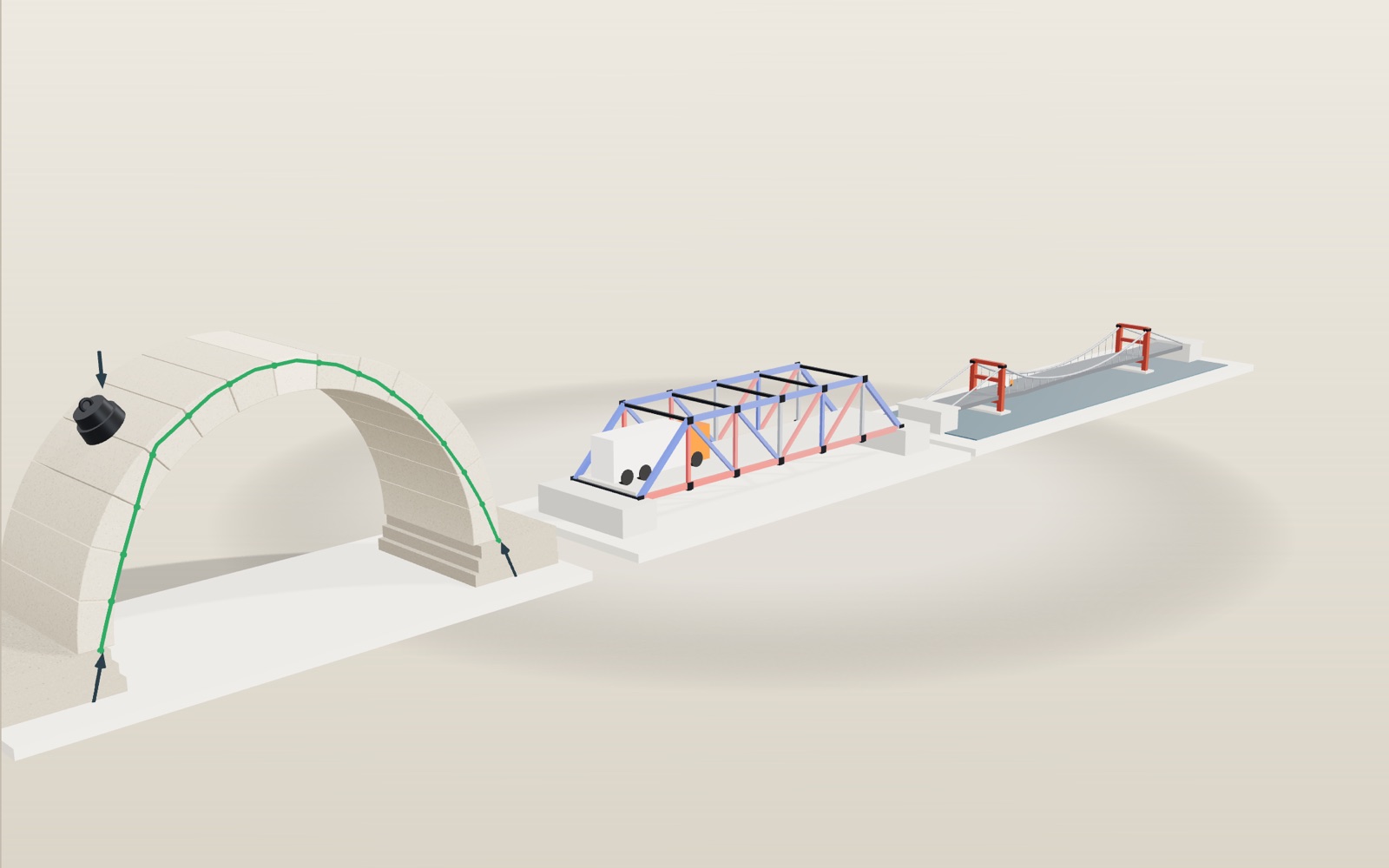
Stone arch bridge: load it and watch how it carries weight
A stone arch has no glue between its blocks, yet it stands on its own once the last stone is set at the top.
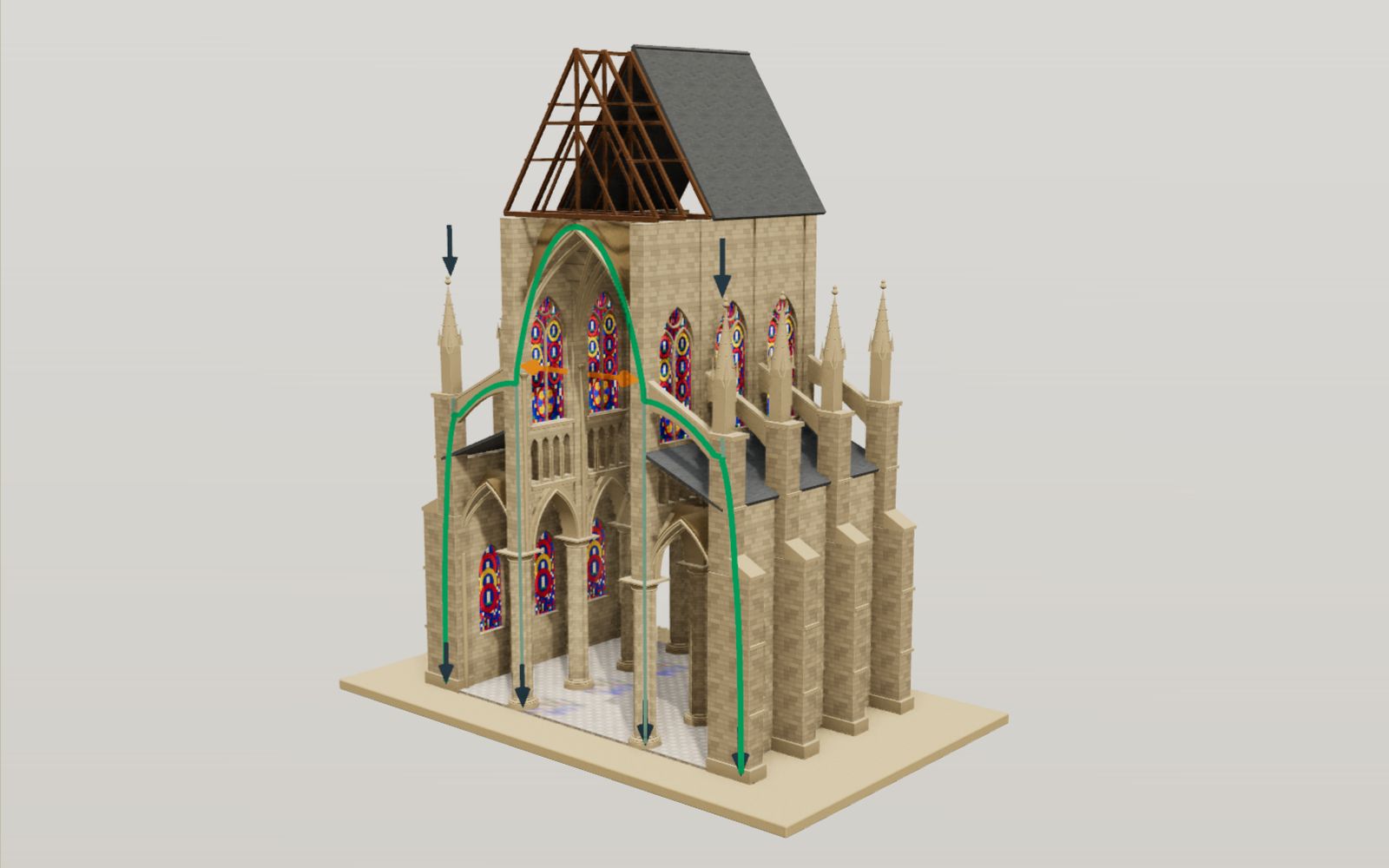
Gothic cathedral: flying buttresses, interactive model
The stone vault of Amiens Cathedral hangs 42.3 metres above the floor, and the walls under it are mostly glass.

Why a tower crane doesn't tip over
A tower crane that lifts 8 tonnes next to its mast may carry only 3.2 tonnes at the tip of its 50 m jib, and the reason is a single multiplication.
Walk through Machu Picchu
Most of the work that holds Machu Picchu on its ridge, 60 per cent by one estimate, lies under the ground in foundations and drains nobody sees.
Walk through Pompeii on its last day
A walkable model of Pompeii with a clock from the first column of Vesuvius to the surge of the next morning, then to the ruins of today.
Walk through the Sagrada Família
Inside the Sagrada Família the columns branch like trees 45 m up, and the sun moves blue and orange light across the floor.