Loading the model
This device cannot show the 3D model. You can read the guide steps below as text.
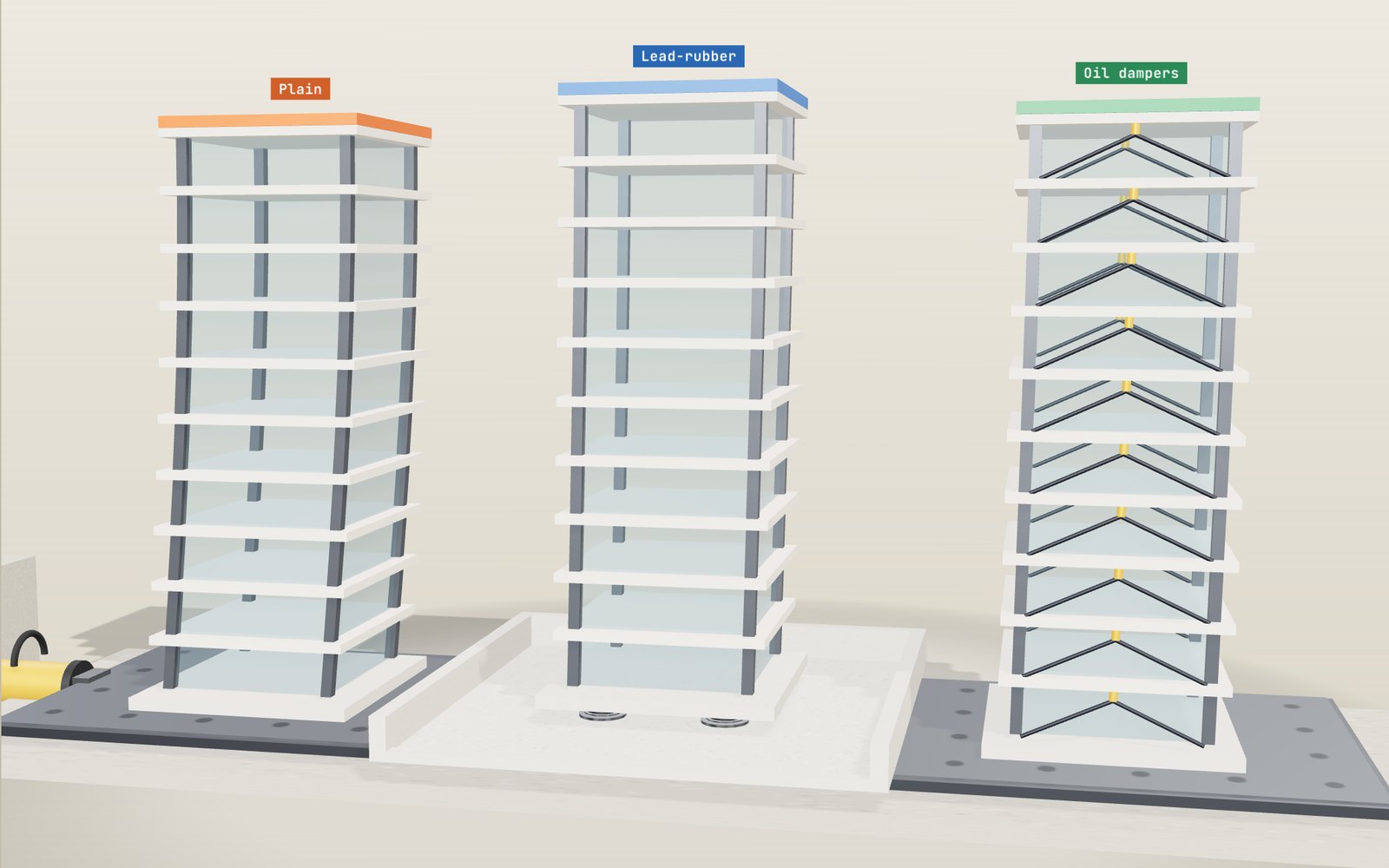
1 / 17 Three buildings on one table The same floors and columns three times over. The left one is plain, the middle one sits on rubber bearings and the right one has a tuned mass on its roof. The table shakes once a second at 0.05 g. Drag to look around.
Drag to turn. Scroll or pinch to zoom.
Guide Parts Controls
01 Three buildings on one table The same floors and columns three times over. The left one is plain, the middle one sits on rubber bearings and the right one has a tuned mass on its roof. The table shakes once a second at 0.05 g. Drag to look around.
02 Every building has its own beat Each building was pushed sideways and let go. The plain one swings once every 0.60 s and the isolated one every 2.55 s. The damper on the right soaks up its building's swing within a few cycles.
03 Shake it at its own period The ground now shakes every 0.6 s, the plain building's period. Each push arrives just as the floors swing back, so the motion grows until damping takes out as much energy per cycle as goes in.
04 The bottom storey bends most The lowest columns carry the inertia of all six floors, so their drift is the largest. At 0.05 g it reaches 0.97% of the storey height, close to the 1.5% the Korean code allows for importance class I.
05 Soft bearings change the period The middle building's bearings are soft sideways. Its period becomes 2.55 s, far from the 0.6 s shaking, so the building barely moves while the table shakes underneath.
06 Long, slow shaking finds the bearings At 2.5 s the ground matches the isolated building instead. The building still bends little, but its base slides 39.5 cm on the bearings. That is why the moat must be wide.
07 The damper moves against the roof Near 0.65 s the damper block swings about a quarter of a cycle behind the roof and pulls back on it. Over every shaking period, the right building's worst drift at 0.05 g is 0.21%, against 0.97% for the plain one.
08 Lock the damper Locked, the block is only extra weight. The right building's period grows to 0.615 s, and at 0.62 s it swings almost as hard as the plain one. The third graph shows why.
09 A real record: El Centro, 1940 Now the table plays the recorded El Centro ground motion. The third graph turns into the record's response spectrum, with a dot at each building's period. The plain building sits near the peak; the isolated one sits far out on the slope.
10 Kobe on ten floors A synthetic wave with Kobe's 0.82 g and a 1 s pulse shakes 10-floor buildings. The plain one drifts past 2%; lead-rubber bearings keep the floors under 1% but move 56 cm; oil dampers in every storey stop at 0.91%.
11 Far away, slow and long The synthetic Tohoku wave is only 0.03 g but keeps a 6.5 s rhythm for minutes. 60-floor towers, with periods near 6 s, sway by metres. Isolation makes it worse; dampers in every storey help.
12 Eleven devices up close Pick any device with the slider or the list below. The loop is the force against movement: a slim line stores energy and gives it back, a fat loop takes it out as heat.
13 When the ground turns to liquid Wet, loose sand under 0.15 g. Every cycle raises the water pressure a little, until the grains no longer press on each other and the sand carries nothing. Try denser sand or a deeper water table.
14 Push a swing at the right moment Eight pendulums hang from one shaken bar. Only the one whose period matches the shaking builds up: at 3.17 s, the 2.5 m swing. Buildings answer the ground in the same way.
15 Taipei 101's sphere Typhoon gusts sway the 508 m tower at its 7 s period. The 660 t sphere swings behind the tower and its dampers take energy out. Lock it and compare the top acceleration.
16 Inside an isolation floor Under an isolated hospital: bearings, oil dampers, the gap round the building, a cover plate at the door and pipes in flexible loops. The ground shakes much harder than the floors above.
17 A bridge on bearings The same idea under a bridge deck. Isolating bearings let the deck swing slowly while the piers stay calm. Lock the bearings and the piers take the full load; the deck must also stay on its seat.
Shake table A steel table that carries all three buildings, so each gets exactly the same ground motion. For a sine of acceleration it moves A/ω² either way: 1.2 cm at 0.05 g and 1 s, 20 cm at 0.05 g and 4 s. Actuator The hydraulic ram that pushes the table, following a sine wave, the 1940 El Centro record or one of six synthetic waves. Floor slabs Each floor is one lumped mass of 400 t, 12 m square, with floors 3.5 m apart. All of a floor's weight is treated as if it sat at the slab. Columns The columns of one storey act as one sideways spring, chosen so that the plain building's period is 0.1 s per floor: 755 MN/m for 6 floors and 0.60 s, with 2% damping. Fixed footing A building that is not isolated is bolted to the table, so its base moves exactly with the ground. Isolation layer Rubber, lead-rubber, friction pendulum or sliding bearings under a 400 t slab. With rubber bearings set to 2.5 s, the 6-floor building's first period becomes 2.55 s instead of 0.60 s. Moat The gap round an isolated building. In the tasks it is 80 cm; shaken every 2.5 s at 0.05 g, the base of the 6-floor model on rubber bearings moves 39.5 cm. Storey devices Oil dampers, steel dampers, buckling-restrained braces or shear walls, fitted in every storey of the building that carries them. Roof damper A tuned mass, water tanks or an active mass on the roof. The 6-floor building's tuned mass is 66 t, 5% of its first-mode mass of 1,319 t, with a period of 0.638 s and 13.5% damping. Roof accelerometers Red boxes on each roof. They feel the total acceleration, the building's own plus the ground's, which is what people and furniture on the top floor feel. Device up close One device at a time, moved back and forth at its design size. The loop beside it is the force against movement that the model uses. Saturated sand Ten metres of sand drawn in ten slices. Each slice turns from tan to blue as the water pressure in it rises towards the weight of the sand above. House on sand A small house resting on the surface. When the sand under it liquefies it sinks and tilts, as the Niigata apartments did in 1964. Pendulums and swing Eight pendulums from 1.0 s to 3.17 s on one shaken bar. The longest is a 2.5 m playground swing. Taipei 101 The 508 m tower drawn after its structural paper: a tapered base, eight flared 8-storey modules and a spire. Its first period is about 7 s. Damper sphere 660 t of stacked steel plates hanging from level 92 on cables, with oil dampers beneath. Drawn much larger than the tower beside it. Isolated hospital A 5-floor hospital on 12 lead-rubber bearings and 4 oil dampers. A concept drawing, not a particular building. Gap cover and pipes A steel plate covers the gap at the door and pipes cross it in flexible loops, so nothing breaks when the building moves. Bridge deck A 2,000 t girder deck in three spans, resting on bearings on two piers and on seats at the abutments. Bridge bearings Lead-rubber bearings on the pier tops. Locked, they make the piers carry the deck's full inertia.