FIG. 56Old Machines
How the Jagyeokru water clock works
In 1434 a float rising in a bronze vessel in Seoul began to drop small balls that set wooden figures striking a bell, a drum and a gong.
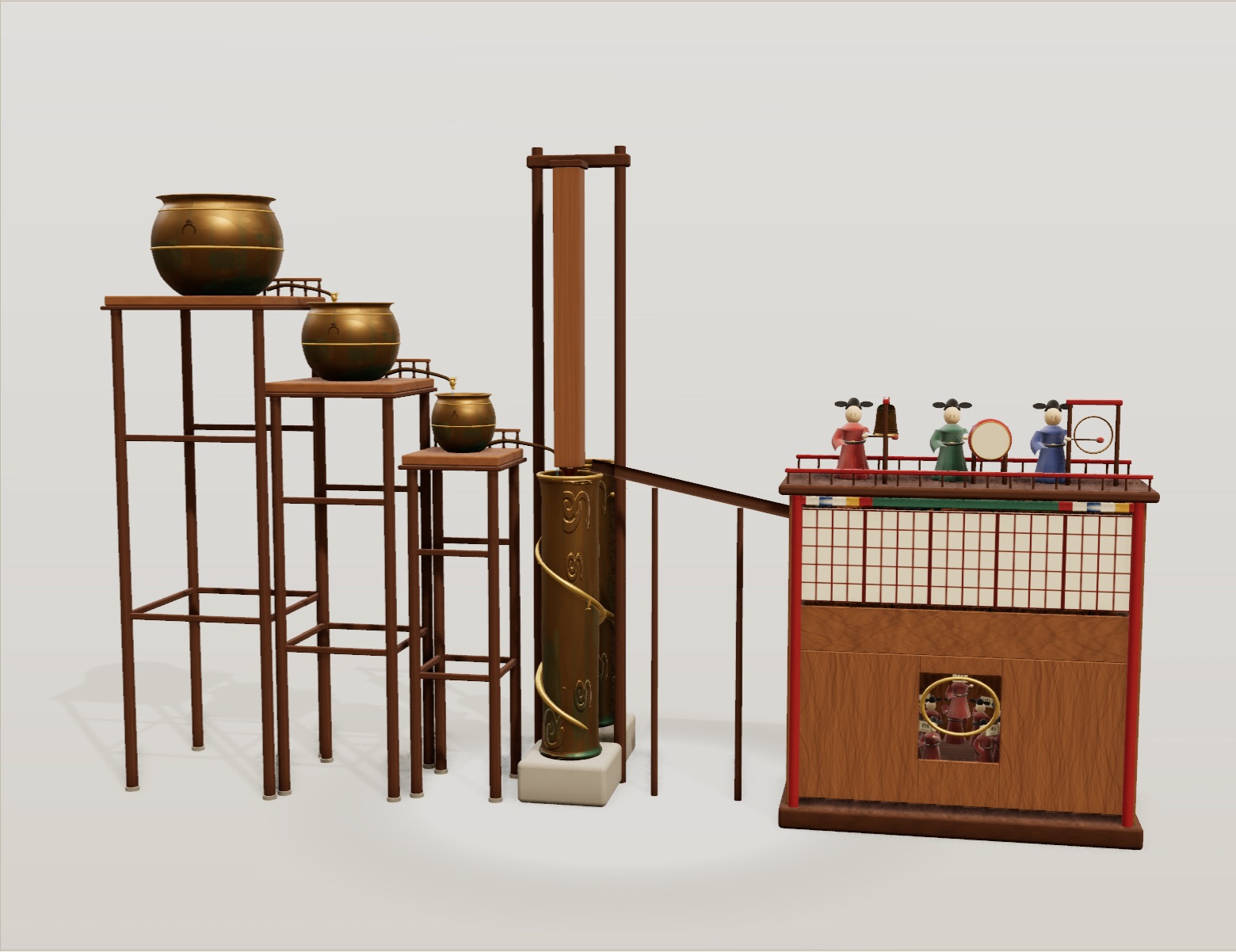
This device cannot show the 3D model. You can read the guide steps below as text.
1 / 15 Two machines joined by ballsWater on the left, striking house on the right. The model follows the restoration at the National Palace Museum of Korea, which rebuilt the striking gear from the Record of the Borugak. The day runs 1,200 times faster than real time.
Drag to turn. Scroll or pinch to zoom.
A clock that struck the hours by itself
Before 1434, the time in the Joseon palace was announced by people. An official watched a float rise in a bronze vessel, read the marks on its rod and called the hour, and a mistake could bring a heavy punishment. The Record of the Borugak in the Annals of King Sejong says the king worried about exactly that, and ordered the military officer Jang Yeong-sil to make wooden figures that would announce the time of themselves, without borrowing human strength. The result was Jagyeokru, the water clock that strikes by itself. The new clock came into use on the first day of the seventh month of 1434.
Jagyeokru is two machines joined together. One is a water clock: bronze jars pass water down into a tall vessel, where a float lifts a graduated rod. The other is a striking house: wooden figures sound a bell, a drum and a gong. The link between them is a stream of balls, small copper ones and large iron ones, and a set of levers shaped like spoons. This page lets you watch that link in 3D, from the water in the top jar to the moment a figure strikes, and then cut the house open to see how one ball hands over to the next.
No complete original survives. The working model follows the restoration installed at the National Palace Museum of Korea, which copied the water half from the vessels that remain from 1536 and rebuilt the striking half from the written record. Where this page gives a number that is a model choice rather than a measurement, it says so.
Six scenes and what each one shows
The bar at the top of the stage switches between six scenes.
- Working model. The whole clock as restored: three supply jars on a stepped wooden loft, a receiving vessel about 2 m tall with a dragon winding up it, the square column above it, a channel to the striking house and three figures on the house's upper tier. The day runs fast and every ball is simulated.
- Inside the chain. The column and the striking house cut open and drawn about twice as large. Pick Hour, Watch or Point and the six steps of that signal play slowly, with a caption for each.
- Borugak, 1434. The same clock inside a pavilion of three bays, as the Annals describe it: jars and vessels in the middle bay, the figures on two tiers in the east bay.
- Surviving vessels, 1536. The bronze jars and the two receiving vessels that survive from the clock made for Changgyeonggung palace in 1536.
- Water clocks elsewhere. An Egyptian outflow clock from Karnak, the inflow clock of Ctesibius, Su Song's clock tower, al-Jazari's elephant clock and a sinking bowl.
- Sundial check. An angbu-ilgu, the bowl-shaped sundial set up beside two Seoul streets in 1434, next to an armillary sphere. Its shadow shows the solar time; the panel compares it with the water clock.
The panel at the top left of the working model shows two clocks at once. Solar time is the true time of the model. Water clock is the time the float is actually showing. If the flow into the vessel weakens, the float falls behind, the two drift apart and Clock error shows by how much. Fast-forward runs the day up to 14,400 times faster than real time; up to 1,200 times, the day waits whenever a ball is rolling, so no strike is missed. Ball slow motion slows the balls and figures to an eighth of their speed, and Follow the ball moves the camera with each ball.
Why the water has to flow at a steady rate
A water clock of this kind measures time by volume. In the model, 1.47 millilitres flow into the vessel every second. That is 127 litres a day, and a float in a vessel 30 cm across rises 1.8 m. One hour is then 75 mm of rod and one minute 1.25 mm. A mark on the rod stands for a time, but only if the flow is the same all day.
The trouble is that water does not leave a jar at a fixed rate. It leaves faster when the jar is full. The speed of water coming out of a small hole at depth h below the surface is given by Torricelli's law:
v = √(2gh)
where g is 9.81 m/s². The flow is that speed times the area of the hole (and a discharge coefficient for a sharp hole, about 0.62), so it grows with the square root of the height. Doubling the water above a hole raises the flow by only about 41%, but halving it cuts the flow by about 29%, and a clock fed straight from one jar would run slower and slower as the jar drains.
There are three answers to this, and Jagyeokru uses all of them.
- Inflow, not outflow. The clock reads the water that has arrived, not the water that is left. Water falls into the receiving vessel from a spout above its surface, so how full the vessel is makes no difference to how fast it fills. Only the jar feeding it matters.
- Several jars in a row. A large jar feeds a middle jar, which feeds a small jar, which feeds the vessel. Each jar below fills from above about as fast as it drains, so its level hardly changes, and the last jar feeds the vessel from an almost constant height.
- An overflow hole. Nam Moon-hyon, who led the restoration, describes a hole in the inner wall of the small jar that lets any water above a set level run off. If the jars above send a little more than the clock needs, the small jar stays full to the edge of that hole all day, and the head above its spout never changes.
Checking the flow with v = √(2gh)
The model uses the sizes of the jars that survive from 1536, listed by the Korea Heritage Service: the large jar is 93.5 cm across and 70 cm tall, the small one 46 cm across and 40.5 cm tall. The middle jar (70 cm across) and the receiving vessel are model values. At the start of the day the large jar holds water 60 cm deep, the middle jar 45 cm and the small jar 30 cm, and each spout is sized so that all three pass the same 1.47 mL/s.
With those heights the water speeds are:
- large jar, h = 0.60 m: v = √(2 × 9.81 × 0.60) = 3.43 m/s
- middle jar, h = 0.45 m: v = 2.97 m/s
- small jar, h = 0.30 m: v = 2.43 m/s
To pass 1.47 mL/s at 2.43 m/s, the opening needs 0.61 mm² of clear flow, and with a discharge coefficient of 0.62 the hole itself is about 1.12 mm across. The flow is a thin thread of water. The control Last spout size changes that hole by up to 20% either way.
Stepping the jars forward every 30 seconds gives the following clock error, with every jar filled once at 10:30 and left alone for 24 hours (minutes late):
| Set-up | after 6 h | after 12 h | after 24 h | flow at 24 h |
|---|---|---|---|---|
| 1 jar (large only) | 6.9 | 27.8 | 111.1 | 84.6% |
| 2 jars (large, small) | 0.7 | 5.1 | 36.0 | 93.1% |
| 3 jars (large, middle, small) | 0.0 | 0.2 | 3.2 | 99.2% |
| 3 jars and the overflow hole | 0.0 | 0.0 | 0.0 | 100% |
The cushion comes from the size of each jar compared with the flow. The small jar has a water surface of 0.166 m². For its level to change by 1 cm, 1.66 litres must go in or out, which is 18.8 minutes of the whole flow. A change in the jar above therefore reaches the small jar slowly and much reduced. With the overflow hole the small jar spills about 42 litres in a day, the price of a perfectly steady head.
The Flow lab under the controls draws all four set-ups for one day. Two other experiments are worth trying there. Lower the large jar's starting water to a few centimetres and its flow dies away during the day: the middle and small jars keep the clock going for a while, then it falls behind, 66.6 minutes by the end of the day. Make the last spout 10% wider with the overflow hole on, and the clock runs fast by about five hours a day, because the head is fixed and the hole alone sets the flow. Without the overflow hole the same wider spout costs less, about two and a half hours, because the small jar's level sinks and partly makes up for it.
From a rising rod to a falling ball
The float in the receiving vessel was shaped like a turtle. The Korea Heritage Foundation article by Nam Moon-hyon explains the symbolism: the vessel stood for the sea, the turtle for long life, and the dragon on the vessel for the ruler who receives the time from heaven and passes it to the people. The turtle carries the rod, and the rod rises inside a hollow square column of wood, the bangmok, that stands over the vessel. The Record of the Borugak gives the column as 11 cheok 4 chon long, 6 chon wide and 4 chon deep, open on its face.
Inside the column are two copper strips as long as the rod. The left strip has 12 holes for the twelve double hours; the right one has 25 for the watches and points of the night. Each hole holds a small copper ball "the size of a pellet" behind a catch. As the rod rises, a cross-bar on its head, 4 chon 5 pun long, pushes each catch in turn and lets that ball go.
This is where a smooth measurement becomes a string of separate signals. The float moves like a hand on a dial. A ball either drops or it does not. The positions of the holes are the clock's programme: move a hole up the strip and that signal comes later. Nam compares the water clock to an analogue system and the striking house to a digital one, with the balls as the converter between them.
In the model the 12 hour balls sit on the left strip and the 25 night balls on the right. Their heights come straight from the ideal rise of 75 mm an hour, so on a perfect day every ball drops on time. With fewer jars the float lags, and so does every signal after it.
The ball and spoon chain, step by step
The Record of the Borugak describes the chain in detail, and the scene Inside the chain follows that description. Its layout is a model of the text, not a measured drawing.
- Two copper tubes. Below the column, a wide board runs at a slant from the foot of the column to the east bay. Two copper tubes lie on it, also slanting: the left one 4 cheok 5 chon long with 12 holes in its floor for the hours, the right one 8 cheok long with 25 holes for the watches and points. Each hole has a latch.
- The small ball opens a latch. A falling small ball rolls into its tube and drops through its own hole. On the way it trips the latch, which then closes that hole so the next small ball rolls past it.
- The iron balls. On four partitions along the board lie large iron balls "the size of a hen's egg": 12 on the left for the hours, 5 in the middle for the watches and the first point of each watch, 20 on the right for the other points. The opened latch lets one of them go.
- The hanging tubes and the spoons. Under the upper tier of the east bay hang short tubes. In each is a lever shaped like a spoon, hooked at one end and round at the other, with an axle in the middle. The iron ball falls onto the round end; the other end rises from inside the tube and pushes up the elbow of a figure on the tier above. For the hours that figure strikes the bell.
- Drum, then gong. A watch ball works the spoon in the left round pillar, and the watch figure strikes the drum. The same ball then rolls into the point tube and turns the spoon for the first point inside the right round pillar, and the point figure strikes the gong. It comes to rest in a straight short tube under a lotus leaf.
- Lotus leaves and dragon mouths. On two square pillars, small tubes are threaded at a slant, four to a pillar, with a lotus leaf at one end and a dragon's mouth at the other: the leaf catches a ball and the mouth spits it on to the leaf below. Point balls from the second point on run through them, each stopping in its own short tube. When the ball of the fifth point arrives, it trips the lowest catch, an iron chain pulls out the bars one after another, and all the waiting balls come down together, ready for the next watch.
- The hour figure rises. After ringing the bell, the hour ball rolls on and lands on the north end of a beam 6 cheok 6 chon long. The south end rises and pushes a round rod 2 cheok 2 chon long under the feet of one of twelve figures standing on a flat wheel, each holding the tablet of its hour. That figure is lifted above the middle tier, and the figure of the previous hour slides back down a hinged copper plate onto the wheel.
The Annals add one detail that matters for the whole design: every mechanism was hidden, and all that could be seen were the wooden figures in court dress.
Why a small ball has to release a heavier one
The fall of a ball the size of a pellet cannot swing a mallet hard enough to sound a bronze bell. So the clock adds a step that the restoration describes as energy amplification. The small ball only has to release a catch. The work of striking comes from the fall of the iron ball, and the water only decides when that fall begins.
In the model the small balls are 48 mm across and the iron balls 84 mm. If both were solid metal of similar density, the iron ball would be about (84 ÷ 48)³ ≈ 5.4 times heavier. The same idea, a weak signal releasing a stored weight, is how the escapement of a mechanical clock lets a weight or spring drive the hands one step at a time.
Set Ball slow motion to 1/4 and press step 5 in the guide to see one complete hand-off in the working model: the small ball leaves the strip, drops through the column, rolls down the channel into the house, and an iron ball leaves the rack.
Twelve double hours and 100 gak
Joseon used two time systems at once, and Jagyeokru announced both.
The first divides the whole day into twelve double hours (si), named after the twelve animals, from the Rat around midnight to the Pig. Each lasts two of our hours and has a first half (cho) and a second half (jeong). The Record of the Borugak puts 8 gak in each double hour, plus the remainders of the halves, for 100 gak in a day, and each gak is divided into 12 parts. So one gak is 14.4 minutes, and a double hour holds 8 1/3 gak. The panel writes the time in this form: "hour of the Rooster, second half, mark 2" is between 18:28.8 and 18:43.2.
At each double hour a figure strikes the bell once, and the figure with the tablet of the new hour rises into view and stays until the next. In the model the bell sounds as each double hour begins, at odd hours of local solar time: the Horse at 11:00, the Goat at 13:00 and so on. Local solar time in Seoul is about 32 minutes behind today's Korean clocks, because the official time is set for 135° E and Seoul lies at about 127° E.
Night watches: dusk to dawn in 25 points
The second system counts only the night, and it starts and ends with twilight. Uri History Net, written for the National Institute of Korean History, explains that dusk (hon) was set 2.5 gak, 36 minutes, after sunset and dawn (sin) 2.5 gak before sunrise. The night between them was cut into five watches (gyeong), and each watch into five points (jeom), for 25 points a night. Because the nights are long in winter, the watches and the points are long too.
A clock with fixed marks cannot follow a night that changes length, so the clock used a set of rods and plates for the night. The Record of the Borugak says the 21 night rods used before were reduced, one rod serving two solar terms. Sejong's clock used 11 night rods: according to the National Science Museum of Korea, the manual Nujutongui assigns rod 1 to the weeks around the winter solstice, rod 6 to the equinoxes and rod 11 to the summer solstice. Later, after the Shixian calendar was adopted, King Yeongjo raised the number to 24 and King Jeongjo to 37.
In the model, each rod is cut for an evenly spaced point on the sun's path, and sunset and sunrise are computed for Seoul (37.57° N). For three of the rods:
| Rod | dusk | dawn | night | one watch | one point |
|---|---|---|---|---|---|
| no. 1 (winter solstice) | 17:23 | 06:37 | 13.24 h | 158.8 min | 31.8 min |
| no. 6 (equinoxes) | 18:40 | 05:20 | 10.66 h | 127.9 min | 25.6 min |
| no. 11 (summer solstice) | 19:59 | 04:01 | 8.04 h | 96.5 min | 19.3 min |
Uri History Net quotes Nam Moon-hyon's tables for Sejong's rods 1 and 11. On rod 1 the first point began at the hour of the Rooster, first half, mark 1 plus 4 minutes, about 17:18, and the last point at the hour of the Rabbit, second half, start plus 1.8 minutes, about 06:02. The model gives 17:23 and 06:05, within 5 minutes. On rod 11 the record gives about 19:45 and 03:47; the model gives 19:59 and 03:42, the first point 14 minutes late. The lab's table shows all four. The model computes the sun for Seoul with modern formulas, while the rods of 1434 were cut from the tables of the Shoushi calendar, so a few minutes of difference are expected.
Using one rod for several weeks has a cost too. The lab's chart Night through the year compares the actual length of one watch on each of the 24 solar terms with the rod in use. Where a term falls between two rods, the night on the rod differs from the real night by up to 18.8 minutes, so the last points of the night drift by about that much.
The striking house marks a new watch with the drum, struck as many times as the number of the watch, and every point with the gong, struck as many times as the number of the point. In one night that makes 15 drum strokes and 75 gong strokes. The lab lists every one for the rod in use.
Injeong and paru: the city hears the clock
The palace clock set the time for the whole capital. The Record of the Borugak describes the relay: when the figures' bells and drums sounded, keepers at the south gate of Gyeonghoeru, at Wolhwamun and Geunjeongmun struck their own bells and drums in turn, up to the great bell and drum at Gwanghwamun. Two signals mattered most to the people of Seoul. At injeong the city gates closed and the curfew began; at paru they opened.
Uri History Net gives the rules. Injeong was struck at watch 1, point 3 with 28 strokes of the bell, and paru at watch 5, point 3 with 33 strokes, on the drum until 1469 and on the bell after that. Until 1414 the morning signal came at the first point of the fifth watch; in 1423 both signals moved from the end of the point to its start. Under the rule of 1469 the drum and the gong were struck through the night as many times as the number of the watch and of the point, 295 drum and 303 gong strokes from injeong to paru. With rod 6 in place, the model's injeong falls at 19:31 and its paru at 04:03 local solar time.
The Annals also record a debate just before the new clock came into use. On the 24th day of the sixth month of 1434 the king noted that the old clock had given injeong too late and paru too early, and asked whether the new clock, which followed the Shoushi calendar exactly, should be used even though it moved both signals. The court chose the new clock.
The Borugak of 1434
The Record of the Borugak describes the building in a few lines. A pavilion of three bays (gan) stood at Gyeongbokgung; Uri History Net places it south of Gyeonghoeru. In the middle bay stood a loft with the supply jars above and the receiving vessels below. The east bay had a seat built in two tiers. Three figures stood on the upper tier: one for the hours with a bell, one for the watches with a drum, one for the points with a gong. Under the middle tier a flat wheel carried the twelve figures of the hours. The building was named Borugak, the pavilion that reports the clock, and clerks of the Office of Astronomy took turns on duty there.
The scene Borugak, 1434 puts the working model inside such a pavilion: a stone platform, eight round columns, painted beams and a tiled hip roof with lifted corners. The proportions and colours are a model. The Annals do not give the size of the building, and nothing of it survives.
What survives from 1536
In 1505 the clock was moved to a Borugak in Changdeokgung, according to the Korea Heritage Service's history of the object. About a hundred years after Sejong's clock, a new Borugak was built east of Munjeongjeon in Changgyeonggung, and the craftsman Bak Se-ryong made a new self-striking clock to the Record of the Borugak, finished in 1536. Nam Moon-hyon notes that the new clock was needed partly so that a bell tower at Heunginjimun could also be given the time.
Only the water half of that clock survives: three bronze supply jars and two receiving vessels. The supply jars carry the inscription for the sixth month of the year byeongsin of the Jiajing reign, which dates them to 1536, and the back of each receiving vessel names the people who made it. The vessels are decorated with a five-clawed dragon among clouds.
The clock's later history shows how long it was used. Repairs are recorded in 1601 and 1652. After Sejong's clock was lost in the Japanese invasions, King Gwanghaegun rebuilt the Heumgyeonggak and repaired the clock of 1536 as the standard clock. It worked in Changgyeonggung, then for about 20 years near Deoksugung, in Changgyeonggung again from 1616 and in Gyeongbokgung from about 1866, until the injeong and paru signals were abolished in 1895. Nam counts about 360 years of service. From 1908 the vessels were shown in the imperial museum at Changgyeonggung as geumnugi; in 1938 they were moved to Deoksugung, where they stood inside Gwangmyeongmun gate for 80 years. They appeared on the 10,000 won note from 1979 to 2008, were designated a National Treasure in 1985, went into conservation in 2018 and were moved to the National Palace Museum of Korea in 2020.
Restorations and new evidence
The working restoration was led by Nam Moon-hyon of Konkuk University. A Korea Heritage Service article of 2008 describes how the work began with a translation of the Record of the Borugak in the early 1980s and ended as a joint project of Konkuk University's institute for the history of Korean technology, traditional craft workshops and the National Palace Museum. Nam writes that the clock was installed at the museum in 2005, that its water clock copies the surviving vessels while the striking gear follows the Record of the Borugak, and that it has reproduced the Joseon time signals since late 2007.
New evidence keeps arriving. In 2021, copper plates and ball-release parts were dug up in Insadong, Seoul. The National Science Museum of Korea identified them as night rods (jujeon) for points: one plate is marked rod 1, and others belong to rods 3 and 6. Comparing them with the Record of the Borugak and with the instruments found with them, the museum dated them to the Borugak of 1536, and in 2022 it published a design of the whole rod system: the floating rod, the square column, two kinds of copper plate and the ball release.
Jang Yeong-sil's second great water clock, the Okru of 1438, is described in the Annals too. It stood in the Heumgyeonggak beside the king's quarters: a mountain of paper 7 cheok high with water-driven wheels inside and a golden sun that circled it once a day. It is not part of this exhibit, but the same craftsman and the same idea of letting water drive a display lie behind both.
Water clocks elsewhere
Water clocks are much older than Jagyeokru, and the scene Water clocks elsewhere shows five ways of making one.
Letting water out. The water clock found at Karnak in 1904 dates from the reign of the third Amenhotep (Amenhotep III), around 1390 BCE. The Science Museum Group, which holds a plaster cast, explains that water leaked from a small hole near the bottom and the sloping sides were shaped so that the level fell at an even rate. Twelve scales inside, one for each month, read the hours, because Egyptian hours changed length with the season. The original is now in the National Museum of Egyptian Civilization in Cairo. An outflow clock has the problem Jagyeokru avoids: its flow weakens as it empties, so the shape of the vessel has to correct for it.
Letting water in. Vitruvius credits Ctesibius of Alexandria with water clocks in which the water entered through a hole drilled in gold or a gem, so it would neither wear nor clog, and a float rose and drove a toothed rod and drum wheels. Vitruvius also explains how the flow or the scale was changed through the zodiac so that the clock showed the longer hours of summer and the shorter ones of winter, a problem Joseon solved with its night rods.
Several vessels in a row. The National Astronomical Observatory of Japan describes the rokoku, the stepped water clock imported from China: several boxes passing water down to a last one in which an arrow floats. The Nihon Shoki records that Prince Naka-no-Oe made the first one in Japan in 660 and that in 671, as Emperor Tenji, he set it on a new stand and sounded the hours with a bell and a drum. Japan keeps 10 June as Time Day.
Water as a power source. Su Song's astronomical clock tower, built in China in 1088, used water to turn a wheel. The Science Museum Group explains that scholars who rediscovered the text in the 20th century found that this wheel worked as an escapement, releasing its energy in small amounts at regular intervals. In 1206 the engineer al-Jazari finished his book of ingenious devices at Diyarbakir; in his elephant clock, as Donald Hill translates it, a bowl with a hole sinks in a tank inside the elephant every half hour, turning a scribe as it goes, and when it sinks a ball drops from a falcon's beak and a bird on the dome whistles and turns. Like Jagyeokru, it lets a falling ball start the show.
The simplest of all. A sinking bowl is a bowl with a small hole floated on water. The Science Museum Group holds a replica of a Saxon bronze bowl of 750 to 850 CE that sinks in about an hour, and a copper bowl from Sri Lanka, its hole bushed with gold, that sinks in about 24 minutes.
Checking the clock against the sun
A water clock drifts, so it has to be checked against the sky. The Record of the Borugak says the new clock agreed with the ganui, the observing instrument, "to a hair". Three months later, the Annals record that angbu-ilgu sundials were set up for the first time at Hyejeonggyo bridge and in front of Jongmyo shrine so that people passing could read the time.
An angbu-ilgu is a bronze hemisphere facing the sky. The tip of its gnomon sits at the centre of the bowl and the gnomon points toward the celestial pole, so the shadow of the tip falls on a grid of lines. In the model the bowl carries hour lines and 13 curves, one for each pair of solar terms with the same day length. In the scene Sundial check, the sun moves with the time and date, the key light follows it, and the panel shows the sundial's time next to the water clock's. The lines on the bowl are computed for Seoul's latitude with the same solar formulas as the night rods.
Where the model is simpler than the real clock
- The middle jar, the receiving vessel (30 cm inside, 2 m tall), the spout sizes and the overflow factor (the jars above send 1.35 times the clock's flow) are model values.
- The receiving vessels in the model are swapped at 10:30 solar time so that one float covers a whole night. The original used two vessels in turn, but this exhibit does not claim to know at what hour they were changed.
- The night rods are cut for evenly spaced points on the sun's path, not from the tables of the Nujutongui, and sunset and sunrise are computed with modern formulas.
- In the working model the balls run along one channel and one rail. The scene Inside the chain follows the Record of the Borugak more closely, but its positions and sizes are still a reading of the text.
- The figures, their dress, the pavilion and the world clocks are drawn in a simplified way. Their shapes and colours are not copies of any object.
- The jars start the day full and are not topped up. Keepers who refilled the top jar, or used the overflow hole, would have kept the clock closer to the sun.
Questions
Who made Jagyeokru?
The Annals name Jang Yeong-sil, then a military officer (hogun), as the maker of the figures and their mechanism, on the orders of King Sejong. The same record says Jang was a government slave from Dongnae with a gift for fine work who had long led the palace craftsmen. The clock came into use on the first day of the seventh month of 1434.
Where can I see it?
The bronze vessels of 1536 are at the National Palace Museum of Korea in Seoul, which also holds a working restoration installed in 2005. The National Science Museum of Korea has published a new design for the rod system based on finds of 2021.
Why did the clock need several supply jars?
Water leaves a hole faster when the water above it is deeper (v = √(2gh)), so a single draining jar feeds the clock less and less. In this model one jar makes the clock 111 minutes late in a day, two jars 36 minutes and three jars 3.2 minutes. An overflow hole that keeps the last jar at a fixed level removes the error.
What did the bell, the drum and the gong each mean?
The bell marked each of the twelve double hours, day and night. The drum marked the start of each of the five night watches, struck as many times as the number of the watch. The gong marked each point of the night, struck as many times as the number of the point.
How long was one night point?
It depended on the season. In this model for Seoul, one point lasts 31.8 minutes around the winter solstice, 25.6 minutes at the equinoxes and 19.3 minutes around the summer solstice. The night was counted from dusk, 2.5 gak after sunset, to dawn, 2.5 gak before sunrise.
Why was the night counted differently from the day?
Uri History Net points out that a time system tied to sunset and sunrise suited a life ruled by daylight, and that the night in particular had to be controlled: the gates closed at injeong and opened at paru, and patrols changed by the watches. Europe also used unequal night hours until mechanical clocks spread in the 14th century.
What is a gak?
A hundredth of a day, 14.4 minutes. The Record of the Borugak divides the day into 12 double hours of 8 gak each plus remainders, 100 gak in all, and each gak into 12 parts. Late Joseon changed to a day of 96 gak.
How fast does the float rise?
In this model, 1.8 m in a day: 75 mm an hour or 1.25 mm a minute. That needs a steady flow of 1.47 mL a second into a vessel 30 cm across.
Why does a small ball release a big one?
A ball the size of a pellet does not fall with enough force to swing a mallet. It only opens a latch, and an iron ball the size of an egg does the work. The restoration calls this energy amplification.
Is the restored clock exactly like the original?
No. Its water clock copies the vessels of 1536, and its striking gear was rebuilt from the written record, since no part of it survives. Parts found in 2021 have already led to a new design of the rod system. This exhibit follows the record where it can and marks its own choices as model values.
Was Jagyeokru the only water clock with figures in its time?
No. Al-Jazari described several water clocks with moving figures in 1206, and Japan's water clock of 671 already sounded the hours with a bell and a drum. What stands out in Jagyeokru is how its signals were tied to the day and night of a whole city, and the 360 years that its successor of 1536 served.
How did people outside the palace know the time?
By sound. Bells and drums at the palace gates repeated the figures' signals up to Gwanghwamun, and the bell tower in the city struck injeong and paru. In the daytime the angbu-ilgu sundials on the street gave the time to anyone passing.
Terms
- Jagyeokru (자격루): "the water clock that strikes by itself".
- Borugak (보루각): the pavilion that housed it.
- Pasuho (파수호): supply jar.
- Susuho (수수호): receiving vessel.
- Bangmok (방목): the square column over the vessel in which the rod rises.
- Jujeon (주전): the float rod and its plates; the night rods were changed with the season.
- Gak (각): a hundredth of a day, 14.4 minutes.
- Si (시): one of the twelve double hours, with a first half (cho) and a second half (jeong).
- Gyeong and jeom (경, 점): the five watches of the night and the five points of each watch.
- Hon and sin (혼, 신): dusk and dawn, 2.5 gak after sunset and before sunrise.
- Injeong and paru (인정, 파루): the evening signal that closed the city gates and the morning signal that opened them.
- Angbu-ilgu (앙부일구): the hemispherical sundial.
Sources
- National Institute of Korean History, Annals of the Joseon Dynasty, Sejong 6/5/6 (1424), article 5. https://sillok.history.go.kr/id/kda_10605006_005 (checked 2026-10-19)
- National Institute of Korean History, Annals of the Joseon Dynasty, Sejong 16/6/24 (1434), article 6. https://sillok.history.go.kr/id/kda_11606024_006 (checked 2026-10-19)
- National Institute of Korean History, Annals of the Joseon Dynasty, Sejong 16/7/1 (1434), article 4, the Record of the Borugak. https://sillok.history.go.kr/id/kda_11607001_004 (checked 2026-10-19)
- National Institute of Korean History, Annals of the Joseon Dynasty, Sejong 16/10/2 (1434), article 4. https://sillok.history.go.kr/id/kda_11610002_004 (checked 2026-10-19)
- National Institute of Korean History, Annals of the Joseon Dynasty, Sejong 20/1/7 (1438), article 3, the Record of the Heumgyeonggak. https://sillok.history.go.kr/id/kda_12001007_003 (checked 2026-10-19)
- National Institute of Korean History, Uri History Net, "Jagyeokru". https://contents.history.go.kr/mobile/kc/view.do?code=kc_age_30&levelId=kc_r300785 (checked 2026-10-19)
- National Institute of Korean History, Uri History Net, Mun Jung-yang, "Night time, unequal hours". https://contents.history.go.kr/front/km/view.do?levelId=km_015_0040_0020_0020 (checked 2026-10-19)
- National Institute of Korean History, Uri History Net, "Time signals, injeong and paru". https://contents.history.go.kr/front/km/view.do?levelId=km_015_0040_0020_0030 (checked 2026-10-19)
- National Institute of Korean History, Uri History Net, "Bosingak bronze bell". https://contents.history.go.kr/mobile/kc/view.do?levelId=kc_r300520&code=kc_age_30 (checked 2026-10-19)
- National Institute of Korean History, Uri History Net, "Angbu-ilgu". https://contents.history.go.kr/mobile/kc/view.do?code=kc_age_30&levelId=kc_r300715 (checked 2026-10-19)
- Korea Heritage Service, Digital Heritage, "Changgyeonggung Jagyeongnu Nugi" (National Treasure, 1536): sizes and history. https://digital.khs.go.kr/heri/heriDetail.do?ctptUid=13898859666590200076 (checked 2026-10-19)
- Korea Heritage Service monthly, "Jagyeokru, combining the political thought, science, culture and art of Joseon" (11 January 2008). https://www.khs.go.kr/cop/bbs/selectBoardArticle.do?nttId=5574&bbsId=BBSMSTR_1008&mn=NS_01_09_01 (checked 2026-10-19)
- Korea Heritage Foundation, Gugyujeongdam, Nam Moon-hyon, "The new Borugak Jagyeokru of Changgyeonggung" (2017). https://kh.or.kr/brd/board/741/L/menu/740?bbIdx=105076&brdType=R (checked 2026-10-19)
- National Palace Museum of Korea, collection, "Jagyeokru" (restoration). https://www.gogung.go.kr/gogung/pgm/psgudMng/view.do?menuNo=800065&psgudSn=362605 (checked 2026-10-19)
- National Science Museum of Korea, press release on the jujeon of the early Joseon Jagyeokru (13 July 2022). https://www.science.go.kr/mps/1112/bbs/215/moveBbsNttDetail.do?nttSn=9687 (checked 2026-10-19)
- Science Museum Group, "Egyptian Water Clock" (1923-48). https://collection.sciencemuseumgroup.org.uk/objects/co454/egyptian-water-clock (checked 2026-10-19)
- McMaster University, Ancient Egyptian Astronomy database, "Water clocks". https://aea.physics.mcmaster.ca/index.php/en/?view=category&id=137 (checked 2026-10-19)
- Vitruvius, De Architectura, Book IX (Gwilt translation), LacusCurtius, University of Chicago. https://penelope.uchicago.edu/Thayer/E/Roman/Texts/Vitruvius/9*.html (checked 2026-10-19)
- Science Museum Group, "Model of a Chinese Astronomical Clock-Tower, 1965" (1965-7). https://collection.sciencemuseumgroup.org.uk/objects/co893/model-of-a-chinese-astronomical-clock-tower-1965 (checked 2026-10-19)
- Science Museum Group, "Scale model of Su Song's Water-Balance Escapement" (1965-8). https://collection.sciencemuseumgroup.org.uk/objects/co894/scale-model-of-su-songs-water-balance-escapement (checked 2026-10-19)
- CNRS Editions, "Al-Jazari's Compendium of Ingenious Devices", in Le livre technique avant le XXe siecle (2017). https://books.openedition.org/editionscnrs/27688?lang=en (checked 2026-10-19)
- D. R. Hill (translator), The Book of Knowledge of Ingenious Mechanical Devices, Reidel, 1974. https://link.springer.com/book/10.1007/978-94-010-2573-7 (checked 2026-10-19)
- The Metropolitan Museum of Art, "The Elephant Clock", folio dated 1315. https://www.metmuseum.org/art/collection/search/451402 (checked 2026-10-19)
- National Astronomical Observatory of Japan, "Koseirenrouzu, Diagram of an Ancient Lotus Water Clock". https://www.nao.ac.jp/en/gallery/weekly/2015/20150609-waterclock.html (checked 2026-10-19)
- Science Museum Group, "Replica of Saxon 'Sinking Bowl' Water Clock, 1931". https://collection.sciencemuseumgroup.org.uk/objects/co530/replica-of-saxon-sinking-bowl-water-clock-1931 (checked 2026-10-19)
- Science Museum Group, "Sinking bowl water clock" (Sri Lanka, L2015-3520). https://collection.sciencemuseumgroup.org.uk/objects/co8558057/sinking-bowl-water-clock (checked 2026-10-19)
- Science Museum Group, "Drum type water clock, about 1700" (1894-131). https://collection.sciencemuseumgroup.org.uk/objects/co146/drum-type-water-clock-about-1700 (checked 2026-10-19)
- NOAA Global Monitoring Laboratory, "General Solar Position Calculations" (sunrise and sunset with 0.833° for refraction and the sun's radius). https://gml.noaa.gov/grad/solcalc/solareqns.PDF (checked 2026-10-19)
- Calculations on this page: the jars stepped every 30 s with Q = Cd·a·√(2gh), the overflow hole, the night of each rod and solar term for Seoul at 37.57° N, and the sundial lines.
More exhibits
How a pendulum clock works, and why its length sets the time
A pendulum clock counts seconds with one rod 99.4 cm long. Change its length, its temperature and its place on Earth, swap four escapements and see how many seconds a day each costs.
Sundial: interactive model, how to read the time
In Seoul a sundial reads about half an hour behind the clock, because the city lies 8° west of the meridian that sets Korean time.
How windmills and watermills work
The sails of a Dutch mill are as wide as an eight-storey building is tall, and at 7 m/s they still take only about a fifth of the wind.
How does a mechanical watch work without a battery?
A balance wheel the size of a fingernail swings eight times a second, and each swing lets the gears move on by half a tooth.
How film cameras and instant cameras work
At 1/1000 of a second a camera shutter never uncovers the whole frame at once: a narrow slit sweeps across the film instead.
Walk through the Sagrada Família
Inside the Sagrada Família the columns branch like trees 45 m up, and the sun moves blue and orange light across the floor.