Loading the model
This device cannot show the 3D model. You can read the guide steps below as text.
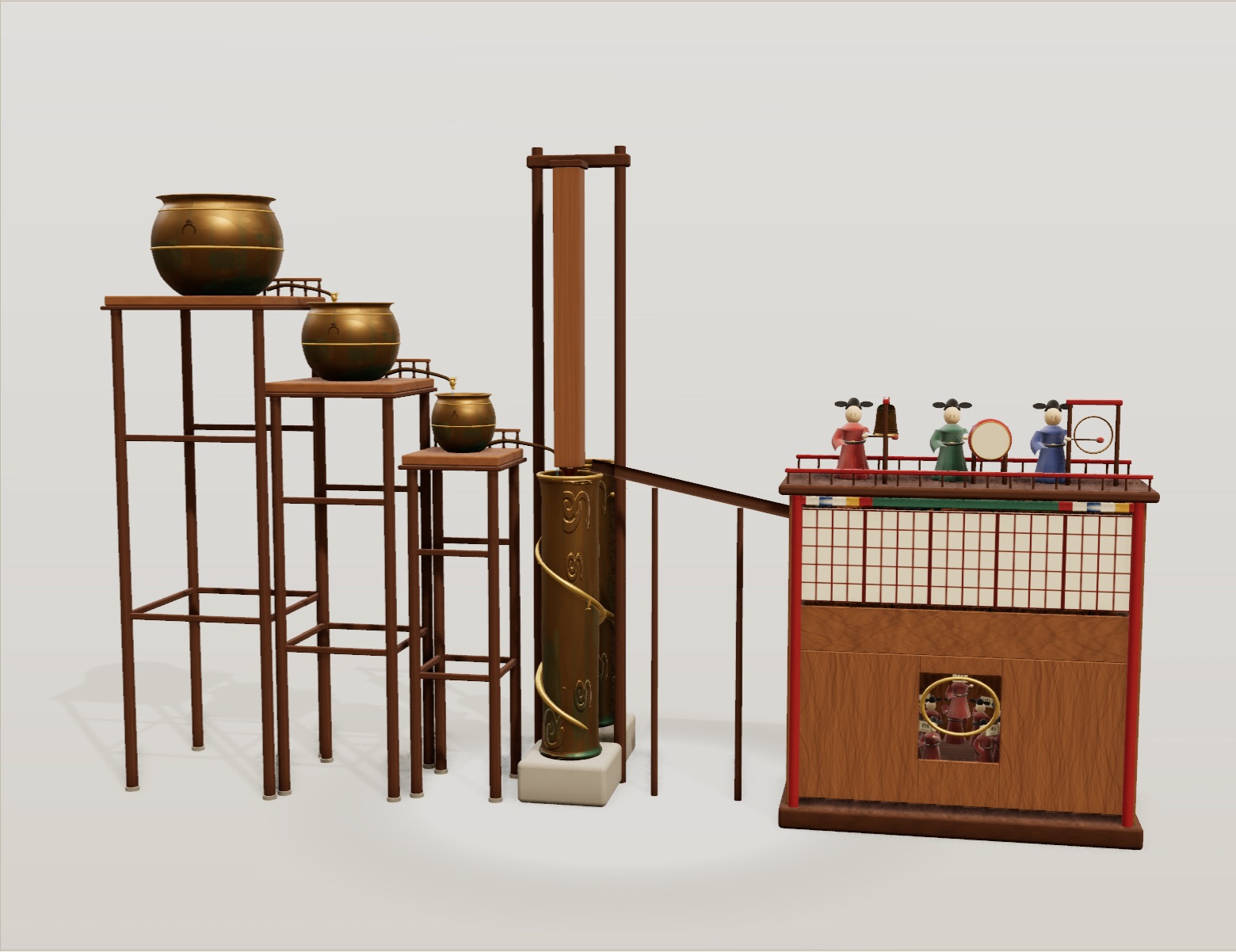
1 / 15 Two machines joined by balls Water on the left, striking house on the right. The model follows the restoration at the National Palace Museum of Korea, which rebuilt the striking gear from the Record of the Borugak. The day runs 1,200 times faster than real time.
Drag to turn. Scroll or pinch to zoom.
Guide Parts Controls
01 Two machines joined by balls Water on the left, striking house on the right. The model follows the restoration at the National Palace Museum of Korea, which rebuilt the striking gear from the Record of the Borugak. The day runs 1,200 times faster than real time.
02 Water steps down through three jars Water runs from the large jar to the middle jar, then the small jar, then the tall vessel. The flow from a spout depends on the water height above it, and each step down holds that height steadier.
03 A turtle measures the day The vessel is see-through here. A float shaped like a turtle rises with the water and lifts the graduated rod: about 75 mm an hour in this model, if the inflow stays the same.
04 Each ball waits at its own height The rod rises inside the square column. Small balls sit in the copper strips at the heights the rod will reach at each double hour (left) and each night point (right). The rod pushes each one out as it passes.
05 One ball at a quarter speed Just before the next double hour. The small ball leaves its strip, drops down the column and rolls along the channel into the house. Turn on Follow the ball to ride with it.
06 Inside: the spoon lever The chain cut open and drawn larger. The small ball opens a latch, an iron ball the size of an egg falls into a short tube, presses a spoon-shaped lever, and the lever pushes up the arm of the hour figure.
07 Inside: drum first, then gong Pick Watch. The watch ball works the drum lever in the left round pillar, then rolls on into the point tube and works the gong lever. In watch 2 the drum sounds twice before the gong.
08 The figures strike in the full model At the start of a night watch the drum figure strikes once for each watch and the gong figure once for the first point. Turn on Sound to hear them.
09 Night points change with the season The night runs from dusk to dawn and is cut into 5 watches of 5 points, so the points are long in winter. This is rod no. 1 for the winter solstice: the 25 balls on the right strip spread out.
10 With a single jar The large jar now feeds the vessel by itself. As it drains, its water height and its flow fall. Watch Clock error: by the end of the day this clock is nearly two hours late.
11 An overflow hole holds the level Three jars again, with a hole in the wall of the small jar that lets the extra water spill. The jars above send a little more than needed, so the small jar stays full to that hole and the error stays at zero.
12 The Borugak of 1434 The Annals describe a pavilion of three bays: jars and vessels in the middle bay, figures on two tiers in the east bay. The building here is a model of that description.
13 What survives from 1536 The water half of the clock made for Changgyeonggung in 1536: one large, one middle and one small supply jar and two receiving vessels. The striking gear is lost.
14 Other ways to time with water An Egyptian clock that leaks out, Ctesibius's clock that fills, Su Song's tower, al-Jazari's elephant and a sinking bowl. Click one for its story.
15 Checking the clock by the sun An angbu-ilgu sundial. The gnomon's tip is at the centre of the bowl, so its shadow falls on the hour and solar-term lines. Change the time and the date to move it.
Large supply jar Bronze, 93.5 cm across and 70 cm tall, the size of the surviving 1536 jar. It holds the reserve and feeds the jars below. Middle supply jar A step between the large and small jars in the restoration. Its level drifts much less than the jar above it. Small supply jar 46 cm across and 40.5 cm tall, like the surviving small jars. Its water height sets the flow into the vessel: v = √(2gh). Receiving vessel The tall bronze cylinder with a dragon in relief. Water falls in from the spout, so the inflow does not depend on how full it already is. A second one waits behind. Turtle float and rod A float shaped like a turtle carries a graduated rod. In this model it rises 1.8 m in a day, about 1.25 mm a minute. Square column and copper strips The rod rises inside this column. Copper strips hold 12 small balls for the hours and 25 for the night watches, each at the height the rod reaches at that moment. Ball channel A released small ball drops through the column and rolls down this channel into the striking house. Iron balls and levers A small ball is too light to strike anything, so it frees an iron ball the size of an egg. The board holds 12 for the hours, 5 for the watches and 20 for the points. Striking figures Three wooden figures: one strikes the bell for each double hour, one the drum for each night watch, one the gong for each point. Twelve hour figures Twelve figures holding hour tablets stand on a flat wheel. When the bell rings, the wheel turns and the figure of the new hour rises into the window. Striking house The wooden case that holds the rail, levers and figures. See inside makes it clear. Copper tubes and board Two slanting copper tubes, 4 cheok 5 chon and 8 cheok long, with 12 and 25 holes, laid over a sloping board with four partitions that hold the iron balls. Spoon lever A lever shaped like a spoon in each short hanging tube. The falling iron ball presses its round end; the other end pushes up a figure's arm. Long beam A beam 6 cheok 6 chon long. The hour ball lands on its north end, the south end rises and lifts the figure of the new hour off the wheel. Borugak pavilion Three bays in Gyeongbokgung, built for the clock in 1434: the jars and vessels in the middle bay, the figures on two tiers in the east bay. Shape and colours here are a model. Supply jars of 1536 The surviving bronze jars: the large one 93.5 cm across and 70 cm tall, the small one 46 cm across and 40.5 cm tall. The middle jar's size here is a model value. Receiving vessels of 1536 Two tall bronze vessels with a dragon among clouds. The back of each names the people who made it. Karnak clepsydra An Egyptian alabaster outflow clock from the reign of the third Amenhotep, with twelve scales inside, one for each month. Ctesibius's water clock Water enters through a hole drilled in gold or a gem; the rising float lifts a figure that points at the hours (Vitruvius). Su Song's clock tower China, 1088: a water wheel that moves in small regular steps, an early escapement, driving the instruments of an astronomical tower. Al-Jazari's elephant clock Described in 1206: a bowl with a hole sinks in a tank inside the elephant every half hour and sets off a ball, a whistle and moving figures. Sinking bowl A bowl with a small hole that fills and sinks after a fixed time: about an hour for a Saxon bowl, 24 minutes for one from Sri Lanka. Angbu-ilgu sundial A bronze bowl facing the sky. The tip of the gnomon is at the centre, so its shadow falls on hour lines and on 13 lines for the solar terms. Armillary sphere Rings for the meridian, the horizon, the equator and the sun's path. Instruments like this were used to check the water clock against the sky.