FIG. 13Old Machines
Slide rule: how to use one, with an interactive model
On a 25 cm slide rule the 2 sits 75.3 mm from the 1, because 250 × log 2 = 75.3, and laying two such lengths end to end multiplies the numbers.
This device cannot show the 3D model. You can read the guide steps below as text.
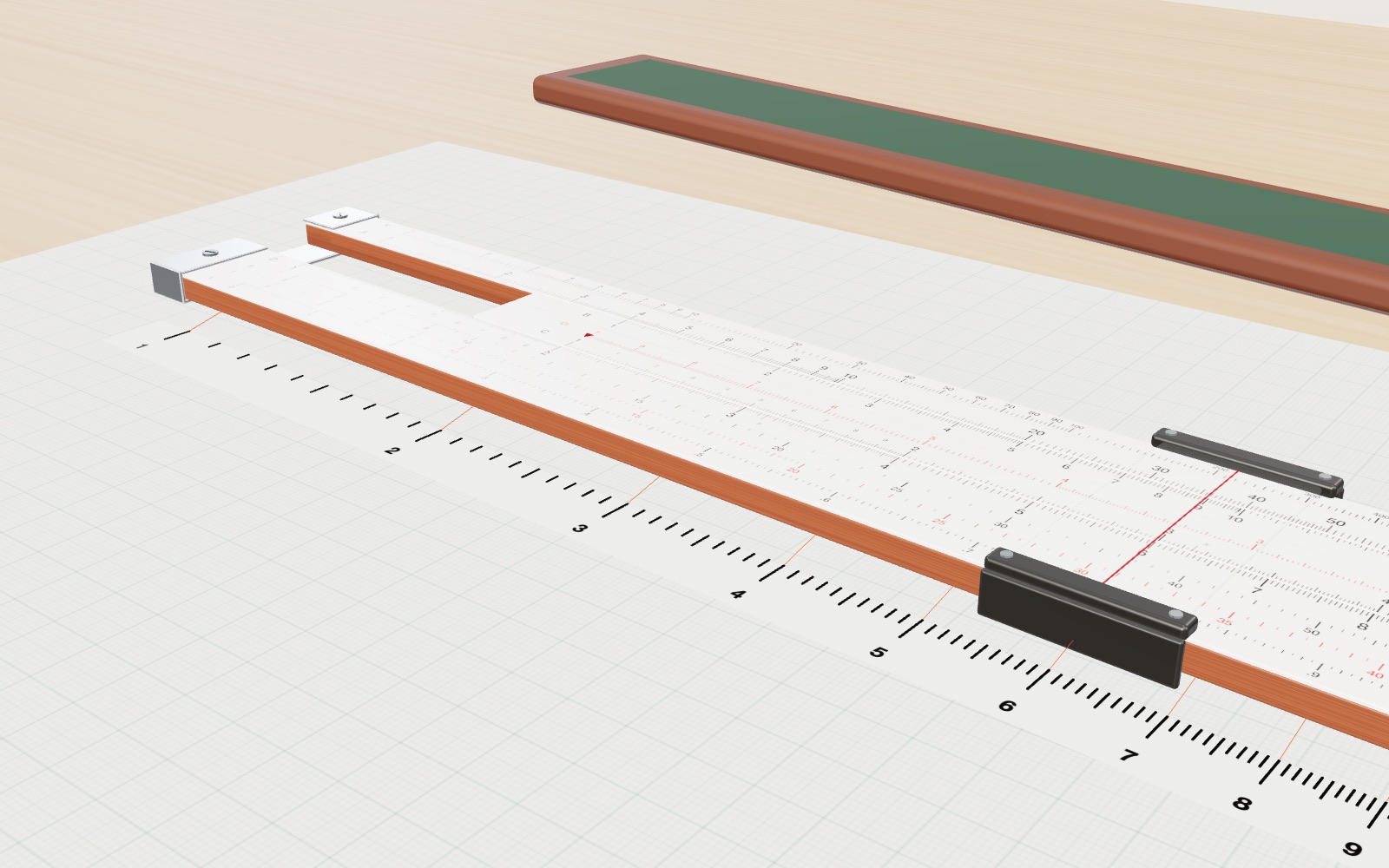
1 / 15 A ruler for multiplyingThis is a 25 cm Mannheim-type rule with nine scales. Drag the slide or the cursor on the model, or use the sliders under Controls. The box in the corner shows every scale under the hairline and the product you have set up.
Drag to turn. Scroll or pinch to zoom.
What the model shows
Before pocket calculators, an engineer who needed 3.14 × 2.72 did not write out a long multiplication. They pulled a ruler out of a shirt pocket, moved its middle strip a few centimetres, slid a little window along and read 8.54. The whole job took a few seconds and needed no batteries. This exhibit is a working copy of that ruler, the slide rule, and the page explains why sliding two strips of wood past each other multiplies numbers.
The model is a 25 cm Mannheim-type rule of the kind sold by the million in the 20th century. It has three pieces that move against each other. The stock is the fixed body, made of two halves held together by end brackets. The slide runs in the groove between them. The cursor is a clear window with a red hairline that rides over everything. There are nine scales. K and A sit on the upper half of the stock, D, S, T and L on the lower half, and B, CI and C on the slide.
You can drag the slide or the cursor straight on the model with a mouse or one finger, or move them with the sliders under Controls. The box in the corner of the stage lists the value of every scale under the hairline. Below that it shows the multiplication you have set up: the number on D under the C index, times the number on C under the hairline, with their logarithms, the exact product and what the rule shows.
The desk holds three more instruments that work on the same idea, and the Instrument control switches between them: a 15 cm yellow aluminium pocket rule like the ones Apollo crews carried, a circular rule with a 10 cm dial, and an E6B flight computer of the kind pilots still learn on. Under the controls there is a lab with six tasks, a calculator that sets any problem on the rule, a bank of 33 problems with a timer, a table of reading errors and a list of 39 slide rules and the people who used them.
Why multiplying turns into adding
Lay two ordinary rulers side by side and you have a machine for adding. Put the 0 of the top ruler on 3 of the bottom one, look along to 4 on the top ruler, and the bottom ruler reads 7. Lengths add.
A slide rule does the same thing with a different kind of ruler. On a logarithmic scale, the distance from the 1 at the left end to a number v is not proportional to v but to its logarithm:
x(v) = 250 mm × log v
On this rule that puts 2 at 250 × 0.30103 = 75.3 mm, 3 at 250 × 0.47712 = 119.3 mm and 6 at 250 × 0.77815 = 194.5 mm. Now add the first two lengths: 75.3 + 119.3 = 194.5 mm, which is exactly where 6 is. That is the rule log a + log b = log (a × b) drawn in wood and celluloid. Setting the left end of C over 2 on D and reading under 3 on C adds the two lengths, and the D scale turns the total length back into a number.
Division is the same move run backwards, because log a − log b = log (a ÷ b). Subtracting one length from another is as easy as adding them.
The L scale at the bottom of the stock makes the idea visible. It is an ordinary evenly divided scale from 0 to 1, laid along D. Put the hairline on 2 on D and L reads 0.301, the logarithm of 2. Before slide rules, people multiplied by looking up logarithms in printed tables, adding them by hand and looking the sum up again. The L scale is a small version of that table.
Reading the scales
The numbers on C and D run from 1 at the left index to 10 at the right index, and they bunch up towards the right. The gap between 1 and 2 is 75.3 mm, while the gap between 9 and 10 is only 250 × log (10/9) = 11.4 mm. Rule makers deal with this by changing the number of divisions as they go. On this model C and D are divided every 0.01 between 1 and 2, every 0.02 between 2 and 4, and every 0.05 between 4 and 10.
The physical width of the smallest gap shows how readable each part of the scale is:
- between 1.00 and 1.01: 250 × log 1.01 = 1.08 mm
- between 2.00 and 2.02: also 1.08 mm, because 2.02/2 = 1.01
- between 4.00 and 4.05: 250 × log 1.0125 = 1.35 mm
- between 8.50 and 8.55: 250 × log (8.55/8.5) = 0.64 mm
- between 9.95 and 10: 0.54 mm
A slide rule never shows the decimal point. The D scale says 6, and you decide whether the answer is 0.6, 6 or 6,000 from a rough estimate. Engineers kept track of the powers of ten on paper, often in scientific notation.
Multiplying and dividing on the model
Take 2 × 3. Move the slide until the left index of C (the 1 at its left end, marked with a red wedge) is over 2 on D. Move the hairline to 3 on C. Under the hairline, D shows 6. The box shows log 0.301 + 0.477 = 0.778, and 10^0.778 is 6.
Sometimes the answer runs off the end. For 7 × 4, the left index on D7 puts C4 at 211.3 + 150.5 = 361.8 mm from the left index of D, beyond the 250 mm scale. The fix is to use the right index, the 10 at the right end of C. Setting C10 over D7 moves the slide 38.7 mm to the left, since 250 × (log 7 − 1) = −38.7 mm. The hairline on C4 then lands on D at 2.8. You have really computed 7 × 4 ÷ 10, and you put the decimal point back yourself: 28.
For 8.4 ÷ 2.1, set the hairline on 8.4 on D, slide 2.1 on C under the hairline, and read D under the C index. It shows 4. You have subtracted log 2.1 from log 8.4 and 0.924 − 0.322 = 0.602, which is log 4.
Chained work is where the rule saves the most time. To compute 8.4 ÷ 2.1 × 1.5, leave the slide where it is after the division and move the hairline to 1.5 on C. D shows 6, and a quick estimate (8 ÷ 2 × 1.5 is about 6) confirms where the decimal point goes. You do not need to read or write down the intermediate 4.
Squares, square roots and reciprocals
The A and B scales fit two copies of 1 to 10 into the same 250 mm, so a number v sits at 125 × log v. A point on D at 250 × log u lines up with A at the value v where 125 × log v = 250 × log u. That gives v = u². Put the hairline on 3 on D and A reads 9. Going upwards squares a number. Going downwards takes a square root: 50 on A is at 125 × log 50 = 212.4 mm, and D under it reads 7.07, the square root of 50. Which half of A you start from matters. 5 on the left half gives 2.24, while 50 on the right half gives 7.07.
CI is the C scale printed backwards, usually in red. A value v sits at 250 × (1 − log v) = 250 × log (10/v), which is where 10/v sits on C. Under the hairline, CI always shows the reciprocal of C, with the decimal point moved one place. With the hairline on C4, CI reads 2.5, so 1/4 = 0.25. Multiplying by a CI value is the same as dividing by the C value under it, so you can turn a run of divisions into multiplications without moving the slide back and forth.
Cubes on K, angles on S and T
The K scale on the far edge of the stock goes one step further than A. It fits three copies of 1 to 10 into 250 mm, so a value v sits at 83.3 × log v. A point u on D lines up with u³ on K. Put the hairline on 2 on D and K reads 8; on 2.5 it reads 15.6, close to the exact 15.625. Reading down from K gives cube roots, and as with A, the part of K you start from decides the answer. 2 in the first third of K gives 1.26, 20 in the middle third gives 2.71 and 200 in the last third gives 5.85.
The S and T scales below D carry angles instead of numbers. S is laid out so that the angle θ sits where D shows 10 × sin θ, at 250 mm × log (10 sin θ). The hairline on 30 on S finds 5 on D, which you read as sin 30° = 0.5. The scale cannot go below 5.74°, because sin 5.74° = 0.1 and anything smaller would fall off the left end. Small angles were handled with the rule that sin θ is close to θ in radians, about θ ÷ 57.3. T, printed in red on this model, does the same for tangents from 5.71° to 45°: the hairline on 20 shows 3.64 on D, so tan 20° = 0.364. For angles above 45° you use tan θ = 1 / tan (90° − θ) and read the reciprocal on CI.
Because S and T sit on the same stock as D, a trig value can go straight into a multiplication. To find the height of a 12 m ladder leaning at 70°, set the hairline on 70 on S, bring the right C index under it and move the hairline to 1.2 on C. D shows 1.13, so the top of the ladder is 11.3 m up.
How a logarithmic scale is laid out
The Build the scale control shows where the marks on D come from. A paper tape on the desk starts as an ordinary ruler with 1 to 10 at equal steps of 27.8 mm. As the control moves, every mark slides to 250 mm × log v. The 2 travels from 27.8 mm to 75.3 mm, the 5 from 111.1 mm to 174.7 mm, and the 10 stays at 250 mm. The orange leads end on the same numbers on D, so you can see that nothing else is involved: the log scale is an ordinary scale with its marks moved.
Instrument makers did this with a dividing engine, a machine that moves a cutting tool along the blank by set amounts and scribes a line at each stop. The positions came from tables of logarithms. The finer the division, the more lines: this model draws 321 marks on each of C and D, 321 on A across its two decades and 226 on K across three.
How many digits a slide rule can give
Try 3.14 × 2.72. Set the left index on 3.14 and the hairline on 2.72. The exact product of those two numbers is 8.5408. The box shows the rule's reading as 8.54, a difference of −0.0094%. Near 8.5 the D scale is divided every 0.05 and each gap is 0.64 mm wide, so the hairline sits about four fifths of the way from 8.50 to 8.55 and you write 8.54. A fourth digit would need you to split that 0.64 mm gap into fifty parts. The Setting error control shows what a small slip does: a blue line marks where a hurried eye might set the hairline, and the box shows the size of the error as a percentage.
The size of the error follows from the scale formula. Moving the hairline by Δx changes the value by a fixed fraction:
Δv / v ≈ ln 10 × Δx / 250 mm
So 1 mm of error is 2.3026/250 = 0.92% anywhere on the rule, and a careful setting good to 0.1 mm is 0.092%. Near the left index that is 0.0009, small enough to guess a fourth digit of 1.234. Near the right index it is 9 × 0.00092 = 0.008, so 9.87 is about the limit. This is the usual rule of thumb: the engraved divisions give two figures and the user estimates the third.
Because the error is a fixed fraction of the scale length, a longer scale reads more finely. A 50 cm rule halves the fraction. Gaining a whole extra digit would need a scale ten times as long, 2.5 m, which is why long-scale calculators wound their scale into a spiral or around a cylinder.
Four instruments on the desk
The 25 cm rule is the one most students and engineers owned. A pocket rule is the same instrument made shorter. The 15 cm yellow model carries the same scales at 0.6 of the length, so every answer is the same but every reading is coarser. A 0.1 mm slip on a 150 mm scale changes the value by 0.15 %, against 0.09 % on 250 mm. The National Air and Space Museum's Apollo 13 rule, a Pickett N600-ES, measures 15.24 cm by 3.81 cm and is made of aluminium and plastic. Its record says NASA chose it because it was popular with engineers and needed no changes for space.
A circular rule wraps the D scale round a fixed ring and the C scale round a disc that turns inside it. Since the circle has no ends, you never have to swap indexes. Set the disc's 1 over 7, put the arm on 4 and D shows 2.8 straight away. On a 10 cm dial, the boundary between the ring and the disc is 36 mm from the centre, so the scale is 2π × 36 = 226 mm long, close to a 25 cm straight rule in a body half the length.
The E6B flight computer is a circular rule with pilot's markings. Its outer scale is read as distance or fuel and the inner disc as minutes. A red arrow at 60 on the inner scale is the speed index, because speed is distance per 60 minutes. Set the arrow under 120 for 120 knots, look over 45 on the inner scale and the outer scale shows 90 nautical miles. The same setting answers the reverse question too: how long 90 nautical miles takes at 120 knots. Philip Dalton, a naval pilot trained as an engineer, developed these computers in the 1930s, and the E6B is still taught for the pilot's knowledge test.
Practice on the model
The tasks under Controls ask you to set up a result yourself, by dragging or with the sliders. Each is ticked when the rule shows the answer, not when you press a button: 3.14 × 2.72, 8.4 ÷ 2.1, the square root of 50, sin 30°, a 45 minute leg on the E6B and five problems in a row from the bank.
The problem bank has 33 problems a 25 cm rule can answer, from 2 × 3 to tan 40°. Work one on the model, type what the rule shows and press Check. An answer within 0.5 % of the exact value counts, which is the precision a careful reader gets from three figures. The timer starts at the first answer and stops at the fifth correct one in a row; the best time stays in your browser. Show on the rule plays the steps for the current problem one at a time.
How the model differs from a real slide rule
The proportions and scale layout follow a common 25 cm rule. The C and D divisions and the A, B and CI scales are drawn from the formulas above, so you can take real readings from them. Several things are simpler than on a real instrument:
- Real engineering rules usually carry more scales than the nine here: folded scales (CF, DF, CIF) and log log scales for powers. Many put S and T on the back of the slide. This model puts them all on one face so the cursor reads them together.
- The pocket rule, the circular rule and the E6B stand in for their types. They are not copies of particular objects, and the E6B's wind side is shown as a plain grid.
- The reading box calculates its values from the exact positions of the slide and cursor and rounds them to three significant figures. On a real rule your eye does the rounding, and the result depends on light, parallax and how fine the hairline is.
- The slide here has no friction and the brackets hold no adjustable tension. On a real rule you loosen the bracket screws to set how stiffly the slide runs.
- The 3.14 example uses 3.14, not π. The π mark on C and D sits at 3.1416, and 3.1416 × 2.7183 = 8.5397.
From Napier's tables to the pocket calculator
John Napier published his account of logarithms in 1614, in Mirifici logarithmorum canonis descriptio. Around 1620 Edmund Gunter drew a single logarithmic line on a ruler and multiplied with it by stepping off lengths with a pair of dividers. Seamen called it a "gunter". William Oughtred is usually credited with the slide rule itself, putting two such scales side by side and sliding one along the other around 1622. He also made a circular version, dated to about 1630.
Isaac Newton suggested something like a cursor in 1675, but it did not catch on. Specialised rules came first: a carpenter's rule perfected by Henry Coggeshall in 1677 stayed in use for 200 years, and gauging rules worked out the contents of barrels and the excise tax on them. By 1799 James Watt and Matthew Boulton's Soho rule was in use in steam engine work, and in 1815 Peter Roget, later the author of the thesaurus, invented the log log scale for powers. The layout on this model goes back to Amédée Mannheim, a French artillery officer, in the 1850s. Sources give dates from 1850 to 1859. His rule used C and D for most work, A and B for squares, and a cursor to read across them. Keuffel and Esser in the United States later added the CI scale. German makers such as Dennert & Pape and Faber laminated celluloid onto wood, and William Cox's duplex rule of 1891 put scales on both faces under one cursor. For more digits, makers wound the scale up. George Fuller's cylindrical calculator of 1878 carried 41 feet (about 12.5 m) of scale in a spiral, and Otis King's pocket cylinder, patented in 1922, packed 66 inches (about 168 cm) into a tube 1.2 inches (about 3 cm) across. In Japan, Hemmi faced bamboo with celluloid and was making about a million rules a year in the 1960s. The Oughtred Society cites an estimate of about 40 million slide rules made in the 20th century, and Pickett slide rules flew on Apollo missions as a backup. The rule used on Apollo 13 in April 1970 is now in the National Air and Space Museum. Wernher von Braun worked out the Redstone rocket's thrust profile on a Nestler 23, and E. H. Lowry designed the approaches to the Golden Gate Bridge with a Dietzgen rule.
The end came quickly. Hewlett-Packard's HP-35, the first handheld scientific calculator, went on sale in 1972 at 395 US dollars, and within a few years cheaper calculators had made slide rules obsolete. On the Apollo-Soyuz flight of 1975, the last to use Apollo hardware, the crew carried a Hewlett-Packard pocket calculator instead of a slide rule.
Why a rounded answer can fail in the next calculation
Three significant figures are usually enough to compare two lengths or estimate a fuel allowance. They are not a promise that every later calculation will keep three useful figures. Suppose an engineering calculation needs the difference between 3.14 × 2.72 and 8.54. These are chosen numbers for an arithmetic example, not measurements of a particular machine. The exact product is 8.5408, so the difference is 0.0008. If you first copy the rule's rounded reading, 8.54, onto paper, the subtraction gives zero. The product was very close, but rounding removed the entire difference you wanted.
The subtraction itself is not a slide-rule operation. It would be done separately on paper. This matters because a small percentage error in a large intermediate result can be larger than a small final answer. Extra digits in the exhibit's exact-product display help explain the loss, but they do not make an engraved scale more readable. Treat that display as a comparison, not as evidence that a person could read every displayed digit from the model's marks.
A useful check is to write down the expected order of magnitude before moving the slide, and keep any subtraction of nearly equal quantities separate from the multiplication. If the desired difference is smaller than the uncertainty in either quantity, a longer rule or a different calculation method is needed. Repeating the same reading does not recover information already lost by rounding. The example follows directly from the logarithmic scale formula and the three-significant-figure readout described above; it does not assume that the practice bank contains this subtraction problem.
Questions
Why are the numbers on a slide rule not evenly spaced?
Each number sits at a distance proportional to its logarithm, x = 250 mm × log v on this rule. Logarithms grow quickly at first and then slowly, so the gap from 1 to 2 (75.3 mm) is much wider than the gap from 9 to 10 (11.4 mm).
How does adding lengths multiply numbers?
Because log a + log b = log (a × b). Sliding C along D puts the length for log a end to end with the length for log b, and D reads the number whose logarithm is the total. For 2 × 3, 75.3 mm + 119.3 mm = 194.5 mm, the position of 6.
How accurate is a slide rule?
About three significant figures on a 25 cm rule. A 0.1 mm setting error is a 0.092% error in the value, which is 0.0009 near the left end and about 0.008 near the right end. Near 1 you can sometimes estimate a fourth digit.
Where does the decimal point go?
The rule cannot tell you. You estimate the size of the answer separately. For 7 × 4 the rule shows 2.8, and since 7 × 4 is somewhere near 30, you write 28.
What are the A and B scales for?
Squares and square roots. They hold two decades in the same length as C and D, so each value on A sits directly above its square root on D. The hairline on D3 shows 9 on A.
What does the CI scale do?
CI is C reversed. Under the hairline it shows the reciprocal of the C value, so C4 lines up with CI 2.5, read as 0.25. Multiplying by a CI value divides by the C value, which saves slide movements in long calculations.
Can a slide rule add or subtract?
Not directly. Its scales add logarithms, which multiplies numbers. To add 2 + 3 you would need ordinary linear scales, like the L scale on this model, which are rarely used that way.
Why did engineers stop using slide rules?
Handheld electronic calculators gave many more digits and placed the decimal point for you. The HP-35 appeared in 1972, and within a few years much cheaper calculators were common.
What is the K scale for?
Cubes and cube roots. K holds three decades in the length of D, so the hairline on 2 on D shows 8 on K. Reading downwards from K gives a cube root, and which third of K you start from decides which root you get.
How do you find a sine on a slide rule?
Put the hairline on the angle on the S scale and read D. D shows 10 times the sine, so 30° gives 5, read as 0.5. Tangents up to 45° work the same way on T. For angles below about 5.7°, use the angle in radians, since sin θ and tan θ are both close to it.
Is a circular slide rule better than a straight one?
It never runs off the end, so you never switch indexes, and it fits a long scale into a small body. The drawbacks are that the numbers turn as you go round, which makes them harder to read, and that the inner scales are shorter than the outer ones.
How does an E6B flight computer work?
It is a circular slide rule. The outer scale is distance or fuel, the inner scale is minutes, and an arrow at 60 marks the hour. Set the arrow under the speed and the outer scale over any time shows the distance covered in that time. The back has a sliding grid for wind corrections.
Did astronauts really carry slide rules?
Yes. NASA chose the 5-inch Pickett N600-ES for Apollo crews, and the one carried on Apollo 13 is in the National Air and Space Museum. The guidance computer did the navigation; the rule was for routine sums and as a backup.
How long did it take to multiply on a slide rule?
A practised user set and read a product in a few seconds. The problem bank on this page times five answers in a row, so you can see how your speed changes with practice.
Terms
- Logarithm (common): the power of 10 that gives a number. log 100 = 2 and log 2 = 0.301.
- Stock: the fixed body of the rule, in two halves joined by end brackets.
- Slide: the middle strip that moves along the stock.
- Cursor: the sliding window with a hairline, used to read across scales that do not touch.
- Index: the 1 at either end of the C or D scale.
- C and D scales: the main logarithmic scales from 1 to 10, used for multiplication and division.
- A and B scales: double logarithmic scales from 1 to 100, used for squares and square roots.
- CI scale: an inverted C scale that shows reciprocals.
- L scale: an evenly divided 0 to 1 scale that shows the logarithm of the D value.
- K scale: a triple logarithmic scale from 1 to 1000, used for cubes and cube roots.
- S and T scales: angle scales placed so that D shows 10 times the sine or tangent.
- Duplex rule: a rule with scales on both faces and a cursor that reaches both sides.
- E6B: a circular slide rule for pilots, with a speed index at 60 minutes.
- Significant figures: the digits of a number that carry information. 8.54 has three.
Sources
- The Oughtred Society, Slide Rule History (Napier, Gunter, Oughtred, Newton's cursor, Mannheim, K&E and the CI scale, Apollo, 40 million estimate). https://www.oughtred.org/history.shtml (checked 15 October 2026)
- MacTutor History of Mathematics, University of St Andrews, John Napier (Mirifici logarithmorum canonis descriptio, 1614). https://mathshistory.st-andrews.ac.uk/Biographies/Napier/ (checked 15 October 2026)
- MacTutor History of Mathematics, University of St Andrews, Edmund Gunter (Gunter's rule with dividers). https://mathshistory.st-andrews.ac.uk/Biographies/Gunter/ (checked 15 October 2026)
- MacTutor History of Mathematics, University of St Andrews, William Oughtred (early slide rule, circular slide rule in 1630). https://mathshistory.st-andrews.ac.uk/Biographies/Oughtred/ (checked 15 October 2026)
- Computer History Museum, This Day in History, January 4: Hewlett-Packard Introduces the HP-35 (1972, 35 keys, sold for $395, the end of slide rules). https://www.computerhistory.org/tdih/january/4/ (checked 17 October 2026)
- HP Virtual Museum, HP-35 handheld scientific calculator, 1972 (first handheld scientific calculator, quickly replaced the slide rule). https://www.hp.com/hpinfo/abouthp/histnfacts/museum/personalsystems/0023/index.html (checked 17 October 2026)
- International Slide Rule Museum (photographs and manuals of Mannheim-type rules). https://sliderulemuseum.com/ (checked 15 October 2026)
- Smithsonian National Museum of American History, Linear Slide Rules (Napier, Gunter and Oughtred between 1614 and 1622). https://americanhistory.si.edu/collections/object-groups/slide-rules/linear-slide-rules (checked 18 October 2026)
- Smithsonian National Museum of American History, Slide Rules object group (more than 250 objects). https://americanhistory.si.edu/collections/object-groups/slide-rules (checked 18 October 2026)
- Smithsonian NMAH, Otis King's Pocket Calculator Model L Cylindrical Slide Rule (British patent 183,723, 1922). https://americanhistory.si.edu/collections/object/nmah_1214638 (checked 18 October 2026)
- Smithsonian NMAH, Cooper 100-Inch Slide Rule (20 lines of about five inches, W. F. Stanley, £4). https://americanhistory.si.edu/collections/object/nmah_1215045 (checked 18 October 2026)
- Smithsonian, Keuffel & Esser 4081-3 Log Log Duplex Decitrig Slide Rule (wood with white celluloid, metal end pieces). https://www.si.edu/object/keuffel-esser-4081-3-log-log-decitrig-duplex-slide-rule%3Anmah_1214626 (checked 18 October 2026)
- National Air and Space Museum, Slide Rule, 5-inch, Pickett N600-ES, Apollo 13 (April 1970, 15.24 x 3.81 cm, aluminium and plastic). https://airandspace.si.edu/collection-objects/slide-rule-5-inch-pickett-n600-es-apollo-13/nasm_A19840160000 (checked 18 October 2026)
- National Air and Space Museum, Don't Know What a Slide Rule is For (von Braun's rule, the Space Vehicle Pocket Designer, Apollo-Soyuz calculator). https://airandspace.si.edu/stories/editorial/dont-know-what-slide-rule (checked 18 October 2026)
- National Air and Space Museum, Slide Rule, Space Vehicle Pocket Designer. https://airandspace.si.edu/collection-objects/slide-rule-space-vehicle-pocket-designer/nasm_A20170087000 (checked 18 October 2026)
- The Museum of HP Calculators, Cylindrical Slide Rules (Fuller's 41 foot scale, Otis King's 66 inch scale). https://www.hpmuseum.org/srcyl.htm (checked 18 October 2026)
- Science Museum Group, Otis King Calculator, cylindrical slide rule, England, 1920-1939. https://collection.sciencemuseumgroup.org.uk/objects/co148287/otis-king-calculator-cylindrical-slide-rule-england-1920-1939 (checked 18 October 2026)
- Gleim Aviation, Celebrating the E-6B's 80th Birthday (Philip Dalton, the dead reckoning computer). https://aviation.gleim.com/2019/12/27/celebrating-the-e-6bs-80th-birthday/ (checked 18 October 2026)
- Charles Petzold and others, The Lost Art of Logarithms, chapter 1 (Oughtred about 1622). https://www.lostartoflogarithms.com/chapter01/ (checked 18 October 2026)
- Calculations on this page: positions from x = 250 mm × log v (C, D), 125 mm × log v (A, B), 250 mm × (1 − log v) (CI), 83.3 mm × log v (K), 250 mm × log (10 sin θ) (S) and 250 mm × log (10 tan θ) (T); reading error from Δv/v ≈ ln 10 × Δx / 250 mm.
More exhibits
How to play chess, step by step
After just four moves by each side there are 84,998,978,956 possible games.
How the Enigma machine worked: rotors, reflector and plugboard
Press A five times on an Enigma set to I-II-III and AAA and the lamps light B, D, Z, G, O.
How logic gates add numbers: sum bits and carry bits
Adding 7 and 9 on this board takes 20 gates, and the last carry lands 8 gate delays after you flip the switches.
How to solve a 3×3 cube, step by step
A 3×3 cube has 43,252,003,274,489,856,000 positions, and every one of them can be solved in 20 moves or fewer.

Why should you switch doors in the Monty Hall problem?
After the host opens a door with a goat, the door you did not pick hides the car in two games out of three.
How a pendulum clock works, and why its length sets the time
A pendulum clock counts seconds with one rod 99.4 cm long. Change its length, its temperature and its place on Earth, swap four escapements and see how many seconds a day each costs.