FIG. 112Follow Along
How to solve a 3×3 cube, step by step
A 3×3 cube has 43,252,003,274,489,856,000 positions, and every one of them can be solved in 20 moves or fewer.
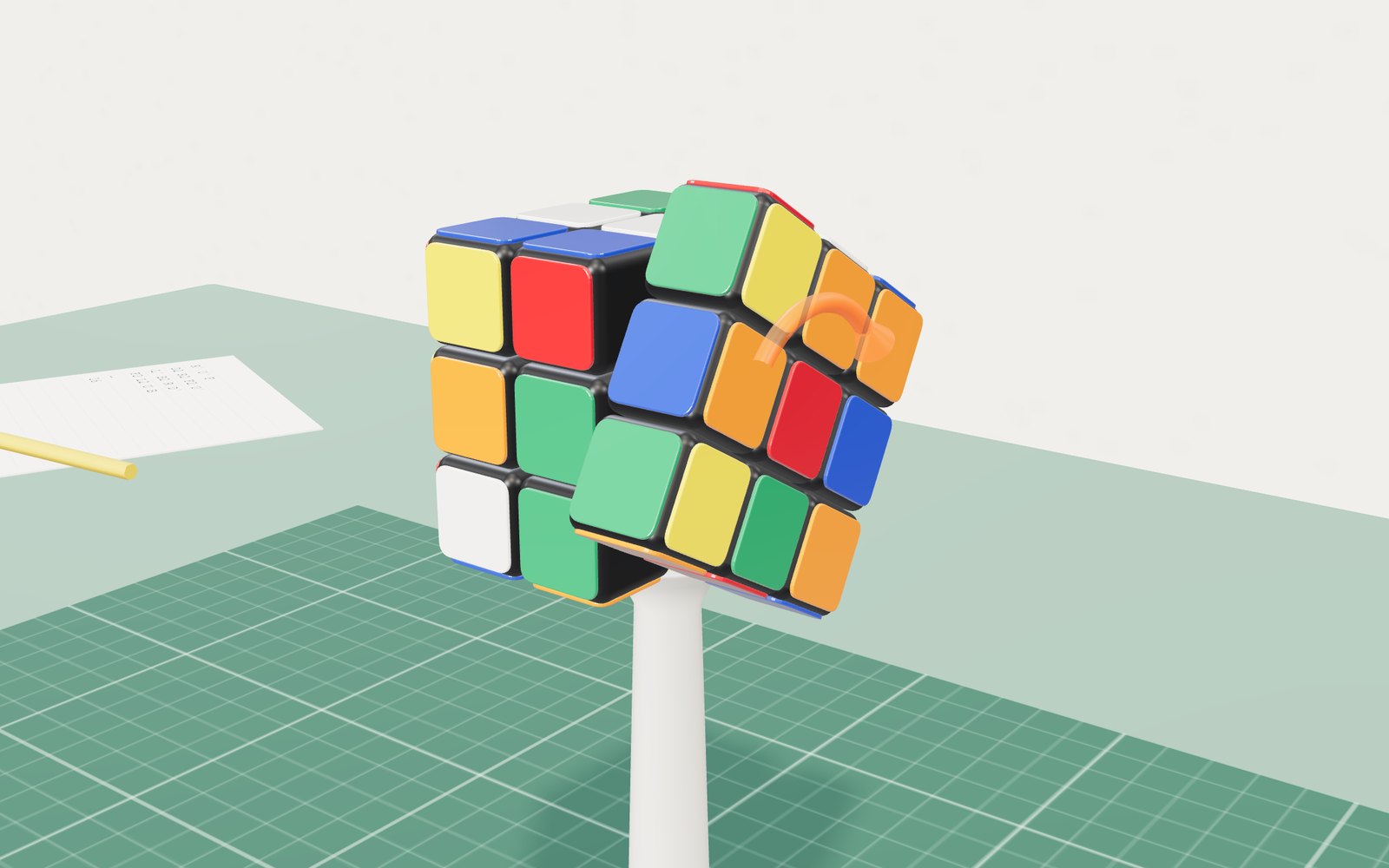
This device cannot show the 3D model. You can read the guide steps below as text.
1 / 15 A scrambled cube solves itselfThis cube was scrambled to one of its 43,252,003,274,489,856,000 positions. Watch the beginner method put it back, one layer after another, at 16 turns a second.
Drag to turn. Scroll or pinch to zoom.
A cube that scrambles in ten seconds and takes an afternoon to learn
Pick up a scrambled 3×3 cube and turn one face. Three stickers on each of the four neighbouring faces move with it, and the face you turned spins in place. Turn another face and the damage spreads. After five or six turns the cube looks completely random, and most people who try to undo it by feel find that every fix breaks something they had already done.
The cube on this page starts that way. It was scrambled to one of its 43,252,003,274,489,856,000 positions, and in the first seconds you watch it solve itself with the beginner method, one layer after another, at 16 turns a second. Then it is yours. You can drag any layer with a finger or a mouse, step through the same solution one move at a time (forwards or backwards), paint in the colours of the real cube on your desk and get a solution for it, take the cube apart to see what holds it together, and set it beside a 2×2 and a 4×4.
The method shown here is the one most people learn first: a white cross, the rest of the white layer, the middle layer, then the yellow face and the last layer. It uses seven short formulas. It is slow compared with what competitors use, about 140 moves on average for this page's version, but every step can be followed with your eyes, and once you have done it a few times you do not need the page any more.
Around the cube there are the numbers people ask about. Why the number is so large, and why you cannot get more by taking the cube apart. What "God's number" is, and why it took computers until 2010 to show that it is 20. How fast the fastest people are, according to the World Cube Association, which runs official competitions. Under the controls there is a lab with twelve tasks, a calculator for how many times a sequence has to be repeated before the cube comes back, the table of how far positions are from solved, and the records.
The page avoids the brand name on the stage and calls the puzzle a 3×3 cube. The name of its inventor, Ernő Rubik, appears where the history comes in.
The pieces: why the centres decide the colours
A 3×3 cube looks like 27 small cubes, but there are only 26 visible pieces and they come in three kinds.
- Centres. Six pieces with one sticker each, in the middle of each face. They are fixed to the core and can only spin in place. Because they never move relative to each other, the white centre is always opposite the yellow one, green opposite blue and red opposite orange. When the cube is solved, each face has the colour of its centre.
- Edges. Twelve pieces with two stickers each, between two centres. An edge can sit in its own slot either way round: the two ways are its "flip".
- Corners. Eight pieces with three stickers each. A corner can sit in its own slot in three ways: the three ways are its "twist".
A turn of a face moves four edges and four corners round in a cycle and spins the centre. A turn of a middle slice moves four edges and four centres. That is all a turn can do, which is why the cube is solved piece by piece rather than sticker by sticker: you never need to think about stickers, only about where each edge and each corner is and which way round it sits.
The fact that the centres stay put is also why the paint mode on this page fixes them. Hold your cube with white up and green in front (the orientation the World Cube Association uses for scrambles), and the colours of the other stickers tell the page exactly which piece is where.
What holds it together
Open the Inside view and drag the slider. In the middle there is a hub with six arms, one pointing at each face. Each arm holds a centre, and in the model a screw and a small spring sit under every centre cap, the way many cubes are built today: tighten the screws and the cube turns stiffer. The edges and corners are not attached to anything. Each has a foot that slides under its neighbours, and the centres press down on the edges, the edges on the corners. Pull the layers apart and the cube falls into its 26 pieces and the core.
Ernő Rubik's Hungarian patent for the cube (HU 170062, filed on 30 January 1975 and published on 28 March 1977) describes pieces held round a central core in this spirit. The exact shape of the feet and the springs in the model are a drawing of a modern cube, not of the patent.
Not quite the first
A cube that turns in groups of pieces was patented before the 3×3. In March 1970 Larry D. Nichols filed US patent 3,655,201 for a "pattern forming puzzle": eight small cubes held together by magnets, which rotate in groups of four about three axes. It was published in April 1972. That is a 2×2×2 in everything but its mechanism. Both patents hang on the wall of the room on this page.
Reading the notation
Cube instructions are written as letters, and the letters come from the World Cube Association's regulations (Article 12). Hold the cube still with one face towards you. Then:
- F is the front face, B the back, R the right, L the left, U the upper face and D the bottom (down).
- A letter on its own means a quarter turn of that face, clockwise as you look straight at that face. R turns the right face clockwise as seen from the right, which moves the front stickers of the right column up.
- A prime (R′, often typed R') is a quarter turn counterclockwise.
- A 2 (R2) is a half turn. Direction does not matter.
So R U R′ U′ means: right face clockwise, top face clockwise, right face back, top face back. That four-move sequence is the most used one in the method on this page, and you can watch it with the turn arrows switched on in the second guide step.
Slices, wide turns and whole-cube turns
The beginner method needs only the six face letters, but other notation turns up in books, in the lab and in the turn buttons:
- M, E and S turn a middle slice. M is the slice between L and R and turns the same way as L; E is between U and D and turns like D; S is between F and B and turns like F.
- Rw (also written r) turns the right face and the middle slice together, a "wide" turn. The regulations allow both Rw and 2Rw for this on a 3×3.
- x, y and z turn the whole cube: x the same way as R, y the same way as U, z the same way as F. They change how you hold the cube, not its pattern.
The check program behind this page tests these definitions against each other: x is the same as R M′ L′, r is the same as R M′, and so on for every letter.
How moves are counted
There is more than one way to count. In the half-turn metric, used for God's number, R and R2 each count as one move. In the quarter-turn metric R2 counts as two. The regulations define the Outer Block Turn Metric for the fewest moves event, where face turns and wide turns count one each and whole-cube rotations count zero. The move counts on this page are in the half-turn metric and leave out x, y and z.
The layer-by-layer method on this page
The method solves the cube in seven stages. Each stage leaves alone what the stages before it finished, or puts it back by the end of its formula. The check program solves 2,000 positions (1,000 picked uniformly at random from all positions, 1,000 from random 25-move scrambles) and tests after every stage that what it promised is true.
Hold: white down
The page solves with the white centre at the bottom. If white is somewhere else, the first "move" is a whole-cube turn (x, x2 or z) that brings it down. Building the white cross on the bottom means you never have to turn the cube over later, at the price of not seeing the cross while you make it. That is why the third guide step looks at the cube from below, and why there is a small unfolded picture of the cube in the corner of the stage that shows every face at once.
Step 1: the white cross
Bring the four white edges down round the white centre. Each edge has a second colour, and it must sit next to the centre of that colour: the white-green edge below the green centre, the white-red edge below the red one. A cross with the right shape and the wrong side colours is not finished.
People do this step by feel, and so does the page in a way: it searches through all positions of the four white edges and picks a shortest way to place them together. That search covers 190,080 arrangements and shows that the cross never needs more than eight moves. Over 2,000 test positions the page needs 5.8 moves on average.
Step 2: the first layer
Now the four white corners. Find one, turn the top until it sits directly above the slot where it belongs, and repeat R U R′ U′ (said for that slot) until it drops in with white facing down. It takes one, three or five rounds, depending on which way the white sticker was facing. If the corner is already in the bottom layer but in the wrong place or twisted, one round of the same formula lifts it out first.
This is the longest stage in moves, about 48 on average, because each round is four moves and a corner can need five rounds. It is also the stage where the formula becomes a habit: R U R′ U′ is short enough to learn by hand in a few minutes, and the "Learn a formula" task asks you to enter it from memory.
Step 3: the second layer
The middle layer has four edges and none of them is white or yellow. Turn the top until one of these edges lines up with the centre of its colour on the side. Its top colour then tells you where it must go: if the top colour matches the centre on the right, send it right with U R U′ R′ U′ F′ U F; if it matches the centre on the left, send it left with U′ L′ U L U F U′ F′. Each formula takes the corner below out for a moment and puts it back with the edge.
If an edge is stuck in the middle layer in the wrong slot, or flipped in the right slot, one of the same formulas pushes any top edge into that slot, which brings the stuck edge up where it can be placed properly. The page needs about 37 moves for this stage on average.
Step 4: the top cross
Now only the top (yellow) layer is left. First the yellow cross: F R U R′ U′ F′. Look at the top. If you see only the yellow centre (a dot), one round makes an L shape; with the L at the back left, a second round makes a line; with the line horizontal, a third round makes the cross. The formula flips two top edges at a time and keeps the first two layers intact.
Step 5: the yellow face
R U R′ U R U2 R′, a formula many people call "Sune", twists three top corners and leaves everything else in place, except that the top edges change places among themselves. Turn the top and repeat until the whole top is yellow. It takes one to three rounds. The page tries the formula after each of the four top turns and picks the shortest combination, which a person does by recognising a few shapes.
Step 6: the last layer
Two formulas finish the cube. R′ F R′ B2 R F′ R′ B2 R2 moves three top corners round in a circle without twisting them; with the right top turn before it, the corners all go home. Then R2 U R U R′ U′ R′ U′ R′ U R′ moves three top edges round in a circle, and once or twice, with a top turn, finishes the solve.
How many moves it takes
On the 2,000 test positions this version of the method needs between 68 and 209 moves, 140.8 on average. The scrambled cube in the first guide step needs 129. Competitors use methods with many more formulas and far fewer moves, and the shortest possible solution is never more than 20, as the next sections explain. The beginner method buys its simplicity with length.
Why formulas work: going away and coming back
Turn R U R′ U′ once and the cube looks a little scrambled. Turn it six times and the cube is solved again. That is not a coincidence of this sequence. Any sequence of turns, repeated often enough, comes back to where it started, because the cube has only finitely many positions and every turn can be undone.
The number of repeats needed is called the order of the sequence. R alone has order 4. R2 U2 has order 6. R U, the simplest two-move sequence, has order 105: you have to repeat it 105 times, 210 turns, before the cube is solved again. R U2 D′ B D′ needs 1,260 rounds, 6,300 turns.
The lab under the controls works these numbers out for any sequence you type. It composes the sequence into a single shuffle of the 54 stickers, splits that shuffle into cycles, and the order is the least common multiple of the cycle lengths. For short orders it can then play the repeats on the cube so you can watch it come back.
Formulas such as R U R′ U′ are useful because they change very little. R U R′ U′ affects only a handful of pieces near one corner, and its effect on the bottom layer cancels out after a round, which is exactly what the first-layer step needs. Group theory, the branch of mathematics that studies sequences of moves like this, calls R U R′ U′ the commutator of R and U. Commutators of two moves that overlap in only a few pieces move only a few pieces, and most of the formulas in more advanced methods are built from them.
43,252,003,274,489,856,000 positions
Where does 43,252,003,274,489,856,000 come from? Count the ways the pieces can be arranged, then the ways that turns can actually reach.
Take the cube apart. The eight corners can go back into the eight corner slots in 8! = 40,320 orders, and each corner can sit in three twists: 3⁸. The twelve edges can go back in 12! = 479,001,600 orders, and each can sit in two flips: 2¹². Multiplied together, that is 519,024,039,293,878,272,000 ways to reassemble a cube.
Turning cannot reach all of them. Three rules hold for every position you can reach by turning, and only for those:
- Twist. Number the twists of the corners 0, 1 and 2. The sum of all eight twists is always a multiple of 3. So once seven corners are twisted, the eighth has no choice: divide by 3.
- Flip. Number the flips 0 and 1. The sum of all twelve flips is always even. The twelfth edge has no choice: divide by 2.
- Swaps. Every quarter turn of a face swaps corners an odd number of times and edges an odd number of times. So the corners and edges are always swapped an even number of times together, or an odd number together. You cannot swap just two edges: divide by 2.
519,024,039,293,878,272,000 ÷ 3 ÷ 2 ÷ 2 = 43,252,003,274,489,856,000, or written as on the stage, 8! × 3⁷ × 12! × 2¹¹ ÷ 2. University course notes, such as Janet Chen's notes on group theory and the cube, prove that these three rules are not only necessary but sufficient: any arrangement that obeys all three can be reached by turning, which is what makes the solver on this page work for every painted cube that passes them.
What it means for a cube taken apart
Put a cube back together at random and it obeys the twist rule with probability 1 in 3, the flip rule with probability 1 in 2 and the swap rule with probability 1 in 2. Together that is 1 in 12. Eleven times out of twelve, a cube that has been taken apart and put back carelessly can never be solved by turning, however clever the solver. The check program confirms the figure by assembling 24,000 random cubes and testing them; about 8.3% pass.
The paint mode lets you build such a cube on purpose. "Twist a corner" twists one corner in place, "Flip an edge" flips one edge, "Swap two edges" exchanges two edges. Each time the page refuses and says which rule was broken. The same test catches mistakes in painting your own cube: a colour on ten stickers instead of nine, a corner whose colours no corner has (or an edge such as white with yellow, which no cube has), two stickers swapped on one corner so that its colours run the wrong way round, or the same piece appearing twice.
How long that would take to look through
If you looked at one position every second, seeing them all would take about 1.37 trillion years. The universe is about 13.8 billion years old, according to the Planck satellite team's 2018 results, so that is roughly 99 times the age of the universe. The "Me" panel and the lab take your birthday and tell you what share of the positions you would have seen by now at one per second: far below a millionth of a percent for anybody alive. At a billion positions per second, the speed of the program that settled God's number, the share grows to a few percent for a long life.
The 2×2 and the 4×4
The 2×2 has only corners. With no centres to fix the orientation, one corner is held still to count each position once: 7! × 3⁶ = 3,674,160 positions. Small enough that a computer checks all of them in moments.
The 4×4 has 8 corners, 24 edge pieces and 24 centre pieces, and no fixed centres at all, which is why it has situations (called parity cases by cubers) that look impossible on a 3×3. Holding one corner still again, it has 7! × 3⁶ × 24! × 24! ÷ (4!)⁶ = 7,401,196,841,564,901,869,874,093,974,498,574,336,000,000,000 positions, about 7.4 × 10⁴⁵. Both counts are computed by the check program with exact integers and shown in the Sizes view.
God's number
Some positions need many moves. What is the largest number of moves that the hardest position needs, if you always use the shortest possible solution? Cubers call it God's number, and it was an open question from the time the cube appeared until 2010.
The history, as Tomas Rokicki, Herbert Kociemba, Morley Davidson and John Dethridge summarise it in their paper in the SIAM Journal on Discrete Mathematics (2013), goes like this, counting in the half-turn metric:
| Year | At least | At most | Who |
|---|---|---|---|
| 1981 | 18 | 52 | Thistlethwaite's four-stage method gives the upper bound; a counting argument the lower |
| 1990 | 18 | 42 | Kloosterman |
| 1992 | 18 | 39, then 37 | Reid, then Winter |
| 1995 | 20 | 29 | Reid: the superflip needs 20 |
| 2005 to 2006 | 20 | 28, then 27 | Radu |
| 2007 | 20 | 26 | Kunkle and Cooperman, Northeastern University, with a computer cluster |
| 2008 | 20 | 25, 23, 22 | Rokicki, then Rokicki and Welborn |
| 2010 | 20 | 20 | Rokicki, Kociemba, Davidson, Dethridge |
The lower bound of 18 came from counting: there are not enough sequences of 17 moves or fewer to reach every position, so some position must need at least 18. The upper bounds came from methods that always finish within a number of moves, then from computer searches that grew cleverer each time. Kunkle and Cooperman's 26 took 8,000 CPU hours and terabytes of disk.
How 20 was proved
The 2010 proof did not solve every position optimally. It split all the positions into 2,217,093,120 groups (cosets) of 19,508,428,800 positions each, cut the number that had to be handled to 55,882,296 using the cube's symmetry, and for each group showed that every position in it could be solved in 20 moves or fewer. The program at the heart of it worked through about a billion positions a second on one desktop processor. The whole run took place on Google's servers in July 2010; on a single Nehalem desktop processor it would have taken about 35 CPU years. Morley Davidson is a mathematician at Kent State University, and Kociemba introduced the two-phase algorithm in 1992, the method behind many fast solvers since.
As a side result, the authors found the exact number of positions exactly 15 moves from solved: 91,365,146,187,124,313. The table in the lab shows the counts for every distance. Up to 15 they are exact. From 16 on they are the authors' estimates: about 1.1 × 10¹⁸ positions at 16 moves, 1.2 × 10¹⁹ at 17, 2.9 × 10¹⁹ at 18, 1.5 × 10¹⁸ at 19, and only about 300 million at 20. So a random scramble is almost always 17 or 18 moves from solved, and a position that needs all 20 is rarer than 1 in 100,000,000,000.
Richard Korf of UCLA found the first optimal solutions of random positions in 1997, with a search that took about a day per position. His estimate for the median optimal length was 18 moves, which fits the later counts.
The superflip
The superflip is the position with every corner in place and every edge in place but flipped. Michael Reid proved in 1995 that it needs 20 moves, which raised the lower bound to 20. The page shows one 20-move sequence that makes it: U R2 F B R B2 R U2 L B2 R U′ D′ R2 F R′ L B2 U2 F2. Because the superflip is its own opposite (flipping every edge twice undoes it), the same 20 moves played again solve it. The eleventh guide step does exactly that, and the patterns list lets you make it yourself.
Other ways of counting
In the quarter-turn metric, where a half turn counts as two, the 2013 paper gives a lower bound of 26 and an upper bound of 29 and expects the answer to be 26. In the slice-turn metric, where middle slices count as one move, it gives 18 to 20 and expects 18.
Bigger cubes and harder questions
For an n×n×n cube, Erik Demaine and colleagues at MIT showed in 2011 that God's number grows in proportion to n² ÷ log n. The number of pieces grows like n², so a big cube needs fewer moves per piece than a small one, because one turn of a big cube can make progress on many pieces in parallel.
Finding the shortest solution of a given position is another matter. Demaine, Sarah Eisenstat and Mikhail Rudoy proved in 2017 that, for n×n×n cubes in general, deciding whether a position can be solved within a given number of moves is NP-complete. No method is known that always answers quickly as the cubes grow, and finding one would settle one of the central open problems of computer science. For the 3×3 itself the question is finite and has been answered by brute force, with a lot of cleverness on top.
Computers, networks and a robot hand
Computers solve the 3×3 in two quite different ways.
The first is search with lookup tables. Korf's 1997 solver and Kociemba's two-phase algorithm both precompute tables of how far certain parts of the cube are from solved, then search for move sequences while using the tables to cut off branches that cannot succeed. The cross stage on this page is a tiny example: a precomputed table of 190,080 arrangements of four edges tells the page which move brings the cross one step closer.
The second is learning. A team at the University of California, Irvine (Stephen McAleer, Forest Agostinelli, Alexander Shmakov and Pierre Baldi) trained a neural network to estimate how far a position is from solved, starting from the solved cube and working backwards, without being given any human method. Their 2019 program, DeepCubeA, published in Nature Machine Intelligence, solved every position it was tested on and found a shortest solution 60.3% of the time.
In 2019 a team at OpenAI trained a humanoid robot hand in simulation and then used it to turn a real cube. The hand handled the physical turning; which turns to make came from a Kociemba solver. On scrambles that needed 15 face rotations it succeeded 60% of the time, on the hardest scrambles (26 quarter turns) 20% of the time.
Speedcubing and the World Cube Association
The World Cube Association (WCA) was founded in 2004 and governs competitions for twisting puzzles. It is run almost entirely by volunteers. More than 245,000 people from 158 regions have competed, and a world championship is held every two years.
What happens at a competition
Under the WCA regulations, a competitor gets strictly less than 15 seconds to inspect the scrambled cube. The solve is timed on a timer with two hand pads, and the clock starts when the competitor's hands leave them. Most events use an average of 5: five solves, the best and the worst are dropped, and the other three are averaged. The scorecard on the table in the room shows one such round: 9.84, 7.12, 8.95, 12.40 and 9.31 seconds give an average of 9.37.
Scrambles are not random turns. Regulation 4b3 requires an official scramble program to produce a random state from all states that need at least two moves to solve, each with equal probability. The program then writes down a sequence of turns that makes that state. The free play mode on this page does the same: "Scramble" picks a position uniformly at random from all solvable ones.
The records
As of 20 October 2026, the WCA records page lists these world records:
| Event | Record | Holder |
|---|---|---|
| 3×3 single | 2.51 s | Xuanyi Geng (China), Guangzhou Grand Open 2026 |
| 3×3 average of 5 | 3.51 s | Yiheng Wang (China), Hefei Cubing League 3x3 III 2026 |
| 2×2 single | 0.39 s | Ziyu Ye (China), Hefei Open 2025 |
| 4×4 single | 15.18 s | Tymon Kolasiński (Poland), Spanish Championship 2025 |
| 3×3 one-handed single | 5.62 s | Patrick Ponce (United States), Mid-Atlantic Championship 2026 |
| 3×3 blindfolded single | 11.56 s | Tommy Cherry (United States), Mid-Atlantic Quiet Champs 2026 |
| 3×3 fewest moves single | 16 moves | Sebastiano Tronto (2019), then three others |
| 7×7 single | 1:27.47 | Timofei Tarasenko (Russia), Beijing Autumn Rivalry 2026 |
The 3×3 single record has been broken often. The WCA history starts with Minh Thai's 22.95 seconds at the first world championship in Budapest on 5 June 1982, where 19 people competed. At the 2003 world championship in Toronto, Jess Bonde set 16.53 seconds and Dan Knights won the event with an average of 20.00. The record fell below 10 seconds in 2007, below 5 seconds in 2015 (Lucas Etter, 4.90) and below 4 in 2018 (Yusheng Du, 3.47). In October 2017 SeungBeom Cho of Korea held it with 4.59 seconds. Max Park set 3.13 in 2023, Xuanyi Geng 3.05 in April 2025, Teodor Zajder 2.76 in February 2026, and on 5 October 2026 Xuanyi Geng set the current 2.51.
The "Me" part of the lab compares your best time with the record: at one minute you are about 24 times slower, and the record holder could solve 23 cubes in your time.
Blindfolded, one hand, fewest moves
In blindfolded solving the timer starts first. The competitor studies the cube (the memorisation phase), puts on a blindfold and solves without seeing it; the recorded time includes the memorising. Notes are not allowed. The 11.56-second record includes all of that.
The fewest moves event is the opposite of speed. Competitors get the scramble, paper and 60 minutes, and the shortest written solution wins. It is counted in the Outer Block Turn Metric and may not be longer than 80 moves including rotations. The first world record, at the 2003 championship, was 29 moves. The current single record, 16 moves, was first reached by Sebastiano Tronto in 2019 and has since been matched by three others. A result of 16 is below 20 because a competition scramble is rarely one of the hardest positions: the shortest solution of most positions is 17 or 18 moves, and finding a 16 for a given scramble by hand takes skill and some luck.
A short history
The cube's history in documents is short and well dated. Larry Nichols filed his magnetic 2×2 patent on 4 March 1970, published on 11 April 1972. Ernő Rubik filed Hungarian patent 170062 for the 3×3 on 30 January 1975, published on 28 March 1977. Thistlethwaite's 52-move method, the first guaranteed upper bound for God's number, is from July 1981. The first world championship took place in Budapest in 1982. The modern era of competitions began with the 2003 championship in Toronto and the founding of the WCA in 2004, and the long search for God's number ended in July 2010 with the proof that 20 moves are always enough.
Much of the rest of the story told about the cube (how many were sold, when it reached which country) is popular history that this page has not been able to check against an institution or a journal, so it leaves it out.
How the model on this page works
The cube on the stage is driven by 54 stickers, numbered face by face. Every move in the notation is built from geometry rather than typed in: each sticker has a position and an outward direction, and a move turns the stickers of its layers by 90 degrees about an axis. The page then finds where each sticker went. The same tables drive the 3D cube, the solver and the check program, so the cube you see and the cube that is solved are the same thing.
The 3D cube is drawn with 26 rounded pieces and 54 stickers, each kind as one instanced mesh, so the whole cube costs two draw calls. A turn rotates the pieces of one layer; at the end of the turn the pieces snap back to their places and the stickers take their new colours from the 54-sticker state.
Dragging works like a real cube. When you press on a sticker and move your finger, the page looks at the two directions along that face, picks the one closest to your drag on the screen, and turns the layer that the drag would move: dragging up on the right column of the front face is R, dragging sideways along the top row is U or U′. Middle rows turn slices.
The solver is the beginner method described above, written as code. Its cross stage uses a table search; the other stages follow the same rules a person would, and the last-layer stages try their formula after each of the four top turns. The check program solves 1,000 random positions and 1,000 random scrambles, verifies after each stage that it did its job, checks all the counts with exact integers, and confirms that the painted-cube test accepts every real position and refuses every twisted, flipped or swapped one.
What the model simplifies:
- The cube is a 57 mm model (three pieces of 19 mm); real cubes vary in size and shape, and the springs and feet are drawn, not measured.
- Turns are perfect: no corner-cutting, no lock-ups, no pieces popping out.
- The beginner method here is one version among many; books and teachers differ in which formulas they use for the last layer.
- The God's number table uses the paper's estimates for 16 to 20 moves, marked with ≈.
Things to try
- Stay on the first guide step and watch the whole solve. Then press "Follow it slowly" and step through the same 129 moves with the arrows.
- In Turn, drag the right column of the front face up. That is R. Drag it back down: R′. Do R U R′ U′ six times and watch the cube come back.
- Scramble and try the white cross yourself. The unfolded picture in the corner shows the bottom face while you work.
- Paint your own cube. Hold it white up, green in front, and paint all 54 stickers. If the page refuses, it tells you which rule your cube breaks; if it was taken apart, you may need to twist one corner back.
- In the lab, type R U and press "Work it out": 105. Then try R U2 D′ B D′.
- Make the superflip, then play the same 20 moves again.
- Find the 14 hidden things in the room. The timer, the scorecard, the robot hand and the patents each open a card.
Questions
How many positions does a 3×3 cube have?
43,252,003,274,489,856,000, about 4.3 × 10¹⁹. That is the number reachable by turning. If you take the cube apart and reassemble it in every possible way, there are 12 times as many, but 11 out of every 12 of those cannot be solved.
What is God's number?
The largest number of moves the hardest position needs, if you always use the shortest solution. For the 3×3, counting half turns as one move, it is 20. This was proved in 2010 with computer time donated by Google.
Which position needs 20 moves?
Many do (about 300 million, by the authors' estimate), but the first one found was the superflip, every edge flipped in place, proved to need 20 moves by Michael Reid in 1995.
Can a person solve a 3×3 in 20 moves?
Not reliably. The 20-move solutions come from computer search. People in the fewest moves event get an hour, and the record is 16 moves on a scramble that happened to allow it.
What does R U R′ U′ mean?
Right face clockwise, top face clockwise, right face counterclockwise, top face counterclockwise, each "clockwise" as seen looking straight at that face. Repeat it six times and the cube returns to where it started.
How long does it take to learn the beginner method?
That depends on the person, and this page has not measured it. The method needs seven formulas, the longest eleven moves, and the first one (R U R′ U′, used for the corners) carries a large part of the work.
What is the world record?
As of 20 October 2026, 2.51 seconds for a single solve (Xuanyi Geng, October 2026) and 3.51 seconds for an average of five (Yiheng Wang, 2026), according to the WCA.
Has a Korean solver held the world record?
Yes. SeungBeom Cho held the 3×3 single world record with 4.59 seconds in October 2017, according to the WCA record history.
Why can't I solve my cube after putting it back together?
Probably because it was reassembled with a corner twisted, an edge flipped, or two pieces swapped. Turning cannot fix any of these. Paint your cube into the page: if it is refused for a twist, flip or swap, take out one corner or one edge and put it back the right way.
Why does the page solve with white at the bottom?
So that the cube never has to be turned over halfway through. Many guides build the white cross on top and then flip the cube; the moves are the same, only the way you hold the cube differs.
Is the solution on this page the shortest one?
No. It is the beginner method, about 140 moves on average, chosen because every step can be followed. The shortest solution of a random position is usually 17 or 18 moves.
How do competitions make sure scrambles are fair?
The WCA requires a program that picks a random position with equal probability from all positions needing at least two moves, then writes the turns to make it.
How big is a 4×4's number of positions?
About 7.4 × 10⁴⁵. It has no fixed centres, which also causes the "parity" situations that a 3×3 never shows.
Did a computer or a robot ever solve the cube?
Both. Computer programs have found optimal solutions since 1997, and in 2019 a neural network program, DeepCubeA, learned to solve it without human methods. The same year a robot hand turned a real cube, with a solver choosing the moves.
Who invented the cube?
Ernő Rubik filed the Hungarian patent for the 3×3 in January 1975. A related 2×2 held by magnets was patented by Larry D. Nichols, filed in 1970.
Are the numbers on the stage measured or computed?
Computed. The counts, the orders of sequences, the solver's move counts and the share of random reassemblies are worked out by the page or its check program. Records come from the WCA, God's number and the distance table from the 2013 paper.
Terms
- Centre, edge, corner: the three kinds of piece, with one, two and three stickers.
- Twist and flip: the ways a corner (three) or an edge (two) can sit in its own slot.
- Notation: letters for turns (U, D, R, L, F, B, M, E, S, x, y, z) with ′ for counterclockwise and 2 for a half turn.
- Formula (algorithm): a fixed sequence of turns with a known effect.
- Order: how many times a sequence must be repeated before the cube returns to where it started.
- Half-turn metric: counting R, R′ and R2 each as one move.
- God's number: the largest number of moves needed by any position with a shortest solution; 20 for the 3×3 in the half-turn metric.
- Superflip: every edge flipped in place, every corner solved.
- Average of 5: five solves, best and worst dropped, mean of the rest.
- Inspection: the time before a solve to look at the scrambled cube, strictly less than 15 seconds at WCA competitions.
Sources
- Rokicki, Kociemba, Davidson, Dethridge, "The Diameter of the Rubik's Cube Group Is Twenty", SIAM Journal on Discrete Mathematics 27(2), 2013, DOI 10.1137/120867366 (authors' copy): https://kociemba.org/math/papers/rubik20.pdf (checked 2026-10-20)
- T. Rokicki, "Twenty-Five Moves Suffice for Rubik's Cube", arXiv 2008: https://arxiv.org/abs/0803.3435 (checked 2026-10-20)
- T. Rokicki, "Twenty-Two Moves Suffice for Rubik's Cube", The Mathematical Intelligencer: https://link.springer.com/article/10.1007/s00283-009-9105-3 (checked 2026-10-20)
- D. Kunkle and G. Cooperman, "Twenty-Six Moves Suffice for Rubik's Cube", Northeastern University (ISSAC 2007): https://www.khoury.northeastern.edu/home/gene/papers/rubik.pdf (checked 2026-10-20)
- R. E. Korf, "Finding Optimal Solutions to Rubik's Cube Using Pattern Databases", AAAI-97, UCLA: https://cdn.aaai.org/AAAI/1997/AAAI97-109.pdf (checked 2026-10-20)
- E. D. Demaine, M. L. Demaine, S. Eisenstat, A. Lubiw, A. Winslow, "Algorithms for Solving Rubik's Cubes", MIT, arXiv 2011: https://arxiv.org/abs/1106.5736 (checked 2026-10-20)
- E. D. Demaine, S. Eisenstat, M. Rudoy, "Solving the Rubik's Cube Optimally is NP-complete", arXiv 2017: https://arxiv.org/abs/1706.06708 (checked 2026-10-20)
- OpenAI et al., "Solving Rubik's Cube with a Robot Hand", arXiv 2019: https://arxiv.org/abs/1910.07113 (checked 2026-10-20)
- F. Agostinelli, S. McAleer, A. Shmakov, P. Baldi, "Solving the Rubik's cube with deep reinforcement learning and search", Nature Machine Intelligence 2019: https://www.nature.com/articles/s42256-019-0070-z (checked 2026-10-20)
- S. McAleer, F. Agostinelli, A. Shmakov, P. Baldi, "Solving the Rubik's Cube Without Human Knowledge", University of California, Irvine, arXiv 2018: https://arxiv.org/abs/1805.07470 (checked 2026-10-20)
- J. Chen, "Group Theory and the Rubik's Cube", Harvard University: https://people.math.harvard.edu/~jjchen/docs/Group%20Theory%20and%20the%20Rubik's%20Cube.pdf (checked 2026-10-20)
- MIT SP.268, "The Mathematics of the Rubik's Cube": https://web.mit.edu/sp.268/www/rubik.pdf (checked 2026-10-20)
- M. Hutchings, "The mathematics of Rubik's Cube", UC Berkeley, Bay Area Math Circle colloquium, December 2022: https://math.berkeley.edu/~hutching/rubik.pdf (checked 2026-10-20)
- Morley Davidson, Department of Mathematics, Kent State University: https://www.math.kent.edu/~davidson/ (checked 2026-10-20)
- World Cube Association, records: https://www.worldcubeassociation.org/results/records (checked 2026-10-20, page updated 2026-10-20)
- World Cube Association, 3×3 record history: https://www.worldcubeassociation.org/results/records?event_id=333&show=history (checked 2026-10-20)
- World Cube Association, Regulations (Articles 4, 9, 12, A, B, E): https://www.worldcubeassociation.org/regulations/ (checked 2026-10-20)
- World Cube Association, scrambles: https://www.worldcubeassociation.org/regulations/scrambles/ (checked 2026-10-20)
- World Cube Association, about: https://www.worldcubeassociation.org/about (checked 2026-10-20)
- World Cube Association, 3×3 single ranking: https://www.worldcubeassociation.org/results/rankings/333/single (checked 2026-10-20)
- World Cube Association, 3×3 average ranking: https://www.worldcubeassociation.org/results/rankings/333/average (checked 2026-10-20)
- World Cube Association, World Rubik's Cube Championship 1982: https://www.worldcubeassociation.org/competitions/WC1982 (checked 2026-10-20)
- World Cube Association, World Rubik's Games Championship 2003: https://www.worldcubeassociation.org/competitions/WC2003 (checked 2026-10-20)
- E. Rubik, Hungarian patent HU 170062 (filed 1975-01-30, published 1977-03-28): https://patents.google.com/patent/HU170062B/en (checked 2026-10-20)
- L. D. Nichols, US patent 3,655,201, "Pattern forming puzzle and method with pieces rotatable in groups" (filed 1970-03-04, published 1972-04-11): https://patents.google.com/patent/US3655201A/en (checked 2026-10-20)
- Planck Collaboration, "Planck 2018 results. VI. Cosmological parameters", arXiv 2018 (age of the universe, Table 2): https://arxiv.org/abs/1807.06209 (checked 2026-10-20)
More exhibits
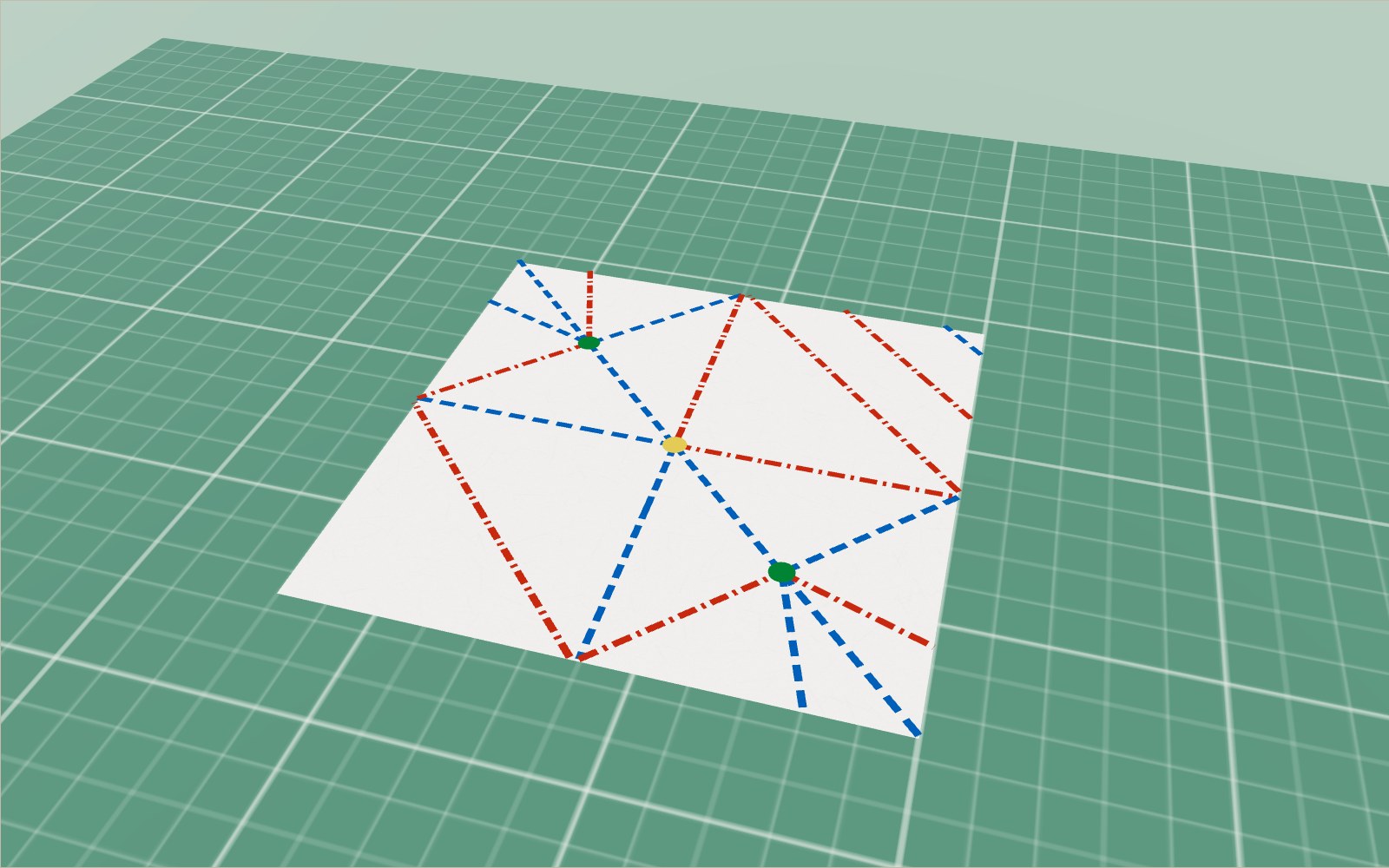
Origami: 20 models to fold step by step and unfold
A crane uses about 30 folds, a cup six; every flat-folded point you make has mountains and valleys that differ by exactly two.
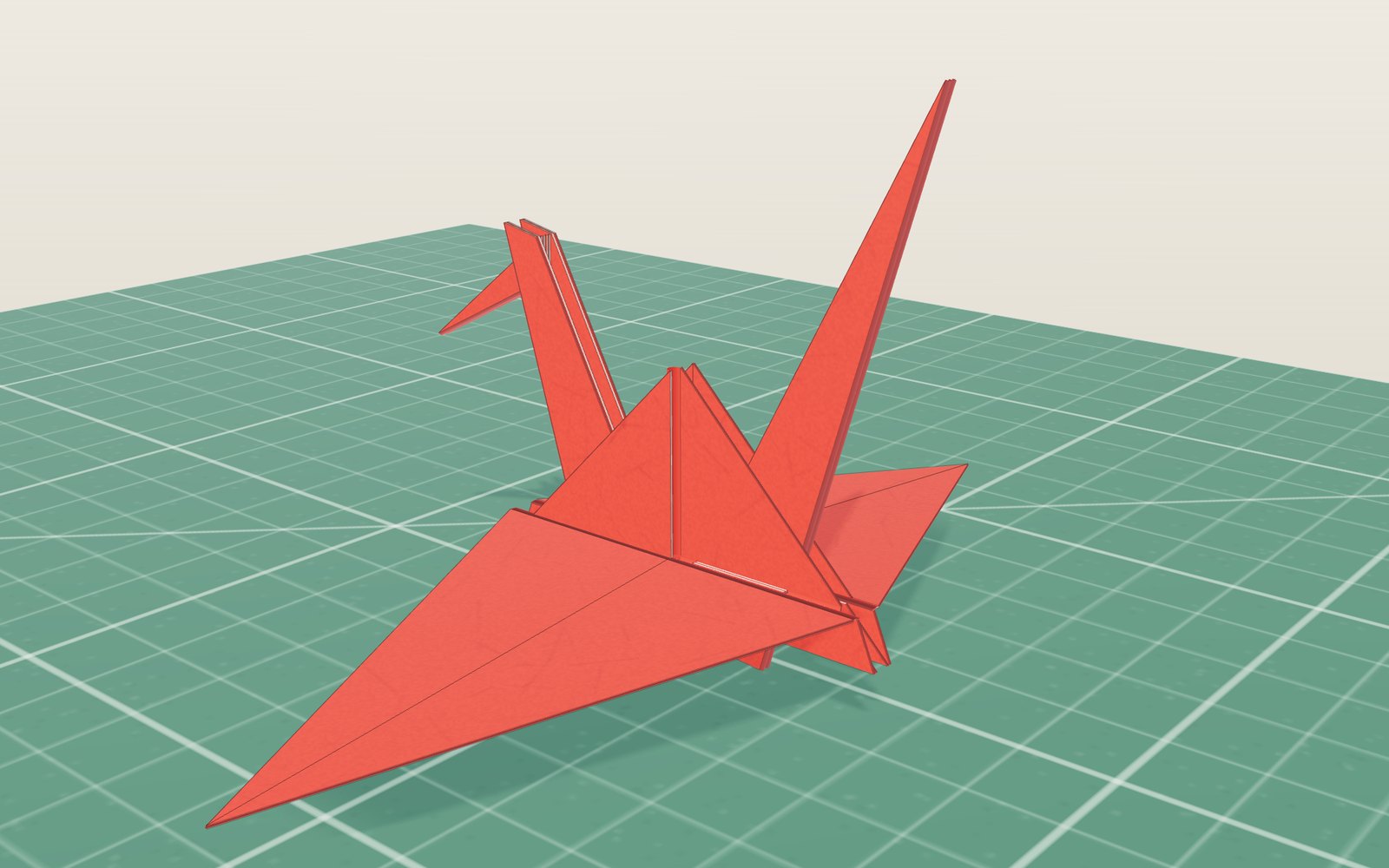
How to fold a paper crane and read its crease pattern
A paper crane is folded from one uncut square, and its two wings, neck and tail are the square's four corners.
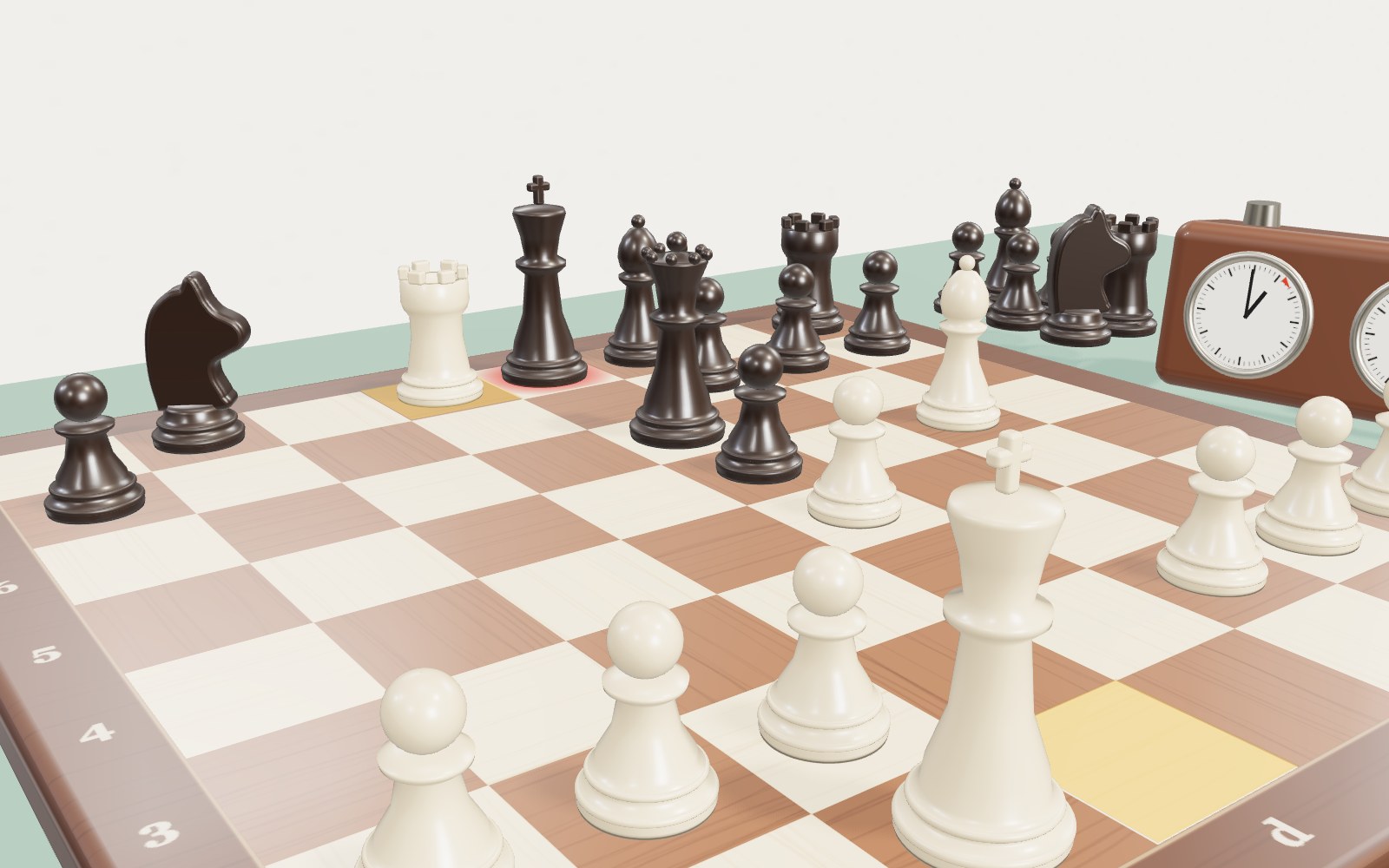
How to play chess, step by step
After just four moves by each side there are 84,998,978,956 possible games.
Slide rule: how to use one, with an interactive model
On a 25 cm slide rule the 2 sits 75.3 mm from the 1, because 250 × log 2 = 75.3, and laying two such lengths end to end multiplies the numbers.
Why should you switch doors in the Monty Hall problem?
After the host opens a door with a goat, the door you did not pick hides the car in two games out of three.
Bicycle gears: which gear makes climbing a hill easier
In a 50 by 11 gear one turn of the pedals moves a road bike 9.57 metres; in 34 by 32 it moves 2.24 metres.