FIG. 108Follow Along
Origami: 20 models to fold step by step and unfold
A crane uses about 30 folds, a cup six; every flat-folded point you make has mountains and valleys that differ by exactly two.
This device cannot show the 3D model. You can read the guide steps below as text.
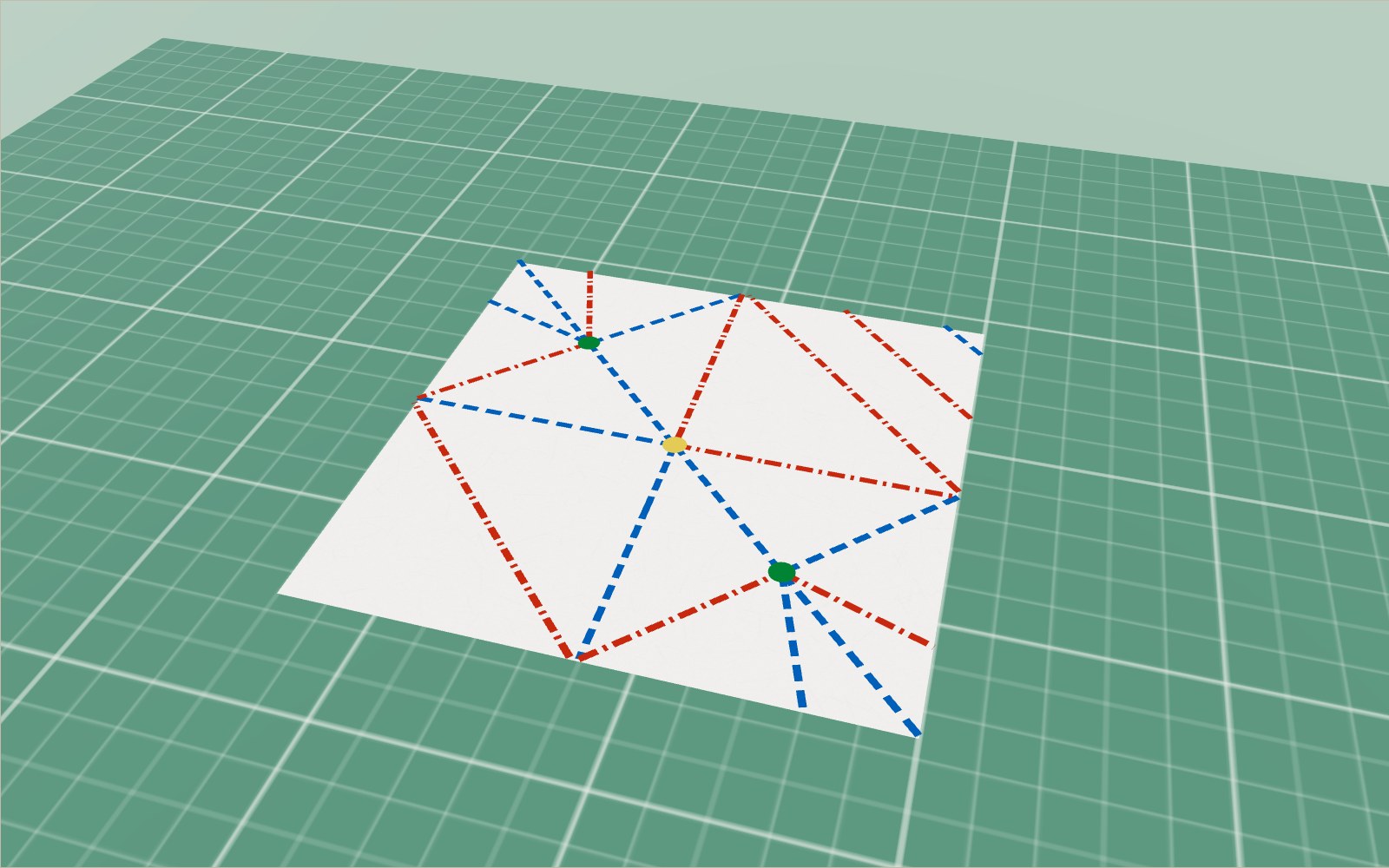
1 / 13 A flat square becomes a birdTwenty-six moves turn one square into the flapping bird. Every line you see on the paper is a crease it will need.
Drag to turn. Scroll or pinch to zoom.
A square that turns into a bird
Origami turns a sheet into a shape by folding rather than cutting or gluing. These twenty models range from a cup to a crane, with each move shown forwards and backwards. Their unfolded crease patterns show where mountain and valley folds meet.
Take a square of paper 15 cm on a side. Fold it about thirty times and it becomes a crane that stands on the table. You have not cut it, glued it or added anything. Every part of the bird, the neck, the head, the two wings and the tail, was already somewhere in that square; the folds only moved it.
This exhibit folds twenty models in front of you, one move at a time: a cup, a samurai helmet, faces of a dog, a fox and a cat, a tulip, a heart, a paper hat, a sailboat, a mouse, a cicada, a swan, a penguin, a fortune teller, an eight-point star, a water bomb, a butterfly, a jumping frog, the crane and the flapping bird. You can play each one, slow it down, step through it with the arrows or run it backwards until the sheet is flat again.
Around the table there are four more things to look at. The crease pattern panel shows the finished model unfolded, with every valley and mountain in colour. The fold-limit lab asks how many times paper can be folded in half and follows the stack until it passes the Moon. The space view opens a solar array folded in the Miura pattern with one pull. And you can bring in the record crane, 81.94 m from wing tip to wing tip, or a thousand small cranes on strings.
How to read the folds on the stage
Origami diagrams in books use a small set of signs, and the stage uses the same ones.
- Valley fold: a dashed blue line. The paper on one side of the line comes up and over toward you, so the crease sinks like the bottom of a valley.
- Mountain fold: a red line of dashes and dots. The paper goes away from you, behind, and the crease rises like a ridge.
- Arrow: shows which part moves and where it lands.
- Crease and unfold: the paper folds and comes straight back, leaving a line to use later.
- Turn over: the whole model flips like a pancake.
- Reverse fold: a flap that is already folded in half is pushed inside itself (inside reverse fold) or wrapped around the outside (outside reverse fold).
Turn on Hands and two mannequin hands appear: one holds the edge that is moving, the other presses the rest of the paper flat. The read-out in the corner counts the pieces of paper, the creases, how many layers deep the stack is at its thickest, and checks two laws of flat folding at every point inside the sheet. More on those below.
Valley and mountain are the same crease seen from opposite sides. Fold a valley, turn the paper over, and the crease is now a mountain. That is why every crease pattern says which side is up; on this page it is always the front, the coloured side of the paper.
Twenty models in three levels
The models are grouped by how much care they need, not by how many steps they have.
Easy (★). The cup takes six moves and holds water for a while. The samurai helmet (kabuto) is folded in Japan for Children's Day; made from a sheet of newspaper it fits a child's head. The dog, fox and cat faces start from the same triangle and differ only in where the corners go: down beside the face for floppy ears, back up past the top for pointed ones. The tulip crosses two corners over the top for petals. The heart is two turns over and some edges to the middle. The paper hat is the newspaper hat, whose brim locks the corners. The sailboat makes two sails from the two layers of one triangle.
Medium (★★). The cicada (semi) folds its wings first and then its striped head. The swan uses kite folds twice before its neck turns out. The penguin starts white side up so its wings come out dark. The fortune teller folds the corners to the centre twice. The eight-point star does the same and then turns the points back out. The mouse uses one inside reverse fold to lift its tail.
Hard (★★★). The water bomb, the butterfly and the jumping frog all start from the waterbomb base, a collapse of six creases that meet in the middle. The crane and the flapping bird share the bird base, which takes a square base and two petal folds.
Most of these are traditional: folded for generations, with no known designer. Four of them, the sailboat, the penguin, the mouse and the eight-point star, are simple sequences written for this exhibit and are marked that way in the collection. No model designed by a named origami artist is used here.
The moves every model is made of
Twenty models sound like twenty different things to learn, but they are built from a handful of moves.
A valley or mountain fold turns some layers about a straight line by 180 degrees. Which layers move is decided by the paper itself. The fold starts with the layers you lift, and everything joined to them on that side of the line comes along. If those layers are joined to the other side anywhere except along the fold line, the fold would tear the paper. The program behind this page refuses such a fold, the same way paper does.
A crease and unfold leaves a line for later. Many of the harder models begin with a few of these, because a later move needs the paper to know where to bend.
A turn over does not fold anything. It is there because the next fold is easier to see from the other side.
A reverse fold works on a flap that is already folded in half. Imagine the neck of the swan: two layers joined along a closed edge, the spine. To make the neck rise, you open the two layers slightly and push the tip inside out around the spine, so it now points up between them (inside reverse) or wraps around them (outside reverse). Both layers fold along the same line at once, in opposite directions.
A collapse folds several creases together. The waterbomb base has six creases meeting at the centre of the square: the two diagonals and one line across the middle. Push the centre and the whole sheet falls into a triangle in one motion. On the stage this collapse is computed exactly: by symmetry, one crease stays in a vertical plane, and the angles between neighbouring creases fix where every other crease points as the paper closes.
The petal fold and the squash fold in the crane are moves like this too: several creases move at once and no single line is a hinge for all of the paper. The crane on this page uses the same moves as the crane exhibit, which solves them as small linkages.
Bases: shapes that many models start from
Folders noticed long ago that many models share their first steps. These shared stages are called bases.
- Kite: two edges folded to a diagonal. The swan and the mouse start here.
- Waterbomb base: a triangle with two flaps on each side, from the six-crease collapse. The water bomb, the butterfly and the jumping frog start here.
- Square base (also called the preliminary base): a small square with four flaps, from a collapse of the diagonals and the two middle lines.
- Bird base: a square base with two petal folds, a long diamond with four points. The crane and the flapping bird start here.
Bases are a good way to see how origami design works. The bird base has four long points from four corners; the crane uses two of them for the neck and tail and two for the wings. The flapping bird uses the same four points but does not narrow the neck and tail, which is why its wings can still move.
Why the paper on the stage never stretches
Paper hardly stretches. If a simulation lets it stretch, the result can look right and still be impossible to fold.
The program on this page treats the sheet as a set of flat pieces. Before each fold, every piece that the fold line crosses is cut along that line, so each piece only ever turns as a rigid plate. A piece never changes shape or size, so the area of the sheet stays exactly the area of the square. The read-out shows this as "paper area kept 100 %". Each fold is a reflection of some pieces across the fold line, and the pieces keep their own edges joined to their neighbours. A check run on every model tests that, for every state of the folding, the shared edges between neighbouring pieces still meet. They do, to within a millionth of the sheet's size.
A real sheet has thickness, and real creases are rounded. The stage separates stacked layers by a small gap, about 0.24 mm on a 15 cm square, and joins neighbouring pieces at different heights with thin strips so no gap shows. The Paper thickness (drawn) control makes that gap thinner or thicker, from tissue to card.
Layers: which flap goes on top
When a fold puts paper on paper, the order of the layers matters. Fold a flap to the front and it lies on top of everything it covers; fold it behind and it lies underneath. A reverse fold slides the tip between the two halves of the flap.
The stage keeps a layer number for every piece. After each move the numbers are packed again, so that two pieces keep their order only where they actually overlap; elsewhere they are free to share a height. That keeps the stack as thin as the folding allows.
There are two ways layers can be in an impossible order, and the checks look for both in every flat state of every model.
- A fold edge is where paper turns back on itself. If another layer sits between the two sides of that fold and crosses the line of the fold, the paper would have to pass through it.
- If two folds lie on the same line and open to the same side, their layer ranges must be nested or separate. If they interleave, the two folds would cut through each other.
For all twenty models, every flat state passes both checks. The checks also sample each move at several moments and look for any piece passing through another. Two kinds of move are shown more simply than paper does them; see "How the models on this page work" below.
Maekawa's theorem
Unfold any flat origami model and look at a point inside the sheet where creases meet. Count the mountains and the valleys. The difference is always two.
Why? Fold the paper flat and cut a tiny circle around that point. The edge of that circle is now a flat zig-zag, like a folded fan seen from above. Going around it, every valley turns the edge back one way and every mountain turns it back the other way. The edge makes one full loop, and the turns must add up accordingly. Work it out and you get M − V = 2 or M − V = −2, depending on which side you look from. Thomas Hull's survey gives this proof, which it credits to Siwanowicz, along with the history of the theorem.
One consequence is that every inner point of a flat fold has an even number of creases: M + V = (M − V) + 2V, and M − V is plus or minus 2.
Turn on Maekawa and Kawasaki at each point. Every inner point of the crease pattern on the panel gets a dot, green when it passes and red when it fails, and two numbers: mountains and valleys. In all twenty models every point passes. The bird base of the crane has a point with 4 mountains and 2 valleys, and points where a straight crease of 2 mountains simply passes through.
Kawasaki's theorem
Maekawa counts creases; Kawasaki measures the angles between them. Around a point where creases meet, number the angles between neighbouring creases 1, 2, 3 and so on. The point can fold flat only if the odd-numbered angles add up to 180 degrees, and so do the even ones.
Again there is a short reason. Folding along a crease reflects the paper on one side to the other. Walk once around the point, crossing each crease: each crossing is one reflection, and after the whole loop you must be back where you started. Two reflections in a row make a rotation by twice the angle between the lines, so the whole loop is a rotation by twice the alternating sum of the angles. For you to end where you began, that sum must be zero: a1 − a2 + a3 − a4 and so on equals 0. With all the angles adding up to 360 degrees, that is the same as the alternate angles each adding to 180.
Kawasaki's theorem is a complete answer for one point on its own: if the alternating sum is zero, some way of folding that point flat exists. The MIT course 6.849, Geometric Folding Algorithms, covers both theorems in its third lecture, and its later slides note that Maekawa and Kawasaki found them in the early 1980s.
The quiz in the lab below the controls asks about both. Maekawa: here are the mountains at a point, how many valleys are there? Kawasaki: three of four angles are given, what must the fourth be?
When the local rules are not enough
Maekawa and Kawasaki are about one point at a time. A crease pattern can pass both at every point and still not fold flat, because the layers at one point can block the layers at another.
In 1996 Marshall Bern and Barry Hayes proved that deciding whether a crease pattern folds flat is NP-hard in general, and that even finding a valid order of the layers, given which creases are mountains and which are valleys, is NP-hard. In practical terms, nobody knows a fast method that works for every large pattern, and there probably is none.
The stage does not have to solve that problem, because it never starts from a crease pattern alone. It folds step by step, as a person does, and each step decides where its layers go. The checks then confirm that the result obeys the local laws and the layer rules.
Reading the crane's crease pattern
Open the Crease pattern view with the crane. The square is crossed by its two diagonals, by lines from the corners toward the middle, and by the outline of a large diamond. This is the pattern of the bird base: the crane's neck, tail, head and narrowing folds come after it.
Some things to look for:
- The two diagonals are not alike. Follow each one and see where it is a valley and where it is a mountain.
- Lines meet at steps of 22.5 degrees. Every angle in the bird base is a multiple of 22.5 degrees, which is why its points are so sharp.
- Count any inner point. Mountains and valleys always differ by two.
The Name the pattern quiz shows the crease pattern of a random model and asks which one it is. It is harder than it sounds: the cup and the dog face look nothing alike folded, and their patterns are both a few lines across a square.
How many times can you fold paper in half?
There is an old claim that paper cannot be folded in half more than seven or eight times. It is not true, but it is close to the limit for an ordinary sheet in ordinary hands, because each fold doubles the thickness and halves the size.
Start with copy paper 0.1 mm thick. Fold once: 2 layers, 0.2 mm. Fold 7 times: 128 layers, 12.8 mm, a stack that is thick for its size if you started with an A4 sheet. By then the paper is too thick for its length to bend around.
On 27 January 2002 Britney Gallivan, a high-school student in Pomona, California, folded a single sheet of paper in half 12 times. Guinness World Records lists it as the record for most times to fold a piece of paper. She did it with a very long strip, folding always in the same direction, and she worked out why length was the limit: at every fold the outer layers have to go around the inner ones, and that uses up paper. Her formula for the length of strip needed for n folds of paper of thickness t is
L = (π t / 6) (2^n + 4) (2^n − 1).
For copy paper, 12 folds need a strip about 879 m long. The lab shows this number for whatever paper and number of folds you choose.
Choose Paper for the fold test and Times folded in half in the controls, or use the minus and plus buttons in the lab view. The stack grows next to the person by the table: 12 folds of copy paper are 4,096 layers and about 41 cm thick. The stack's footprint is drawn at least 4 cm wide so you can see it; a real 30 cm sheet folded 12 times would be only a few millimetres across.
Folding to the Moon
Keep doubling and the numbers run away.
| Folds | Layers | Copy paper stack |
|---|---|---|
| 7 | 128 | 12.8 mm |
| 12 | 4,096 | 41 cm |
| 14 | 16,384 | 1.6 m |
| 17 | 131,072 | 13 m |
| 27 | 134,217,728 | 13.4 km |
| 42 | 4,398,046,511,104 | 439,805 km |
At 14 folds the stack is about as tall as a person; at 27 it is taller than Mount Everest; at 42 it would reach past the Moon, which is 384,400 km away on average (NASA). Nobody can do this. To fold anything 42 times you would need a sheet larger than any that can be made, and the strip in Gallivan's formula would be absurdly long. The table is about doubling, not about paper.
The lab names the tallest thing the stack has passed: a person, a three-storey house, Lotte World Tower, Mount Everest, the space station, the Moon and finally the Sun. Find the number of folds that gets copy paper past the Moon to earn the "To the Moon" star.
The Miura fold: a map that opens with one pull
In 1985 Koryo Miura, of Japan's Institute of Space and Astronautical Science, published a way to pack large thin sheets for space. The sheet is divided into rows of parallelograms, slanted slightly, so that the creases running one way are straight and the creases running the other way zig-zag. The JAXA Space Education Center describes the result simply: the sheet folds into a compact pack, and pulling one end opens it smoothly.
What makes it special is that it has only one degree of freedom. In a sheet of 64 cells there is one number that decides the shape of the whole thing; change it and every cell moves together. The stage's Miura sheet is computed that way. Each corner of the grid is placed from three lengths: how far the zig-zag rises, the spacing along one direction and the offset along the other. Choose the rise and the other two follow from the side lengths of the parallelograms, so every cell stays flat and every crease keeps its length at every stage.
Try Miura cell angle. At 80 degrees the cells are slanted parallelograms and the sheet folds in both directions at once. Move it to 90 degrees and the cells become rectangles. Now the sheet can only fold one way at a time: the JAXA material makes the point that a rectangular version will not unfold smoothly. The slant is what ties the two directions together.
Mark Schenk and Simon Guest, at Cambridge, described the geometry of Miura-folded sheets in detail in 2013 and showed how folding changes their stiffness. Folded sheets like these are also studied as mechanical metamaterials, materials whose behaviour is set by their folds rather than by what they are made of.
Origami in space
The Space Flyer Unit was launched from Tanegashima on 18 March 1995 and brought back to Earth by the Space Shuttle on mission STS-72 in January 1996. One of its experiments was the two-dimensional solar array, a Miura-folded panel that opened in orbit. The JAXA ISAS mission page lists the array among the experiments that returned results.
In 2014 NASA's Jet Propulsion Laboratory and Brigham Young University showed a different origami array, designed with the origami artist Robert Lang. It folds into a bundle about 2.7 m across and opens to 25 m; their tabletop model opens to 1.25 m. The JPL article makes the same point the Miura fold makes: with the right folds, one pull on one corner opens the whole thing.
The James Webb Space Telescope also flew folded. Its sunshield, five thin layers about the size of a tennis court, was folded and packed to fit inside the rocket and unfolded in space. It is not a crease pattern of the kind on this page, but the problem is the same: a large thin surface has to travel small.
Origami inside the body
Folding is also useful at the other end of the size scale. In 2006 Kaori Kuribayashi and colleagues, from the University of Oxford and Japan, described a stent graft made from a thin foil of shape-memory alloy, folded in an origami pattern so that it could be pushed through a blood vessel small and then open at body temperature. The foil was etched along its fold lines so that it bent there and nowhere else, which is the same idea the stage uses: rigid panels joined by creases.
A thousand cranes
A senbazuru is a thousand cranes threaded on strings, given as a wish for recovery or for peace. It is often hung as 25 strings of 40, which is how the stage arranges them when you turn on A thousand cranes. On a fast computer the stage draws all 1,000; on a slow one it draws 300.
The story most people know comes from Hiroshima. Sadako Sasaki was two years old when the atomic bomb fell on the city on 6 August 1945. At twelve she fell ill with leukaemia, and in hospital she folded paper cranes, more than a thousand of them; when she died there were 1,300 cranes in her room. The US National Park Service tells her story and how her classmates raised money for the Children's Peace Monument, which has stood in Hiroshima since 1958.
How long would a thousand take you? Guinness World Records lists the fastest time to make 100 origami cranes as 40 minutes 35 seconds, by Yoneyama Yuichi in Nagoya in 2010, an average of 24.35 seconds each. The fastest time to make 1,000 is 9 hours 31 minutes 13 seconds, by Evelyne Chia in Colchester in 2021. Put your own time for one crane into the lab under the controls and it works out your senbazuru: at three minutes a crane that is 50 hours of folding, or 50 days at one hour a day.
The biggest crane
Turn on Record crane at full size. Behind the room, a crane with a wingspan of 81.94 m appears, the largest origami crane listed by Guinness World Records. It was folded by 800 people of the Peace Piece Project at Hiroshima Shudo University on 29 August 2009, from a sheet 100 m by 100 m made of smaller pieces taped together. The wingspan was measured by a surveyor using triangulation.
The person by the table is 1.7 m tall. The record crane's sheet was 100 m on a side, about 670 times the 15 cm square on the table, and so about 440,000 times its area.
Where the models come from
Origami history is full of guesses, so here is only what the sources support.
The crane is old. David Lister, the origami historian whose notes the British Origami Society keeps, wrote that Satoshi Takagi traced pictures of the crane back to the early 17th century, when it was already an established model.
The oldest known book of recreational origami in Japan, Hiden Senbazuru Orikata (the secret of folding a thousand cranes), shows 48 models of cranes folded from one sheet and still joined to each other, with comic poems. Kyushu University's library guide says the models were designed by Gido, a Buddhist monk in Kuwana, and selected and named by the writer Akisato Rito. The guide gives the date as 1789, while the year 1797 is also widely quoted. The sources disagree, so the exhibit gives both.
The flapping bird is a puzzle. It looks like a close cousin of the crane, but Lister noted that Japanese folders shown it often said they had never seen it. Gershon Legman wrote that Japanese stage conjurors brought it to the West in the 1870s or 1880s; Lister traced that claim to a 1936 newspaper article and was not convinced. Its origin is still unknown.
The water bomb, the jumping frog, the samurai helmet and the paper hat are all traditional, folded in many countries with no known designer. Origami societies such as the Nippon Origami Association, OrigamiUSA and the British Origami Society keep diagrams and histories of models like these.
The jumping frog's spring
The jumping frog is folded from a card, here with the 3 by 5 proportions of an index card. Its front is a waterbomb base with the front legs folded up. Its back is folded up and then half back down, making a Z-shaped pleat. Press the back edge down and let go, and the pleat springs open and throws the frog forward.
On the stage, Make it jump uses a simple model of that spring: a stiffness of about 30 N/m, a mass of about 1 g and a take-off angle of 40 degrees, with the compression depending on how hard you press. It gives jumps of roughly 5 to 30 cm, which is the range paper frogs reach, but it is an estimate, not a measurement; real frogs depend on the card, how sharp the creases are and the press. Get a jump of more than 10 cm for the "Frog jump" star.
Blowing up the water bomb
The water bomb is folded flat and then inflated by blowing into a small hole at its bottom. The paper puffs out into a rough cube. Real paper does this by bending and crumpling a little along new lines, which no rigid-piece model can show. So the last step on the stage fades the folded paper into a drawn, puffed shape of the same colour. The folding before it is exact; the inflation is a drawing.
The real water bomb also tucks two small points into pockets before it is blown up, which holds it closed. The stage stops before the tucks.
You and the paper
Open Me in the corner of the stage. Enter your height and the person by the table changes to your size. The note then works out how many times the paper chosen in the fold-limit lab would have to be folded in half to make a stack as tall as you: copy paper, 0.1 mm thick, needs 15 folds for a person 1.7 m tall, because 14 folds give only 1.6 m. The note also gives your thousand cranes at the speed you entered in the lab.
How the models on this page work
Each model is a list of moves written in the coordinates of the paper as it lies on the table. For each move the program cuts the pieces that the fold line crosses, finds the layers that move by growing outward from the ones you lift, reflects them across the line and packs the layer numbers again. The same code runs in the browser and in a check program that runs every model before the page is published.
The check program tests, for all twenty models:
- the area of the paper is unchanged and no edge changes length at any moment of any move;
- shared edges between neighbouring pieces still meet in every flat state;
- every inner point of the crease pattern of the finished flat state passes Maekawa's and Kawasaki's theorems;
- no flat state puts a layer through a fold, and no two folds on one line cross;
- no piece passes through another at sampled moments of each move;
- every task can be done and every quiz has an answer;
- every source used on the stage is listed below.
Some moves are shown more simply than paper does them.
- Inside reverse folds (the swan's head, the penguin's head, the mouse's tail, the flapping bird's neck, tail and head) end in the exact folded position, but on the way the tip slides round in the plane of the paper while the layers above it lift slightly. Real paper opens the flap and turns the tip inside out through the space between the layers.
- The crane uses the crane exhibit's own fold sequence and motion. The checks above run on it up to the bird base; the narrowing folds, neck, tail and head are that exhibit's moves.
- The water bomb's inflation is drawn, as described above, and the frog's jump is a model estimate.
- Wings and other 3D shaping turn each layer about the fold line at its own height, so stacked layers stay nested as they bend.
A paper box (the traditional masu) is not among the twenty. Its walls rise with folds at the corners that all move together, and the stage does not yet animate that honestly.
Things to try
- Pick the cup, turn on Hands and step through it with the arrows. Then turn on Unfold backwards and watch it open.
- Fold the crane, open Crease pattern and turn on Maekawa and Kawasaki at each point. Count the creases at three points.
- Fold the dog face and the fox face one after the other. They share their first two moves.
- In the fold-limit lab, find how many folds of tissue, copy paper and card make a stack taller than you.
- In the space view, pull the array open at 80 degrees, then set the cell angle to 90 and try again.
- Turn on the record crane and turn the camera round it. Then come back to the table.
- Find all thirteen hidden things around the table. One of them is under it.
Questions
How many folds does a paper crane take?
On this page the crane takes 30 moves, counting each crease, unfold and turn over. Diagrams in books often show 15 to 25 numbered steps because they combine several moves into one picture.
What is the difference between a valley fold and a mountain fold?
A valley fold brings the paper toward you, so the crease sinks; a mountain fold takes it away from you, so the crease rises. It is the same crease seen from the two sides of the paper.
What is a reverse fold?
A reverse fold changes the direction of a flap that is already folded in half. In an inside reverse fold the tip goes between the two layers; in an outside reverse fold it wraps around them. Both layers fold along the same line in opposite directions.
What is a crease pattern?
The lines left on a sheet when you unfold a finished model, with each line marked as a mountain or a valley. Experienced folders can fold some models from the crease pattern alone.
What is Maekawa's theorem?
At any point inside a sheet where creases meet, if the paper folds flat, the number of mountain folds and the number of valley folds differ by exactly two.
What is Kawasaki's theorem?
A point where creases meet can fold flat only if the angles between neighbouring creases, taken alternately, add up to 180 degrees. For one point on its own this condition is also enough.
Can a computer tell whether any crease pattern folds flat?
For small patterns yes, but in general the problem is NP-hard, as Bern and Hayes proved in 1996. There is probably no fast method that works for every large pattern.
How many times can you fold a piece of paper in half?
The Guinness record is 12, by Britney Gallivan in 2002, using a very long strip. An ordinary sheet in your hands usually stops at seven or eight.
Would folding paper 42 times really reach the Moon?
On paper, yes: 0.1 mm doubled 42 times is about 439,805 km, more than the Moon's average distance of 384,400 km. In practice the sheet and the strip length needed are impossible, so it stays a fact about doubling.
What is the Miura fold used for?
For packing large thin sheets so they open with one movement: maps, solar arrays and membranes in space. A Miura-folded solar array was tested on the Space Flyer Unit in 1995.
Why are the cells of the Miura fold parallelograms and not rectangles?
The slant ties the folds in one direction to the folds in the other, so the whole sheet moves together. With rectangles the two directions are independent and the sheet does not open smoothly.
What is a senbazuru?
A thousand origami cranes threaded on strings, given as a wish for health, recovery or peace. It is often hung as 25 strings of 40.
How long does it take to fold a thousand cranes?
The Guinness record is 9 hours 31 minutes 13 seconds. At three minutes a crane it is 50 hours of folding.
Which of these models are traditional?
All except the sailboat, the penguin, the mouse and the eight-point star, which are simple sequences written for this exhibit. No model by a named designer is used.
Why does the paper on the stage look slightly thick at the folds?
Stacked layers are drawn a small distance apart, about 0.24 mm, so they never overlap on screen, and thin strips join pieces at different heights. You can change the gap with the paper thickness control.
Is the jumping frog's distance real?
It is a model estimate from a spring and the frog's mass. Real paper frogs jump roughly 5 to 30 cm depending on the card and the press.
Terms
- Valley fold: a fold toward you; the crease sinks.
- Mountain fold: a fold away from you; the crease rises.
- Crease pattern: the creases of a finished model, unfolded, each marked mountain or valley.
- Flat fold: a folded state that lies flat, as if pressed in a book.
- Base: a folded stage that many models share (kite, waterbomb, square, bird).
- Reverse fold: a fold that turns a doubled flap inside out, inside or outside.
- Petal fold: lifting one layer along two creases so it narrows into a long point.
- Collapse: folding several creases at once so the sheet falls into a new shape.
- Maekawa's theorem: mountains and valleys at a flat-folded point differ by two.
- Kawasaki's theorem: alternate angles around a flat-folded point add up to 180 degrees.
- Miura fold: a pattern of slanted parallelograms that opens and closes with one movement.
- Senbazuru: a thousand cranes on strings.
Sources
- Guinness World Records, Origami: largest paper crane. https://www.guinnessworldrecords.com/world-records/origami-largest-paper-crane (checked 2026-10-20)
- Guinness World Records, Fastest time to make 1000 origami cranes. https://www.guinnessworldrecords.com/world-records/655831-fastest-time-to-make-1000-origami-cranes (checked 2026-10-20)
- Guinness World Records, Fastest time to make 100 origami cranes. https://www.guinnessworldrecords.com/world-records/fastest-time-to-make-100-origami-cranes (checked 2026-10-20)
- Guinness World Records, Most times to fold a piece of paper. https://www.guinnessworldrecords.com/world-records/494571-most-times-to-fold-a-piece-of-paper (checked 2026-10-20)
- Thomas C. Hull, The combinatorics of flat folds: a survey (arXiv:1307.1065). https://arxiv.org/abs/1307.1065 (checked 2026-10-20)
- MIT 6.849 Geometric Folding Algorithms, Maekawa and Kawasaki revisited and extended (slides). https://courses.csail.mit.edu/6.849/fall10/lectures/L20_images.pdf (checked 2026-10-20)
- MIT 6.849 Geometric Folding Algorithms, Lecture 3: single-vertex crease patterns. https://courses.csail.mit.edu/6.849/fall10/lectures/L03.html (checked 2026-10-20)
- Erik Demaine and Joseph O'Rourke, a survey of folding and unfolding in computational geometry. https://erikdemaine.org/papers/FUCG_MSRI/paper.pdf (checked 2026-10-20)
- Marshall Bern and Barry Hayes, The complexity of flat origami (1996), OSTI record. https://www.osti.gov/biblio/416799 (checked 2026-10-20)
- Koryo Miura, Method of packaging and deployment of large membranes in space, ISAS Report 618 (1985), CiNii record. https://cir.nii.ac.jp/crid/1050003824960950144 (checked 2026-10-20)
- JAXA ISAS, Space Flyer Unit (SFU). https://www.isas.jaxa.jp/en/missions/spacecraft/past/sfu.html (checked 2026-10-20)
- JAXA Space Education Center, From origami to IKAROS. https://edu.jaxa.jp/activities/SEEC/material/assets/SEEC27-yo.pdf (checked 2026-10-20)
- Mark Schenk and Simon Guest, Geometry of Miura-folded metamaterials, PNAS 2013. https://doi.org/10.1073/pnas.1217998110 (checked 2026-10-20)
- Jesse Silverberg and others, Using origami design principles to fold reprogrammable mechanical metamaterials, Science 2014. https://doi.org/10.1126/science.1252876 (checked 2026-10-20)
- NASA, Webb's sunshield. https://science.nasa.gov/mission/webb/webbs-sunshield/ (checked 2026-10-20)
- NASA, Moon facts. https://science.nasa.gov/moon/facts/ (checked 2026-10-20)
- NASA Jet Propulsion Laboratory, Solar power, origami-style (2014). https://www.jpl.nasa.gov/news/solar-power-origami-style (checked 2026-10-20)
- BYU News, BYU engineers turn to origami to solve astronomical space problem (2013). https://news.byu.edu/news/byu-engineers-turn-origami-solve-astronomical-space-problem (checked 2026-10-20)
- Kaori Kuribayashi and others, Self-deployable origami stent grafts, Materials Science and Engineering A (2006). https://doi.org/10.1016/j.msea.2005.12.016 (checked 2026-10-20)
- Kyushu University Library, History of origami: late 1700s to early 1800s. https://guides.lib.kyushu-u.ac.jp/origami-en/late18C-mid19C (checked 2026-10-20)
- British Origami Society, The Lister List: origins of the flapping bird. https://www.britishorigami.org/cp-lister-list/origins-of-the-flapping-bird/ (checked 2026-10-20)
- British Origami Society, The Lister List. https://www.britishorigami.org/resources/the-lister-list (checked 2026-10-20)
- US National Park Service, The story of Sadako Sasaki. https://www.nps.gov/articles/000/the-story-of-sadako-sasaki.htm (checked 2026-10-20)
- Nippon Origami Association. https://www.origami-noa.jp/ (checked 2026-10-20)
- OrigamiUSA. https://origamiusa.org/ (checked 2026-10-20)
- Erik Demaine, Fold-and-cut problem. https://erikdemaine.org/foldcut/ (checked 2026-10-20)
More exhibits
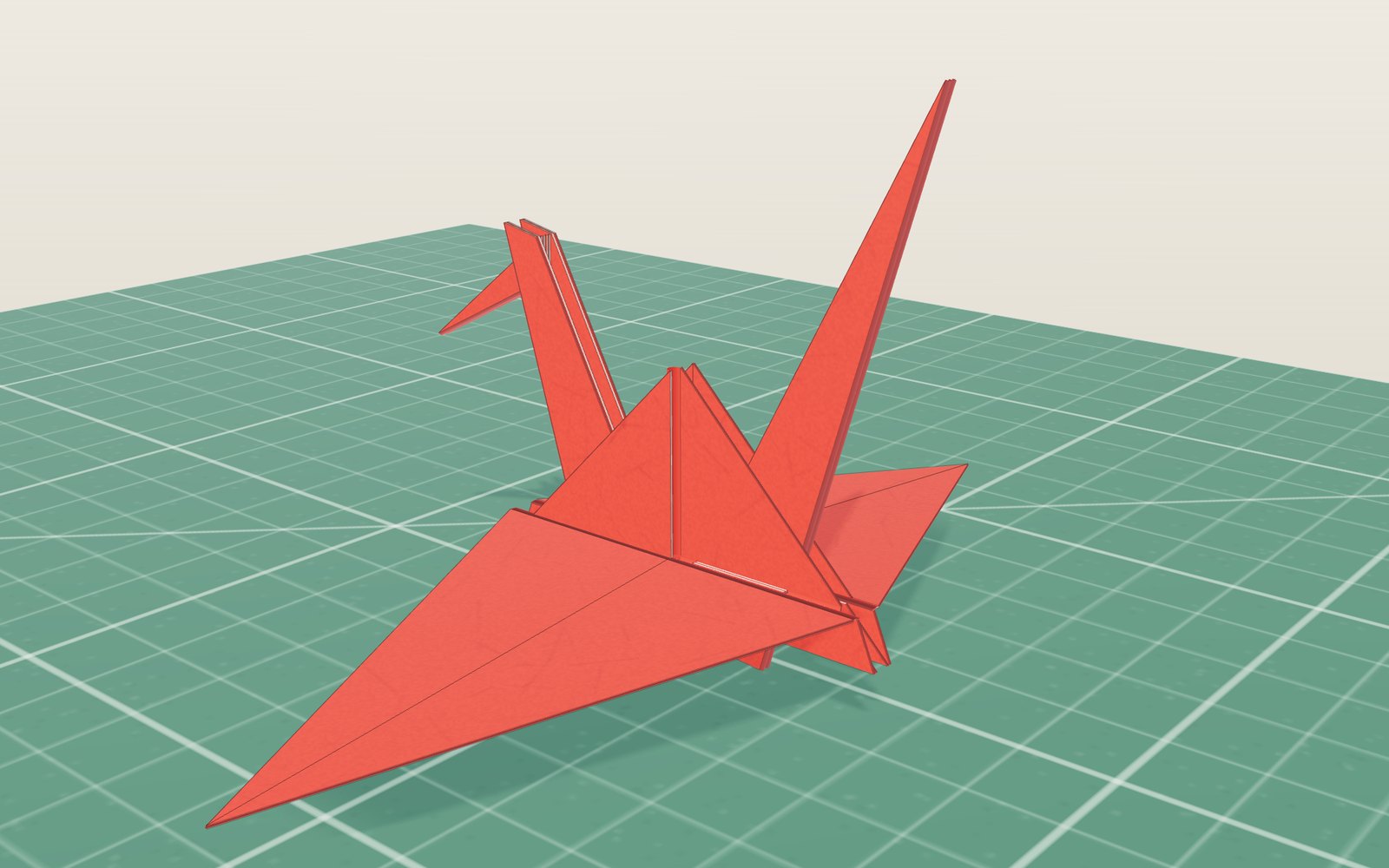
How to fold a paper crane and read its crease pattern
A paper crane is folded from one uncut square, and its two wings, neck and tail are the square's four corners.
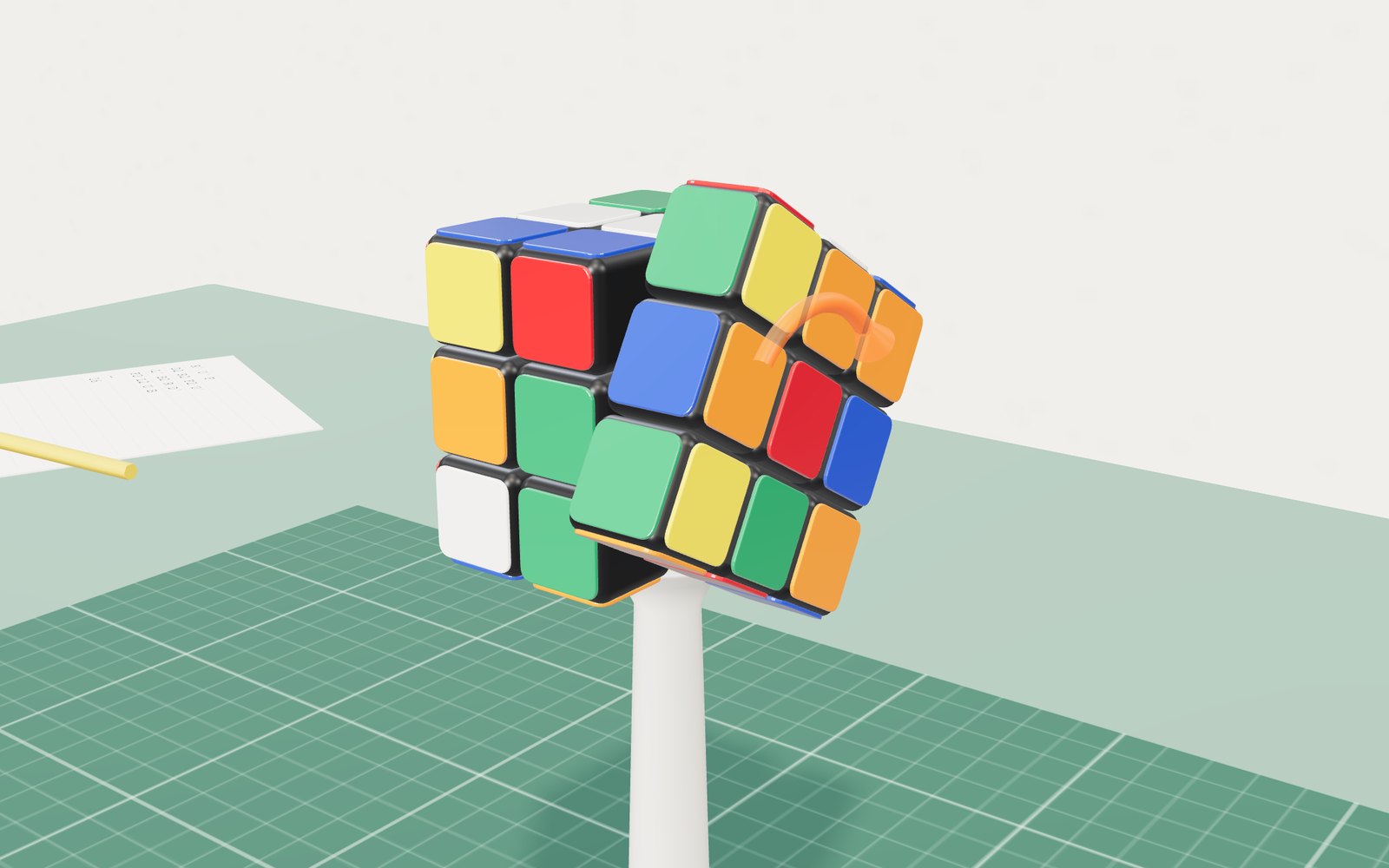
How to solve a 3×3 cube, step by step
A 3×3 cube has 43,252,003,274,489,856,000 positions, and every one of them can be solved in 20 moves or fewer.
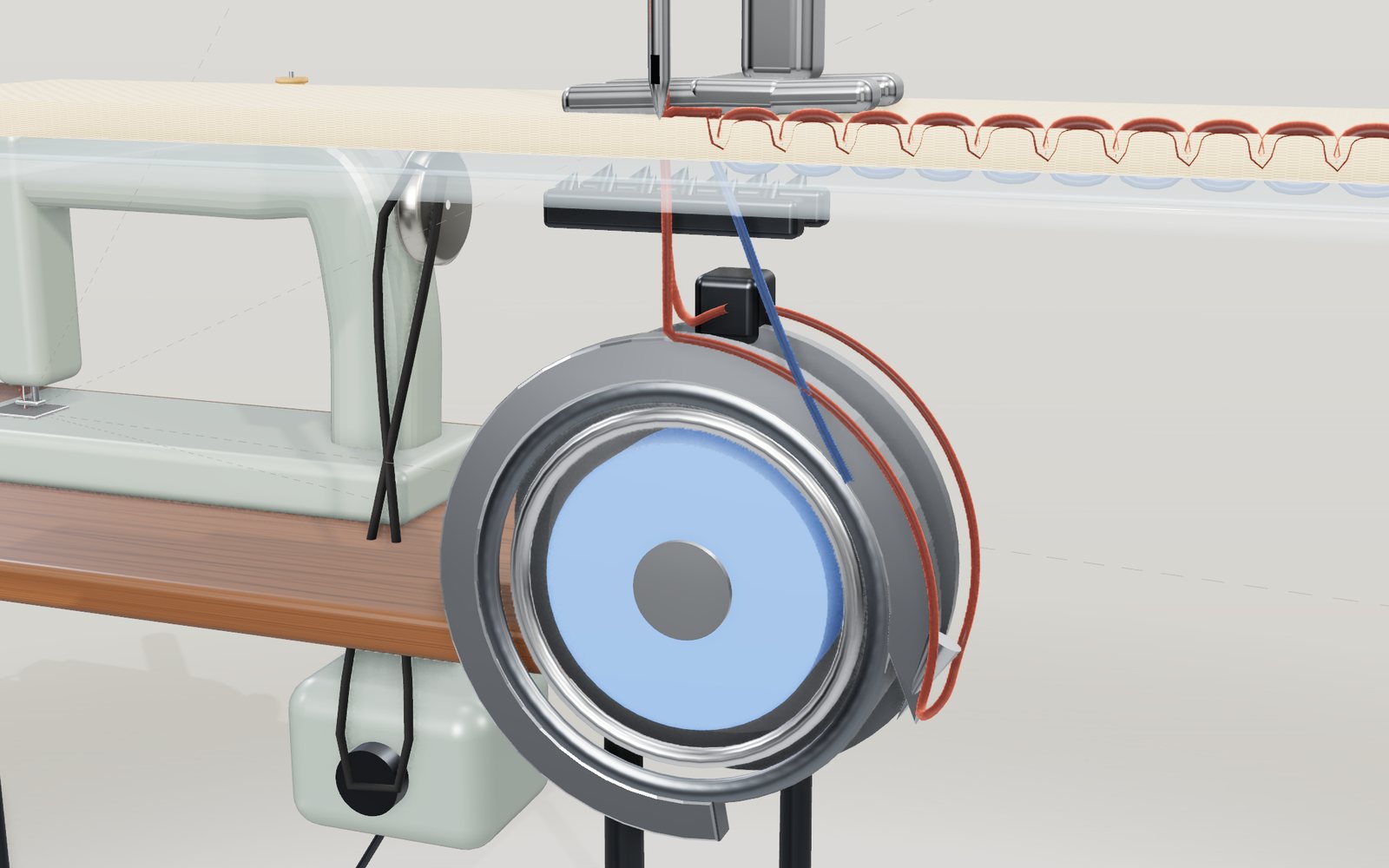
How a sewing machine makes a stitch
A sewing machine needle never goes through the cloth: at every stitch the hook drags its thread right round the bobbin instead.
How a 3D printer works, layer by layer
A 20 mm cube printed in 0.2 mm layers is exactly 100 layers, each drawn by a nozzle 0.4 mm wide.
Bicycle gears: which gear makes climbing a hill easier
In a 50 by 11 gear one turn of the pedals moves a road bike 9.57 metres; in 34 by 32 it moves 2.24 metres.
Slide rule: how to use one, with an interactive model
On a 25 cm slide rule the 2 sits 75.3 mm from the 1, because 250 × log 2 = 75.3, and laying two such lengths end to end multiplies the numbers.