FIG. 80Follow Along
How to fold a paper crane and read its crease pattern
A paper crane is folded from one uncut square, and its two wings, neck and tail are the square's four corners.
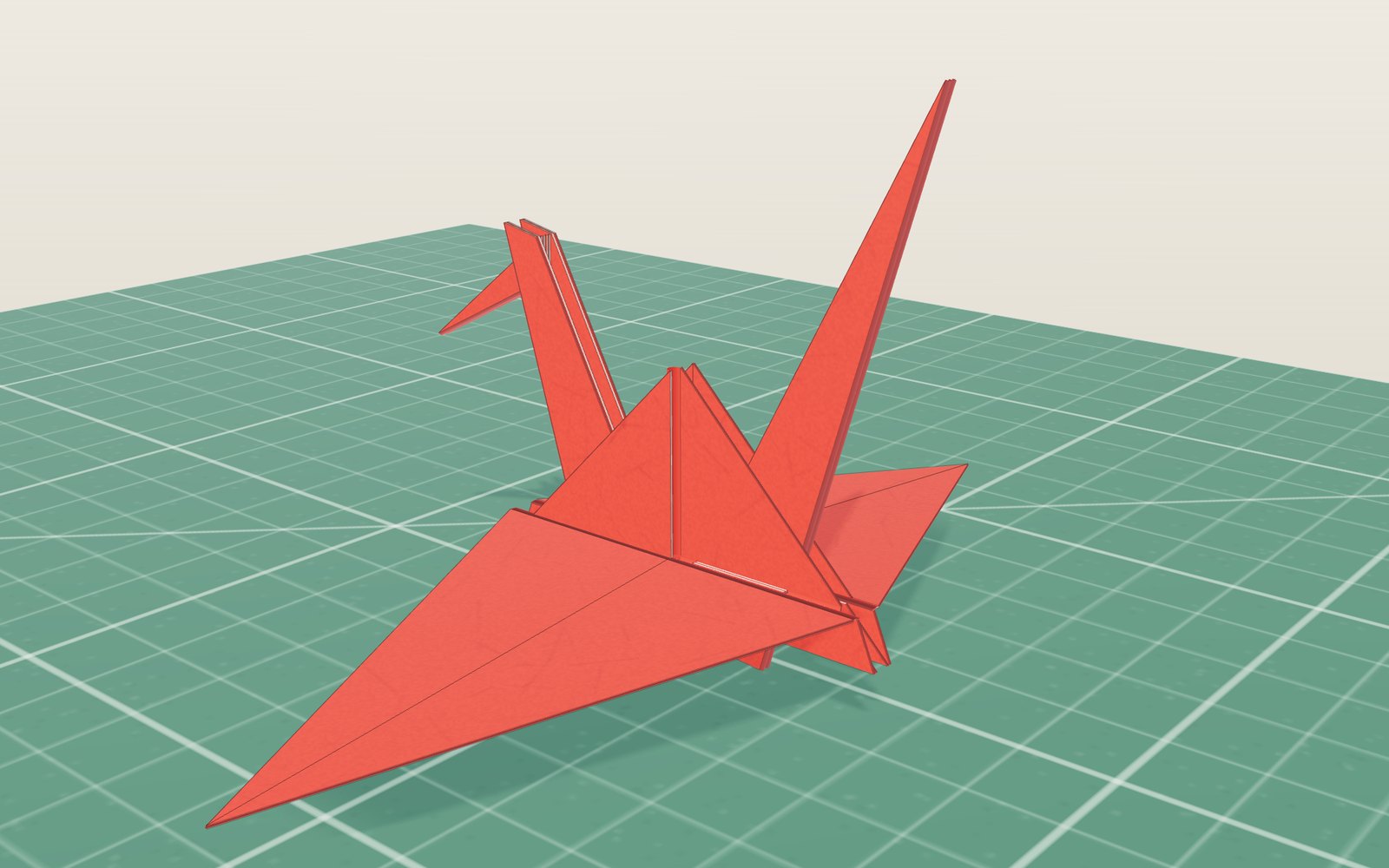
This device cannot show the 3D model. You can read the guide steps below as text.
1 / 8 Pre-crease the squareTwo diagonals from the coloured side, two midlines from the white side. Each fold opens again, and the creases are all the next move needs. The bar under the model steps one move at a time.
Drag to turn. Scroll or pinch to zoom.
What the model shows
A paper crane starts with a square base, opens into a bird base and uses inside reverse folds to form the neck, tail and head. Unfolding the finished crane reveals the crease pattern left by those moves. The model lets you follow each fold forwards or backwards and separate the layers to see where the paper goes.
Pick up a square of origami paper and you can make a crane without scissors or glue. Ask how, and most people remember the end, a bird with a thin neck and flat wings, but not the thirty or so moves in between. This exhibit folds one square into the traditional crane in 3D, a move at a time, and then unfolds it again so you can see every crease it used.
The bar under the model steps forward and back one move at a time. The rewind button takes the paper back to a flat square, playing every fold in reverse. The shortcuts across the top jump to the eight stages listed in the Guide. While a move is about to play, a dashed line marks a valley fold and a dash-dot line marks a mountain fold, and an orange arrow traces the real path of the corner that moves. Drag to turn the model and look at it from underneath. In Controls you can change the folding speed, scrub through all 30 moves with a slider, hide the arrows, fold lines or crease marks, pull the stacked layers further apart, and change the colour of the paper. The Parts list names the four corners, the centre, the main creases and the finished head, neck, tail, wings and body. Choosing one lights it up on the paper.
Why the creases come first
The first ten moves fold and unfold the square four times and leave it looking almost untouched. They are there because the next move, the collapse into the square base, folds eight creases at once. Paper will only do that cleanly if the creases are already in it.
Seen from the coloured side, the two diagonals are valley folds: the paper bends towards you along them. The two midlines, folded from the white side, are mountain folds. When you push the sides in, the centre rises, the four corners slide together underneath, and the sheet flattens into a square with sides half as long as the original. In the model you can watch this happen in three phases. First the centre lifts while all eight creases fold together. Then, with the four corner creases pointing straight down, the four flaps swing in pairs until they lie flat. Last, the small square is laid on the table.
This flat shape has several names. Origami books call it the preliminary fold, the preliminary base or the square base. Turn it inside out and you get the waterbomb base, which has the same creases with every mountain and valley swapped.
Two kinds of fold and how diagrams draw them
Every move in this exhibit is built from two simple actions. A valley fold bends the paper towards you so the fold line sits at the bottom of a V. A mountain fold bends it away so the line is a ridge. Turn the paper over and every valley becomes a mountain, which is why the same crease can be called either, depending on which side you are looking at.
Origami diagrams draw these with the system Akira Yoshizawa introduced in his 1954 book Atarashi Origami Geijutsu. A dashed line is a valley fold and a dashed line with dots is a mountain fold. Samuel Randlett and Robert Harbin added symbols such as "rotate" and "zoom in", and Randlett described the system in The Art of Origami in 1961. It is now known as the Yoshizawa–Randlett system and is used in origami books in most languages. The fold lines in this exhibit follow it.
The petal fold makes the bird base
From the square base, the crane needs two long points that will become wings and two that will become the neck and tail. The petal fold makes them. First come three practice folds: the two lower edges of the top layer are folded to the centre line (the kite folds), the top triangle is folded down over them, and all three are opened again. Then the bottom corner of the top layer is lifted along the horizontal crease. As it rises, the two sides swing inwards along the kite creases and the flap lies flat as a long diamond.
The petal fold is the hardest move in the crane, because four pieces of paper move at once and none of them can be held still. In the model each end of the horizontal crease is a point where four creases meet: the hinge the flap turns on, the kite crease on the flap, the crease between the side triangle and the layer under it, and the kite crease in that lower layer. With the paper kept flat between creases, those four pieces behave like a linkage of four hinged plates. Lifting the flap by any angle fixes where the side triangle and the inner layer must be, so the model works out their positions at every frame. The side triangles swing round the back of the lifting flap and end up on its outside, which is why the finished bird base shows a seam down the middle of each long flap.
Repeat the kite folds and the petal fold on the back and you have the bird base, also called the crane base: two long flaps above and two split flaps below. It is one of the classic bases listed in the table further down.
Neck, tail and head are reverse folds
The two lower flaps are too wide for a neck, so their lower edges are folded in to the centre line on both sides. Each flap ends up about half as wide.
To turn a thin point upwards, you cannot simply fold it up, because it would then sit on the outside of the body and block the wing. Instead you make an inside reverse fold. Open the two halves of the point slightly, push the point up between them along a fold line, and flatten. The point turns inside out along its folded edge and ends up sandwiched between the layers of the body. The neck and the tail are one reverse fold each, turned in opposite directions. In the model the neck turns through 152 degrees. The head is a third, smaller reverse fold, here 100 degrees, near the end of the neck.
Last, the bird stands up and each wing is folded down along the line that joins the base of the neck to the base of the tail. Lifting the wings out level finishes the crane.
Numbers you can check on the model
Take the side of the square as 1.
- The square base is a square of side 1/2, so it covers a quarter of the original area.
- The kite creases make an angle of 22.5 degrees with a diagonal. Each one meets a midline at a distance of 1 − 1/√2, about 0.293, from the centre.
- The four petal hinges form a small square around the centre with side √2 − 1, about 0.414.
- The square base and the bird base both measure 1/√2, about 0.71 of the paper side, from the closed centre point to an open tip.
- At the thickest point of the folded, flat crane the model stacks 20 layers of paper.
- When the crease pattern is drawn, 111 crease segments have been folded. Their total length is about 15.7 times the side of the square, and mountain folds make up about 60% of that.
Maekawa's and Kawasaki's theorems
The unfolded square in the last stage is the crease pattern. Two rules hold at every point inside it where creases meet, if the paper can fold flat there.
Maekawa's theorem says that the number of mountain folds and the number of valley folds differ by exactly two. Kawasaki's theorem says that if you go round the point and add and subtract the angles between neighbouring creases in turn, the result is 0. Put another way, the angles split into two alternating sets that each add up to 180 degrees.
The centre of the square is a good place to check both. In the square base its eight creases are four mountain midlines, two valley diagonals and two diagonals that end up opened flat on the front and back faces. Four minus two is two, as Maekawa's theorem requires. Ignoring the two flat ones, the angles between the remaining six creases are 90, 45, 45, 90, 45 and 45 degrees. Taking every other one gives 90 + 45 + 45 = 180 on both sets, as Kawasaki's theorem requires.
Both rules are local. Marshall Bern and Barry Hayes showed in 1996 that deciding whether a whole crease pattern with many points can fold flat is NP-complete, so there is no quick general test of that kind.
The model's own pattern has 62 points inside the square where folded creases meet. 46 of them pass the Kawasaki test. The ones that fail are at the top of the narrowing folds and at the ends of the reverse folds, the places where the model simplifies what the paper does (see the next section).
How the model differs from real paper
The model never stretches the paper. It is cut into 80 flat pieces along every line that will ever be creased, and each move turns pieces about fold lines. The collapse into the square base is solved exactly at the centre point, and the petal fold is solved as the four-plate linkage described above. Stacked layers are drawn a fixed distance apart, 0.0016 of the side (0.24 mm on a 15 cm square), and joined along every shared edge by a thin strip, so the sheet never shows a gap. A checking program steps through all 30 moves at 25 points each and confirms that no piece passes through another.
Three simplifications remain.
- The reverse folds are shown as the point swinging round inside the layers about a single point on its folded edge. Real paper opens the layers a little and the point turns inside out. The end position has the same outline, mirrored.
- Where a narrowed flap meets the wing layer above it, real paper bends slightly. The model draws a small strip of paper across the gap.
- The model keeps the body flat. On a real crane, pulling the wings apart puffs the body into a three-dimensional shape.
A short history of the folded crane
The orizuru (folded crane) is one of the best known Japanese origami designs. The Origami Resource Center points to a woodblock print by Torii Kiyotada, dated 1720 to 1750, that shows a woman holding a paper crane, a sign that the model was already familiar in Japan in the early 18th century. The Hiden Senbazuru Orikata of 1797 is one of the oldest known origami books. It shows renzuru, groups of cranes folded from one sheet that has been partly cut into smaller squares, so that the birds stay joined at the wings, beaks or tails.
In Japan cranes are a symbol of long life, and folding a thousand of them, senbazuru, is linked to the wish for recovery from illness or for peace. Sets sold for senbazuru usually hold about a thousand sheets and string, and the cranes are often hung as 25 strings of 40. The custom became known around the world through Sadako Sasaki, who was exposed to radiation from the atomic bombing of Hiroshima at the age of two and died of leukaemia on 25 October 1955. Many retellings have her folding fewer than a thousand. Her family, and the Hiroshima Peace Memorial Museum, say she finished a thousand and kept folding, to more than 1,300. The Children's Peace Monument in Hiroshima Peace Memorial Park, unveiled on 5 May 1958, shows her holding a crane above her head, and folded cranes from around the world are left there.
Other models from the same folds
The crane shares its first moves with a large family of models. The classic bases below are the shapes that books expect you to know before a model begins. Most models on the list start from one of them or change the crane itself.
| Model or base | Starts from | How it relates to the crane |
|---|---|---|
| Preliminary (square) base | Square, 4 creases | The crane's second stage |
| Waterbomb base | Same creases as the square base | The square base turned inside out |
| Kite base | Square | Two edges folded to a diagonal, like one of the crane's kite folds |
| Fish base | Square | Two rabbit ears side by side |
| Bird (crane) base | Square base | Petal folds on front and back, the crane's fourth stage |
| Frog base | Square or waterbomb base | Four squash folds, then four petal folds |
| Blintz base | Square | Corners folded to the centre first, giving more points |
| Stretched bird base | Bird base | Two opposite corners pulled apart until the centre square lies flat |
| Blintzed bird base | Blintzed square | A bird base with extra small flaps |
| Blintzed frog base | Blintzed square | Nine long flaps |
| Double blintzed frog base | Twice-blintzed square | 13 large flaps |
| Flapping bird | Bird base | Pull the tail and the wings flap; earliest known drawing 1883 |
| Flapping crane | Bird base | The flapping bird with its neck thinned |
| Flapping dove | Bird base | The flapping bird with its tail thinned, attributed to Toshio Chino |
| Traditional frog | Frog base | The model the base is named after |
| Iris (lily) | Frog base | The frog base with its small flaps folded down |
| Imoseyama | 2 × 1 rectangle, cut halfway | Two cranes sharing one wing |
| Renzuru | Square cut into smaller squares | Several cranes joined at wings, beaks or tails |
| Hyakkaku | Cut square | "One hundred cranes", a renzuru in the 1797 book |
| Senbazuru | A thousand squares | A thousand separate cranes on strings |
| Bald Eagle (Robert J. Lang) | Stretched bird base | A complex bird on the crane's creases |
| Eeyore (Greenberg) | Stretched bird base | A complex animal from the same base |
| Crab (Akira Yoshizawa) | Double blintzed frog base | Many legs from the extra flaps |
| Fluted diamond ornament | Preliminary base | A decoration from the square base |
| Red and white crane | The crane | A published variation on the crane |
| Chinese flying crane (G. Vong) | The crane | A published variation on the crane |
| Congratulations crane (kotobukizuru) | The crane | A published variation on the crane |
| Tsuru rose (S. Kamiya) | The crane | A published variation on the crane |
Choosing a paper size
A larger sheet produces a larger crane only if the crease positions and the final opening angles remain in the same proportions. Let the original square have side s and let the finished wingtip distance be w. The ratio w/s is dimensionless. If a particular crane measures 12 cm across when folded from a 15 cm square, its measured ratio is 0.8. A geometrically similar crane from a 20 cm square would then span 16 cm. These are an assumed measurement and its scaled prediction, not a guaranteed dimension of every traditional crane. Opening the wings changes the projected span without changing the paper size. A photograph taken at an angle can also make a correct crane appear narrower.
Several dimensions can be calculated without guessing the final wing angle. The square base has side s/2, so a 15 cm sheet makes a base of side 7.5 cm. Its visible square area is 56.25 cm², compared with the original 225 cm². Paper has not disappeared: several layers now overlap in the same footprint. The petal-hinge square has side (√2 − 1)s, which is about 6.21 cm for this sheet. The centre-to-tip length of either base is about 10.6 cm for this 15 cm sheet. It is not the finished crane’s height or open wingspan.
If a 7.5 cm square replaces a 15 cm square, every ideal length halves and the original area falls to a quarter, from 225 to 56.25 cm². The number of folds does not halve. Neither does the thickness of a sheet cut from the same paper. That is why a miniature crane is harder to fold neatly even though the geometric construction is unchanged. The practical comparison is the thickness divided by the sheet width, which doubles when the sheet width halves.
Twenty layers do not behave like one sheet
The thickest stack in this model contains 20 layers. Suppose, for a thickness estimate only, that one sheet is 0.10 mm thick. Twenty perfectly packed layers would occupy 2.0 mm. With 0.15 mm paper the same count gives 3.0 mm. Real folds also contain air spaces and rounded bends, so this multiplication is a lower-order estimate of the stack, not a prediction of the exact body thickness. Do not confuse paper mass per area, often printed in g/m², with thickness in millimetres: papers of equal mass per area can have different densities and coatings.
The screen separates neighbouring layers by 0.0016 times the square's side. At 15 cm that visual spacing is 0.24 mm. It is a drawing convention intended to make overlapping surfaces readable, not a claim that all origami paper is 0.24 mm thick. Increasing the layer separation in Controls helps expose the neck between body layers, but it does not change the model into a simulation of thicker paper. The software does not calculate friction, tearing strength or the force required to flatten a crease.
When a physical petal fold jams, first check whether both lower edges reached the centre line before the flap was raised. Forcing a misplaced crease flat creates another crease and changes the intended pattern. With thick paper, opening the flap slightly while reversing its side creases is often more useful than pressing harder. The ideal linkage explains where the panels belong; it does not prescribe the pressure of a thumb or the bend radius of a real sheet.
Flat-folding rules and deployable spacecraft
At an interior vertex with four active creases, Maekawa permits three mountains and one valley, or the reverse. Two mountains and two valleys do not meet its difference-of-two condition. For Kawasaki, consider four consecutive sector angles of 60, 80, 120 and 100 degrees. They total 360 degrees, and the alternating sums are 60 + 120 = 180 and 80 + 100 = 180. Merely having four angles total 360 is insufficient: 60, 80, 110 and 110 total 360 but their alternating sums are 170 and 190. These are teaching examples, not measurements of a vertex selected on the crane.
The hypotheses matter. A crease that stays open is not counted as an active mountain or valley. A point on the sheet boundary does not have a complete ring of paper around it, so the same interior-vertex test cannot simply be applied there. Even passing both local checks does not prove that distant flaps can pass one another during a continuous folding motion. A flat final arrangement and a collision-free route to it are different questions.
Space engineering adds still more constraints. The Miura-ori pattern uses a repeated arrangement of parallelograms rather than the crane's bird base. Its linked motion is useful when a large surface must be packed compactly and deployed. Not every folded spacecraft uses that pattern. JAXA's IKAROS, launched on 21 May 2010, deployed a 14 m by 14 m solar sail using centrifugal force. Its sail also carried thin-film solar cells, and the mission demonstrated solar-sail acceleration. The shared engineering problem is storing a large surface in a smaller volume, not making an enlarged paper bird. A sail must tolerate launch loads and work in space; the crane exhibit models neither of these conditions. IKAROS is not shown as an additional selectable model here.
Tests to try on the screen
Pause playback and use the step slider to compare the square base with the bird base. Keep the viewing direction fixed so that a perspective change is not mistaken for a change in length. The square base's outline shrinks because layers overlap, not because paper area has been removed. Then turn the view underneath the petal fold and increase layer separation enough to distinguish the inner flap. Return the separation to its original setting before judging the final silhouette.
At the neck fold, hide the arrows and follow the narrow point itself. Restore the fold lines if the hinge is difficult to locate. The head is another reverse fold on a smaller part of the same point; it is not a separate piece attached to the neck. Rewind to the flat sheet and compare the remaining crease marks with the folds you remember. A crease records a previous bend, but need not remain a fully closed mountain or valley at the final stage. None of these controls measures a real crane's wingspan. For that, fold a physical sheet and state both its size and the wing position alongside the measurement.
Six more models on the same stage
The Models button opens a list of seven models, the crane included. Each one is folded by the same program that folds the crane: the sheet is cut along every crease it will ever get, each move turns a set of facets about a fold line, and the layers stay a fixed small distance apart. Search by name or filter by animals, objects and toys, then pick a model to fold it on the stage. The Diagram link beside each entry opens the published diagram or instructions that the sequence follows.
The flapping bird is the crane without its narrowing folds. Because the lower points stay wide, the reverse folds that make the neck and tail turn much more paper, and the tail becomes a handle: pulling it swings the wings about the body. The samurai helmet (kabuto), the cup and the dog face all start the same way, white side up with the square turned to a diamond and folded into a triangle. They then differ only in where the corners go. The paper airplane is the dart from the Smithsonian's National Air and Space Museum instructions, folded here from a square instead of a rectangular sheet, so a small corner of each side flap reaches past the tail. The fortune teller began as the salt cellar: corners to the centre on one face, then again on the other, which halves the area each time.
| Model | Moves | Folded crease segments | Points inside | Maekawa holds | Kawasaki holds | Finished size (side = 1) |
|---|---|---|---|---|---|---|
| Crane | 30 | 111 | 62 | 43 | 46 | 0.95 |
| Flapping bird | 27 | 51 | 26 | 15 | 14 | 1.01 |
| Samurai helmet | 12 | 28 | 9 | 3 | 1 | 0.71 |
| Cup | 7 | 11 | 4 | 4 | 4 | 0.59 |
| Dog face | 8 | 10 | 4 | 4 | 4 | 0.93 |
| Paper airplane | 9 | 19 | 4 | 4 | 4 | 1.08 |
| Fortune teller | 14 | 20 | 4 | 4 | 4 | 0.50 |
The counts come from each model's crease pattern, the same numbers the panel shows under the list. A point inside is a place away from the edge of the square where two or more folded creases meet. Finished size is the largest extent of the last pose measured across the table, so a 15 cm square gives a crane about 14 cm across with its wings spread as on the stage, and a cup about 9 cm wide.
The four simple models pass both tests at every point. The helmet fails at most of its points, and the reason is instructive. Several of its folds go through only some of the layers: the horns turn the top layer of each flap, and the band turns only the front layer. A crease made that way stops where that layer's folded edge is, so on the open sheet it ends at another crease instead of crossing it, and the point has an odd number of creases. Real paper copes by bending a little at those ends. The crane and the flapping bird fail for the reason given earlier: the model simplifies the reverse folds.
Challenges
The Challenges button lists seven tasks. The list shows how many are solved, and progress is kept on this device only. One asks you to fold the whole crane with the › button in 150 seconds. Five ask questions whose answers you can find on the stage: the creases at the centre, the two flat folding theorems, the corner that becomes the head and the size of the finished crane. The last asks you to fold every model to its final move. Answers are checked against the same crease data and final pose that the numbers panel uses, so a change to the model would change the answers with it.
Paper kinds
The Paper button switches between three surfaces. Kami is the thin, smooth paper sold for origami, coloured on one side. Washi is drawn with long plant fibres and a softer surface, the way paper made from kozo bark looks against the light. Foil paper has a metal layer on the coloured face and a paper backing, which is why only the front turns shiny. The geometry does not change: the stage still folds an ideal sheet with no thickness of its own, so a heavier paper would in practice need more room at every fold.
The square base and the bird base both measure about 0.71 of the paper side from the closed centre point, which is the centre of the sheet, to an open tip. This is half the sheet diagonal, 1/√2. The finished crane’s width is different: the last pose spans about 0.95 times the side, or 14.2 cm from a 15 cm square, rounded to 14 cm for the challenge. The numbers panel and the table use that same final pose.
Questions
Why does the crane start with folds that are opened again?
The collapse into the square base folds eight creases at once. If they are already creased, the paper falls into place along them. Folding them one at a time first also sets which way each one bends.
Which side of the paper should face up at the start?
For a crane that is coloured on the outside, start coloured side up for the diagonals and turn over for the midlines, as the model does. The diagonals then fold as valleys and the midlines as mountains seen from the coloured side.
What is the difference between the square base and the waterbomb base?
They have the same four creases. In the square base the midlines are mountains and the diagonals are valleys, seen from the outside. The waterbomb base swaps them, so it is the square base turned inside out.
Why is the petal fold hard?
Four pieces of paper move together and none of them is held still. The kite folds and the top fold made beforehand tell the paper where to bend, which is why the crane makes them and then opens them again.
What is an inside reverse fold?
A way of turning a thin point so that it ends up inside the layers around it. You open the point a little, push it up between its own layers along the fold line, and flatten. The crane uses three: neck, tail and head.
Why is the bird base called the crane base?
Because the crane is the best known model folded from it. Books use both names, and the flapping bird and many other birds start from the same shape.
Does a crane have to be folded from a square?
The traditional crane is. Some variations use other shapes, and imoseyama uses a 2 × 1 rectangle cut halfway to make two cranes that share a wing.
How many cranes are in a senbazuru?
A thousand. Sets sold for the purpose include about a thousand sheets, and the cranes are often strung as 25 strings of 40.
Why do some points in the model's crease pattern fail Kawasaki's test?
Because the model simplifies the paper in two places, the top of the narrowing folds and the reverse folds. Real paper adds small bends there, so a real crane folds flat while the model's simplified pattern does not pass at those points.
Can a 15 cm square guarantee a particular wingspan?
No. A 12 cm span would give a ratio of 0.8 for that particular opening angle, not a universal crane constant. Keep the wing position and measurement direction the same when comparing sizes.
Which model should a beginner fold first?
The cup or the dog face. Both take fewer than ten moves, use only plain valley and mountain folds, and pass both flat folding rules at every point. The helmet adds folds through some of the layers, and the crane adds the square base, two petal folds and three reverse folds.
Why do the cup, the helmet and the dog face start white side up?
Their first fold turns the coloured face to the outside. Starting with the white side up means the finished model shows colour where it matters and white only on the flaps that are folded back, such as the cup's top flaps and the dog's chin.
Is the flapping bird a different base from the crane?
No. It uses the same bird base. The difference comes later: the crane narrows its lower points before the reverse folds, while the flapping bird keeps them wide so that the tail can pull the wings.
Terms
- Valley fold: a fold that bends the paper towards you, leaving the fold line at the bottom of a V.
- Mountain fold: a fold that bends the paper away from you, leaving the fold line as a ridge.
- Crease pattern: the lines left on the unfolded sheet, usually marked as mountain or valley.
- Square base (preliminary fold): a square a quarter of the original area with four flaps, made by collapsing the diagonal and midline creases.
- Petal fold: lifting one layer of a flap along a crossing crease while its sides fold in along two existing creases.
- Bird base (crane base): the square base with a petal fold on the front and on the back.
- Inside reverse fold: turning a point so it reverses along its folded edge and ends up between the layers around it.
- Flat-foldable: able to fold completely flat without tearing or stretching the paper.
- Rigid folding: folding in which the paper stays flat between creases and only turns about them, as in this model.
Sources
City of Hiroshima, Paper Cranes and Children's Peace Monument (Sadako Sasaki, exposed at two, died 25 October 1955). https://www.city.hiroshima.lg.jp/english/peace/1033408/1009685.html (checked 17 October 2026)
Hiroshima Peace Memorial Museum, Sadako and the Paper Cranes: Message of Life Transcending Time (2001 special exhibition; she folded over 1,300 cranes). https://hpmmuseum.jp/virtual/VirtualMuseum_e/exhibit_e/exh0107_e/exh01075_e.html (checked 17 October 2026)
Hiroshima Peace Memorial Museum, Completion of the Children's Peace Monument (unveiled 5 May 1958). https://hpmmuseum.jp/modules/exhibition/index.php?action=DocumentView&document_id=507&lang=eng (checked 17 October 2026)
Hiroshima Peace Memorial Museum. https://hpmmuseum.jp/?lang=eng (checked 17 October 2026)
British Origami Society, The Origins of Symbols (Randlett and Harbin, The Art of Origami, 1961). https://www.britishorigami.org/cp-lister-list/the-origins-of-symbols/ (checked 17 October 2026)
Japanese American National Museum, Folding Paper: The Infinite Possibilities of Origami, Artists (Yoshizawa's 1954 book introduced a folding notation). https://www.janm.org/exhibits/foldingpaper/artists (checked 17 October 2026)
MIT 6.849, Demaine, Lecture 20: Maekawa and Kawasaki's Theorems Revisited and Extended (guest lecture by Thomas Hull). https://courses.csail.mit.edu/6.849/fall10/lectures/L20.html (checked 17 October 2026)
MIT 6.849, Demaine, Geometric Folding Algorithms lectures (crease patterns, NP-hardness of flat folding, rigid origami). https://courses.csail.mit.edu/6.849/fall12/lectures/ (checked 17 October 2026)
Origami Resource Center, Bird Base. https://origami-resource-center.com/bird-base/ (checked 17 October 2026)
Origami Resource Center, Preliminary Base. https://origami-resource-center.com/preliminary-base/ (checked 17 October 2026)
Origami Resource Center, Frog Base. https://origami-resource-center.com/frog-base/ (checked 17 October 2026)
Origami Resource Center, Origami Paper Crane (history and crane variations). https://origami-resource-center.com/paper-crane/ (checked 17 October 2026)
Origami Resource Center, Origami Basics. https://origami-resource-center.com/origami-basics/ (checked 17 October 2026)
British Origami Society, Bases. https://www.britishorigami.org/resources/bases/ (checked 17 October 2026)
Abrashi Origami School, Traditional Origami Bases. https://abrashiorigami.com/traditional-origami-bases/ (checked 17 October 2026)
David Mitchell, The Flapping Bird, Public Paperfolding History Project. http://www.origamiheaven.com/historyoftheflappingbird.htm (checked 17 October 2026)
Origami.me, Traditional Origami Crane (folding sequence). https://origami.me/crane/ (checked 17 October 2026)
OrigamiUSA, Cup, traditional, diagram by Atsushi Tajiri. https://origamiusa.org/diagrams/cup (checked 27 October 2026)
OrigamiUSA, Samurai Helmet, traditional, diagram by Francesco Mancini. https://origamiusa.org/diagrams/samurai-helmet (checked 27 October 2026)
OrigamiUSA, Dog, traditional, diagrams by Francesco Mancini and Francesco Decio (the head). https://origamiusa.org/diagrams/dog (checked 27 October 2026)
OrigamiUSA, Flapping Bird, traditional. https://origamiusa.org/diagrams/flapping-bird (checked 27 October 2026)
OrigamiUSA, Crane, traditional. https://origamiusa.org/diagrams/crane (checked 27 October 2026)
Smithsonian National Air and Space Museum, How to Make a Paper Airplane. https://airandspace.si.edu/multimedia-gallery/image/paper-airplane-instructionsjpg (checked 27 October 2026)
David Mitchell, The Salt Cellar / Pepperpot, Public Paperfolding History Project. http://www.origamiheaven.com/historyofthesaltcellar.htm (checked 27 October 2026)
Nippon Origami Association, sample diagrams (kabuto). https://www.origami-noa.jp/%E3%81%8A%E3%82%8A%E3%81%8C%E3%81%BF%E3%81%AB%E3%81%A4%E3%81%84%E3%81%A6/%E3%81%8A%E3%82%8A%E3%81%8C%E3%81%BF%E6%8A%98%E5%9B%B3 (checked 27 October 2026)
JAXA / ISAS, IKAROS mission overview (14 m square sail, launch and deployment). https://www.isas.jaxa.jp/en/missions/spacecraft/past/ikaros.html (checked 23 October 2026)
More exhibits
Origami: 20 models to fold step by step and unfold
A crane uses about 30 folds, a cup six; every flat-folded point you make has mountains and valleys that differ by exactly two.
How to solve a 3×3 cube, step by step
A 3×3 cube has 43,252,003,274,489,856,000 positions, and every one of them can be solved in 20 moves or fewer.
How a sewing machine makes a stitch
A sewing machine needle never goes through the cloth: at every stitch the hook drags its thread right round the bobbin instead.
How a 3D printer works, layer by layer
A 20 mm cube printed in 0.2 mm layers is exactly 100 layers, each drawn by a nozzle 0.4 mm wide.
Bicycle gears: which gear makes climbing a hill easier
In a 50 by 11 gear one turn of the pedals moves a road bike 9.57 metres; in 34 by 32 it moves 2.24 metres.
Slide rule: how to use one, with an interactive model
On a 25 cm slide rule the 2 sits 75.3 mm from the 1, because 250 × log 2 = 75.3, and laying two such lengths end to end multiplies the numbers.
How to tie knots: 40 knots step by step
In one set of break tests a bowline kept about 63% of the rope's strength and a sheet bend about half.
How a QR code is read
Cover 30 % of a QR code with your hand and a phone still reads it. Cover one corner and it does not.
Walk down the Grand Canyon rock layers
Walk 1,360 m down the Bright Angel Trail through 13 rock layers, from a 270-million-year-old sea floor on the rim to 1.75-billion-year-old schist by the river.
How lightning and thunder work
A lightning channel heats the air to about five times the temperature of the Sun’s surface, and its thunder needs about 3 seconds to cover each kilometre to you.
How a steam locomotive works
Mallard's driving wheels are 2.03 m across, taller than most people, and at its record 126 mph they turned almost nine times a second.
Travelling at the speed of light
Light goes round the equator 7.5 times in a second, yet the same light needs 2.5 million years to reach the Andromeda galaxy.