FIG. 17Follow Along
How to tie knots: 40 knots step by step
In one set of break tests a bowline kept about 63% of the rope's strength and a sheet bend about half.
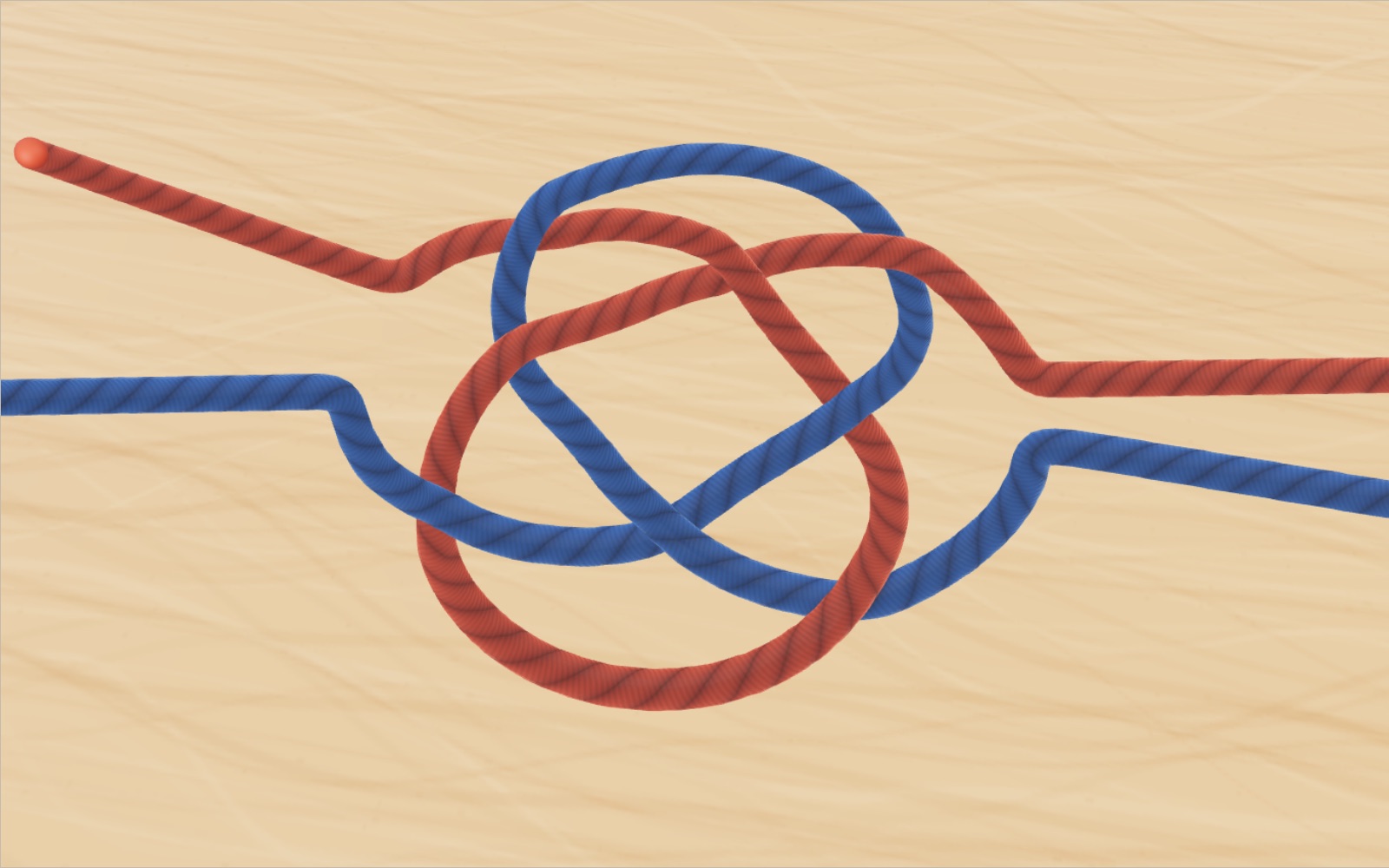
This device cannot show the 3D model. You can read the guide steps below as text.
1 / 17 Names for the parts of a ropeKnot instructions use a handful of words: standing part, working end, bight, loop and turn. The highlighted part of this bowline is the standing part. The Parts list shows the others.
Drag to turn. Scroll or pinch to zoom.
What the model shows
Most people can tie a shoelace without thinking and very little else. Ask for a loop that will not slip, or a way to join two ropes, and the usual answer is a pile of granny knots pulled tight. This exhibit ties 40 knots on a wooden table, one move at a time: stoppers, loops, bends that join two ropes, hitches round a ring or a post, fishing knots, decorative knots, and a shelf of closed knots and linked rings from knot theory.
Pick a knot from the menu at the top left of the model, or step through the families with the arrows beside it. The bar underneath steps forward and back one move at a time, and each step changes the rope on screen. While a step is running, a thin orange line shows where the end is about to go. The part of the rope that has not been used yet is held up in the air, the way your hand would hold it. Drag to turn the table and scroll or pinch to zoom.
The Controls panel has more. Tying speed slows the rope down to a quarter of normal speed. The Step slider scrubs through the knot by hand. Hands puts a marker where each hand would hold the rope: the working hand on the free end and the other hand on the part already tied. Colour by step shades each step's stretch of rope differently, so you can see which part of the finished knot came from which move. Untie plays any knot backwards, the end drawn out the way it went in. Mirror flips the knot left to right, which is how it looks to a left-handed person tying it. Crossings puts a dot on every place where the finished knot crosses itself, seen from above.
Under the controls is the lab. It has five tasks that use the model, the full list of knots with a search box and filters for family and difficulty, a table of every tested strength figure used here with its source, a small table of knot theory numbers, and fact cards that open as you finish tasks. The Parts list names the parts of a rope that every knot book uses: standing part, working end, bight, loop and turn. Choosing one lights it up on the rope.
Why a knot holds at all
A rope under tension wants to straighten. A knot holds because, somewhere inside it, one part of the rope is pressed against another part hard enough that friction stops it sliding. Knot books call the place where this happens the nip. In the bowline, the small loop closes round the two strands of the end like a collar. In the clove hitch, the diagonal riding turn pins both ends against the post. In the clinch knot, five turns of line squeeze the end against the standing line.
The pressure comes from the load itself. Pull harder on the standing part and the nip squeezes harder. That is why many good knots are loose and floppy until they are loaded, and why a knot that holds firmly on a tight rope can shake itself undone when the rope goes slack and tight again many times.
Look at any crossing in the model and you will see one strand clearly on top. The order of these overs and unders is the knot. Swap a single crossing and you may have a different knot or no knot at all. The reef, granny and thief knots in the model use exactly the same two U shapes; only the crossings and the position of the short ends differ, and they behave very differently under load.
Stoppers: from the overhand to the stevedore
A stopper knot sits in the end of a rope so that it cannot run out through a hole, a pulley or a cleat. The overhand knot is the simplest one possible. It has three crossings, and following the rope you meet them as over, under, over, under in turn. The US Army's rigging manual FM 5-125 lists it as the most commonly used and simplest knot, used to stop an end untwisting, to form a knob, or as part of another knot. The same manual says it reduces the strength of a straight rope by 55 percent.
The figure-eight adds one more crossing. In the model you make a loop over the standing part, take the end round behind, and bring it down through the loop. The result is fatter than an overhand knot, which helps it stop a rope in a bigger hole, and FM 5-125 notes that it is easy to untie.
Two more stoppers grow out of these. The double overhand passes the end through the loop twice, so the end and the side of the loop wind round each other. In the model it is drawn loose, so you can count its five crossings. The stevedore is a figure-eight whose end goes round the standing part a second time before it goes through the loop. Every extra turn round a strand adds two crossings, which is why the stevedore has six.
The slip knot is the odd one out. It is an overhand in which a folded bight of rope goes through the loop instead of the end. Pull the end and the bight slides out, and the knot is gone. Switch on Untie in Controls to watch it happen. Joining its two ends shows why: the drawing contains no knot at all, only rope lying over itself.
Loops that keep their size
A fixed loop can be dropped over a post, tied round an object, or clipped into. The bowline makes one at the end of a rope. FM 5-125 calls it the best knot for a single loop that will not tighten or slip under strain, and notes that it unties easily. John Smith's A Sea Grammar, first printed in 1627, already names the "boling-knot".
The tying sequence in the model is the one taught to children with a rabbit and a tree. Make a small loop (the rabbit hole) with the eye side lying on top of the standing part (the tree). Carry on round to make the eye. Bring the end up through the hole, round behind the tree and back down the hole. When the standing part is loaded, the small loop tightens round the two strands of the end and holds them.
The bowline has known weak points. It can work loose when it is not loaded or when the load comes and goes. Jan Simon, Vladimír Dekýš and Peter Palček pulled the eye of bowlines sideways (a ring load) and found that a bowline began to slip at about 1.95 kN on average, a left-hand bowline at about 10.77 kN, and that both came undone rather than broke. They concluded that neither should be used in life-critical work.
The other loops in the model are tied with the rope doubled. Fold the rope into a long bight, hold both strands together, and tie an overhand or a figure-eight with the pair: the bight that comes out of the knot is the eye. These are the overhand loop and the figure-eight loop. In the model both strands move at the same time, the way your hands move them.
The figure-eight follow-through ends up as exactly the same knot as the figure-eight loop, but it is tied another way, so it can go round something closed such as a harness or a ring. You tie a loose single figure-eight in the standing part, take the end round the anchor, and then follow the first eight back, side by side, all the way. Switch on Colour by step and the two halves show up in different shades. Simon and his colleagues describe the figure-eight loop as the knot most teaching material recommends for tying into a harness because it is simple, symmetrical and easy for a partner to check.
Bends: joining two ropes
A bend joins two ropes. The sheet bend is the bowline with the eye cut away. In the model, the blue rope is folded into a bight and stays still. The red end comes up through the bight, goes round the back of both legs, and is tucked under its own standing part. When the ropes are loaded, the bight pinches the red end against itself. FM 5-125 gives it two main uses: tying together two ropes of unequal size, and tying a rope to an eye. It also notes that it draws tight under load but can loosen when the lines are slackened. The double sheet bend takes the end round the bight a second time, and the manual says it holds better than the single version for wet ropes and ropes of unequal size.
The reef knot (square knot) is two half knots tied in opposite directions. Seen flat, it is two U shapes locked together. FM 5-125 gives the check: the end and the standing part of one rope come out on the same side of the bight formed by the other rope. The same manual warns that it will not hold if the ropes are wet or of different sizes; it is a binding knot for parcels and bandages, not a way to join two ropes under load.
Tie both half knots the same way round and you get the granny knot. Each rope's two parts now leave the other rope's bight on opposite sides, and the knot slips. The thief knot has the same U shapes as the reef, but its short ends come out diagonally opposite each other. The model shows all three with the same layout so you can compare them crossing by crossing, and the second task in the lab asks you to tell them apart.
The water knot and the Flemish bend are built the same way as the follow-through. Tie a loose overhand (or figure-eight) in the red rope and feed the blue end in where the red end comes out, then trace the red rope backwards, staying on the same side all the way. The offset overhand bend uses the same overhand, but the two ropes are held side by side and tied together, so both standing parts leave on one side of the knot and both tails on the other. Climbers use it to join abseil ropes, and Simon's paper gives its Ashley Book of Knots number, 1410.
The double fisherman's (grapevine) is two double overhand knots, each tied round the other rope. In the model each end coils twice round both ropes, working back toward its own standing part, and then tucks back through the inside of its coils. Pulled together, the two halves jam against each other. Dave Richards found it the best of the joining knots he tested for the Cordage Institute.
The carrick bend is a flat, symmetrical bend with eight crossings, each one over then under in turn. FM 5-125 recommends it for heavy loads and for joining large hawsers. Join its two ends and it becomes a carrick mat, which is a three-lead, four-bight Turk's head lying flat; that is how the model draws it.
Hitches: tying to a ring or a post
A hitch ties a rope to an object. The clove hitch is two turns round an object, the second crossing over the first. On the front of the post you see an X, and each end leaves from under that diagonal, pointing the opposite way. The name is already in William Falconer's Universal Dictionary of the Marine of 1769, which describes the ratlines of a ship's rigging being fastened with a clove-hitch. Its strength is that it is quick to tie and easy to adjust. Its weakness is that it can roll and loosen when the pull keeps changing direction.
The two half hitches and the round turn and two half hitches are tied to a steel ring lying on the table. The rope goes over the ring and back down through it, then the end makes two half hitches round its own standing part. FM 5-125 points out that if the two half hitches are slid together along the standing part, they become a clove hitch. In the model you can see the clove hitch shape sitting on the standing part. The round turn takes the rope round the ring twice. The two turns carry most of the pull, which is why this is a classic way to moor a boat: the half hitches can be undone while the line is still loaded. FM 5-125 adds that it does not jam.
For hitches, Brian Kane's tests on a 20 cm utility pole found that the four hitches he tried (clove, cow, running bowline and timber hitch) broke at similar loads: the spread between hitches was 1.45 kN, against 16.6 kN between ropes. Every rope failed at the first sharp bend where the standing part entered the hitch. In the same study the clove and cow hitches needed an extra half hitch and a stopper knot to stop the end pulling through before the rope broke.
Fishing knots
Fishing line is thin, slippery and springy, so fishing knots rely on many turns rather than a single nip. The clinch knot passes the line through the eye of the hook, twists the end round the standing line five times, and brings it back through the small loop next to the eye. The improved clinch adds one more tuck, back through the big loop that the end has just made. The blood knot joins two lines of similar size: each end twists five times round the other line, and then both ends go through the same gap in the middle, in opposite directions.
Coils are hard to see in a tight knot, so the model draws them spread out sideways on the table, the way knot books draw them. The order of overs and unders at every crossing is the same as in a round coil. Most anglers wet the line before pulling a knot tight; the friction of the turns sliding over each other heats the line.
Decorative knots
The Turk's head is a woven ring. Its name gives its two numbers: leads are the strands that go round, and bights are the bends at each edge. The model has a three-lead, four-bight head and a four-lead, five-bight one. Both are alternating: every crossing is over then under in turn. The monkey's fist is a ball tied in the end of a heaving line so it carries when thrown: three turns one way, three more at right angles round those, and three more through the first set and round the second. The Ashley Book of Knots, published in 1944, describes around 3,800 knots with 7,000 drawings, and a large part of it is decorative work of this kind.
Knot theory: crossings, determinants and links
Mathematicians study knots as closed loops, with the ends joined so nothing can slip out. Join the ends of an overhand and you get the trefoil, the simplest knot that cannot be undone without cutting. The figure-eight stopper closes into the figure-eight knot, known in knot tables as 4_1: four crossings, the smallest number possible for it. Knot tables such as KnotInfo, maintained by mathematicians at Indiana University, list every knot up to 13 crossings with dozens of measured properties.
One of the easiest properties to compute is the determinant. You label each stretch of rope between two under-passes, write one equation per crossing, and take a determinant of the resulting table of numbers. Draw the same knot however you like and the answer does not change. This exhibit uses it as a check on its own drawings: the program that builds the paths joins the two ends of each stopper above the knot and computes the determinant. It gives 3 for the overhand, 5 for the figure-eight, 7 for the double overhand and 9 for the stevedore, the values the tables list for 3_1, 4_1, 5_2 and 6_1. The slip knot gives 1, the value for no knot at all.
The theory shelf has the trefoil and the figure-eight knot, the cinquefoil (5_1) and septafoil (7_1), which wind twice round a ring shape, and the torus knot T(3,4), listed as 8_19, which winds three times round and four times through. The three-twist knot (5_2) and the stevedore knot (6_1) are the double overhand and the stevedore with their ends joined. The cinquefoil and the three-twist knot both have five crossings but determinants of 5 and 7, so they are different knots. There are also three links: the Hopf link (two rings through each other), Solomon's knot (two rings crossing four times), and the Borromean rings, three rings that hold together although no two of them are linked.
Knots also tie themselves. Dorian Raymer and Douglas Smith dropped strings into a box 0.30 m across and turned it at one revolution per second for ten seconds, hundreds of times. Strings shorter than 0.46 m never knotted. Between 0.46 and 1.5 m the chance of a knot rose sharply, and from 1.5 to 6 m it levelled off at about 50%.
Why the reef holds and the granny slips
In 2020 Vishal Patil, Joseph Sandt, Mathias Kolle and Jörn Dunkel tied knots in fibres that change colour when strained, so they could see where the stress sits inside a knot. They found simple counting rules that rank the stability of bends from their diagrams, based on how the twisting at each crossing adds up. Where neighbouring crossings twist the same way, the knot tends to roll; where they twist opposite ways, it locks. In their tests the grief knot was least stable and the reef knot most stable among the four related knots (grief, thief, granny and reef), and both their theory and experiments put the Zeppelin bend ahead of the alpine butterfly.
Why shoelaces come undone
A shoelace bow is tied in two stages: a starting knot, then a finishing bow made with loops. Ian Fieggen, whose shoelace site has covered tying methods since 2003, explains that each stage twists the laces slightly. If the two stages are tied in opposite directions, the twists cancel and the finished knot is a reef knot whose ends have been doubled into loops. If both stages go the same way, you get a granny knot, which sits crooked along the shoe and comes loose more easily. The model has both: the shoelace bow and the granny bow.
Christopher Daily-Diamond, Christine Gregg and Oliver O'Reilly filmed shoelaces failing while people ran and then reproduced it on a swinging-leg rig. The impact of the shoe on the ground loosens the knot, and the swinging free ends tug it apart. More swing in the ends made knots fail faster, and the structure of the knot made a large difference to how quickly it came undone.
How much strength a knot costs
Every bend in a rope puts the fibres on the outside of the curve under more strain than the rest, so a knotted rope breaks at a lower load than a straight one. Test results are usually given as efficiency: the breaking load of the knotted rope as a percentage of the unknotted rope. The figures below come from published tests. They describe those ropes under those test conditions, not every rope, and the model shows no figure for knots that the sources did not test.
Dave Richards tested knots for the Cordage Institute, five breaks per knot, with the same person tying every knot.
| Knot | 12.5 mm static rope | 10.5 mm dynamic rope | 7 mm cord |
|---|---|---|---|
| Bowline | 63.3% | 63.1% | 67.1% |
| Figure-eight loop (end) | 75.3% | 69.4% | 73.3% |
| Figure-eight loop (bight) | 77.5% | 69.9% | 74.7% |
| Sheet bend | 51.1% | 49.9% | 61.1% |
| Double sheet bend | 54.7% | 54.6% | 57% |
| Double fisherman's | 78.2% | 73.4% | 81.0% |
The sheet bend slipped in his tests unless backed up with two half hitches and an overhand knot, and most of the joining knots needed backup knots before the rope would break. He also found that the figure-eight loop and the butterfly were almost impossible to untie after a load of about 1,000 lb, and that a cowboy (left-hand) bowline gave almost the same numbers as the standard one.
Simon, Dekýš and Palček measured loop knots in 10.5 mm static rope for Acta Physica Polonica A. On a single rope type, the bowline averaged 58.51%, the figure-eight loop 63.97% to 64.42% depending on how it was dressed, and the overhand loop 56.92% to 61.46%. The bowline, the left-hand bowline and the bowline on a bight could not be told apart statistically. They also found that the figure-eight loop's efficiency differed by up to 16% between eleven ropes tested under identical conditions, which is a good reason to treat any single percentage with care.
Rescue equipment maker CMC ran 487 tests on 11 mm and 9.5 mm ropes and recommends assuming 50% knot efficiency in system safety calculations until more testing is done.
How the model was built
The rope here is laid along a fixed path rather than simulated with friction and stretch. Most knots were drawn as flat diagrams with the over or under at every crossing written down. Hitches, fishing knots and the double fisherman's were first sketched in three dimensions, coiling strands round each other, and the heights of that sketch decided every over and under before it was flattened. A small program then nudged the strands apart until no two parts of the rope come closer than 1.03 rope diameters, and checked that no crossing changed on the way. The tube is drawn 0.96 diameters thick, so the rope never cuts through itself. The same check runs on every step of every knot, 212 states in all, including the free end held in the air.
The knots are shown loose, the way a diagram shows them, not pulled tight. A real knot changes shape as it is dressed and loaded, and the tight form of a bowline looks quite different from the open one here. The monkey's fist is an approximation of the real ball: its three sets of turns cross in the right order, but the turns are spread out more evenly than hands would leave them.
Knots that hold people
If a knot will hold a person (climbing, rescue, work at height, tying in a boat crew), learn it from a qualified instructor and practise it under supervision. The knots on this page are tied in their basic forms. Climbing and rescue use specific versions, backups and partner checks that are not shown here, and a mistake that looks small on a screen can let a rope pull straight through. The knots marked as a teaching model in the read-out are the ones most often used for such loads. The US Army's mountaineering manual FM 3-97.61 gives a whole chapter to rope management and knots for this reason.
Questions
What is the difference between a knot, a bend and a hitch?
In knot books, a bend joins two ropes (the sheet bend), a hitch ties a rope to an object (the clove hitch), and "knot" covers everything else, including loops and stoppers. Everyday speech calls them all knots.
Why does the bowline not slip?
When the standing part is loaded, the small loop tightens round the two strands of the end and holds them by friction. The pull itself closes the nip. When the load is taken off, the nip opens again, which is why the bowline is easy to untie. A sideways load on the eye can make it slip, which is why it needs a backup.
Is the figure-eight stronger than the overhand knot?
As loop knots in the Simon, Dekýš and Palček tests, the figure-eight loop averaged around 64% and the overhand loop between 57% and 61%. As stoppers, the bigger point is that the figure-eight is easier to untie after loading.
How can I tell a reef knot from a granny knot?
Look at where each rope leaves the other rope's U. In a reef knot, both parts of one rope come out on the same side of the other rope's bight. In a granny they come out on opposite sides, and the knot usually sits twisted. The thief knot looks like a reef but its short ends are diagonally opposite.
Why do my shoelaces keep coming undone?
Often because the bow is a granny knot: the starting knot and the bow are tied in the same direction. A crooked bow that lies along the shoe is the sign. Reversing the starting knot usually fixes it. Running loosens any bow faster, because the impact of each step and the swinging ends both work on it.
Can I use a sheet bend on ropes of different thickness?
Yes, that is its usual job. Make the bight in the thicker or stiffer rope and use the thinner one as the working end. Tests found it slips in modern synthetic rope without backup knots, so do not rely on it for important loads. The double sheet bend holds better.
Why does a rope break near the knot rather than inside it?
The sharpest bend carries the most strain on the outer fibres. In Kane's hitch tests every rope failed at the first bend where the standing part entered the hitch.
What do the numbers 3_1, 4_1 and 5_2 mean?
They are the names knot tables give to knots: the first number is the smallest number of crossings any drawing of the knot can have, and the second is its place in the traditional list of knots with that many crossings. 3_1 is the trefoil, 4_1 the figure-eight knot, 5_1 the cinquefoil and 5_2 the three-twist knot.
Why does the model show crossings only for some knots?
The count is taken from the loose drawing seen from above. For knots that sit flat on the table that count is meaningful. For hitches round a ring and for coiled fishing knots it depends on how the coils are drawn, so the read-out leaves it out.
What does the Mirror control change?
It flips the knot left to right. A left-handed person tying a knot often makes this mirror image. For most knots the mirror image works the same way; the reef knot stays a reef knot. Some knots, such as the trefoil, are a different knot from their mirror image in knot theory, but both are overhand knots in a rope.
Should I use these knots for climbing?
Not from this page. Climbing uses particular knots, backups and partner checks that should be taught in person by a qualified instructor.
Why are the strength figures different between sources?
Ropes, diameters, test speeds and the way a knot is dressed all change the result. Simon and his colleagues saw up to 16% difference for one knot across eleven ropes under identical conditions. Treat a single percentage as a description of one test, not a property of the knot.
Terms
- Standing part: the part of the rope that takes the load and is not used in the tying.
- Working end: the end that moves and makes the knot.
- Bight: the rope folded back on itself into a U, without crossing.
- Loop: the rope crossing itself so that it encloses a hole.
- Turn: the rope taken once round an object or another rope. A round turn goes round twice.
- Nip: the place inside a knot where one part of the rope is squeezed against another.
- Efficiency: the breaking load of a knotted rope as a percentage of the same rope without a knot.
- Dressing: arranging the parts of a knot neatly before tightening it.
- Lead and bight (Turk's head): leads are the strands that go round the ring, bights the bends at each edge.
- Crossing number: the smallest number of crossings any drawing of a knot can have.
- Determinant: a whole number computed from any drawing of a knot that stays the same however the knot is drawn.
- Link: two or more closed loops tangled together, such as the Borromean rings.
Sources
- Dave Richards, Cordage Institute, Knot break strength vs. rope break strength (test data, hosted by PACI). http://www.paci.com.au/downloads_public/knots/03_Cordage_Institute_Tests.pdf (checked 18 October 2026)
- Jan Simon, Vladimír Dekýš, Peter Palček, Revision of Commonly Used Loop Knots Efficiencies, Acta Physica Polonica A 138 (2020), Institute of Physics, Polish Academy of Sciences (efficiencies, ring-load slipping forces, Ashley numbers 46, 524, 1009, 1010, 1047, 1410). https://przyrbwn.icm.edu.pl/APP/PDF/138/app138z3p11.pdf (checked 18 October 2026)
- Brian Kane, Breaking Load of Hitches and Ropes Used in Rigging, Arboriculture & Urban Forestry 38(1), International Society of Arboriculture. https://auf.isa-arbor.com/content/38/1/1 (checked 16 October 2026)
- CMC, Evaluating Rescue Knot Efficiency in 11 mm General Use Ropes. https://www.cmcpro.com/evaluating-knot-efficiency-in-11-mm-ropes/ (checked 16 October 2026)
- US Army, FM 5-125 Rigging Techniques, Procedures, and Applications, chapter 2 Knots, Splices, Attachments, and Ladders, 1995, copy at GlobalSecurity.org (overhand, figure-eight, square knot, single and double sheet bend, carrick bend, bowline, half hitch, two half hitches, round turn and two half hitches, clove hitch). https://www.globalsecurity.org/military/library/policy/army/fm/5-125/ch2.pdf (checked 18 October 2026)
- US Army, FM 3-97.61 Military Mountaineering, chapter 4 Rope Management and Knots, copy at GlobalSecurity.org. https://www.globalsecurity.org/military/library/policy/army/fm/3-97-61/index.html (checked 18 October 2026)
- Vishal P. Patil, Joseph D. Sandt, Mathias Kolle, Jörn Dunkel, Topological mechanics of knots and tangles, Science 367 (2020) 71–75. https://www.science.org/doi/10.1126/science.aaz0135 (checked 18 October 2026)
- American Association for the Advancement of Science, EurekAlert press release on the Patil et al. study (colour-changing fibres and the rules behind the stability of bend knots). https://www.eurekalert.org/news-releases/829055 (checked 18 October 2026)
- Dorian M. Raymer, Douglas E. Smith, Spontaneous knotting of an agitated string, PNAS 104 (2007) 16432–16437. https://www.pnas.org/doi/10.1073/pnas.0611320104 (checked 18 October 2026)
- Christopher A. Daily-Diamond, Christine E. Gregg, Oliver M. O'Reilly, The roles of impact and inertia in the failure of a shoelace knot, Proceedings of the Royal Society A 473 (2017). https://pmc.ncbi.nlm.nih.gov/articles/PMC5415684/ (checked 18 October 2026)
- Ian W. Fieggen, Ian's Shoelace Site, The "Granny Knot". https://www.fieggen.com/shoelace/grannyknot.htm (checked 16 October 2026)
- Jae Choon Cha, Charles Livingston, KnotInfo: Table of Knot Invariants, Indiana University (crossing numbers and determinants of 3_1, 4_1, 5_1, 5_2, 6_1, 7_1, 8_18, 8_19). https://knotinfo.org/ (checked 18 October 2026)
- Clifford W. Ashley, The Ashley Book of Knots, Doubleday, 1944, Internet Archive. https://archive.org/details/TheAshleyBookOfKnots (checked 18 October 2026)
- John Smith, The Sea-Man's Grammar and Dictionary, 1699 edition of A Sea Grammar (first printed 1627), Internet Archive ("boling-knots"). https://archive.org/details/seamansgrammardi00smit (checked 17 October 2026)
- William Falconer, An Universal Dictionary of the Marine, 1769, Internet Archive ("clove-hitch", and ratlines fastened to the shrouds with a clove-hitch). https://archive.org/details/universaldiction00will (checked 17 October 2026)
- Wikimedia Commons, Square_knot.svg (layout of the two-colour reef knot used for the reef family and the shoelace bows). https://commons.wikimedia.org/wiki/File:Square_knot.svg (checked 16 October 2026)

More exhibits
How to fold paper airplanes and fly rubber-powered models
The farthest a folded sheet of paper has flown is 98.43 m, indoors, in Shanghai in December 2025.
How a sewing machine makes a stitch
A sewing machine needle never goes through the cloth: at every stitch the hook drags its thread right round the bobbin instead.
How a 3D printer works, layer by layer
A 20 mm cube printed in 0.2 mm layers is exactly 100 layers, each drawn by a nozzle 0.4 mm wide.
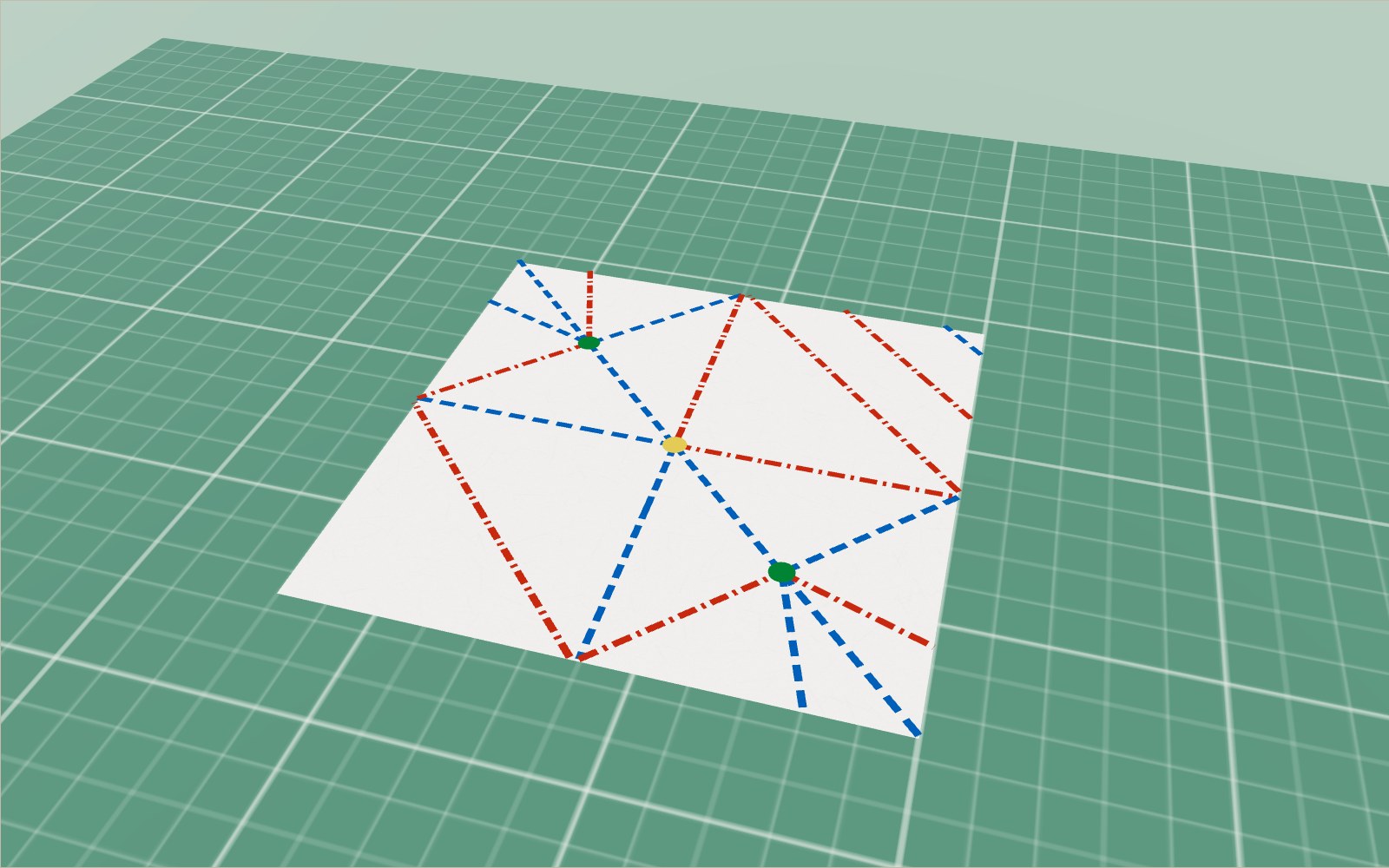
Origami: 20 models to fold step by step and unfold
A crane uses about 30 folds, a cup six; every flat-folded point you make has mountains and valleys that differ by exactly two.
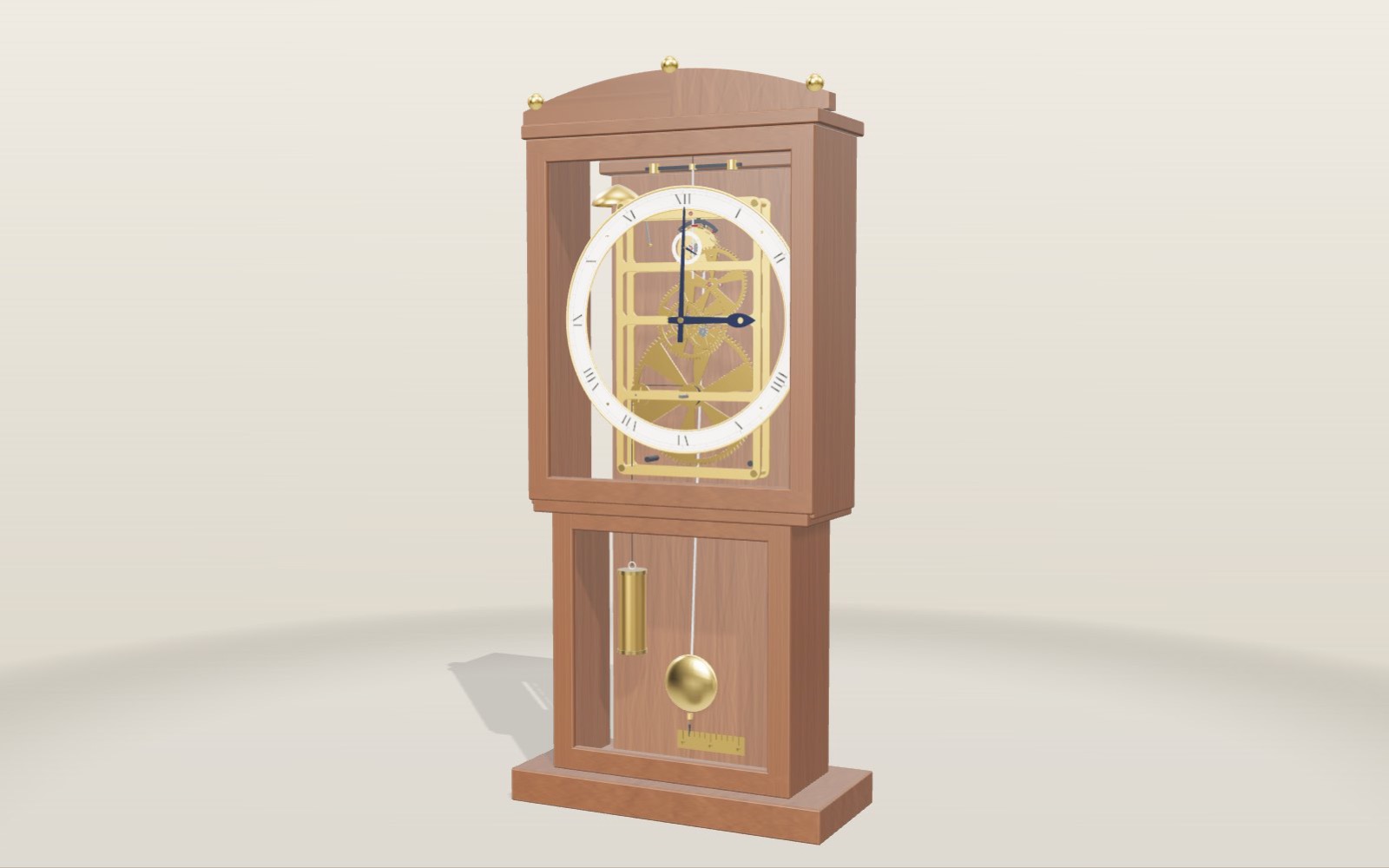
How a pendulum clock works, and why its length sets the time
A pendulum clock counts seconds with one rod 99.4 cm long. Change its length, its temperature and its place on Earth, swap four escapements and see how many seconds a day each costs.
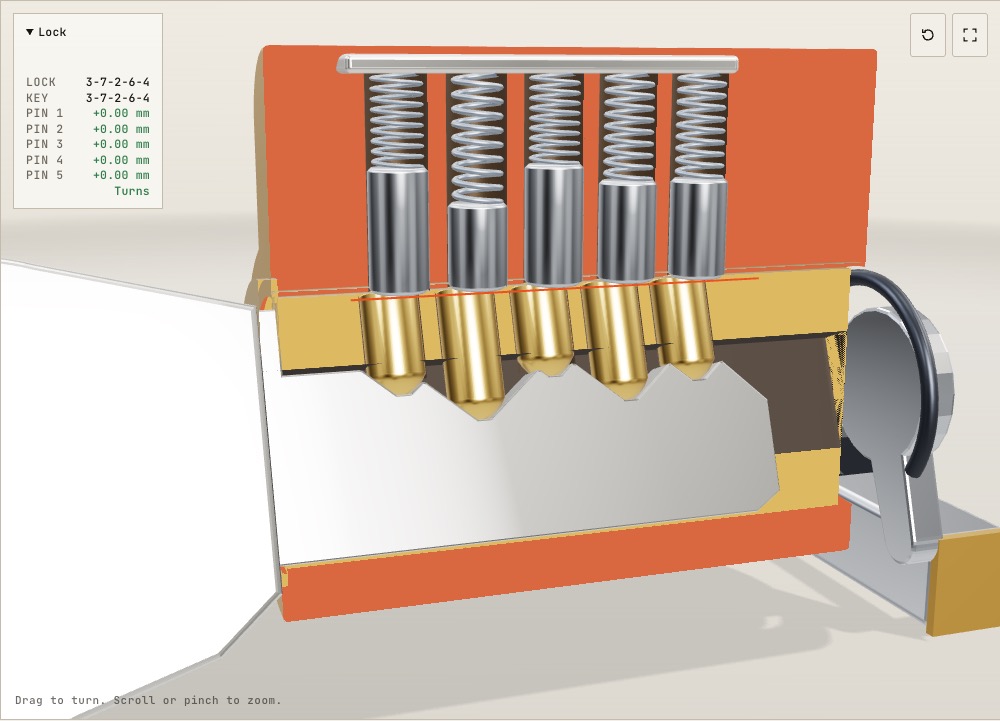
How does a pin tumbler lock work inside? A 3D cutaway
On a common Schlage key one cut depth differs from the next by 0.381 mm, and that small step is enough to keep a wrong key from turning.