Loading the model
This device cannot show the 3D model. You can read the guide steps below as text.
1 / 17 Names for the parts of a rope Knot instructions use a handful of words: standing part, working end, bight, loop and turn. The highlighted part of this bowline is the standing part. The Parts list shows the others.
Drag to turn. Scroll or pinch to zoom.
Guide Parts Controls
01 Names for the parts of a rope Knot instructions use a handful of words: standing part, working end, bight, loop and turn. The highlighted part of this bowline is the standing part. The Parts list shows the others.
02 Overhand knot Three crossings, each one over then under in turn. Use the arrows under the model to step through it, or let it play. The menu at the top left has all 40 knots.
03 Figure-eight knot One more crossing than the overhand. The extra turn makes the knot bigger, so it is harder to pull through a hole, and it unties after a load.
04 Stevedore knot A figure-eight with a second turn round the standing part. Each extra turn adds two crossings.
05 Bowline The end goes up through a small loop, round the standing part and back down. Under load the small loop squeezes the two strands of the end. Tests found it can come undone under a sideways load.
06 Figure-eight follow-through A single figure-eight, then the end goes round the anchor and follows the knot back. The hands show where to hold. Learn it with an instructor before you trust it with a person.
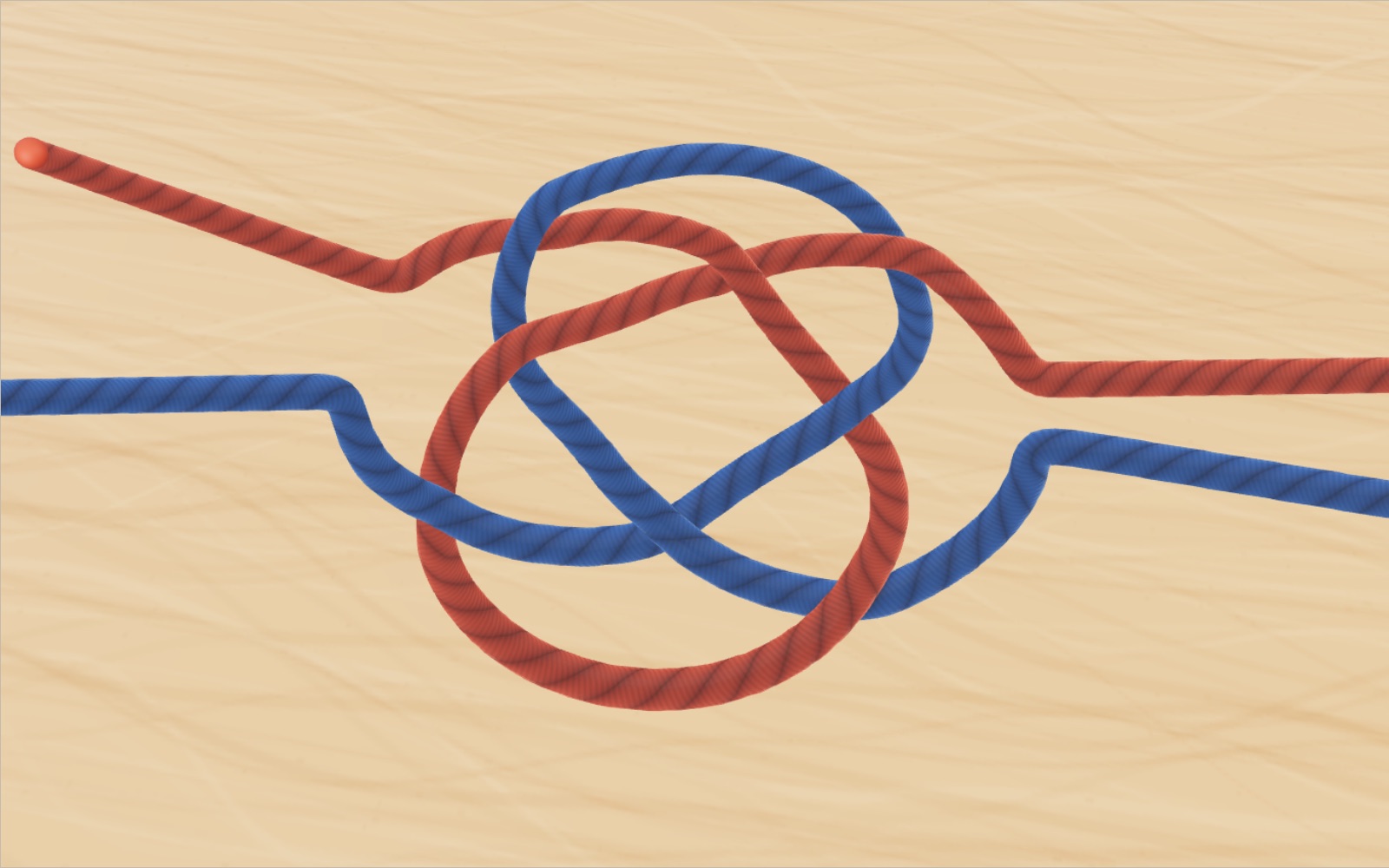
07 Sheet bend The same structure as the bowline, used to join two ropes. The blue bight stays still while the red rope does all the moving.
08 Reef knot Two U shapes locked together. Each rope's two parts leave the other rope's U on the same side.
09 Granny knot The same two U shapes crossed the other way. Each rope's parts leave on opposite sides, and the knot slips. Compare it with the reef knot.
10 Clove hitch Two turns round the post, with the second crossing over the first. Each end leaves under the diagonal, pointing the opposite way.
11 Round turn and two half hitches Two turns round the ring take the load, so the half hitches on the standing part can be undone while the rope is still pulled.
12 Clinch knot Fishing line through the eye of a hook, five turns round the line, and back through the small loop by the eye.
13 Double fisherman's Each end coils twice round both ropes and tucks back through its own coils. Pulled together, the two halves jam against each other.
14 Untying Switch on Untie in Controls and any knot plays backwards, the end drawn out the way it went in. The slip knot comes apart from a single pull.
15 Knot theory Join the two ends of an overhand and you get the trefoil, the simplest knot that cannot be undone without cutting. The dots mark its three crossings.
16 Borromean rings Three rings hold together although no two of them are linked. Cut one and the other two fall apart.
17 Monkey's fist Three sets of three turns, each set at right angles to the last, close into a ball at the end of a throwing line.
Standing part The part that takes the load. It is not used in the tying. Working end The end that moves and does the tying. Bight Rope folded back on itself into a U, without crossing. Loop Rope that crosses itself and so encloses a hole. Turn Rope taken once round an object, or round another rope. Rope The rope on the table. Red and blue mark two ropes, or the two ends of one; green is a third ring. Direction arrow Shows where the end goes next while a step is running. Hands Where each hand would hold the rope: one on the free end, one holding what is already tied. Crossing markers A dot at every place the finished knot crosses itself, seen from above. Ring A steel ring lying on the table, for the hitches and the fishing knots. Post A wooden post for the clove hitch. Table The wooden board the knots are tied on. The turntable spins it.