FIG. 98Follow Along
How to fold paper airplanes and fly rubber-powered models
The farthest a folded sheet of paper has flown is 98.43 m, indoors, in Shanghai in December 2025.
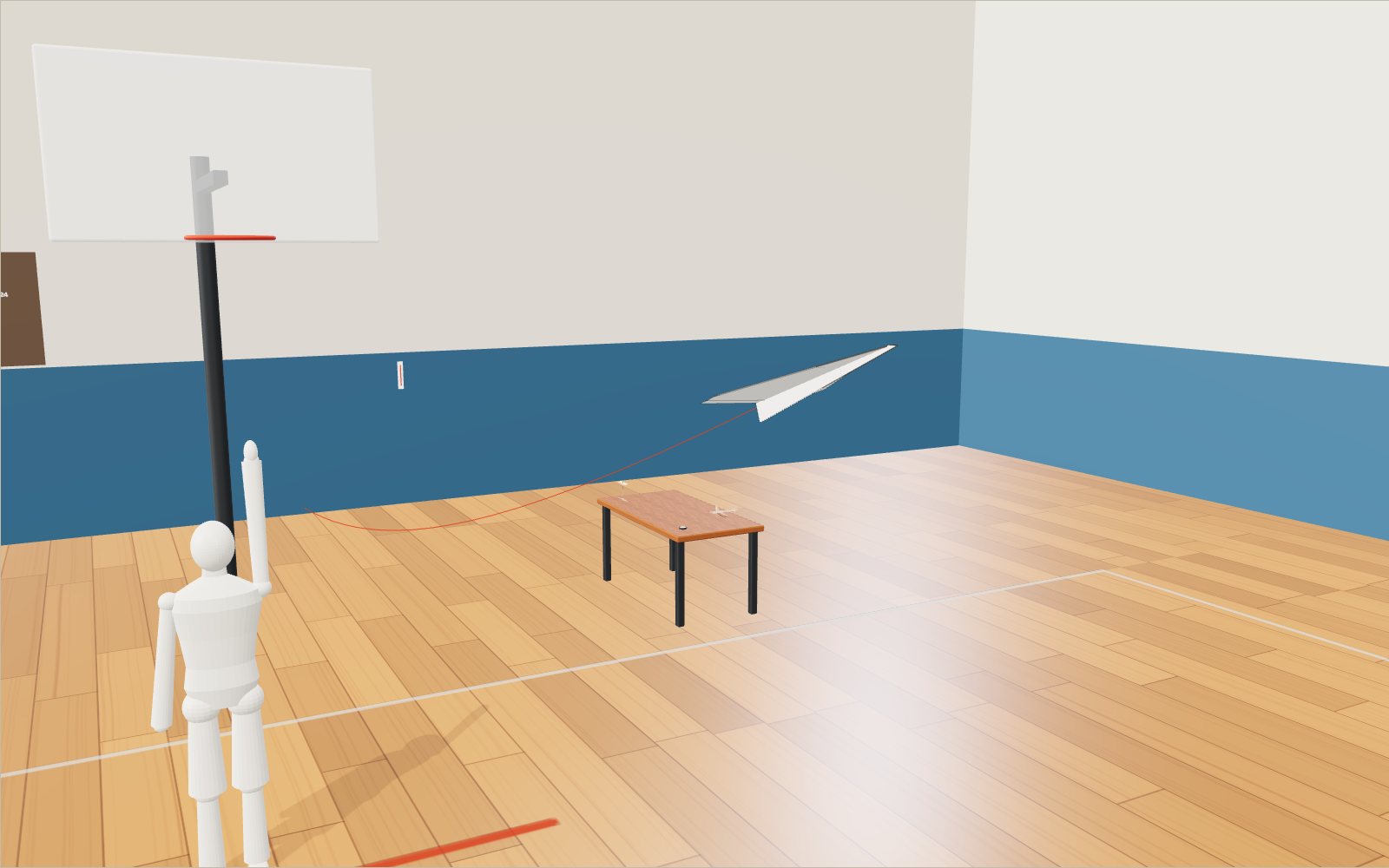
This device cannot show the 3D model. You can read the guide steps below as text.
1 / 15 One sheet, one throwA dart folded from one A4 sheet leaves the hand at 11 m/s. The red line is its path, the dashed line the next throw at the current settings.
Drag to turn. Scroll or pinch to zoom.
A sheet of paper that flies
Drop a sheet of printer paper and it never falls straight. It slides one way, stops, flips over, slides back and lands somewhere you did not expect. Fold the same sheet a dozen times and throw it, and it crosses a school gym in a smooth line. Nothing was added. There is no engine, no glue, not even a gram of extra weight. The folds only moved paper from one place to another.
This exhibit is about what those folds do. On the table there are twelve paper planes, each folded one step at a time from an A4 sheet. You can stop at any step, turn the model round, unfold it again and look at the creases it leaves. When a plane is finished, a mannequin throws it down the gym, and the flight you see is worked out from the shape you just folded: its wing area, its span, where its weight sits and how far its elevators are bent. Then there is a second kind of model, the rubber-powered plane, where a twisted rubber loop turns a propeller for a few seconds or for nearly 30 minutes.
The numbers on the stage are model values. They come from a simplified flight model and the real folded geometry, not from a wind tunnel. Where the records come in (the longest paper plane flight, the longest time in the air, the longest rubber-powered indoor flight), they come from Guinness World Records and from the FAI, the world air sports federation.
The tabs at the top left of the model switch between three activities. Fold steps through the folding on a cutting mat, with an arrow for each move, the fold line drawn on the paper and a pair of mannequin hands that show where to hold. Fly puts the finished plane in a hand at the start of a throwing line in a school gym, a large hall or a playing field. Rubber power moves to a workbench where three rubber-powered models are put together part by part, wound and flown. Under the controls there is a lab with twelve tasks, a list of all the planes you have folded and flown, the thirteen hidden things in the scene, the records, and a stack of cards that each begin with "Actually".
Why plain paper flutters and a paper plane glides
In 2022 a group at New York University's Applied Mathematics Laboratory, with a physicist from Cornell University, set out to answer what looks like a children's question: what does a paper plane need in order to glide smoothly? Their paper in the Journal of Fluid Mechanics starts from the falling sheet. A flat, evenly weighted sheet tumbles end over end. To make it glide, they stuck thin metal tape along its front edge, a little more each time, and launched it again.
The result was a clear pattern. With the weight at the centre of the sheet, or only a little forward of it, the sheet fluttered or tumbled. With the weight far forward, it dived and crashed. Only in between, in what the researchers called a "sweet spot", did it glide. Real paper planes get there in one of two ways, the NYU news release says: the front edge is folded over several times, or a paper clip is added. Both moves shift the centre of mass forward.
That is the first thing to watch for on the table. Every fold that brings paper towards the nose adds a layer at the front. A dart, for example, starts with two corners folded to the centre line, then the new slanted edges folded in again. By the time it is finished, the front third of the plane holds six or eight layers of paper and the back third holds two. The paper did not get heavier, but its weight moved forward.
The NYU team also built a "flight simulator" from their measurements, a mathematical model that reproduced the fluttering, tumbling, gliding and diving they saw. The researchers say the way a paper plane keeps level is quite different from the stability of a conventional aircraft with a tail, which is part of why such a simple object took a fluid mechanics paper to explain.
What the fold model does
Folding is modelled the way paper actually behaves: it does not stretch. Each step names a fold line and the part of the sheet that moves. Before the move, every piece of paper the line crosses is cut along it, so the moving part can turn about the line as a rigid flap while the rest stays put. A flat fold turns the flap through 180 degrees and stacks it on top (a valley fold) or underneath (a mountain fold). The last steps are not flat: the wings turn down by about 85 degrees on each side of the body, the wing tips bend, and the trailing edges lift for the elevators.
Because the paper is only ever cut and turned, never stretched, the total area stays exactly 623.7 cm², the area of an A4 sheet, at every step. The check that runs before this page is published confirms that for all twelve planes and every step. The crease pattern you can switch on at the end is simply the record of every line the paper was cut along, coloured by whether it was folded as a valley or a mountain when seen from the front of the sheet. Blue dashes are valley folds, red dash-dots are mountain folds, and paler lines were creased and opened flat again.
The same fold can look like a valley from one side and a mountain from the other. When a flap has already been turned over, a fold that looks like a valley to you is a mountain on the front of the paper. The pattern is always drawn as seen from the front, which is why some lines in it surprise people who folded every step as a valley.
Lift, drag and the glide angle
A glider has no engine, so it is always going downhill through the air. NASA's Glenn Research Center explains the basic geometry in its Beginner's Guide to Aeronautics, using the Wright brothers' gliders as the example; it names paper airplanes as the most obvious example of a glider. In a steady glide the plane descends along a straight line tilted at the glide angle. Three forces balance: the weight pulls straight down, the drag acts backwards along the path, and the lift acts at right angles to the path. Working through the geometry, NASA shows that the tangent of the glide angle equals the drag divided by the lift:
tan(glide angle) = D / L = drag coefficient / lift coefficient
Turned the other way round, the lift-to-drag ratio L/D tells you how far the glider travels for each metre it drops. A plane with L/D of 5 covers 5 m for every metre of height it loses. Thrown level from a hand 1.9 m above the floor, such a plane could in a perfectly steady glide reach about 9.5 m before touching down. Most of a good throw's distance comes from the extra speed and height the throw gives, which the plane then trades away.
Lift and drag themselves follow NASA's lift and drag equations:
L = C_L × ½ ρ V² × A, D = C_D × ½ ρ V² × A
Here ρ is the air density (about 1.2 kg per cubic metre in a room), V is the speed, A the wing area, and C_L and C_D the lift and drag coefficients. NASA notes that the coefficients collect everything complicated about the shape and the angle into one number each, usually measured in a wind tunnel. In this exhibit they are estimated from the folded shape, which is why the read-out calls them model values.
The speed squared is the important part. A plane that flies steadily at 3 m/s and is thrown at 12 m/s meets 16 times as much lift as it needs. That extra lift does not hold it level. It curves the path upwards, often into a loop. Watch the stunt plane: with its elevators bent far up it needs very little speed to make a lot of lift, so a hard throw sends it straight up and over.
Short wings, fast sinking
Paper planes have stubby wings. A dart folded from A4 spans about 16 cm and its wing area is about 266 cm² (model values from the folded shape), so its aspect ratio, the span squared divided by the area, is about 1. An airliner wing has an aspect ratio of about 9, a high-performance glider over 20.
NASA's page on induced drag explains why this matters. Air leaks round the wing tips from the high pressure underneath to the low pressure on top and rolls up into two vortices. That swirl adds a drag that grows with the square of the lift coefficient and shrinks with the aspect ratio:
C_Di = C_L² / (π × AR × e)
where e is an efficiency factor, about 0.7 for a rectangular wing according to NASA. With an aspect ratio of 1 the induced drag is huge compared with a long, slender wing. NASA's wing geometry page puts the trade-off plainly: a higher aspect ratio gives lower drag, a higher lift-to-drag ratio and a better glide angle. This is the main reason a paper dart's L/D in the model is only about 5, and why the long-distance designs try to keep the wings as wide and flat as the sheet allows.
Short wings also lift less for each degree of angle. The model uses the classic correction for a finite wing, in which the two-dimensional lift slope of 2π per radian is reduced by the downwash of the tip vortices: a = a0 / (1 + a0 / (π AR)). For an aspect ratio of 1 this gives about 2.1 per radian, a third of the value for an endless wing.
Where the numbers come from on a real plane
NASA's paper airplane activity, written for secondary school classes, asks students to fold one of five designs, fly each for distance and for time aloft, and then use NASA's FoilSim program to relate the lift of an airfoil to the surface area of the wing. It is the same chain this exhibit follows: measure the shape, estimate the lift, compare with what the plane does. The activity ends by challenging students to fold a better plane and explain why their changes worked.
Balance: the centre of mass and the lift centre
A plane is stable in pitch when a gust that lifts the nose also produces a force that pushes the nose back down. For a wing without a separate tail, that happens only if the centre of mass sits ahead of the point where the extra lift acts, a point called the neutral point or, here, the lift centre. The distance between the two, divided by the mean chord of the wing, is the static margin. The read-out calls it the balance margin.
NASA's centre of gravity page describes how engineers find the balance point: for a uniform object with a line of symmetry, it lies on that line, and for a complex object it is the weighted average of all the pieces. The exhibit does exactly that with the folded paper. Each piece of paper has the same mass per square centimetre, 80 g per square metre for ordinary copy paper, so the centre of mass is the area-weighted average of every piece in its folded position. For the dart it lands about 13 mm behind the middle of the sheet's length.
The lift centre is harder. For a long, straight wing it sits at about a quarter of the chord back from the leading edge. For very short wings, slender-wing theory moves it further back, towards the middle of the area. The model blends the two according to the aspect ratio and finds the dart's lift centre about 18 mm behind the middle. The balance margin of the bare dart comes out at only about 3 percent of the chord: it flies, but only just.
Add one paper clip to the nose (0.5 g in the model) and the centre of mass moves forward by about 14 mm; the margin grows to about 12 percent. Two clips give 18 percent, three 24 percent. You can see the two marks move on the stage: the black and yellow ball is the centre of mass, the blue ring the lift centre.
More margin is not simply better. A very nose-heavy plane wants to fly at a small angle of attack, which means it has to fly fast to make enough lift. In the model the dart's steady glide speed rises from about 2.9 m/s with no clip to about 4.2 m/s with one clip and 5.3 m/s with two. That is the "dives and crashes" end of the NYU result.
Why a plane with its weight too far back does not always flip
The NYU work points out something that textbook aircraft do not show: on a flat plate the centre of pressure moves with the angle. At small angles it sits near the quarter chord; as the plate tilts towards 90 degrees it moves back to the middle. The model includes that shift. A plane whose centre of mass is a little behind its lift centre therefore does not simply flip over. It pitches up until the centre of pressure has moved back far enough to balance it, at a high angle of attack, and then it sinks slowly and steeply, partly stalled. That is the folded-edge glider without clips: it stalls and mushes down instead of gliding. Two clips fix it.
A sheet whose weight sits right in the middle has no such balance point at any angle short of 90 degrees, and that is the sheet that tumbles. Hold a plain sheet flat and drop it to see the difference.
Elevators: a small bend that sets the speed
Most paper plane instructions end with "bend the back edges up slightly". Those bent edges are the elevators. Bending the trailing edge up gives the wing a reflex camber that pushes the nose up. In the model it appears as a nose-up pitching moment proportional to the bend. With a stable balance margin, the plane settles at the angle of attack where that nose-up moment is balanced by the nose-down moment of the lift acting behind the centre of mass. More elevator means a higher trim angle, more lift per unit of speed, and therefore a slower glide.
On the bare dart the model gives these trimmed glides (model values):
| Elevator | Trim angle | Glide speed | L/D |
|---|---|---|---|
| 0° | 2.5° | 5.7 m/s | 3.5 |
| 3° | 9.5° | 2.9 m/s | 4.9 |
| 6° | 13.7° | 2.4 m/s | 4.0 |
| 10° | 17.6° | 2.2 m/s | 3.3 |
The best L/D sits in the middle. Too little elevator and the plane flies too fast for its wing, wasting height on drag; too much and it flies near the stall, where drag climbs steeply. Turn the elevator slider and watch the dashed line: it is the path the next throw will take at the current settings, recalculated each time you move a control.
The elevator also explains a common complaint, the plane that climbs, stops and drops. With a lot of elevator a plane needs little speed to fly, so a normal throw is far too fast for it. The extra lift curves the path up, the plane slows at the top, and if the climb was steep enough it stalls. Take a little elevator out, or throw more gently and more level.
Throwing: speed, angle and why hard throws loop
A thrown plane begins with far more speed than its steady glide. What happens next depends on the trim. A plane trimmed for 3 m/s and thrown at 11 m/s has about 13 times the lift it needs. It climbs, slows, and then levels out into its glide, often with a gentle up-and-down motion called a phugoid. In the model the dart thrown at 11 m/s and 6 degrees from 1.9 m reaches about 4.4 m, then glides down and lands about 24 m away after about 7 seconds.
Throw it harder and it climbs higher before settling: in the big hall, the same dart thrown at 25 m/s reaches nearly 10 m and lands about 31 m away. The distance does not keep growing with throw speed, because much of the extra speed turns into height and drag. The long-distance and arrow designs, with very little elevator and a lot of nose weight, are trimmed for higher speeds and keep more of the throw.
The opposite case is the time-aloft throw. Contest fliers in the Japan Origami Airplane Association's time-aloft event throw the plane almost straight up as high as they can; the association's event page says this event is decided by the throw upwards and by the trim of the plane. In the model the hang-time glider thrown nearly vertically climbs about 10 m in a gym, slows to almost nothing at the top, and has to turn over. A plane with plenty of dihedral (the wings raised in a shallow V) rolls itself upright when it finds itself upside down; the model does this as a half roll at the top and lets the plane glide down in a circle.
The throwing pad in the bar under the model is a quick way to feel this. Drag from the red dot: the length of the drag sets the speed and its direction sets the angle. Then try the same plane with the throw speed and angle sliders, where the dashed line shows the result before you throw.
Dihedral and turning
Dihedral is the angle of the wings above the horizontal. NASA's wing geometry page says it is added for roll stability: a wing with some dihedral returns to its original position after a slight roll. The paper planes here have dihedral angles from about 3 to 12 degrees, measured from the folded shape. The Turn slider tilts the plane into a bank so that part of its lift pulls it sideways into a circle. Indoor time-aloft flights circle on purpose so that the plane stays inside the hall.
Wind
On the playing field there is wind. A headwind slows the plane over the ground but not through the air, so it lands closer; a tailwind carries it farther. There is also one rising thermal about 22 m down the field, where the air climbs gently and a slow plane can stay up a little longer. Gyms and halls have no wind in the model, which is one reason Guinness measures the distance record indoors.
Twelve planes, twelve trade-offs
All twelve designs are folded from the same 5 g sheet. Their differences come from where the folds put the paper. The table lists what the model finds for each at its default trim (model values; the distances are for the default throw in the gym).
| Plane | Steps | Wing area | Span | Aspect ratio | Balance margin | Glide speed | Distance |
|---|---|---|---|---|---|---|---|
| Dart | 11 | 266 cm² | 16.4 cm | 1.01 | 3 % | 2.9 m/s | 24 m |
| Glider | 12 | 240 cm² | 18.0 cm | 1.35 | 7 % | 3.0 m/s | 18 m |
| Nakamura lock | 13 | 267 cm² | 18.2 cm | 1.24 | 0 % | 2.4 m/s | 16 m |
| Bulldog dart | 12 | 270 cm² | 16.8 cm | 1.05 | 4 % | 3.0 m/s | 23 m |
| Folded-edge glider | 10 | 372 cm² | 18.2 cm | 0.89 | -5 % | stalls | 13 m |
| Winglet dart | 13 | 234 cm² | 12.6 cm | 0.68 | -2 % | 2.7 m/s | 20 m |
| Stunt plane | 12 | 242 cm² | 18.4 cm | 1.40 | 5 % | 2.1 m/s | 8 m |
| Long-distance dart | 14 | 295 cm² | 17.0 cm | 0.98 | 1 % | 2.7 m/s | 27 m |
| Hang-time glider | 15 | 270 cm² | 16.8 cm | 1.04 | -2 % | 2.2 m/s | 8 m |
| Delta | 9 | 413 cm² | 18.4 cm | 0.82 | -12 % | stalls | 10 m |
| Arrow | 13 | 135 cm² | 9.0 cm | 0.60 | 9 % | 6.1 m/s | 23 m |
| Gull | 14 | 234 cm² | 17.6 cm | 1.33 | 6 % | 3.0 m/s | 18 m |
A few patterns stand out. The delta has by far the largest wing, because its corners are folded only once, but most of its paper sits at the back, so its centre of mass is too far aft: it stalls until clips are added. The arrow is the opposite: narrowed three times, it has a tiny wing and a strong forward balance, so it is fast and straight but sinks quickly. The winglet dart loses some lifting area to its upturned tips, which also moves its lift centre forward. The folded-edge glider is the NYU experiment in paper: its only nose weight is the rolled front edge, and on its own that is not quite enough. The hang-time glider and the stunt plane look poor in the table because their default throws are not meant for distance: one goes up, the other loops.
Names such as Dart and Nakamura lock are the ones commonly used for these shapes. The folding sequences here are generic versions drawn for the exhibit, not copies of any particular published plan.
Folding tips the model cannot show
Real folding has a few habits that matter as much as the sequence. Crease every fold hard, running a thumbnail along it, so the layers stay flat. Keep the two sides identical: a plane whose left wing is folded a few millimetres differently from its right will turn. And check the wings from behind before each throw. Seen from the tail, both wings should rise in the same shallow V, and the elevators should be bent by the same small amount. In the model both sides are always perfect, which is one reason its planes fly straighter than most paper planes do.
The distance record
Guinness World Records keeps a record for the farthest flight by a paper aircraft. Its rules, as published on the record page, say the record is for a paper plane thrown indoors, by an individual, measured in metres to the nearest 0.01 m, and that the aircraft must be a sheet of paper folded to fly, with clear recognisable wings.
The current record is 98.43 m. Liu Liwen threw it in Shanghai, China, on 28 December 2025, with the support of five other students; Guinness says the group had studied engineering and aerodynamics and trained for a long time for the attempt.
The record has climbed in steps:
- The first Guinness title for this record, according to Guinness's 2022 news story, was set in 1985 by Tony Felch at La Crosse, Wisconsin, USA: 58.82 m.
- On 26 February 2012, quarterback Joe Ayoob and paper plane designer John M. Collins (USA) reached 69.14 m.
- On 16 April 2022, in Daegu, South Korea, a three-person team reached 77.134 m. Kim Kyu Tae threw the plane, Shin Moo Joon folded it and Chee Yie Jian of Malaysia designed it. Eight throws were measured; even the shortest, 71.813 m, would have beaten the 2012 record. The team used the same stiff 100 g paper John Collins had used (Conqueror CX22), and made a 78 m indoor test flight two months before the attempt.
- Guinness later reported 88.31 m by Dillon Ruble (USA) and his team.
- Then came the Shanghai throw of 98.43 m.
In the big hall of this exhibit the record marks stand beside the throw line at those distances. The model's best paper planes reach 30 to 45 m with hard throws. That gap is honest. Record planes are designed and built for one job, from heavier and stiffer paper, trimmed over hundreds of test throws, and thrown by people who can launch them far faster and more precisely than a model mannequin.
What the Daegu team said about paper
Guinness's story about the Daegu record includes some practical advice. Shin Moo Joon said that most Korean competitions use 80 g high-quality copy paper and recommended 80 g paper for general flying. Chee Yie Jian described two kinds of distance plane: "precise skinny darts" and gliders that fly slower but "tend to have a mind of their own". His advice was to decide the goal first, distance or time, and design backwards from it. The three had worked together online; Chee had never met the other two in person when the record was set.
The time-aloft record
The Guinness record for the longest time flying a paper aircraft is 31.2 seconds, set by a team of seven in Kunshan, Jiangsu, China, on 11 February 2026. Some members of the same group also took part in the distance record attempt.
Before that the record belonged to Takuo Toda of Japan, with 29.2 seconds on 19 December 2010. Toda is the chair of the Japan Origami Airplane Association, which he founded in 1995 (it took its present name in 2013), and he opened a paper airplane museum in 2001, according to the association's own page. The Daegu team's Shin Moo Joon told Guinness that watching Toda's 2010 attempt was what made him a paper aircraft enthusiast.
The association's contests show how different the two goals are. The time-aloft event uses an A5 sheet; the distance event uses A4. A smaller sheet makes a lighter plane with a lower wing loading, which sinks more slowly. And the throw is upwards. In the model the hang-time glider gains its time from height: about 10 m of height and a sink rate of a little over half a metre per second give most of its flight. Real record planes are lighter for their wing area than anything folded from A4 here.
The world championship
Guinness also records the largest paper aircraft competition. Red Bull Paper Wings, first held in 2006 and run every three years, had 61,210 entrants in the first rounds of 2022. After more than 500 qualifying rounds, 171 contestants from 57 countries flew in the finals in Salzburg, Austria. The championship has three categories: distance, airtime and aerobatics. The distance winner, Lazar Krstić of Serbia, threw 61.11 m, the farthest yet recorded at the championship, and the airtime winner, Rana Muhammad Usman Saeed of Pakistan, stayed up for 16.39 seconds.
The biggest paper plane
The largest paper aircraft on record has a wingspan of 20.04 m. It was built by Progetto Icarus and Jakidale in Bologna, Italy, on 25 June 2026, is about 7 m long and weighs about 28.5 kg, made entirely of paper and glue. Look up in the big hall.
A paper plane at Mach 7
In 2008 researchers at the University of Tokyo worked with the Japan Origami Airplane Association on a paper plane meant to be launched from the International Space Station. A prototype folded in the shape of the Space Shuttle was tested in the university's hypersonic wind tunnel, where it survived winds of Mach 7, about 8,500 km/h, and temperatures of 200 °C, as the journal Science reported at the time. One of these little shuttles is hidden on the table.
Rubber power: a motor you wind by hand
A rubber-powered model stores energy in a loop of rubber strip. Turning the propeller backwards twists the loop; each turn adds a little more twist until the strands begin to knot, first in a row of small knots and then in a second layer of knots on top of the first. Let go and the loop untwists, turning the propeller.
How much energy can a gram of rubber hold? In a classic Model Aviation article published by the Academy of Model Aeronautics (AMA), tests of competition rubber from the late 1970s gave energies of 3,450 and 3,725 foot-pounds per pound. In metric units 3,450 ft·lb/lb is about 10.3 joules per gram. That is the value the model uses at the breaking point. A rubber motor gives back less than it took to wind; the model allows about three quarters.
The same article gives the formula modellers use for the maximum number of turns:
turns (max) = K × length × √(length / weight)
with the length in inches, the weight in ounces and K about 5.7 for that batch of rubber. Longer, thinner motors take more turns. Plug in an F1D motor of 0.4 g and about 23 cm and the formula gives about 1,300 turns, the figure the world champion Brett Sanborn gave Sandia National Laboratories for how far he winds his F1D models. The AMA article also warns that rubber stores more energy when warm but breaks more easily when wound in hot sun.
In the model the torque of the rubber rises steeply over the first few percent of the turns, levels off, and climbs sharply again near the maximum, when the knots form. That shape is a model; the energy at the top is set by the AMA figure. A University of British Columbia physics teaching page uses the same toy for the same lesson: the energy stored in a stretched or twisted rubber band is elastic potential energy, and a rubber-powered plane turns it into motion and height.
The propeller
A propeller blade is a small twisted wing. Each section of the blade travels round in a circle, and the section is set at the angle that would screw it forward by one pitch per turn: the blade angle equals the arctangent of the pitch divided by 2πr, steep near the hub and flat near the tip. The propeller on the stage is built that way, and the Propeller pitch slider re-twists it.
The propeller has to absorb the rubber's torque. A propeller with more pitch takes more torque to turn at a given speed, so it turns more slowly and the rubber unwinds over a longer time. In the model the school-contest plane wound to 800 turns runs its motor for about 17 seconds with a 10 cm pitch and about 38 seconds with a 27 cm pitch, and the whole flight grows from about 47 to about 66 seconds (model values). The trade is thrust: a slow propeller pushes less, and the model climbs more gently.
Winding, climbing, cruising, gliding
A good rubber flight has three parts. Right after launch the torque is high, the propeller is fast and the model climbs. As the turns run down the torque settles onto the flat part of the curve and the model cruises, nearly level. When the rubber is nearly unwound the propeller slows and stops, and the model glides down. Indoors, the ceiling sets a limit. If the model climbs too fast it hits the roof and loses energy. One of the tasks asks for 40 seconds in the gym without touching the ceiling: fewer turns, or more pitch, are the two ways to do it.
The model flies a trimmed circle: lift, thrust, drag and weight along the path, with the bank angle setting the circle. A real model is trimmed by small bends of the fin and tilts of the wing and tail; here one number does that job.
Longer rubber, heavier plane
The Rubber length slider changes the loop's length while keeping its thickness. A longer loop takes more turns and holds more energy, but it also weighs more, so the model has to fly faster to stay up. In the model the school plane with a 24 cm loop wound halfway flies for about 48 seconds, with the standard 40 cm loop about 56 seconds and with a 60 cm loop about 67 seconds, while its weight grows from 9.8 g to 11 g. The extra time is smaller than the extra rubber, which is the trade every rubber model builder weighs.
F1D: 30 minutes on 0.4 grams of rubber
F1D is the FAI's top class for indoor rubber-powered models. The FAI Sporting Code sets its limits: a monoplane wingspan of at most 550 mm, a chord of at most 200 mm on the lifting surfaces, a tail span of at most 450 mm, a weight without the rubber motor of at least 1.4 g, and a lubricated rubber motor of at most 0.4 g. The competitor must build the models. The FAI's indoor page says such models are usually a balsa frame with a transparent covering of microfilm or plastic, and that competitors get six official flights, of which the best two count.
Sandia National Laboratories, where Brett Sanborn works as an engineer, described his models in 2018: balsa frames reinforced with boron fibre, wings and tails covered with Mylar film 0.5 micrometres thick, 40 to 50 hours of work for one model. He winds the rubber about 1,300 turns. The model flies at 2 to 3 feet per second, less than walking pace, and its propeller turns about 50 times a minute. "The propeller turns throughout the entire flight. There is no glide time," he told Sandia. Flight time improves by matching the rubber to the propeller: thickness, length, total turns and torque on one side, pitch, diameter and how the pitch changes during the flight on the other.
The FAI lists a world record for F1D duration in competition, two flights together, of 58 minutes 38 seconds, by Yuan Kang Lee (USA) on 26 March 2024. That was during the 2024 F1D World Championships, held from 23 to 26 March 2024 in the salt mine at Slănic Prahova, Romania, where Lee won the senior title and Sanborn was second. Sanborn described the venue to Sandia as a hall about 200 feet tall, shaped like a cathedral, deep underground, at a constant temperature that is "way worse for rubber energy".
The F1D model in this exhibit is built to the class limits: 1.4 g plus 0.4 g of rubber, a 55 cm span, a propeller of 48 cm. In the model it winds to about 1,300 turns, flies at about 0.6 m/s and turns its propeller at around 50 to 60 rpm. In the big hall a full winding gives about 30 minutes. The clock on the stage runs 40 times faster than real time, so you do not have to wait.
Climbing into the roof
Indoor contests group flying sites by ceiling height, and the FAI Sporting Code refers to these ceiling categories for F1D. A tall site allows a model to climb into the slow, still air near the roof and use all of its rubber. In the gym (11 m in the model) the same F1D model reaches the ceiling and has to be wound less. The AMA's report on the 2018 world championship in the atrium of the West Baden Springs Hotel in Indiana describes how much the air inside a building matters: on a cold, overcast day the air in the atrium was turbulent and most flights caught a downdraft, while sunlight on the floor later calmed it and the times went up.
Pénaud and the Planophore
The rubber motor is older than the aeroplane. On 18 August 1871, in the Jardin des Tuileries in Paris, Alphonse Pénaud flew a rubber-powered model in front of members of the French aeronautical society. According to the FAI's CIAM Flyer of 2021, it flew 40 m in 11 seconds. He called it the Planophore. It had a wingspan of 46 cm, a length of 51 cm and weighed 16 g, of which 5 g was rubber, with a pusher propeller 21 cm in diameter. Otto Lilienthal did not fly his gliders until 1891, twenty years later. The AMA's history of Pénaud adds that flights of 11 to 13 seconds and 130 to 200 feet were recorded.
The Planophore was stable by design. Its tail sat in front of the rear propeller and its wing tips were turned up to give a dihedral effect, the FAI notes, so that it could keep itself level. Pénaud also saw, the CIAM Flyer says, that a rubber motor stores far more energy for its weight than a steel spring or even a steam engine.
Pénaud built small helicopters too, with a single rubber band turning two propellers in opposite directions. One of these toys reached the Wright household. In the University of Houston's radio series The Engines of Our Ingenuity, John Lienhard tells how Bishop Milton Wright bought one of Pénaud's toy helicopters and took it home to his boys. A University of British Columbia teaching page tells the rest: the brothers played with it until it broke and then built several of their own. The year of the gift differs between sources.
The Planophore in this exhibit uses Pénaud's published sizes. Its wing area, propeller pitch and the strength of 1871 rubber are not known and are estimated; they are tuned so that a modest winding gives a flight of roughly the length recorded in 1871.
How the models on this page work
Everything you see flying is calculated. Here is what is simplified, so that the numbers can be read for what they are.
The fold engine. The paper is a set of flat pieces cut along every fold line. Each piece keeps its shape and only turns. Stacked layers are drawn a fraction of a millimetre apart. Real paper bends, springs back and has thickness; folds are never perfectly sharp.
Geometry from the fold. When a plane is finished, the model measures its mass from the paper area (80 g per square metre), its centre of mass and moment of inertia from the folded pieces, its wing area and span from the near-level paper seen from above, and its lift centre from that outline, as described above. The wing tips, the keel and the winglets are counted separately.
Aerodynamics. Lift and drag use NASA's equations with a finite-wing lift slope and induced drag for the measured aspect ratio, a drag at zero lift that depends on how much of the plane is keel and folds, and a smooth change to flat-plate behaviour beyond about 13 degrees, where the wing stalls. The centre of pressure moves back as the angle grows, as on a flat plate. The elevators add a nose-up pitching moment that changes sign when the air comes from behind.
Flight. The thrown plane is a rigid body that moves in the vertical plane along its heading, with pitch and pitch rate. A bank angle turns it. An upside-down plane with dihedral rolls itself upright in the model by a half roll; a real plane does that in three dimensions, with yaw and roll that the model leaves out. Collisions with walls end the flight; touching the ceiling costs speed. Wind on the playing field is a steady headwind or tailwind, and there is one rising thermal.
Rubber. The rubber stores energy as described above, with the torque curve as a model. The propeller absorbs the torque according to its pitch and the airspeed. The model flies a trimmed circle whose climb and dive are limited, as a well-adjusted model's are.
Checks. All twelve planes were folded and tested: the paper area never changes, that no fold stretches a piece, that the flight model conserves energy exactly when drag is switched off and loses it steadily when drag is on, that a steady glide in the model matches NASA's tan(glide angle) = D/L, and that the rubber model's energy books balance: the energy stored in the rubber equals what ends up as height, speed, drag and propeller losses, to within a few thousandths of a percent.
Things to try
- Fold the folded-edge glider, throw it, and watch it stall. Then add two clips, or more elevator, and throw again.
- Throw the same plane at the same speed with the elevator at 0, 3, 6 and 10 degrees. Note the distance each time.
- Switch on Crease pattern after folding the Nakamura lock and find the small triangle that locks the flaps.
- Use the throwing pad: drag from the red dot. A long drag is a fast throw; a steep drag is a high one.
- Put your own height in. A taller thrower lets go higher, which adds a little distance to every throw.
- In the big hall, see how far the record marks are from your best throw.
- Wind the school model fully in the gym and count the ceiling hits. Then halve the turns.
- Change the propeller pitch and see how the motor run and the propeller speed change.
- Look for the thirteen hidden things. Some are in the gym, some in the big hall and some on the two tables.
Questions
What is the farthest a paper plane has flown?
98.43 m, by Liu Liwen with five supporting team members in Shanghai, China, on 28 December 2025, according to Guinness World Records. The record is thrown indoors by one person.
What is the longest a paper plane has stayed in the air?
31.2 seconds, by a team of seven in Kunshan, China, on 11 February 2026 (Guinness World Records). The previous record was 29.2 seconds by Takuo Toda of Japan in 2010.
Did a Korean team ever hold the distance record?
Yes. On 16 April 2022 in Daegu, Kim Kyu Tae threw a plane 77.134 m. Shin Moo Joon folded it and Chee Yie Jian of Malaysia designed it. The record has since been broken twice.
Why does my paper plane nose-dive?
Usually its weight is too far forward for the elevator it has, or it has no elevator at all. Bend the back edges of the wings up a little. In the model a dart with no elevator glides at about 5.7 m/s; with 3 degrees of elevator, about 2.9 m/s.
Why does my paper plane climb, stall and drop?
It is either thrown too hard for its trim, or its weight is too far back. Throw it more gently and more level, take a little elevator out, or add a paper clip to the nose.
Does a paper clip really help?
Often, yes. NYU's experiments found that a sheet glides only when its centre of mass is in a sweet spot forward of the middle, and the researchers name a paper clip as one common way to get there. On the dart in the model one clip moves the balance margin from about 3 to about 12 percent of the chord.
Which is better, a dart or a glider?
They do different jobs. Darts fly fast and straight and suit hard throws for distance. Gliders have wider wings and fly slower, which suits time in the air. Record-setting distance planes in the Guinness story included both "precise skinny darts" and slower gliders.
What paper should I use?
Ordinary 80 g copy paper works well. Shin Moo Joon of the Daegu team told Guinness that most Korean competitions use 80 g paper and recommended it for general flying; for the record they used a stiffer 100 g paper. In Japanese contests the time-aloft event uses A5 sheets and the distance event A4.
How should I throw for distance and for time?
For distance, throw hard and a little upwards, with a plane trimmed for speed (little elevator, weight forward). For time, contest fliers throw almost straight up as high as they can and let the plane turn over and glide.
How long can a rubber-powered model fly?
A school model in a gym flies for a minute or two. An F1D indoor model, built to 1.4 g with 0.4 g of rubber, flies for around 30 minutes in a tall hall; the FAI record for two flights together is 58 minutes 38 seconds.
How many turns can I wind into a rubber motor?
It depends on the length and the weight of the rubber. The AMA formula is turns = K × length × √(length / weight), with K about 5.7 for good rubber (inches and ounces). Wind to less than the maximum, because a motor near its limit can break.
What does propeller pitch do?
Pitch is how far one turn of the propeller would carry it through the air if there were no slip. More pitch makes the propeller harder to turn, so it turns more slowly and the rubber lasts longer, with less thrust. Less pitch gives a fast, short, powerful run.
Who made the first rubber-powered model?
Alphonse Pénaud of France. His Planophore flew 40 m in 11 seconds in Paris on 18 August 1871, twenty years before Otto Lilienthal's glider flights.
Are the numbers on the stage measured?
No. They are model values calculated from the folded shape and a simplified flight model. The records and rules are from Guinness World Records, the FAI and the other sources listed below.
Why does the plane in the model fly straighter than mine?
Because both of its sides are folded exactly alike and its wings never bend in flight. Small differences between the left and right wing of a real plane make it turn; the Turn slider adds that on purpose.
Terms
- Valley fold: a fold that makes a V seen from your side of the paper.
- Mountain fold: a fold that makes a ridge seen from your side; the same fold seen from the back is a valley.
- Crease pattern: the unfolded sheet with every fold line drawn.
- Wing area: the area of the wing seen from above.
- Span: the distance from wing tip to wing tip.
- Aspect ratio: the span squared divided by the wing area.
- Lift-to-drag ratio (L/D): how many metres a glider travels for each metre it descends in a steady glide.
- Glide angle: the angle of the glide path below the horizontal; its tangent equals D/L.
- Centre of mass: the balance point of the plane.
- Lift centre (neutral point): the point where extra lift from a change in angle acts.
- Balance margin (static margin): the distance from the centre of mass forward of the lift centre, divided by the mean chord.
- Elevator: the bent-up back edge of the wing that sets the nose-up trim.
- Trim angle: the angle of attack at which the plane balances in pitch.
- Stall: the loss of lift when the angle of attack is too high.
- Dihedral: the upward angle of the wings from the horizontal.
- Induced drag: the drag caused by the wing-tip vortices, larger for short wings.
- Pitch (propeller): how far one turn would move the propeller forward through the air.
- F1D: the FAI class of indoor rubber-powered models, 1.4 g minimum without the 0.4 g rubber motor.
Sources
- Guinness World Records, "Farthest flight by a paper aircraft": https://www.guinnessworldrecords.com/world-records/farthest-flight-by-a-paper-aircraft (checked 2026-10-19)
- Guinness World Records, record rules for the same title: https://www.guinnessworldrecords.de/world-records/farthest-flight-by-a-paper-aircraft (checked 2026-10-19)
- Guinness World Records, "Longest time flying a paper aircraft": https://www.guinnessworldrecords.com/world-records/longest-time-flying-a-paper-aircraft (checked 2026-10-19)
- Guinness World Records news, "Epic paper airplane throw shatters world record in South Korea" (19 May 2022): https://www.guinnessworldrecords.com/news/2022/5/epic-paper-airplane-throw-shatters-record-in-south-korea-704368 (checked 2026-10-19)
- Guinness World Records Kids news, "His paper plane flew 88 metres!" (January 2023): https://kids.guinnessworldrecords.com/news/2023/1/his-paper-plane-flew-88-metres-732788 (checked 2026-10-19)
- Guinness World Records, "Largest paper aircraft": https://www.guinnessworldrecords.com/world-records/largest-paper-aircraft (checked 2026-10-19)
- Guinness World Records, "Largest paper aircraft competition": https://www.guinnessworldrecords.com/world-records/729563-largest-paper-aircraft-competition (checked 2026-10-19)
- Japan Origami Airplane Association, about the association: https://www.oriplane.com/about (checked 2026-10-19)
- Japan Origami Airplane Association, contest events: https://www.oriplane.com/challenge (checked 2026-10-19)
- New York University news, "For New Insights into Aerodynamics, Scientists Turn to Paper Airplanes" (March 2022): https://www.nyu.edu/about/news-publications/news/2022/march/for-new-insights-into-aerodynamics--scientists-turn-to-paper-air.html (checked 2026-10-19)
- Li, Goodwill, Wang and Ristroph, "Centre of mass location, flight modes, stability and dynamic modelling of gliders", Journal of Fluid Mechanics 937, A6 (2022): https://www.cambridge.org/core/journals/journal-of-fluid-mechanics/article/centre-of-mass-location-flight-modes-stability-and-dynamic-modelling-of-gliders/D4983A693B836A364D19C95B4D5FFC3B (checked 2026-10-19)
- NASA Glenn Research Center, Lift Equation: https://www1.grc.nasa.gov/beginners-guide-to-aeronautics/lift-equation/ (checked 2026-10-19)
- NASA Glenn Research Center, Drag Equation: https://www1.grc.nasa.gov/beginners-guide-to-aeronautics/drag-equation/ (checked 2026-10-19)
- NASA Glenn Research Center, Glide Angle: https://www1.grc.nasa.gov/beginners-guide-to-aeronautics/glide-angle/ (checked 2026-10-19)
- NASA Glenn Research Center, Lift to Drag Ratio: https://www1.grc.nasa.gov/beginners-guide-to-aeronautics/lift-to-drag-ratio/ (checked 2026-10-19)
- NASA Glenn Research Center, Induced Drag Coefficient: https://www1.grc.nasa.gov/beginners-guide-to-aeronautics/induced-drag-coefficient/ (checked 2026-10-19)
- NASA Glenn Research Center, Wing Geometry: https://www1.grc.nasa.gov/beginners-guide-to-aeronautics/wing-geometry/ (checked 2026-10-19)
- NASA Glenn Research Center, Center of Gravity: https://www1.grc.nasa.gov/beginners-guide-to-aeronautics/center-of-gravity/ (checked 2026-10-19)
- NASA Glenn Research Center, Paper Airplane Activity: https://www.grc.nasa.gov/www/k-12/aerosim/LessonHS97/paperairplaneac.html (checked 2026-10-19)
- FAI, Sporting Code Section 4, Volume F1, Free Flight Model Aircraft (2025): https://www.fai.org/sites/default/files/sc4_vol_f1_freeflight_25.pdf (checked 2026-10-19)
- FAI, Indoor Models: https://www.fai.org/page/ciam-f1-indoor-models (checked 2026-10-19)
- FAI, Aeromodelling and Spacemodelling Records: https://www.fai.org/page/ciam-records (checked 2026-10-19)
- FAI, "2024 FAI F1D World Championships for Indoor Model Aircraft: winners": https://www.fai.org/news/2024-fai-f1d-world-championships-indoor-model-aircraft-winners (checked 2026-10-19)
- FAI, "Pénaud's 'Planophore' took off 150 years ago": https://www.fai.org/news/penauds-planophore-took-150-years-ago (checked 2026-10-19)
- FAI CIAM Flyer 5/2021, "Alphonse Pénaud: 150 Years of Aeromodelling": https://www.fai.org/sites/default/files/ciam_flyer_5-2021.pdf (checked 2026-10-19)
- Academy of Model Aeronautics, history of Charles Alphonse Pénaud: https://www.modelaircraft.org/sites/default/files/PenaudCharlesAlphonse.pdf (checked 2026-10-19)
- Academy of Model Aeronautics, Model Aviation library, "Rubber: All You Need to Know": https://library.modelaviation.com/article/rubber-all-you-need-know-1 (checked 2026-10-19)
- Academy of Model Aeronautics, Model Aviation, "F1D World Championships" (2018): https://www.modelaviation.com/f1d-world-championship (checked 2026-10-19)
- Sandia National Laboratories, Lab News, "Rubber-powered world champ" (2018): https://www.sandia.gov/labnews/2018/11/21/f1d/ (checked 2026-10-19)
- University of Houston, The Engines of Our Ingenuity, episode 1129, "Alphonse Penaud": https://engines.egr.uh.edu/episode/1129 (checked 2026-10-19)
- University of British Columbia, Physics 420 project, "Rubber Band Powered Airplane": https://phys420.phas.ubc.ca/p420_09/Angela%20Coburn/Introduction.htm (checked 2026-10-19)
- Science, news note on the University of Tokyo origami space plane test (2008): https://www.science.org/doi/10.1126/science.319.5867.1165a (checked 2026-10-19)
- ISO 216, writing paper and certain classes of printed matter, trimmed sizes: https://www.iso.org/standard/36631.html (checked 2026-10-19)
More exhibits
How to tie knots: 40 knots step by step
In one set of break tests a bowline kept about 63% of the rope's strength and a sheet bend about half.
How a sewing machine makes a stitch
A sewing machine needle never goes through the cloth: at every stitch the hook drags its thread right round the bobbin instead.
How a 3D printer works, layer by layer
A 20 mm cube printed in 0.2 mm layers is exactly 100 layers, each drawn by a nozzle 0.4 mm wide.
Origami: 20 models to fold step by step and unfold
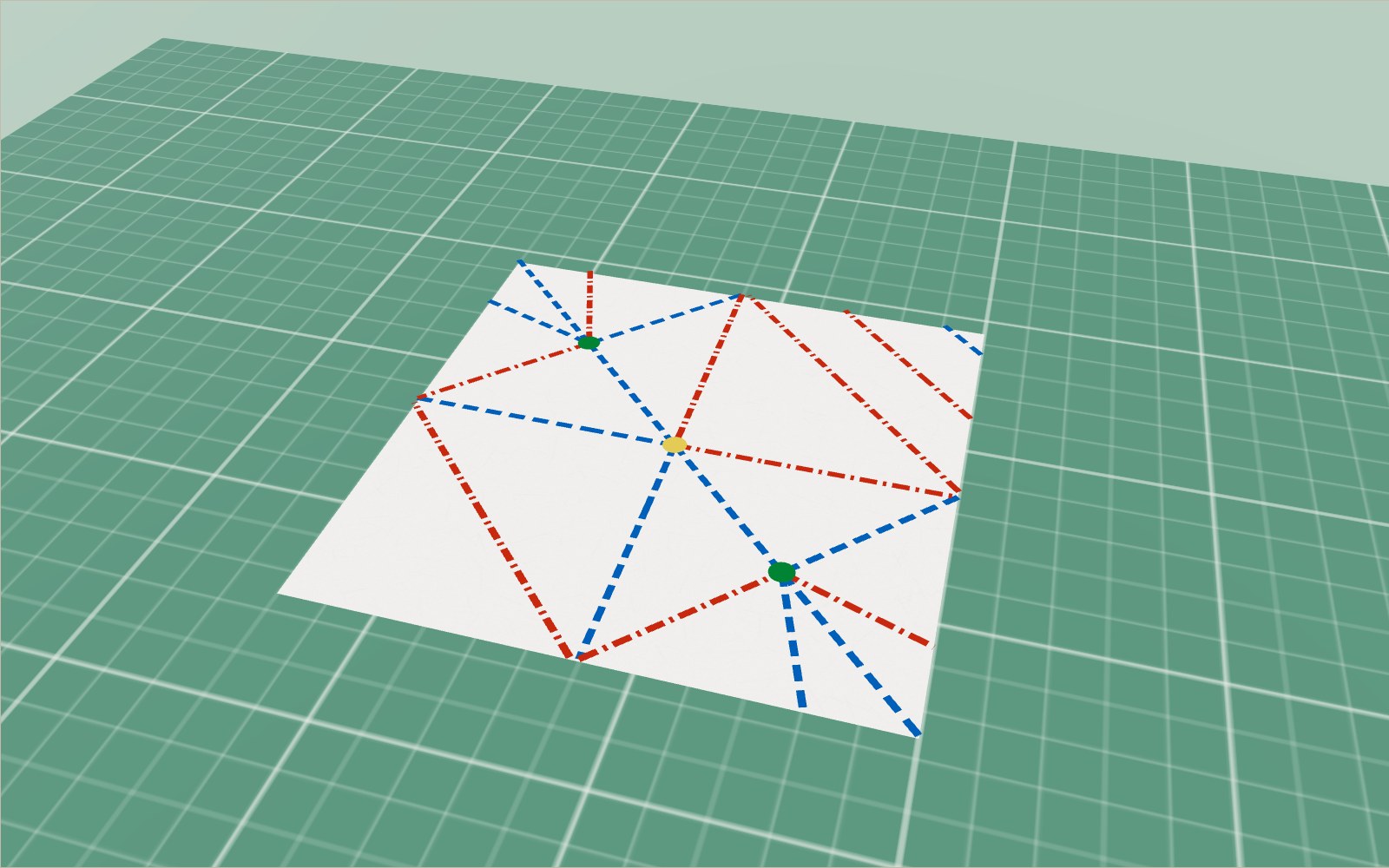
A crane uses about 30 folds, a cup six; every flat-folded point you make has mountains and valleys that differ by exactly two.
How a pendulum clock works, and why its length sets the time
A pendulum clock counts seconds with one rod 99.4 cm long. Change its length, its temperature and its place on Earth, swap four escapements and see how many seconds a day each costs.
How does a pin tumbler lock work inside? A 3D cutaway
On a common Schlage key one cut depth differs from the next by 0.381 mm, and that small step is enough to keep a wrong key from turning.