Loading the model
This device cannot show the 3D model. You can read the guide steps below as text.
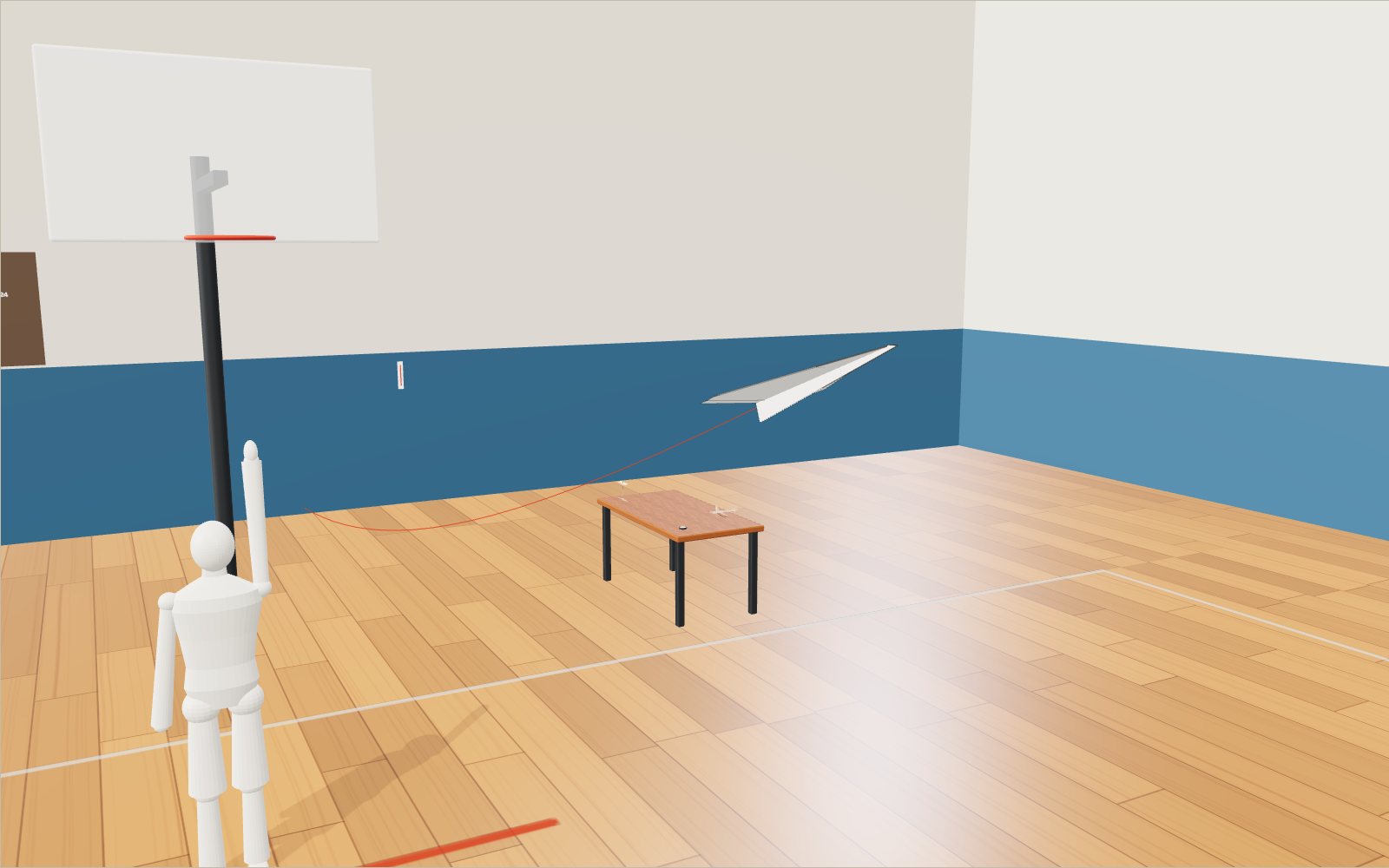
1 / 15 One sheet, one throw A dart folded from one A4 sheet leaves the hand at 11 m/s. The red line is its path, the dashed line the next throw at the current settings.
Drag to turn. Scroll or pinch to zoom.
Guide Parts Controls
01 One sheet, one throw A dart folded from one A4 sheet leaves the hand at 11 m/s. The red line is its path, the dashed line the next throw at the current settings.
02 A sheet of A4 210 by 297 mm and about 5 g. Every plane here starts from this sheet, and the folds never stretch it: the paper only turns about fold lines.
03 The centre crease Folded in half and opened again. Every later fold is lined up with this line, and the plane is folded in half along it near the end.
04 Corners to the centre The two top corners come down to the centre line. Each fold adds a layer at the front, so the nose gets heavier.
05 Wings down Folded in half, then each wing is folded down along a line beside the body. The wings stay a little raised: that is dihedral.
06 The crease pattern Unfold a Nakamura lock and every fold shows on the sheet. Blue dashes are valley folds, red dash-dots mountain folds, seen from the front.
07 Where the weight sits The black and yellow mark is the centre of mass, the blue ring the lift centre. A glider flies only when the weight sits ahead of the lift.
08 Elevators and stalls The stunt plane has its elevators bent far up. Thrown hard, the lift pulls the nose up into a climb and over.
09 Throwing for distance In the big hall the record marks stand beside the line: 61 m, 69 m, 77 m (Daegu, 2022), 88 m and the record of 98.43 m.
10 Throwing for time A hang-time glider goes up almost vertically, rolls upright at the top and circles down. The record is 31.2 seconds.
11 Building a rubber model A balsa stick, a wing, a tail, a fin, a twisted propeller and a rubber loop. Step through the parts with the bar at the bottom.
12 Winding the rubber Each turn twists the loop tighter. Past about two thirds of the maximum it knots up, and the energy it stores climbs fast.
13 The first flight Let go: the propeller unwinds the rubber, the model climbs in a circle, cruises, and glides down when the motor stops.
14 F1D in the big hall A 1.8 g model wound 1,300 turns flies for many minutes at walking pace. The clock runs 40 times faster than real time.
15 Twelve planes to try The gull is the last of twelve designs. The lab under the controls has the list, the tasks and the hidden things you have found.
Nose The front of the plane, where the folds pile up layers of paper and most of the weight. Wings The near-level paper on both sides. Its area and span set the lift and how fast it sinks. Body (keel) The folded-in-half strip under the wings that you hold when you throw. Winglets Wing tips bent up or down. They steady the plane but take some area away from the wings. Elevators The back edge of each wing bent up a little. More bend lifts the nose and slows the glide. Crease pattern The unfolded sheet with every fold drawn: blue dashes for valley folds, red dash-dots for mountain folds. Centre of mass The balance point of the paper (black and yellow mark). It has to sit ahead of the lift centre. Lift centre The neutral point of the wing (blue ring), estimated from the planform. Lift acts here in a steady glide. Paper clip A small weight on the nose (0.5 g each, model value). It moves the centre of mass forward. Thrower A 1.7 m mannequin, or your own height. The hand lets go a little above the head. Propeller Two twisted blades. The pitch is how far one turn would screw it forward through the air. Rubber motor A loop of rubber that stores energy when twisted. It knots up as the turns build. Motor stick The balsa strip that carries the rubber, the wing, the tail and the propeller. Tail plane The horizontal tail. It keeps the nose steady. Fin The vertical tail. A little bend sets the circle the model flies.