FIG. 109Senses
How lightning and thunder work
A lightning channel heats the air to about five times the temperature of the Sun’s surface, and its thunder needs about 3 seconds to cover each kilometre to you.
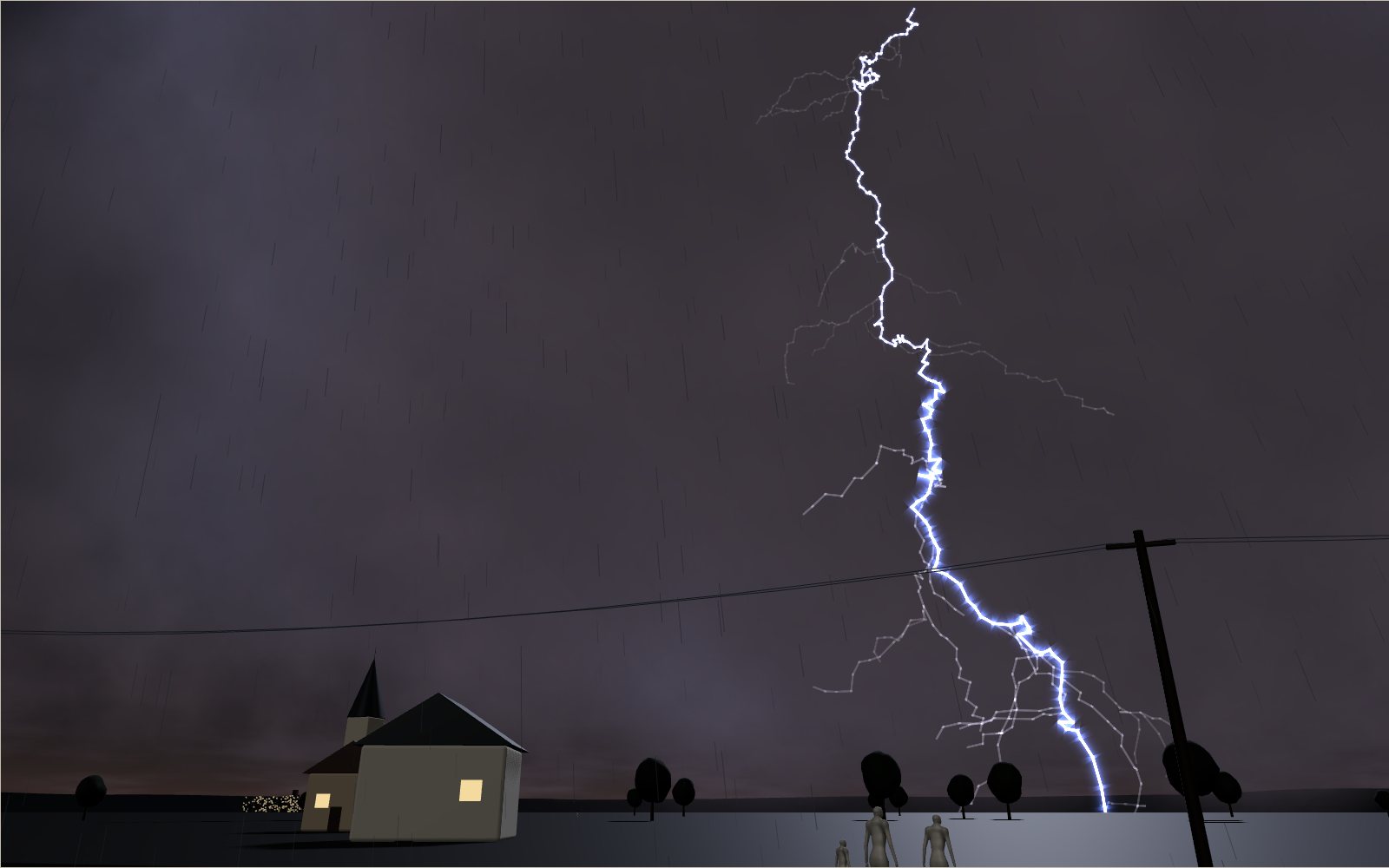
This device cannot show the 3D model. You can read the guide steps below as text.
1 / 19 A storm 3.4 km awayThis is a small town at night with a thunderstorm 3.4 km away, at true size. Watch the channel come down, then count. The thunder takes about 10 seconds to arrive. Drag to look around; the buttons along the top open six more scenes.
Drag to turn. Scroll or pinch to zoom.
What you are looking at
Everyone has counted the seconds between a flash and the thunder that follows it. This exhibit puts you in a small town on a wet night, with a thunderstorm at whatever distance you choose, and lets you count for real. Everything in the first scene is at true size: the houses, the church spire, the people walking to their car, the storm cloud and the lightning channel. The cloud base is about 1.5 km up, the top about 12 km, and a channel from the cloud to the ground is several kilometres long. The people next to it are 1.7 m tall.
The other six scenes take the flash apart. One cuts the thundercloud in half so you can see the ice that charges it. One slows a single flash down as much as a million times, until the faint stepped leader, the upward streamers and the bright return stroke happen one after another. One shows the kinds of lightning from the ground to 90 km up, including the red sprites and blue jets that were only recorded for the first time in 1989 and 1994. One puts a lightning rod on a house. One follows the sound of thunder across a map, piece by piece. The last one shows the whole Earth with a dot for every flash, about 44 of them a second.
Under the stage are the safety rules from the Korea Meteorological Administration (KMA) and the US National Weather Service (NWS), a stopwatch for counting a flash yourself, 16 challenges, a lightning book with 47 entries, hidden finds, cards that correct common mistakes, and a log of the strikes you have watched.
The first ten seconds
The exhibit opens at night with the storm 3.4 km away. About a second after the scene appears, a channel splits the sky, branches spreading from it, and lights the cloud from inside. A counter in the middle of the stage starts at the moment of the flash. Light covers the 3.4 km in about 11 microseconds, so the flash you see is, for any purpose, the moment the lightning happened. The thunder takes 9.9 seconds. When it arrives the counter turns the time into a distance: 9.9 seconds at 343 m a second is 3.4 km.
Drag to look around. You are standing at eye height at the edge of a field, with houses behind you and to the left, a church spire with a lightning rod further off, and a power line along the road. The storm sits over the field. More strikes follow on their own; the Storm activity control sets how many a minute, and the Strike button on the stage adds one whenever you like.
Counting the seconds
The rule of thumb is that sound travels about a kilometre in three seconds, or a mile in five. The National Severe Storms Laboratory (NSSL) gives both: sound covers roughly a third of a kilometre or a fifth of a mile each second, so dividing the seconds by 3 gives kilometres and dividing by 5 gives miles. The NWS writes it as "5 seconds = 1 mile, 15 seconds = 3 miles, 0 seconds = very close".
The rule works because light is about a million times faster than sound. The flash reaches you almost at once; the thunder is the only part of the event that takes time to travel. The exhibit shows both numbers for every strike: the exact delay worked out from the distance and the temperature, and the rule-of-thumb distance you would get from that delay. At 20 °C they differ by about 3 %, because sound does 343 m a second, not 333.
You can try it yourself under the stage. Press the first button when you see a flash on the stage and the second when you hear (or see the counter report) the thunder. The exhibit turns your time into a distance and compares it with the real one. Get within 15 % and the challenge is solved. The same two buttons work in a real storm, as long as you are watching from indoors.
Why the answer depends on the temperature
The speed of sound in air depends on the temperature, not on the pressure. The exhibit uses the ideal-gas formula, 331.3 m/s at 0 °C, multiplied by the square root of the absolute temperature divided by 273.15 K. That gives 343.2 m/s at 20 °C, about 325 m/s at −10 °C and about 352 m/s at 35 °C, an increase of roughly 0.6 m/s for every degree.
So the same count means slightly different distances on a cold night and a hot afternoon. Three seconds at −10 °C is 976 m; at 35 °C it is 1,056 m, about 80 m more. The Air temperature control changes the sound speed everywhere in the exhibit, including the thunder map and the inside of the cloud, where it moves the freezing level.
How hot a lightning channel gets
Lightning itself is a movement of charge and has no temperature. What gets hot is whatever the current passes through. Air is a very poor conductor, so it heats violently. The NWS gives 50,000 °F for the air in the channel, which it describes as about five times hotter than the surface of the Sun. NASA puts the Sun's visible surface, the photosphere, at about 10,000 °F (5,500 °C). In Celsius, 50,000 °F is about 27,760 °C.
The NSSL gives a range, 18,000 to 60,000 °F, and says the heating happens "in only a few millionths of a second". The KMA's annual lightning report gives 20,000 to 30,000 °C. The numbers differ because the channel is not one temperature: it is hottest at the peak of the current and cools quickly afterwards, and different methods catch different moments.
When lightning hits a tree, the heat turns the water inside to steam, which can blow off a strip of bark or split the trunk. When it hits sand or soil, it can melt it into a glassy tube along the path of the current. These tubes are called fulgurites; one appears in the lightning-rod scene when a strike reaches open ground.
How a thundercloud gets its charge
A thunderstorm grows where warm, moist air rises strongly enough to carry a cloud far above the freezing level. The NWS describes the inside of a mature storm: small ice crystals in the upper part, a mixture of ice crystals and small hail in the middle, and rain and melting hail lower down.
Charge appears in the middle of the cloud, where three things meet: graupel (soft hail a quarter of a millimetre to a few millimetres across, growing by catching supercooled droplets), small ice crystals, and supercooled water. When graupel and ice crystals collide and bounce apart, a little charge moves from one to the other. The NSSL calls this the non-inductive process, because it does not need an electric field to start, and notes that "the exact physical mechanisms are not completely understood".
Which way the charge goes depends on the temperature. Laboratory work, starting with Takahashi in 1978, found that graupel takes positive charge at temperatures a little below freezing and negative charge where it is colder. The NSSL says the same in plain terms. The temperature at which the sign changes depends on how much liquid water there is in the cloud; the exhibit uses −10 °C and marks it with a yellow ring.
Where the charge ends up
Once the particles are charged, the updraft sorts them. Light ice crystals rise faster than heavy graupel, so positive charge collects high in the cloud and in the anvil, while negative charge stays on the graupel in the middle. A smaller positive region often forms below, where graupel charges positive in slightly warmer air. The ground under the storm becomes positively charged in answer to the negative charge above it.
The inside-the-cloud scene shows this. The heights are real; the particles are drawn thousands of times larger than life and the clock runs fast. The rings mark 0, −10, −20 and −40 °C. They follow a standard lapse rate of 6.5 °C per kilometre from the ground temperature, so a warmer afternoon lifts all of them. Each spark marks a collision: blue where graupel took negative charge, red where it took positive. When the main negative charge is full, the cloud discharges, usually inside itself, sometimes to the ground. The Updraft control sets how hard the air rises and so how often collisions happen.
Thunderstorms do more than make lightning. The NSSL explains that they act like batteries in the global electric circuit, keeping the Earth's surface negative and the air above positive. In fair weather there is an electric field of about 100 V/m near the ground. Without thunderstorms, the NSSL says, that balance would disappear in about five minutes.
The stepped leader
A flash to the ground does not start at the ground. Most, if not all, flashes start inside the cloud. In the common kind, a channel of negative charge called the stepped leader grows downward. The NSSL describes it zigzagging down in segments of about 50 yards, in a forked pattern, invisible to the eye, reaching the ground "in less time than it takes to blink".
Each step forms where the air ahead is already becoming ionised as many faint streamers; the streamer that carries the most current becomes the next step. A review by Rakov (2013) gives an average downward speed of about 200 km/s. A channel 6 km long takes about 30 thousandths of a second.
The slow-motion scene grows a leader in the same way. Starting under the cloud base, each step goes about 46 m in a slightly new direction, pulled toward the ground but wandering; side branches split off and die. The time the leader reaches every point is the path length divided by 200 km/s. The stage plays the leader up to 500 times slower, whatever the Slow motion control says, so a leader that takes a few tens of milliseconds in real life comes down in about 10 seconds; the control sets how slowly the return stroke plays.
Streamers and the moment of contact
As the leader nears the ground, the electric field at the tops of tall objects becomes strong enough for them to send sparks upward. The NSSL says this starts when the leader is less than about 100 yards above the ground, and that trees, bushes and buildings all do it. Taller objects are more likely to produce the upward channel, which is why they are more likely to be struck.
Usually only one streamer meets the leader. The NWS lists streamers as one of the five ways lightning injures people: when the main channel discharges, all the other streamers in the area discharge too, so a person who is part of one can be hurt even though the lightning did not connect through them. In the slow scene the rod, the tree, the pole and even the person send up streamers; at ×100,000 you can watch which one connects.
The return stroke
The moment the leader connects, a powerful current begins to flow. This is the return stroke: a wave of current and light that runs from the ground back up the channel. It is the bright part you see. The NSSL gives its speed as about 60,000 miles a second. Streak-camera measurements by Idone and Orville (1982) found a mean of 1.1 × 10⁸ m/s near the ground, about a third of the speed of light, with first strokes a little slower at 9.6 × 10⁷ m/s.
At that speed the return stroke climbs about 1.1 km in 10 microseconds, a hundred-thousandth of a second. A 6 km channel lights from bottom to top in about 55 microseconds. This is why the Slow motion control goes to ×1,000,000: at that setting, one real microsecond takes one second on screen, and you can watch the light run up the channel.
How much current flows? The NWS gives a typical flash as about 300 million volts and 30,000 amps, against 120 volts and 15 amps for a household circuit. The NSSL gives 100 million to 1 billion volts. The Peak current control sets the current used in the lightning-rod scene, from 5 to 300 kA; 30 kA is the commonly quoted median for first strokes.
Why lightning flickers
A flash rarely ends with one stroke. After the first return stroke the channel cools, but it stays easier to break down than fresh air. Tens of milliseconds later a dart leader runs down the same path, without steps, and another return stroke follows. The NSSL says a negative flash can have one or as many as 20 return strokes; we see this as flickering.
The slow scene plays the strokes in order: stroke, glow, a pause between strokes, the dart leader, the next stroke. The Return strokes control sets how many. Many flashes also reach the ground in more than one place. The NWS cites tests in the United States and Japan that found multiple ground attachments in at least half of negative flashes and more than 70 % of positive ones.
Positive lightning
Less often, a flash lowers positive charge to the ground. These positive flashes usually come from the upper part of the storm or the anvil, often far from the rain. The NSSL says they typically have a single return stroke, are more likely to carry a sustained current, and may be considered more dangerous because their peak current is often stronger and their continuing current lasts longer, which is also thought to make them better at starting fires.
Lightning that never reaches the ground
Most lightning never touches the ground. Flashes that stay inside one cloud are called intra-cloud (IC) flashes; flashes between clouds are cloud-to-cloud; flashes whose channels reach out into clear air without striking anything are cloud-to-air. The NSSL estimates roughly 5 to 10 times as many cloud flashes as ground flashes, and spider lightning, long channels crawling along the underside of the anvil, is one of its photographs. When a cloud flash is hidden inside the cloud, the whole cloud seems to light up at once; this is sometimes called sheet lightning.
The kinds scene has a button for each: negative and positive ground flashes, in-cloud, cloud-to-cloud, cloud-to-air, a bolt from the blue, an upward flash from a tall tower and four kinds above the cloud.
Bolts from the blue
A bolt from the blue starts inside the cloud, leaves through the side of the storm, travels a long way sideways through clear air and then turns down. It can strike the ground where the sky overhead looks blue. The NWS says such bolts can strike 10 to 15 miles from the thunderstorm, and that lightning in general often strikes more than three miles from the storm's centre, outside the rain. The NSSL describes a cyclist struck under a cloudless sky by a bolt that probably came from a storm about 10 miles away, hidden behind mountains.
This is the reason behind the NWS's simplest rule. If you can hear thunder, you are likely within striking distance.
Above the clouds
For most of history, nobody knew that thunderstorms also produce light far above their tops. On the night of 22 to 23 September 1989, researchers testing a low-light camera caught an upward discharge over a storm 250 km away; it rose from the cloud tops at 14 km into the clear air above (Franz, Nemzek and Winckler, 1990). Aircraft campaigns in 1994 then gave the first colour images and measured heights.
Red sprites are red flashes with a main body typically between 50 and 90 km up and 5 to 30 km across, with faint blue tendrils hanging below, lasting less than 16 milliseconds (Sentman and others, 1995). They usually appear above large positive ground flashes. Astronauts have photographed them from the International Space Station.
Blue jets are narrow cones of blue light that rise from the cloud top at about 100 km/s and end at 40 to 50 km (Wescott and others, 1995). Gigantic jets go further, from the top of the thundercloud to the lower ionosphere, reported by Pasko and colleagues in 2002 and by Su and colleagues in 2003.
Elves are faint rings that flash at 75 to 105 km, about 100 to 300 km across, in under a millisecond (Fukunishi and others, 1996). They are thought to be the lower ionosphere heated by the radio pulse of a strong flash below. Because they spread so fast, the ring in the exhibit grows over more than a second: the upper-air events are shown about 100 times slower than real.
Gamma rays and antimatter
In 1994 detectors on the Compton Gamma Ray Observatory, built to look at the distant universe, recorded brief, intense flashes of gamma rays coming from Earth (Fishman and others, 1994). These terrestrial gamma-ray flashes come from thunderstorms; electrons accelerated to millions of electron volts give off gamma rays as they slow down. In 2011 the Fermi spacecraft detected beams of electrons and positrons, the antimatter partners of electrons, sent up from thunderstorms (Briggs and others, 2011). A small gold satellite in the kinds scene opens a card about them.
Where lightning strikes
The NWS lists three things that decide where lightning strikes: height, a pointed shape and isolation. Metal makes no difference to where it strikes. It does conduct current, which is why the NWS says to keep away from metal fences, railings and bleachers.
Lightning also does strike the same place twice. The Empire State Building is hit an average of 23 times a year. The NSSL suggests two reasons. With so much lightning, two strikes will sometimes land close together by chance; and something about a site, its height or the ground under it, can make it a better source of upward streamers. In the first scene, a tall tower in the city on the horizon is one of the hidden finds, and the Tall tower button sends a flash to it.
Striking distance and the rolling sphere
The last jump between the leader and the ground is not decided until the leader is close. Engineers describe this with the striking distance: the distance from the leader tip at which an object can launch the streamer that connects. Draw a sphere of that radius around the tip; the first object inside it is the one struck.
The traditional formula used in lightning protection is S = 10 I^0.65, with S in metres and I the peak current in kiloamps. Cooray, Rakov and Theethayi (2007) worked out the charge on the leader from measured currents and proposed S = 1.9 I^0.90 instead. For the median first-stroke current of 30 kA, the old formula gives 91 m and the new one 41 m. The lightning-rod scene uses the newer one and shows both in the readout.
The same idea gives the rolling-sphere method for placing rods: imagine a sphere with the striking distance as its radius rolling over a building. Anything it touches can be struck; anything it cannot reach is protected. With the rod tip 11.7 m up and a 41 m sphere, the sphere resting on the rod and the ground leaves a ring of ground about 28 m around the rod untouched. The formula is r = √(2Sh − h²), where h is the height of the rod.
What a lightning rod does
Benjamin Franklin proposed the lightning rod in the early 1750s, and the KMA's lightning report dates the discovery that lightning is electricity to his hypothesis and proposed experiment of 1752 (Krider, 2006, tells the story). A rod does not pull lightning from far away. It gives the leader a better place to connect than the roof, and a conductor gives the current a path down to a ground rod, so it does not pass through the building.
In the lightning-rod scene the leader comes down slowed about 900 times, with its striking-distance sphere around the tip. With the rod up, the rod is nearly always the first thing inside the sphere; the down conductor glows and rings of current spread from the ground rod. Take the rod down with the Rod button and the strike goes to the chimney, the tree, the car, the fence or open ground instead.
How lightning hurts people
The NWS lists five ways lightning strikes people. A direct strike makes the person part of the main channel; it is less common but the most likely to kill. A side flash jumps from a taller object, usually a tree, to someone within a foot or two. Ground current spreads out from a strike through the ground and causes the most deaths and injuries; it also kills many farm animals, because the current has a long path between their front and back legs. Conduction carries current along wires, plumbing and metal into anyone touching them, which is why the NWS says to keep off corded phones and away from plumbing indoors. Streamers, as described above, are the fifth.
In the United States, lightning killed an average of 20 people a year over the ten years from 2016 to 2025, according to the NWS's preliminary figures. The NSSL puts the odds of being struck in a given year at 1 in 1.2 million, and over an 80-year lifetime at 1 in 15,300. People struck by lightning carry no charge: it is safe to touch them, call for help and start CPR.
Thunder: from shock wave to rumble
Thunder starts as a shock wave. The return stroke heats the channel in a few millionths of a second, faster than the air can expand, so the pressure inside jumps. The air then bursts outward. The NSSL says the disturbance is a shock wave for the first 10 yards or so and an ordinary sound wave after that.
Thunder rolls because a channel is long. Every part of it makes its sound at the same moment, but the parts are at different distances from you. You hear the nearest part first, then parts further and further away; a channel that runs for kilometres through the cloud can keep you listening for tens of seconds. The NWS adds that a sharp crack or click means the channel passed nearby, while a rumble means the lightning was at least several miles away, and that the loud boom you sometimes hear comes from the main channel reaching the ground.
The thunder scene draws this on a map. The channel comes down to the ground and then runs several kilometres sideways inside the cloud. Every piece sends out its own sound front; the rings on the ground show where each one has reached. When a ring passes you, that piece is heard, and the trace above the stage adds them up. The first thunder comes from the nearest piece and the last from the farthest; the readout gives both distances and the length of the rumble. With you 3 km from the strike, the first sound arrives after about 9 seconds and the last more than 30 seconds after the flash.
How far thunder carries
Thunder fades with distance and loses its high notes on the way. The NSSL notes that higher frequencies are absorbed more quickly by the air, so close thunder sounds like tearing, then a crack, and distant thunder becomes a low rumble; it can be heard up to 25 miles away. The NWS says it can usually be heard for about 10 miles when there is no background noise, and that traffic, wind and rain shorten that. The KMA gives about 20 km, sometimes about 40 km.
The Background noise control uses a simple model, not a measurement: the thunder level falls by spreading and by air absorption, and it is heard where it is louder than the noise. At 30 dB, a quiet night, the model puts the edge at about 18 km; at 60 dB, near traffic, at about 4 km. Set the storm beyond that and the flash comes with no thunder at all. People call that heat lightning, a name that suggests a special kind seen on hot nights. The NSSL says it is lightning too far away for the thunder to be heard.
44 flashes a second
The old textbook answer to "how much lightning is there?" was 100 flashes a second, an estimate made in 1925 from records of thunderstorm days. Satellites changed it. The Optical Transient Detector watched the whole planet for five years and counted an average of 44 ± 5 flashes a second, in-cloud and ground flashes together (Christian and others, 2003). That is about 1.4 billion a year. The same data show lightning mainly over land, with an average land-to-ocean ratio of about 10 to 1.
The Earth scene shows a dot for each flash, 44 a second on average, placed at random but weighted by a map. That map is a model built from latitude, land and sea, and the ten published hotspots; it is an estimate for the picture, not the satellite grid itself. The counter shows how many flashes have happened on Earth since you opened the scene.
Lightning hotspots
Using 16 years of observations from the Lightning Imaging Sensor on the Tropical Rainfall Measuring Mission, Albrecht and colleagues (2016) ranked the places with the most lightning per square kilometre. The top spot is not in Africa, as earlier work had suggested, but over Lake Maracaibo in Venezuela: about 233 flashes per square kilometre a year. Storms form over the warm lake on 297 nights a year, peaking in September, when mountain, lake and sea breezes meet. The flashes are so regular that sailors once used them as a lighthouse.
Kabare in the Democratic Republic of the Congo is second with 205. Africa has 283 of the top 500 places and, NASA notes, six of the top ten. In the United States, the NSSL says the highest frequency of cloud-to-ground lightning is in Florida between Tampa and Orlando, where moist air and sea breezes meet on many days of the year.
Lightning in Korea
The KMA's network of 21 sensors records ground strikes over South Korea with a median location accuracy within 250 m. Its 2025 lightning report counted 106,750 ground strikes on land that year. The ten-year mean, 2016 to 2025, is 105,385. The year before was unusually busy: 145,784 strikes in 2024, and 27,431 on a single day, 5 August, about 19 % of the year's total.
Most Korean lightning falls in summer. The ten-year monthly means are highest in July (37,073) and August (31,767) and lowest in January (42) and February (253). The lab under the stage uses those means: choose a month and it tells you how many ground strikes Korea's land gets on average then.
Records from space
A geostationary lightning mapper watches the same half of the planet all the time, and that made it possible to measure single flashes hundreds of kilometres long, called megaflashes. In 2025 the World Meteorological Organization certified a record for distance: one flash on 22 October 2017 that ran 829 km from eastern Texas to near Kansas City (Peterson and others, 2025). It was found by re-examining GOES-16 data, and it beat the previous record, 768 km on 29 April 2020. The record for duration is a single flash over Uruguay and Argentina on 18 June 2020 that kept going for 17.102 seconds (Peterson and others, 2022).
Records like these change how lightning safety is described. A flash can travel hundreds of kilometres through the clouds and send strokes to the ground far from where the storm seems to be.
Lightning elsewhere
Thunderstorms are not the only source. The NSSL lists volcanic eruptions, very intense forest fires that build their own thunderclouds, heavy snowstorms (thundersnow), large hurricanes and surface nuclear explosions. The eruption of Hunga volcano in Tonga on 15 January 2022 sent a plume at least 58 km high and produced more than 2,600 flashes a minute, arranged in rings that spread outward with gravity waves in the umbrella cloud (Van Eaton and others, 2023).
Jupiter has lightning too. The Juno spacecraft recorded its radio emission at 600 MHz, mostly near the poles (Brown and others, 2018), and later saw small flashes from shallow storms high in the atmosphere (Becker and others, 2020). A banded planet in the corner of the Earth scene opens a card about them; its size and distance there are not to scale.
What the agencies say to do
The two agencies agree on almost everything. There is no safe place outside when a thunderstorm is near. Substantial buildings and hard-topped metal vehicles with the windows closed are safe; small sheds, tents, rain shelters and open vehicles are not. Indoors, keep off corded phones, anything plugged into an outlet, and plumbing, and away from windows and doors. Wait 30 minutes after the last thunder before going outside again, because the last flash of a storm can come many minutes after the one before it.
They differ on one rule. The KMA still teaches the 30-30 rule: count from the flash to the thunder, and if it is 30 seconds or less, move to a safe place at once. The NWS now says that if you hear thunder at all, you are already in danger, and its slogan is "When Thunder Roars, Go Indoors!" Thirty seconds is about 10 km, and lightning can strike that far from the storm.
They also describe being caught in the open differently. The KMA describes, as a way to reduce risk while you get away, crouching low with feet together and keeping 5 to 10 m from other people, and says lying on wet ground is very dangerous. The NWS says crouching does not make you any safer and that lying flat increases the danger from ground current; it advises keeping moving toward shelter. Both agree that the only good answer is to get indoors in time.
About the flashes in this exhibit
Lightning is a bright flash, and bright flashes repeated quickly can trigger seizures in people with photosensitive epilepsy. A review for the Epilepsy Foundation of America found that 15 to 25 flashes a second are the most provocative, with a range of 1 to 65 (Fisher and others, 2005). This exhibit keeps every large bright change of the stage behind one gate: a new peak can start only 0.34 seconds after the last one, so there are never more than three a second, and strokes that come sooner join the glow that is already there instead of making a new flash. The Soft flashes switch spaces the peaks a second apart and makes them weaker. It turns on by itself when your device asks for reduced motion.
This also means the stage does not show the real flicker of a multi-stroke flash at full speed, where strokes are tens of milliseconds apart. The slow-motion scene shows those strokes one by one instead.
How the model differs from reality
The town, the storm and every distance in the first scene are at true size, and the sound delays are worked out exactly from distance and temperature. Some things are simplified:
- The channel is grown from random steps pulled toward the ground. Its shape is plausible, not a copy of any measured flash.
- The cloud is built from soft puffs and lit from inside by the flash; it does not simulate air flow.
- In the cloud scene the particles are thousands of times too large and time runs fast, and the charging is a rule (sign by temperature, amount by collisions), not a microphysics model.
- The thunder heard against noise uses a simple level model; real thunder depends on the channel, the ground, the wind and the temperature layers.
- The Earth map is a model, as described above. The 44 a second, the land-to-ocean ratio and the hotspot values are measured; the shape of the glow is an estimate.
- Ball lightning appears now and then after close strikes. There is real evidence it exists, including one recorded spectrum (Cen, Yuan and Xue, 2014), but how it works is still argued about.
The guided tour and the lab
The guided tour goes through 19 steps, from counting the first strike to the safety rules. Each step sets the stage for you: the scene, the camera, the distance, the kind of lightning. The Controls tab has the same settings for free use; the Parts tab lists 31 parts across the seven scenes and flies to each.
Below the stage, the lab keeps what you do. Challenges are saved in your browser and marked with a star when solved. The lightning book ticks each kind, place and record when you see it on the stage. Hidden finds are things on the stage that open a card when you click them; some appear only now and then, like the silent flashes beyond the hills, a sprite above the storm or a ball of light after a close strike. The Recent strikes table lists the last ten flashes with their distance, strokes and current.
Questions
How do I work out how far away lightning is?
Count the seconds from the flash to the thunder and divide by 3 for kilometres or by 5 for miles. At 20 °C sound covers about 343 m a second, so 9 seconds is about 3.1 km. Do the counting from a safe place: if you can hear thunder, you are close enough to be struck.
Why do I see lightning before I hear thunder?
Light is about a million times faster than sound. The flash reaches you in millionths of a second, while the sound needs about 3 seconds for every kilometre.
How hot is lightning?
The air in the channel can reach about 50,000 °F, about 27,760 °C, which the NWS describes as five times hotter than the Sun's surface. The NSSL gives 18,000 to 60,000 °F and the KMA 20,000 to 30,000 °C.
Does lightning strike the same place twice?
Often. Tall, pointed, isolated things are struck again and again. The Empire State Building is hit an average of 23 times a year.
How many times a second does lightning strike on Earth?
About 44 ± 5 flashes a second on average, about 1.4 billion a year, counted by satellite. The older figure of 100 a second was an estimate from 1925.
Where does lightning strike most?
Over Lake Maracaibo in Venezuela, at about 233 flashes per square kilometre a year. Africa has six of the top ten spots. In the United States, Florida between Tampa and Orlando has the most cloud-to-ground lightning.
How much lightning does Korea get?
The KMA counted 106,750 ground strikes on land in 2025, against a ten-year mean of 105,385. Most come in July and August.
Is it safe in a car during a thunderstorm?
A hard-topped metal car with the windows closed protects you, because of its metal shell. The rubber tyres have nothing to do with it. Convertibles and open vehicles are not safe.
Can I be struck if it is not raining?
Yes. Lightning often strikes more than three miles from the centre of the storm, and bolts from the blue have struck 10 to 15 miles away. If you can hear thunder, take shelter.
What is the 30-30 rule?
Count from the flash to the thunder; if it is 30 seconds or less, take shelter, and then wait 30 minutes after the last thunder. The KMA still teaches it. The NWS now says to take shelter at any thunder, but keeps the 30-minute wait.
Is it safe to touch someone who has been struck?
Yes. The body does not store electricity. Call emergency services (119 in Korea, 911 in the US), move to safety if lightning continues, and start CPR if the person is not breathing.
What is heat lightning?
Lightning from a storm too far away for its thunder to be heard. It is not a separate kind, and it means a storm exists that may come closer.
What are sprites?
Red flashes 50 to 90 km above strong positive lightning, lasting less than 16 milliseconds. They were first caught on camera by chance in 1989.
Does lightning go up or down?
Both. The leader comes down from the cloud, but the bright return stroke that you see runs from the ground up. Tall towers can also start upward flashes.
Why does thunder rumble?
Every part of a long channel sends out sound at the same moment, and the parts are at different distances from you. Their sound arrives one after another over many seconds.
Why does lightning flicker?
Most ground flashes have several return strokes along the same channel, tens of milliseconds apart. This exhibit merges strokes that come too close together, to keep the stage safe for people sensitive to flashing light.
Terms
- Return stroke: the bright wave of current that runs up the channel once the leader connects with the ground.
- Stepped leader: the faint channel that grows down from the cloud in steps before the return stroke.
- Streamer: an upward spark from an object on the ground toward an approaching leader.
- Dart leader: a leader that runs down an existing channel without steps, before a later stroke.
- Graupel: soft hail grown by freezing droplets, central to charging a thundercloud.
- Positive flash: a ground flash that lowers positive charge, usually with one stroke.
- Striking distance: the distance from the leader tip at which an object can launch the connecting streamer.
- Rolling sphere: a design method that rolls a sphere of the striking distance over a building to find what can be struck.
- Transient luminous event: a brief light above a thunderstorm, such as a sprite, jet or elve.
- Megaflash: a single flash hundreds of kilometres long.
Sources
- NOAA National Weather Service, Lightning Myths and Facts: https://www.weather.gov/safety/lightning-myths
- NOAA National Weather Service, Overview: Lightning Safety: https://www.weather.gov/safety/lightning-safety-overview
- NOAA National Weather Service, Lightning Tips: https://www.weather.gov/safety/lightning-tips
- NOAA National Weather Service, Understanding Lightning: https://www.weather.gov/safety/lightning-science-overview
- NOAA National Weather Service, Understanding Lightning: Thunder: https://www.weather.gov/safety/lightning-science-thunder
- NOAA National Weather Service, How Hot Is Lightning?: https://www.weather.gov/safety/lightning-temperature
- NOAA National Weather Service, How Powerful Is Lightning?: https://www.weather.gov/safety/lightning-power
- NOAA National Weather Service, Five Ways Lightning Strikes People: https://www.weather.gov/safety/lightning-struck
- NOAA National Weather Service, Lightning and Cars: https://www.weather.gov/safety/lightning-cars
- NOAA National Weather Service, Lightning Fatalities: https://www.weather.gov/safety/lightning-fatalities
- NOAA National Weather Service, Lightning Safety: https://www.weather.gov/safety/lightning
- NOAA National Weather Service, Lightning Safety and Outdoor Sports: https://www.weather.gov/safety/lightning-sports
- NOAA National Weather Service JetStream, Lightning Safety: https://www.weather.gov/source/zhu/ZHU_Training_Page/lightning_stuff/lightning2/lightning_safety.html
- NOAA National Severe Storms Laboratory, Severe Weather 101: Lightning Basics: https://www.nssl.noaa.gov/education/svrwx101/lightning/
- NOAA National Severe Storms Laboratory, Severe Weather 101: Lightning Types: https://www.nssl.noaa.gov/education/svrwx101/lightning/types/
- NOAA National Severe Storms Laboratory, Severe Weather 101: Lightning FAQ: https://www.nssl.noaa.gov/education/svrwx101/lightning/faq/
- NOAA NESDIS, NOAA Satellites Help Certify World's Longest Lightning Flash (2025): https://www.nesdis.noaa.gov/news/noaa-satellites-help-certify-worlds-longest-lightning-flash
- NOAA GOES-R Series, Geostationary Lightning Mapper: https://www.goes-r.gov/spacesegment/glm.html
- NASA, Earth's New Lightning Capital Revealed (2016): https://www.nasa.gov/missions/trmm/earths-new-lightning-capital-revealed/
- NASA Earth Observatory, A New Look at Earth's Lightning: https://science.nasa.gov/earth/earth-observatory/a-new-look-at-earths-lightning-149301
- NASA Science, Sun: Facts: https://science.nasa.gov/sun/facts/
- NASA Science, Lightning Strikes Twice (Apollo 12, 1969): https://science.nasa.gov/resource/lightning-strikes-twice
- 기상청 (Korea Meteorological Administration), 2025 낙뢰연보: https://www.kma.go.kr/download_01/lightning/lightning_2025.pdf
- 기상청 (Korea Meteorological Administration), 2024 낙뢰연보: https://www.kma.go.kr/download_01/lightning/lightning_2024.pdf
- 기상청 날씨누리, 자연재난행동요령: 낙뢰: https://www.weather.go.kr/w/hazard/safety-guide/lightning.do
- Christian, H. J. et al. (2003), Global frequency and distribution of lightning as observed from space by the Optical Transient Detector, JGR: https://doi.org/10.1029/2002JD002347
- Albrecht, R. I. et al. (2016), Where Are the Lightning Hotspots on Earth?, BAMS: https://doi.org/10.1175/BAMS-D-14-00193.1
- Peterson, M. J. et al. (2022), New WMO Certified Megaflash Lightning Extremes for Flash Distance and Duration Recorded from Space, BAMS: https://doi.org/10.1175/BAMS-D-21-0254.1
- Peterson, M. J. et al. (2025), A New WMO-Certified Single Megaflash Lightning Record Distance: 829 km, BAMS: https://doi.org/10.1175/BAMS-D-25-0037.1
- Idone, V. P. and Orville, R. E. (1982), Lightning return stroke velocities in the Thunderstorm Research International Program, JGR: https://doi.org/10.1029/JC087iC07p04903
- Rakov, V. A. (2013), The Physics of Lightning, Surveys in Geophysics: https://doi.org/10.1007/s10712-013-9230-6
- Cooray, V., Rakov, V. and Theethayi, N. (2007), The lightning striking distance, revisited, Journal of Electrostatics: https://doi.org/10.1016/j.elstat.2006.09.008
- Takahashi, T. (1978), Riming Electrification as a Charge Generation Mechanism in Thunderstorms, J. Atmos. Sci.: https://doi.org/10.1175/1520-0469(1978)035%3C1536:REAACG%3E2.0.CO;2
- Franz, R. C., Nemzek, R. J. and Winckler, J. R. (1990), Television Image of a Large Upward Electrical Discharge Above a Thunderstorm System, Science: https://doi.org/10.1126/science.249.4964.48
- Sentman, D. D. et al. (1995), Preliminary results from the Sprites94 Aircraft Campaign: 1. Red sprites, GRL: https://doi.org/10.1029/95GL00583
- Wescott, E. M. et al. (1995), Preliminary results from the Sprites94 Aircraft Campaign: 2. Blue jets, GRL: https://doi.org/10.1029/95GL00582
- Fukunishi, H. et al. (1996), Elves: Lightning-induced transient luminous events in the lower ionosphere, GRL: https://doi.org/10.1029/96GL01979
- Pasko, V. P. et al. (2002), Electrical discharge from a thundercloud top to the lower ionosphere, Nature: https://doi.org/10.1038/416152a
- Su, H. T. et al. (2003), Gigantic jets between a thundercloud and the ionosphere, Nature: https://doi.org/10.1038/nature01759
- Fishman, G. J. et al. (1994), Discovery of Intense Gamma-Ray Flashes of Atmospheric Origin, Science: https://doi.org/10.1126/science.264.5163.1313
- Briggs, M. S. et al. (2011), Electron-positron beams from terrestrial lightning observed with Fermi GBM, GRL: https://doi.org/10.1029/2010GL046259
- Brown, S. et al. (2018), Prevalent lightning sferics at 600 megahertz near Jupiter's poles, Nature: https://doi.org/10.1038/s41586-018-0156-5
- Becker, H. N. et al. (2020), Small lightning flashes from shallow electrical storms on Jupiter, Nature: https://doi.org/10.1038/s41586-020-2532-1
- Van Eaton, A. R. et al. (2023), Lightning Rings and Gravity Waves: Insights Into the Giant Eruption Plume From Tonga's Hunga Volcano, GRL: https://doi.org/10.1029/2022GL102341
- Cen, J., Yuan, P. and Xue, S. (2014), Observation of the Optical and Spectral Characteristics of Ball Lightning, Physical Review Letters: https://doi.org/10.1103/PhysRevLett.112.035001
- Schumann, U. and Huntrieser, H. (2007), The global lightning-induced nitrogen oxides source, Atmos. Chem. Phys.: https://doi.org/10.5194/acp-7-3823-2007
- Krider, E. P. (2006), Benjamin Franklin and lightning rods, Physics Today: https://doi.org/10.1063/1.2180176
- Fisher, R. S. et al. (2005), Photic- and Pattern-induced Seizures: A Review for the Epilepsy Foundation of America Working Group, Epilepsia: https://doi.org/10.1111/j.1528-1167.2005.31405.x
- Few, A. A. (1969), Power spectrum of thunder, JGR: https://doi.org/10.1029/JC074i028p06926
More exhibits
How a phonograph works: from tinfoil to cassette and CD
Edison's first phonograph cut a voice into tinfoil in 1877, and the same needle played it back from a groove 2.54 mm apart.
Electric motor simulator: how it works, step by step
Eight motors, from Faraday's wire in mercury in 1821 to the magnets inside an electric car, all turning on the same push between current and field.
How electricity gets to your home
Electricity leaves the power station at 345,000 volts and reaches the outlet at 220, because high voltage keeps the current, and the heat lost in the wires, small.
How a lithium-ion battery works: where the ions go on charge
Each time an 18650 cell charges, about 7 × 10²² lithium ions leave a metal oxide and squeeze in between sheets of graphite.
How a microwave oven works: the magnetron that makes the waves
The waves inside a microwave oven are 12.2 cm long, so without a turntable the hot spots in your food sit about 6 cm apart.
How a touchscreen works: how the glass finds your finger
Under the glass of a phone lies a grid of transparent electrodes, and your finger shows up as a small dip in the charge passing between them.