FIG. 49How It Works
How a lithium-ion battery works: where the ions go on charge
Each time an 18650 cell charges, about 7 × 10²² lithium ions leave a metal oxide and squeeze in between sheets of graphite.
This device cannot show the 3D model. You can read the guide steps below as text.
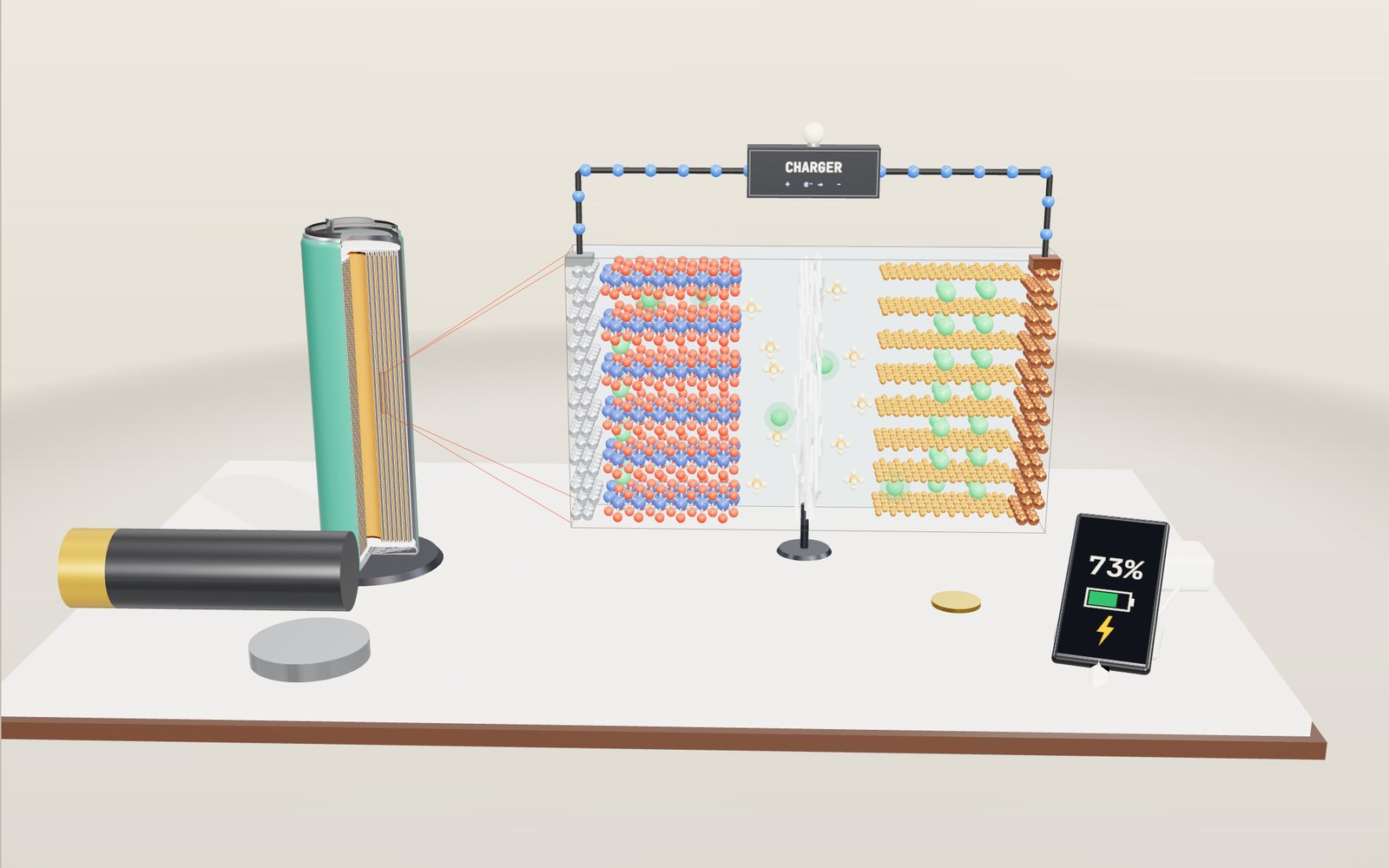
1 / 8 An 18650 cell, cut openThe name gives the size: 18 mm across and 65 mm tall. A quarter of the can is cut away so you can see the rolled layers inside. On the right, a tiny piece of those layers is drawn at the size of atoms, and the red lines show where it comes from.
Drag to turn. Scroll or pinch to zoom.
What the model shows
When a lithium-ion battery charges, lithium ions move from the metal oxide electrode through the electrolyte into graphite. Electrons travel through the external circuit rather than through the separator. Discharging reverses the ion flow and supplies energy to the connected load.
Pull the battery out of a laptop pack, a power tool or an older electric car and you will often find rows of identical metal cylinders inside. Each one is an 18650 cell, named for its size: 18 mm across and 65 mm tall. It weighs less than 50 grams, and yet it can run a bright torch for hours. This exhibit opens one up and follows the lithium inside it.
On the left stands the cell with a quarter of its can cut away. Under the steel you can see a long strip of thin layers rolled up tightly, like a swiss roll. On the right, a tiny piece of that strip is drawn at the size of atoms: aluminium foil, a cathode made of a layered metal oxide, a porous separator soaked in liquid electrolyte, an anode made of graphite, and copper foil. A wire with a charger or a lamp joins the two foils over the top. In front, tabs on the stage put a phone on its charger, an electric car at a fast charger, or a small pack built from copies of the same cell.
The Charge, Discharge and Rest buttons decide which way the green lithium balls travel. The state of charge slider moves them by hand. The readout shows the cell voltage, the charge and energy left in the cell, and a curve of voltage against state of charge with a red dot for the present moment. The series and parallel sliders rebuild the pack, and the temperature slider walks the cell through the stages of thermal runaway.
The cell figures come from the Panasonic NCR18650B data sheet, a common 18650 cell: a rated capacity of 3,200 mAh, a nominal voltage of 3.6 V and a charging voltage of 4.2 V. The shape of the voltage curve between empty and full is a model, and the article says so wherever it matters.
Why lithium, and why two electrodes
A battery stores energy as a chemical difference between two materials. Connect them with a wire and electrons flow from the material that holds them loosely to the one that wants them more. Lithium is the lightest metal and gives up its outer electron very readily, which is why chemists in the 1970s turned to it when they wanted a light battery with a high voltage.
Pure lithium metal is hard to live with, though. It reacts violently with water, and when a lithium metal electrode is recharged, thin whiskers of lithium grow from it. If they reach the other electrode, the cell short-circuits. The lithium-ion cell gets round this by never using lithium as a metal. The lithium stays as ions, and the ions are always stored inside another material: in the cathode when the cell is empty and in the anode when it is full. Chemists call this storing of guests between the layers of a host crystal intercalation.
So a lithium-ion cell is two hosts with a liquid between them. Charging moves lithium from the oxide host into the graphite host, where it sits at a much higher energy. Discharging lets it fall back. The voltage of the cell is a measure of how far it falls.
Where the lithium lives
The cathode in the model is a layered oxide like lithium cobalt oxide, LiCoO₂. Cobalt atoms (blue) sit in flat sheets, each sandwiched between two sheets of oxygen atoms (red). The gaps between these sandwiches are where the lithium sits. Because the sheets are held together whether or not the lithium is there, lithium can slide out of the gaps and back in again without the crystal collapsing. Many cells today use NMC or NCA cathodes, which mix nickel, manganese, cobalt or aluminium into the same layered structure.
The anode is graphite: flat sheets of carbon atoms joined in hexagons and stacked on top of each other. Lithium slips in between the sheets. In the model the oxide has 40 places for lithium and the graphite has 42, and the 40 green balls are shared between them.
Each electrode is a paste of tiny particles coated on a metal foil. The cathode sits on aluminium, the anode on copper. The foils do not take part in the chemistry; they collect the electrons and carry them to the terminals. In the cell on the left the aluminium is joined by a tab to the top cap, which is the positive terminal, and the copper is joined to the bottom of the can, which is the negative terminal.
Charging and discharging, step by step
Press Charge. The charger pulls electrons out of the cathode through the aluminium and pushes them through the wire into the graphite. The graphite now carries extra negative charge and the oxide has lost some, so lithium ions (which carry a positive charge) leave the oxide, cross the electrolyte, pass through the pores of the separator and slide in between the carbon sheets. The blue electrons in the wire and the green ions inside the cell move in the same direction, from the left side to the right, but by different roads.
Press Discharge and the lamp replaces the charger. The lithium in the graphite is at a higher energy, so the process runs downhill: electrons leave the graphite, light the lamp and arrive at the cathode, while the ions travel back through the electrolyte into the oxide. While a ball is in the liquid it carries a faint green halo, so you can pick out the ions in transit.
The two roads are the whole trick. The electrolyte lets ions through but not electrons, so the only way for the electrons to follow the ions is through the wire, where we can make them do work.
The voltage, charge and energy, worked out
The voltage between the terminals depends on how much lithium is left in the graphite. Empty, the cell rests near 3.1 V; full, near 4.1 V. The curve in the readout rises steeply at first, then runs nearly flat through the middle and climbs again at the end. The ends match the sources: Battery University gives 3.0 to 4.2 V as the typical operating range of cobalt-based lithium-ion, with charging to 4.20 V per cell.
When current flows, the cell's internal resistance shifts the voltage. The model gives the cell 0.05 Ω and uses a current of 1.6 A, half the cell's capacity per hour (0.5 C). That moves the voltage by 1.6 × 0.05 = 0.08 V: up while charging, down while discharging. So the charger reaches its 4.20 V limit just as the model reaches 100 %, and the voltage under load falls to 3.00 V just as it reaches 0 %.
Here are the model's figures:
| State of charge | Open-circuit voltage | Charging | Discharging | Charge in cell | Energy in cell |
|---|---|---|---|---|---|
| 0 % | 3.08 V | 3.16 V | 3.00 V | 0 mAh | 0 Wh |
| 20 % | 3.58 V | 3.66 V | 3.50 V | 640 mAh | 2.20 Wh |
| 50 % | 3.71 V | 3.79 V | 3.63 V | 1,600 mAh | 5.71 Wh |
| 80 % | 3.92 V | 4.00 V | 3.84 V | 2,560 mAh | 9.36 Wh |
| 100 % | 4.12 V | 4.20 V | 4.04 V | 3,200 mAh | 11.93 Wh |
Energy is voltage times charge. The quick version uses the nominal voltage: 3.6 V × 3.2 Ah = 11.52 Wh, which is what you would print on the label. The readout adds the energy up slice by slice under the voltage curve and gets 11.93 Wh at rest. Discharging at 0.5 C, the average voltage in the model is 3.65 V and the cell delivers 11.68 Wh, within 1.4 % of the label figure. Battery University describes the nominal 3.6 V as roughly the halfway voltage of a cobalt-based cell discharged at 0.5 C, and the model's halfway voltage under load is 3.63 V.
How many ions is that? One ampere-hour is 3,600 coulombs, so 3.2 Ah is 11,520 coulombs. Divide by the charge of one ion, 1.602 × 10⁻¹⁹ coulombs, and you get about 7.2 × 10²² lithium ions moving from the oxide to the graphite on every full charge. Each green ball in the model stands for 80 mAh, or about 1.8 × 10²¹ of them.
The model charges in 40 seconds. At 1.6 A the real cell would need two hours for the same amount of charge, so the model runs about 180 times faster. The data sheet's standard charge takes four hours because the charger holds 4.2 V at the end and lets the current taper off.
Series, parallel and packs
One cell gives about 3.6 V. A laptop, an e-bike or a car needs more voltage or more capacity, so cells are joined. Cells in series add their voltages and carry the same current; cells in parallel share the current and add their capacities. Engineers write the arrangement as, for example, 10s4p: ten groups in series, each group made of four cells in parallel.
| Pack | Nominal voltage | Full | Empty | Capacity | Energy (nominal) | Cells |
|---|---|---|---|---|---|---|
| 1s1p | 3.6 V | 4.2 V | 3.0 V | 3.2 Ah | 11.5 Wh | 1 |
| 3s1p | 10.8 V | 12.6 V | 9.0 V | 3.2 Ah | 34.6 Wh | 3 |
| 4s2p | 14.4 V | 16.8 V | 12.0 V | 6.4 Ah | 92.2 Wh | 8 |
| 10s4p | 36 V | 42 V | 30 V | 12.8 Ah | 460.8 Wh | 40 |
The 4s2p row is worth a second look. The US Federal Aviation Administration normally allows lithium-ion batteries up to 100 Wh; eight of these cells total 92 Wh. With airline approval, up to two spare batteries above 100 Wh and no more than 160 Wh may be carried. Spare batteries belong in carry-on baggage only, with terminals protected; airlines may impose stricter limits. In the pack the nickel strips on top join the positive end of one column to the negative end of the next, and every other column is turned upside down to make that possible.
A real pack also needs a battery management system that watches the voltage of every series group. If one group drifts higher than the others, it would be the first to pass 4.2 V on charge, so the electronics balance them.
How a hot cell starts heating itself
A charged cell holds a lot of energy close to flammable liquid. Most of the time that is fine, because the reactive surfaces are protected. The graphite is covered by a thin film called the solid electrolyte interphase, or SEI, which forms on the anode and keeps the electrolyte from reacting with the lithium-filled carbon.
Raise the temperature slider and you can follow what Sandia National Laboratories describes. Around 120 °C the SEI starts to break down. The electrolyte reaches the graphite and reacts with it, giving off heat, and the cell starts heating itself even if nothing outside is warming it. In the model the self-heating rate is 0.2 °C per minute at that point, the rate Sandia uses to mark the onset.
At about 135 °C the polyethylene in the separator softens and its pores close. This is a safety feature called shutdown: with the pores sealed the ions cannot pass, so charging and discharging stop. In the model the current drops to zero and the ions freeze where they are. A study of polyethylene separators found them shrinking by more than half at 150 °C, and once the film shrinks away from the edges, the electrodes can touch and short circuit inside the cell.
Higher still, the charged cathode starts to decompose and give off oxygen. Sandia reports onset temperatures from 150 °C to 250 °C depending on the cathode; Battery University lists about 210 °C as typical for NMC. Oxygen released inside a cell full of flammable solvent is what turns a hot cell into a fire. Sandia calls it thermal runaway once the cell heats itself by 10 °C per minute or more, because at that rate no outside cooling can catch up. The model reaches that rate at 210 °C. Above it, red oxygen atoms drift out of the oxide and smoke pours from the vent under the top cap.
The same chain can start without any outside heat: a crushed or punctured cell can short inside, and the short heats the cell from within.
Using lithium-ion cells safely
The safety advice from fire services follows straight from that chain.
- Do not puncture, crush or bend a cell or a battery pack. The US National Fire Protection Association lists penetration and crushing among the main causes of lithium-ion fires.
- Charge with the charger made for the device. A charger built for another battery may push the cell past 4.2 V or keep charging after it is full.
- Stop using a battery that swells, smells unusual, gets very hot, makes popping sounds or changes colour.
- Do not charge a battery that is damaged or has been under water.
- Do not throw used batteries into the household bin or recycling bin. The US Environmental Protection Agency asks for them to go to battery collection points, with the terminals taped.
What this model leaves out
- Distances are not to scale. In a real cell each coating is tens of micrometres thick and the separator is thinner still, so the gap the ions cross is huge compared with the atoms. The model squeezes it to fit next to the electrodes.
- The electrodes are drawn as perfect crystals. Real ones are pastes of particles with binder and carbon black, and the crystal layers point in all directions.
- All 40 model ions can move. A real layered oxide gives up only part of its lithium before it becomes unstable, and some lithium is used up in forming the SEI.
- The voltage curve is a smooth model shape. A real curve depends on the cathode chemistry, temperature, age and current.
- The heat stages use single temperatures from the sources. In a real cell they overlap and depend on the size, the chemistry and how charged it is.
- The pack has no management electronics and no fuse.
- Only the layered oxide cell uses data-sheet values. The voltage curves of LFP, LTO and sodium-ion, their capacities, the plating limit and the 180-times clock are model values.
Three chemists and a Nobel Prize
The 2019 Nobel Prize in Chemistry went to John B. Goodenough, M. Stanley Whittingham and Akira Yoshino "for the development of lithium-ion batteries". The Nobel Committee's account starts in the early 1970s, when Whittingham, working at Exxon, built the first working lithium battery with a cathode of titanium disulphide that could hold lithium ions between its layers. It gave a little over two volts, but its anode was lithium metal, and it was too reactive for wide use.
Goodenough guessed that a metal oxide would give a higher voltage than a sulphide. In 1980 he reported lithium cobalt oxide, which produced about four volts, nearly twice as much. In 1985 Yoshino replaced the lithium metal anode with petroleum coke, a carbon material that can also hold lithium ions. That made the first commercially viable lithium-ion battery: both electrodes were hosts, and no metallic lithium was needed. A Japanese electronics company started selling lithium-ion batteries in 1991.
From a phone label to a car pack
A phone battery marked 5,000 mAh and 3.85 V has a nominal energy of 5 Ah × 3.85 V = 19.25 Wh. The first number measures charge, not energy. A different voltage changes the energy even if the mAh figure stays the same. This is why comparing a phone battery with a power bank by mAh alone can be misleading: the power bank may quote its internal cell voltage, while its USB output operates at another voltage. Voltage conversion also wastes some energy as heat. The calculation is a label comparison, not a prediction of exactly how long a particular phone will run.
For a deliberately simplified electric-car example, suppose a pack stores 75 kWh of nominal energy and uses the exhibit's 11.52 Wh cells. First convert 75 kWh to 75,000 Wh. Dividing by 11.52 Wh gives about 6,510 cells. This is an energy estimate, not a buildable wiring plan. The series count must also match the motor inverter's voltage range, and the parallel count must be a whole number. Actual cars can use much larger cylindrical cells, pouch cells or prismatic cells, so a 75 kWh pack need not contain anything close to this count. Cooling hardware and the enclosure add mass without adding cell energy.
Energy per mass, measured in Wh/kg, has the same boundary problem. A cell figure excludes the pack's cooling plates and protection electronics. Comparing a bare NMC cell with an assembled LFP pack therefore compares different things. A pack's usable energy may also be smaller than its nominal energy because the control system keeps a reserve near full and empty. Neither the exhibit's energy counter nor this phone calculation includes those reserves. State the voltage, measurement boundary and operating conditions before ranking two batteries.
Charging current and heat
C-rate expresses current relative to capacity. For this 3.2 Ah cell, 0.5 C means 1.6 A; 1 C means 3.2 A. If current stayed constant throughout the charge, 1 C would supply the rated charge in one hour. Real lithium-ion charging does not keep that current to the very end. The charger reaches its voltage limit, then holds the voltage while current falls. A charging time cannot therefore be obtained simply by dividing an hour by the advertised maximum C-rate.
The exhibit assumes an internal resistance of 0.05 Ω. Its simple resistive heating estimate is I²R: at 1.6 A it is 0.128 W; at 3.2 A it would be 0.512 W. Doubling current produces four times the resistive heating under this fixed-resistance assumption. These are calculated examples, not a permission to charge the displayed cell at the higher current. Resistance changes with temperature, charge state and age; real heat generation also includes electrochemical contributions. The current slider on the stage (C-rate) reproduces that second case: at 1 C the readout of heat from the current is four times the value at 0.5 C.
A charger also has to keep the anode able to accept lithium. Faster transport through the electrolyte is not enough if lithium cannot enter graphite quickly enough. Cold conditions make fast charging particularly difficult. The review by Edge and colleagues describes fast charging at low temperature as a main trigger for lithium plating. A manufacturer's allowed charging-temperature range is consequently different from a promise that every charging speed is safe throughout that range.
Why capacity fades without a leak
The protective SEI is useful because it limits continuing reactions between graphite and electrolyte. Forming and growing it nevertheless consumes lithium and electrolyte. Lithium trapped in these products no longer carries charge between the electrodes. A thicker layer can also increase resistance. The battery may therefore retain less charge and show a larger voltage drop under load even though its case is intact. This is chemical ageing, not electrical charge simply escaping through an invisible hole.
Ageing continues while a cell is stored. High temperature and a high state of charge can accelerate side reactions, which is why calendar age and cycle count describe different aspects of battery history. During cycling, particles can crack as their volume changes. Fresh surfaces then become places for further reactions and SEI formation. There is no universal number of years or cycles after which every lithium-ion battery fails; chemistry, design and use all matter.
Lithium plating is a different route to damage. Instead of entering graphite, lithium deposits as metal on its surface. Some may return during subsequent operation, but some becomes isolated or reacts to form more SEI. Metallic deposits can also contribute to internal shorts. On the stage, charging too fast for the temperature grows silver needles of lithium on the graphite. The limit there is a model value: the scene shows the tendency, it cannot diagnose a real cell.
Completely discharging a lithium-ion battery before every recharge does not restore this lost lithium. The familiar advice about avoiding a memory effect belongs to other battery behaviours, not a requirement to empty a modern lithium-ion cell. A device showing 0 % normally means its protection system has reached a lower operating limit; it does not mean there are no lithium ions left. Do not bypass that protection to chase a supposedly more complete discharge.
What a transport safety test proves
UN 38.3 concerns the suitability of lithium cells and batteries for transport. Southwest Research Institute lists tests including altitude simulation, temperature cycling, vibration, shock and external short circuit, together with crush or impact, overcharge and forced discharge where applicable. These are controlled tests applied according to the type of cell or battery. Passing them does not mean a damaged pack cannot burn, nor that every individual unit has undergone every destructive test.
The temperature slider illustrates a failure sequence, not a certification test or a method to test a battery at home. The SEI, separator and cathode responses overlap in real cells. Their onset depends on chemistry and state of charge, as well as how the cell is heated. A low-resistance short can create a local hot spot long before the whole case reaches a quoted temperature. Use certified equipment as intended and follow the manufacturer's handling instructions; never heat or puncture a cell to check this exhibit.
Reading the model's controls
Choose Rest at a middle state of charge and note the open-circuit voltage. Without changing that charge setting, switch to Discharge. The terminal voltage is lower because the model subtracts the internal-resistance drop. Charge produces the opposite shift. The red point belongs to the selected operating mode, not to a second battery with a different chemistry. Moving the state-of-charge slider by hand bypasses the time needed to transfer charge; it is not a fast-charging experiment.
For the pack, compare 1s1p with 4s2p at the same charge state. The nominal voltage changes from 3.6 V to 14.4 V and capacity from 3.2 Ah to 6.4 Ah. Energy changes from 11.52 Wh to 92.16 Wh, matching the eight cells. Connecting cells differently redistributes voltage and charge capacity; it creates no extra chemical energy. Return temperature to its ordinary setting before comparing electrical modes, since separator shutdown deliberately stops ion motion in the hot model.
On the stage you can also try things directly. Drag the plug into the phone, or the charging gun into the car, and the scene starts charging at that device's rate: about 1.3 C for a phone fast charger and 2.33 C on average for a car going from 10 % to 80 % in 18 minutes. As the charge rises, the graphite turns dark blue, red and then gold, and its layers spread by 10 %. Raise the current or cool the cell below 0 °C and silver lithium needles grow on the graphite. The chemistry slider swaps the layered oxide for LFP, an LTO anode or sodium-ion, and the voltage curve changes with it. The Controls tab lists twelve challenges, ten battery materials with sources, and seven hidden things on the stage.
Questions
What does 18650 mean?
It is the size: 18 mm in diameter and 65 mm long. The NCR18650B data sheet gives maximum dimensions of 18.25 mm by 65.10 mm.
Why does a lithium-ion cell show 3.6 V or 3.7 V on the label but charge to 4.2 V?
The label gives the nominal voltage, roughly the average during a discharge. The voltage really runs from about 3.0 V when empty to 4.2 V when full. Battery University notes that some makers print 3.7 V instead of 3.6 V for the same kind of cell.
Where do the electrons go during charging?
Through the wire. The charger pulls electrons from the cathode and pushes them into the graphite. The electrolyte does not carry electrons, so inside the cell the charge travels as lithium ions instead.
How do I work out the watt-hours of a battery?
Multiply the voltage by the amp-hours: Wh = V × Ah. For the model cell, 3.6 V × 3.2 Ah = 11.52 Wh. A pack works the same way, using the pack's voltage and capacity: a 10s4p pack of these cells is 36 V × 12.8 Ah = 460.8 Wh.
Why do lithium-ion batteries catch fire?
Because heat can feed more heat. If a cell gets hot enough, from a short, a crush, a fault or overcharging, reactions inside it release heat faster than it can escape. Above about 120 °C the protective film on the graphite breaks down, and at higher temperatures the cathode gives off oxygen inside a cell full of flammable liquid.
Is it bad to keep a phone at 100 %?
High voltage stresses the cell. Battery University advises keeping a lithium-ion cell at its 4.20 V peak for as short a time as possible, and notes that chargers built for standby use often stop at 4.05 V instead.
Who invented the lithium-ion battery?
The 2019 Nobel Prize in Chemistry credits three people: M. Stanley Whittingham for the first lithium battery with an intercalation cathode, John B. Goodenough for the four-volt lithium cobalt oxide cathode, and Akira Yoshino for the first commercially viable cell with a carbon anode.
Must I empty a lithium-ion battery before charging it?
No. A full discharge is not needed to prevent a memory effect. Repeatedly bypassing the device's low-voltage cutoff can damage the cell; recharging cannot reverse lithium lost to ageing reactions.
Does 1 C guarantee a full charge in one hour?
No. It describes current relative to capacity. The voltage-limited finishing stage reduces current, and charging losses and temperature restrictions also affect the elapsed time.
Does UN 38.3 mean a battery can never catch fire?
No. It addresses transport testing of a cell or battery design. Damage, manufacturing faults and misuse can still cause failure; passing a transport test does not remove those risks.
Terms
- Cathode: the electrode that holds the lithium when the cell is empty, here a layered metal oxide. During discharge it is the positive terminal.
- Anode: the electrode that holds the lithium when the cell is charged, here graphite.
- Intercalation: storing ions in the gaps of a host crystal without breaking it up.
- Electrolyte: the liquid that carries ions between the electrodes, a lithium salt (often LiPF₆) in carbonate solvents.
- Separator: a porous plastic film that keeps the electrodes apart but lets ions pass.
- Current collector: the metal foil under each electrode coating; aluminium for the cathode, copper for the anode.
- State of charge (SoC): how full the cell is, from 0 % to 100 % of its capacity.
- mAh and Ah: units of charge. 1 Ah is one ampere flowing for one hour, 3,600 coulombs.
- Wh: watt-hour, a unit of energy. Volts times amp-hours.
- C-rate: current relative to capacity. 0.5 C for a 3.2 Ah cell is 1.6 A.
- SEI (solid electrolyte interphase): the thin protective film that forms on the anode.
- Thermal runaway: self-heating that speeds itself up until the cell vents, burns or bursts.
Sources
Nobel Prize Outreach, The Nobel Prize in Chemistry 2019: Press release. https://www.nobelprize.org/prizes/chemistry/2019/press-release/ (checked 16 October 2026)
Nobel Prize Outreach, The Nobel Prize in Chemistry 2019: Popular information (They created a rechargeable world). https://www.nobelprize.org/prizes/chemistry/2019/popular-information/ (checked 16 October 2026)
Panasonic, Lithium ion NCR18650B data sheet (rated capacity, nominal and charging voltage, dimensions). https://www.orbtronic.com/content/NCR18650B-Datasheet-Panasonic-Specifications.pdf (checked 16 October 2026)
Battery University, BU-205: Types of Lithium-ion. https://www.batteryuniversity.com/article/bu-205-types-of-lithium-ion/ (checked 16 October 2026)
Battery University, BU-303: Confusion with Voltages. https://www.batteryuniversity.com/article/bu-303-confusion-with-voltages/ (checked 16 October 2026)
Battery University, BU-409: Charging Lithium-ion. https://www.batteryuniversity.com/article/bu-409-charging-lithium-ion/ (checked 16 October 2026)
Battery University, BU-302: Series and Parallel Battery Configurations. https://www.batteryuniversity.com/article/bu-302-series-and-parallel-battery-configurations/ (checked 16 October 2026)
D. H. Doughty and E. P. Roth (Sandia National Laboratories), A General Discussion of Li Ion Battery Safety, The Electrochemical Society Interface, Summer 2012. https://www.sandia.gov/app/uploads/sites/213/2022/08/Doughty_2012_Electrochem._Soc._Interface_21_37.pdf (checked 16 October 2026)
Multilayer Polyethylene Separator with Enhanced Thermal and Electrochemical Performance for Lithium-Ion Batteries, PubMed Central. https://pmc.ncbi.nlm.nih.gov/articles/PMC12843065/ (checked 16 October 2026)
The Role of Separator Thermal Stability in Safety Characteristics of Lithium-ion Batteries, Journal of The Electrochemical Society 169 (2022) 090521. https://iopscience.iop.org/article/10.1149/1945-7111/ac8edf (checked 16 October 2026)
National Fire Protection Association, Lithium-Ion Battery Safety. https://www.nfpa.org/en/education-and-research/home-fire-safety/lithium-ion-batteries (checked 16 October 2026)
US Federal Aviation Administration, PackSafe: Lithium Batteries. https://www.faa.gov/hazmat/packsafe/lithium-batteries (checked 16 October 2026)
US Environmental Protection Agency, Used Lithium-Ion Batteries. https://www.epa.gov/recycle/used-lithium-ion-batteries (checked 16 October 2026)
Model values (0.05 Ω internal resistance, the voltage curve between 3.08 V and 4.12 V, 40 drawn ions, 40-second charge, self-heating rate between 120 °C and 210 °C) were worked through by hand.
Southwest Research Institute, Transport testing of lithium-ion batteries. https://www.swri.org/markets/automotive-transportation/automotive/battery-testing-research/un-383-transportation-testing-lithium-ion-batteries
J. S. Edge et al., Lithium ion battery degradation: what you need to know, Physical Chemistry Chemical Physics (2021). https://research-information.bris.ac.uk/ws/portalfiles/portal/286803843/Full_text_PDF_final_published_version_.pdf
Hyundai Motor Company, IONIQ 5 Charging. https://www.hyundai.com/worldwide/en/eco/ioniq5-2022/charging
S. Ahmed et al., Enabling fast charging: a battery technology gap assessment, Journal of Power Sources 367 (2017) 250-262 (US Department of Energy). https://doi.org/10.1016/j.jpowsour.2017.06.055
P. Asenbauer et al., The success story of graphite as a lithium-ion anode material, Sustainable Energy & Fuels 4 (2020) 5387-5416. https://doi.org/10.1039/D0SE00175A
Cross-Sectional In Situ Optical Microscopy with Simultaneous Electrochemical Measurements for Lithium-Ion Full Cells, Journal of The Electrochemical Society 169 (2022). https://doi.org/10.1149/1945-7111/ac6c57
N. Nitta et al., Li-ion battery materials: present and future, Materials Today 18 (2015) 252-264. https://doi.org/10.1016/j.mattod.2014.10.040
CATL, First generation of sodium-ion batteries (2021). https://www.catl.com/en/news/665.html
More exhibits
How electricity gets to your home
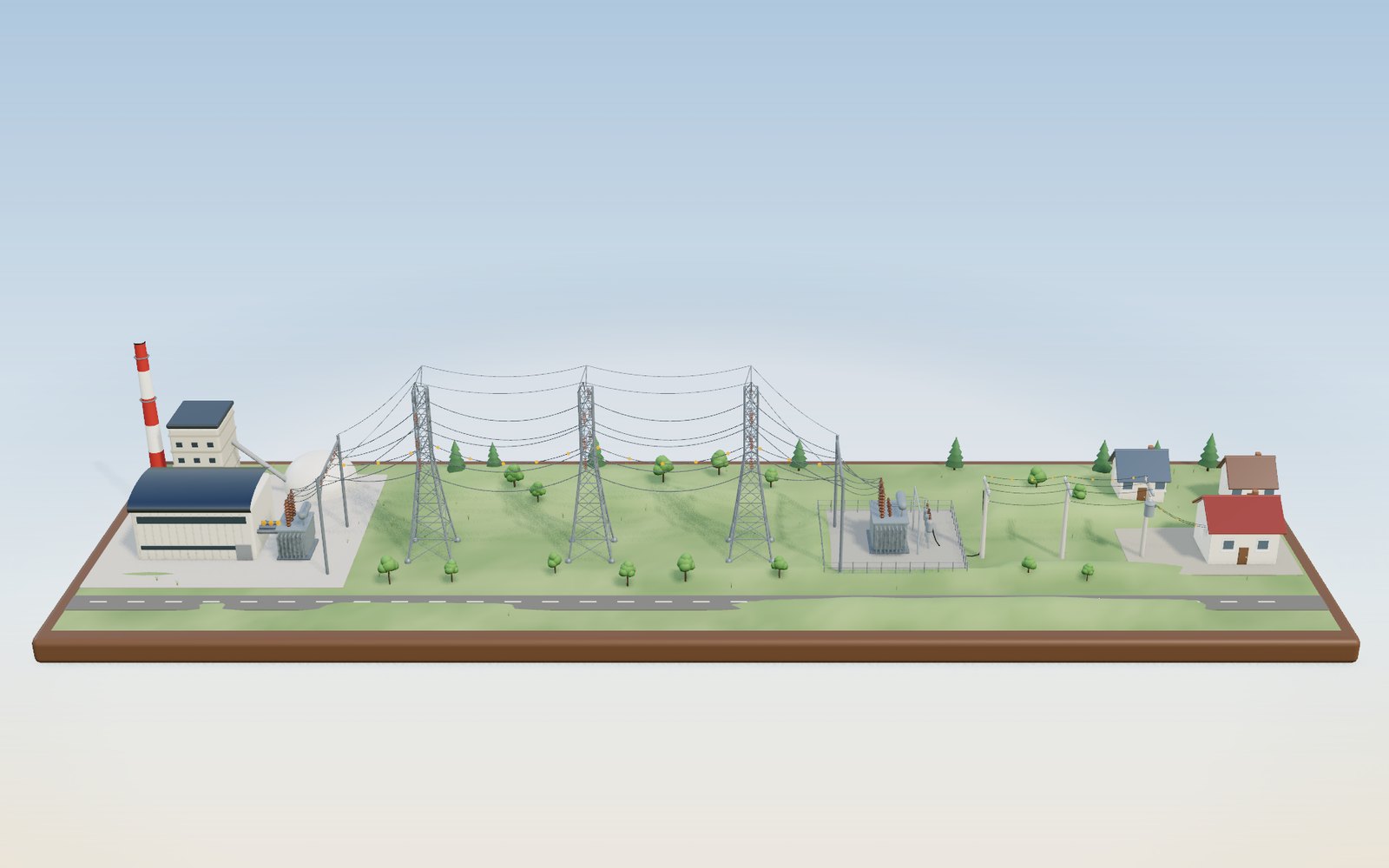
Electricity leaves the power station at 345,000 volts and reaches the outlet at 220, because high voltage keeps the current, and the heat lost in the wires, small.
How a microwave oven works: the magnetron that makes the waves
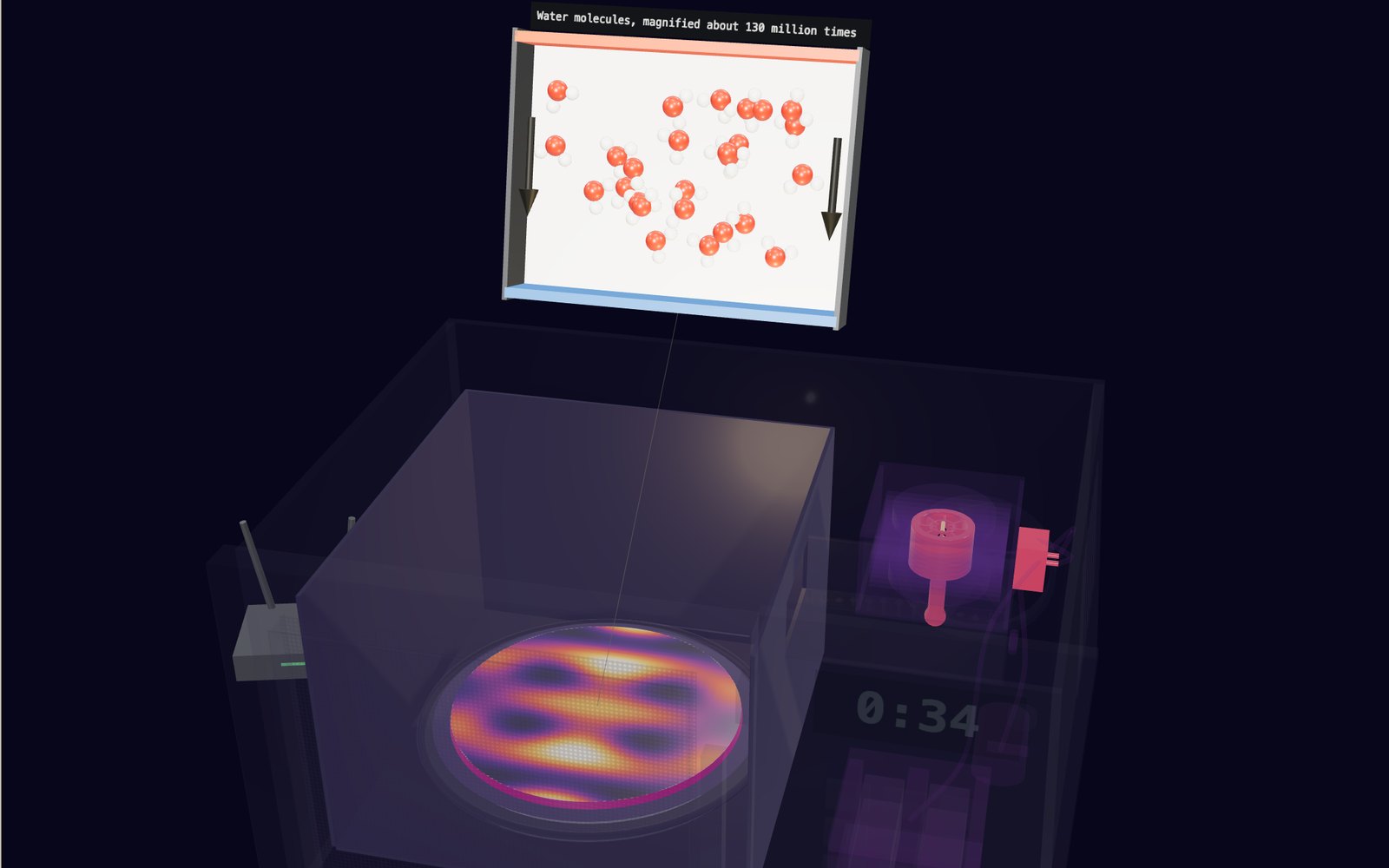
The waves inside a microwave oven are 12.2 cm long, so without a turntable the hot spots in your food sit about 6 cm apart.
How a touchscreen works: how the glass finds your finger
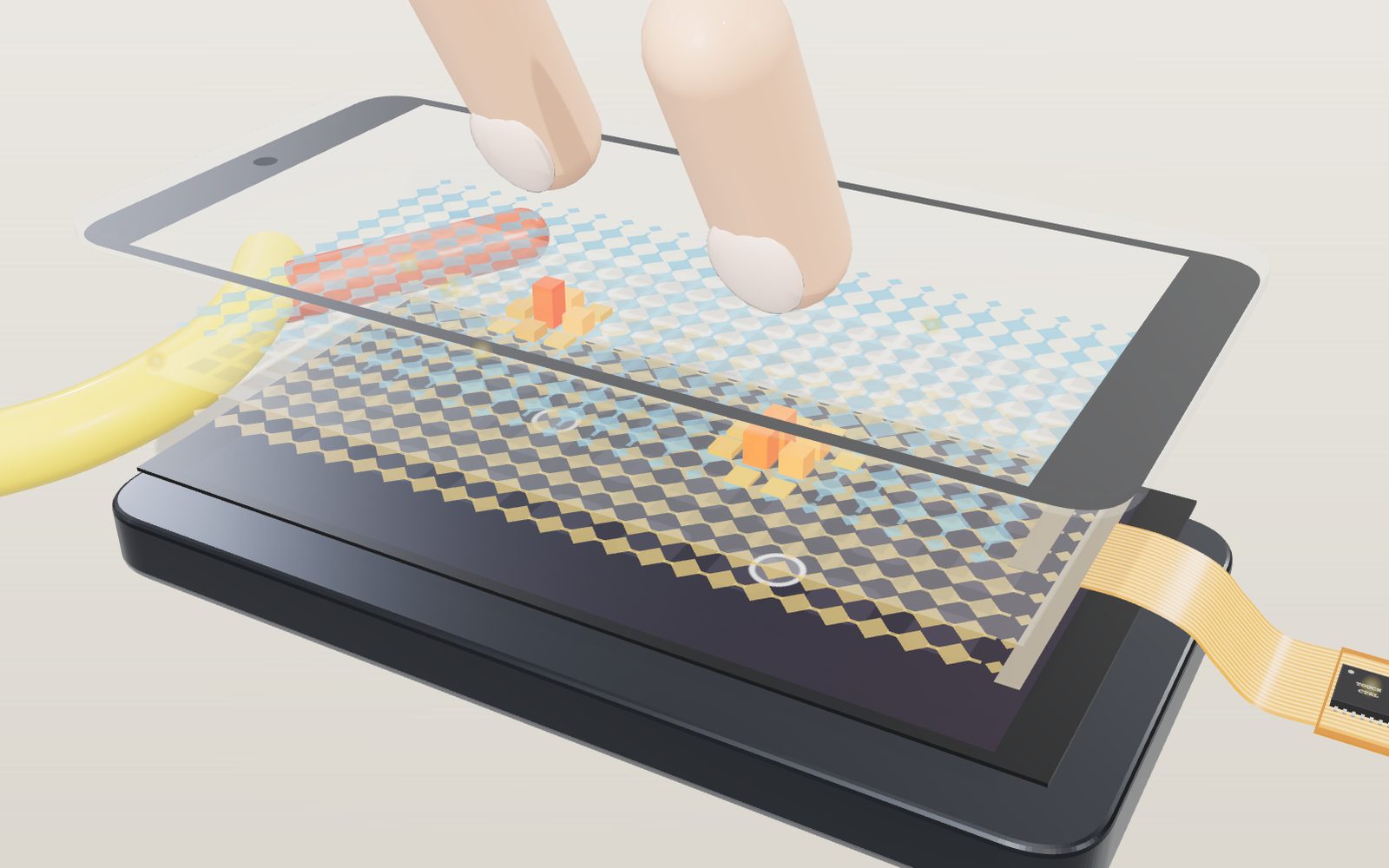
Under the glass of a phone lies a grid of transparent electrodes, and your finger shows up as a small dip in the charge passing between them.
Electric motor simulator: how it works, step by step
Eight motors, from Faraday's wire in mercury in 1821 to the magnets inside an electric car, all turning on the same push between current and field.
How lightning and thunder work
A lightning channel heats the air to about five times the temperature of the Sun’s surface, and its thunder needs about 3 seconds to cover each kilometre to you.
How a solar panel works
In full sun a 60-cell rooftop panel makes about 300 watts, and all of it comes from an electric field sitting inside each slice of silicon.

How a phonograph works: from tinfoil to cassette and CD
Edison's first phonograph cut a voice into tinfoil in 1877, and the same needle played it back from a groove 2.54 mm apart.
What is under the street
Korean road rules put a water main at least 1.2 metres under the road and a main sewer at least 3 metres down, so four kinds of pipe and cable all lie within the top 2 metres.

How a QR code is read
Cover 30 % of a QR code with your hand and a phone still reads it. Cover one corner and it does not.
How a 3D printer works, layer by layer
A 20 mm cube printed in 0.2 mm layers is exactly 100 layers, each drawn by a nozzle 0.4 mm wide.

Walk down the Grand Canyon rock layers
Walk 1,360 m down the Bright Angel Trail through 13 rock layers, from a 270-million-year-old sea floor on the rim to 1.75-billion-year-old schist by the river.

How a steam locomotive works
Mallard's driving wheels are 2.03 m across, taller than most people, and at its record 126 mph they turned almost nine times a second.