FIG. 111Old Machines
How a steam locomotive works
Mallard's driving wheels are 2.03 m across, taller than most people, and at its record 126 mph they turned almost nine times a second.
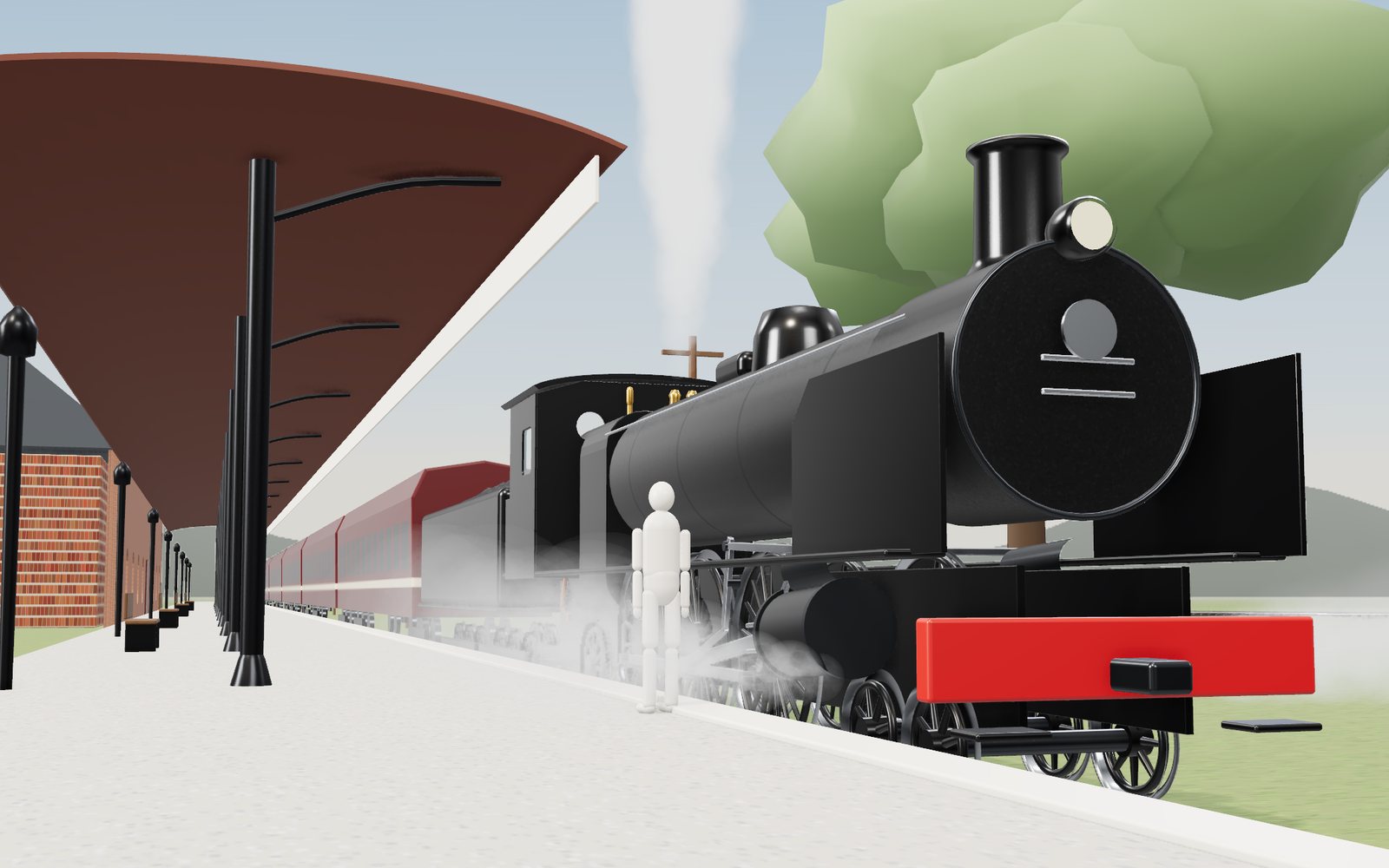
This device cannot show the 3D model. You can read the guide steps below as text.
1 / 14 An engine comes inThe Korean Pashi type, an express passenger engine of 1942, runs into the platform, drains its cylinders and stops. Its safety valves lift: the boiler is full. The person on the platform is your size.
Drag to turn. Scroll or pinch to zoom.
A train comes in
Stand on a platform when a steam locomotive runs in and you notice the size first. The driving wheels of a big express engine are as tall as a person, and the boiler is higher than a bus. Then you hear it: the beat from the chimney slows, steam hisses out sideways from low down at the front, and as the train stops the safety valves on top lift with a roar. Nothing in a steam locomotive is hidden in a sealed box. Everything it does, it does in the open, at a size you can stand next to.
This exhibit starts the same way. A Korean Pashi type express engine of 1942 comes into a station and stops beside you. The person on the platform is drawn to your height, so you can see how its 1,850 mm driving wheels compare. From there you can drive it: fire the boiler, open the regulator, move the reverser, add coaches or wagons, put the line on a gradient, and watch what the boiler pressure, the water in the gauge glass and the pull at the rail do. Five other engines are on the same track: Stephenson's Rocket of 1829, an American 4-4-0 of the 1870s type, the Korean Mika freight engine, the streamlined Mallard of the 1938 speed record, and the articulated Big Boy of 1941.
The boiler can be cut open along its middle to show the fire, the tubes and the water. The cylinders open to show the piston, the piston valve and the steam inside each end, coloured by what it is doing. A small graph, the indicator diagram, draws the pressure in one cylinder against the position of the piston as the wheels turn, which is how engineers measured a locomotive's work a century ago. The rest of this page explains what you are looking at, with the numbers the model uses and where they come from.
Why a locomotive needs a fire inside a box of water
A steam locomotive carries its own power station. The fire turns water into steam, the steam pushes pistons, and the pistons turn the wheels. The difficulty is getting enough heat from a fire into the water quickly enough, inside an engine narrow enough to fit between station platforms and under bridges.
The fire burns on a grate at the back of the engine, inside the firebox. The firebox is a box within a box: an inner box where the coal burns, and an outer wrapper, with water filling the space between them on the sides, the front, the back and over the top. The top of the inner box, the crown, is the hottest metal on the engine and must always have water over it. In the model you can see this when the boiler is cut open: the glowing fire bed, the inner firebox, and the blue water round it.
Coal goes in through the fire door on the back of the firebox, a shovelful at a time. In the cab of the model the fireman turns to the coal at the front of the tender, fills the shovel, turns back, and the fire doors open just long enough for the coal to go in. Press Fire on the stage to make him put a round on. A Pashi working hard in the model burns about 1.8 tonnes of coal an hour, and every bit of it is lifted by hand. The model's firing rate, a single slider, stands in for all of that work.
Fresh coal on a hot fire gives off gas before it burns cleanly, and if there is not enough air the chimney turns dark. In the model, smoke from the chimney turns darker after each round of firing and when the fire is bigger than the draught can burn; it goes back to white steam when the fire catches up.
Rocket's answer: a boiler full of tubes
The fire's hot gas has to pass through the water on its way to the chimney, and the more surface it touches on the way, the more heat it gives up. The Science Museum Group's description of Rocket, the engine Robert Stephenson designed for the Rainhill trials of 1829, says it brought together in one machine two developments that set the pattern for later locomotives: the multi-tube boiler and the blast pipe.
In a multi-tube boiler the gas from the firebox goes forward through dozens or hundreds of small tubes laid lengthwise in the water, and comes out at the front into the smokebox, under the chimney. Many small tubes have far more surface than one big flue of the same cross-section. The National Park Service says a Big Boy boiler had more than a mile of tubes and flues. In the cut-open boiler of the model you can see the tubes running from the firebox to the smokebox with the water round them, and the larger flues near the top, which carry the superheater on the later engines.
Rocket won. The Science Museum Group says it was the only locomotive to complete the trials, averaging 12 mph and reaching a top speed of 30 mph, and the Stephensons took the £500 prize and the contract to build engines for the Liverpool & Manchester Railway. Five engines had entered: Cycloped, Novelty, Perseverance, Sans Pareil and Rocket. Rocket itself did not stay that way for long. It was substantially rebuilt within 18 months and laid aside within ten years, and what the museum holds is the rebuilt engine, preserved in 1862 incomplete and semi-derelict.
The water in the glass
A boiler makes steam by boiling away its own water, so water has to go in as fast as steam goes out. The driver and fireman watch the level in the gauge glass on the backhead in the cab, a glass tube connected to the boiler at top and bottom, so the water inside stands at the same height as the water in the boiler. In the model it is the little tube beside the pressure gauge, and the readout gives the level as a percentage of the glass.
Water goes in through the injector. The Science Museum Group holds an original Giffard injector of 1858, described as a device for feeding water to a steam boiler while it is working. The puzzle it solves is that the water has to enter a vessel at full boiler pressure, and a pump driven by the engine's own motion only works while the engine moves. In the model the injector keeps the glass near three-quarters full on its own while the Injector control is on, at a small cost in pressure, because cold water going in cools the boiler a little.
Turn the injector off while the engine is working hard and the level falls. If it falls far enough to uncover the crown of the firebox, the crown has nothing to cool it. The safeguard is a fusible plug: a plug in the crown with a core of metal that melts at a lower temperature than the plate. The Science Museum Group holds three fusible plugs of 1862 and explains that if the water falls too low, the plug is exposed, the metal melts and steam blows into the firebox, warning the crew.
In the model, with the injector off and the Pashi working hard with 400 t, the plug melts after about six minutes. The steam puts the fire out, the pressure falls and the engine stops working. A report by the US National Transportation Safety Board on a firebox failure in Pennsylvania in 1995 notes that once a fusible plug has gone the locomotive must go to the works for repair, and that railways differed on whether to fit them.
Pressure and the safety valves
As the fire boils the water, steam collects in the space above it and the pressure rises. The gauge in the cab shows it, and the bar in the readout shows it against the red line, the pressure the safety valves are set to. At the red line the valves lift and steam roars out of them until the pressure falls a little. That is the roar you hear when an engine stands in a station with a good fire.
A boiler that is blowing off is wasting coal: the fire is making more steam than is being used. A good fireman keeps the pressure just under the red line, building the fire up before a climb and letting it burn down before a stop. One of the tasks in the lab asks for exactly that: bring the pressure from 80% to 95% of full and hold it there for 30 seconds without the valves lifting.
The pressures in the model are given in bar and in pounds per square inch. The Pashi and Mika work at about 14 to 15 bar (about 200 to 220 psi), Mallard at 17.2 bar (250 psi), Big Boy at 20.7 bar (300 psi) and Rocket at 3.4 bar (50 psi). Except where a source gives them, these are model values for a typical engine of each kind, and the page marks them so.
From the regulator to the cylinders
The steam that reaches the cylinders is taken from the highest point of the boiler, usually inside a dome, so that as little water as possible comes with it. The regulator valve sits there, and the driver works it from the cab with a long handle. In the model the Regulator control is that handle: shut, nothing goes to the cylinders; wide open, steam goes at nearly full boiler pressure. The steam then runs forward along the main steam pipe to the smokebox.
On the later engines in the model it passes on the way through the superheater: small pipes that run back through the large flues, where the hot gas dries the steam and heats it well above its boiling point. Superheated steam does more work per kilogram, because it can expand further before it starts to condense. In the model the engines with superheaters use about three-quarters of the steam by weight that the saturated engines, Rocket and the 4-4-0, need for the same cylinder filling.
From the smokebox, steam pipes run down to the steam chests on top of the cylinders. In the cut-open boiler you can follow the copper pipes from the dome to the front, and down to the cylinders.
Steam pushes a piston, first one side then the other
Each cylinder is closed at both ends. Steam enters one end and pushes the piston to the other; then it is let out and steam enters the other end and pushes the piston back. So each cylinder gives two pushes for every turn of the wheels. The piston rod comes out through the back of the cylinder to a crosshead that slides between guide bars, and a connecting rod joins the crosshead to a crank pin on the main driving wheel. Coupling rods join the crank pins of all the driving wheels on that side, so they turn together.
The two sides are set a quarter turn apart. When one piston is at the end of its stroke, where its push cannot turn the wheel, the other is in the middle of its stroke. That way the engine can start whatever position it stopped in. In the model Mallard's three cranks are a third of a turn apart, with the third cylinder between the frames.
Open the cylinders with See inside and you can watch this. Red is fresh steam coming in, orange is steam expanding behind the piston after the valve has shut, blue is used steam going out to the exhaust, and purple is the little steam trapped and squeezed at the end of the return stroke.
The valve: lap, lead, cutoff, release
Above the cylinder, in the steam chest, a piston valve slides to and fro on its own spindle. Its two heads open and close the ports at each end of the cylinder, first to steam from the boiler, then to the exhaust. The valve has to be timed to the piston: it must open the port to steam just as the piston starts its stroke, close it partway along, and open it to the exhaust before the stroke ends.
Two small dimensions make this work. The lap is the overlap of each valve head over its port when the valve is in the middle of its travel; because of it, the valve can close the port to steam well before the end of the stroke. The lead is how far the port is already open to steam when the piston is at the very end of its stroke, so that full pressure is waiting as it starts back. The model uses a lead of 0.18 of the lap.
As the wheels turn, each end of the cylinder goes through the same six events in order: steam in, cutoff (the valve closes and the steam expands), release (the valve opens to exhaust a little before the end of the stroke), exhaust (the piston pushes the used steam out on the return), compression (the valve closes to exhaust and the remaining steam is squeezed) and steam in again. The lab has a task to put them in order, and the table under the indicator diagram gives the piston position for each event at the current reverser setting.
Walschaerts valve gear and the reverser
The valve is moved by the valve gear. The larger engines in the model carry Walschaerts gear on the outside, which is why you can see it. It adds two motions together. One comes from a return crank on the main crank pin, a quarter turn out of step with the crank, through the eccentric rod to the foot of a slotted, curved expansion link that rocks to and fro. A die block slides in that link, and the radius rod takes the motion from the die block forward to a combination lever. The other motion comes from the crosshead itself, through a union link to the bottom of the combination lever. The lever adds the two and drives the valve spindle.
The driver moves the die block up and down the link with the reverser. With the block at one end of the link the valve travels furthest and the engine runs forward; at the other end the motion is reversed and the engine runs backward. Near the middle, in mid gear, the link's motion hardly reaches the valve, which moves only by the lap and lead from the crosshead. The Science Museum Group holds sectioned models of Walschaerts gear made for demonstration.
In the model the valve position is the sum of a part from the return crank, scaled by the reverser setting, and a part from the crosshead that gives lap and lead at the dead centres. Full gear is set so that steam is cut off at 75% of the stroke. In mid gear the valve still opens by the lead around each dead centre, which on its own would admit steam for about 9% of the stroke; but the opening is so small, and comes when the crank can hardly turn the wheel, that there is no push. Try it in the lab task: reverser in the middle, regulator half open, and nothing moves.
Cutoff: making the steam work twice
The reverser does more than choose the direction. By setting how far along the stroke the valve closes, it sets the cutoff, and that is the main way a driver controls an engine once it is moving.
At full gear, steam is admitted for three-quarters of the stroke. That gives the strongest push, which is what you need to start a heavy train, but most of the steam leaves the cylinder still at high pressure. Bring the reverser back towards the middle, notching up, and the valve closes earlier. Steam comes in for, say, a quarter of the stroke, then expands for the rest, pushing all the while at falling pressure. The push is smaller but each kilogram of steam does much more work.
The indicator diagram shows it. The model draws pressure in one end of a cylinder against its volume as the wheels turn, and the area inside the loop is the work of one stroke. At full gear the loop is fat; notched up it is thin, with a long sloping line where the steam expands. Starting from rest at full pressure, the Pashi's mean pressure over the stroke is 12.9 bar at 75% cutoff, 85% of boiler pressure, and 6.0 bar at 25% cutoff, 40% of it.
The saving is real in the model. At 60 km/h, the Pashi pulling the same force on 25% cutoff with the regulator open uses 2.1 kg of steam a second; on 60% cutoff with the regulator eased to match, it uses 2.8 kg a second. That is a quarter less steam, and so a quarter less water and coal, for the same work. The lab's notch-up task asks you to hold 80 km/h with 400 t on 25% cutoff or less.
The exhaust beat draws the fire
Used steam leaves each cylinder through the exhaust ports and goes up a nozzle in the smokebox, the blast pipe, and out of the chimney. Each exhaust is a beat, the chuff you hear. With two cylinders there are four beats to each turn of the driving wheels; with three, six. At its record speed of 126 mph, Mallard's 2,032 mm wheels turned almost nine times a second, which in the model is about 53 beats a second, far too fast to hear one by one.
The blast does a second job, and it is the one Rocket's design is remembered for. Each jet of steam up the chimney drags the gas in the smokebox with it, lowering the pressure there. That pulls the fire's gas through the tubes and fresh air up through the grate. So the harder the engine works, the harder it draws its own fire: more steam used, more blast, more air, more heat, more steam. In the model the fire burns as fast as the fireman feeds it only when the exhaust is drawing; standing still, the blower gives a gentler draught, and the evaporation the fire can manage falls.
The Science Museum Group holds a sixth-scale model of a smokebox and blast pipe, and the National Railway Museum names Mallard's Kylchap exhaust system among the innovations that made it a candidate for the speed record.
Three limits on the pull
How hard can a locomotive pull? The Encyclopedia of Korean Culture's article on trains gives a clear answer. It names three tractive forces: the adhesive force, the grip of the driving wheels on the rails before they spin; the cylinder force, which grows with the cylinders and falls with the size of the wheels; and the boiler force, what the boiler can keep up in steam. The real pull is limited by the smallest of the three. Whether the train speeds up, slows down or holds its speed depends on whether that pull is more than, less than or equal to the resistance from speed, gradients and curves.
The lab draws all three against speed for the engine on the stage. The grip line is flat: the weight on the driving wheels times a friction coefficient, 0.25 on dry rail in the model and 0.33 with sand. The cylinder line is highest at a standstill and falls as the engine speeds up, because steam has less time to get through the ports. The boiler line falls steeply with speed: the boiler can supply only so much power, and power is force times speed. A dashed line marks the smallest of the three. Where it crosses the blue line, the resistance of the train you have chosen on the gradient you have set, is the fastest the engine can go.
At low speed the grip limit usually decides, and putting more force on the wheels only makes them spin. At high speed the boiler decides. In between, the cylinders and the driver's choice of cutoff and regulator decide.
Tractive force by the rule of thumb
Engineers rated a locomotive by its starting tractive force, worked out from its dimensions. For two cylinders: 0.85 times the boiler pressure times the square of the cylinder bore times the stroke, divided by the driving wheel diameter. The 0.85 allows for the pressure lost between boiler and piston. For three cylinders multiply by 1.5, for four by 2.
With Mallard's three cylinders of 18.5 by 26 inches, 250 psi and 80 inch wheels the rule gives 35,455 pounds force (157.7 kN). With Big Boy's four cylinders of 23.75 by 32 inches, 300 psi and 68 inch wheels it gives 135,375 pounds force (602 kN). The model's own figure, worked out from the indicator diagram at full gear and full pressure, comes within 2% of the rule for all six engines.
There is one check against a published figure. The Korea Heritage Service lists Mika No. 304, kept in Jeju, with driving wheels 1,450 mm across, a weight of 90.65 t and a tractive force of 15,430 kg. The model's Mika, with cylinders of 530 mm bore and 660 mm stroke and a pressure of 13.73 bar, gives 15,216 kg, 1.4% lower. Those cylinder sizes and that pressure are model values. The lab has a task to work out the Mika's figure yourself.
Divide the weight on the driving wheels by the tractive force and you get the factor of adhesion. If it is too low, the engine slips whenever it is worked hard; if it is too high, weight is carried that could have been more cylinder. In the model it comes out at 3.9 to 4.5 for the five later engines, and 6.9 for Rocket, which has a lot of weight on its single driving axle for the size of its cylinders.
Wheel slip and sand
Open the regulator wide on a heavy train and the cylinders can push harder than the wheels can grip. The wheels spin, the engine stops pulling, and the rods race round. In the model the wheels race too, sparks come off the rails, and the readout's pull bar turns red.
The lab's first engine task shows it. The Mika has 1,000 t of wagons on a climb of 1 in 100. Holding that train on the gradient takes 112.5 kN, and getting it rolling takes another 15 kN or so for the wagons' resistance. The grip of the 60 t on its driving wheels is 147 kN on dry rail. With the regulator wide open the cylinders push 149 kN, a little more than the grip, and the wheels spin. With the regulator barely open there is not enough push and nothing moves.
There are two ways through. Open the regulator gently, so the push sits between what is needed and what the rail will take. Or press Sand: sand dropped in front of the driving wheels raises the grip in the model to 194 kN, and the engine gets away. In the model the sandbox sits on top of the boiler, with pipes down to the rail in front of the wheels.
Gradients and the weight of the train
A train's resistance comes from the bearings, from the wheels on the rails and from the air, and on a gradient from gravity. The model uses the formula W. J. Davis published in the General Electric Review in 1926: a part that depends on the weight on each axle, a part that grows with speed, and an air part that grows with the square of speed, with a larger air coefficient for the leading vehicle than for the rest of the train. Railways still use versions of it.
Gravity soon outweighs the rest. The Pashi with 400 t of coaches meets 28 kN of resistance at 100 km/h on the level; a climb of 1 in 100 adds 54.8 kN, twice as much again. The lab's what-if table gives the highest speed the engine on the stage can hold with full pressure at 45% cutoff, for four train weights and five gradients, and says when it cannot hold the train at all.
Mallard's record is the clearest case. With the 240 t record train at 200 km/h the model's resistance is 43.9 kN; on a descent of 1 in 200 gravity gives back 19.9 kN of it. In the model, starting at 120 km/h down that bank with the regulator open and 40% cutoff, Mallard passes 200 km/h, as the National Railway Museum says the real one did on Stoke Bank. On the level with the same train the model reaches about 176 km/h.
Counting wheels: the Whyte notation
Locomotives are named by their wheels. In the Whyte notation, which the US National Park Service sets out in its study of the Steamtown collection, you count the wheels on both sides in groups from the front: the carrying wheels of the leading truck, the driving wheels, the trailing wheels. Rocket is 0-2-2: no leading wheels, one pair of driving wheels, one pair of trailing wheels. Mallard is 4-6-2. Big Boy, with two groups of driving wheels, is 4-8-8-4.
In America the arrangements had names. The 4-4-0 was the American, the 4-6-2 the Pacific, the 2-8-2 the Mikado. Korea used the same types under Japanese short names. The Railroad Museum in Uiwang explains that Pashi comes from Pacific and Mika from Mikado, and that the Pashi was the express passenger engine between Seoul and Busan from about 1922 while the Mika came in around 1919 for freight between Busan and Sinuiju.
The leading wheels guide the engine into curves, and the trailing wheels carry the weight of a firebox too big to fit between the driving wheels. More driving wheels put more weight on the rail to grip with, which suits freight; bigger driving wheels turn fewer times a minute at a given speed, which suits passenger trains. The lab has a quiz with sixteen arrangements drawn from the side: name three in a row.
John Bull and the American 4-4-0
The Smithsonian's National Museum of American History holds John Bull, built in England by Robert Stephenson & Co. in 1831 as a standard 0-4-0 of the Planet type for the Camden and Amboy Railroad. It was assembled in New Jersey by Isaac Dripps, a young steamboat mechanic who, the museum says, had never seen a locomotive before. On uneven American track it kept derailing, so Dripps added a pair of guide wheels in a frame out in front. The museum says that pilot truck was adopted on virtually all American steam locomotives except yard switchers. John Bull ran for 35 years; in 1981 it ran again, the oldest locomotive in existence still able to work.
Add a second pair of driving wheels and a four-wheel truck in front and you have the 4-4-0, which the National Park Service says became so typical of the United States in the mid-19th century that it was called the American type. The Smithsonian's Jupiter, a narrow-gauge 4-4-0 built by Baldwin in 1876 for the Santa Cruz Railroad, has equalized springing: as each wheel rocks over uneven track, the weight on every driving wheel stays nearly the same. The model's 4-4-0 follows the general form of the 1870s, with a wooden cab, brass domes, a diamond spark-arresting chimney and a cowcatcher; its dimensions are model values.
Mallard and the speed record
Mallard is an A4, one of 35 streamlined Pacifics designed by Sir Nigel Gresley for the London & North Eastern Railway. The Science Museum Group's record says the A4s were introduced in 1935 and the first four were painted silver-grey; by 1938 the standard colour was garter blue. The National Railway Museum says their shape was honed in a wind tunnel to cut through the air, making 120 mph and more possible.
On 3 July 1938, during a series of brake tests, Mallard reached 126 mph on Stoke Bank between Grantham and Peterborough. The museum's blog says the run was made under the guise of a brake test, and its account of the run says the dynamometer car behind the engine recorded 120 mph for five miles on the descent. That car was a travelling laboratory that recorded the train's speed on paper rolls. The Flaman speed recorder in Mallard's cab, French in design, is still there.
126 mph is about 203 km/h, and it remains the record for steam. It is not the first time a steam engine was said to have passed 100 mph. A letter in the Science Museum Group collection concerns publishing the 102.3 mph that a timer recorded behind City of Truro on 9 May 1904; the National Railway Museum, however, calls Flying Scotsman officially the first steam locomotive to reach 100 mph, in 1934. The records chart in the lab marks the 1904 figure as not official.
Mallard was withdrawn in 1963, went on show at the Museum of British Transport in Clapham, and has been in the Great Hall of the National Railway Museum in York since it opened in 1975.
Big Boy
For hauling heavy freight over mountains, the Union Pacific had the American Locomotive Company build 25 Big Boys, 20 in 1941 and five in 1944. The National Park Service, which keeps No. 4012 at Steamtown National Historic Site, says they were built for power: they pulled 120-car, 3,800-ton trains at 40 mph in the mountains of Utah and Wyoming. Each had 16 driving wheels of 68 inches, a grate of 150 square feet and more than a mile of tubes and flues; with its tender it was 132 ft 9 in long and weighed 1,189,500 lb in working order.
An engine that long could not take sharp curves on a rigid frame, so the front group of driving wheels is on a frame of its own, hinged to the rest, and each group has its own pair of cylinders. The NPS credits the hinge to the Swiss designer Anatole Mallet, and adds a fact that surprises most people: the Big Boys were not the most powerful engines, though they were the heaviest.
In the model the Big Boy pulls 3,447 t, the metric equivalent of 3,800 short tons, on the level up to about 100 km/h, and its peak power comes out at about 6,300 hp against the 6,200 hp the NPS gives. Of the 25, eight survive. No. 4014 was restored to run in 2019, and in July 2026, the Smithsonian's magazine reports, it crossed the United States for the country's 250th anniversary.
Steam in Korea
Korea's railways began with steam. The Encyclopedia of Korean Culture says trains first ran on the Gyeongin line between Noryangjin and Incheon on 18 September 1899, with a locomotive built by Brooks in the United States; the Korea Rail Industry Information Center describes it as a Mogul-type tank engine. Prairie-type tank engines and Teou-type tender engines followed from America in 1905, American-type tender engines in 1911, superheated engines in 1914, Mika types in 1919 and Pashi types in 1921 and 1923. In 1927 the Seoul works built two Teou-type engines, the first locomotives made in Korea.
On 27 December 1945, according to the same history, the first locomotive built by Korean engineers ran trials between Yeongdeungpo and Suwon: 2,000 horsepower, able to run at 100 km/h with 20 coaches. Diesel-electric locomotives arrived during the Korean War, and after 31 August 1967 steam stopped running on Korea's main lines.
Several engines survive as national registered heritage, registered on 17 October 2008. Pashi No. 23, made in Japan and assembled at the Seoul works in 1942, is the only Pashi left in Korea; the Heritage Service lists its driving wheels at 1,850 mm and its height at 4,750 mm. After liberation it was converted to burn heavy oil and hauled passenger trains on the main lines into the 1960s, and its conservation was completed in 2024 at the Railroad Museum in Uiwang. Mika No. 304 of 1944 stands in Samu Park in Jeju. Mika No. 129, at the National Cemetery in Daejeon, was taken off the register on 12 June 2025.
The Railroad Museum, opened in 1988, also keeps Teou No. 700. Built in 1914 and worked from 1919 to 1935, it was sectioned at a railway school and used for more than 80 years to show students how a locomotive works inside, much as the cut-open boiler and cylinders in this exhibit do.
Turning round and taking water
At the end of a line an engine that has to run back chimney first is turned. On the turntable in the model the engine and tender stand on a deck in a circular pit, and the deck turns on a centre pivot with wheels at its ends running on a circular rail. Use the arrows or the Turntable slider to turn it round to face the other way; the task asks for 180° within one degree. A turntable has to be longer than the longest engine and tender it serves, and the model's pit is 44 m across so that Big Boy fits.
Water runs out long before coal. In the model each kilogram of coal boils six to seven kilograms of water, so a tender carries several times as much water as coal by weight. The Pashi's tender in the model holds 25,000 litres, about two hours at the boiler's full output. At the water crane on the platform the arm swings over the tender's filler, and the leather hose fills the tank. With See inside on, you can watch the water in the tender rise.
How the model differs from real engines
The six engines are built from the general proportions of each type, not from makers' drawings, and carry no numbers, makers' plates or marks. Where a source gives a dimension it is used: Mallard's 2,032 mm wheels and 104.6 t, the Pashi's 1,850 mm wheels, the Mika's 1,450 mm wheels and 90.65 t, the Big Boy's 68 inch wheels and total weight. Cylinder sizes, pressures, boiler outputs and the rest are model values.
The boiler is one store of hot water whose pressure rises and falls with the difference between steam made and steam used. The fire is one number that follows the firing rate and is limited by the draught. Real boilers respond more slowly, and real firing is a craft learned over years. Steam in the cylinders expands along a simple curve; real cylinders lose heat to their walls, and the ports throttle the steam in ways the model only approximates with a factor that grows with piston speed. Train resistance follows Davis, and curves are left out. The track is straight and level except for the gradient you set, which the model applies without tilting the scene.
Time can be slowed to a tenth to watch the valve gear, or speeded up thirty times to run a whole climb. The crew and the person on the platform are smooth mannequins with no faces.
Questions
How does a steam locomotive work?
A fire in the firebox heats water in the boiler to make steam. The steam is let into cylinders, where it pushes pistons to and fro, and connecting rods turn the pistons' motion into the turning of the driving wheels. Used steam goes up the chimney through a nozzle that draws the fire.
Why does a steam locomotive puff?
Each puff is the exhaust from one end of one cylinder going up the chimney. A two-cylinder engine gives four puffs for each turn of its driving wheels, a three-cylinder engine six.
What is the white cloud from the chimney, smoke or steam?
Mostly steam from the cylinders, which shows as a white cloud in cool air. It turns grey or black when the fire is making smoke, for example just after fresh coal goes on. The model shows both.
What is cutoff?
How far along the piston's stroke the valve shuts off steam. Long cutoff gives a strong push for starting; short cutoff lets the steam expand and saves water and coal at speed. The driver sets it with the reverser.
Why do the wheels sometimes spin?
When the cylinders push harder than the grip of the driving wheels on the rail. The fix is to ease the regulator, or to drop sand on the rail.
What does 4-6-2 mean?
It is the Whyte notation: four leading wheels, six driving wheels and two trailing wheels, counting both sides. The 4-6-2 was called the Pacific; in Korea, Pashi.
What do Pashi and Mika mean?
They are Japanese short forms of the American type names: Pashi for Pacific (4-6-2), Mika for Mikado (2-8-2). The Railroad Museum in Uiwang explains both.
What is the fastest steam locomotive?
Mallard, an LNER A4, reached 126 mph (about 203 km/h) on 3 July 1938 on Stoke Bank, a descent between Grantham and Peterborough. The record still stands.
Was Big Boy the most powerful steam locomotive?
It was the heaviest, but the US National Park Service says the Big Boys were not the most powerful engines.
What is the heaviest train in this exhibit?
Big Boy with 3,447 t, the 3,800 short tons the NPS says it hauled at 40 mph in the mountains. On the level the model can take that train to about 100 km/h.
How much water does a steam locomotive use?
In the model, six to seven kilograms of water for each kilogram of coal. The Pashi's tender holds 25,000 litres, about two hours of the boiler's full output.
What is the injector?
It is the device that feeds water from the tender into the boiler against full boiler pressure, while the engine is working. Henri Giffard's injector of 1858 is in the National Railway Museum.
What happens if the water runs low?
The crown of the firebox is uncovered and overheats. A fusible plug in the crown melts first and blows steam into the fire as a warning. In the model the engine then stops working until the plug is reset.
Why do some locomotives have a streamlined casing?
To reduce air resistance at speed. The National Railway Museum says the A4's shape was honed in a wind tunnel.
When did steam end in Korea?
Steam stopped running on Korea's main lines after 31 August 1967, according to the Korea Rail Industry Information Center.
Where can I see these engines?
Rocket and Mallard are in the Science Museum Group collection, and Mallard is in the National Railway Museum in York. John Bull and Jupiter are in the Smithsonian's National Museum of American History. Pashi No. 23 is at the Railroad Museum in Uiwang, Mika No. 304 in Jeju, and Big Boy No. 4012 at Steamtown in Scranton.
Terms
- Firebox: the box at the back of the boiler, surrounded by water, in which the fire burns on a grate.
- Crown sheet: the top plate of the inner firebox; it must always be covered with water.
- Fire tubes: the small tubes that carry hot gas from the firebox through the water to the smokebox.
- Smokebox: the front end of the boiler, under the chimney, where gas leaves the tubes.
- Blast pipe: the nozzle in the smokebox through which exhaust steam goes up the chimney, drawing the fire.
- Regulator: the driver's valve that lets steam from the boiler to the cylinders.
- Superheater: pipes in the large flues that heat the steam above its boiling point.
- Reverser: the control that sets direction and cutoff by moving the die block in the expansion link.
- Cutoff: the fraction of the piston's stroke during which steam is admitted.
- Lap: the overlap of the valve over its port when the valve is central.
- Lead: how far the port is open to steam when the piston is at the end of its stroke.
- Walschaerts valve gear: outside valve gear that combines a return crank's motion, through an expansion link, with the crosshead's motion.
- Mean effective pressure: the average push on the piston over one stroke; the area of the indicator diagram divided by the stroke volume.
- Tractive force: the pull at the rims of the driving wheels, also called tractive effort.
- Factor of adhesion: the weight on the driving wheels divided by the tractive force.
- Injector: the device that forces water from the tender into the boiler.
- Fusible plug: a plug in the firebox crown that melts if the water falls too low.
- Tender: the vehicle behind the engine that carries water and coal.
- Whyte notation: the wheel count, front to back, that names a locomotive type (4-6-2 and so on).
Sources
- Science Museum Group Collection, Rocket locomotive (object 1862-5). https://collection.sciencemuseumgroup.org.uk/objects/co26704/rocket-locomotive (checked 20 October 2026)
- Science Museum Group Collection, Robert Stephenson and Company. https://collection.sciencemuseumgroup.org.uk/people/cp2736 (checked 20 October 2026)
- Science Museum Group Collection, 'Puffing Billy' locomotive with tender and rails (object 1862-2). https://collection.sciencemuseumgroup.org.uk/objects/co26701/puffing-billy-locomotive-with-tender-and-rails (checked 20 October 2026)
- Science Museum Group Collection, Steam locomotive No. 1 'Locomotion', Stockton & Darlington Railway. https://collection.sciencemuseumgroup.org.uk/objects/co205767/steam-locomotive-no-1-locomotion-stockton-darlington-railway (checked 20 October 2026)
- Science Museum Group Collection, London & North Eastern Railway steam locomotive 'Mallard' (object 1975-7007). https://collection.sciencemuseumgroup.org.uk/objects/co205732/london-north-eastern-railway-steam-locomotive-mallard (checked 20 October 2026)
- Science Museum Group Collection, Letter about 100mph speed record of City of Truro. https://collection.sciencemuseumgroup.org.uk/objects/co9350075/letter-about-100mph-speed-record-of-city-of-truro (checked 20 October 2026)
- Science Museum Group Collection, Giffard's injector, 1858. https://collection.sciencemuseumgroup.org.uk/objects/co26717/gifford-injector (checked 20 October 2026)
- Science Museum Group Collection, Model Walschaert's valve gear (object 1980-7189). https://collection.sciencemuseumgroup.org.uk/objects/co212220/model-walschaerts-valve-gear (checked 20 October 2026)
- Science Museum Group Collection, Three fusible plugs for preventing boiler explosions, 1862. https://collection.sciencemuseumgroup.org.uk/objects/co51623 (checked 20 October 2026)
- Science Museum Group Collection, Model steam locomotive smokebox and blastpipe. https://collection.sciencemuseumgroup.org.uk/objects/co211553/model-steam-locomotive-smokebox-and-blastpipe (checked 20 October 2026)
- Science Museum blog, Mallard 75: Celebrating Britain's steam record (3 July 2013). https://blog.sciencemuseum.org.uk/mallard-75-celebrating-britains-steam-record (checked 20 October 2026)
- National Railway Museum, Mallard: the world's fastest steam locomotive. https://www.railwaymuseum.org.uk/whats-on/mallard-worlds-fastest-steam-locomotive (checked 20 October 2026)
- National Railway Museum, Mallard 75: a short history of Mallard 4468. https://www.railwaymuseum.org.uk/what-was-on/mallard-75 (checked 20 October 2026)
- National Railway Museum blog, Mallard: streamlined for speed (30 June 2010). https://blog.railwaymuseum.org.uk/mallard-streamlined-for-speed (checked 20 October 2026)
- National Railway Museum blog, My favourite object: Flaman speed recorder (5 March 2014). https://blog.railwaymuseum.org.uk/my-favourite-object-flaman-speed-recorder (checked 20 October 2026)
- National Railway Museum, The history of Flying Scotsman. https://www.railwaymuseum.org.uk/objects-and-stories/history-flying-scotsman (checked 20 October 2026)
- Smithsonian National Museum of American History, John Bull locomotive (exhibition). https://americanhistory.si.edu/explore/exhibitions/john-bull-locomotive (checked 20 October 2026)
- Smithsonian National Museum of American History, Landmark object: John Bull locomotive (fact sheet). https://www.americanhistory.si.edu/press/fact-sheets/landmark-object-john-bull-locomotive (checked 20 October 2026)
- Smithsonian Institution, Steam locomotive, John Bull (record nmah_841968). https://www.si.edu/object/steam-locomotive-john-bull:nmah_841968 (checked 20 October 2026)
- Smithsonian Institution, Jupiter, steam locomotive (record nmah_1051146). https://www.si.edu/object/jupiter-steam-locomotive%3Anmah_1051146 (checked 20 October 2026)
- Smithsonian Institution, Steam locomotive, Southern Railway 1401 (record nmah_214493). https://www.si.edu/object/steam-locomotive-southern-railway-1401:nmah_214493 (checked 20 October 2026)
- Smithsonian Magazine, The largest operating steam locomotive in the world weighs 1.2 million pounds (July 2026). https://www.smithsonianmag.com/smart-news/the-largest-operating-steam-locomotive-in-the-world-weighs-1-2-million-pounds-now-the-historic-train-may-be-coming-to-your-town-180989112/ (checked 20 October 2026)
- US National Park Service, Steamtown National Historic Site: history of the Union Pacific Big Boy No. 4012. https://www.nps.gov/stea/learn/historyculture/history-of-the-union-pacific-big-boy-no-4012.htm (checked 20 October 2026)
- US National Park Service, Steamtown National Historic Site: special history study. https://www.nps.gov/parkhistory/online_books/steamtown/shs2.htm (checked 20 October 2026)
- US National Transportation Safety Board, Steam locomotive firebox explosion on the Gettysburg Railroad near Gardners, Pennsylvania, 16 June 1995 (SIR-96/05). https://www.ntsb.gov/safety/safety-studies/Documents/SIR9605.pdf (checked 20 October 2026)
- W. J. Davis Jr., The tractive resistance of electric locomotives and cars, General Electric Review 29 (October 1926), scan at the US National Transportation Library. https://rosap.ntl.bts.gov/view/dot/79072/dot_79072_DS1.pdf (checked 20 October 2026)
- Korea Heritage Service, National registered heritage: Pashi-type steam locomotive No. 23. https://www.heritage.go.kr/heri/cul/culSelectDetail.do?ccbaKdcd=79&ccbaAsno=0004170000000&ccbaCtcd=31&ccbaCpno=4413104170000&sngl=Y (checked 20 October 2026)
- Korea Heritage Service, National registered heritage: Mika-type steam locomotive No. 304. https://www.heritage.go.kr/heri/cul/culSelectDetail.do?ccbaAsno=0004140000000&ccbaCpno=4413904140000&ccbaCtcd=50&ccbaKdcd=79&sngl=Y (checked 20 October 2026)
- Korea Heritage Service, Mika-type steam locomotive No. 129 (registration cancelled 12 June 2025). https://www.heritage.go.kr/heri/cul/culSelectDetail.do?ccbaCpno=4412504150000 (checked 20 October 2026)
- Railroad Museum (Uiwang), visitor questions: the Mika and Pashi types. https://www.railroadmuseum.co.kr/bbs/board.php?bo_table=qna&wr_id=94 (checked 20 October 2026)
- Encyclopedia of Korean Culture (Academy of Korean Studies), Train. https://encykorea.aks.ac.kr/Article/E0037069 (checked 20 October 2026)
- Encyclopedia of Korean Culture (Academy of Korean Studies), Railway. https://encykorea.aks.ac.kr/Article/E0056112 (checked 20 October 2026)
- Encyclopedia of Korean Culture (Academy of Korean Studies), Railroad Museum. https://encykorea.aks.ac.kr/Article/E0056113 (checked 20 October 2026)
- Korea Rail Industry Information Center (KRIC), railway history: locomotives. http://www.kric.go.kr/jsp/railplaza/rhp/fieldsHistoryDetail.jsp?p_id1=M02040201&p_id2=18&q_name=all2 (checked 20 October 2026)
- Korea Rail Industry Information Center (KRIC) news, Pashi No. 23 conservation completed (13 September 2024). https://www.kric.go.kr/jsp/board/portal/sub01/railNewsDetail.jsp?p_id1=M01060101&p_id2=583191 (checked 20 October 2026)
- Uiwang City, Railroad Museum national registered heritage. https://www.uiwang.go.kr/culture/UWTOURSEE0321 (checked 20 October 2026)
More exhibits
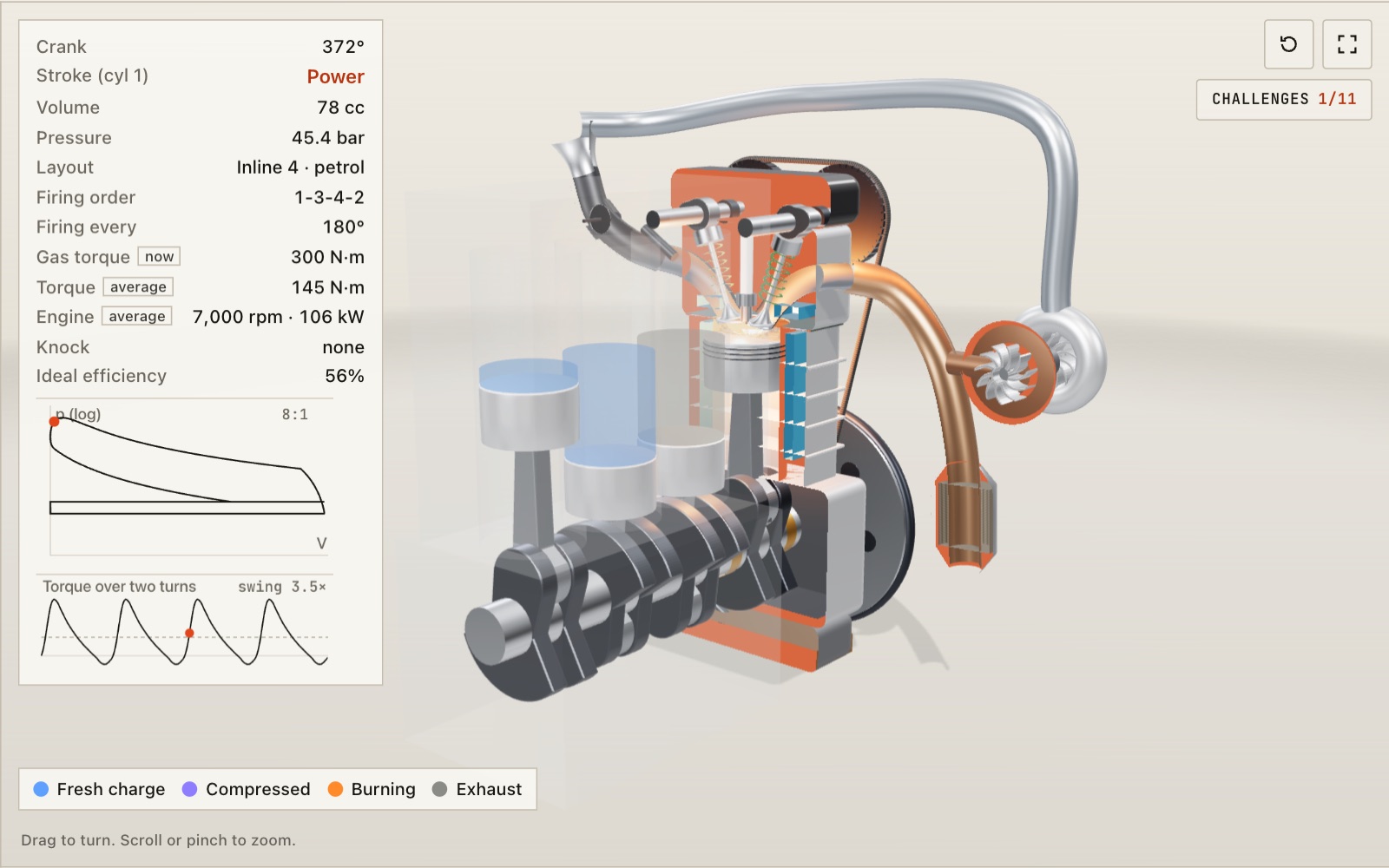
How a four-stroke engine works: two crank turns per cycle
At 3,000 rpm each cylinder fires 25 times a second. Here the engine turns slowly enough to follow every stroke, laid out as anything from a single to a V8 with its own firing order.
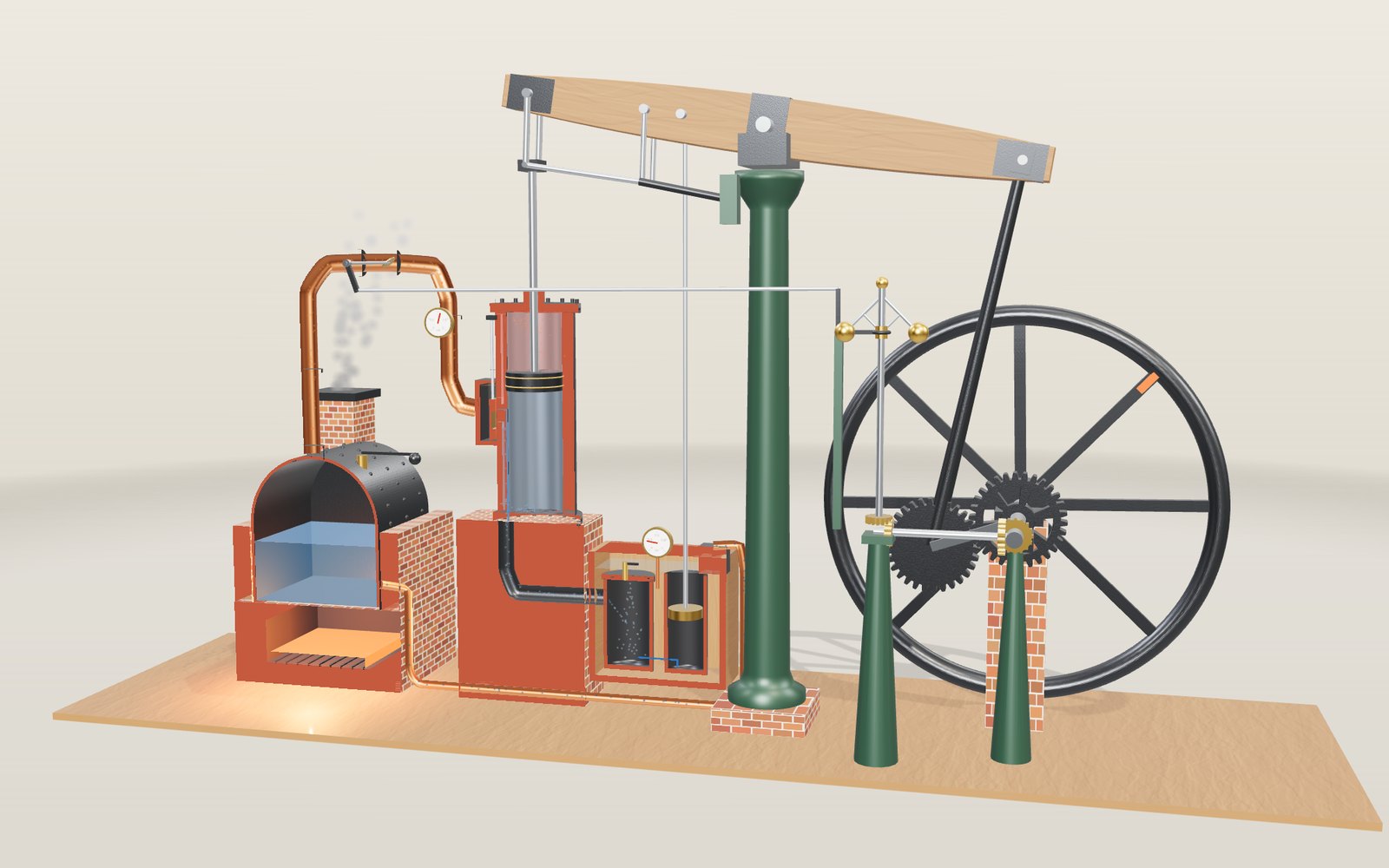
How does the Watt steam engine work? A working 3D model
A Watt engine did the same work as a Newcomen engine on about a third of the coal, because it condensed its steam in a separate vessel.
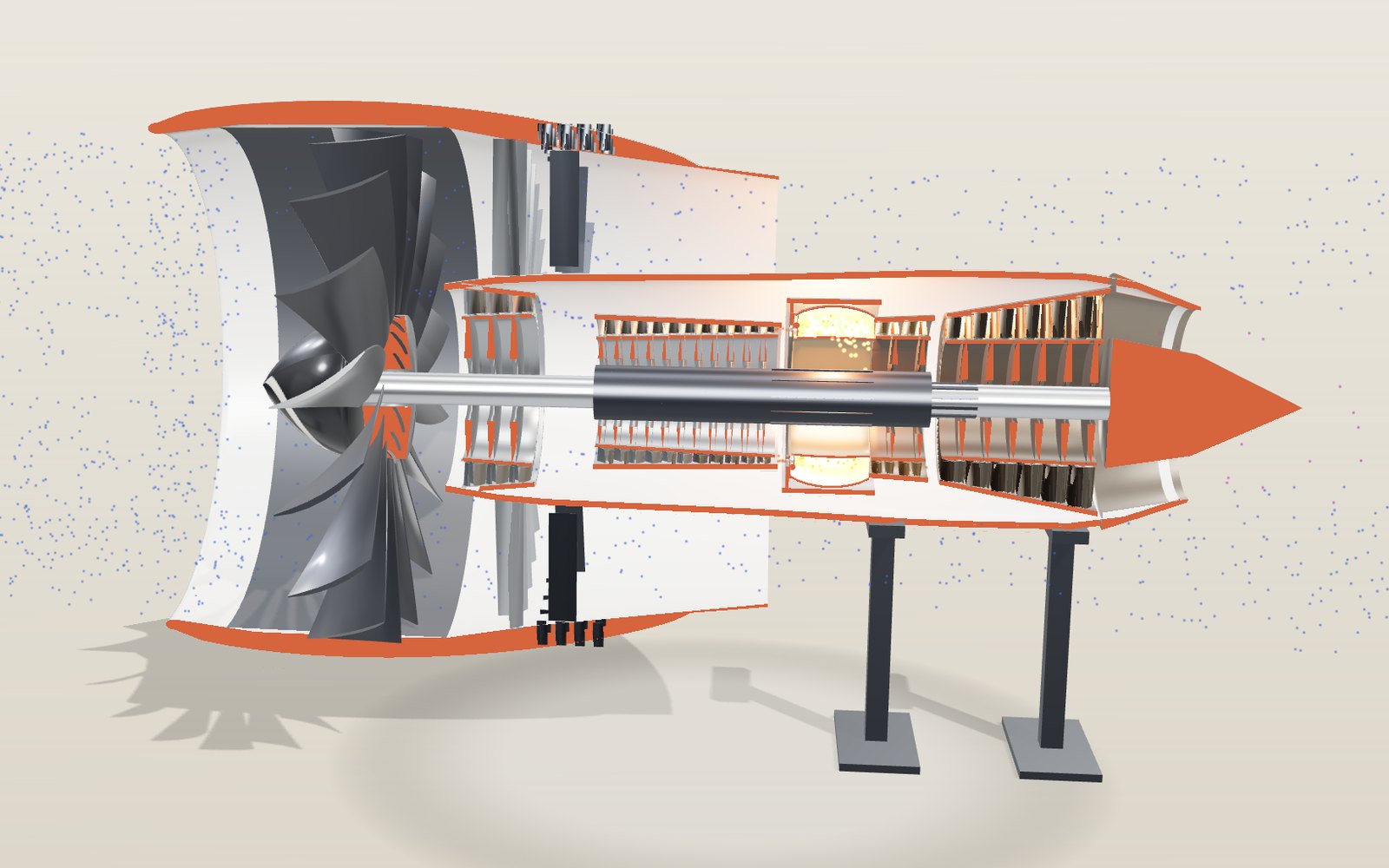
How a jet engine works: where an airliner’s thrust comes from
In an airliner's turbofan only one kilogram of air in eleven passes through the flame. Six other kinds of jet engine split the work differently, and you can open each one here.
How film cameras and instant cameras work
At 1/1000 of a second a camera shutter never uncovers the whole frame at once: a narrow slit sweeps across the film instead.
Walk through the Sagrada Família
Inside the Sagrada Família the columns branch like trees 45 m up, and the sun moves blue and orange light across the floor.
How a sewing machine makes a stitch
A sewing machine needle never goes through the cloth: at every stitch the hook drags its thread right round the bobbin instead.