Loading the model
This device cannot show the 3D model. You can read the guide steps below as text.
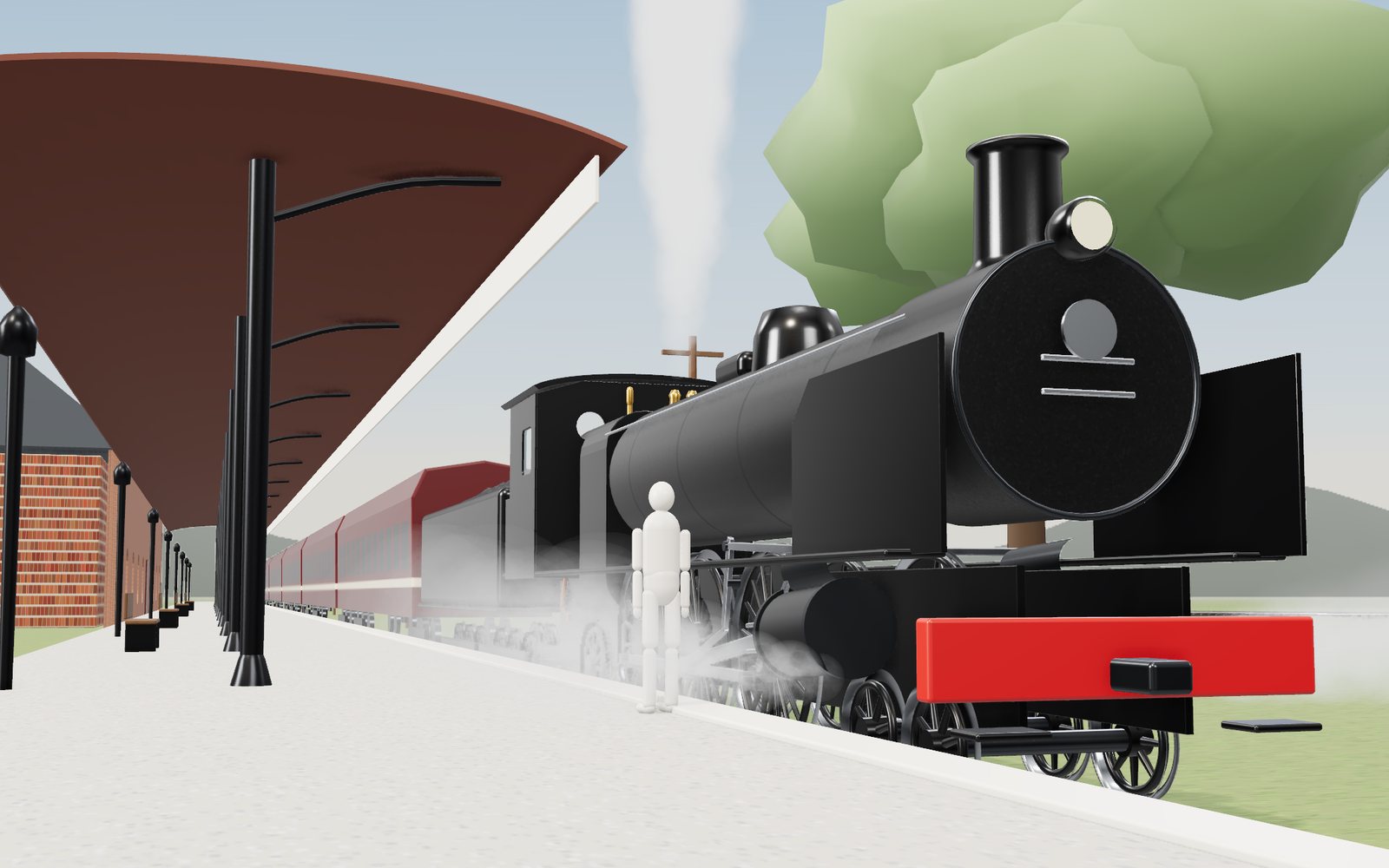
1 / 14 An engine comes in The Korean Pashi type, an express passenger engine of 1942, runs into the platform, drains its cylinders and stops. Its safety valves lift: the boiler is full. The person on the platform is your size.
Drag to turn. Scroll or pinch to zoom.
Guide Parts Controls
01 An engine comes in The Korean Pashi type, an express passenger engine of 1942, runs into the platform, drains its cylinders and stops. Its safety valves lift: the boiler is full. The person on the platform is your size.
02 Taller than you The driving wheels of the Pashi are 1,850 mm across. Mallard's are 2,032 mm. Press Me and enter your height to compare.
03 Fire In the cab the fireman throws coal through the fire door onto the grate. Working hard, the model Pashi burns about 1.8 tonnes of coal an hour, every shovelful by hand.
04 Fire tubes in water Cut open, the boiler shows the fire in its firebox, surrounded by water, and the hot gas running forward through the tubes. The water line rises and falls with the injector.
05 From dome to cylinders Steam is taken from the top of the boiler by the regulator, dried in the superheater and sent down the main pipe to the cylinders.
06 Steam pushes a piston With the cylinder open, steam enters one end, pushes the piston, then leaves by the exhaust while the other end takes steam. Slowed down ten times.
07 Cutoff The reverser sets how long each end takes steam. At 25% cutoff the valve closes a quarter of the way along and the steam expands for the rest: less steam, nearly as much work. Watch the indicator diagram.
08 Exhaust draws the fire Each beat of exhaust shoots up the chimney through the blast pipe and drags the fire's gas through the tubes. The harder the engine works, the harder it draws its fire.
09 Wheel slip Mika with 1,000 t on a 1 in 100 climb, regulator wide open: the cylinders push harder than the rails can grip and the wheels spin. Press Sand: the grip rises by about a third.
10 The heaviest Big Boy with 3,447 t (3,800 short tons): two sets of eight driving wheels under one boiler, the train the National Park Service says it pulled at 40 mph.
11 126 mph Mallard with the 240 t record train on a 1 in 200 descent, as on Stoke Bank in 1938. Watch the speed and the boiler pressure.
12 Water In the model each kilogram of coal turns six to seven kilograms of water into steam, so the tender runs dry of water long before coal. At the water crane, press Take water.
13 Turning round On the turntable the engine and tender turn in their pit. Turn it 180° to face the other way.
14 In Korea Mika type, the freight engine of Korea's main lines. Steam stopped on Korea's main lines after 31 August 1967; Pashi No. 23 and Mika No. 304 are kept as registered heritage.
Firebox Where the coal burns, on a grate inside a box surrounded by water. Fire door The fireman throws coal through it; it opens only for each shovelful. Fire tubes Hot gas from the fire runs through dozens of tubes lying in the water. Boiler A long drum of water round the tubes. Steam gathers at the top. Steam dome The highest point, where the driest steam is taken off by the regulator. Main steam pipe Carries steam from the regulator to the cylinders. Superheater Steam runs back through the large flues and gets hotter and drier. Smokebox The front end, where gas leaves the tubes and exhaust steam blasts up. Blast pipe Exhaust steam shoots up the chimney and drags the fire's gas with it. Chimney Each beat of exhaust leaves here as a puff. Safety valves Lift at full pressure and blow off steam. Whistle Sounded by steam from the boiler. Sandbox Sand dropped in front of the wheels helps them grip. Regulator The driver's throttle: how much steam goes to the cylinders. Reverser Sets the direction and the cutoff: how long steam is let in. Pressure gauge and water glass Boiler pressure, and how high the water stands. Injector Feeds water from the tender into the boiler under pressure. Cylinders Steam pushes a piston to and fro inside, first one side then the other. Piston Moves the length of the stroke twice for each turn of the wheel. Piston valve Opens each end of the cylinder to steam, then to the exhaust. Crosshead Slides between guide bars and joins the piston rod to the connecting rod. Connecting rod Turns the to and fro of the piston into the turning of a wheel. Coupling rods Make all the driving wheels on one side turn together. Valve gear Walschaerts gear: links that time the valve to the wheel. Driving wheels The wheels the cylinders turn; their grip on the rail is all the pull there is. Leading wheels Small wheels in front that guide the engine into curves. Trailing wheels Carry the weight of a large firebox at the back. Frames Two steel plates that hold everything together. Cab Where the driver and fireman stand. Tender Water tank and coal bunker, towed behind. Coal Burned at about one tonne for every six or seven of water (model value). Tank water Seen with See inside: it falls as the injectors feed the boiler. Streamlined casing Mallard's wedge-fronted shell, shaped to cut through the air. Smoke deflectors Plates that lift the smoke clear of the driver's view.