FIG. 100Old Machines
How film cameras and instant cameras work
At 1/1000 of a second a camera shutter never uncovers the whole frame at once: a narrow slit sweeps across the film instead.
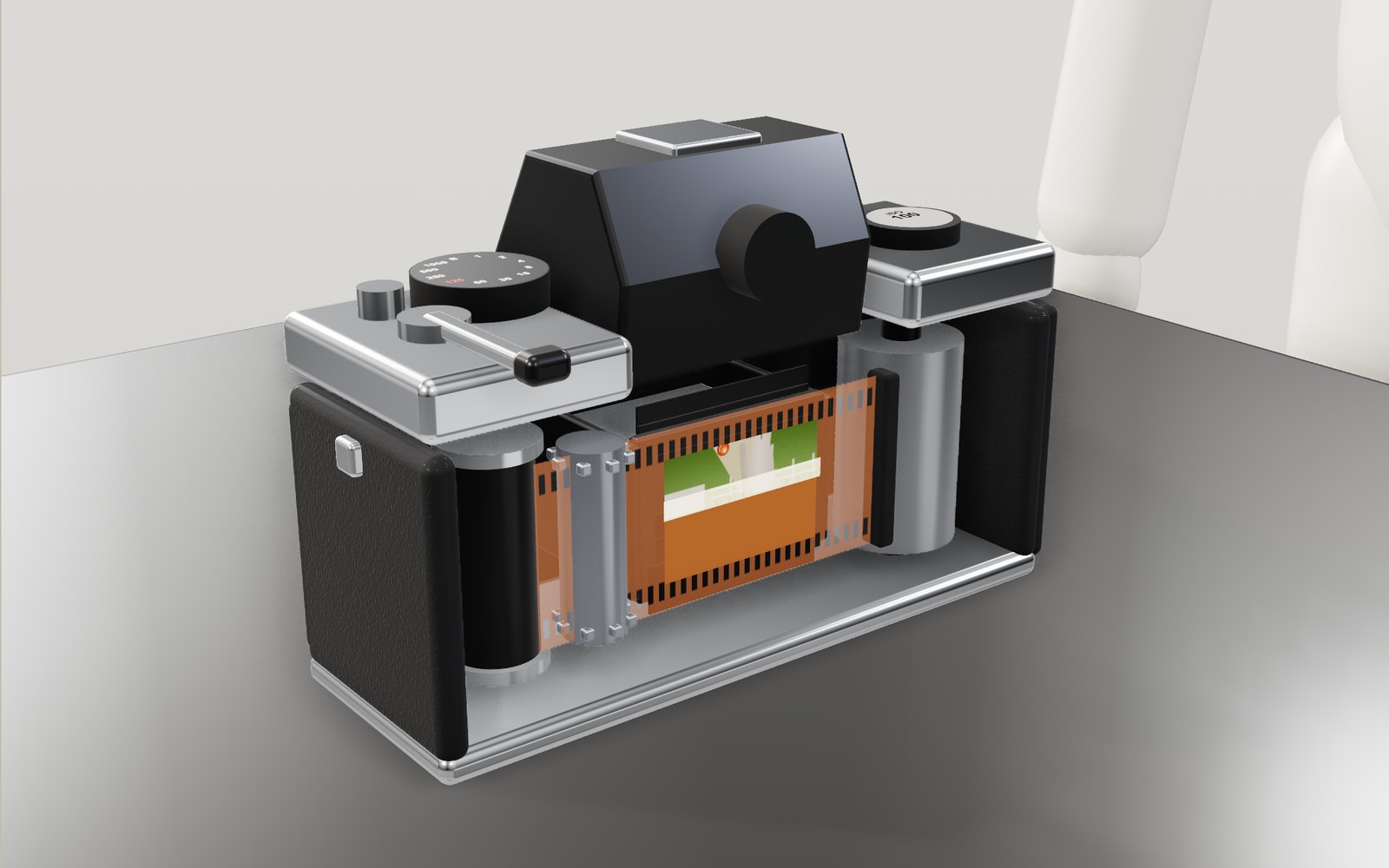
This device cannot show the 3D model. You can read the guide steps below as text.
1 / 15 A shutter at 1/1000 of a secondThis is the back of a single-lens reflex with its door open, played 300 times slower than life. Press Release and watch the film: the picture does not appear all at once. A bright band slides down it.
Drag to turn. Scroll or pinch to zoom.
What happens when you press the release
Press the release on a film camera and you hear one click. Inside, in less time than the click takes, a short sequence of events has run in a fixed order. On a single-lens reflex the lens closes down to the aperture you chose, a mirror swings up out of the light, one curtain runs across the film to uncover it, a second curtain runs after it to cover it again, and then the mirror drops back and the lens opens wide. At a shutter time of 1/1000 of a second the whole frame is never uncovered at once. A slit a few millimetres wide sweeps across the film, and the picture is laid down band by band as it passes.
The stage starts there, at the back of an SLR with its door open, played 300 times slower than life. Press Release and watch the film. Then switch to six other machines from the history of photography: a daguerreotype box camera of the 1839 type, a view camera with bellows, a 35 mm rangefinder of the 1925 type, a twin-lens reflex of the 1929 type, a folding instant camera of the 1972 type and a single-use camera of the 1986 type. The eighth stop is a darkroom.
All seven machines photograph the same park scene: a mannequin standing still at 3 m, a ball kicked across the view at 4 m, two people walking past at 8 m, a house at 14 m, trees at 45 m and a planter of flowers at 1.5 m. The print in the corner of the stage, and the larger one under the controls, is worked out from your settings with the formulas on this page. Change the aperture and the trees go soft or sharp. Change the shutter time and the ball freezes or smears. Change the film speed and the picture gets brighter and grainier.
A dark box with a hole in it
Every camera on the stage is the same idea: a box that keeps out all light except what comes through the lens. The lens bends the light from each point of the scene to a point on the film, and the picture it forms is upside down and reversed left to right. Stand behind the view camera on the stage and look at its ground glass: the house, the trees and the mannequin are all there, upside down.
The daguerreotype camera of 1839 is little more than that box. The Victoria and Albert Museum keeps a Giroux daguerreotype camera, designed by Louis Daguerre and made by Alphonse Giroux, which it describes as the first model of camera on general sale. It is a sliding box: one wooden box moves inside another to bring the picture into focus on a ground glass at the back, and there is a brass lens in the front panel. There is no shutter. The photographer took the cap off the lens and put it back when the time was up.
Everything that came after added ways to control three things: how much light reaches the film, for how long, and how sensitive the film is to it. The rest of the page is about those three numbers and the machines built around them.
Three numbers set the exposure
The amount of light that falls on each spot of the film is the exposure. Marc Levoy's Stanford lecture on image formation writes it as H = E × T: the exposure is the brightness of the light on the film (set by the aperture) multiplied by the time it falls there (set by the shutter). Film speed decides how much exposure a film needs for a good picture.
Photographers fold the first two into one number, the exposure value:
EV = log₂(N² / t)
where N is the f-number and t is the shutter time in seconds. Each step of 1 in EV is one stop, a factor of two in light. f/16 at 1/125 of a second gives log₂(256 × 125) = log₂(32,000) = 14.97, so EV 15 in round numbers. f/8 at 1/500 gives log₂(64 × 500) = 14.97 too. Any pair with the same EV lets in the same amount of light.
A scene has an EV of its own: the setting that exposes it correctly on ISO 100 film. Bright sun is about EV 15, an overcast day about EV 12, a bright room about EV 9 and a street at night about EV 5. These are the model's light levels, taken from the usual exposure tables, and the Light control picks one. Faster film needs less light, one stop less for each doubling of its speed:
EV needed = EV of the scene + log₂(ISO / 100)
So ISO 400 film in bright sun needs EV 17: f/16 at 1/500 gives 16.97. The exposure readout on the stage is the difference between the EV the scene needs and the EV you set. Positive numbers mean too much light, negative numbers too little. The meter bar under it has its middle at zero and runs from three stops under to three stops over.
The old rule of thumb called sunny 16 says that in bright sun you set f/16 and a shutter time of 1 over the film speed. For ISO 100 that is f/16 at 1/125, EV 14.97, which matches the EV 15 of bright sun. One of the tasks asks you to find it.
Aperture: why a bigger number is a smaller hole
The f-number is the focal length divided by the diameter of the opening. The Stanford lecture gives the example of f/2 on a 100 mm lens, an opening 50 mm across. On the SLR's 50 mm lens, f/2 means an opening 25 mm wide and f/1.4 one 35.7 mm wide.
The light reaching the film goes with the area of the opening, so with the square of its diameter, and it falls off with the square of the distance to the film. Dividing one by the other leaves 1 / N². Doubling N therefore cuts the light by four, and to cut it by two you multiply N by the square root of 2, about 1.4. That is why the f-numbers on a lens run 1.4, 2, 2.8, 4, 5.6, 8, 11, 16, 22: each one lets in half the light of the one before.
The aperture blades are in the lens. On the stage, look at the SLR from the front and press Release with Aperture at f/16: the blades close to a small six-sided hole and open again. On a real SLR you would not see this while looking through the camera. The lens stays wide open so the viewfinder is bright, and the blades close to the working aperture only at the moment of the picture.
Depth of field in numbers
A lens focuses exactly at one distance. A point in front of or behind it spreads into a small disc on the film. The Stanford depth-of-field applet calls the largest disc that still looks like a point the circle of confusion. While a point's disc stays smaller than that, the point still looks sharp, and the range of distances where that holds is the depth of field. The model uses a circle of confusion of 0.03 mm for 35 mm film, and larger values for larger film: 0.05 mm for 6 x 6 cm, 0.1 mm for 4 x 5 inch sheets and 0.15 mm for the daguerreotype plate.
For a lens of focal length f focused at distance s, a point at distance d makes a disc of diameter
c = f² × |d − s| / (N × d × (s − f))
and the near and far limits of sharpness follow from the hyperfocal distance
H = f² / (N × c) + f.
The SLR's 50 mm lens at f/2.8, focused on the mannequin at 3 m, gives H = 29.8 m and a sharp zone from 2.73 m to 3.33 m, only 0.6 m deep. Close down to f/8 and the zone runs from 2.34 m to 4.19 m. At f/16 it runs from 1.92 m to 6.92 m. The lecture's rule that doubling the f-number doubles the depth of field holds well here, where the subject is much closer than the hyperfocal distance.
Focus at the hyperfocal distance itself and everything from half that distance to infinity is sharp. For the 50 mm lens at f/8, H is 10.5 m, so focusing at 10.5 m makes everything from 5.2 m to the horizon sharp. The task called Everything sharp needs this trick with a wider lens: the 28 mm lens at f/16 has H = 1.66 m, so focusing there keeps the flowers at 1.5 m, the mannequin and the trees all sharp.
Blurring the background works the other way. The 135 mm lens at f/2.8 focused at 3 m turns a point in the far distance into a disc 2.27 mm across, 5.25 % of the frame diagonal. The same point through the 50 mm lens at the same f-number makes a disc of only 0.303 mm. The bar under the controls shows each object in the scene as a dot: green when its disc is smaller than the circle of confusion, red when it is larger.
Shutter time and movement
The shutter decides how long the film sees the scene, and anything that moves during that time leaves a streak. The Stanford lecture puts it simply: doubling the exposure time doubles the motion blur.
For something crossing the view at speed v and distance d, the streak on the film is
blur = v × t × f / (d − f).
The ball on the stage crosses at 4 m. At 10 m/s and 1/1000 of a second its image moves 0.127 mm on the film through the 50 mm lens. The ball itself moves 10 mm, less than 1/20 of its 22 cm width, and looks frozen. At 1/60 of a second its image moves 2.11 mm and it becomes a smear. The task Stop a moving ball asks for the ball to move less than a tenth of its own width while the shutter is open.
The camera moves too. The lecture says that people can hand-hold a camera down to about 1/60 of a second and gives the rule of thumb that the slowest safe time is 1 over the focal length, 1/180 of a second for a 180 mm lens. The model turns that rule into numbers: a hand-held camera wanders at 0.03 radians per second, which at 1/50 of a second through a 50 mm lens smears the picture by 0.03 mm, one circle of confusion. At 1/15 of a second the smear is 0.1 mm and the readout warns about shake. The Tripod control stops it.
Two kinds of shutter
There are two ways to open and close the light path. A leaf shutter sits inside the lens: a ring of thin overlapping blades that swing open from the middle and close again. A focal-plane shutter sits just in front of the film: two curtains that run across the frame one after the other.
The Stanford lecture lists their trade-off. The focal-plane shutter is loud, fast (to 1/4000 of a second on later cameras) and distorts motion. The leaf shutter is quiet and slower, to about 1/500 of a second, and every lens needs one of its own, since it lives inside the lens.
On the stage, the view camera and the twin-lens reflex have leaf shutters, and the single-use camera has a single spring blade that kicks across the opening. The rangefinder and the SLR have focal-plane shutters. The daguerreotype camera has neither, only its lens cap. The Science Museum Group also holds an early flap shutter of about 1885, made of wood, metal and felt and 83 x 80 x 27 mm in size, a step between the cap and the shutters of later cameras. You can find it on the floor next to the view camera's tripod.
How a slit makes 1/1000 of a second
A focal-plane shutter cannot open the whole frame, hold it, and close it in a thousandth of a second: the curtains would have to move impossibly fast. Instead both curtains run at the same steady speed, and the second one starts a set time after the first. Between them travels a slit, and every strip of film sees light only while the slit passes over it. The width of the slit sets the exposure time:
slit width = gate length × t / crossing time.
In the model the SLR's metal curtains cross its 24 mm gate in 7 thousandths of a second. At 1/1000 of a second the slit is 24 × 1 / 7 = 3.43 mm wide, at 1/500 it is 6.86 mm and at 1/250 it is 13.71 mm. At 1/125, 8 thousandths of a second, the first curtain has reached the bottom before the second one starts, and for a moment the whole frame is open. The rangefinder's cloth curtains cross its 36 mm gate sideways in 20 thousandths of a second in the model, so at 1/500 its slit is 3.6 mm and at 1/100 it is 18 mm.
That is what the first step of the tour shows. The film in the open camera back is painted band by band as the slit passes, with a bright line where the light comes through. The painted picture is the right way round only after you turn it through 180 degrees, because the lens projects it upside down and reversed. The latent image on real film cannot be seen at all until it is developed; the model shows where the light has fallen.
Because the top of the frame and the bottom are exposed at different moments, a fast-moving subject is drawn at slightly different places in each band. The Los Angeles County Museum of Art holds Jacques Henri Lartigue's photograph At the A.C.F. Grand Prix 1912, which the Stanford lecture uses to show this effect of a focal-plane shutter. On the stage, kick the ball at 20 m/s and shoot it with the SLR at 1/1000. Its image moves at 253 mm per second across the film, so in the 7 thousandths of a second the slit takes to cross the frame it shifts 1.77 mm, 7.4 % of the frame height, and the ball leans.
Flash and the slit
A flash lasts a very short time, so it freezes whatever it lights. With a focal-plane shutter it has to fire at a moment when the whole frame is open: after the first curtain has finished and before the second one starts. That is only possible when the shutter time is at least as long as the crossing time. The model SLR's flash speed is 1/125 of a second, longer than its 7 thousandths of a second crossing.
Choose a faster time and the flash, fired as the first curtain finishes, lights only the band of film the slit is passing over at that moment. At 1/250, 4 thousandths of a second, that is 4 / 7 = 57 % of the frame, and the rest of the picture gets only the room light. The task Half a flash picture asks you to make this mistake on purpose. Leaf shutters open the whole frame at once, so they work with flash at any speed.
How much light the flash adds depends on distance. A flash's guide number is the f-number times the distance it lights correctly at ISO 100. The model SLR's flash has a guide number of 20, so a subject at 3 m is lit correctly at f/6.67, and with ISO 400 film, which doubles the guide number, at f/13.3. Something twice as far away gets a quarter of the light, which is why the trees in a flash picture stay dark.
Film speed and grain
Film speed says how little exposure a film needs. Each doubling of the ISO number saves one stop: ISO 400 film needs a quarter of the light of ISO 100, and ISO 3200 needs 1/32 of it. The Stanford lecture names the price: film trades sensitivity for grain. The print on the stage adds grain that grows with the square root of the film speed, so the night street at ISO 3200 comes out bright enough and visibly rough.
Film speed was measured long before the ISO scale. The Science Museum Group holds Hurter and Driffield's actinograph of 1888, patent 5545, a wooden slide rule with scales for f-number, time and lighting and for the H and D speed the two of them had defined. It does on wood what the exposure table under the controls does on the page.
The film itself does not respond to light in a straight line. Past a point more light makes little difference, and below a point too little light leaves nothing. The model prints every picture through a curve with a toe and a shoulder, and gives each process a different range: colour negative film keeps detail four stops over, black-and-white three, and the instant print and the daguerreotype less. These latitudes are model values chosen to show the difference between processes.
The single-lens reflex: a mirror and a prism
The single-lens reflex lets you look through the same lens that takes the picture. A mirror at 45 degrees behind the lens sends the light up to a focusing screen, and a five-sided glass prism above the screen turns the picture the right way round for your eye. When you press the release the mirror swings up out of the way, the curtains do their work, and the mirror comes back down.
The pieces arrived at different times, and the Science Museum Group has a camera for each step. The Kine Exakta, made in Dresden in 1936, is a single-lens reflex for 24 x 36 mm frames on 35 mm film. The Contax S, launched at the Leipzig Spring Fair in 1949, had a fixed eye-level pentaprism and was one of the first pentaprism SLRs; its fabric focal-plane shutter ran sideways from 1/2 to 1/1000 of a second. The Asahiflex IIB of 1954 had an instant return mirror, so the view came back as soon as the picture was taken.
The SLR on the stage is a later type with a metal shutter running top to bottom. Turn on See inside and watch it from the side as the release is pressed. In the model the lens stops down over the first 6 thousandths of a second, the mirror is up by 14, the first curtain starts at 16, and when the second curtain has finished the mirror and the aperture return. At 1/250 the whole sequence takes about 50 thousandths of a second, which is the model's timing and not a measurement of one camera. One of the tasks asks you to put the six events in order.
Two small things on the model come from the 1949 camera's record. The rewind knob carries a film reminder, a dial that shows the film type and speed loaded, and the front of the body has a delayed-action lever.
The rangefinder: two windows and no mirror
A rangefinder camera has no mirror. You look through a separate window, and a second window a few centimetres away sees the same subject from a slightly different angle. In the viewfinder the two views are laid over each other, and turning the focus ring moves one of them until the two images line up. The distance at which they line up is worked out from the angle between the two lines of sight, the way surveyors measure distance.
The Science Museum Group's first production Leica, made in Wetzlar in about 1925, is the model for this machine. It had a fixed 50 mm f/3.5 lens that could not be changed, and a focal-plane shutter with seven speeds from 1/20 to 1/500 of a second, plus a mark labelled Z. The record of another Leica I gives its size as 65 x 130 x 55 mm, small enough for a coat pocket. Turn on the mannequin and compare.
The rangefinder's curtains are cloth on rollers and run sideways, so on the stage the slit sweeps across the film from one side to the other. With no mirror to swing up, the release is quieter and quicker, and nothing blacks out the view at the moment of the picture.
The twin-lens reflex: two lenses, one mirror
The twin-lens reflex puts two matched lenses one above the other. The lower lens takes the picture through its leaf shutter. The upper lens is only for looking: a fixed mirror behind it throws the picture up onto a ground glass under a folding hood, so you hold the camera at your waist and look down.
The Science Museum Group's original Rolleiflex, made in Germany in 1929 after three years of development, took 6 x 6 cm pictures on 117 roll film. Its taking lens was a 75 mm f/4.5 Tessar; its viewing lens was a brighter f/3.1, for focusing. The Compur shutter had speeds of 1, 1/2, 1/5, 1/10, 1/25, 1/50, 1/100 and 1/300 of a second, with B and T. The ground glass had a spirit level, and the hood a magnifier and a mirror for eye-level use. The model's dials follow that record, and the level and magnifier are hidden things to find.
Because the picture on the screen comes off one mirror, it is reversed left to right. Look down on the screen on the stage: the house is on the wrong side. Following a moving subject takes practice, since turning the camera left slides the picture right.
The view camera: upside down under a dark cloth
A view camera is a lens on a board, a ground glass on a frame and a folding bellows between them, all on a rail. You focus by sliding the front or the back along the rail while you look at the ground glass, usually under a dark cloth to shade it. The picture there is upside down and reversed. When it is right, a holder with a sheet of film goes in where the ground glass was, its dark slide is pulled out, and the leaf shutter in the lens is fired.
The model takes 4 x 5 inch sheet film with a 150 mm lens, and its leaf shutter runs from 1 second to 1/500. With film this large the circle of confusion can be bigger, 0.1 mm in the model, which partly makes up for the long lens's shallow depth of field. A tripod is not optional at these sizes.
1839: minutes in front of the lens
The Giroux camera was sold for the daguerreotype. Each picture is a single image on a silvered plate, with no negative to print from, and the plates were very slow.
Two objects tell the early story on the stage. The Bayerisches Nationalmuseum keeps a mount, from about 1838, that carries Daguerre's dedication to Ludwig I of Bavaria. The Science Museum Group has an all-metal daguerreotype camera made by Voigtlander in Vienna in 1841, for round plates 95 mm across, with a Petzval lens of about f/3.8. Its record explains that once the picture was sharp on the focusing screen, the photographer went into the darkroom and swapped the screen for a daguerreotype plate. A Petzval portrait type lens in the same collection, from about 1860, is an f/5.3 double lens of 8 inch focal length with a fixed aperture.
The model's daguerreotype camera has a lens of f/15 and a plate whose sensitivity is set so that a sunny street needs about 5 minutes (298.5 seconds in the model). That is an estimate made for the model, not a measured film speed: on the ISO scale it comes to about 0.0023. Over 5 minutes, a walker 45 cm wide moving at 1.4 m/s covers any one spot of the street for about a third of a second, 0.107 % of the exposure, and leaves almost nothing. The mannequin standing still stays. Press Release on the daguerreotype and watch the walkers fade from the print.
A daguerreotype is seen from the same side that faced the lens, and there is no negative to turn the picture round again. So the model, like a plate, shows the scene reversed left to right.
Paper negatives and a way to fix them
At the same time in England, William Henry Fox Talbot worked on paper. The Carnegie Museum of Art notes that he patented his calotype process in 1841; its shorter exposures made interiors and portraits possible, and a paper negative could give many prints. The Victoria and Albert Museum's Giroux camera is one that Talbot owned and modified for his paper process, and the museum's record says he also had small, rough box cameras that his wife called mousetraps. One sits on a stool next to the daguerreotype camera on the stage.
A picture made with silver salts keeps darkening in the light unless the unused salts are removed. Nancy Reinhold's paper for the American Institute for Conservation describes how Talbot first stabilized his pictures with potassium iodide and with common salt, and how he learned of sodium thiosulfate from John Herschel, who fixed half of a drawing with it when Talbot visited on 1 February 1839. Herschel's own notebook entry of 29 January 1839, quoted by the University of Houston's Digital History, records that "hyposulphite of soda" washed away the silver salt: "Succeeds perfectly." Darkrooms still call it hypo.
Roll film and the snapshot
Glass plates and sheets had to be loaded one at a time. Roll film and a simple camera changed who could take pictures. US patent 388,850, published on 4 September 1888, covers the case, the lens support and shutter, and the film holder of George Eastman's camera. The Science Museum Group holds an original Kodak camera of 1888 cut in half to show its inside: wood, leather, brass, celluloid and string in a box 100 x 172 x 85 mm.
Twelve years later the price fell again. The Science Museum Group's record of the No. 1 Brownie says the Brownie of 1900 cost $1 in the USA and 5 shillings in Britain, and over 100,000 were sold in the first year.
In the darkroom
The picture on exposed film is invisible. Light has changed a few atoms in some of the silver halide grains, and only development makes those grains into metallic silver that can be seen. The Canadian Conservation Institute's note on processing black-and-white film and paper lists five steps: development, stop bath, fixing, washing and drying.
Film goes onto a spiral reel in total darkness, since film responds to every colour, and into a light-tight tank. Development then takes several minutes, 4 to 9 depending on the film. A stop bath, usually a 2 % solution of acetic acid in water, stops it in 15 to 30 seconds. The fixer, sodium or ammonium thiosulfate, dissolves the silver halide that was not developed, and only then can the negative see light safely. Washing carries the fixer away; the note warns against leaving film or prints in the wash water overnight. Paper develops faster, in 60 to 120 seconds, and black-and-white paper is not sensitive to red, so prints can be made under a dim red safelight.
On the stage the darkroom clock runs 30 times faster than life. Load the reel and the room goes black. Develop the film and the negatives of your own pictures appear on the drying line, dark where the scene was bright. Make a print and your last picture comes up in the developer tray. The Science Museum Group also has a Premo film-pack developing tank of about 1908, which develops twelve films at once in a beehive-shaped rack; it is hidden on the bench.
Instant photography
Edwin Land's idea was a camera that does the darkroom's work inside the film. His patent with priority from 15 January 1947, granted on 27 February 1951, describes a film product carrying a rupturable container of processing liquid. A second patent, filed on 29 August 1946 and granted on 10 February 1948, covers an apparatus that exposes and processes the film. The Science Museum Group's Polaroid Land Camera Model 95 was made from 1948 to 1953 in Cambridge, Massachusetts.
Colour took longer. The American Chemical Society's landmark history describes how Howard Rogers proposed the dye developer molecule, a dye joined to a developer, and how the company made and tested about 5,000 compounds over several years. In the colour film that came out in 1963, acid molecules in a polymer layer of the positive sheet met the alkaline developer once it had done its work, fixing the dyes in place.
Inside the integral print
The folding instant camera of 1972 put everything into one card that comes out of the camera and develops in your hand. The American Chemical Society describes the film unit as about 2 mm thick with 17 layers: polymer sheets, an image-receiving layer, reagent, timing and light-reflecting layers and a three-colour negative. Land wrote in The Photographic Journal in 1974 that as the film is ejected, potassium hydroxide in a few drops of water is spread in a layer 26/10,000 inch thick, about 0.066 mm, and that for several minutes reactions follow one another in that thin sandwich.
The stack beside the camera on the stage shows 15 of the layers in the order given in the Society for Imaging Science and Technology's review of instant imaging and in Land's integral film patent of 1968. Light comes in through the clear polyester window and passes the image-receiving layer, which is still transparent, to reach three light-sensitive layers: blue-sensitive on top, then green, then red, each with its dye developer below it (yellow, magenta and cyan). As the print leaves the camera, two rollers burst the pod and spread the reagent between the receiving layer and the negative. Where a colour layer recorded light, its dye developer is used up in developing that layer and stays put; where it did not, the dye moves up to the receiving layer. Blue light, for example, holds back the yellow dye and lets magenta and cyan through, and those two together look blue.
While all this happens the picture must stay dark, although the print is already out in the daylight. The reagent carries white pigment and opacifying dyes that keep light out at the high alkalinity of the start. The review explains why a timing layer is needed: the dyes need time to move before the pH drops, so the timing layer delays the moment the acid layer neutralizes the alkali. When the acid gets through, the opacifier clears and the dyes stop. Martin Krieger's paper on the system in Optical Engineering notes that integral film took longer than the 60 or even 10 seconds of earlier processes, and that watching the picture appear over several minutes became part of the appeal. In the model the picture is 90 % of the way up after 254 seconds; the time-lapse runs 20 times faster than life, and 40 times when the stage is playing.
The same paper points out that an SX-70 print has no grain structure, since the picture is dye on a white pigment background. The model's instant print has no grain either.
The folding camera around the film
The camera had to fold flat, put a mirror in the light path and drive the print out between rollers. Land, Blinow and Eloranta's patent, granted on 6 February 1973, describes a fully automatic single-lens reflex that folds thin enough for a pocket, with a motor beside the film cassette and a roller processing station on the other side. The same patent says the cassette contains a flat battery in its lowest part, connected to terminals in the camera base. The battery was in the film, so every new pack brought a new one.
The Science Museum Group's SX-70 Land camera record lists automatic exposure with a darken and lighten control, focusing through the lens by a mirror system with a split-image rangefinder, and motorised film ejection, in a camera 130 x 110 x 178 mm when open. On the stage the camera chooses its own shutter time from the light, and both the darken and lighten wheel and the split image are hidden things to find.
The mirror matters because the print is viewed from the side it was exposed from. A picture seen from the exposed side would be reversed, so one reflection in the camera turns it round first. The review describes Kodak's PR-10 integral film as exposed through one side and viewed from the other, which is why its layers are stacked differently.
The camera you use once
The single-use camera turns the idea of selling a camera round: you buy the film, and the camera comes with it. Fuji's patent, with priority from 20 August 1986 and granted on 28 November 1989, describes a film casing fitted with a taking lens, a simple shutter and a film winder, sold with the film inside wherever film is sold. The Science Museum Group keeps single-use cameras too, among them a Fuji camera of 2002 for 27 exposures, 110 x 123 x 35 mm.
Such a camera has nothing to adjust, so its settings have to suit most pictures. The model uses a 32 mm lens at f/10, one shutter time of 1/100 of a second and ISO 400 film; these are typical values chosen for the model. Fixed at f/10, the lens is focused at its hyperfocal distance of 3.4 m, so everything from about 1.7 m to the horizon is acceptably sharp. Its exposure value is log₂(100 × 100) = 13.29; ISO 400 film in bright sun needs EV 17, so the picture is 3.7 stops over. Colour negative film keeps detail that far over, and in shade or with the built-in flash the same camera is about right.
How the model differs from real cameras
The machines are generic, with no makers' names on them. Where a museum record or a patent gives a number (speeds, apertures, frame sizes, dates), the model uses it. Where none does, the model uses a typical value and says so under the controls: the light levels, the curtain crossing times (7 thousandths of a second for the SLR, 20 for the rangefinder), the flash guide numbers, the daguerreotype plate's sensitivity and lens, the instant camera's 116 mm f/8 lens and ISO 150 film, the single-use camera's settings and the hand-shake rate.
The print is drawn, not photographed. Each object is blurred by its own disc, the formulas are those of a thin lens, and the film curves are simple. Real lenses have aberrations, real shutters speed up and slow down as they run, and real films have colour shifts that the model leaves out. The SLR's timing is a model of the order of events, not a measured release. The darkroom clock runs 30 times fast, and the instant print's time-lapse 20 or 40 times.
Questions
Why does a bigger f-number let in less light?
Because the f-number is the focal length divided by the diameter of the opening. A bigger number means a smaller opening. The light goes with the area of the opening, so f/16 lets in a quarter of the light of f/8.
What does EV mean?
Exposure value: log₂(N² / t). Settings with the same EV let in the same amount of light. f/16 at 1/125 and f/8 at 1/500 are both EV 14.97, about 15, which is right for bright sun on ISO 100 film.
Does a 1/1000 shutter open the whole frame for a thousandth of a second?
Not on a focal-plane shutter. Two curtains cross the frame one after the other, and a slit between them gives every strip of film a thousandth of a second of light. In the model the SLR's slit at 1/1000 is 3.43 mm wide.
Why does a fast-moving car or ball lean in some old photographs?
Because the slit reaches the top and bottom of the frame at different moments, and the subject moves in between. In the model a ball at 20 m/s shifts 1.77 mm across the film while the slit crosses the frame.
Why can't I use flash at 1/1000 with an SLR?
The flash must fire while the whole frame is open. With a focal-plane shutter that only happens at the flash speed or slower, 1/125 in the model. At faster speeds only the band under the slit is lit.
What is depth of field?
The range of distances that look sharp. It grows when you close the aperture, when you focus farther away and when you use a shorter lens. The model's 50 mm lens at f/8 focused at 3 m is sharp from 2.34 m to 4.19 m.
What is the hyperfocal distance?
The focus distance that makes everything from half that distance to infinity sharp. For a 50 mm lens at f/8 with a 0.03 mm circle of confusion it is 10.5 m.
Why is the picture upside down on a view camera?
A lens projects the scene upside down and reversed. A view camera shows you that projection directly on its ground glass. An SLR turns it the right way round with a mirror and a prism.
Why is the picture reversed on a twin-lens reflex?
The viewing lens's picture is turned up to the screen by one mirror. One reflection reverses left and right.
Why did old photographs need people to keep still?
The plates were very slow. In the model a daguerreotype in bright sun needs about 5 minutes, and anyone who moves smears away while anyone still stays.
Why do darkrooms use a red light?
Black-and-white printing paper is not sensitive to red, so it can be handled under a dim red safelight. Film is sensitive to all colours and has to be loaded in total darkness.
Does shaking an instant print help it develop?
The integral print develops between sealed layers, behind an opacifier that clears when the acid layer neutralizes the alkali. Nothing in that process needs air or movement, so shaking does not speed up the chemistry.
Where was the battery in the 1972 instant camera?
In the film pack. Land's 1973 patent describes a flat battery in the lowest part of the film cassette, connected to terminals in the camera base.
How sharp is a single-use camera?
Its fixed lens is focused at the hyperfocal distance, about 3.4 m in the model, so everything from about 1.7 m to infinity is acceptably sharp. Closer than that it blurs.
Why does fast film look grainy?
The Stanford lecture puts it as film trading sensitivity for grain: a film made to need less light shows coarser grain. In the model grain grows with the square root of the film speed.
Terms
- Aperture: the opening in the lens, set by blades. Its size is given as an f-number.
- f-number: focal length divided by the opening's diameter. f/2.8 to f/4 is one stop.
- Stop: a factor of two in light.
- Exposure value (EV): log₂(N² / t). Settings with the same EV give the same exposure.
- Film speed (ISO): how little light a film needs. Doubling it saves one stop.
- Shutter time: how long the film is exposed, written as 1/125, 1/1000 and so on.
- Leaf shutter: blades inside the lens that open and close the whole picture at once.
- Focal-plane shutter: two curtains just in front of the film; the slit between them makes the exposure.
- Flash speed: the fastest shutter time at which a focal-plane shutter opens the whole frame for the flash.
- Circle of confusion: the largest blur disc that still looks like a point.
- Depth of field: the range of distances that look sharp.
- Hyperfocal distance: the focus that keeps everything from half that distance to infinity sharp.
- Pentaprism: the five-sided prism over an SLR's focusing screen.
- Rangefinder: a distance meter that lines up two views of the subject.
- Latent image: the invisible change in exposed film that development makes visible.
- Fixer: sodium or ammonium thiosulfate, which removes undeveloped silver halide.
- Dye developer: a molecule joining a dye to a developer, used in instant colour film.
- Opacifier: dyes in an instant print's reagent that keep light out while it develops.
- Timing layer: a layer that delays the acid's neutralizing of the alkali.
Sources
- Victoria and Albert Museum, Giroux Daguerreotype camera, RPS.3042-2017 (designed by Daguerre, made by Giroux, first model of camera on general sale, 1839; sliding box, brass lens; owned and modified by Talbot; his wife's "mousetraps"). https://collections.vam.ac.uk/item/O1427511/giroux-daguerreotype-camera-camera-daguerre-louis/ (checked 19 October 2026)
- Science Museum Group, Voigtlander daguerreotype camera, 1841, 1990-5036/6956 (all metal, round plates 95 mm, Petzval lens about f/3.8, focusing screen swapped for a plate in the darkroom). https://collection.sciencemuseumgroup.org.uk/objects/co8078527/voigtlander-daguerreotype-camera (checked 19 October 2026)
- Science Museum Group, Petzval Portrait Lens, 1979-559/1455 (f/5.3, 8 inch, fixed aperture, about 1860). https://collection.sciencemuseumgroup.org.uk/objects/co8950148/petzval-portrait-lens (checked 19 October 2026)
- Bayerisches Nationalmuseum, Passepartout mit Widmung von Louis Jacques Mandé Daguerre an Ludwig I., König von Bayern, about 1838, L R 6312.4. https://www.bayerisches-nationalmuseum.de/sammlung/00222501 (checked 19 October 2026)
- University of Houston, Digital History, Learn more about cyanotypes (Herschel's notebook, 29 January 1839, hyposulphite of soda). https://www.digitalhistory.uh.edu/exhibits/calhoun/cyanotypes.html (checked 19 October 2026)
- N. Reinhold, The Exhibition of an Early Photogenic Drawing by William Henry Fox Talbot, Topics in Photographic Preservation 5 (1993), American Institute for Conservation (potassium iodide and salt, Herschel's sodium thiosulfate, 1 February 1839). https://resources.culturalheritage.org/pmgtopics/1993-volume-five/05_10_Reinhold.html (checked 19 October 2026)
- Carnegie Museum of Art, William Henry Fox Talbot and the Promise of Photography (calotype patent 1841, shorter exposures, interiors and portraits). https://carnegieart.org/exhibition/talbot/ (checked 19 October 2026)
- Science Museum Group, Early flap shutter, c 1885, 1929-217 (wood, metal and felt, 83 x 80 x 27 mm). https://collection.sciencemuseumgroup.org.uk/objects/co15462/early-flap-shutter-c-1885 (checked 19 October 2026)
- Science Museum Group, Hurter and Driffield actinograph (first model), Patent 5545, 1888, 1990-5036/575. https://collection.sciencemuseumgroup.org.uk/objects/co8203749/hurter-and-driffield-actinograph-first-model-patent-5545 (checked 19 October 2026)
- Google Patents, US388850A, Camera, G. Eastman, published 4 September 1888. https://patents.google.com/patent/US388850A/en (checked 19 October 2026)
- Science Museum Group, Original Kodak camera, sectioned, 1888, 1921-91 (100 x 172 x 85 mm). https://collection.sciencemuseumgroup.org.uk/objects/co15205/original-kodak-camera (checked 19 October 2026)
- Science Museum Group, No. 1 Brownie Box Camera, Y1988.43.2 (1900, $1 or 5 shillings, over 100,000 in the first year). https://collection.sciencemuseumgroup.org.uk/objects/co8406729/no-1-brownie-box-camera (checked 19 October 2026)
- Science Museum Group, Premo film-pack developing tank, about 1908. https://collection.sciencemuseumgroup.org.uk/objects/co8093056/premo-film-pack-developing-tank (checked 19 October 2026)
- Los Angeles County Museum of Art, Jacques Henri Lartigue, At the A.C.F. Grand Prix 1912, printed 1980. https://collections.lacma.org/object/116457 (checked 19 October 2026)
- Science Museum Group, Leica 1 Camera, about 1925, 1979-559/750 (fixed Elmar 50 mm f/3.5; focal-plane shutter, 7 speeds 1/20 to 1/500 and Z; first production model). https://collection.sciencemuseumgroup.org.uk/objects/co8939083/leica-1-camera (checked 19 October 2026)
- Science Museum Group, Leica I camera, 1990-5036/1714 (65 x 130 x 55 mm). https://collection.sciencemuseumgroup.org.uk/objects/co8205029/leica-i-camera (checked 19 October 2026)
- Science Museum Group, Rolleiflex camera, 1929, 1990-5036/912 (117 roll film, 6 x 6 cm; Tessar 75 mm f/4.5-32; viewing lens f/3.1; Compur 1 to 1/300, B, T; spirit level, magnifier). https://collection.sciencemuseumgroup.org.uk/objects/co8204206/rolleiflex-camera (checked 19 October 2026)
- Science Museum Group, Kine Exakta camera, 1936, 1990-5036/4028. https://collection.sciencemuseumgroup.org.uk/objects/co8207673/kine-exakta-camera (checked 19 October 2026)
- Science Museum Group, Contax S camera, 1949 (fixed eye-level pentaprism, fabric focal-plane shutter 1/2 to 1/1000, delayed action lever, film type and speed indicator). https://collection.sciencemuseumgroup.org.uk/objects/co8210865/contax-s-camera (checked 19 October 2026)
- Science Museum Group, Pentax Asahiflex IIB camera, 1954, 2009-5090/5 (instant return mirror). https://collection.sciencemuseumgroup.org.uk/objects/co8191399/pentax-asahiflex-iib-camera-1954 (checked 19 October 2026)
- Google Patents, US2543181A, Photographic product comprising a rupturable container carrying a photographic processing liquid, E. H. Land (priority 15 January 1947, filed 11 December 1948, granted 27 February 1951). https://patents.google.com/patent/US2543181A/en (checked 19 October 2026)
- Google Patents, US2435720A, Apparatus for exposing and processing photographic film, E. H. Land (filed 29 August 1946, granted 10 February 1948). https://patents.google.com/patent/US2435720A/en (checked 19 October 2026)
- Science Museum Group, Polaroid Land Camera Model 95, made 1948 to 1953, 1990-5036/2828. https://collection.sciencemuseumgroup.org.uk/objects/co8085283/polaroid-land-camera-model-95 (checked 19 October 2026)
- American Chemical Society, National Historic Chemical Landmark, Edwin Land and Instant Photography (dye developer, 5,000 compounds, 1963 colour film, 17 layers in 2 mm, Land's 1974 description, 300,000 test photographs). https://www.acs.org/education/whatischemistry/landmarks/land-instant-photography.html (checked 19 October 2026)
- Google Patents, US3415644A, Novel photographic products and processes, E. H. Land (filed 10 March 1967, granted 10 December 1968). https://patents.google.com/patent/US3415644A/en (checked 19 October 2026)
- Google Patents, US3714879A, Reflex camera, E. H. Land, I. Blinow and V. K. Eloranta (filed 16 April 1971, granted 6 February 1973). https://patents.google.com/patent/US3714879A/en (checked 19 October 2026)
- Science Museum Group, Polaroid SX-70 Land camera, 1990-5036/7103. https://collection.sciencemuseumgroup.org.uk/objects/co8208704/polaroid-sx-70-land-camera (checked 19 October 2026)
- M. H. Krieger, Polaroid SX-70 camera system: an optical-mechanical-chemical tightly-coupled design, Optical Engineering 61(12), 120701 (2022). https://www.spiedigitallibrary.org/journals/optical-engineering/volume-61/issue-12/120701/Polaroid-SX-70-camera-system--an-optical-mechanical-chemical/10.1117/1.OE.61.12.120701.full (checked 19 October 2026)
- Society for Imaging Science and Technology, Instant Imaging (review, 1997: timing and acid layers, layer stacks of SX-70 type and PR-10 films). https://www.imaging.org/common/uploaded%20files/pdfs/Papers/1997/IST-0-4/70.pdf (checked 19 October 2026)
- Google Patents, US4884087A, Photographic film package and method of making the same, Fuji Photo Film (priority 20 August 1986, filed 20 August 1987, granted 28 November 1989). https://patents.google.com/patent/US4884087A/en (checked 19 October 2026)
- Science Museum Group, Fuji Film Disposable Camera, 2002, 2014-5139/36. https://collection.sciencemuseumgroup.org.uk/objects/co8429285/fuji-film-disposable-camera (checked 19 October 2026)
- M. Levoy, Image formation, CS 178 Digital Photography lecture, Stanford University, 29 March 2011 (H = E x T, shutter types, Lartigue, hand-holding and 1/f, f-number, depth of field, film speed and grain). https://graphics.stanford.edu/courses/cs178-11/lectures/image-formation-29mar11.pdf (checked 19 October 2026)
- A. Adams, N. Willett and M. Levoy, Depth of field, CS 178 applet, Stanford University. https://graphics.stanford.edu/courses/cs178/applets/dof.html (checked 19 October 2026)
- Canadian Conservation Institute, CCI Notes 16/6, Processing of black-and-white photographic film and paper (2007). https://publications.gc.ca/collections/collection_2011/pc-ch/NM95-57-16-6-2007-eng.pdf (checked 19 October 2026)
More exhibits
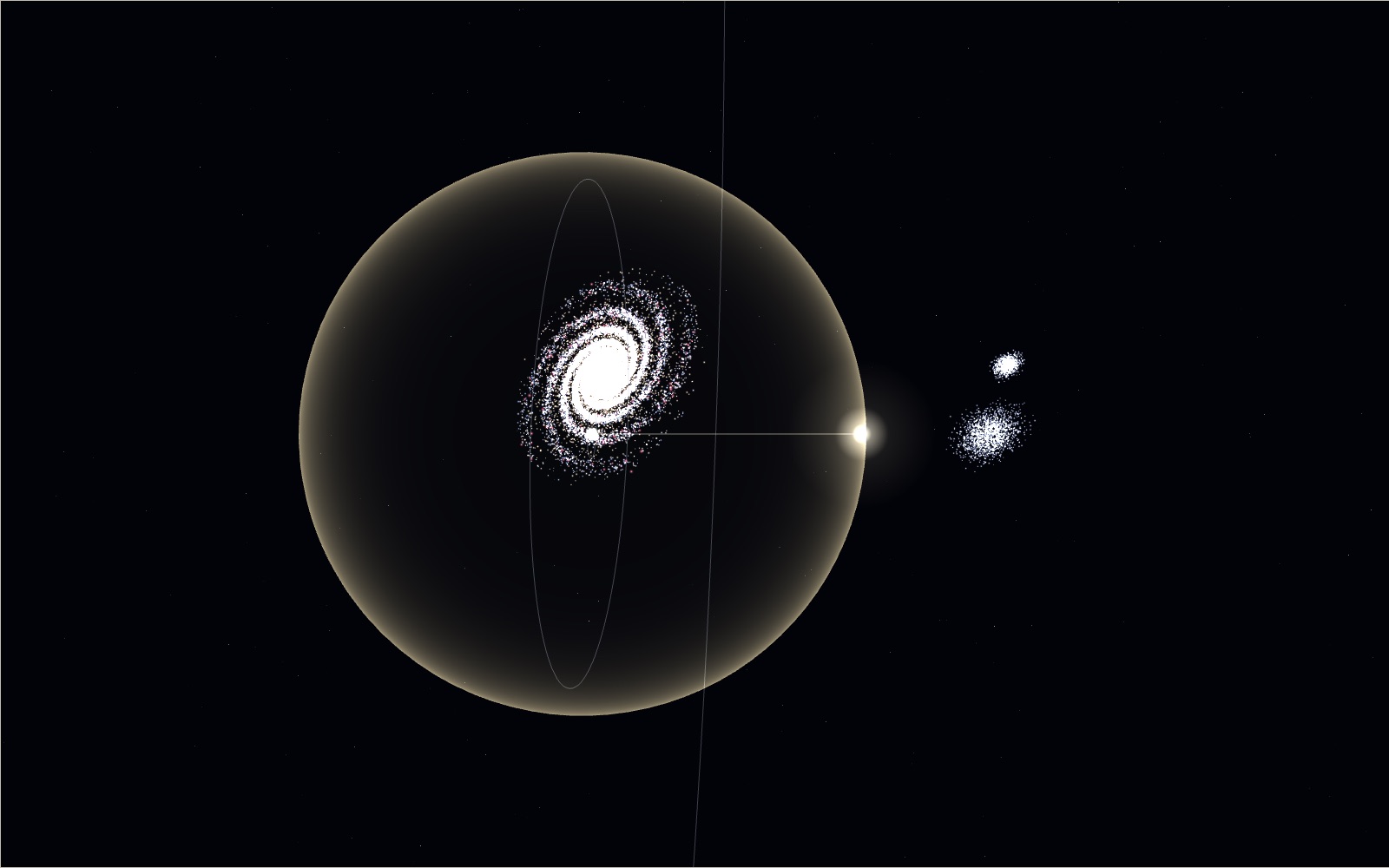
Travelling at the speed of light
Light goes round the equator 7.5 times in a second, yet the same light needs 2.5 million years to reach the Andromeda galaxy.
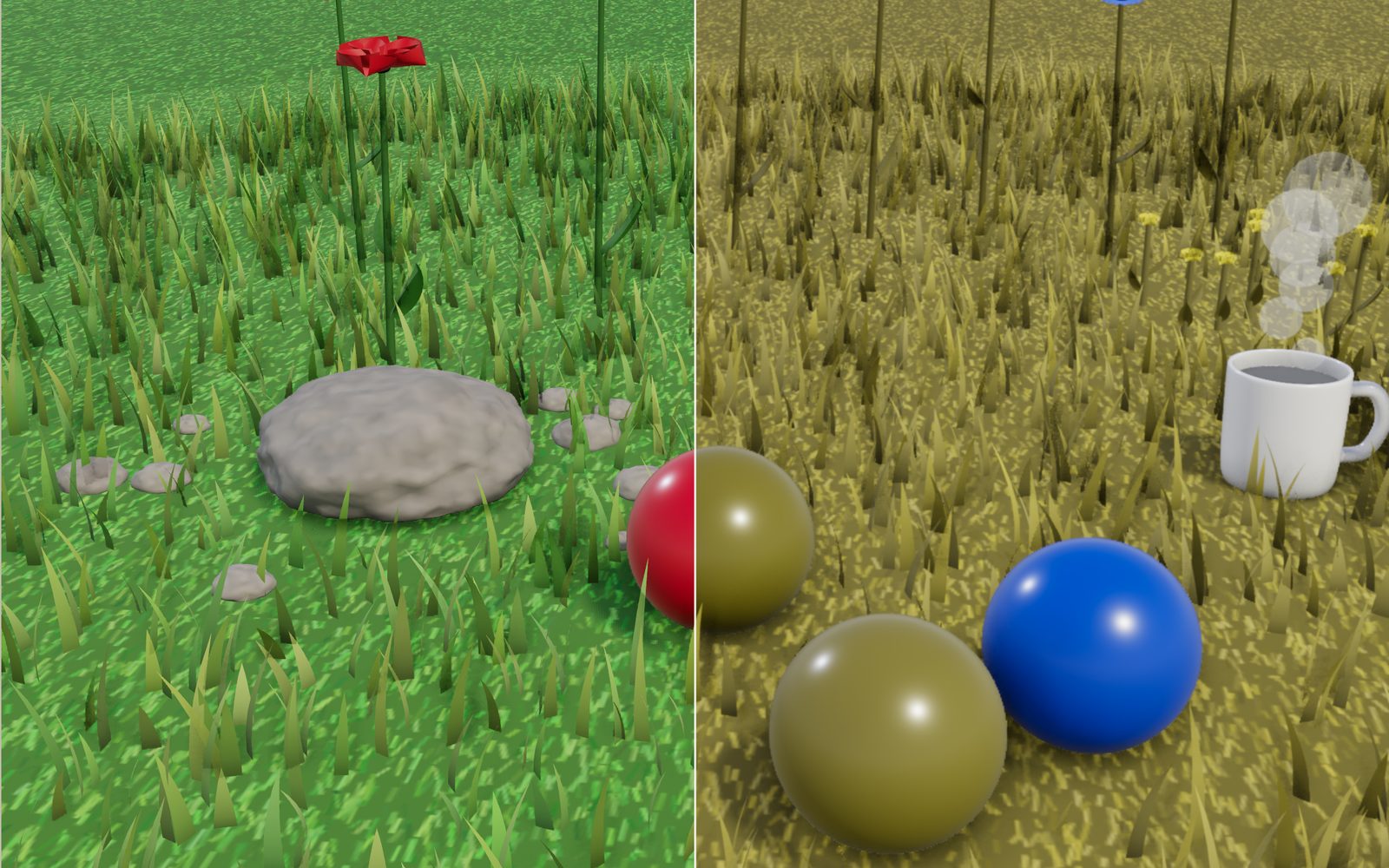
Animal vision: see the world through 69 animals’ eyes
A red ball on green grass is easy for you to find and surprisingly hard for a dog. A honeybee sees a pattern in the same flower that you cannot.
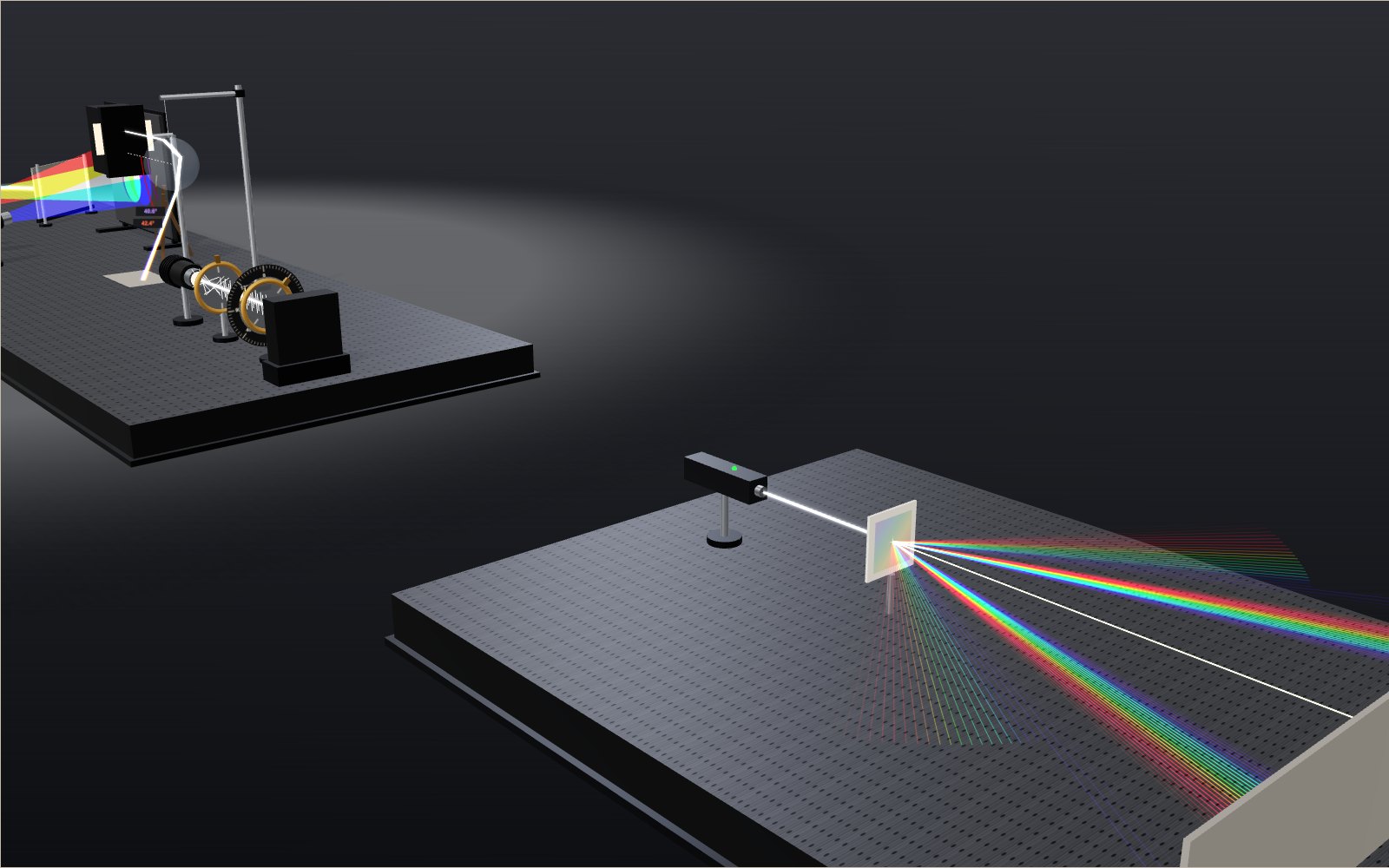
Light and colour, from prisms to polarisers
A glass prism bends violet light about 1.6 degrees more than red, and that small gap is all it takes to spread white light into a spectrum.
How fibre optics and submarine cables work
Light in a submarine cable stays inside a glass core 8.2 micrometres wide for thousands of kilometres because it meets the core wall at more than 84.5°.
How a pendulum clock works, and why its length sets the time
A pendulum clock counts seconds with one rod 99.4 cm long. Change its length, its temperature and its place on Earth, swap four escapements and see how many seconds a day each costs.
Walk through the Sagrada Família
Inside the Sagrada Família the columns branch like trees 45 m up, and the sun moves blue and orange light across the floor.