FIG. 113Senses
Travelling at the speed of light
Light goes round the equator 7.5 times in a second, yet the same light needs 2.5 million years to reach the Andromeda galaxy.
This device cannot show the 3D model. You can read the guide steps below as text.
1 / 18 A flashlight turns onThe dot of light runs round the equator. In one second it covers 299,792 km, 7.5 times round. Then it leaves Earth. Drag to look around; the buttons along the top open five more scenes.
Drag to turn. Scroll or pinch to zoom.
What you are looking at
Light is the fastest thing there is, and it is still slow enough to measure with a wheel and a mirror on two hills. This exhibit follows a single flash of light outward from Earth, at true distances, until it reaches the Andromeda galaxy. In the first second the flash could go round the equator seven and a half times. It needs 1.3 seconds for the Moon, 8 minutes 19 seconds for the distance to the Sun, about 4 hours for Neptune, one day for Voyager 1, 4.25 years for the nearest star, about 26,700 years for the centre of the Milky Way and 2.5 million years for Andromeda.
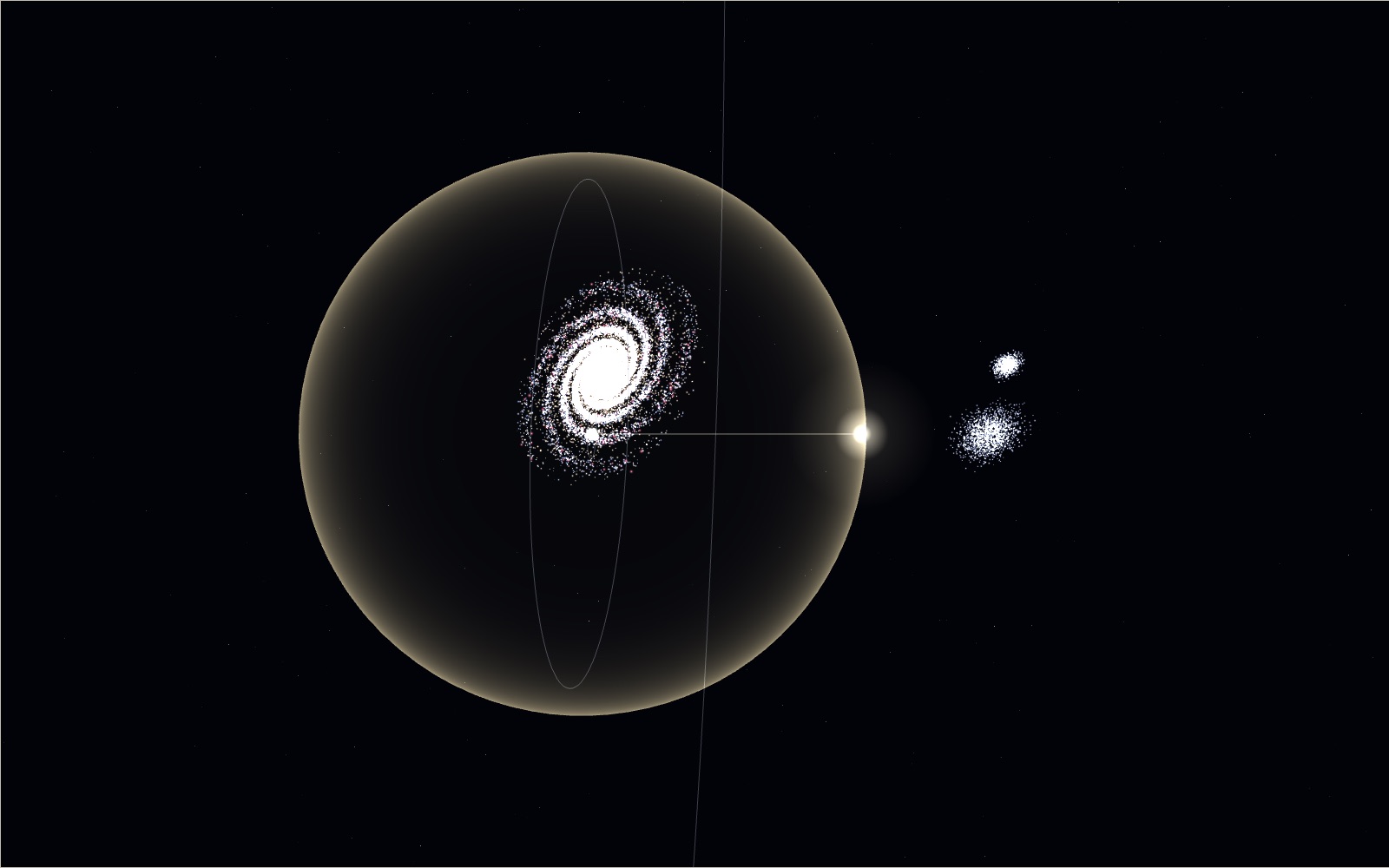
Those numbers are spread over more than 13 powers of ten, so the stage uses a sliding scale. The bright sphere is the flash itself: a shell of light growing by 299,792 km every second, centred on Earth. Anything inside it has already seen the flash. As the sphere grows, the view pulls back so the sphere always fits on the screen, and the strip in the corner tells you how big one screen unit is at that moment.
Five more scenes sit along the top of the stage. You can talk to a Mars rover across the real distance of any date between October 2025 and December 2028. You can stand at the two experiments that first measured light: Rømer's eclipses of Io in 1676 and Fizeau's toothed wheel in 1849. Five pulses race through vacuum, air, water, glass and diamond. A ship flies to Proxima Centauri close to the speed of light while two clocks disagree. The last scene is tonight's sky, where every star tells you the year its light set off, and one of them is your birthday star.
Under the stage are 12 challenges, a light-time book with 46 entries, 23 hidden finds, cards that correct common mistakes and a log of everything the flash has reached.
The first ten seconds
The exhibit opens on Earth. A dot of light starts at the equator and runs round it, leaving a fading trail. The counter in the corner shows the time: at 0.25 seconds it has gone nearly two laps, at 0.5 seconds three and three quarters. At 1.00 seconds the dot has covered 299,792 km and gone round 7.5 times. Then it leaves.
Real light cannot follow the curve of the Earth, of course. Light travels in straight lines unless something bends it. The laps are a way of making one second of light the size of something we know: the equator is 40,075 km long, and a second of light is that length seven and a half times over.
Once the dot leaves, the flash becomes a sphere. The first 1.28 seconds run at real speed, so you see how long the trip to the Moon really takes, about as long as it takes to say "the Moon". After that the Auto setting speeds time up, slowing down near each arrival so that you can watch the sphere reach it.
Seven and a half times round the Earth
The speed of light in a vacuum is exactly 299,792,458 metres per second. In one second light covers 299,792.458 km. The equator, from the equatorial radius of 6,378.137 km that NASA lists for Earth, is 2 × π × 6,378.137 = 40,075 km long. Dividing the two gives 299,792 ÷ 40,075 = 7.48 laps.
A more useful comparison for everyday life is the nanosecond, one billionth of a second. In a nanosecond light covers 29.98 cm, about the length of a ruler. A screen 30 cm from your eyes sends you light that is 1 nanosecond old. Light crosses a 1.7 m person in 5.7 nanoseconds, which is the number the scale strip on the stage gives for the default height.
Computers live in this world of nanoseconds. A processor running at 3 GHz finishes a cycle every third of a nanosecond, in which time light covers about 10 cm. That is one reason the fastest chips are small and their parts close together.
The Moon in 1.3 seconds
The Moon's average distance is 384,400 km, so light takes 384,400 ÷ 299,792 = 1.28 seconds. Because the Moon's orbit is not a perfect circle, the time varies from about 1.21 seconds at perigee (363,300 km) to 1.35 seconds at apogee (405,500 km).
Apollo crews felt the delay. When the astronauts on the Moon asked Houston a question, the radio signal took 1.3 seconds to reach Earth, and the answer took 1.3 seconds to come back. Add the time people needed to think and speak, and conversations had pauses of several seconds.
The Moon is still used as a giant stopwatch. Apollo 11, 14 and 15 left corner-cube reflectors on the surface, and two Soviet Lunokhod rovers carried more. Observatories fire short laser pulses at them and time the faint echo, about 2.5 seconds later. The best stations measure the distance to a few millimetres. That is how we know the Moon is moving away from Earth by about 3.8 cm a year. In the stage, tap the Moon once the flash is near it to find the reflectors.
Sunlight that is 8 minutes old
The astronomical unit, the average distance from Earth to the Sun, was fixed by the International Astronomical Union in 2012 as exactly 149,597,870,700 m. Light needs 149,597,870,700 ÷ 299,792,458 = 499.0 seconds to cross it: 8 minutes 19 seconds.
Earth's orbit is slightly oval, so the real time changes through the year. In early January, near perihelion at 147.1 million km, sunlight takes 8 minutes 11 seconds. In early July, near aphelion at 152.1 million km, it takes 8 minutes 27 seconds. The exhibit uses the actual distance for the date you choose, which is why the Sun's arrival time on the stage is rarely exactly 8:19.
If the Sun vanished, Earth would go on getting sunlight for those eight minutes, and nobody here could know sooner. Everything we see in the sky is a message that has already been on its way for a while.
There is a second, much longer story inside the Sun. The energy in sunlight is made in the core, and on its way out it is absorbed and sent out again countless times. The light that reaches you left the surface 8 minutes ago, but its energy may have spent a very long time getting there. The scene on light in matter comes back to this.
The planets: minutes and hours
The flash passes the planets in order of their distance from Earth on the chosen date. The exhibit calculates their positions from the approximate orbit formulas published by NASA's Jet Propulsion Laboratory, which are accurate to a fraction of a degree between 1800 and 2050.
Average distances from the Sun turn into these light times: Mercury 0.387 au, 3 minutes 13 seconds; Venus 0.723 au, 6 minutes 1 second; Mars 1.524 au, 12 minutes 40 seconds; Jupiter 5.2 au, 43 minutes; Saturn 9.54 au, 1 hour 19 minutes; Uranus 19.2 au, 2 hours 40 minutes; Neptune 30.07 au, 4 hours 10 minutes. Seen from Earth the numbers swing widely. Venus can be just 2 minutes away when it passes between us and the Sun, or 14 minutes when it is on the far side.
For spacecraft these hours are the whole problem of operating them. A command to a probe at Neptune takes about 4 hours to arrive and the reply another 4. Engineers send long, carefully checked sequences and then wait to find out what happened. The flash in the exhibit marks each planet as it passes, and the log under the stage records the times.
Voyager 1 and the first light-day
Voyager 1 left Earth on 5 September 1977. It flew past Jupiter and Saturn, then headed out of the plane of the planets at about 17 km/s relative to the Sun. On 25 August 2012, at about 122 au, it crossed the heliopause, where the wind of particles from the Sun gives way to the gas between the stars.
NASA has worked out the moment it will pass the next milestone. On Wednesday 18 November 2026 at 2:16:07 a.m. Pacific time, Voyager 1 will be 25.902 billion km from Earth, the distance light travels in 24 hours. It will be the first human-made object one light-day away. A command sent to it that morning arrives the next morning, and its answer the morning after.
The exhibit draws Voyager 1 at its distance for the chosen date using a straight-line model through NASA's milestone, so its place is an estimate away from that day. Earth's own motion round the Sun adds or takes away up to 30 km/s, which is why the real distance from Earth wobbles over the year.
Talking to Mars
The Mars scene shows the inner Solar System from above at true distances, one unit to one astronomical unit, on any date you choose with the slider. The planets are drawn much larger than to scale so that you can see them. A dashed line joins Earth and Mars and gives the distance and the light time.
NASA gives the range: from 54.6 million km, about 3 minutes, when the two planets are close together on the same side of the Sun, to 400.2 million km, about 22.4 minutes, when Mars is on the far side. The two planets line up on the same side about every 26 months. Within the range of the date slider the closest approach is around 20 February 2027, when Mars comes within about 0.68 au and a signal takes 5.6 minutes. The farthest is around the turn of 2026, when Mars was behind the Sun and the one-way time was about 20 minutes.
Press Send command. A pulse of light leaves Earth, crosses the gap at c and reaches Mars. The rover, shown at true size in its own view, drives 2 m. Its reply comes back the same way. At the normal setting the stage squeezes the wait into a few seconds and tells you how much it has sped up; with Real time on you wait the true minutes.
Why rovers drive themselves
With up to 22 minutes each way, nobody can steer a rover live. If a driver on Earth saw a rock in a picture and pressed Stop, the rover would already have reached the rock long before the command arrived. So engineers plan a day's work, check it and send it in one go. The rover drives, looks at the ground with its own cameras, picks a safe path and stops if something looks wrong.
Most of the rover's data does not come straight home. NASA's Mars Relay Network uses orbiters that pass over the rovers, collect their data at up to 2 million bits a second and send it on to Earth. The rovers also lose sight of Earth for about 12 hours each Martian day as the planet turns. Light speed sets the delay, but antennas, power and the turning of two planets set when anyone can talk at all.
About every 26 months Mars passes behind the Sun as seen from Earth. Radio passing close to the Sun is scrambled by its hot outer atmosphere, so missions stop sending commands for a couple of weeks. NASA's planning papers for crewed missions expect communication blackouts of up to about three weeks and one-way delays of up to about 22 minutes.
Out to the nearest star
After Voyager the gaps jump. The flash needs 4.25 years to reach Proxima Centauri, the nearest star to the Sun. Its parallax, measured by the European Space Agency's Gaia satellite and published in Data Release 3, is 768.07 thousandths of an arcsecond, which gives 4.2465 light-years. Its two bright companions, Alpha Centauri A and B, are a little farther at about 4.3 to 4.4 light-years.
Proxima is a small red dwarf, far too faint to see without a telescope. The nearest star most people can see easily is Alpha Centauri, low in the southern sky, and the brightest star of the night is Sirius, 8.6 light-years away. In the first scene the stars around the Sun are drawn at their true distances, so as the view pulls back past ten light-years you see the Sun's neighbourhood as a scattering of points, with the flash sphere among them.
At this scale the Solar System has shrunk to a single point. The whole orbit of Neptune is 60 au across, and 4.25 light-years is about 268,000 au.
What a light-year is
A light-year is a distance, not a time. It is how far light travels in one Julian year of 365.25 days: 299,792,458 m/s × 31,557,600 s = 9.4607 × 10¹⁵ m, about 9.46 trillion km. NASA puts it the same way when it explains Voyager's light-day: the milestone is about distance.
The useful thing about light-years is that the number is also the age of the light. Light from a star 25 light-years away left it 25 years ago. Astronomers often prefer the parsec, 3.26 light-years, because it comes straight from the geometry of parallax.
Light-seconds, light-minutes and light-hours work the same way. The Moon is 1.28 light-seconds away, the Sun 8.3 light-minutes, Neptune about 4 light-hours and Voyager 1, from 18 November 2026, one light-day.
How star distances are measured
Hold a finger at arm's length and close one eye, then the other: the finger jumps against the background. Stars do the same as Earth goes round the Sun. Observed six months apart, from two points 2 au apart, a nearby star shifts slightly against far-away stars. Half that shift is its parallax. A star with a parallax of one arcsecond is one parsec away, and the distance in parsecs is 1 divided by the parallax in arcseconds.
The shifts are tiny. Proxima's, the largest of any star, is 0.768 arcseconds, about the width of a coin seen from 6 km. ESA's Hipparcos satellite measured parallaxes for about 118,000 stars in the early 1990s; a new reduction of its data was published by Floor van Leeuwen in 2007. Gaia, launched in 2013, measures positions for about 1.8 billion objects, and its third data release in 2022 gave parallaxes for about 1.5 billion of them.
Every star in this exhibit comes from the SIMBAD database run by the Strasbourg astronomical data centre, queried for the stars brighter than magnitude 4.6, the stars brighter than 6 within about 109 light-years, and the stars nearer than about 34 light-years. SIMBAD adopts one parallax for each star and names where it comes from. For most stars here that is Gaia DR3; for the brightest it is the Hipparcos reduction, because very bright stars overwhelm Gaia's detectors.
Your birthday star
Type your birth date under the stage. The exhibit works out your age in years and looks for stars at that distance in light-years: the light from those stars that reaches you tonight left them about when you were born. It lists three, with each star's distance, how far off it is from your exact age, its brightness and whether you can see it without help. Show in the sky turns tonight's sky to the star and marks it in gold.
A 25-year-old's birthday star might be Vega, 25.0 light-years away by Hipparcos, or Fomalhaut, 25.1. A 37-year-old gets Arcturus at 36.7. The list has stars at almost every age from about 5 to 100. Younger than about 4 years, there is no answer at all: the nearest star is 4.2 light-years away, and the exhibit says so.
The same idea runs the other way. A flash that left Earth on the day you were born is now as many light-years away as you are years old. The exhibit tells you how many kilometres that is. For a 30-year-old, it is about 284 trillion km.
When studies disagree
Some bright stars have distances that are still argued over. They are too bright for Gaia to measure well, too far for an easy parallax, or both. The exhibit marks them rather than picking one answer.
Betelgeuse, the red shoulder of Orion, has a Hipparcos parallax that gives about 500 light-years, with an uncertainty of more than 10 %. In 2020 Meridith Joyce and colleagues combined models of the star's pulsations with its brightness and got about 550 light-years. Together the studies put its light at somewhere between about 440 and 640 years old.
Deneb, in the Swan, is even harder. Hipparcos gives about 1,400 light-years, while a detailed study of its spectrum in 2008 suggested about 2,600. Polaris, the North Star, has a Hipparcos distance of about 433 light-years, while a 2018 measurement of its faint companion with the Hubble Space Telescope gave about 521. When you tap these stars in tonight's sky, the exhibit shows both values.
The centre of the Milky Way
At the centre of the Milky Way is a black hole of about four million times the mass of the Sun, called Sagittarius A*. Its distance has been measured by following stars that orbit it. In 2019 the GRAVITY collaboration, combining the four large telescopes of the European Southern Observatory's Very Large Telescope, gave 8,178 parsecs, with an uncertainty of 0.3 %. That is about 26,700 light-years.
When the flash reaches it, the view has pulled back so far that the Milky Way appears whole. Up to this point the points that make the galaxy were drawn on a sky sphere around Earth, where they formed the band of the Milky Way across the night. Pulled back to 30,000 light-years, the same points become a spiral disc seen from above, with the Sun about halfway out from the centre. The galaxy in the exhibit is a model drawn from 46,000 points, with four arms and a bar; its shape is a sketch, not a map.
Visit the galactic centre and the view slides there. Earth becomes a label 26,700 light-years behind you.
Andromeda and beyond
The flash passes the Large Magellanic Cloud, a small galaxy circling ours, at 49.59 kiloparsecs, about 161,700 light-years. In 2019 a team led by Grzegorz Pietrzyński measured that distance to about one per cent using pairs of eclipsing stars. Its partner, the Small Magellanic Cloud, is about 203,700 light-years away.
Then comes the Andromeda galaxy, which NASA puts at 2.5 million light-years. On a dark night you can see it without a telescope as a faint oval, which makes it the most distant thing most people can see with their own eyes. The light from that oval set off 2.5 million years ago.
Andromeda is coming closer. Measurements of its sideways motion with the Hubble Space Telescope suggest the two galaxies will make their first close pass in about 4 billion years and merge later. Auto stops when the flash arrives there. The book under the stage lists a few places farther out: the black hole in M87, about 55 million light-years away, photographed by the Event Horizon Telescope in 2019, and the oldest light of all.
The oldest light
Beyond a few hundred million light-years, a single distance stops being simple, because the universe expands while the light is on its way. The light from a very distant galaxy has travelled for a certain time, but the galaxy is now much farther away than that time multiplied by the speed of light. The book therefore gives travel times, not distances, for the two most distant entries.
JADES-GS-z14-0, confirmed in 2024 with the James Webb Space Telescope, is one of the most distant galaxies known. We see it as it was about 290 million years after the Big Bang, so its light has been travelling for about 13.5 billion years. The cosmic microwave background is older still. It was sent about 380,000 years after the Big Bang, when the universe first became transparent, and has been travelling for almost the whole age of the universe, about 13.8 billion years by the Planck satellite's measurement.
Rømer and the eclipses of Io
For most of history people argued about whether light took any time at all. The first evidence came from Jupiter's moon Io, which goes behind Jupiter, into its shadow, every 42.5 hours. Astronomers in the 1600s timed these eclipses to make tables for finding longitude at sea.
In 1676 the Danish astronomer Ole Rømer, working at the Paris Observatory, noticed that the eclipses came later than predicted when Earth was moving away from Jupiter, and earlier when Earth was approaching. He explained it by the time light needs to cross the changing distance. Rømer estimated that light needed about 22 minutes to cross the diameter of Earth's orbit. The true figure is 2 au ÷ c = 16.6 minutes.
The history scene has a table model of the Sun, Earth, Jupiter and Io. Earth goes round, Io slips in and out of Jupiter's shadow, and the readout tells you how late the eclipse appears compared with when Earth is nearest. Rømer did not give a speed in kilometres per second, since the size of the astronomical unit itself was poorly known. What he showed was that light takes time.
Bradley's tilted telescope
The second clue came in 1729. James Bradley was trying to measure the parallax of a star in the Dragon when he found a much bigger yearly shift, in the wrong direction for parallax. He realised it came from Earth's motion. Rain falling straight down seems to slant when you run through it, and in the same way starlight seems to come in at a slight angle when Earth moves across its path. The telescope has to be tilted a little to catch it.
From the size of the tilt Bradley worked out that light needs 8 minutes 12 seconds to come from the Sun. With today's astronomical unit that would mean about 304,000 km/s, within 1.5 % of the true value. The same effect, called aberration, appears in the near-light-speed scene, where the ship moves so fast that the whole sky crowds forward. A tilted telescope stands by the second table in the history scene.
Fizeau's toothed wheel
The first measurement on Earth came in 1849. Hippolyte Fizeau put a lamp, a glass plate and a toothed wheel in a house in Suresnes, west of Paris, and a mirror on Montmartre, 8,633 m away. Light from the lamp was turned by the glass plate, passed through a gap between two teeth, went to the mirror, came back and, if it found a gap again, reached Fizeau's eye through the plate.
With the wheel still, the light came back through the same gap. As the wheel turned faster, the returning light found the gap partly closed. At a certain speed the next tooth had moved exactly into its way, and the eyepiece went dark. The wheel had 720 teeth. The light needed 2 × 8,633 m ÷ c = 57.6 millionths of a second for the round trip, and in that time the wheel had to turn by half a tooth, 1 ÷ (2 × 720) of a turn. That happens at C ÷ (4 × 720 × 8,633) = 12.06 turns a second.
Fizeau reported the first darkness at 12.6 turns a second, which with his numbers gives 4 × 720 × 8,633 × 12.6 = 313,000 km/s, about 4.5 % too high. Turn the wheel in the exhibit and watch the chart: the eyepiece gets dark at 12.06 turns a second, bright again at about 24, then dark at 36.2. The wheel is drawn 40 times slower than it turns.
Michelson and the mountain baseline
Rotating mirrors replaced the toothed wheel. Albert Michelson spent half a century improving them. In 1926 he sent light from Mount Wilson to a mirror on Mount San Antonio, about 35 km away in California, and back to a spinning eight-sided mirror. He found 299,796 km/s with an uncertainty of 4 km/s.
Air slows light slightly and its temperature changes along such a long path, so Michelson, Francis Pease and Fred Pearson tried again in a mile-long pipe pumped down to a partial vacuum. Their result, published in 1935, was 299,774 km/s with an uncertainty of 11 km/s. Today we know it was too low by more than the stated uncertainty, a reminder that a measurement's error bars are also an estimate.
After the Second World War, radio methods took over. Louis Essen measured the resonant frequencies of a metal cavity of known size in 1950 and got 299,792.5 km/s with an uncertainty of 3 km/s. The chart in the history scene, under Measurements, shows these values against the year.
From measuring to defining
In 1972 a team at the US National Bureau of Standards, now NIST, led by Kenneth Evenson measured both the frequency and the wavelength of a laser locked to a line of methane. Speed is wavelength times frequency, and they found 299,792,456.2 m/s with an uncertainty of 1.1 m/s. The speed of light was now known better than the metre itself, which was then defined by a wavelength of light from krypton.
So in 1983 the General Conference on Weights and Measures turned the definition around. The metre became the length of the path travelled by light in a vacuum in 1/299,792,458 of a second. Since then the speed of light has not been measured: it is exactly 299,792,458 m/s by definition, and measurements of length use it. When a laboratory today reports a better measurement involving c, it is really reporting a better way of making the metre.
Light in water, glass and diamond
Light slows down inside matter. The factor is the refractive index n: in a material with index n, light moves at c ÷ n. Air at sea level has n of about 1.0003, so light in air is about 80 km/s slower than in a vacuum. Water has n = 1.333, so light moves at about 225,000 km/s. Fused silica glass has 1.4585, giving about 206,000 km/s. Diamond has 2.417, giving about 124,000 km/s.
In the slow scene five pulses start together on lanes 3 m long and race, slowed so that one nanosecond takes 0.4 s. In a vacuum the 3 m take 10.0 nanoseconds; in water 13.3; in glass 14.6; in diamond 24.2. The pulses speed up again when they leave the block. Nothing is used up: the slowing comes from the light being taken up and passed on by the atoms in its path, and once past the atoms the light moves at c again.
The same slowing bends light. When a beam enters a block at an angle, the side that enters first slows first and the beam turns. Snell's law gives the new angle: a beam meeting water at 45° continues at 32.0°, and in diamond at 17.0°. Choose a material and the red laser in the scene bends to match. Diamond's high index is also why it sparkles: light inside bounces back from its faces instead of escaping.
Light slowed to 17 m/s
In 1999 Lene Vestergaard Hau and her team at Harvard slowed a pulse of light to 17 m/s, slower than a racing cyclist. They sent it into a cloud of sodium atoms cooled to near absolute zero and lit by a second laser that made the cloud transparent in a very narrow band of colours. Inside that band the pulse slowed by a factor of about 18 million. Later work by the same group stopped light completely and released it again.
The trick does not break any speed limit: light still moves at c between the atoms, and the pulse's energy is stored in the atoms for a while and then given back. It shows that the speed of light in a material can be almost anything, depending on the material, and that only the speed in a vacuum is fixed. A steel vacuum chamber in the slow scene holds this find.
Faster than light in water
Nothing travels faster than c in a vacuum. In water, though, light moves at only 225,000 km/s, and particles can go faster than that. When an electrically charged particle outruns light in a material, it gives off a cone of light, much as a jet faster than sound makes a sonic boom. This is Cherenkov radiation, reported by Pavel Čerenkov in 1937.
For an electron in water, the speed c ÷ 1.333 is reached at a kinetic energy of about 0.26 MeV, about half of its rest energy. Electrons set loose by a reactor's fuel easily pass that, which is why the water around the fuel in a research reactor pool glows blue. Large detectors use the same light to catch neutrinos: a neutrino occasionally knocks an electron to such a speed inside a tank of very pure water, and rings of Cherenkov light show where it came from. Look for the glowing pool in the slow scene.
The Sun's slow light
Sunlight crosses the gap to Earth in 8 minutes, but its energy is old. It is made by nuclear fusion in the Sun's core, as gamma rays. The inside of the Sun is so dense that light can travel less than a millimetre before it is absorbed and sent out again in a random direction. The energy wanders outward in a random walk of an enormous number of steps.
In 1992 Romas Mitalas and Kenneth Sills worked out the time for this walk with a model of how the Sun's density changes with depth, and found about 170,000 years. Older estimates had used a constant step length and came out shorter; a NASA archive page notes that most careful answers fall between 10,000 and 170,000 years. The particular photon that reaches your eye was made near the surface, minutes before it left. The energy it carries may be about 170,000 years old. The small Sun in the slow scene shows a random walk inside it.
Close to the speed of light
What would it be like to travel close to c? Einstein's special relativity of 1905 says that a clock moving relative to you runs slow by a factor γ = 1 ÷ √(1 − v²/c²). At half the speed of light γ is 1.155; at 0.9 c it is 2.29; at 0.99 c, 7.09; at 0.999 c, 22.4.
The near-light-speed scene sends a ship to Proxima Centauri, 4.25 light-years away, at a steady speed. On Earth the trip takes distance ÷ speed: at 0.9 c, 4.7 years. On board it takes γ times less: 2.1 years. At 0.973 c the crew's clock shows less than one year. From the ship's point of view nothing strange happens to its clocks; instead the distance to Proxima is shorter, by the same factor γ. Both descriptions give the same answer.
The scene is a concept calculation. It leaves out the years of speeding up and slowing down, the energy needed and the dust that would hit the ship. No spacecraft has come anywhere near: Voyager 1's 17 km/s is about 0.006 % of c.
Stars bunching forward
Light from the stars looks different from a fast ship. Bradley's aberration, the small tilt caused by Earth's 30 km/s, grows huge near c. Light that would arrive from the side seems to come from in front, and the whole sky crowds toward the direction of travel. At 0.9 c, a star at right angles to your path appears only about 26° from straight ahead.
The colours change too. Light from stars ahead is squeezed to shorter wavelengths and arrives bluer and brighter; light from behind is stretched, redder and dimmer. The scene draws both effects for every star: set the ship's speed to 0.999 c and the stars close in on Proxima in a bright blue ring, while the sky behind empties and reddens. The formulas are the same ones physicists use for fast particles in accelerators.
Relativity in your pocket
Time dilation is not only for starships. Muons, made when cosmic rays hit the upper air, live on average 2.2 millionths of a second when at rest. Moving near c, a muon would cover only about 660 m in that time, yet many reach the ground from heights of about 15 km. In 1963 David Frisch and James Smith counted muons on top of Mount Washington and at sea level and found that the moving muons' clocks ran slow by a factor of about 9.
In 1971 Joseph Hafele and Richard Keating flew four atomic clocks round the world on airliners. The clocks flown eastward lost 59 billionths of a second against the clocks at home and those flown westward gained 273, close to the predictions that combine the effects of speed and of gravity.
GPS depends on both. Clocks in GPS satellites, 20,200 km up, run fast by about 45.7 millionths of a second a day because gravity is weaker there, and slow by about 7.1 because they move. The net 38.6 millionths of a second, multiplied by c, is about 11.6 km a day. The satellites' clocks are set to tick slower before launch so that positions stay right. Neil Ashby's review of relativity in GPS sets out the calculation.
How the model differs from reality
The flash is drawn as a sphere centred on Earth, which is right for light sent in all directions. The planets are placed from approximate orbit formulas, good to well under a degree for the dates the slider allows, and drawn at their true sizes in the first scene; on the Mars map they are drawn hundreds of times too large. The Moon's direction is rough. Voyager 1's distance comes from a straight-line model through NASA's milestone and its direction is approximate.
Star distances are SIMBAD's adopted parallaxes. For some bright stars these have errors of 10 % or more, and the exhibit marks the stars where studies disagree. The Milky Way, Andromeda and the Magellanic Clouds are drawn as clouds of points shaped like the real galaxies, not star by star; their distances are measured values, their shapes are sketches. The sky scene guesses your longitude from your time zone.
The relativity scene assumes a constant speed with no acceleration. The slowing in matter uses refractive indices at 589 nm, yellow light, at room temperature; other colours differ slightly. The Fizeau wheel is drawn 40 times slower than it turns, and its mirror is drawn 9 m away, not 8,633 m.
The guided tour and the lab
The 18 steps of the guided tour start with the flashlight, follow the flash to the Moon, the Sun, Neptune, Voyager 1, Proxima Centauri, Betelgeuse, the galactic centre and Andromeda, then visit the Mars rover, Rømer, Fizeau, the racing lanes, the starship and the night sky.
Under the stage, You and light takes your birth date and height. The 12 challenges include finding the date when Mars answers fastest, turning Fizeau's wheel to darkness and getting to Proxima in under a year of ship time; stars are kept in your browser. The light-time book lists 46 places from your screen to the cosmic microwave background, with the light time for each and a button that shows it on the stage. Hidden finds, 23 of them, open cards when you tap small things on the stage. The Actually cards correct ten common mistakes, each with its sources.
Questions
How fast is the speed of light?
Exactly 299,792,458 metres per second in a vacuum, about 1.08 billion km/h. It has been exact by definition since 1983, when the metre was redefined in terms of it.
How many times can light go round the Earth in one second?
About 7.5 times. The equator is 40,075 km long, and light covers 299,792 km in a second: 299,792 ÷ 40,075 = 7.48.
How long does light take to get from the Sun to Earth?
About 8 minutes 19 seconds on average: 149,597,870,700 m ÷ 299,792,458 m/s = 499 s. It varies from about 8 minutes 11 seconds in early January to 8 minutes 27 seconds in early July.
How long does light take to reach the Moon?
About 1.28 seconds on average, from 1.21 to 1.35 seconds as the Moon's distance changes. A round trip, as with the laser echoes from the Apollo reflectors, takes about 2.5 seconds.
Is a light-year a unit of time?
No, it is a distance: how far light travels in a Julian year, about 9.46 trillion km. Because it is defined by light, the distance of a star in light-years is also the age of the light we see from it.
How long does a signal take to reach Mars?
Between about 3 and 22 minutes one way, depending on where the two planets are in their orbits. NASA gives a range of 54.6 to 400.2 million km. A command and its reply together take from about 6 to about 45 minutes.
When will Voyager 1 be one light-day away?
NASA calculates that Voyager 1 will be 25.902 billion km from Earth, one light-day, on 18 November 2026 at 2:16:07 a.m. Pacific time. It will be the first human-made object that far.
What is the nearest star, and how long does its light take?
Proxima Centauri, 4.25 light-years away by its Gaia parallax. Its light takes 4.25 years to reach us. It is too faint to see without a telescope; Alpha Centauri A and B, about 4.4 light-years away, are easy to see from the southern hemisphere.
What is my birthday star?
A star whose distance in light-years is about your age in years. The light from it that reaches you tonight left it about when you were born. Enter your birth date under the stage to get three candidates with their distances from the SIMBAD database.
Are the stars I see still there?
Almost certainly. Nearly every star you can see without a telescope is within a few thousand light-years, while stars shine for millions to billions of years, so it is very unlikely that one has died in the time its light has been travelling. The light is old, but the star is still there.
Who first measured the speed of light?
Ole Rømer showed in 1676 that light takes time, using the eclipses of Jupiter's moon Io. Hippolyte Fizeau made the first measurement on Earth in 1849 with a toothed wheel and a mirror 8,633 m away, and got about 313,000 km/s.
Why does light slow down in glass or water?
Inside matter, light is taken up and passed on by the atoms and their electrons, which delays it. The slowdown factor is the refractive index: 1.333 for water, about 1.46 for fused silica glass and 2.417 for diamond. Between the atoms the light still moves at c, and it speeds up again when it leaves.
Can anything go faster than light?
Nothing carrying information or energy travels faster than c in a vacuum. Particles can travel faster than light does inside a material such as water, which gives Cherenkov radiation. The distance between very distant galaxies can grow faster than c because space itself expands, but nothing moves past anything else faster than light.
Would time really slow down if I travelled near the speed of light?
Your own clock would seem normal to you, but compared with clocks on Earth it would run slow by the factor γ. At 0.9 c a trip to Proxima Centauri would take 4.7 years on Earth and 2.1 years on board. This effect is measured every day with GPS satellites, cosmic-ray muons and particle accelerators.
Why do GPS satellites need relativity?
Their clocks gain about 38 microseconds a day compared with clocks on the ground, from weaker gravity and their speed together. Multiplied by the speed of light, that would be an error of about 11.6 km a day, so the clocks are adjusted before launch and the receivers correct the rest.
Terms
- Speed of light (c): the speed of light in a vacuum, exactly 299,792,458 m/s by definition since 1983.
- Light-year: the distance light travels in one Julian year, about 9.46 trillion km.
- Light-second, light-minute, light-hour, light-day: the distance light travels in that time; the Moon is 1.28 light-seconds away.
- Astronomical unit (au): exactly 149,597,870,700 m, about the average distance from Earth to the Sun.
- Parallax: the small yearly shift of a nearby star against far ones, seen from opposite sides of Earth's orbit.
- Parsec: the distance at which a star has a parallax of one arcsecond, about 3.26 light-years.
- Refractive index (n): how many times slower light moves in a material than in a vacuum.
- Aberration: the apparent shift of starlight caused by the observer's motion.
- Time dilation: the slowing of a moving clock, compared with clocks at rest, by the factor γ.
- Lorentz factor (γ): 1 ÷ √(1 − v²/c²), the amount by which moving clocks run slow.
- Cherenkov radiation: light given off by a charged particle moving faster than light does in that material.
- Conjunction: when a planet passes behind the Sun as seen from Earth.
- Heliopause: the boundary where the solar wind meets the gas between the stars.
Sources
- BIPM, The International System of Units (SI Brochure, 9th edition, 2019): https://www.bipm.org/en/publications/si-brochure (checked 2026-10-20)
- BIPM, Resolution 1 of the 17th CGPM (1983), definition of the metre: https://www.bipm.org/en/committees/cg/cgpm/17-1983/resolution-1 (checked 2026-10-20)
- NIST, CODATA value: speed of light in vacuum: https://physics.nist.gov/cgi-bin/cuu/Value?c (checked 2026-10-20)
- NIST, Meter (SI redefinition): https://www.nist.gov/si-redefinition/meter (checked 2026-10-20)
- NIST, CODATA value: electron mass energy equivalent in MeV: https://physics.nist.gov/cgi-bin/cuu/Value?mec2mev (checked 2026-10-20)
- IAU, List of Resolutions (2012 B2, the astronomical unit; 2015 B3, nominal solar values): https://www.iau.org/Iau/Publications/List-of-Resolutions (checked 2026-10-20)
- NASA NSSDCA, Earth Fact Sheet: https://nssdc.gsfc.nasa.gov/planetary/factsheet/earthfact.html (checked 2026-10-20)
- NASA NSSDCA, Moon Fact Sheet: https://nssdc.gsfc.nasa.gov/planetary/factsheet/moonfact.html (checked 2026-10-20)
- NASA NSSDCA, Planetary Fact Sheet: https://nssdc.gsfc.nasa.gov/planetary/factsheet/ (checked 2026-10-20)
- NASA NSSDCA, Pluto Fact Sheet: https://nssdc.gsfc.nasa.gov/planetary/factsheet/plutofact.html (checked 2026-10-20)
- NASA JPL Solar System Dynamics, Approximate Positions of the Planets: https://ssd.jpl.nasa.gov/planets/approx_pos.html (checked 2026-10-20)
- NASA Science, Mars Relay Network: https://science.nasa.gov/mars/mars-relay-network/ (checked 2026-10-20)
- NASA, Mars Communications Disruption and Delay (Moon to Mars Architecture white paper, 2023): https://www.lpi.usra.edu/lunar/strategies/resources/M2M-ACR2023_MarsCommunicationDisruptionDelay.pdf (checked 2026-10-20)
- NASA Science, Mars 2020: Perseverance Rover: https://science.nasa.gov/mission/mars-2020-perseverance/ (checked 2026-10-20)
- NASA, Deep Space Network: https://www.nasa.gov/communicating-with-missions/dsn/ (checked 2026-10-20)
- NASA, Deep Space Optical Communications (DSOC): https://www.nasa.gov/mission/deep-space-optical-communications-dsoc/ (checked 2026-10-20)
- NASA Science, Where Are Voyager 1 and Voyager 2 Now?: https://science.nasa.gov/mission/voyager/where-are-voyager-1-and-voyager-2-now/ (checked 2026-10-20)
- NASA Science, Voyager 1: What Is a Light-Day?: https://science.nasa.gov/mission/voyager/voyager-1/voyager-1-what-is-a-light-day/ (checked 2026-10-20)
- NASA Science, Voyager 1: https://science.nasa.gov/mission/voyager/voyager-1/ (checked 2026-10-20)
- NASA Science, Voyager Interstellar Mission: https://science.nasa.gov/mission/voyager/interstellar-mission/ (checked 2026-10-20)
- NASA Science, Webb orbit: https://science.nasa.gov/mission/webb/orbit/ (checked 2026-10-20)
- NASA, International Space Station facts and figures: https://www.nasa.gov/international-space-station/space-station-facts-and-figures/ (checked 2026-10-20)
- GPS.gov, Space Segment: https://www.gps.gov/space-segment (checked 2026-10-20)
- ESA, Types of orbits: https://www.esa.int/Enabling_Support/Space_Transportation/Types_of_orbits (checked 2026-10-20)
- NASA Science, Sun: Facts: https://science.nasa.gov/sun/facts/ (checked 2026-10-20)
- NASA Sun-Earth Day archive, Technology Through Time 50: Ancient Sunlight: https://spdf.gsfc.nasa.gov/pub/documents/old/websites/sunearthday.nasa.gov/2007/locations/ttt_sunlight.php (checked 2026-10-20)
- NASA Science, Oort Cloud: https://science.nasa.gov/solar-system/oort-cloud/ (checked 2026-10-20)
- NASA Science, Messier 31 (the Andromeda Galaxy): https://science.nasa.gov/mission/hubble/science/explore-the-night-sky/hubble-messier-catalog/messier-31/ (checked 2026-10-20)
- ESA, Gaia: https://www.esa.int/Science_Exploration/Space_Science/Gaia (checked 2026-10-20)
- ESA, Planck and the cosmic microwave background: https://www.esa.int/Science_Exploration/Space_Science/Planck/Planck_and_the_cosmic_microwave_background (checked 2026-10-20)
- Gaia Collaboration, Vallenari et al. (2023). Gaia Data Release 3: summary of the content and survey properties. A&A 674: A1. https://doi.org/10.1051/0004-6361/202243940
- van Leeuwen (2007). Validation of the new Hipparcos reduction. A&A 474: 653. https://doi.org/10.1051/0004-6361:20078357
- Wenger et al. (2000). The SIMBAD astronomical database. A&AS 143: 9. https://doi.org/10.1051/aas:2000332 (queried through the CDS TAP service, 2026-10-20)
- Gaia Collaboration, Babusiaux et al. (2018). Gaia Data Release 2: observational Hertzsprung-Russell diagrams. A&A 616: A10. https://doi.org/10.1051/0004-6361/201832843
- GRAVITY Collaboration (2019). A geometric distance measurement to the Galactic center black hole with 0.3% uncertainty. A&A 625: L10. https://doi.org/10.1051/0004-6361/201935656
- Pietrzyński et al. (2019). A distance to the Large Magellanic Cloud that is precise to one per cent. Nature 567: 200. https://doi.org/10.1038/s41586-019-0999-4
- Graczyk et al. (2020). A distance determination to the Small Magellanic Cloud with an accuracy of better than two percent. ApJ 904: 13. https://doi.org/10.3847/1538-4357/abbb2b
- van der Marel et al. (2012). The M31 velocity vector. III. Future Milky Way M31-M33 orbital evolution, merging, and fate of the Sun. ApJ 753: 9. https://doi.org/10.1088/0004-637X/753/1/9
- Event Horizon Telescope Collaboration (2019). First M87 Event Horizon Telescope results. I. ApJL 875: L1. https://doi.org/10.3847/2041-8213/ab0ec7
- Planck Collaboration (2020). Planck 2018 results. VI. Cosmological parameters. A&A 641: A6. https://doi.org/10.1051/0004-6361/201833910
- Carniani et al. (2024). Spectroscopic confirmation of two luminous galaxies at a redshift of 14. Nature 633: 318. https://doi.org/10.1038/s41586-024-07860-9
- Kounkel et al. (2017). The Gould's Belt Distances Survey (GOBELINS). II. ApJ 834: 142. https://doi.org/10.3847/1538-4357/834/2/142
- Joyce et al. (2020). Standing on the shoulders of giants: new mass and distance estimates for Betelgeuse. ApJ 902: 63. https://doi.org/10.3847/1538-4357/abb8db
- Bond et al. (2018). Hubble Space Telescope trigonometric parallax of Polaris B. ApJ 853: 55. https://doi.org/10.3847/1538-4357/aaa3f9
- Schiller and Przybilla (2008). Quantitative spectroscopy of Deneb. A&A 479: 849. https://doi.org/10.1051/0004-6361:20078590
- Bobis and Lequeux (2008). Cassini, Rømer and the velocity of light. Journal of Astronomical History and Heritage 11: 97. https://doi.org/10.3724/sp.j.1440-2807.2008.02.02
- Bradley (1729). An account of a new discovered motion of the fix'd stars. Philosophical Transactions 35: 637. https://doi.org/10.1098/rstl.1727.0064
- Fizeau (1849). Sur une expérience relative à la vitesse de propagation de la lumière. Comptes rendus 29: 90 (Académie des sciences): https://www.academie-sciences.fr/pdf/dossiers/Fizeau/Fizeau_pdf/CR1849_p90.pdf (checked 2026-10-20)
- Michelson (1927). Measurement of the velocity of light between Mount Wilson and Mount San Antonio. ApJ 65: 1. https://doi.org/10.1086/143021
- Michelson, Pease and Pearson (1935). Measurement of the velocity of light in a partial vacuum. ApJ 82: 26. https://doi.org/10.1086/143655
- Essen (1950). The velocity of propagation of electromagnetic waves derived from the resonant frequencies of a cylindrical cavity resonator. Proc. R. Soc. A 204: 260. https://doi.org/10.1098/rspa.1950.0172
- Evenson et al. (1972). Speed of light from direct frequency and wavelength measurements of the methane-stabilized laser. Phys. Rev. Lett. 29: 1346. https://doi.org/10.1103/PhysRevLett.29.1346
- Ciddor (1996). Refractive index of air: new equations for the visible and near infrared. Applied Optics 35: 1566. https://doi.org/10.1364/AO.35.001566
- Hale and Querry (1973). Optical constants of water in the 200-nm to 200-µm wavelength region. Applied Optics 12: 555. https://doi.org/10.1364/AO.12.000555
- Malitson (1965). Interspecimen comparison of the refractive index of fused silica. JOSA 55: 1205. https://doi.org/10.1364/JOSA.55.001205
- Phillip and Taft (1964). Kramers-Kronig analysis of reflectance data for diamond. Phys. Rev. 136: A1445. https://doi.org/10.1103/PhysRev.136.A1445
- Hau, Harris, Dutton and Behroozi (1999). Light speed reduction to 17 metres per second in an ultracold atomic gas. Nature 397: 594. https://doi.org/10.1038/17561
- Čerenkov (1937). Visible radiation produced by electrons moving in a medium with velocities exceeding that of light. Phys. Rev. 52: 378. https://doi.org/10.1103/PhysRev.52.378
- Mitalas and Sills (1992). On the photon diffusion time scale for the Sun. ApJ 401: 759. https://doi.org/10.1086/172103
- Einstein (1905). Zur Elektrodynamik bewegter Körper. Annalen der Physik 322: 891. https://doi.org/10.1002/andp.19053221004
- Ashby (2003). Relativity in the Global Positioning System. Living Reviews in Relativity 6: 1. https://doi.org/10.12942/lrr-2003-1
- Hafele and Keating (1972). Around-the-world atomic clocks: observed relativistic time gains. Science 177: 168. https://doi.org/10.1126/science.177.4044.168
- Frisch and Smith (1963). Measurement of the relativistic time dilation using μ-mesons. American Journal of Physics 31: 342. https://doi.org/10.1119/1.1969508
- Particle Data Group (2024). Review of Particle Physics. Phys. Rev. D 110: 030001. https://doi.org/10.1103/PhysRevD.110.030001
- Murphy (2013). Lunar laser ranging: the millimeter challenge. Reports on Progress in Physics 76: 076901. https://doi.org/10.1088/0034-4885/76/7/076901
- The Staff at the National Astronomy and Ionosphere Center (1975). The Arecibo message of November, 1974. Icarus 26: 462. https://doi.org/10.1016/0019-1035(75)90116-5
More exhibits
Satellites orbiting Earth right now
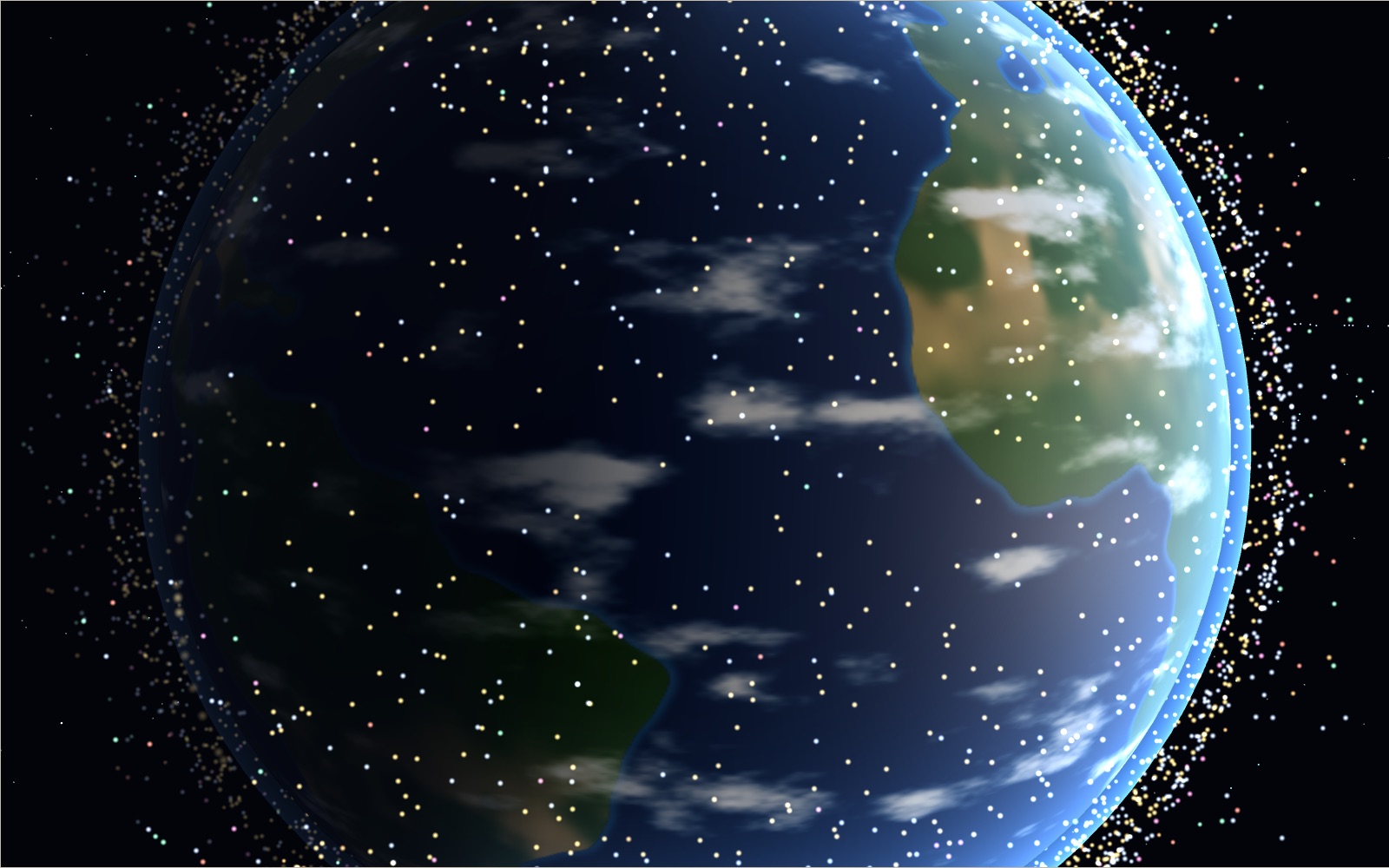
On 20 October 2026 the public catalogue listed 16,768 working satellites, and two in every three belonged to one company's internet network.
Powers of ten: from a proton to the observable universe
From inside a proton to the edge of the observable universe is 42 steps of ten.
Your weight and jump height on other planets and moons
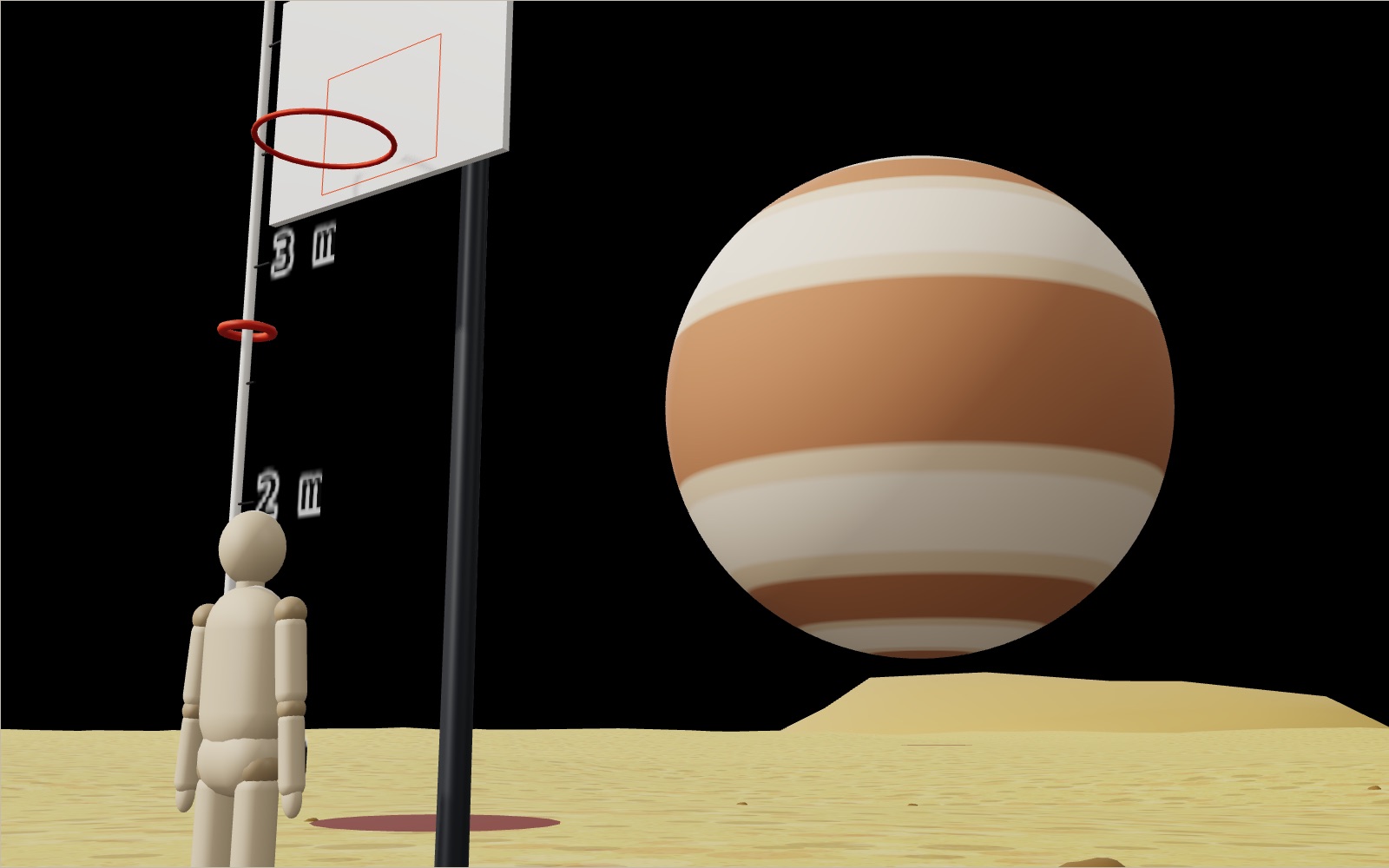
A 50 cm jump on Earth becomes a 3 m leap on the Moon, 18 m on Ceres and a one-way trip off asteroid Bennu.
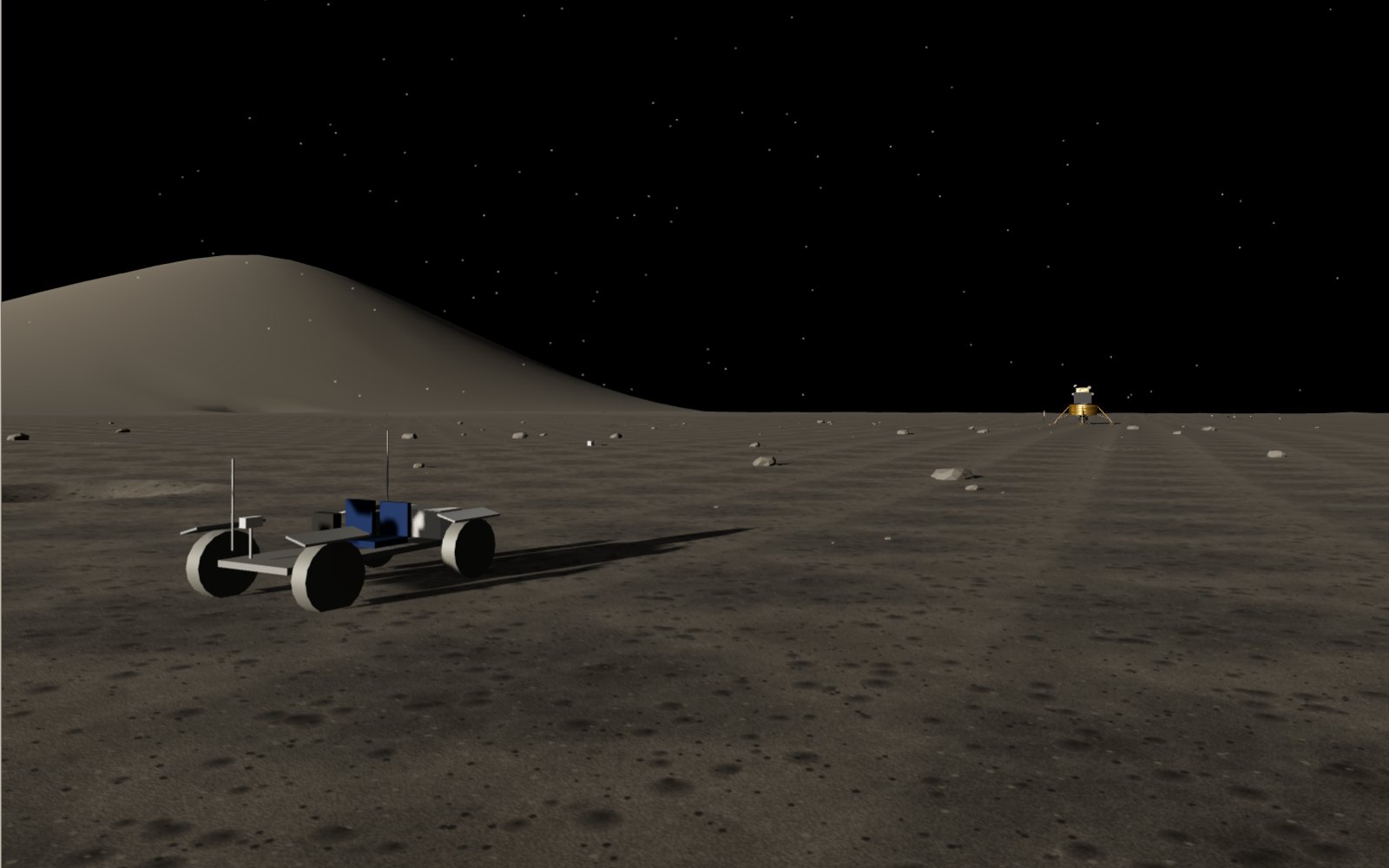
Walk the Apollo landing sites
Standing on the Moon with your eyes 1.6 m up, the horizon is only about 2.4 km away. All six Apollo landing sites are here, from Tranquility Base to Taurus-Littrow.
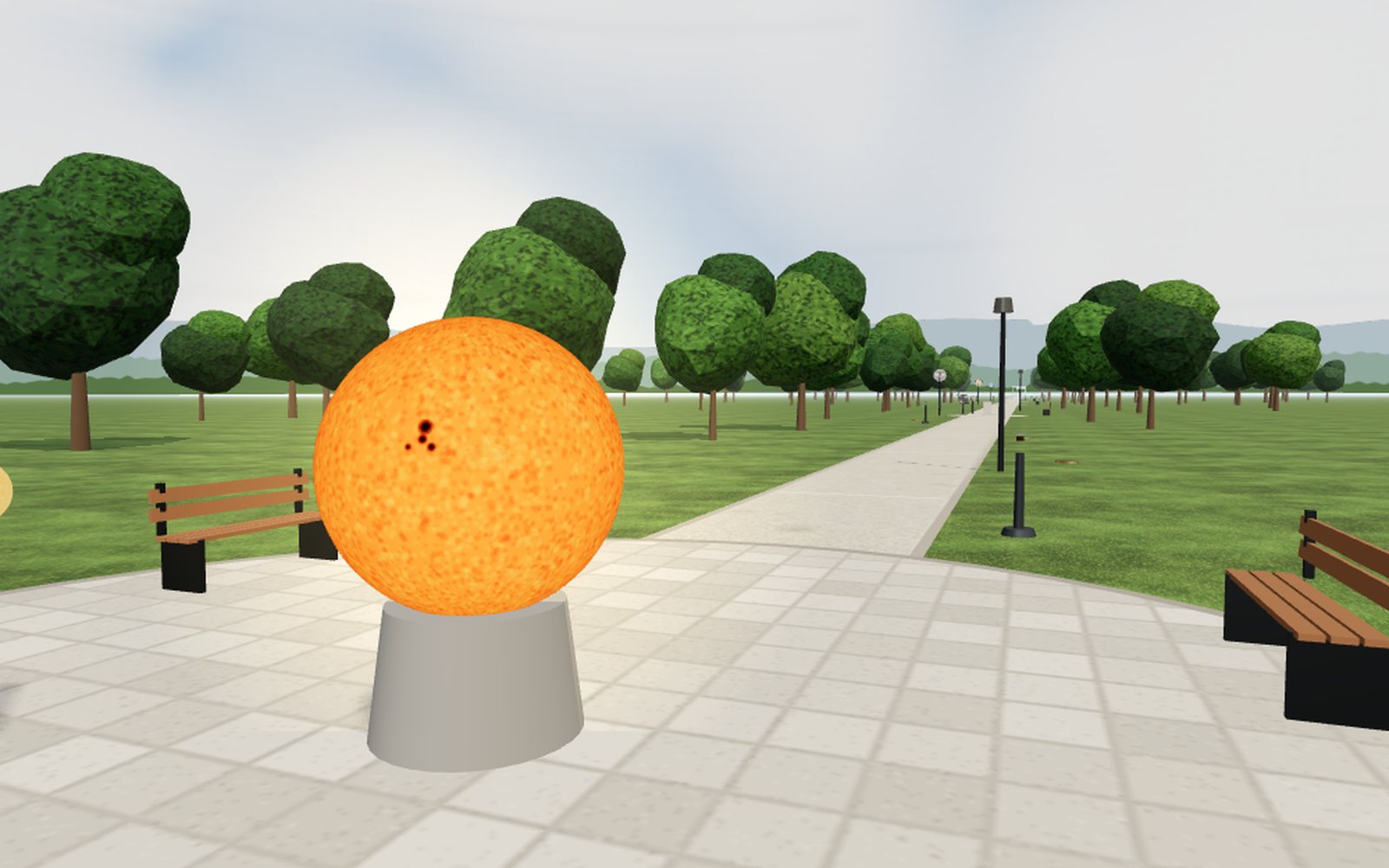
Solar system scale model measurements along a park walk
Shrink the Sun to a ball 1.39 m wide and Earth becomes a 1.27 cm marble 150 m down the path, Neptune is 4.5 km away and Voyager 1 would be 25.7 km.
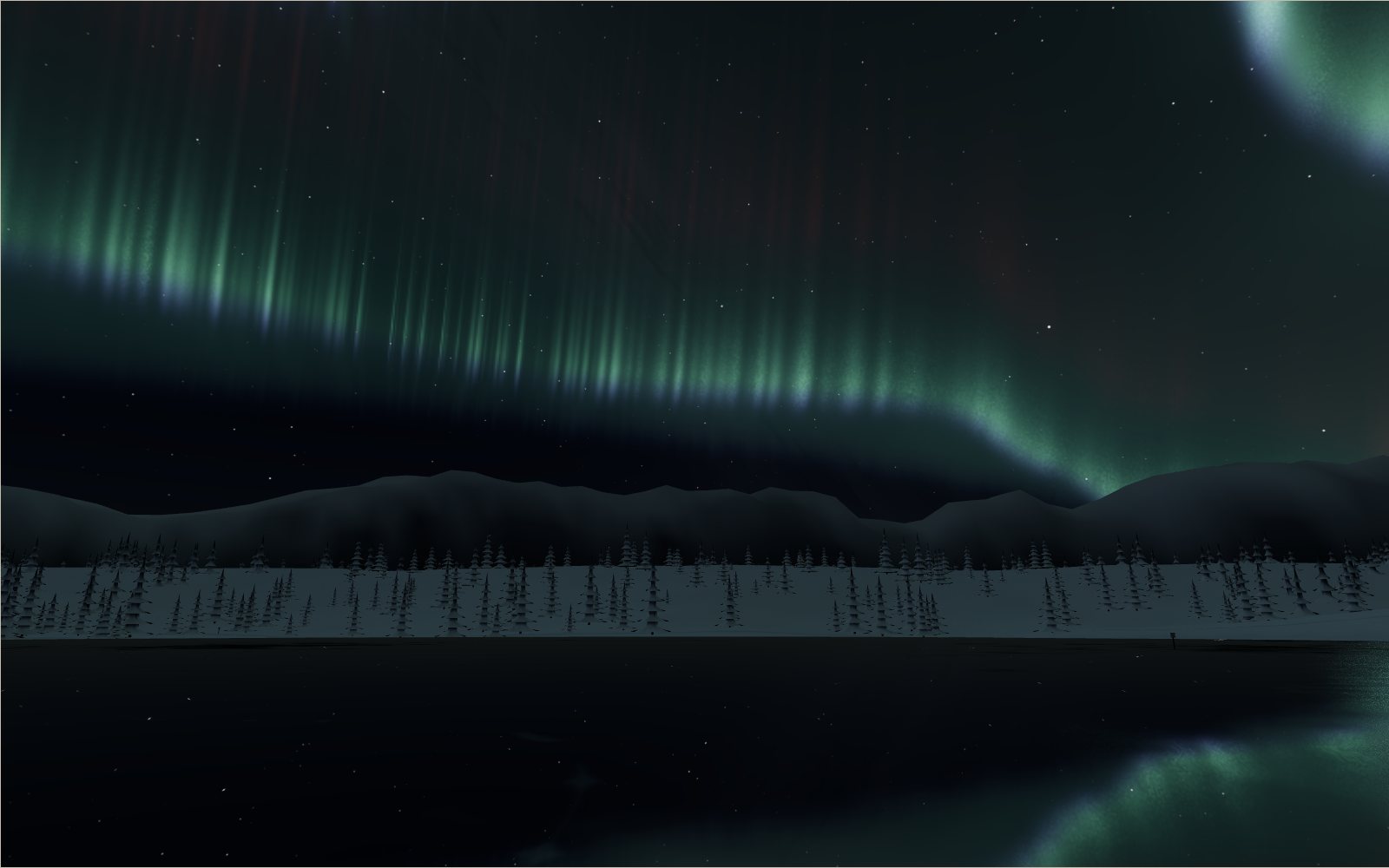
Northern lights over an Arctic village
The green of the northern lights comes from oxygen about 100 km up, and in the biggest storms the red glow above it can be seen as far south as Korea.