FIG. 30Senses
Your weight and jump height on other planets and moons
A 50 cm jump on Earth becomes a 3 m leap on the Moon, 18 m on Ceres and a one-way trip off asteroid Bennu.
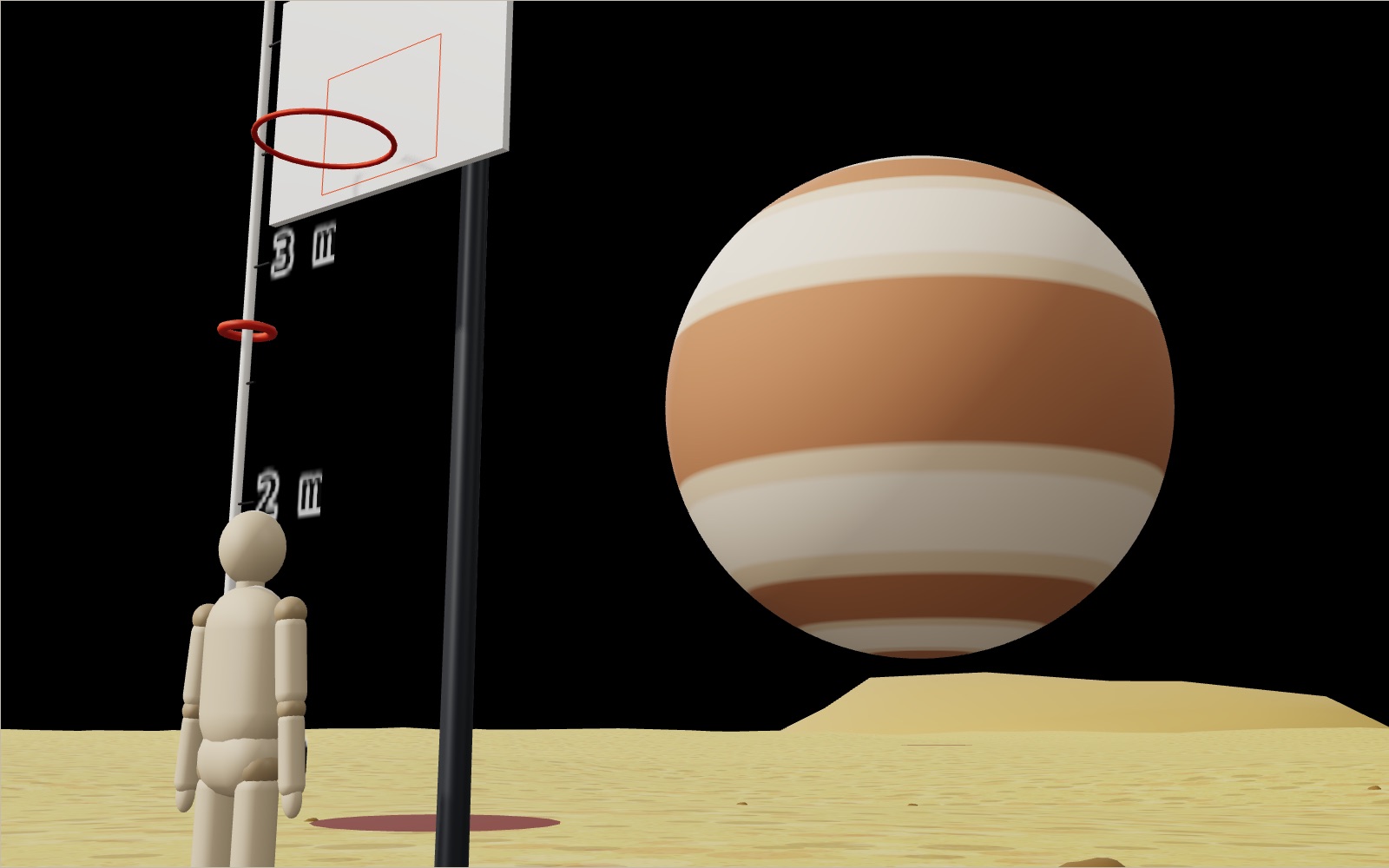
This device cannot show the 3D model. You can read the guide steps below as text.
1 / 16 One person, one scaleThe figure weighs 60 kg on Earth and jumps with a push that lifts it 0.5 m here. On every other world the same person and the same push are used, so only gravity changes. Type your own weight in the box on the stage.
Drag to turn. Scroll or pinch to zoom.
What a bathroom scale would say on Mars
Your weight changes on other planets and moons because their surface gravity differs, but your mass stays the same. With the same take-off speed, weaker gravity lets you jump higher and stay airborne longer. The exhibit compares these effects with Earth across its selected worlds.
Suppose you packed your bathroom scale for a trip to Mars. You step on it in the dust outside the lander, and a person who reads 60 kg at home now reads 22.7 kg. Nothing about your body has changed. You have the same bones, the same muscles and the same breakfast inside you. What changed is how hard the planet pulls on all of that.
This exhibit puts one plain mannequin on 24 worlds: the eight planets, the Moon, Phobos, four moons of Jupiter, Titan and Enceladus at Saturn, Triton at Neptune, the dwarf planets Pluto and Ceres, the asteroids Vesta, Bennu and Ryugu, comet 67P and, as a concept only, the visible surface of the Sun. Each world has its own ground and sky, drawn after the pictures landers and orbiters sent back, and the stage says which parts come from photographs and which are estimates.
Seven experiments run on whichever world you pick: a jump from a bathroom scale next to a basketball hoop, a 1 m drop with a feather, a throw, a pendulum, a pot of water heated until it boils, a parachute drop (or a pair of strapped-on wings) and a throw from the surface of a round model of the world to find its escape speed. The numbers come from NASA's planetary fact sheets, the Jet Propulsion Laboratory's tables of planets and moons, and papers written by the teams that flew the spacecraft.
Mass stays, weight changes
Your mass is the amount of matter in you, measured in kilograms. Your weight is the force with which a world pulls that mass down, measured in newtons:
W = m × g
Here g is the acceleration a falling object gets near the surface. At Earth's equator it is 9.80 m/s², so a 60 kg person weighs 60 × 9.80 = 588 N. On Mars, with 3.71 m/s², the same person weighs 223 N.
A home scale cannot show newtons in a way people would accept, so it is calibrated for Earth. It measures the push from your feet and divides by Earth's gravity. Carried to another world it simply shows
reading = Earth weight × g(world) / g(Earth)
That is the number on the little green display. Type your own weight into the box on the stage and every reading changes with it. The readout also gives the force in newtons, which is the honest physical quantity. While the figure is in the air the scale drops to 0.0, because nothing is pressing on it.
On the smallest worlds the readings become strange. On Bennu a 60 kg person reads half a gram, and on Ryugu just under one gram. The scale would need to be as sensitive as a kitchen balance for letters to show anything at all.
Where the gravity numbers come from
The exhibit does not copy a gravity figure from a table. It works it out from two measured numbers: the world's mass, written as GM (the gravitational constant times the mass, which is what spacecraft tracking actually measures), and its radius R:
g = GM / R²
For the planets and the dwarf planets the exhibit takes GM and the equatorial radius from JPL's table of planetary physical parameters, so its gravity matches the "equatorial gravity" column there: 3.70 m/s² for Mercury, 9.80 for Earth, 3.71 for Mars, 24.79 for Jupiter and 0.62 for Pluto. For the moons it uses GM and the mean radius from JPL's table of satellite parameters, and for the small bodies the values published by the Dawn, OSIRIS-REx, Hayabusa2 and Rosetta teams. Recomputing the density of every moon from these two numbers and comparing it with JPL's own column catches any typing slip.
This formula leaves out spin. A fast-spinning planet throws you outwards a little at its equator, and it bulges there, which moves its mass around. For small rocky worlds the effect is tiny: Earth's 9.80 m/s² becomes 9.78 m/s² once the spin is counted, which is the value in NASA's fact sheet. For the giants it is large. Jupiter turns once in 9.93 hours, and NASA gives 23.12 m/s² at its equator against the 24.79 m/s² of GM/R². The spin term ω²R plus the bulge term reproduces NASA's numbers for Earth, Jupiter, Saturn, Uranus and Neptune within 2 %. The stage shows the simpler GM/R² everywhere so that every world is treated the same way, and the article gives the spin-corrected value where it matters.
On the giants there is a further choice: where to stand. They have no surface, so the fact sheets give values at the "1 bar level", the height in the atmosphere where the pressure equals Earth's at sea level. The exhibit uses that level as the floor.
Why Saturn weighs you like Earth
Saturn has 95 times the mass of Earth, so it is natural to expect a crushing reading. The scale shows 63.9 kg for a 60 kg person, only about 7 % more than at home. Gravity falls with the square of distance from the centre, and Saturn's 1 bar level is 9.45 times farther from its centre than Earth's surface is from ours. Squaring that gives 89, so 95 times the mass spread over 89 times the area leaves the pull close to Earth's. With the spin counted it drops to 8.96 m/s², a little below Earth's.
Uranus (8.87 m/s²) and Neptune (11.15 m/s²) land close to Earth for the same reason. Jupiter is the only giant where you would feel clearly heavier, at 2.53 times your Earth weight.
The rule also works the other way. Ceres is 940 km wide, bigger than many countries, yet its gravity is only 2.7 % of Earth's. Its mass is small because it is small in every direction at once: halve a world's radius at the same density and its volume, and so its mass, falls eightfold, while the distance from the centre only halves. Surface gravity therefore grows in proportion to size for worlds of the same density.
24 worlds at a glance
The table uses a person who weighs 60 kg on Earth and jumps 0.5 m there.
| World | g (m/s²) | × Earth | Scale | Jump | Escape speed |
|---|---|---|---|---|---|
| Mercury | 3.70 | 0.378 | 22.7 kg | 1.32 m | 4.25 km/s |
| Venus | 8.87 | 0.905 | 54.3 kg | 55 cm | 10.4 km/s |
| Earth | 9.80 | 1 | 60 kg | 50 cm | 11.2 km/s |
| Moon | 1.62 | 0.166 | 9.9 kg | 3.02 m | 2.38 km/s |
| Mars | 3.71 | 0.379 | 22.7 kg | 1.32 m | 5.02 km/s |
| Phobos | 0.00577 | 0.00059 | 35 g | 919 m | 11.3 m/s |
| Jupiter (1 bar) | 24.8 | 2.53 | 152 kg | 20 cm | 59.5 km/s |
| Io | 1.80 | 0.183 | 11.0 kg | 2.73 m | 2.56 km/s |
| Europa | 1.31 | 0.134 | 8.1 kg | 3.73 m | 2.03 km/s |
| Ganymede | 1.43 | 0.146 | 8.8 kg | 3.43 m | 2.74 km/s |
| Callisto | 1.24 | 0.126 | 7.6 kg | 3.96 m | 2.44 km/s |
| Saturn (1 bar) | 10.4 | 1.07 | 63.9 kg | 47 cm | 35.5 km/s |
| Titan | 1.35 | 0.138 | 8.3 kg | 3.62 m | 2.64 km/s |
| Enceladus | 0.113 | 0.0116 | 0.70 kg | 43.2 m | 239 m/s |
| Uranus (1 bar) | 8.87 | 0.905 | 54.3 kg | 55 cm | 21.3 km/s |
| Neptune (1 bar) | 11.1 | 1.14 | 68.3 kg | 44 cm | 23.5 km/s |
| Triton | 0.781 | 0.0797 | 4.8 kg | 6.27 m | 1.45 km/s |
| Pluto | 0.616 | 0.0628 | 3.8 kg | 7.96 m | 1.21 km/s |
| Ceres | 0.269 | 0.0275 | 1.7 kg | 18.2 m | 510 m/s |
| Vesta | 0.253 | 0.0258 | 1.5 kg | 19.4 m | 364 m/s |
| Bennu | 0.0000814 | 0.0000083 | 0.5 g | leaves | 0.20 m/s |
| Ryugu | 0.000149 | 0.0000152 | 0.9 g | leaves | 0.37 m/s |
| Comet 67P | 0.000245 | 0.000025 | 1.5 g | leaves | 0.90 m/s |
| Sun (concept) | 274 | 28.0 | 1,679 kg | 1.8 cm | 618 km/s |
A larger version of this table, with fall times, pendulum swings and boiling points, sits under the controls, and pressing a row takes you to that world.
Moons that keep a planet in the sky
Most of the moons here turn once for every trip around their planet, so they always show it the same face. Stand on the near side and the planet hangs in one spot in the sky, never rising or setting, while the Sun and the stars move behind it.
How big it looks depends on its size and its distance. For a planet of radius R seen from a distance d from its centre, the angular diameter is 2 × arcsin(R / d). From the Moon, Earth is 1.91° across, nearly four times the width of a full Moon in our own sky. From Io, Jupiter is 19.6° across, about the width of your outstretched hand at arm's length. From Europa it is 12.3°, from Ganymede 7.7° and from Callisto 4.4°. From Enceladus, Saturn spans 29°. Its rings lie in the same plane as the moon's orbit, so they are seen edge on, as a thin line through the planet. From Triton, Neptune is 8° wide.
The biggest of all is Mars from Phobos. Phobos orbits only 9,376 km from the centre of Mars, and from its near side Mars covers 42° of the sky, about 80 full Moons side by side. Pluto and Charon are locked to each other, so from one side of Pluto, Charon hangs still at 3.8° and from the other side it is never seen. Titan is the exception on the stage: Saturn would be 5.7° wide in its sky, but the orange haze hides it, as it does in every picture the Huygens probe took.
The Sun is drawn at its true angular size too. NASA gives it a radius of 695,700 km, so it is 0.53° wide from Earth, 1.38° from Mercury and 0.018° from Neptune, too small to see as a disc. Its light falls off with the square of the distance: 1,361 W/m² at Earth, 50 W/m² at Jupiter, 0.87 W/m² at Pluto. The stage does not show the true dimming, which would leave the outer worlds black on a screen. It scales the light by the logarithm of these values and draws a halo around small suns so you can find them.
Which grounds are photographed and which are guessed
A world's ground and sky are only drawn from a photograph where a camera has stood on that world, or flown down through its air. That is a short list: Earth, the Moon (Apollo), Mars (Viking, Pathfinder, Curiosity, Perseverance), Venus (Venera 13 and 14), Titan (Huygens), Ryugu (the MINERVA-II1 rovers and the MASCOT lander), Bennu (close-ups taken during the OSIRIS-REx sample grab) and comet 67P (Philae and Rosetta's last descent).
Everywhere else the ground is an estimate based on pictures taken from orbit or during a flyby, and the readout says so. Io is drawn as yellow and orange sulfur with dark lava spots after Voyager and Galileo images. Europa is bright ice crossed by brown ridges. Ganymede has dark old ground and lighter grooved ice, Callisto is dark and cratered with bright frost on the rims. Enceladus is white ice with blue cracks. Triton has pink and grey nitrogen frost with dark streaks left by geysers. Pluto has cells of nitrogen ice and reddish ground. Ceres and Vesta follow the Dawn orbiter's views.
The sky follows physics where there are no pictures. A world without air has a black sky even at noon, as Apollo photographs show for the Moon. Venus's sky is yellow-orange in the Venera colour pictures, and the Sun cannot be seen through the cloud. Titan's is orange haze. Mars's sky is butterscotch by day, and around the setting Sun it turns blue: the fine dust scatters blue light forward, close to the direction of the Sun, which Curiosity photographed in 2015. Pluto's thin air holds layers of haze that glowed blue when New Horizons looked back at them against the Sun.
The giant planets have no ground at all, and no camera has ever looked around from inside their clouds. On those four the figure stands on a dashed, see-through deck at the 1 bar level, with deeper cloud below and haze above, in colours taken from pictures shot from above. The deck makes the experiments possible. It does not exist, and someone standing there would just keep sinking.
Small worlds curve away under your feet
On a ball of radius R, an eye at height h sees the horizon at a distance of about √(2Rh). For a standing person with eyes 1.7 m up that is 4.7 km on Earth, 2.4 km on the Moon, 1.3 km on Ceres and only 29 m on Bennu. The stage draws the smallest worlds (Phobos, Bennu, Ryugu and comet 67P) as real spheres of their true size, so the ground visibly bends away a few steps from the figure. Comet 67P is actually shaped like a rubber duck about 4 km long; the model rounds it into a ball of the same volume.
Bennu and Ryugu are piles of rubble held together by their own weak gravity, and they spin fast. Bennu turns once in 4.3 hours and Ryugu in 7.6 hours, quickly enough that at the equator the spin cancels a good share of the pull. The exhibit leaves the spin out, so its numbers for these two describe gravity alone.
The same jump on every world
A standing jump is a short push. Your legs straighten and your body leaves the ground at some speed v. After that only gravity acts, and the body rises until that speed is used up. Near the ground the height is
h = v² / (2g)
The model assumes the figure clears 0.50 m on Earth. Working backwards, v = √(2 × 9.80 × 0.50) = 3.13 m/s. The exhibit keeps that take-off speed on every world, so the height scales with 1/g: 3.02 m on the Moon, 1.32 m on Mars, 7.96 m on Pluto, 18.2 m on Ceres and 20 cm at Jupiter's 1 bar level. The jump power slider changes the Earth jump from 2 cm to 1 m, and the blue ring on the pole always marks the Earth height while the orange ring marks this world's.
On the small worlds the simple formula is not good enough, because gravity weakens as you rise. Energy gives the exact answer: the jump stops where v²/2 = GM(1/R − 1/(R+h)), which solves to
h = R²v² / (2GM − Rv²)
On Phobos this gives 919 m instead of 847 m, and the time in the air comes out at about 20 minutes. The stage plays long flights faster and says by how much. If v is greater than the escape speed, the denominator turns negative and there is no top at all. On Bennu, Ryugu and comet 67P that is what happens: an ordinary Earth jump of 3.1 m/s is many times their escape speeds of 0.2, 0.37 and 0.9 m/s, so the figure rises and never comes back.
The time in the air is 2v/g near the ground: 0.64 s on Earth, 3.85 s on the Moon and 10.2 s on Pluto. For the exact case the exhibit treats the flight as a straight-up orbit and uses Kepler's equation, and a step-by-step simulation agrees with it.
Keeping the take-off speed fixed is a simplification. Real legs push against your own weight, so on a light world they might launch you a little faster, and on Jupiter you might not manage 3.13 m/s at all. Apollo astronauts also found that a stiff, pressurised suit and a heavy backpack made jumping awkward, and most of them moved in a loping run rather than high leaps. The model shows the role of g, not a forecast of anyone's athletics.
Reaching a basketball rim
The hoop next to the figure has its rim at the regulation 3.05 m. The model's figure, 1.72 m tall, reaches 2.24 m with one arm raised, so on Earth an ordinary 0.5 m jump leaves the hand 31 cm short.
Which is the heaviest world where the same jump does touch the rim? The hand has to rise 0.81 m, and the take-off speed of 3.13 m/s reaches that height wherever g is below about 6.0 m/s². That rules out Venus, Earth and the four giants. Of the rest, the strongest gravity belongs to Mars at 3.713 m/s², by a hair over Mercury at 3.699 m/s². One of the tasks under the controls asks you to find it.
Dropping a ball and a feather
The drop stand releases three things from 1 m: a red ball that falls under the chosen world's gravity, a blue ball that falls as it would on Earth, and a feather. With no air the distance fallen after time t is g t² / 2, so the time to fall a height h is
t = √(2h / g)
On Earth that is 0.45 s. On the Moon it is 1.11 s, on Pluto 1.80 s, and at Jupiter's 1 bar level 0.28 s, quicker than the Earth ball. On Bennu a ball would take two and a half minutes to fall 1 m.
Mass does not appear in the formula, so where there is no air a feather falls with the balls. At the end of the last Apollo 15 moonwalk in 1971, David Scott dropped a 1.32 kg aluminium hammer and a falcon feather from about 1.6 m, and they landed together. The formula gives 1.40 s for that drop.
Air changes the feather completely. A feather is light for its size, so drag soon balances its weight and it drifts at a steady speed. The model gives it a terminal speed of 0.6 m/s in Earth air and scales the drag with the air's density. With quadratic drag the time to fall a height h is
t = arccosh(e^(k h)) / √(g k), where k is the drag per metre, proportional to the air density.
On Earth the feather takes 1.7 s to fall 1 m. On Titan, where the air is four times as dense and gravity is weak, it takes about 9 s. On Venus, with air 53 times as dense as ours, it drifts for nearly 13 s. On Mars the air is so thin that the feather falls almost as fast as the ball. The red ball also feels buoyancy: a baseball is 683 kg/m³, and in Venus's 65 kg/m³ air it loses 9.5 % of its weight.
Throwing a ball
In vacuum a thrown ball follows a parabola, and on flat ground its range is v² sin(2θ) / g. Throw at 20 m/s and 45° and the ball flies 248 m on the Moon, 1.5 km on Ceres and only 18 m at Jupiter's 1 bar level.
Air shortens every throw. The model throws a baseball (145 g, 7.3 cm wide) and adds a drag force ½ ρ C A v² with a drag coefficient of 0.35, plus buoyancy, and steps the flight forward in small time steps. On Earth the 20 m/s throw lands at 36 m instead of 43 m. On Titan it reaches 56 m instead of nearly 300 m. On Venus it falls after 6 m: the air there is so dense that the ball behaves more like a stone tossed into a swimming pool. The dashed blue curve on the stage is the same throw on Earth.
On small worlds the ground is no longer flat over the length of a throw. Where a throw would cover more than a small fraction of the world's radius, the exhibit switches to the same orbital calculation it uses for escape, and the readout suggests the Escape scene. Apollo crews saw clean ballistic arcs on the Moon for themselves: the dust thrown up by the Lunar Roving Vehicle's wheels flew in sharp curves and fell straight back, with no air to hold it in a cloud.
A pendulum that keeps another planet's time
A pendulum of length L swings from one side to the other in
t = π √(L / g)
The weight of the bob does not appear, which is why pendulums made good clocks. On Earth a pendulum 99 cm long swings once a second, the classic seconds pendulum of a grandfather clock. On Mars the same one-second swing needs a pendulum only 38 cm long, and on the Moon 16 cm.
Take a grandfather clock from Earth to the Moon and its pendulum slows to 2.47 s per swing. The clock counts only 41 % of the real seconds, so it loses about 14 hours a day. On Mars it would lose about 9 hours, and on Jupiter it would gain. The stage swings a red pendulum on the chosen world next to a blue pendulum of the same length under Earth gravity.
Spacecraft measure gravity in far more precise ways, but the idea is the same: the way a test mass moves tells you the local g. The GRAIL mission mapped the Moon's gravity by tracking two spacecraft flying in line, and Juno's radio tracking measured Jupiter's gravity field closely enough to show that its winds reach about 3,000 km down.
Where water boils
Water boils when its vapour pressure, the pressure of the steam it gives off, matches the pressure of the air above it. Lower the air pressure and water boils at a lower temperature. The exhibit uses the international industrial formulation for water and steam (IAPWS-IF97), which gives the boiling point at any pressure between the triple point and the critical point. It agrees with steam tables and with the Clausius-Clapeyron equation,
ln(p₂/p₁) = −(L/R)(1/T₂ − 1/T₁),
which says how the boiling point moves with pressure when the heat of vaporisation L is known.
The results are the most surprising numbers in the exhibit:
- Earth at sea level: 100.0 °C. At 5 km up, 83 °C. On the summit of Everest, about 70 °C.
- Venus: the air presses 92 times as hard as ours, so water only boils at 305 °C. The ground is 464 °C, so any water there boils away at once.
- Titan: 1.467 bar, so water boils at 111 °C. That hardly matters, because the air is −179 °C and water is as hard as rock.
- Mars: the average pressure is 636 Pa, only about 25 Pa above water's triple point of 611.657 Pa. Water there boils at about half a degree Celsius. On high ground, where the pressure is lower, it cannot exist as a liquid at all: ice turns straight to vapour, which the Phoenix lander watched happen in 2008.
- The Moon, Mercury, the airless moons and the small bodies: below the triple point there is no liquid water. A pot of water would boil and freeze at the same time.
The height slider carries the pot up through the air. On Earth the pressure falls to 4.2 kPa at about 21.7 km, and there water boils at 30 °C. The exhibit uses the US Standard Atmosphere of 1976 for Earth and the Venus International Reference Atmosphere for Venus, both built from measurements. For the other worlds it assumes a single scale height, so their numbers high up are rough.
At about 19 km on Earth the pressure falls to 6.3 kPa, where water boils at body temperature, 37 °C. Above that height, sometimes called the Armstrong limit, exposed body fluids would start to boil, which is why high-altitude pilots wear pressure suits. Mars's whole surface lies far below that pressure.
Parachutes in thin and thick air
A falling body speeds up until air drag balances its weight. That terminal speed is
v = √(2 m g / (ρ C A))
where ρ is the air density, A the area and C the drag coefficient. The exhibit drops the figure, plus 20 kg of suit and harness, from 30 m under a round canopy with C = 0.8 and works out the landing speed exactly.
Weak gravity and dense air both help. On Titan a canopy only 2 m wide brings the figure down at 3.6 m/s, a gentle step off a chair. The same canopy on Earth gives 17.6 m/s. On Venus the air is so thick that even no parachute at all would leave you at 5.6 m/s after 30 m: Venera 13 threw away its parachute about 47 km up and finished its descent with only a disc-shaped airbrake.
Mars is the hard case. Its gravity is a third of Earth's, but its air is about 75 times thinner. A 20 m canopy still leaves the figure falling at 12 m/s at its terminal speed. That is why Mars landers have all needed rockets, airbags or a sky crane as well as a parachute: Perseverance's parachute was 21.5 m across and still could not finish the job.
On worlds without air the canopy hangs limp and the figure falls as it would in vacuum. On the giant planets a parachute works, but there is no ground to land on: the Galileo probe opened its parachute in Jupiter's air in 1995 and sent data for 58 minutes, until the pressure reached about 23 bar and the probe fell silent.
Flying with your own muscles
To hover, wings must push air down hard enough to carry your weight. Momentum theory, the same reasoning used for helicopter rotors, gives the least power needed for a disc of area A:
P = (m g)^1.5 / √(2 ρ A)
The exhibit treats the wings as a disc as wide as their span and divides by 0.6 for real-world losses. With 4 m wings and 80 kg, hovering on Earth takes about 6,600 W, far beyond the roughly 200 W a fit person can keep up. On Mars, where the air is thin, it takes even more, about 13,500 W. On Titan it takes only about 160 W. Weak gravity enters as g^1.5 and dense air as 1/√ρ, and together they cut the effort about 40 times compared with Earth.
That is why NASA chose a rotorcraft, Dragonfly, to explore Titan. On Mars the Ingenuity helicopter needed rotors 1.2 m across spinning at about 2,400 revolutions a minute to lift its 1.8 kg in air that thin. It made the first powered flight on another planet on 19 April 2021 and flew 72 times.
Escape speed and orbits
Throw a ball fast enough and it never comes back. The escape speed from the surface of a round world is
v_esc = √(2 G M / R)
It is 11.2 km/s for Earth, 2.38 km/s for the Moon and 59.5 km/s for Jupiter. For Bennu it is 0.20 m/s, slower than a slow walk. Anything that falls onto a world from far away arrives at least that fast, which is why the fragments of comet Shoemaker-Levy 9 hit Jupiter at about 60 km/s in 1994.
There is a second speed, v_orb = √(G M / R), the speed of an orbit that skims the surface. A ball thrown horizontally at that speed falls around the world as fast as the ground curves away beneath it, and comes back to the thrower from behind one orbit later. For Earth that is 7.9 km/s and about 85 minutes (the model ignores the air). For Bennu it is 14 cm/s and about three hours.
The escape scene shrinks the world to a ball and draws the path to the same scale. The ball falls back, goes round, or leaves. The throw speed slider runs from 2 cm/s to 70 km/s on a logarithmic scale, and the angle slider sets the direction. The path is worked out step by step with gravity weakening as 1/r², and the outcome comes from the exact energy of the throw. A person can throw a ball at perhaps 40 m/s, enough to leave Bennu, Ryugu, comet 67P and Phobos, but not Vesta (364 m/s) or Ceres (510 m/s).
Spacecraft have run into exactly this. When the Philae lander touched down on comet 67P in 2014 its harpoons did not fire, and it bounced back up at 38 cm/s, well under the comet's escape speed of about 0.9 m/s. It flew for 1 hour 50 minutes, travelled about 1 km and then made a second, smaller hop before coming to rest. On Ryugu, the MINERVA-II1 rovers were built to hop, because wheels would lift them off the ground; a single hop could keep one in the air for up to 15 minutes.
Without a suit
The space suit switch dresses the figure and adds a line about what would happen without one, with a link to the exhibit on space without a suit. On airless worlds a person would lose consciousness in about 15 seconds. On Mars the air is far too thin to breathe, and well below the 6.3 kPa at which body fluids boil. On Venus the pressure and heat would crush and cook. Titan is the odd one out: the pressure is bearable, only 1.45 times Earth's, but there is no oxygen and the air is −179 °C. Earth is the only world on the list where you could step out as you are.
The Sun as a world
The Sun has no surface. What looks like one is the photosphere, the layer where the gas becomes thin enough for light to escape, at about 5,500 °C (NASA gives an effective temperature of 5,772 K). The exhibit includes it as a concept only, to show what gravity alone would do there: 274 m/s², 28 times Earth's. A 60 kg person would read 1,679 kg on the scale, the 0.5 m jump would reach 1.8 cm, and a ball would fall 1 m in 0.085 s. The escape speed is 618 km/s. The closest anything built by people has come is Parker Solar Probe, which passed 6.1 million km from the photosphere on 24 December 2024 at about 192 km/s.
What the model leaves out
- Spin, except where the article quotes it. Gravity is
GM/R²at the equatorial radius for planets and the mean radius for moons and small bodies. - Irregular shapes. Phobos, Vesta, Bennu, Ryugu and comet 67P are drawn as spheres, and their gravity varies from place to place.
- Tides. On Phobos the pull of Mars cancels part of the moon's own gravity, very unevenly.
- Drag on the jumping figure, and the effect of a suit on how a person moves.
- Air above the ground on most worlds: only Earth and Venus have measured profiles; the rest use one scale height.
- Real places. Rocks, craters, ridges and plumes are placed at random and coloured after spacecraft images. The plumes on Io and Enceladus are left out, and those on Triton and comet 67P are drawn far shorter than the real ones, which rise kilometres high.
- Model values: the 0.5 m Earth jump, the feather's 0.6 m/s, the baseball's drag coefficient of 0.35, the canopy's 0.8, the 20 kg of gear, the wings' 0.6 efficiency and the 200 W a person can keep up.
Questions
Does my mass change on another planet?
No. Mass is the amount of matter in you and stays the same everywhere. Weight, the force of gravity on that mass, changes with the world's surface gravity. A 60 kg person has a mass of 60 kg on Mars, but a scale calibrated on Earth shows 22.7 kg.
How much would I weigh on the Moon?
About one sixth of your Earth weight. Lunar gravity is 1.62 m/s² against Earth's 9.80, so a person who reads 60 kg at home reads 9.9 kg on the Moon. Your mass is unchanged.
Why is Saturn's gravity close to Earth's when it is so massive?
Saturn has 95 times Earth's mass, but its 1 bar level is 9.45 times farther from the centre than Earth's surface. Gravity falls with the square of distance, which divides by 89 and leaves the pull only about 7 % above Earth's, or a little below once Saturn's fast spin is counted.
Can you stand on Jupiter?
No. Jupiter, Saturn, Uranus and Neptune have no solid surface; their gas thickens with depth into hot, dense fluid. The exhibit puts an imaginary deck at the 1 bar level, the height where the pressure equals Earth's at sea level.
How high could I jump on Mars?
About 2.6 times as high as on Earth, if your legs push off at the same speed. A 0.5 m jump on Earth becomes 1.32 m on Mars and lasts 1.69 s instead of 0.64 s. In a real space suit it would be less.
Could you jump off an asteroid into space?
On small ones, yes. Bennu's escape speed is 0.20 m/s, Ryugu's 0.37 m/s and comet 67P's about 0.9 m/s. An ordinary standing jump leaves the ground at about 3 m/s, many times faster, so you would never come down. On Ceres (510 m/s) or Vesta (364 m/s) you would land again after a jump of about 20 m.
Would a feather fall like a hammer on the Moon?
Yes. There is no air on the Moon to slow the feather. David Scott showed this on Apollo 15 in 1971 by dropping a hammer and a falcon feather together; they landed at the same moment.
Why is the Martian sunset blue?
Fine dust in the Martian air scatters blue light forward, close to the direction of the Sun, while the rest of the sky stays butterscotch. Curiosity photographed the blue glow around the setting Sun in Gale Crater in 2015.
At what temperature does water boil on Mars?
At the average surface pressure of 636 Pa it boils at about half a degree Celsius, barely above freezing. On high ground the pressure falls below water's triple point (611.657 Pa) and liquid water cannot exist at all; ice turns straight into vapour.
Could a parachute work on Mars?
Only partly. Mars's air is about 75 times thinner than Earth's at the surface, so even a 20 m canopy leaves a person falling at about 12 m/s. Every Mars lander has also needed rockets, airbags or a sky crane. On Titan, by contrast, a 2 m canopy is enough for a soft landing.
Could people fly on Titan?
According to momentum theory, yes. Titan's air is four times as dense as Earth's and its gravity is a seventh of ours, so hovering with 4 m wings takes about 160 W, an effort a fit person can keep up. On Earth the same wings would need about 6,600 W.
How fast would you need to throw a ball to leave the Moon?
At 2.38 km/s, the Moon's escape speed, about seven times the speed of sound in Earth's air. Throwing it horizontally at 1.68 km/s would put it in an orbit that skims the surface and returns after about 1 hour 48 minutes.
Why is a day on Mercury longer than its year?
Mercury turns once every 58.6 Earth days, but it also moves fast along its 88 day orbit. The two motions combine so that sunrise to sunrise takes 176 Earth days, about two Mercury years.
What does the sky look like from Io?
Black, because Io has almost no air, with Jupiter hanging still at 19.6° across, about 38 times the width of our full Moon. Io keeps one face to Jupiter, so from the near side the planet never rises or sets.
Terms
- Mass: the amount of matter in an object, in kilograms. The same on every world.
- Weight: the force of gravity on a mass, in newtons.
W = m × g. - Surface gravity (g): the acceleration of a falling object near the surface, in m/s².
- GM: the gravitational constant times a body's mass, the quantity spacecraft tracking measures directly.
- 1 bar level: the height in a giant planet's atmosphere where the pressure equals Earth's at sea level. Used as a stand-in for a surface.
- Escape speed: the launch speed from the surface at which an object never falls back,
√(2GM/R). - Terminal speed: the steady speed at which air drag balances weight.
- Triple point: the pressure and temperature (611.657 Pa, 0.01 °C) below which water cannot exist as a liquid.
- Scale height: the height over which air pressure falls by a factor of e (about 2.7).
- Angular diameter: how wide an object looks, as an angle.
Sources
All addresses checked on 2026-10-18.
- NASA Goddard Space Flight Center, National Space Science Data Center (NSSDCA), Planetary Fact Sheet, metric. https://nssdc.gsfc.nasa.gov/planetary/factsheet/
- NSSDCA, Planetary Fact Sheet notes (definitions of gravity, length of day and the 1 bar level). https://nssdc.gsfc.nasa.gov/planetary/factsheet/planetfact_notes.html
- NSSDCA, Venus Fact Sheet. https://nssdc.gsfc.nasa.gov/planetary/factsheet/venusfact.html
- NSSDCA, Earth Fact Sheet. https://nssdc.gsfc.nasa.gov/planetary/factsheet/earthfact.html
- NSSDCA, Moon Fact Sheet. https://nssdc.gsfc.nasa.gov/planetary/factsheet/moonfact.html
- NSSDCA, Mars Fact Sheet. https://nssdc.gsfc.nasa.gov/planetary/factsheet/marsfact.html
- NSSDCA, Jupiter Fact Sheet. https://nssdc.gsfc.nasa.gov/planetary/factsheet/jupiterfact.html
- NSSDCA, Saturn Fact Sheet. https://nssdc.gsfc.nasa.gov/planetary/factsheet/saturnfact.html
- NSSDCA, Uranus Fact Sheet. https://nssdc.gsfc.nasa.gov/planetary/factsheet/uranusfact.html
- NSSDCA, Neptune Fact Sheet. https://nssdc.gsfc.nasa.gov/planetary/factsheet/neptunefact.html
- NSSDCA, Pluto Fact Sheet. https://nssdc.gsfc.nasa.gov/planetary/factsheet/plutofact.html
- NSSDCA, Sun Fact Sheet. https://nssdc.gsfc.nasa.gov/planetary/factsheet/sunfact.html
- NSSDCA, The Apollo 15 Hammer-Feather Drop. https://nssdc.gsfc.nasa.gov/planetary/lunar/apollo_15_feather_drop.html
- JPL Solar System Dynamics, Planetary Physical Parameters. https://ssd.jpl.nasa.gov/planets/phys_par.html
- JPL Solar System Dynamics, Planetary Satellite Physical Parameters. https://ssd.jpl.nasa.gov/sats/phys_par/
- JPL Small-Body Database, 4 Vesta (GM and diameter from Park et al. 2025). https://ssd.jpl.nasa.gov/tools/sbdb_lookup.html#/?sstr=4
- Park, R. S. et al. (2016), A partially differentiated interior for (1) Ceres deduced from its gravity field and shape, Nature 537, 515. https://doi.org/10.1038/nature18955
- Scheeres, D. J. et al. (2019), The dynamic geophysical environment of (101955) Bennu based on OSIRIS-REx measurements, Nature Astronomy 3, 352. https://doi.org/10.1038/s41550-019-0721-3
- Lauretta, D. S. et al. (2022), Spacecraft sample collection and subsurface excavation of asteroid (101955) Bennu, Science 377, 285. https://doi.org/10.1126/science.abm1018
- Watanabe, S. et al. (2019), Hayabusa2 arrives at the carbonaceous asteroid 162173 Ryugu, Science 364, 268. https://doi.org/10.1126/science.aav8032
- JAXA Hayabusa2 project, The small exploration rovers, MINERVA-II1 (2018). https://www.hayabusa2.jaxa.jp/en/topics/20180919e
- Paetzold, M. et al. (2016), A homogeneous nucleus for comet 67P/Churyumov-Gerasimenko from its gravity field, Nature 530, 63. https://doi.org/10.1038/nature16535
- Jorda, L. et al. (2016), The global shape, density and rotation of Comet 67P/Churyumov-Gerasimenko from preperihelion Rosetta/OSIRIS observations, Icarus 277, 257. https://doi.org/10.1016/j.icarus.2016.05.002
- ESA Operations, Rosetta (Philae touchdowns). https://www.esa.int/Enabling_Support/Operations/Rosetta
- Fulchignoni, M. et al. (2005), In situ measurements of the physical characteristics of Titan's environment, Nature 438, 785. https://doi.org/10.1038/nature04314
- Tomasko, M. G. et al. (2005), Rain, winds and haze during the Huygens probe's descent to Titan's surface, Nature 438, 765. https://doi.org/10.1038/nature04126
- Seiff, A. et al. (1985), Models of the structure of the atmosphere of Venus from the surface to 100 kilometers altitude, Advances in Space Research 5(11), 3. https://doi.org/10.1016/0273-1177(85)90197-8
- NOAA, NASA and US Air Force (1976), U.S. Standard Atmosphere, 1976. https://ntrs.nasa.gov/citations/19770009539
- IAPWS R7-97(2012), Revised Release on the IAPWS Industrial Formulation 1997 for the Thermodynamic Properties of Water and Steam. http://www.iapws.org/relguide/IF97-Rev.html
- Siddiqi, A. A. (2002), Deep Space Chronicle, NASA SP-2002-4524 (Venera landers). https://www.nasa.gov/wp-content/uploads/2023/04/sp-4524.pdf
- NASA Science, Galileo Jupiter Atmospheric Probe. https://science.nasa.gov/mission/galileo-jupiter-atmospheric-probe
- NASA Science, Ingenuity Mars Helicopter. https://science.nasa.gov/mission/mars-2020-perseverance/ingenuity-mars-helicopter/
- NASA Science, Mars 2020: Perseverance rover. https://science.nasa.gov/mission/mars-2020-perseverance/
- NASA Science, Dragonfly mission. https://science.nasa.gov/mission/dragonfly/
- NASA JPL, Bright chunks at Phoenix lander's Mars site must have been ice (2008). https://www.jpl.nasa.gov/news/bright-chunks-at-phoenix-landers-mars-site-must-have-been-ice/
- NASA Science, What do sunrises and sunsets look like on Mars? https://science.nasa.gov/solar-system/planets/mars/what-does-a-sunrise-sunset-look-like-on-mars/
- Zuber, M. T. et al. (2013), Gravity field of the Moon from the Gravity Recovery and Interior Laboratory (GRAIL) mission, Science 339, 668. https://doi.org/10.1126/science.1231507
- Iess, L. et al. (2018), Measurement of Jupiter's asymmetric gravity field, Nature 555, 220. https://doi.org/10.1038/nature25776
- Porco, C. C. et al. (2006), Cassini observes the active south pole of Enceladus, Science 311, 1393. https://doi.org/10.1126/science.1123013
- Stern, S. A. et al. (2015), The Pluto system: Initial results from its exploration by New Horizons, Science 350. https://doi.org/10.1126/science.aad1815
- NASA Science, Comet Shoemaker-Levy 9. https://science.nasa.gov/solar-system/comets/p-shoemaker-levy-9/
- NASA Scientific Visualization Studio, Parker Solar Probe extended mission (2025). https://svs.gsfc.nasa.gov/5534
- NASA, Apollo Lunar Surface Journal. https://www.nasa.gov/history/alsj/
More exhibits
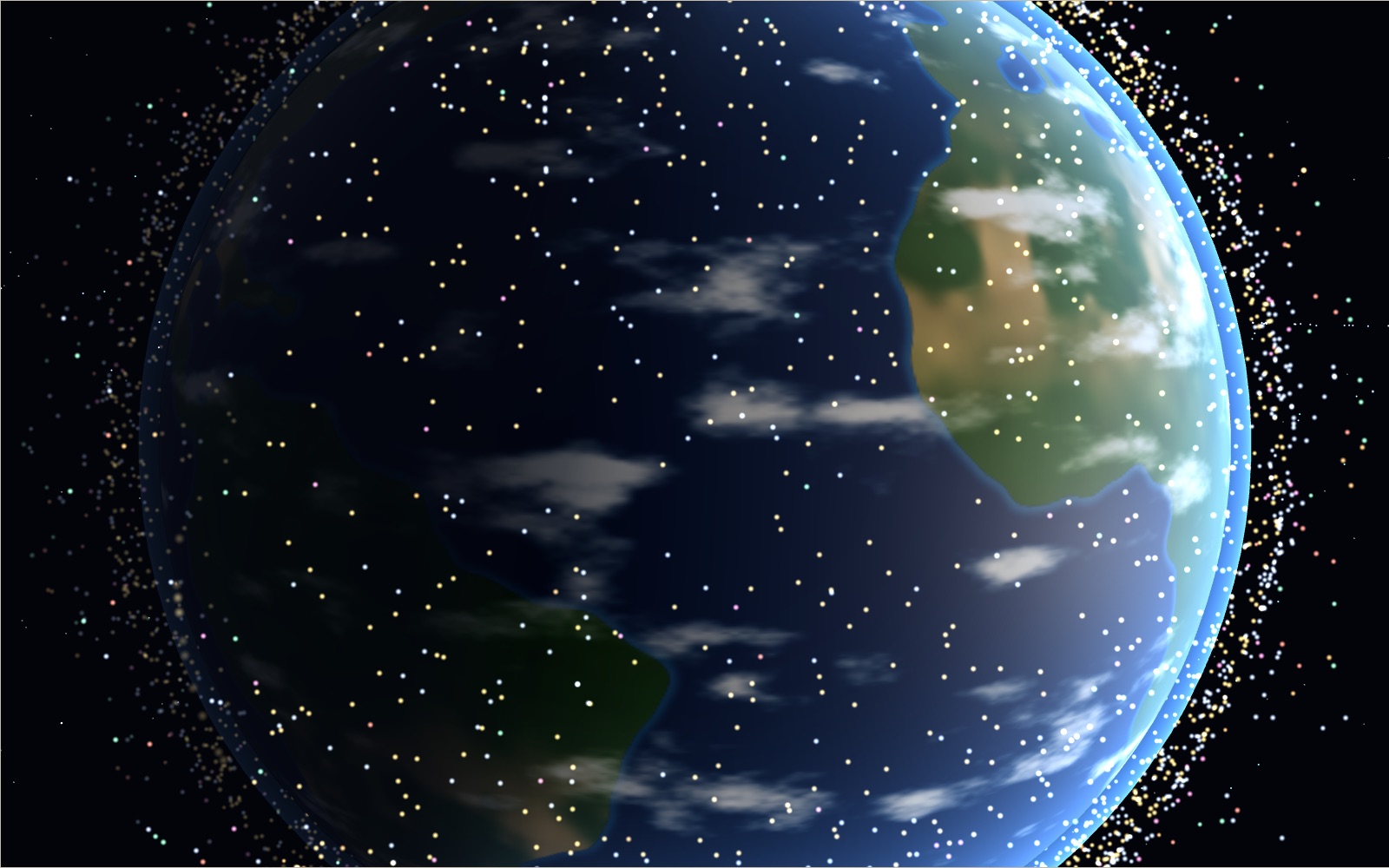
Satellites orbiting Earth right now
On 20 October 2026 the public catalogue listed 16,768 working satellites, and two in every three belonged to one company's internet network.
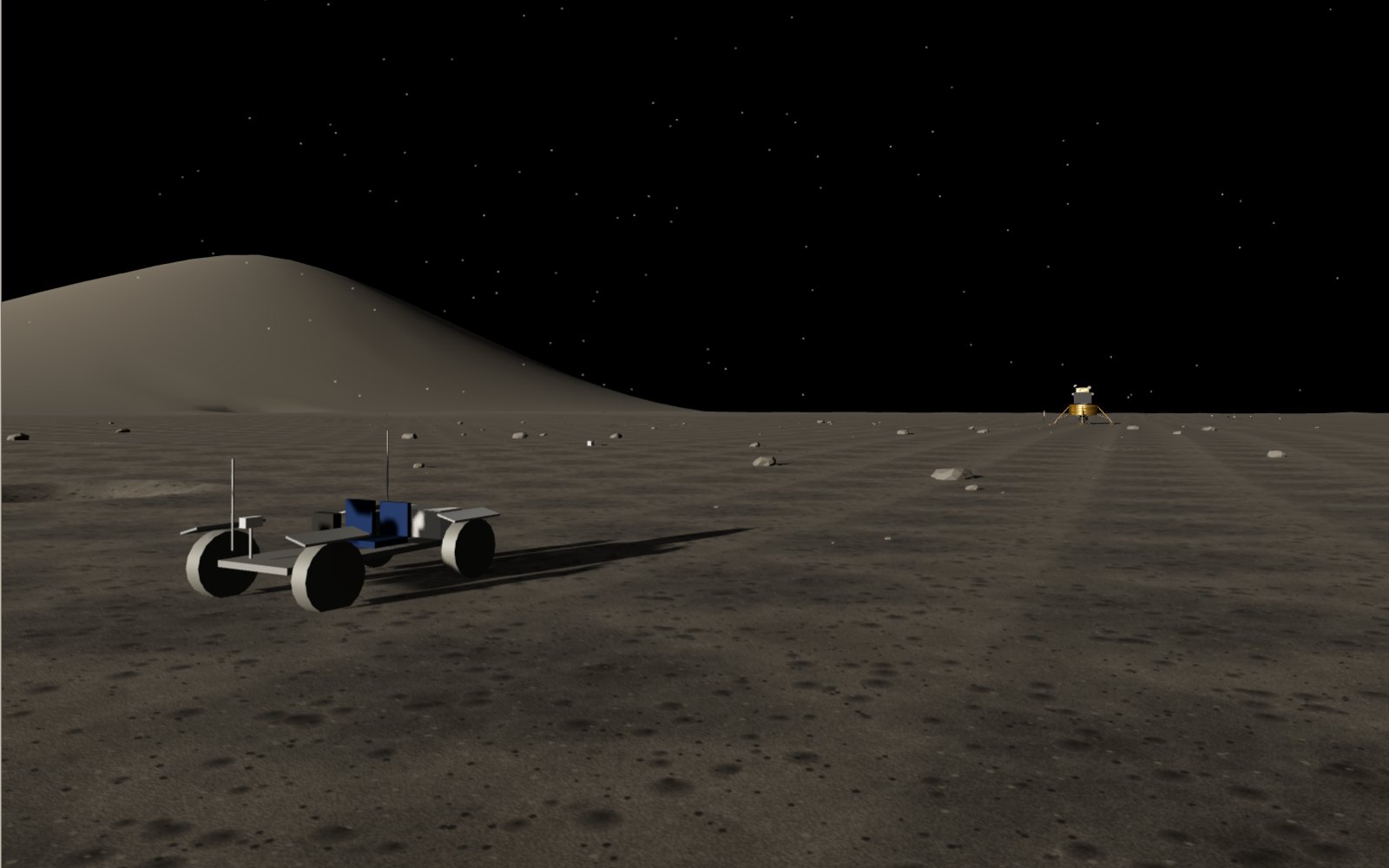
Walk the Apollo landing sites
Standing on the Moon with your eyes 1.6 m up, the horizon is only about 2.4 km away. All six Apollo landing sites are here, from Tranquility Base to Taurus-Littrow.
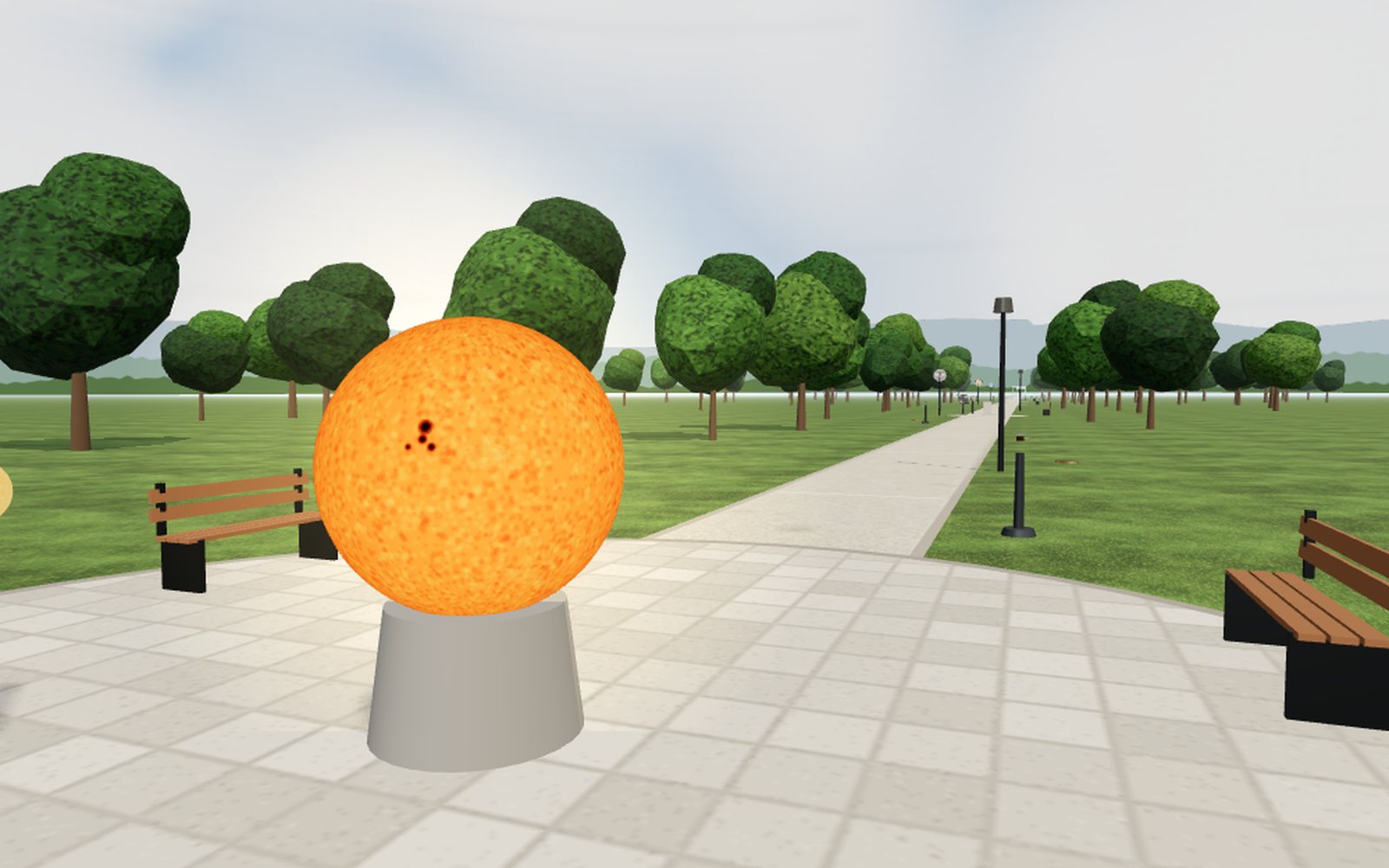
Solar system scale model measurements along a park walk
Shrink the Sun to a ball 1.39 m wide and Earth becomes a 1.27 cm marble 150 m down the path, Neptune is 4.5 km away and Voyager 1 would be 25.7 km.
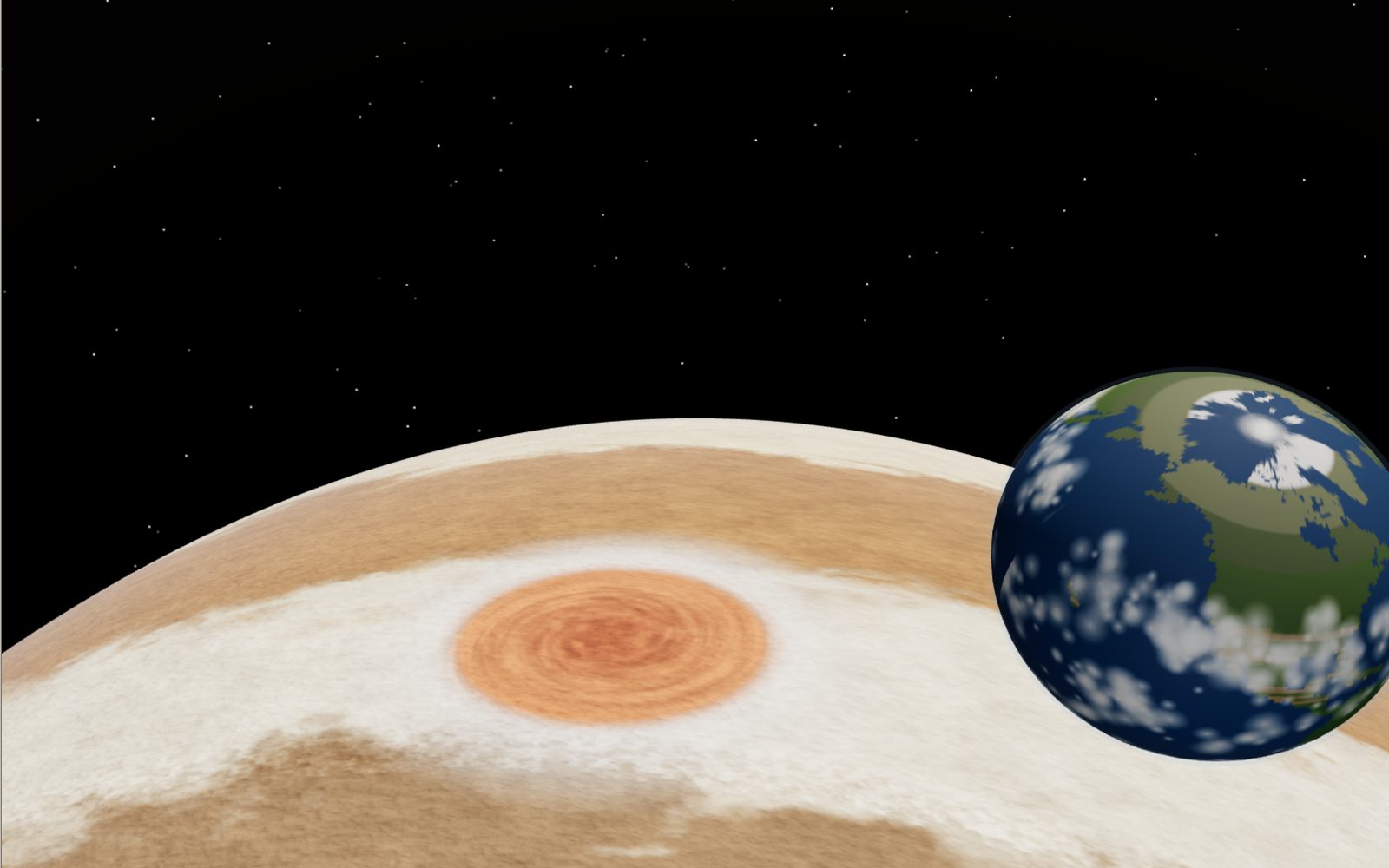
Fly over Jupiter's clouds and the Great Red Spot
In the late 1800s the Great Red Spot was about three Earths long; Hubble now measures it at about one. Float over it with Earth beside you, then sink 132 km into the clouds with the Galileo probe.
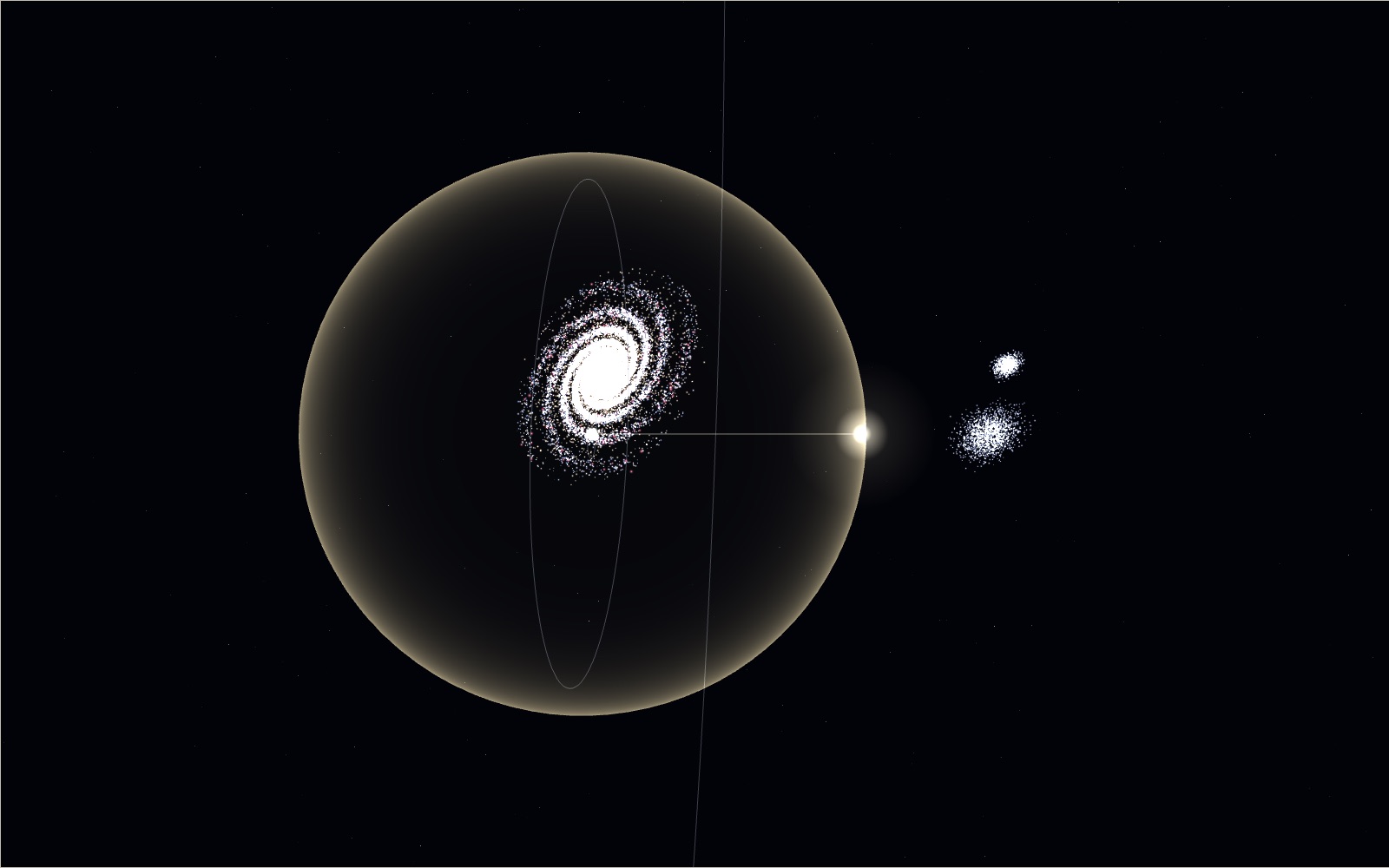
Travelling at the speed of light
Light goes round the equator 7.5 times in a second, yet the same light needs 2.5 million years to reach the Andromeda galaxy.
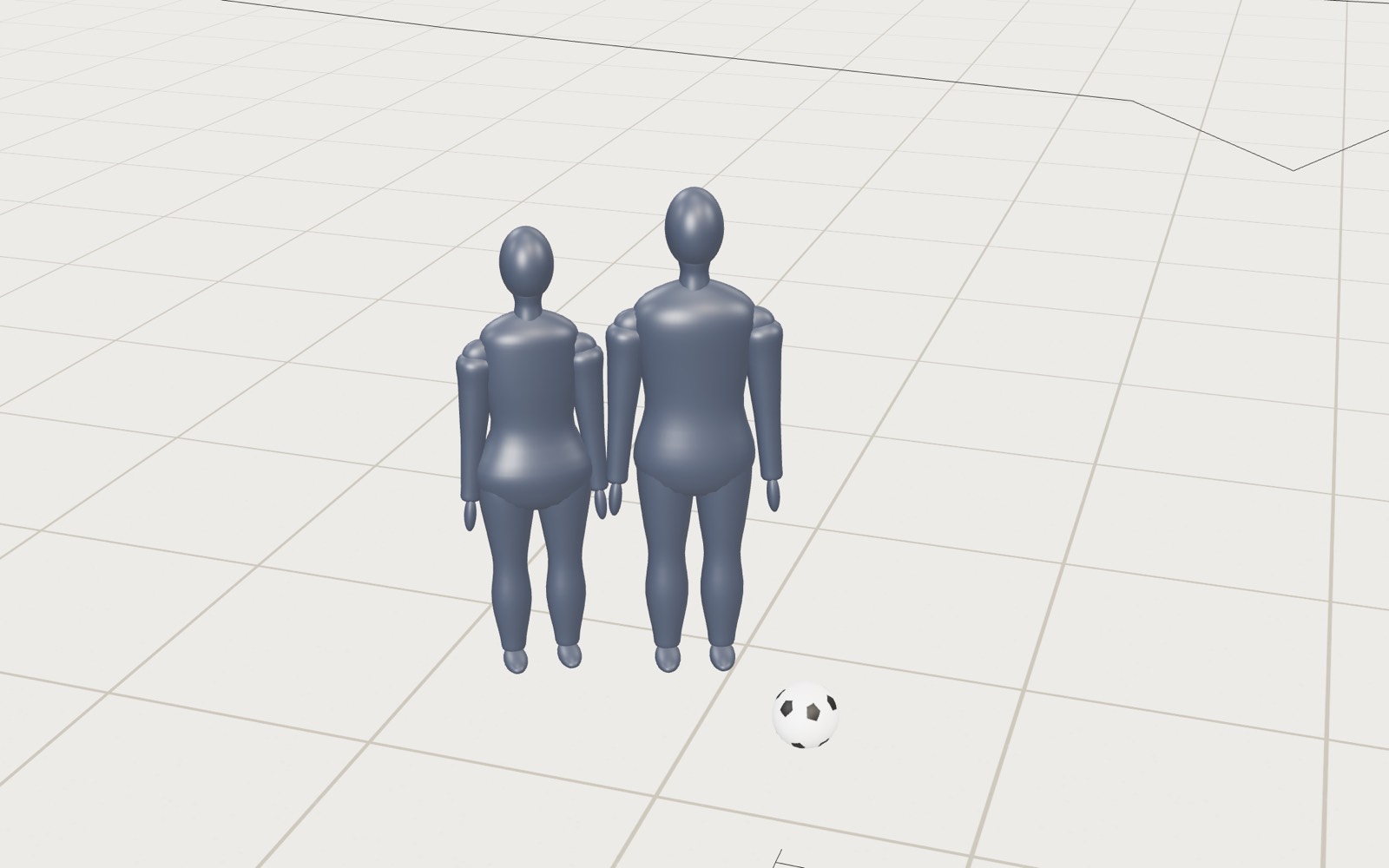
Powers of ten: from a proton to the observable universe
From inside a proton to the edge of the observable universe is 42 steps of ten.