Loading the model
This device cannot show the 3D model. You can read the guide steps below as text.
1 / 16 One person, one scale The figure weighs 60 kg on Earth and jumps with a push that lifts it 0.5 m here. On every other world the same person and the same push are used, so only gravity changes. Type your own weight in the box on the stage.
Drag to turn. Scroll or pinch to zoom.
Guide Parts Controls
01 One person, one scale The figure weighs 60 kg on Earth and jumps with a push that lifts it 0.5 m here. On every other world the same person and the same push are used, so only gravity changes. Type your own weight in the box on the stage.
02 The Moon: a 3 m jump Gravity is 1.62 m/s², a sixth of Earth's. The scale shows 9.9 kg and the same push now lifts the figure 3.02 m, with 3.85 s in the air.
03 A blue sunset on Mars With the Sun low, the butterscotch sky of Mars turns blue around the Sun. Fine dust scatters blue light forward, the opposite of what happens on Earth. Curiosity photographed it in 2015.
04 Jupiter has no ground This is the 1 bar level, where the air presses as hard as Earth's at sea level. Gravity is 24.8 m/s²: the scale reads 152 kg and the jump reaches only 20 cm.
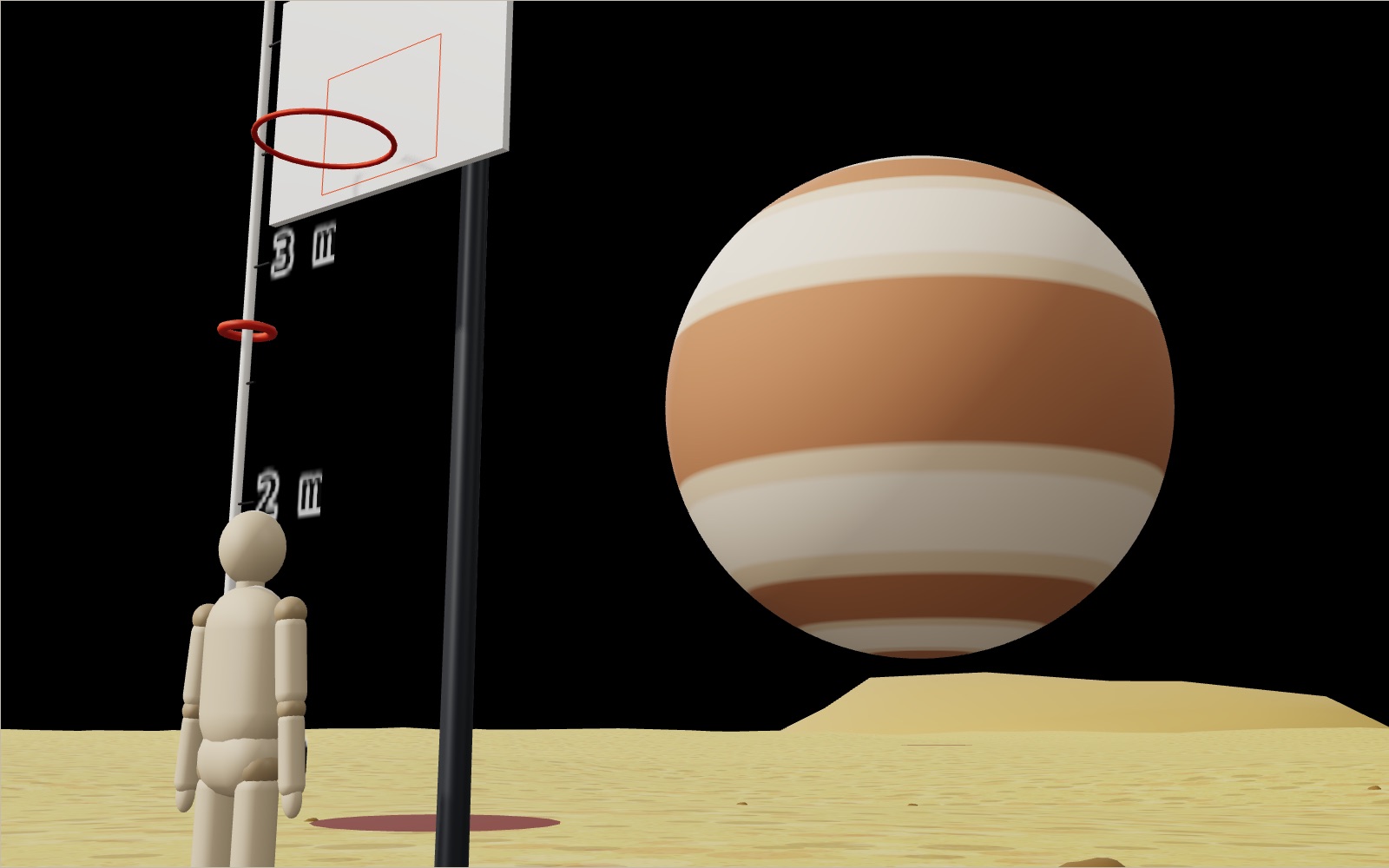
05 Jupiter fills the sky of Io From Io, Jupiter is 19.6° wide and never moves, because Io always keeps one face towards it. The ground is sulfur, drawn after Voyager and Galileo pictures.
06 Hammer and feather With no air on the Moon nothing slows the feather. It falls 1 m in 1.11 s, side by side with the red ball, as in David Scott's Apollo 15 demonstration.
07 A feather on Titan Titan's air is four times as dense as Earth's. The ball still drops 1 m in 1.22 s, but the feather drifts for about 9 s.
08 Throwing through thick air On Venus the air is 65 kg per cubic metre. A 20 m/s throw that would fly 244 m on the Moon and 36 m on Earth stops after 6 m.
09 A seconds pendulum on Mars One swing takes π√(L/g). On Mars a pendulum only 38 cm long ticks once a second, against 99 cm on Earth.
10 Water at 305 °C At the surface of Venus the pressure is 92 bar, so water would only boil at 305 °C. The ground is 464 °C, so it boils away at once.
11 Water at 30 °C Carry the pot 21.7 km up into Earth's air. The pressure drops to 4.2 kPa and water boils at 30 °C, while the air outside is −55 °C.
12 A parachute on Titan Thick air and gravity of only 1.35 m/s² make a 2 m canopy enough: the figure lands at 3.6 m/s. The same canopy on Earth would hit at 17.6 m/s.
13 Flying with wings Hovering with 4 m wings on Titan takes about 160 W, an effort a fit person can keep up. On Earth the same wings would need about 6,600 W.
14 Bennu lets you go Gravity on asteroid Bennu is 0.00008 m/s². The scale reads half a gram, and the Earth jump of 3.1 m/s is fifteen times its escape speed of 0.2 m/s: the figure never comes down.
15 Throwing a ball into space On the model of Bennu a ball thrown at 0.3 m/s leaves for good. Lower the speed to watch it fall back or circle the asteroid.
16 Concept: the Sun Nothing can stand on the Sun. If you could, gravity of 274 m/s² would make the scale read 1,679 kg and the jump reach 1.8 cm.
Figure A plain mannequin, 1.72 m tall unless you change it. Its mass never changes from world to world. Only the pull on it does. The suit switch dresses it for the trip. Bathroom scale Reads weight the way a home scale does: it measures the push of the feet and shows it in Earth kilograms. It drops to zero while the figure is in the air. Jump pole Marked every 0.5 m up to 10 m and every 5 m above. The blue ring is the Earth jump, the orange ring is the height the same push reaches here. Basketball hoop A regulation rim at 3.05 m. The readout says whether the raised hand reaches it at the top of the jump. Ground Rock, dust, ice or rubble, coloured after lander or orbit photos. On the giant planets and the Sun there is nothing to stand on, so a dashed deck marks the 1 bar level. Rocks and craters Boulders, slabs, pebbles, ridges, frost spots and plumes scattered at random, each world with its own kinds. Small bodies curve away at their true radius. Sky Colours from cameras on the ground where they exist (Earth, Moon, Mars, Venus, Titan, Ryugu). Elsewhere the sky is black for want of air or marked as an estimate. Sun Drawn at its true angular size for the distance, with a halo so it can still be found from Neptune or Pluto. Thick cloud on Venus and haze on Titan hide the disc. Planet in the sky The planet a moon goes round, at its true angular size: Earth from the Moon, Mars from Phobos, Jupiter from its moons, Saturn from Enceladus, Neptune from Triton, Charon from Pluto. 1 m drop stand A post marked every 10 cm. The balls and the feather hang with their lowest point 1 m above the ground. Red ball Falls under this world's gravity. Air drag is too small to matter for a ball over 1 m, but buoyancy in thick air is included. Earth ball Falls at Earth's 9.80 m/s² beside the red ball, so you can see the difference instead of reading it. Feather Slowed by air to about 0.6 m/s on Earth (model value). Where there is no air it falls with the balls, as on Apollo 15. Thrown ball A baseball of 145 g and 7.3 cm. In air it feels drag and buoyancy; with no air it follows a clean curve around the world. Flight path The full path of the throw. The dashed blue line is the same throw on Earth. Pendulum A bob on a light string. One swing takes π√(L/g), so it depends only on length and gravity. Earth pendulum The same length swinging under Earth gravity, for comparison. Pot of water Heated on a small stove at the local air pressure. Bubbles appear at the boiling point; below 611 Pa water cannot stay liquid at all. Thermometer Shows the water temperature from 0 to 320 °C as it heats. Parachute A round canopy with a drag coefficient of 0.8 (model value). Its width sets the landing speed; with no air it hangs limp. Wings Strapped-on wings. The readout gives the power needed to hover, from momentum theory for a disc as wide as the wings. Model world The world shrunk to a ball 6 units across, so the path of a throw can be drawn to the same scale. Ball in flight Moves along the path, faster than real time when the flight is long. Path Worked out step by step under the world's gravity: back to the ground, all the way round, or away for good.