FIG. 29Senses
Powers of ten: from a proton to the observable universe
From inside a proton to the edge of the observable universe is 42 steps of ten.
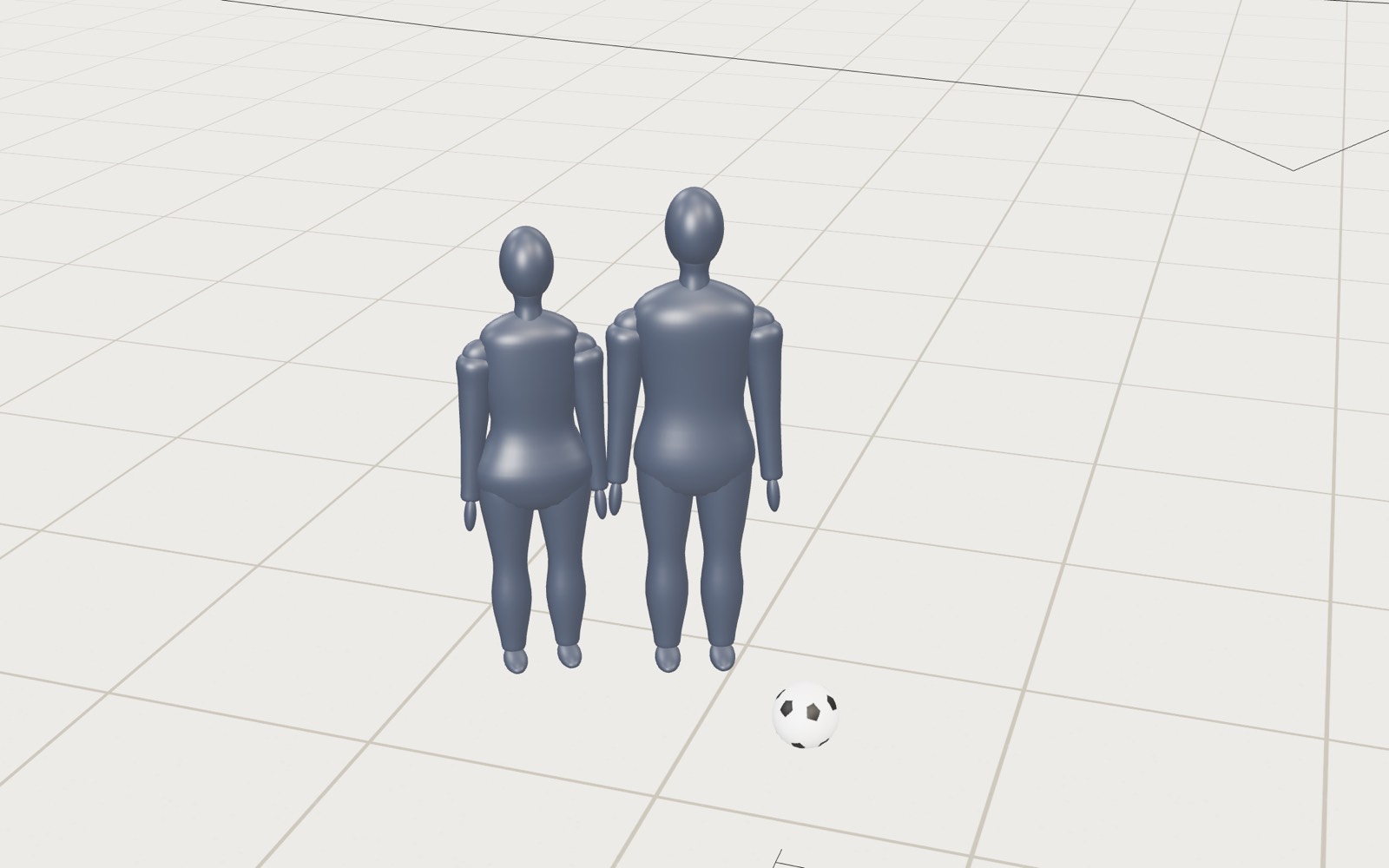
This device cannot show the 3D model. You can read the guide steps below as text.
1 / 19 Start with two peopleA man of 172.5 cm and a woman of 159.6 cm on tiles one metre wide. The ruler along the bottom shows where you are: 10 to the power 0 is one metre. Scroll, pinch or drag the ruler to change it.
Drag to turn. Scroll or pinch to zoom.
How many times bigger is the universe than a proton?
A proton is about 1.68 femtometres, or 1.68 × 10⁻¹⁵ m, across. The observable universe is about 93 billion light-years across, or 8.8 × 10²⁶ m. Divide one by the other and you get a number with 42 digits. Numbers like that stop meaning anything after the first few zeros, so this exhibit does what Charles and Ray Eames did in their 1977 film: it moves in steps of ten. Each step makes the view ten times wider. Forty-two steps take you from the inside of a proton to the edge of everything we can see.
On the way you pass 24 nested scenes and 115 measured objects. The scenes are 3D models built in code, and each one sits inside the next bigger one: quarks in a proton, the proton at the centre of a hydrogen atom, the atom on a strand of DNA, the DNA packed in the head of a virus, the virus standing on a bacterium, the bacterium resting on a hair, the hair lying under an ant, the ant at a person's feet, and so on out to the Milky Way in its group of galaxies and that group inside a supercluster. Every size the stage shows comes from a named institution or a published paper, and the sources are listed at the end of this page.
The stage has three panels. The guide takes you through 19 stops. The parts list names every model; choose one to fly to it. The controls tab holds the ruler controls, a card for the scene you are looking at, six tasks, a tool for comparing any two objects, and the full size catalogue.
Why the scale has to be logarithmic
On an ordinary ruler each centimetre adds the same length. On the ruler along the bottom of the stage each mark multiplies by ten. The mark labelled 10⁰ is one metre, 10³ is a kilometre and 10⁻³ is a millimetre. This is a logarithmic scale: equal distances stand for equal ratios, not equal differences.
Try drawing the same trip on an ordinary scale and you see why. If a hydrogen atom were one millimetre wide on your screen, a hair would be about 850 metres wide and a person would be about 16,000 km tall, more than the width of the Earth. Nothing at both ends would fit. On the log ruler the proton, the person and the universe all get the same amount of room. The grey ticks just above the line show where each object in the catalogue sits; they spread out fairly evenly from 10⁻¹⁵ to 10²⁷ because the things people have measured are spread evenly in this sense, not in metres.
The power of ten in the readout is the width of the view. When it says 10⁷ m the stage shows a patch about ten thousand kilometres across, a little less than the width of the Earth. The second line gives the same width in everyday units, worked out from the camera's real field of view on your screen. A phone in portrait shows a narrower strip than a wide monitor, so the two lines may not agree exactly with the ruler mark; the ruler is the true scale, the second line is what fits on your screen.
Keeping 42 powers of ten on one screen
Computer graphics have trouble with very large and very small numbers in the same scene. Graphics cards store positions as 32-bit floating point numbers, which keep about seven significant digits. Put a proton and a galaxy in the same coordinate system, measured in metres, and the proton's position would round away to nothing. The depth buffer, which decides which surface is in front, has the same problem: two surfaces at nearly the same distance flicker as the card cannot decide between them. This flicker is called z-fighting.
The exhibit avoids both problems by never storing metres. The camera stays where it is, and zooming changes a single number, the power of ten. Each model is built in its own units, where one unit is the object's real size: one unit is 1.68 fm for the proton, 2.5 nm for the DNA and 12,742 km for the Earth. Each frame, every model is drawn at a scale equal to its real size divided by the current view width. A model is shown only while that scale lies between about a thousandth and a few dozen. Outside that range it is either smaller than a few pixels or so large that the camera would be inside it, so it is hidden. The numbers sent to the graphics card therefore always stay between about a thousandth and a hundred.
Nesting works through one shared point. Each model has an anchor, the spot inside it where the next smaller model sits, and that spot is always placed at the centre of the scene. The phage's anchor is the middle of its head, where the DNA is packed. The bacterium's anchor is a point just above its top surface, where the phage stands on its tail. The Earth's anchor is Seoul, turned to face up. Because a smaller object touches its parent at that point, the two surfaces could fight for the same pixels, so each model pushes its depth back by an amount that grows with its size and the smaller model always wins.
Forty-two powers of ten would be a lot of geometry to hold at once. The exhibit does not. A model is built only when the ruler comes within about one power of ten of the range where it is visible, and it is taken apart again, with its shapes, colours and textures freed, once the ruler is three powers of ten away. At any moment three to six of the 24 models exist. Moving from one end of the ruler to the other builds and frees each model in turn, so a phone holds about as much as it did when the exhibit showed only 15 objects.
Going down: from two people to three quarks
Two people, 10⁰ m. The trip starts with a man and a woman of average Korean height: 172.5 cm and 159.6 cm, from the 8th Size Korea survey by the Korean Agency for Technology and Standards. They are drawn as plain silhouettes, without faces or clothes, because the point is their size. They stand on tiles exactly one metre wide, with a one-metre bar on the ground and a size 5 football, about 22 cm across.
Ten and a hundred times smaller. At 10⁻¹ m the football fills part of the view and the people's feet are huge. At 10⁻² m a 500-won coin, 26.5 mm across according to the Bank of Korea, lies on the ground. A pavement ant 4.8 mm long walks next to it among sand grains. The University of California's pest management program gives the ant's length, and the US Geological Survey's grain-size scale says sand runs from 0.0625 to 2 mm.
A hair and blood cells, 10⁻⁴ m. Under the ant lies a hair 90 µm wide. The National Nanotechnology Initiative gives human hair as 80,000 to 100,000 nm, and a sheet of paper as about 100,000 nm thick, so a hair and a page are about the same. On top of the hair rests an E. coli bacterium, 2 µm long and 1 µm wide (BioNumbers), beside red blood cells about 7.5 µm across.
A virus on a bacterium, 10⁻⁷ m. Standing on the bacterium is a T4 phage, a virus that infects E. coli. Its head is an elongated icosahedron 120 nm long and 86 nm wide (Rao and Black, 2010), and its tail is about 113 nm long (BioNumbers). Six tail fibres reach down to the cell wall. Visible light has wavelengths of 380 to 700 nm, so a phage is smaller than a single wave of the light you would use to look at it. That is why viruses were only seen once electron microscopes arrived. For comparison, the virus that causes COVID-19 measures 60 to 140 nm in electron microscope images.
DNA and water, 10⁻⁸ m. Inside the phage head the DNA is folded tight. Close up it becomes the double helix: 2.5 nm wide, turning once every 3.4 nm with ten base pairs per turn, the repeat Watson and Crick described in 1953. Small bent molecules float around it. They are water, with the oxygen and hydrogen 95.78 pm apart and the angle between the two bonds 104.5 degrees, the values NIST lists.
A hydrogen atom, 10⁻¹⁰ m. One hydrogen atom sits on the DNA backbone. NIST gives the Bohr radius as 5.29177210544 × 10⁻¹¹ m, and the model treats twice that, about 0.106 nm, as the atom's width. The dots are drawn from the probability formula for the electron in its lowest state, so they cluster around one Bohr radius and thin out beyond it. The red ball in the middle marks the nucleus, and it is drawn far too big.
Empty space, 10⁻¹¹ to 10⁻¹³ m. Keep zooming and almost nothing happens. The electron cloud spreads out until only a few dots are left, and the middle stays empty. This is the most honest stretch of the trip. If the proton were a marble 1 cm across, the hydrogen atom would be about 630 m wide. The only thing that keeps the proton findable is a soft glow the model adds around it.
Inside the proton, 10⁻¹⁵ m. At the bottom of the ruler the proton fills the view. CODATA 2022 gives its charge radius as 0.84075 fm, so it is about 1.68 fm across. Inside are two up quarks and one down quark, held together by gluons, drawn here as wavy strings. Quarks have no measured size at all, so the coloured balls only mark where they are. The faint dots around them stand for the short-lived quark pairs that physicists describe filling a proton.
Going up: from a tower to the edge of what we can see
A tower and a pitch, 10² to 10³ m. Back up past the people, the Lotte World Tower rises 554.5 m and 123 floors (CTBUH). Next to it, at the same scale, are a football pitch 105 m long, an Airbus A380 72.72 m long drawn from above, and a pale ghost of Burj Khalifa, 828 m. Lines painted on the ground near the people show SUE the T. rex at 12.3 m (the Field Museum gives 40.5 feet) and a blue whale at 33.5 m (NOAA gives up to 110 feet).
Seoul and Korea, 10⁴ to 10⁵ m. Seoul fills the view as a disc of its real area, 605.24 km², with the Han River across it. The pale cone at the edge is Everest, 8,848.86 m, at the same scale: about a third of Seoul's width. A little wider and Korea appears: South Korea's registered land, 100,472.4 km², and Hallasan on Jeju, 1,947.06 m.
The Earth and its satellites, 10⁶ to 10⁷ m. The Earth is 12,742 km across on average. Three rings show orbits: the space station at about 400 km, GPS satellites at about 20,200 km and geostationary satellites at 35,786 km over the equator. The space station is four times higher than the 100 km line used for spaceflight records, yet its ring is so close to the ground that you need to zoom in to separate them.
The Moon and the Sun, 10⁸ to 10⁹ m. Light covers 299,792,458 m in one second, and the yellow mark on the line to the Moon shows that distance. The Moon is a little farther, 384,400 km, and about 30 Earths fit in the gap. The Sun, 1,391,400 km across, is drawn around the Earth for comparison, and the whole orbit of the Moon fits inside it.
The planets, 10¹¹ to 10¹³ m. Wider again, the Sun shrinks to a point and the planets' orbits appear at their real sizes from NASA's fact sheets. The Earth is one astronomical unit from the Sun, exactly 149,597,870,700 m since the International Astronomical Union fixed it in 2012. Mars orbits at 228 million km. A dashed circle shows how big Betelgeuse is: NASA says that if it replaced the Sun, its surface would reach past the orbit of Jupiter. Further out are Neptune at 4,515 million km and Pluto's tilted orbit, which averages 5,906.4 million km.
The edge of the Sun's bubble, 10¹⁴ m. The Kuiper Belt of icy bodies lies at about 30 to 50 AU. The orange shell is the termination shock, where Voyager 1 found the solar wind slowing in 2004 at 94 AU. The blue shell is the heliopause, the edge of the Sun's bubble. Voyager 1 crossed it in 2012 at about 122 AU and Voyager 2 in 2018 at about 119 AU. The directions of the two paths are drawn roughly.
The Oort cloud and the nearest star, 10¹⁵ to 10¹⁷ m. A light-year is about 9.46 trillion km. The faint shell is the Oort cloud, a reservoir of comets NASA describes as starting 2,000 to 5,000 AU out and reaching perhaps 100,000 AU. It has never been seen directly. Proxima Centauri is 4.25 light-years away, and the dashed line to it has a tick every light-year.
Our neighbours, 10¹⁸ m. 19 star systems within 12 light-years, from the RECONS list of nearby stars, placed by their direction in the sky and their distance. Sirius is 8.6 light-years away, Tau Ceti 11.9. The thin lines drop each star to the plane of the galaxy so you can see which are above and which below. Most of them are small red dwarfs you cannot see without a telescope.
The Orion Arm, 10¹⁹ to 10²⁰ m. The nearby stars collapse into a dot. The Crab Nebula, left by the star that exploded in 1054, is six light-years wide according to NASA's Hubble pages. The Pleiades lie roughly 445 light-years away and the Orion Nebula 1,500 light-years away, both in the same spiral arm as the Sun.
The Milky Way, 10²¹ to 10²² m. A disc about 100,000 light-years across. The small ring marks the Sun, 26,000 light-years from the centre, where the black hole Sagittarius A* sits. The Hercules globular cluster M13, over 100,000 stars, is 25,000 light-years away. Outside the disc are the Magellanic Clouds; the larger one is about 160,000 light-years away.
The Local Group, 10²³ m. Andromeda, 2.5 million light-years away, and the Triangulum Galaxy, about 3 million, share a group of over 50 galaxies with the Milky Way. NASA describes the group as about 10 million light-years across. Most members are dwarf galaxies, drawn here as small dots around the two big spirals; their positions are only roughly right.
Laniakea and the cosmic web, 10²⁴ to 10²⁶ m. M87, 54 million light-years away, sits at the heart of the Virgo Cluster of some 2,000 galaxies. In 2014 a team led by Brent Tully mapped how galaxies move and found the supercluster that holds us, Laniakea: about 500 million light-years across with 100,000 galaxies, all flowing towards a region called the Great Attractor. Wider still, galaxies line up along filaments around huge empty voids.
The observable universe, 10²⁷ m. The end of the ruler. The observable universe is about 93 billion light-years across. The glowing shell stands for the cosmic microwave background, the oldest light we can see, and the white dot in the middle is us.
Where the sizes come from
The catalogue in the controls tab lists 115 objects and distances, each with the source it came from. A few rules decided what went in.
- Only published sizes. An object went on the list only if a public institution or a published paper gives its size: NIST, NASA, NOAA, the US Geological Survey, the Bank of Korea, the Korean Agency for Technology and Standards, ISO standards, museums, or a journal article. Encyclopaedias written by volunteers were not used.
- Ranges use the middle. When a source gives a range, such as 60 to 140 nm for the coronavirus or 80,000 to 100,000 nm for a hair, the catalogue uses a value near the middle and the note gives the full range.
- Worked-out values say so. A few numbers are calculated from published ones. The size of the event horizon of Sagittarius A* comes from its mass of about 4 million Suns, as reported by the Event Horizon Telescope, using the formula for a black hole's horizon. The Earth's circumference comes from its equatorial radius. The note says "calculated" or "worked out" when that happens.
- Kinds of size. Each object is either a size (a diameter, length or height) or a distance. The compare tool draws sizes as circles and distances as bars.
- Moving targets. Some numbers change as measurements improve. The proton radius changed in 2018, distances to nearby stars are refined by every star survey, and the heights of mountains change after each new survey. The date each source was checked is listed below.
The Korean outlines, the continents and the Seoul disc are drawn by hand from maps and should not be used as survey data. The star positions use right ascension and declination converted to the plane of the galaxy, which is good enough to show which stars are near each other but not a star chart.
Checking a few of the numbers
The Moon's orbit inside the Sun sounds wrong, so check it. The orbit's diameter is twice 384,400 km, or 768,800 km. The Sun's diameter is twice 695,700 km, or 1,391,400 km. The orbit is only 55% as wide as the Sun.
How many Earths fit across the Sun? 1,391,400 ÷ 12,742 is about 109. How many between the Earth and the Moon? 384,400 ÷ 12,742 is about 30.2.
How long does sunlight take to reach us? 149,597,870,700 m divided by 299,792,458 m per second is about 499 seconds, or 8 minutes 19 seconds. Voyager 1 crossed the heliopause at about 122 AU, so light needs about 122 × 499 seconds, a little under 17 hours, to get there.
How far apart are a person and an atom? 1.725 m divided by 0.106 nm is about 16 billion, which is 10 to the power 10.2. That is the answer to the first task.
How deep is the deepest sea compared with the tallest mountain? NOAA puts Challenger Deep at about 10,935 m, and Everest is 8,848.86 m, so the trench is about 2 km deeper than the mountain is tall.
The whole ruler: 8.8 × 10²⁶ m for the observable universe divided by 1.68 × 10⁻¹⁵ m for the proton is about 5 × 10⁴¹. Add the room needed to frame each end and the ruler runs from 10⁻¹⁵ to 10²⁷.
Using the compare tool and the tasks
The compare tool takes any two objects from the catalogue. It tells you how many times bigger one is than the other and how many powers of ten that is, marks both on a small ruler, and draws them side by side to scale. Press the button to show both on the stage: the first object is drawn in orange and the second in blue, as outlines next to the scene at the right size, and the ruler moves to the larger of the two. If the smaller object is less than a few pixels across it disappears, which is the honest answer. Try a 500-won coin against a red blood cell, or Earth against Betelgeuse.
The six tasks ask you to find things on the ruler or answer a question about sizes. Two of them check the stage itself: one ticks when the T4 phage fills the view, another when you reach the bottom of the ruler and see the quarks. Your progress is kept in this browser.
The switch for same-size outlines draws up to three objects from the catalogue that fall in the power of ten you are looking at, so a scene with nothing else in it still shows what is that size. The switch for AU and light-years changes the units in the readout and the catalogue. Stopping on whole powers makes the ruler settle on 10¹, 10², 10³ and so on whenever you let go. The auto trip zooms on its own from one end of the ruler to the other at the speed you choose.
What the model leaves out
The models are meant to show sizes, so a few things are simplified. The atom's nucleus is drawn as a red ball you can see; at the atom's scale the real proton would be far less than a pixel. Quarks are drawn as balls although they have no measured size. Planets in the solar system views are drawn as dots of a fixed size on screen, and they are not at their real positions on any date. The Earth is held at the same place on its orbit at every scale so the smaller scenes stay underneath it. The Sun appears around the Earth only to compare sizes. The heliosphere is drawn as a stretched bubble, which is the common picture, but its real shape is still debated. The Oort cloud is a hypothesised shell nobody has seen. The galaxy's spiral arms are a generic barred spiral, since we see the Milky Way from inside and its exact shape is still being mapped. The Local Group dwarfs, the streams in Laniakea and the filaments of the cosmic web are drawn to look like the real maps, not copied from them.
The 1977 film by Charles and Ray Eames
The idea of stepping through the universe by tens comes from a short film. Powers of Ten, made by Charles and Ray Eames and released in 1977, runs about nine minutes. It begins with a picnic by the lakeside in Chicago seen from one metre away. According to a Library of Congress essay, the camera then moves ten times farther away every ten seconds until it reaches the edge of the known universe, and then reverses into the nucleus of an atom in the sleeping man's hand. An earlier version had been made in 1968, and the film was based on Kees Boeke's 1957 book Cosmic View. In 1998 the Library of Congress selected it for the US National Film Registry. This exhibit uses no footage from the film. Since 1977 the far end has moved: the film stops at about 10²⁴ m, before the supercluster Laniakea had been mapped.
Questions
Why does the view jump by ten instead of two?
Ten is convenient because our numbers are written in base ten: each step adds or removes one zero. Doubling would also work, but you would need about 140 steps instead of 42 to cover the same range.
What does the number in the readout mean?
It is the width of the view as a power of ten. 10⁴ m means the stage shows about ten kilometres across. The line below it gives the width in everyday units for your screen shape.
Why do objects vanish when I zoom in on them?
Each object is hidden once it becomes much larger than the view, because the camera would otherwise be inside it. You then see the next smaller object that was sitting at the centre.
Why is the screen almost empty between the atom and the proton?
Because an atom is almost all empty space. The proton is about 63,000 times smaller than the hydrogen atom, so for more than four powers of ten there is nothing to draw but a thinning cloud of chances where the electron may be.
Are quarks really coloured balls?
No. Quarks have no measured size, and the colours red, green and blue are a label physicists use for a property called colour charge, not real colours. The balls only mark the three quarks.
Is the Sun really bigger than the Moon's orbit?
Yes. The Moon's orbit is about 768,800 km across, and the Sun is about 1,391,400 km across. The orbit would fit inside the Sun with room to spare.
Why is the person 172.5 cm?
It is the average height of Korean men in the 8th Size Korea survey by the Agency for Technology and Standards. The woman beside him is 159.6 cm, the average for Korean women in the same survey.
How can the universe be 93 billion light-years across if it is 13.8 billion years old?
Space kept stretching while the oldest light was on its way to us. The places that sent that light are now much farther away than 13.8 billion light-years, about 46 billion light-years in every direction, which gives a width of about 93 billion light-years.
Are the planet and star positions real?
The orbit sizes and star distances are real. The planets are placed at arbitrary points on their orbits and move faster than real planets when Motion is on. The star directions are converted from their positions in the sky, which is close but not exact.
Why can't I see Voyager 1 where it is today?
The model marks where each Voyager crossed the heliopause, the event that the sources date and measure. Both spacecraft have kept moving outward since then.
How was the size of a black hole worked out?
The Event Horizon Telescope gives the mass of Sagittarius A* as about 4 million times the Sun's. The size of a black hole's event horizon follows from its mass, which gives about 24 million km across. The note in the catalogue marks it as calculated.
Does the exhibit use any footage from the Eames film?
No. Everything on the stage is generated by code. The film is mentioned because it made this way of looking at scale famous.
Terms
- Power of ten: a number written as 10 raised to an exponent. 10³ is 1,000 and 10⁻³ is 0.001.
- Logarithmic scale: a scale where equal distances stand for equal ratios, so each step is ten times the last.
- Femtometre (fm): 10⁻¹⁵ m, the size of a proton.
- Quark: one of the particles that make up protons and neutrons. A proton holds two up quarks and one down quark.
- Bohr radius: the most likely distance of the electron from the nucleus in a hydrogen atom in its lowest state, about 0.0529 nm.
- Bacteriophage: a virus that infects bacteria. T4 is one of the best studied.
- Astronomical unit (AU): 149,597,870,700 m, about the distance from the Earth to the Sun.
- Heliopause: the outer edge of the bubble of solar wind around the Sun.
- Light-year: the distance light travels in one year, about 9.46 trillion km.
- Supercluster: a region holding many groups and clusters of galaxies. Ours is Laniakea.
- Cosmic microwave background: the faint glow left over from the early universe, the oldest light we can see.
- Z-fighting: flicker in 3D graphics when two surfaces sit at almost the same depth.
Sources
- NIST, CODATA internationally recommended 2022 values of the fundamental physical constants (Bohr radius, proton charge radius, electron Compton wavelength, speed of light). https://physics.nist.gov/cuu/Constants/index.html (checked 18 October 2026)
- IAEA Nuclear Data Section, Nuclear charge radii (Angeli and Marinova 2013). https://www-nds.iaea.org/radii/ (checked 18 October 2026)
- Particle Data Group, Review of Particle Physics: quarks. https://pdg.lbl.gov/2024/tables/contents_tables.html (checked 18 October 2026)
- NIST Computational Chemistry Comparison and Benchmark Database, water geometry. https://cccbdb.nist.gov/exp2x.asp?casno=7732185 (checked 18 October 2026)
- National Nanotechnology Initiative, Just How Small Is "Nano"? (DNA 2.5 nm, hair 80,000 to 100,000 nm, paper 100,000 nm, gold atom). https://www.nano.gov/about-nanotechnology/just-how-small-is-nano (checked 18 October 2026)
- Watson and Crick, Molecular structure of nucleic acids, Nature 171, 737 (1953). https://www.nature.com/articles/171737a0 (checked 18 October 2026)
- BioNumbers (Milo and Phillips, Cell Biology by the Numbers), How big is an E. coli cell and what is its mass? https://book.bionumbers.org/how-big-is-an-e-coli-cell-and-what-is-its-mass/ (checked 16 October 2026)
- BioNumbers BNID 104846, dimensions of the T4 head and tail. https://bionumbers.hms.harvard.edu/bionumber.aspx?s=n&v=6&id=104846 (checked 18 October 2026)
- Rao and Black, Structure and assembly of bacteriophage T4 head, Virology Journal (2010). https://pmc.ncbi.nlm.nih.gov/articles/PMC3012670/ (checked 18 October 2026)
- Electron tomography as a tool to study SARS-CoV-2 morphology (2024). https://pmc.ncbi.nlm.nih.gov/articles/PMC11547116/ (checked 18 October 2026)
- NASA Science, Tour of the Electromagnetic Spectrum: visible light. https://science.nasa.gov/ems/09_visiblelight/ (checked 18 October 2026)
- USGS, Grain-size classification, Open-File Report 2006-1195. https://pubs.usgs.gov/of/2006/1195/htmldocs/nomenclature.htm (checked 18 October 2026)
- University of California IPM, Key to identifying common household ants: Pavement ant. https://ipm.ucanr.edu/TOOLS/ANTKEY/pavement.html (checked 16 October 2026)
- Bank of Korea, Coins in circulation. https://www.bok.or.kr/portal/main/contents.do?menuNo=200186 (checked 18 October 2026)
- IFAB, Laws of the Game: the ball and the field of play. https://www.theifab.com/laws/latest/the-ball/ (checked 18 October 2026)
- Korean Agency for Technology and Standards, 8th Size Korea survey results (average height). https://www.kats.go.kr/mobile/content.do?cmsid=557&skin=/mobile/&mode=view&page=&cid=23124 (checked 16 October 2026)
- Field Museum, How well do you know SUE? https://www.fieldmuseum.org/blog/how-well-do-you-know-sue (checked 18 October 2026)
- NOAA Fisheries, Blue whale. https://www.fisheries.noaa.gov/species/blue-whale (checked 18 October 2026)
- Airbus, A380 dimensions and key data. https://aircraft.airbus.com/en/aircraft/a380 (checked 18 October 2026)
- CTBUH Skyscraper Center, Lotte World Tower and Burj Khalifa. https://www.skyscrapercenter.com/building/lotte-world-tower/88 (checked 16 October 2026)
- Seoul Metropolitan Government, Seoul Open Data Plaza, administrative area. https://data.seoul.go.kr/dataList/DT201004K040008/S/2/datasetView.do (checked 16 October 2026)
- Ministry of Land, Infrastructure and Transport via e-Nara Index, national land area. https://www.index.go.kr/unify/idx-info.do?idxCd=2728 (checked 16 October 2026)
- National Geographic Information Institute of Korea, heights of major mountains. https://www.ngii.go.kr/ (checked 18 October 2026)
- Encyclopaedia Britannica, Mount Everest. https://www.britannica.com/place/Mount-Everest (checked 18 October 2026)
- NOAA National Ocean Service, How deep is the ocean? https://oceanservice.noaa.gov/facts/oceandepth.html (checked 18 October 2026)
- NASA, Space station facts and figures. https://www.nasa.gov/international-space-station/space-station-facts-and-figures/ (checked 18 October 2026)
- GPS.gov, Space segment. https://www.gps.gov/space-segment (checked 18 October 2026)
- ESA, Geostationary orbit. https://www.esa.int/ESA_Multimedia/Images/2020/03/Geostationary_orbit (checked 18 October 2026)
- NASA NSSDC, Planetary, Earth, Moon, Sun and Pluto fact sheets. https://nssdc.gsfc.nasa.gov/planetary/factsheet/ (checked 18 October 2026)
- NASA JPL Solar System Dynamics, Astrodynamic parameters (astronomical unit, IAU 2012 Resolution B2). https://ssd.jpl.nasa.gov/astro_par.html (checked 18 October 2026)
- NASA Science, Hubble sees red supergiant star Betelgeuse slowly recovering. https://science.nasa.gov/missions/hubble/hubble-sees-red-supergiant-star-betelgeuse-slowly-recovering-after-blowing-its-top/ (checked 18 October 2026)
- NASA Science, Kuiper Belt facts. https://science.nasa.gov/solar-system/kuiper-belt/facts/ (checked 18 October 2026)
- NASA Science, Voyager Interstellar Mission. https://science.nasa.gov/mission/voyager/interstellar-mission/ (checked 18 October 2026)
- NASA Science, Oort Cloud and scale of the solar system. https://science.nasa.gov/resource/oort-cloud-and-scale-of-the-solar-system-infographic/ (checked 18 October 2026)
- NASA Science, Oort Cloud facts. https://science.nasa.gov/solar-system/oort-cloud/facts/ (checked 18 October 2026)
- NASA Imagine the Universe, The Nearest Star. https://imagine.gsfc.nasa.gov/features/cosmic/nearest_star_info.html (checked 16 October 2026)
- RECONS, The one hundred nearest star systems. http://www.recons.org/TOP100.posted.htm (checked 18 October 2026)
- NASA Science, Hubble's Messier Catalog (M1, M13, M31, M33, M42, M45, M87). https://science.nasa.gov/mission/hubble/science/explore-the-night-sky/hubble-messier-catalog/ (checked 18 October 2026)
- NASA Imagine the Universe, The Milky Way Galaxy. https://imagine.gsfc.nasa.gov/science/featured_science/milkyway (checked 18 October 2026)
- NASA Earth Observatory, The galaxy next door (Large Magellanic Cloud, Local Group). https://science.nasa.gov/earth/earth-observatory/the-galaxy-next-door/ (checked 18 October 2026)
- NASA Science, Galaxy basics. https://science.nasa.gov/universe/galaxies/ (checked 18 October 2026)
- Event Horizon Telescope, Astronomers reveal first image of the black hole at the heart of our galaxy (2022). https://eventhorizontelescope.org/blog/astronomers-reveal-first-image-black-hole-heart-our-galaxy (checked 18 October 2026)
- NRAO, Newly identified galactic supercluster is home to the Milky Way (2014). https://public.nrao.edu/news/supercluster-gbt/ (checked 18 October 2026)
- Tully et al., The Laniakea supercluster of galaxies, Nature 513, 71 (2014). https://www.nature.com/articles/nature13674 (checked 18 October 2026)
- Encyclopaedia Britannica, Observable universe. https://www.britannica.com/topic/observable-universe (checked 18 October 2026)
- Library of Congress, National Film Registry essay on Powers of Ten. https://www.loc.gov/static/programs/national-film-preservation-board/documents/powers_of_ten.pdf (checked 16 October 2026)
- Eames Foundation, Powers of Ten and the Relative Size of Things in the Universe. https://eamesfoundation.org/work/powers-of-ten-and-the-relative-size-of-things-in-the-universe (checked 18 October 2026)
More exhibits
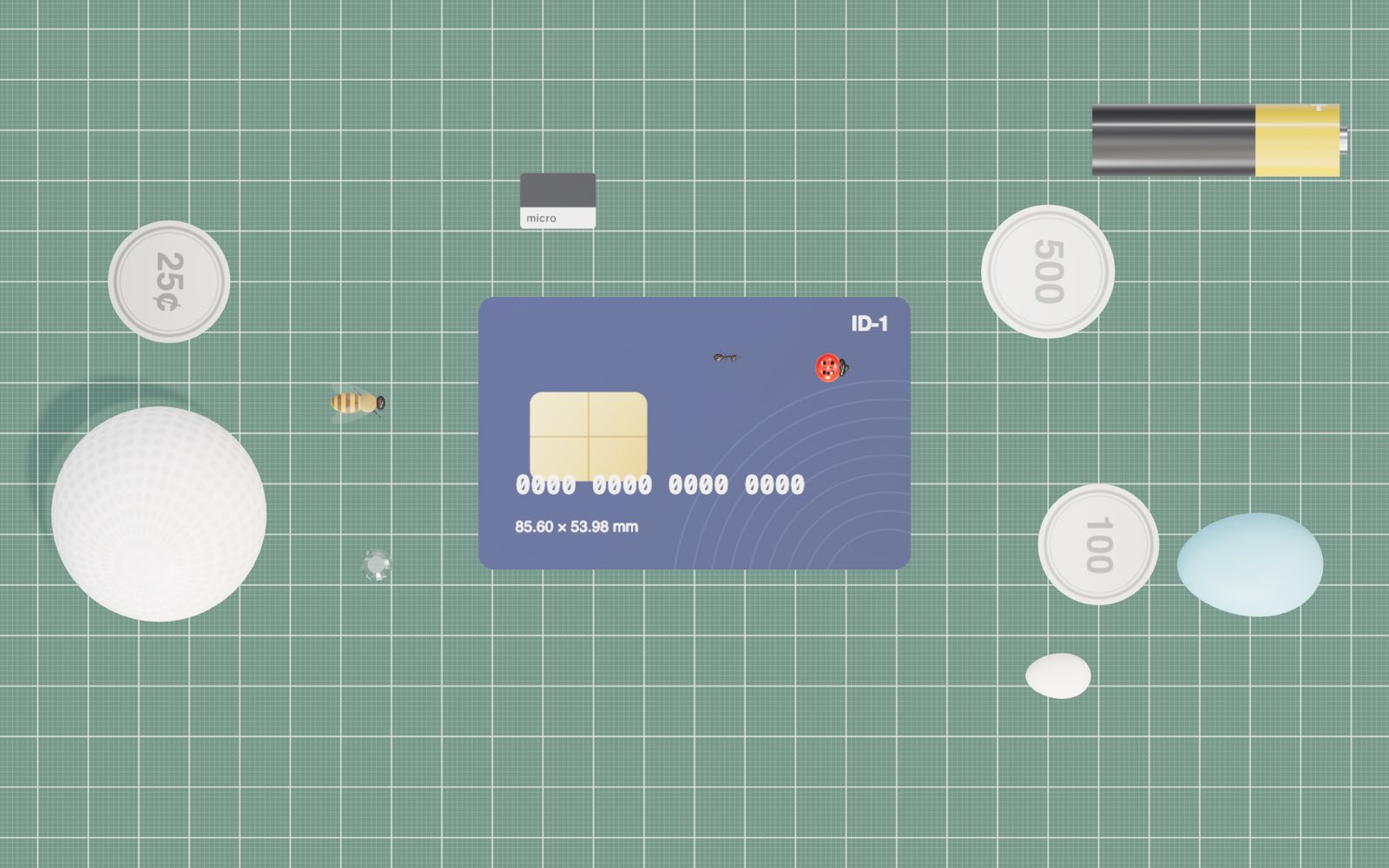
Actual size: see real objects at true scale on your screen
A T. rex tooth was about 30 cm long with its root, longer than most laptop screens are wide. A blue whale would take more than a hundred.
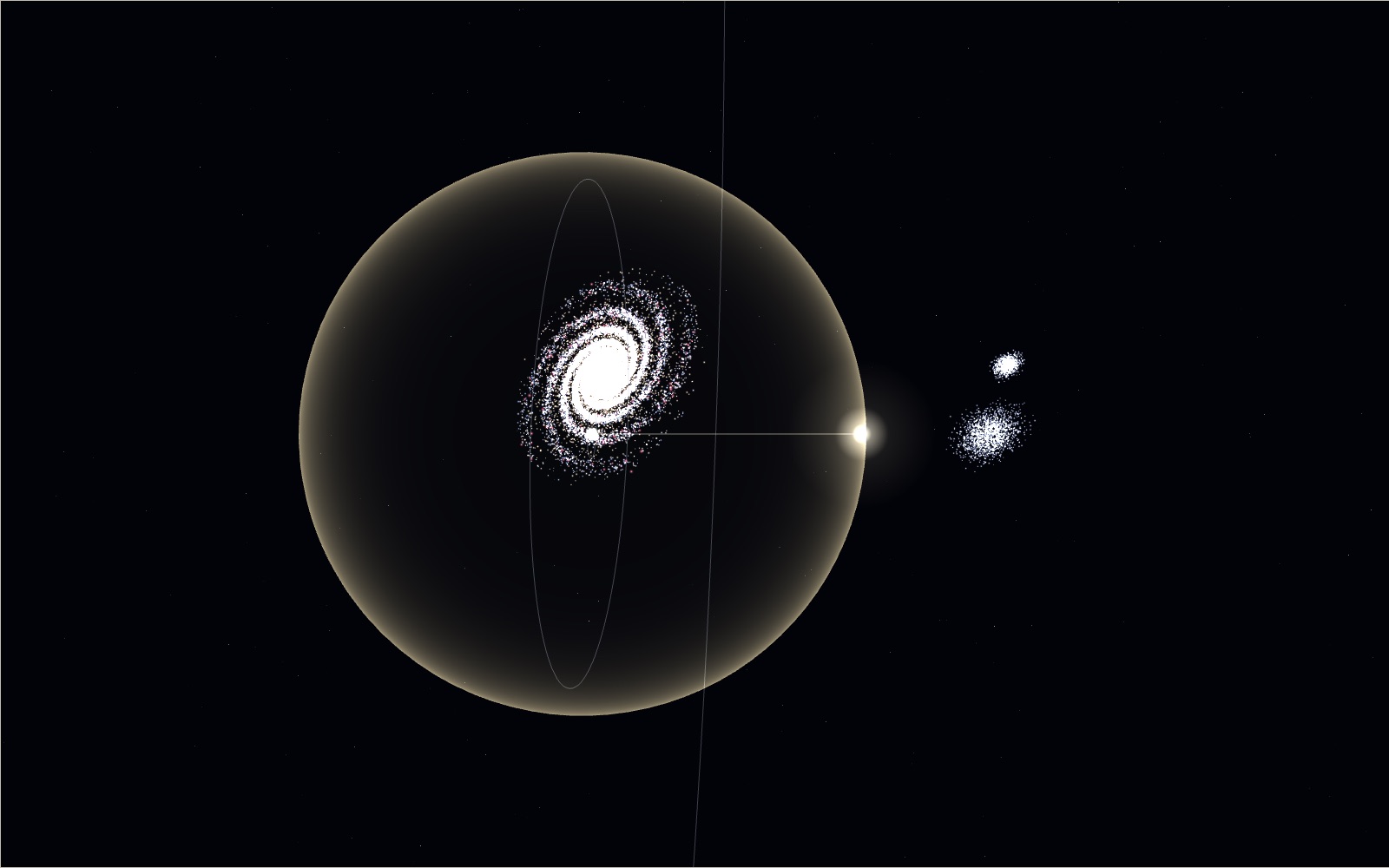
Travelling at the speed of light
Light goes round the equator 7.5 times in a second, yet the same light needs 2.5 million years to reach the Andromeda galaxy.
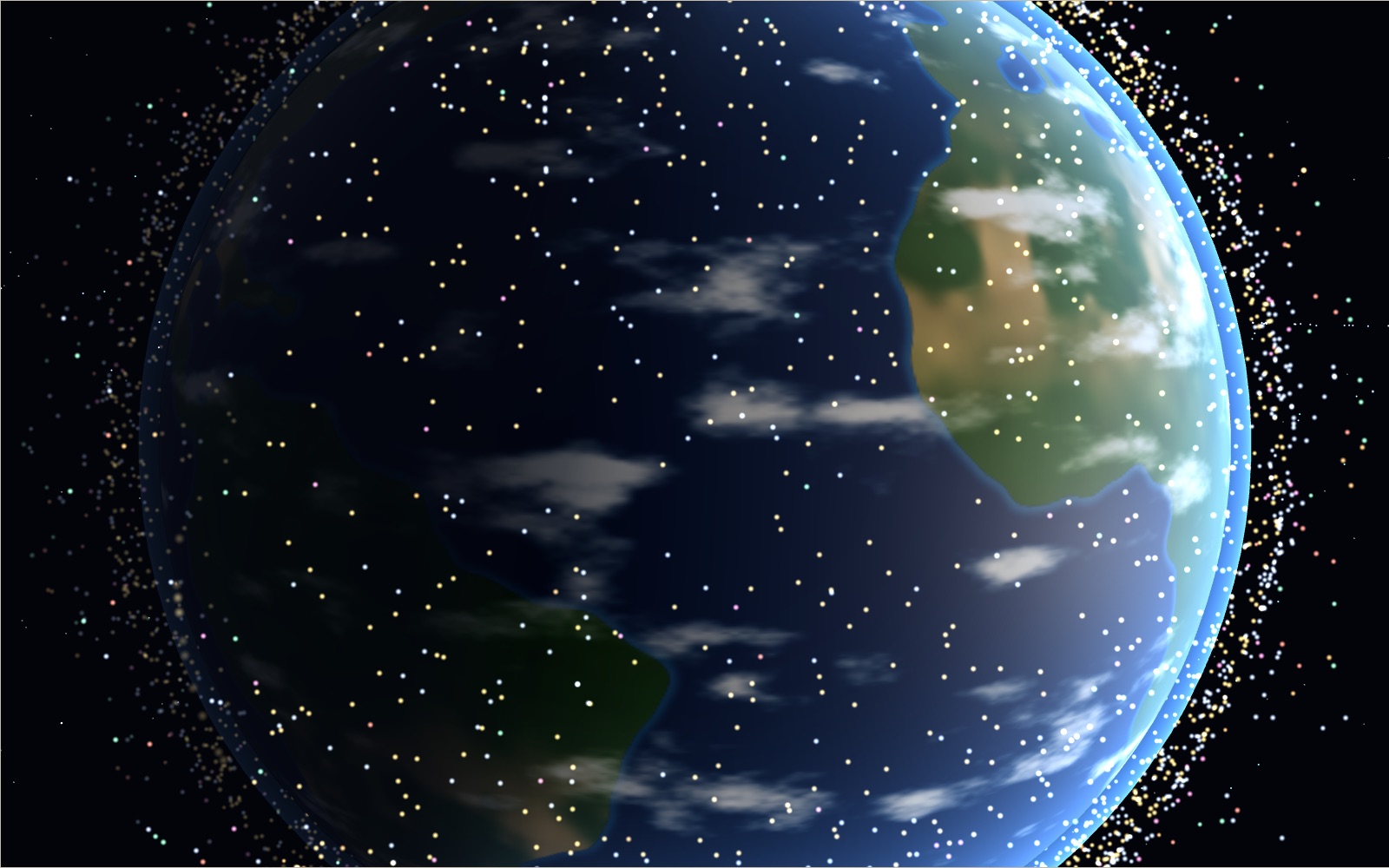
Satellites orbiting Earth right now
On 20 October 2026 the public catalogue listed 16,768 working satellites, and two in every three belonged to one company's internet network.
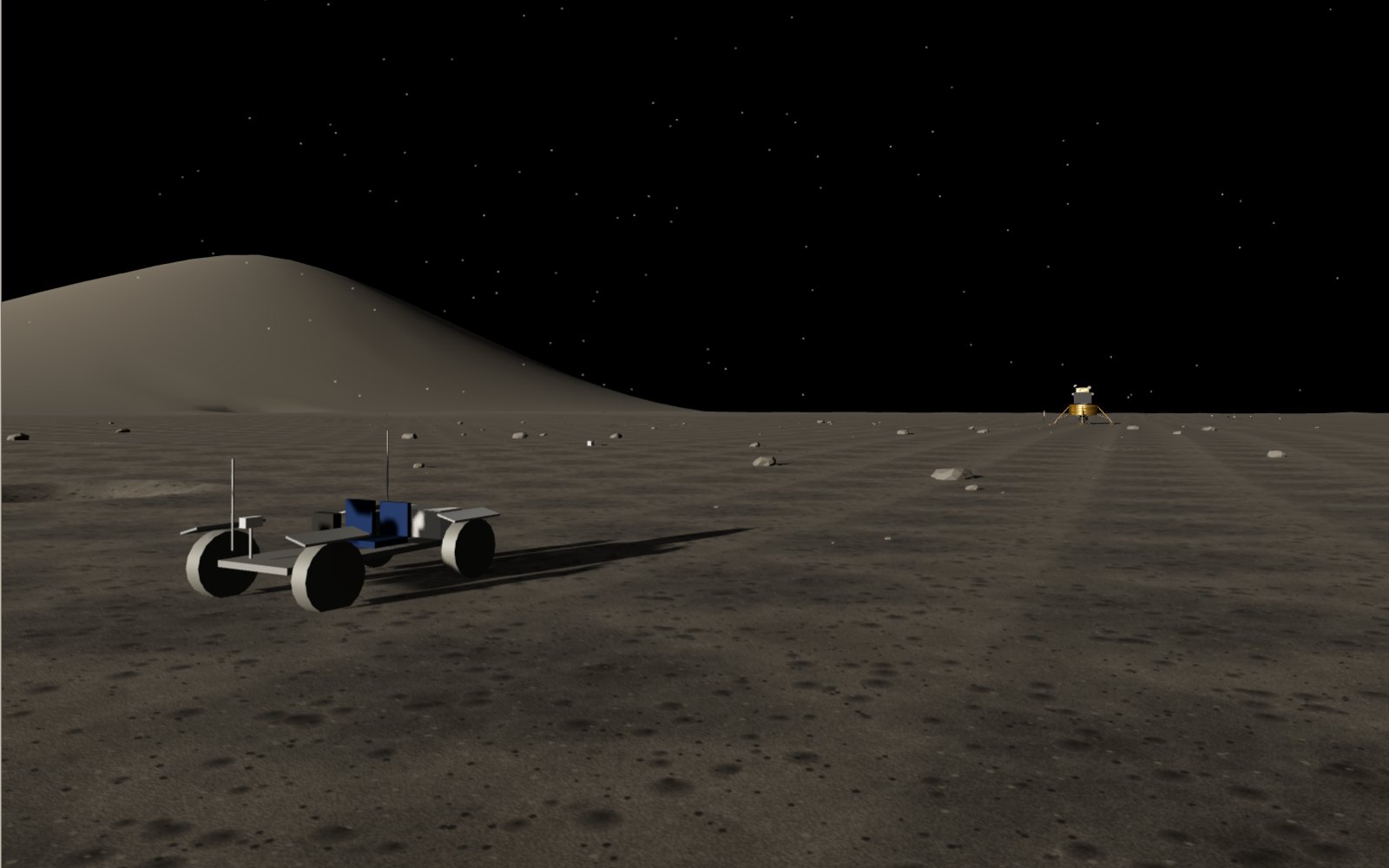
Walk the Apollo landing sites
Standing on the Moon with your eyes 1.6 m up, the horizon is only about 2.4 km away. All six Apollo landing sites are here, from Tranquility Base to Taurus-Littrow.
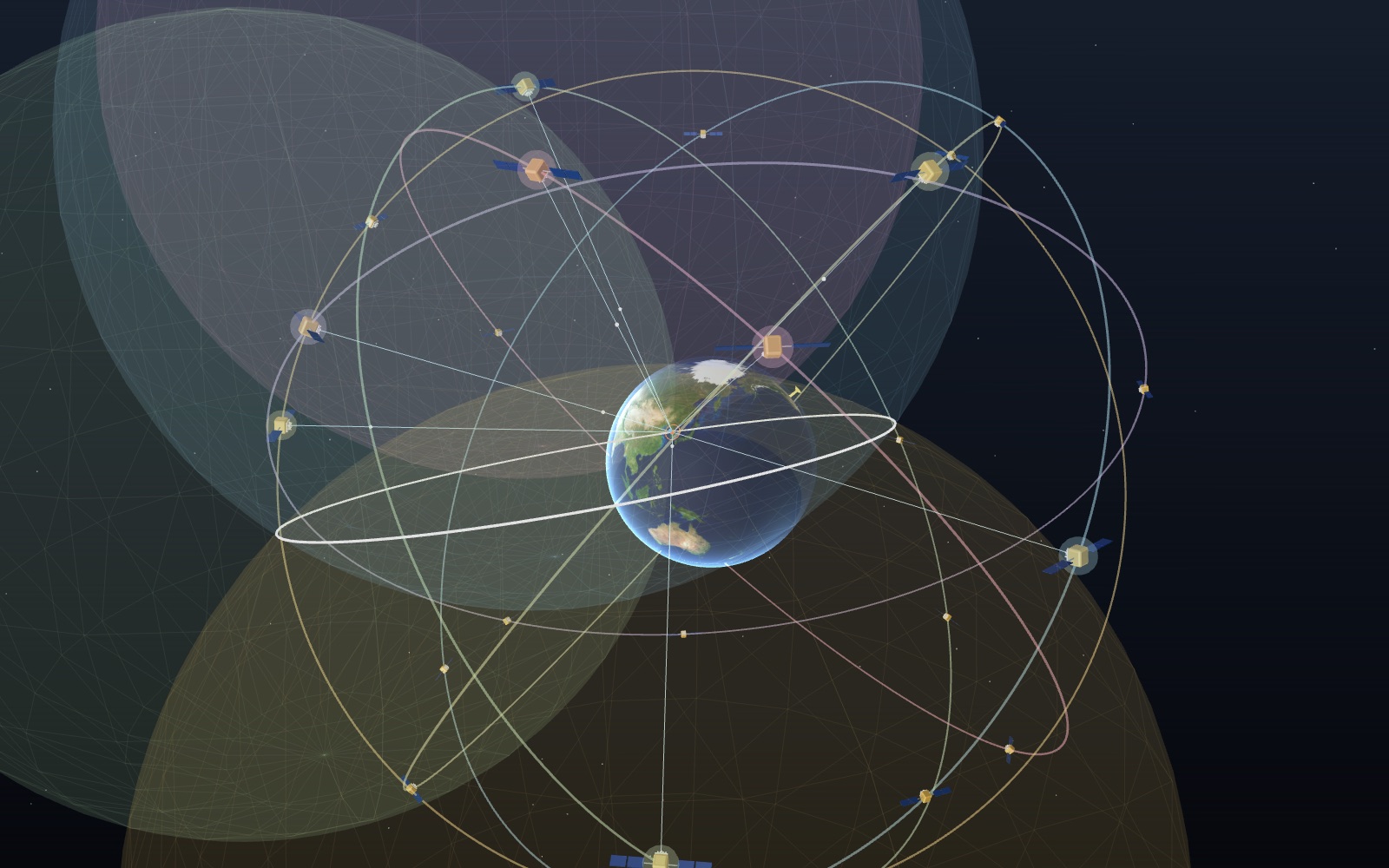
How GPS works: why your phone needs four satellites
A GPS signal takes about 70 thousandths of a second to fall 20,200 km to your phone, and a millionth of a second of error moves you 300 m.
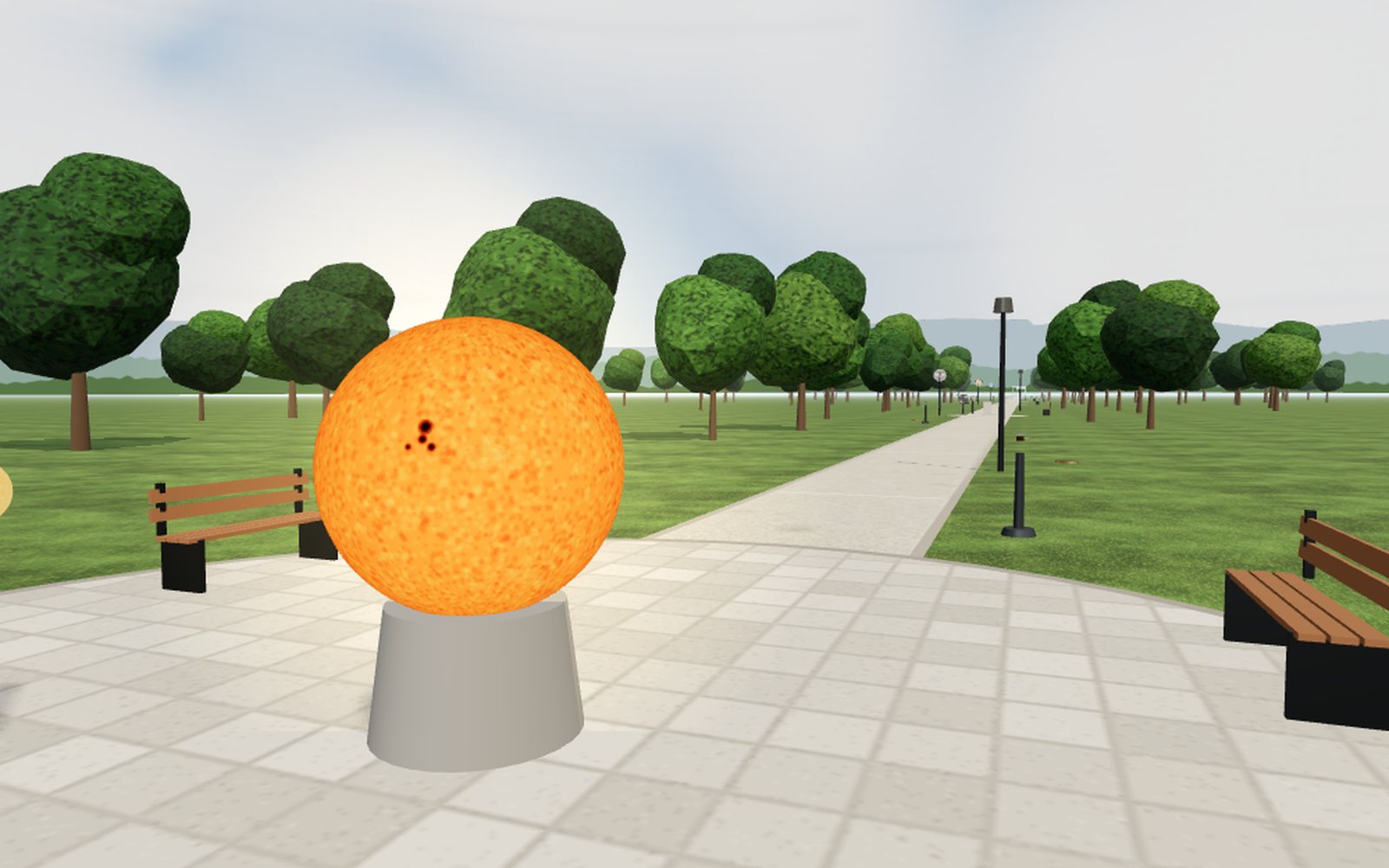
Solar system scale model measurements along a park walk
Shrink the Sun to a ball 1.39 m wide and Earth becomes a 1.27 cm marble 150 m down the path, Neptune is 4.5 km away and Voyager 1 would be 25.7 km.