FIG. 81Walk-throughs
Solar system scale model measurements along a park walk
Shrink the Sun to a ball 1.39 m wide and Earth becomes a 1.27 cm marble 150 m down the path, Neptune is 4.5 km away and Voyager 1 would be 25.7 km.
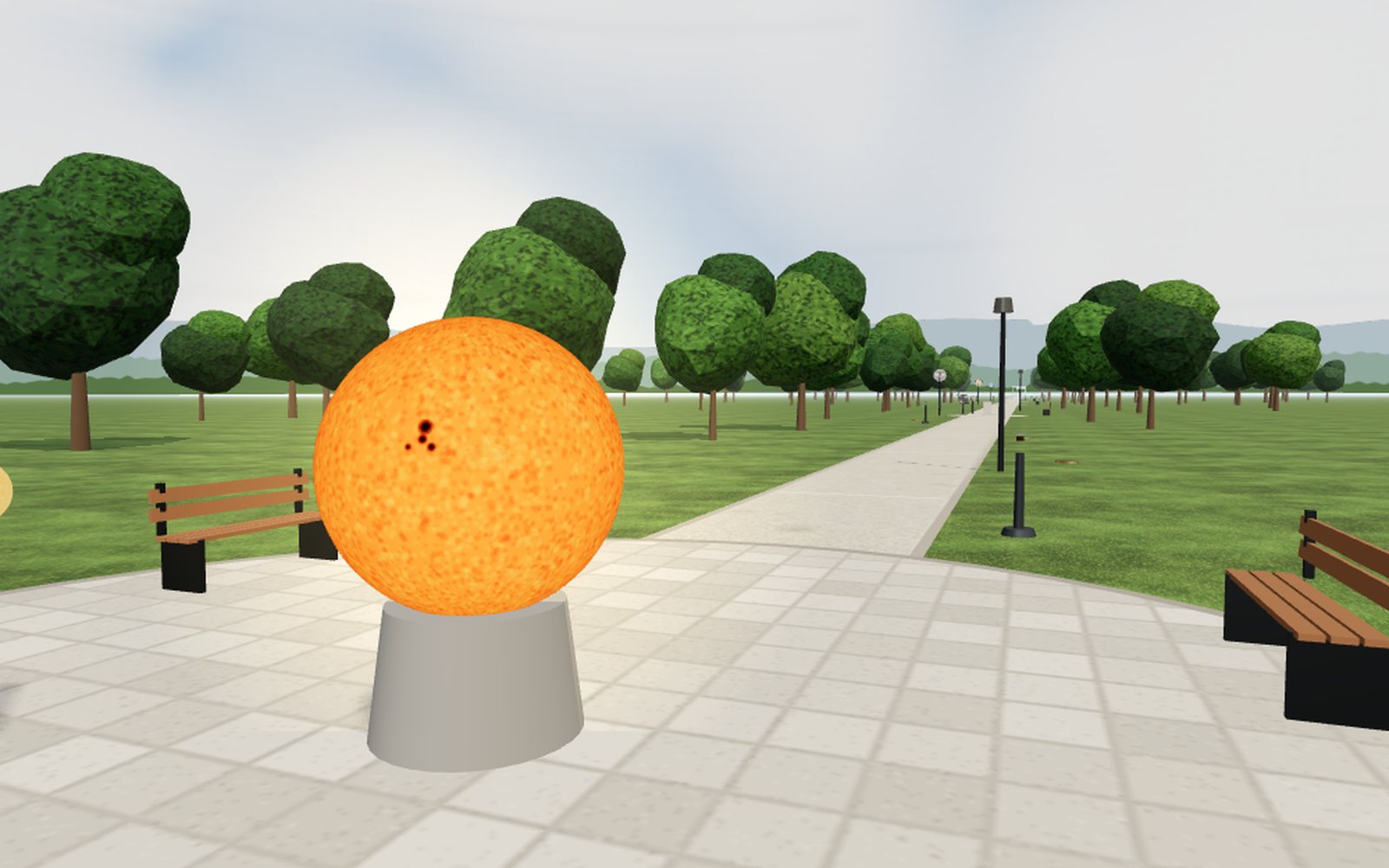
This device cannot show the 3D model. You can read the guide steps below as text.
1 / 9 A Sun 1.39 m wideThis ball is the Sun at one billionth of its size: 1.39 m across. Every metre of the path stands for a million kilometres. Walk with WASD or the arrow keys, or use the buttons to walk or jump to the next stop. The field guide lists 70 things along the way.
Drag to turn. Scroll or pinch to zoom.
How big is the solar system if the Sun is a ball you can stand next to?
Most pictures of the solar system cheat. The planets sit in a neat row a hand's width apart, and Jupiter looks like a beach ball parked next to the Sun. The cheat is necessary, because a page cannot show the real sizes and the real distances at the same time. This exhibit drops the cheat. It shrinks everything by the same factor, sizes and distances together, and lays the result out along a path in a park.
The scale is one billionth (1 : 1,000,000,000). At that scale the Sun, 1,391,400 km across, becomes a glowing ball 1.39 m wide. Earth becomes a marble 1.27 cm wide, on a stone plinth 149.6 m down the path. Neptune is 4.5 km away. At an ordinary walking pace of 1.4 m/s you reach Earth in under two minutes and Neptune in 54 minutes.
Along the way there are 70 things to find: the Sun, eight planets, five dwarf planets, 21 moons, a dozen asteroids and comets, nine spacecraft, and the edges of the belts and of the Sun's own bubble. The field guide button lists them all. Pick one and you are taken to it.
One metre for a million kilometres
At one billionth, one metre of path stands for one million kilometres, and one millimetre of ball for 1,000 km. Every ball has the body's mean diameter divided by a billion, and every plinth stands at the body's mean distance from the Sun (the semi-major axis of its orbit) divided by a billion. The values come from the NASA NSSDCA fact sheets, and the table below was recomputed from them.
| Body | Real diameter | Ball in the park | Distance from the Sun ball | Sunlight takes |
|---|---|---|---|---|
| Sun | 1,391,400 km | 1.39 m | 0 | |
| Mercury | 4,879 km | 4.9 mm | 57.9 m | 3 min 13 s |
| Venus | 12,104 km | 1.21 cm | 108.2 m | 6 min 1 s |
| Earth | 12,742 km | 1.27 cm | 149.6 m | 8 min 19 s |
| Mars | 6,779 km | 6.8 mm | 228.0 m | 12 min 40 s |
| Ceres | 952 km | 0.95 mm | 413 m | 23 min |
| Jupiter | 139,822 km | 14.0 cm | 778.5 m | 43 min 17 s |
| Saturn | 116,464 km | 11.6 cm | 1.43 km | 1 h 20 min |
| Uranus | 50,724 km | 5.07 cm | 2.87 km | 2 h 39 min |
| Neptune | 49,244 km | 4.92 cm | 4.51 km | 4 h 11 min |
| Pluto | 2,376 km | 2.4 mm | 5.87 km | 5 h 26 min |
A few comparisons help. Earth's diameter goes into the Sun's 109 times, so about 1.3 million Earths would fill the Sun's volume. Jupiter is the only planet you could pick out from a few steps away without a sign. Mercury, Mars and Pluto are small enough to lose if you drop them on the path.
Four small planets in the first 230 metres
The rocky planets come and go quickly. Mercury is at 57.9 m, Venus and Earth are 41 m apart, and Mars is at 228 m. Then the path goes quiet. Jupiter waits at 778.5 m, Saturn at 1.43 km, Uranus at 2.87 km and Neptune at 4.51 km. Each gap is roughly as long as everything before it put together, which is why the outer solar system feels so empty on foot.
From the Mars plinth, Jupiter's 14 cm ball is 550 m away. It covers about 0.015°, far too small to pick out against the trees, so every stop has a round signpost and the path carries a painted distance mark every 50 m.
Moons on rails
Most moons are tiny next to their planets and close to them. Earth's Moon is a 3.5 mm bead 38.4 cm from the marble, on its own brass pin. The International Space Station would orbit 0.4 mm above the marble, about the thickness of a fingernail, and the ring of geostationary weather and TV satellites sits 3.6 cm out. The James Webb Space Telescope works near the L2 point, 1.5 million km beyond Earth, so its post stands 1.5 m behind the marble.
Mars's two moons are specks of dust. Phobos, 22 km wide, would be 0.02 mm across and 9.4 mm from the 6.8 mm pea. The model hangs both Martian moons on a hair-thin wire, because a pin would be thicker than they are.
The giant planets need more room. A stone rail runs out from each plinth, and the moons stand on it at their real distances. Jupiter's four large moons, the ones Galileo saw in 1610, stand between 42 cm and 1.88 m from the grapefruit. Saturn's Titan is 1.22 m from Saturn and Iapetus 3.56 m. Uranus's five large moons fit within 58 cm, and Triton stands 35.5 cm from Neptune. Pluto's moon Charon is half Pluto's width and only 2 cm from it, which is why the two are sometimes called a double dwarf planet.
You can walk faster than light here
Light crosses 299,792.458 km every second. Shrink that by a billion and light in the park moves at 0.30 m/s. An ordinary walk is 1.4 m/s, so here you can outpace sunlight by almost five times. Sunlight needs 8 minutes 19 seconds to reach Earth's plinth: 149,600,000 ÷ 299,792 is 499 seconds, often rounded to 8 minutes 20 seconds.
The "Send light from the Sun" switch makes this visible. A pulse leaves the Sun ball at 0.30 m/s and the readout tells you how far ahead or behind it you are. Walk at the default pace of 3 m/s and you reach Earth ten times faster than the light does.
How fast can you go?
The speed button has four steps, and number keys 1 to 4 pick them directly:
| Step | Speed | Sun to Earth | Sun to Neptune | Whole path (10.3 km) |
|---|---|---|---|---|
| Stroll | 1.4 m/s | 1.8 min | 54 min | 2 h 2 min |
| Brisk walk | 3 m/s | 50 s | 25 min | 57 min |
| Run | 6 m/s | 25 s | 12.5 min | 29 min |
| Bike | 12 m/s | 12 s | 6.3 min | 14.3 min |
"Walk to next" walks you to the next stop at the chosen speed. "Fast travel" jumps there in a couple of seconds, and the field guide jumps straight to anything on the list.
The Sun looks the right size from every stop
From Earth's plinth the Sun ball, 1.39 m wide and 149.6 m away, covers 0.53°. That is the same angle the real Sun covers in Earth's sky. When every length shrinks by the same factor, every angle stays the same. From Mars it is 0.35°. From Neptune it is 0.018°, about one minute of arc, which is close to the smallest detail a sharp eye can see. That is why the Sun shows only as a bright point when you look back from the far end.
Why the asteroid belt is almost empty
Two gates cross the path at 329 m and 479 m, marking 2.2 and 3.2 AU, where most main-belt asteroids orbit. Ceres, the largest body in the belt and a dwarf planet, is a 0.95 mm grain at 413 m. Vesta (525 km) and Pallas (512 km) are half that. NASA notes that all the asteroids together weigh less than the Moon.
The grit scattered on the path between the gates is for show. At this scale a typical asteroid would be smaller than a speck of dust, and the gaps between them would be measured in metres of empty air. Spacecraft have crossed the belt many times without needing to steer around anything.
Closer in, posts mark three asteroids that spacecraft visited and brought samples from or landed on: Bennu, Ryugu and Eros. The post for Apophis stands between Venus and Earth. On 13 April 2029 it will pass 32,000 km from Earth, which at this scale is 3.2 cm from the marble.
Out to the Kuiper belt
The Kuiper belt is a wide ring of icy bodies from about 30 to 50 AU, and its two gates stand 4.49 km and 7.48 km from the Sun. Neptune is just inside the first gate. Pluto, a 2.4 mm sesame seed, stands at 5.87 km. Beyond it come posts for Haumea, Quaoar, Makemake and Arrokoth, the two-lobed object New Horizons flew past on 1 January 2019.
New Horizons itself has a post at 9.85 km, where it was in October 2026, 65.8 AU from the Sun. The path ends at 10.3 km, just past Eris. Eris is almost exactly Pluto's size and a little heavier. Its discovery in 2005 is what pushed the International Astronomical Union to write a definition of a planet in 2006, and that definition moved Pluto into the new class of dwarf planets.
What the signposts at the end say
Many things lie too far out for a park. The signposts at the end of the path give each one as a distance in the park:
- Voyager 1, the farthest spacecraft, was 172 AU from the Sun in October 2026. That is 25.7 km in the park. NASA calculates it will be one light day from Earth on 18 November 2026.
- Voyager 2 is at 144 AU (21.6 km), and the silent Pioneer 10 and 11 are at 142 and 119 AU.
- The heliopause, the edge of the bubble of solar wind, was 121.6 AU out when Voyager 1 crossed it on 25 August 2012: 18.2 km in the park.
- The Oort cloud is a shell of comets that no one has seen directly. It may begin somewhere between 2,000 and 5,000 AU (300 km or more in the park) and reach 100,000 AU, which would be about 15,000 km.
- Proxima Centauri, the nearest star, is 40,208 km away in the park, about once around the Earth's 40,075 km equator.
So if the Sun stood in a park in your town, the nearest star would be another ball of about the same size on the far side of the planet.
Scale walks you can visit
This is a well-loved idea and several towns have built one in stone and metal:
- Voyage, on the National Mall in Washington, DC, opened on 17 October 2001 at one ten-billionth, one tenth the size of this one. Its Sun is a 13.9 cm ball and Pluto is about 600 m away.
- The Sagan Planet Walk in Ithaca, New York, was built in 1997 by the Sciencenter in honour of Carl Sagan. It runs 1.2 km at one five-billionth.
- Sweden Solar System uses the Avicii Arena in Stockholm, one of the largest spherical buildings in the world, as the Sun. At one twenty-millionth the planets are lined up northwards across the country.
The walk here is ten times the scale of Voyage, which makes Earth big enough to see as a ball (1.27 cm), while the walk to Neptune still fits in an afternoon.
How the model differs from the real solar system
- All in a line. The planets never line up. Each is somewhere on its own orbit, and the model puts them all in a row so one path passes every one.
- Average distances. Each plinth stands at the mean distance. Mercury's real distance swings between 46 and 70 million km, Mars between 207 and 249, and Pluto between 30 and 49 AU, so a plinth for "today" would sit somewhere else.
- Moons in a row. The moons stand on one rail at their mean distance from the planet, not spread round their orbits.
- Spacecraft distances are dated. Probes that are leaving the solar system keep moving. Voyager 1 adds about 3.6 AU a year, which is 540 m of path.
- Round balls. Saturn is about 11 % wider at the equator than pole to pole, and the balls use the mean diameter. Haumea, which is shaped like an egg, is the only one drawn stretched.
- Brightness. The Sun ball glows but is not blinding, and the planets are lit by the park's afternoon light, not by the Sun ball.
- Trees, lamps and benches are life-size, not to scale, so you can tell how far you have walked.
Calculate a walk before building one
Start with metres on both sides of the calculation. The Sun's diameter in the exhibit's table is 1,391,400 km. Multiplying by 1,000 converts it to 1,391,400,000 m. Dividing by 1,000,000,000 gives a model diameter of 1.3914 m. Doing the division while leaving the original value in kilometres would produce kilometres, not metres. A misplaced unit can turn a park-sized model into something a thousand times too small.
Earth's distance uses the same rule. The table gives 149,598,000 km, which becomes 149,598,000,000 m before scaling and 149.598 m afterwards. Earth's diameter, 12,742 km, becomes 0.012742 m, or 12.742 mm. Distance and diameter have very different starting values, but they must have the same divisor. Neptune's 4,514,953,000 km becomes 4,514.953 m of path. These are the values used to place the stations, rather than distances estimated from their appearance on the screen.
Suppose a visitor takes steps 0.70 m long. That is an assumed step length for this calculation, not a measured property of the visitor or a setting in the exhibit. Divide each model distance by 0.70. Earth is about 214 steps from the Sun, and Neptune about 6,450 steps. At 1.4 m/s this visitor takes two steps each second, so Earth requires about 107 seconds and Neptune about 3,225 seconds, or 53.8 minutes. Longer steps change the step count; they do not change where the planets belong.
A useful check is to choose the Sun's diameter first and recover the distance to Earth from it. Here the distance is about 107.5 solar diameters. If a classroom uses a Sun only 10 cm across, Earth must be about 10.75 m away. Leaving Earth at 149.598 m while substituting that smaller Sun would make two different scales. The result might be convenient to display, but it would no longer preserve apparent sizes or the proportion of empty space.
Why a textbook needs more than one scale
Imagine fitting the Sun and Neptune on a page 30 cm wide, with the Sun at one edge and Neptune at the other. Compressing the model's 4,514.953 m into 0.30 m reduces all its lengths by another factor of about 15,050. The Sun's 1.3914 m diameter becomes about 0.092 mm, narrower than an ordinary pencil line. Earth becomes about 0.00085 mm, or 0.85 micrometres. No printed colour or label can turn that dot into a recognisable globe without enlarging it relative to the distances.
Now try the opposite requirement: make Earth a visible 1 mm dot. This is about 1/13 of its diameter in the park. Neptune would then need to stand about 354 m from the Sun, not at the opposite edge of a page. Making the book wider does not solve the problem unless the page becomes a long strip hundreds of metres across. Showing eight attractive planet portraits in one spread is a different task from representing their sizes and separations faithfully.
That does not make every diagram untrustworthy. A diagram can show orbital order, relative diameters, surface appearance or the shape of a trajectory. Read its caption to find which quantities are drawn to scale. An orbit diagram may enlarge all the planets equally, enlarge small planets more than large ones, or compress the outer distances. None of those choices should be used to measure a travel distance with a ruler.
The line of stations here also has a limitation: it is a comparison of orbital distances, not a map of today's planetary positions. Subtracting the Earth station from the Neptune station gives a difference of solar distances in this layout. It does not give the Earth-to-Neptune separation on a particular date. In reality, the angle between their directions matters as well as their individual distances from the Sun. A real mission needs an ephemeris and a trajectory calculation, not the shortest walk between two plinths.
A signal delay is not a spacecraft travel time
The light switch keeps the unit of time unchanged while shrinking distance. With 149,598,000 km between the Sun and Earth, the one-way light time is about 499 seconds, conventionally rounded to 8 minutes 20 seconds. Neptune's distance gives about 15,060 seconds, or 4 hours 11 minutes. A model light pulse therefore takes those same times to pass the corresponding stations. The scale has reduced its speed to about 0.30 m/s; it has not made sunlight arrive instantaneously.
A reply introduces another delay. For a simple thought experiment, put a receiver at Neptune's mean solar distance and send it a question from the Sun. Even an immediate reply could not return in less than about 8 hours 22 minutes. This doubles the one-way delay and ignores processing time. It is not a prediction for an Earth-based antenna: Earth's position and the spacecraft's actual distance would have to be included. Controllers must distinguish the time a command leaves Earth from the later time when the spacecraft can execute it.
NASA's New Horizons mission shows why the light time must be kept separate from the flight time. The probe launched on 19 January 2006, passed Jupiter for a gravity assist on 28 February 2007, and flew past Pluto on 14 July 2015. That is roughly 9.5 years from launch to Pluto. A photon takes hours to cross a comparable distance. Dividing a distance by light speed answers a communications question, not the question of when a spacecraft will arrive.
The Jupiter encounter changed the probe's trajectory and speed. A spacecraft does not usually point at a destination and cruise along a straight ruler at one fixed speed. It follows a path under gravity, and its speed is always relative to something, such as Earth or the Sun. The exhibit's speed settings are visitor motion in the park, not selectable spacecraft engines. Reaching Pluto quickly with fast travel says nothing about the energy or launch window needed for a real flight.
Larger models occupy a country
The Sweden Solar System gives the same scale problem a different answer. Its organisers describe a scale of 1:20 million, with the Globe in Stockholm representing the Sun and the inner planets in the Stockholm area. The model extends northwards; its Pluto is in Delsbo, about 300 km from the Globe. These are separate installations with local hosts, rather than objects that can all be inspected from one observation point.
Compare that scale with this exhibit's 1:1 billion. Dividing one billion by twenty million gives 50, so corresponding model lengths in Sweden are 50 times larger. Applying that factor to this exhibit's Sun gives about 69.6 m, to Earth's distance about 7.48 km, and to Pluto's distance about 293 km. The last result is reasonably described as about 300 km. These are calculations using the exhibit's adopted astronomical values; they are not fresh measurements of a building or the road route between installations.
The comparison explains why travel directions need care. A station's scale distance represents an astronomical separation. A road may bend, and a visitor may need to detour. The time on a transport planner is therefore not another measurement of the astronomical unit. Both the Swedish installations and the smaller park models need signs explaining what the measured distances refer to. A visitor should not infer that the length of a bus trip is the radius of a scaled planetary orbit.
Three checks to make on the screen
Begin at the Sun and select Earth in the field guide. Before leaving, predict a 1.27 cm globe about 150 m away. Compare that prediction with the distance readout and the small globe on its plinth. Then select Neptune. Its ball is only about 3.9 times Earth's diameter, yet its station is about 30.2 times farther from the Sun. Those ratios answer different questions. A planet does not need to be larger just because it occupies a larger orbit.
Return to the start and turn on "Send light from the Sun". Use the 1.4 m/s speed setting and "Walk to next" for an ordinary walking comparison. After 60 seconds the visitor could cover 84 m while the scaled light covers only about 18 m. Obstacles or a changed route can alter the visitor's progress, so use these as straight-path predictions, not a promise that every manual movement will match the numbers. The pulse's slow motion results from the spatial scale, not a claim that people can outrun light in reality.
Finally, use the field guide to compare Earth, its Moon and Jupiter's moons. The Moon's 38.4 cm separation is easy to underestimate when the Earth globe is only 1.27 cm wide. Keep the displayed distance and the apparent gap separate when changing viewpoint: perspective can make distant objects look close together. The model preserves lengths in its scene, while the camera projects them onto a flat screen. A screenshot alone is not a ruler for that three-dimensional space.
157 things along the path
The field guide now lists 157 things: the Sun, eight planets and five dwarf planets, 44 moons, 40 asteroids and comets, 45 spacecraft and twelve edges and stars. Every one sits where its real distance puts it, and every ball is drawn at its real size, so most of them are far smaller than a grain of sand. The guide has two rows of filters. The first sorts by kind, the second by stretch of the path (Sun to Mars, the asteroid belt, Jupiter, Saturn, Uranus, Neptune, and the Kuiper belt and beyond). Typing a name searches in the page language and in English or Korean, and a tick marks everything you have already seen.
Moons are placed by their mean distance from the planet, from the JPL tables of satellite orbits and sizes. Close moons stand around the planet at spread angles, so their pins do not hide one another: Jupiter's four small inner moons, Metis, Adrastea, Amalthea and Thebe, all sit within 23 cm of the 14 cm Jupiter ball. Saturn's ring shepherds Pan, Atlas, Prometheus and Pandora stand inside or just outside the 27 cm ring. Three moons are so far out that a rail would be absurd. Himalia stands 11.4 m from Jupiter, Phoebe 12.9 m from Saturn and Nereid 5.5 m from Neptune, each on a post of its own in the grass. Pluto's four small moons hang on hair-thin wires 4 to 7 cm from the 2.4 mm Pluto bead.
Asteroids and comets come from the JPL Small-Body Database, which gives each orbit's semi-major axis and, where it has been measured, the diameter. Itokawa, Bennu and Ryugu, the three asteroids that sample missions visited, are each under a micrometre across here. Jupiter's Trojans, which share Jupiter's orbit 60 degrees ahead and behind, stand on posts within 15 m of Jupiter's plinth: Orus, Polymele, Patroclus, Eurybates and Leucus, all on the list of the Lucy probe.
Spacecraft that went to a planet are listed on that planet's display stand, and their entries in the guide take you there. Those that work at a point in space get their own badge on a post: SOHO and DSCOVR at L1, 1.5 m in front of the Earth marble; Webb and Euclid at L2, 1.5 m behind it; Parker Solar Probe and Solar Orbiter at their closest points to the Sun. A spacecraft is never drawn at its true size. At one billionth even the largest one would be smaller than an atom, so the badges are signs, not models.
A display stand at every stop
In front of the Sun, each planet, Ceres and Pluto stands a lectern with a number card and an enlarged cutaway. The card gives the mean diameter, the mass, the length of a day, the length of a year, the mean temperature and the number of known moons, from the NASA planetary fact sheet. Mercury has the longest day on the card, 175.9 Earth days from noon to noon, two of its 88 day years. Venus turns backwards, and its day of 116.8 Earth days is about half its year. Saturn shows 274 known moons, Jupiter 95.
The cutaway beside the card is not to scale. It is a globe 34 cm across with a quarter cut out, showing the layers NASA describes for that world: the core, radiative zone and convective zone of the Sun; Earth's inner core, outer core, mantle and crust; the metallic hydrogen inside Jupiter and Saturn; the water, ammonia and methane ices inside Uranus and Neptune. The giant planet interiors are models built from gravity measurements and could change, so the stand says the layer sizes are rounded. Earth's are measured from earthquake waves and are the firmest numbers on the path.
Tasks, hidden inlays and the map
The Tasks panel has seven tasks that check what you did on the stage rather than what you clicked. One asks you to find the place where sunlight is 8 minutes 20 seconds old, which turns out to be Earth's plinth. Another asks for all four big moons of Jupiter, which you find by walking along the rail beside it. One is a question: at a stroll, how long to Voyager 1? The path would run 25.7 km, so the answer is a little over five hours. The race task is the strangest one: switch on the light pulse and beat it to Mercury, which at this scale anyone can do.
There are 13 brass inlays. They lie in the grass beside the path with no name tag. They mark where Mercury, Earth, Mars and Pluto come closest to the Sun and where they go farthest, where light is one minute and one hour old, where Voyager 1 took the Pale Blue Dot picture and where Jupiter tore comet Shoemaker-Levy 9 apart. The Hidden tab lists them as question marks with the nearest stop as a clue until you step up to one.
The map at the bottom squeezes the 10.3 km path onto a strip. A straight scale would put the four inner planets within one pixel of the Sun, so the map uses a logarithmic one, and the white arrow shows where you are. Tap anywhere on it to travel to the nearest stop. The Size and distance tab shows the same planets twice at the same one billionth scale: once as balls side by side, once as dots along the path. To keep the balls visible, that row is drawn thousands of times larger than the distance row; the panel prints both scales.
From the speed of light to a car
The speed button has six steps. Stroll, brisk walk, run and bike are the speeds people really move at. Car is 25 m/s, 90 km/h, which reaches Neptune in three minutes. Light is the slowest step of all, 0.30 m/s, because light in the park covers 299,792 km a second at one billionth. Walking at light speed is the one setting where the clock and the light time in the readout always agree: after 8 minutes 19 seconds you reach Earth.
Orbits are not circles
Every ball stands at its planet's mean distance, but no orbit is a perfect circle. Mercury swings between 46.0 and 69.8 million km, so its two inlays are 24 m apart. Earth's are only 5 m apart, at 147.1 and 152.1 m, and Earth is closest to the Sun in early January. That is why distance cannot be the cause of the seasons. Pluto's orbit is the most stretched of all on the path: its closest point, 4,436.8 m out, lies inside Neptune's mark, and from 1979 to 1999 Pluto really was closer to the Sun than Neptune.
Questions
Why one billionth and not a smaller scale?
Because at one billionth Earth is still a ball you can see and hold, and Neptune is a walk rather than a road trip. At one ten-billionth, as on the National Mall, Earth shrinks to a 1.3 mm pinhead. At one hundred-millionth, the Sun would be 13.9 m across and Neptune 45 km away.
How long would it take to walk the whole thing?
At an ordinary 1.4 m/s, Earth takes under two minutes, Neptune 54 minutes, Pluto 70 minutes and the end of the path, past Eris, just over two hours. Voyager 1, at 25.7 km, would be about five hours away on foot.
Why can't I see the next planet from where I stand?
Because the gaps are huge and the balls are small. From Earth's plinth, Mars is a 6.8 mm pea 78 m away. It covers 0.005°, about as much as a human hair held at arm's length. The signposts and the painted marks are there so you know which way to look.
Is Pluto a planet?
Since 2006, the International Astronomical Union classes Pluto as a dwarf planet. It is round and orbits the Sun, but it has not cleared its part of space of other bodies: the Kuiper belt around it holds many objects of similar size. Ceres, Eris, Haumea and Makemake are dwarf planets for the same reason.
Would a spacecraft crossing the asteroid belt hit anything?
Almost certainly not. In the park the belt is 150 m deep, and the rocks in it would be smaller than dust. Pioneer 10 was the first spacecraft to cross it, in 1972 and 1973, and every crossing since has been uneventful.
Where is the edge of the solar system?
It depends on what you count. The heliopause, where the solar wind gives way to interstellar gas, is about 120 AU out (18 km in the park). The Sun's gravity still holds comets in the Oort cloud much farther away, possibly to 100,000 AU (15,000 km here).
How far is a light year at this scale?
A light year is 9.46 trillion km, so in the park it is 9,461 km, nearly a quarter of the way round the Earth. Proxima Centauri, 4.25 light years away, ends up 40,208 km from the Sun ball.
Why does sunlight take 8 minutes to reach Earth, but 4 hours to reach Neptune?
Because light covers a fixed 299,792 km every second. Neptune is 30 times farther from the Sun than Earth, so its light time is 30 times longer: 8 minutes 19 seconds × 30.2 is about 4 hours 11 minutes.
Do the balls spin?
Slowly, so you can see their surfaces change. The real spin would be far too slow to notice at this size, apart from Jupiter and Saturn, which each turn in about ten hours.
Does shrinking the model shorten the light delay?
No. Only lengths are scaled here. The model light speed is about 0.30 m/s, so the Sun-to-Earth delay remains about 499 seconds. A faster walking speed changes the visitor motion, not the light pulse or the real speed of light.
Why is light slower than walking here?
Because only lengths are shrunk. Light still takes 499 seconds to reach Earth, but Earth is now 149.6 m away, so in the park light moves at 149.6 m in 499 s, about 0.30 m/s. A stroll at 1.4 m/s is almost five times faster. The real light delay never changes.
Why do some moons stand far out in the grass?
Because they really are that far from their planets. Himalia orbits Jupiter 11.4 million km away, Phoebe circles Saturn at 12.9 million km and Nereid's mean distance from Neptune is 5.5 million km. A rail that long would cross the path, so each gets a post of its own at the right distance.
Where do the spacecraft positions come from?
Craft beyond the planets use dated distances from the Sun, read in October 2026. Craft that orbit or landed on a body are listed at that body, and craft at the L1 and L2 points sit 1.5 million km sunward or behind Earth. Missions on their way, such as Europa Clipper and JUICE, are listed at their goal with their arrival year.
Why are some cutaways labelled rounded?
Earth's layers are measured from earthquake waves, and Mars's core size comes from the InSight lander's seismometer. Nobody has sent a seismometer into Jupiter, Saturn, Uranus or Neptune. Their interiors come from models that fit gravity and magnetic measurements, so the sizes on the stand are round figures.
Do all the other planets really fit between Earth and the Moon?
Yes, just. The mean diameters of Mercury, Venus, Mars, Jupiter, Saturn, Uranus and Neptune add up to 380,016 km, and the Moon's mean distance is 384,400 km. One of the hidden inlays by Earth's plinth says so; on the path it is the 38.4 cm gap between the marble and the Moon bead.
Terms
- AU (astronomical unit): 149,597,870.7 km, roughly the average distance from Earth to the Sun. In the park it is 149.6 m.
- Semi-major axis: half the longest width of an elliptical orbit, used here as a planet's mean distance from the Sun.
- Light time: how long light takes to cover a distance, at 299,792.458 km per second.
- Dwarf planet: a round body that orbits the Sun but has not cleared its orbit of other bodies.
- Kuiper belt: a ring of icy bodies beyond Neptune, about 30 to 50 AU from the Sun.
- Oort cloud: a distant shell of comets thought to surround the solar system, never seen directly.
- Heliopause: the edge of the bubble the solar wind blows into interstellar space.
- L2: a point 1.5 million km beyond Earth, on the far side from the Sun, where a spacecraft can stay in step with Earth.
Sources
- NASA NSSDCA, Planetary Fact Sheet (Metric). https://nssdc.gsfc.nasa.gov/planetary/factsheet/ (checked 17 October 2026)
- NASA NSSDCA, Sun Fact Sheet. https://nssdc.gsfc.nasa.gov/planetary/factsheet/sunfact.html (checked 17 October 2026)
- NASA NSSDCA, Moon Fact Sheet. https://nssdc.gsfc.nasa.gov/planetary/factsheet/moonfact.html (checked 17 October 2026)
- NASA NSSDCA, Pluto Fact Sheet. https://nssdc.gsfc.nasa.gov/planetary/factsheet/plutofact.html (checked 17 October 2026)
- NASA JPL Solar System Dynamics, Planetary Satellite Physical Parameters. https://ssd.jpl.nasa.gov/sats/phys_par/ (checked 17 October 2026)
- NASA JPL Solar System Dynamics, Planetary Satellite Mean Elements. https://ssd.jpl.nasa.gov/sats/elem/ (checked 17 October 2026)
- NASA Science, Ceres: Facts. https://science.nasa.gov/dwarf-planets/ceres/facts/ (checked 17 October 2026)
- NASA Science, Asteroids. https://science.nasa.gov/solar-system/asteroids/ (checked 17 October 2026)
- NASA Science, Apophis. https://science.nasa.gov/solar-system/asteroids/apophis/ (checked 17 October 2026)
- NASA Science, Kuiper Belt. https://science.nasa.gov/solar-system/kuiper-belt/ (checked 17 October 2026)
- NASA Science, Oort Cloud. https://science.nasa.gov/solar-system/oort-cloud/ (checked 17 October 2026)
- NASA Science, Voyager 1: What Is a Light-Day. https://science.nasa.gov/mission/voyager/voyager-1/voyager-1-what-is-a-light-day (checked 17 October 2026)
- NASA Science, Where Are Voyager 1 and Voyager 2 Now? https://science.nasa.gov/mission/voyager/where-are-voyager-1-and-voyager-2-now/ (checked 17 October 2026)
- Heavens-Above, Spacecraft escaping the Solar System. https://www.heavens-above.com/SolarEscape.aspx (checked 17 October 2026)
- NASA Science, New Horizons. https://science.nasa.gov/mission/new-horizons/ (checked 17 October 2026)
- NASA Science, Webb Orbit. https://science.nasa.gov/mission/webb/orbit/ (checked 17 October 2026)
- IAU (ESO archive), Resolution B5: Definition of a Planet in the Solar System (2006). https://iauarchive.eso.org/static/resolutions/Resolution_GA26-5-6.pdf (checked 17 October 2026)
- NASA Imagine the Universe, The Nearest Neighbor Star. https://imagine.gsfc.nasa.gov/features/cosmic/nearest_star_info.html (checked 17 October 2026)
- NASA / Journey through the Universe, Voyage Scale Model Solar System lesson. https://science.nasa.gov/wp-content/uploads/2023/09/voyagescalemodelss.pdf (checked 17 October 2026)
- Sciencenter, Sagan Planet Walk. https://sciencenter.org/experiences/sagan/ (checked 17 October 2026)
- Sharing Sweden, Sweden Solar System. https://sharingsweden.se/materials/sweden-solar-system/ (checked 17 October 2026)
- NASA JPL Solar System Dynamics, Small-Body Database API. https://ssd-api.jpl.nasa.gov/doc/sbdb.html (checked 26 October 2026)
- NASA JPL Solar System Dynamics, Small-Body Database Lookup. https://ssd.jpl.nasa.gov/tools/sbdb_lookup.html (checked 26 October 2026)
- NASA Science, Pluto: Facts. https://science.nasa.gov/dwarf-planets/pluto/facts/ (checked 26 October 2026)
- NASA Science, Voyager 1's Pale Blue Dot. https://science.nasa.gov/mission/voyager/voyager-1s-pale-blue-dot/ (checked 26 October 2026)
- NASA Science, Comet Shoemaker-Levy 9. https://science.nasa.gov/solar-system/comets/p-shoemaker-levy-9/ (checked 26 October 2026)
- NASA Science, SOHO. https://science.nasa.gov/mission/soho/ (checked 26 October 2026)
- NASA Science, Solar Orbiter. https://science.nasa.gov/mission/solar-orbiter/ (checked 26 October 2026)
- NASA Science, Parker Solar Probe. https://science.nasa.gov/mission/parker-solar-probe/ (checked 26 October 2026)
- NASA Science, MESSENGER. https://science.nasa.gov/mission/messenger/ (checked 26 October 2026)
- ESA, BepiColombo. https://www.esa.int/Science_Exploration/Space_Science/BepiColombo (checked 26 October 2026)
- NASA Science, Magellan. https://science.nasa.gov/mission/magellan/ (checked 26 October 2026)
- JAXA, Venus Climate Orbiter Akatsuki. https://global.jaxa.jp/projects/sas/planet_c/ (checked 26 October 2026)
- NASA Science, Hubble Space Telescope. https://science.nasa.gov/mission/hubble/ (checked 26 October 2026)
- ESA, Euclid. https://www.esa.int/Science_Exploration/Space_Science/Euclid (checked 26 October 2026)
- ISRO, Chandrayaan-3. https://www.isro.gov.in/Chandrayaan3_Details.html (checked 26 October 2026)
- NASA Science, Mars Reconnaissance Orbiter. https://science.nasa.gov/mission/mars-reconnaissance-orbiter/ (checked 26 October 2026)
- NASA Science, Mars 2020 Perseverance. https://science.nasa.gov/mission/mars-2020-perseverance/ (checked 26 October 2026)
- NASA Science, Ingenuity Mars Helicopter. https://science.nasa.gov/mission/mars-2020-perseverance/ingenuity-mars-helicopter/ (checked 26 October 2026)
- NASA Science, OSIRIS-REx. https://science.nasa.gov/mission/osiris-rex/ (checked 26 October 2026)
- JAXA, Hayabusa2 Project. https://www.hayabusa2.jaxa.jp/en/ (checked 26 October 2026)
- NASA Science, DART. https://science.nasa.gov/mission/dart/ (checked 26 October 2026)
- NASA Science, Dawn. https://science.nasa.gov/mission/dawn/ (checked 26 October 2026)
- ESA, Rosetta. https://www.esa.int/Science_Exploration/Space_Science/Rosetta (checked 26 October 2026)
- NASA Science, Lucy. https://science.nasa.gov/mission/lucy/ (checked 26 October 2026)
- NASA Science, Juno. https://science.nasa.gov/mission/juno/ (checked 26 October 2026)
- NASA Science, Europa Clipper. https://science.nasa.gov/mission/europa-clipper/ (checked 26 October 2026)
- ESA, Juice. https://www.esa.int/Science_Exploration/Space_Science/Juice (checked 26 October 2026)
- NASA Science, Cassini. https://science.nasa.gov/mission/cassini/ (checked 26 October 2026)
- ESA, Cassini-Huygens. https://www.esa.int/Science_Exploration/Space_Science/Cassini-Huygens (checked 26 October 2026)
More exhibits
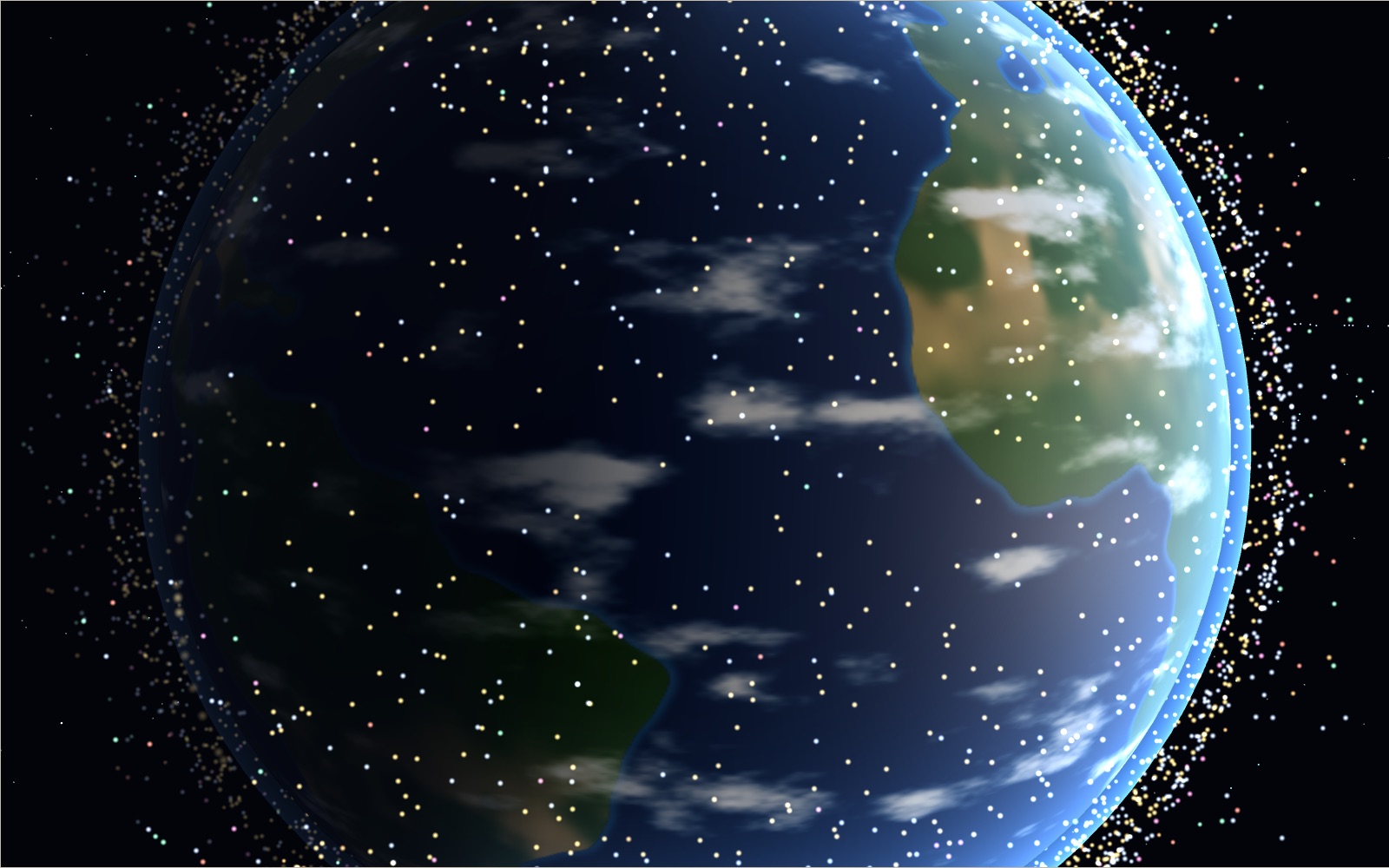
Satellites orbiting Earth right now
On 20 October 2026 the public catalogue listed 16,768 working satellites, and two in every three belonged to one company's internet network.
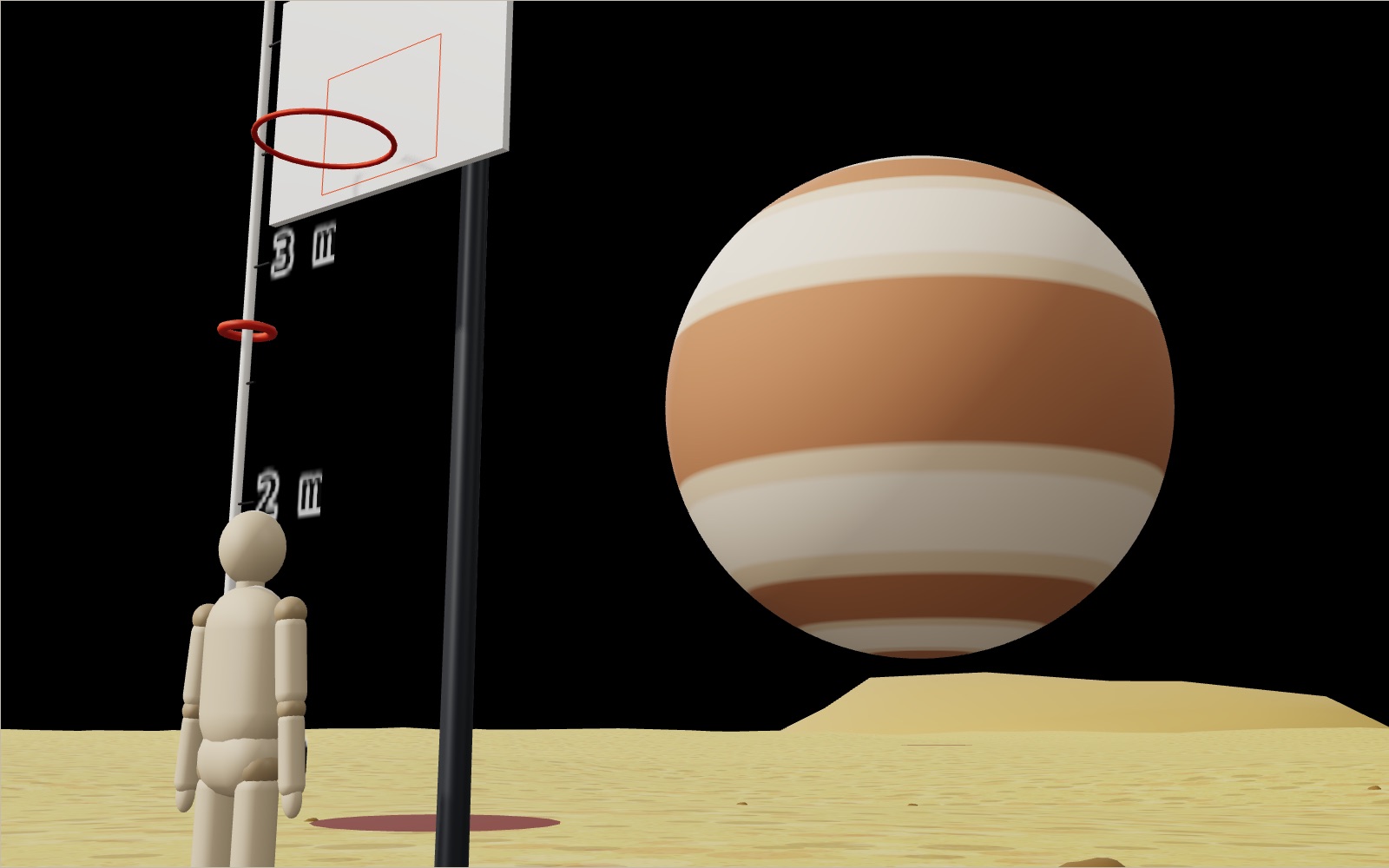
Your weight and jump height on other planets and moons
A 50 cm jump on Earth becomes a 3 m leap on the Moon, 18 m on Ceres and a one-way trip off asteroid Bennu.
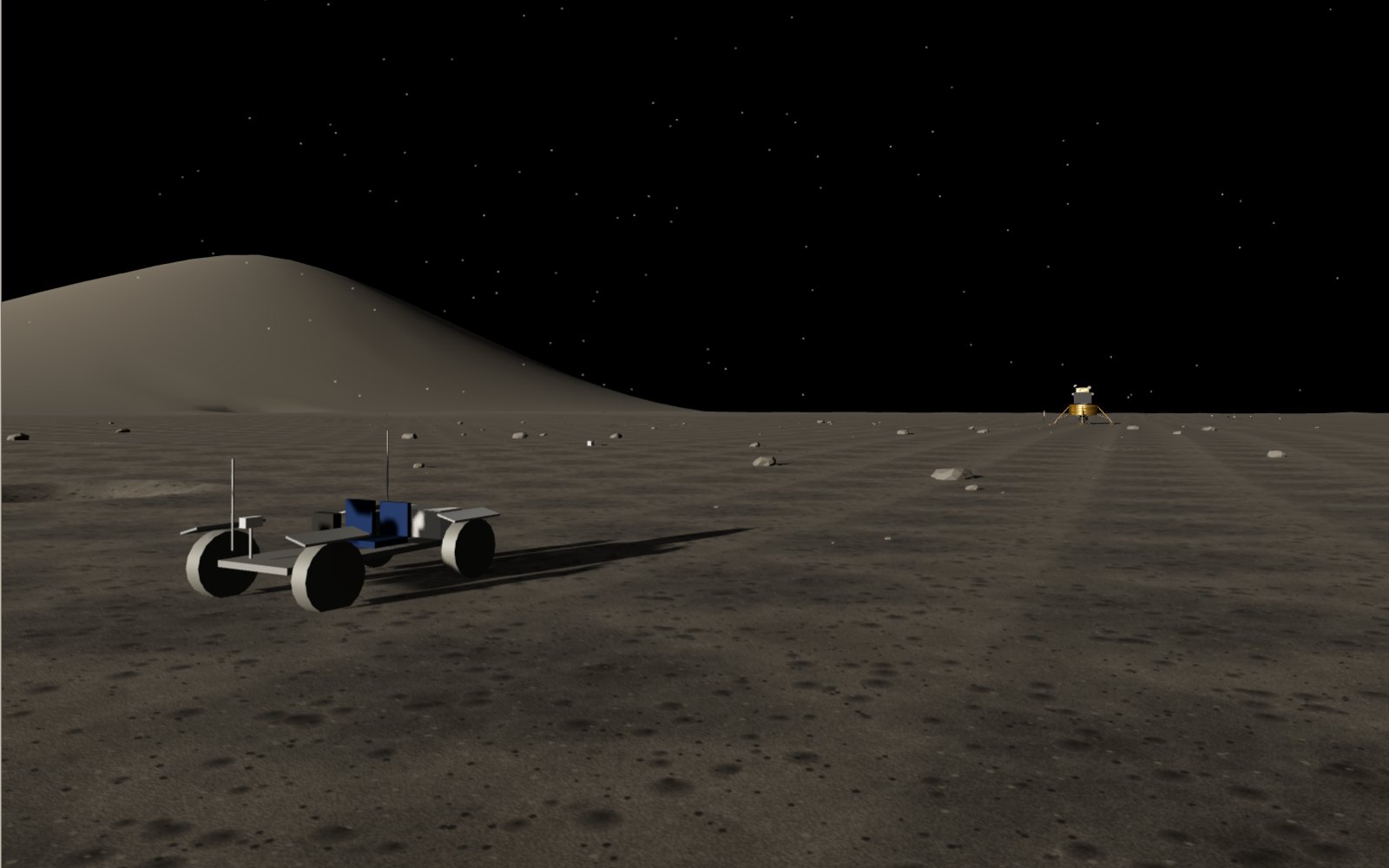
Walk the Apollo landing sites
Standing on the Moon with your eyes 1.6 m up, the horizon is only about 2.4 km away. All six Apollo landing sites are here, from Tranquility Base to Taurus-Littrow.
Fly over Jupiter's clouds and the Great Red Spot
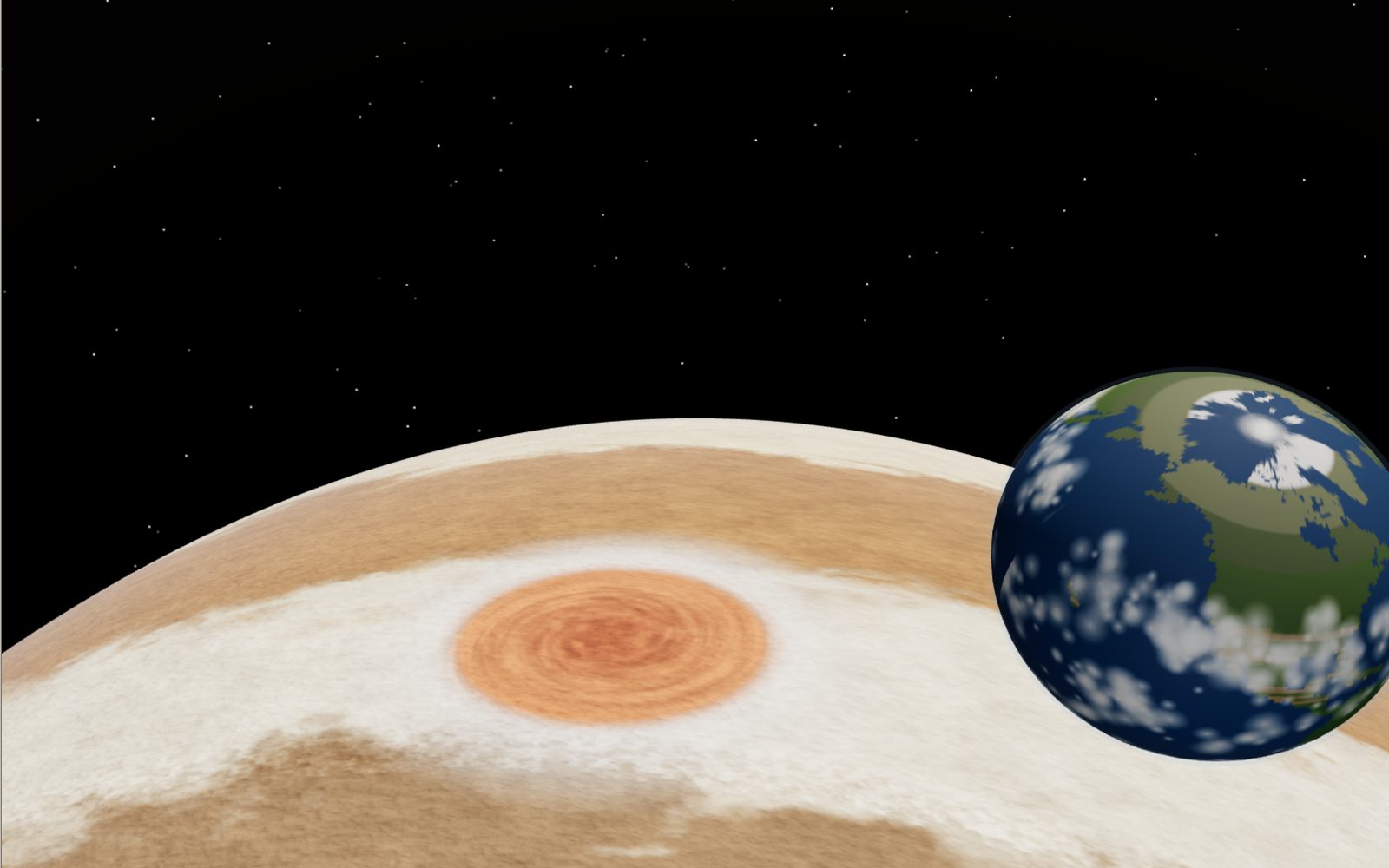
In the late 1800s the Great Red Spot was about three Earths long; Hubble now measures it at about one. Float over it with Earth beside you, then sink 132 km into the clouds with the Galileo probe.
Travelling at the speed of light
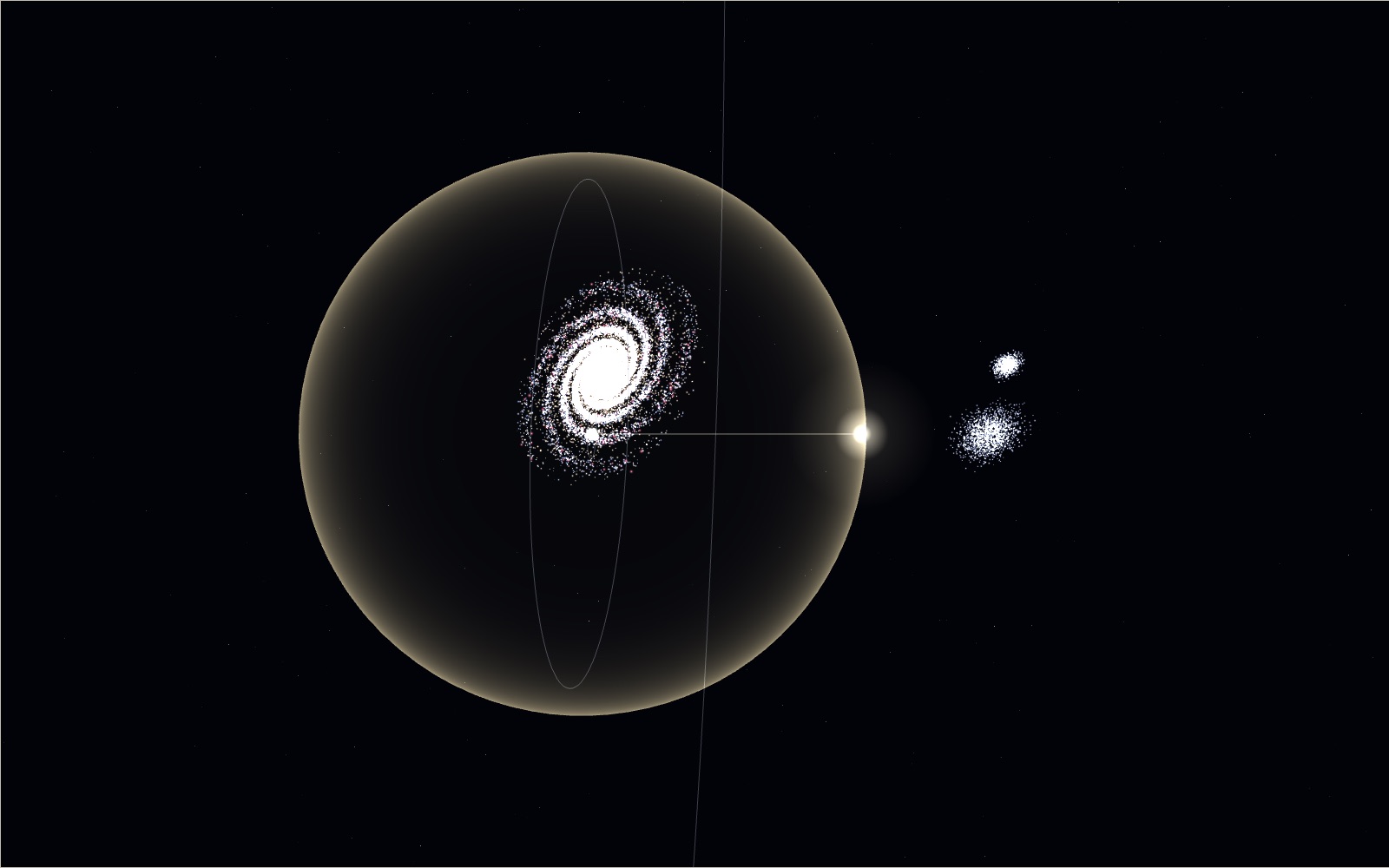
Light goes round the equator 7.5 times in a second, yet the same light needs 2.5 million years to reach the Andromeda galaxy.
Why we have seasons: tilted Earth, changing daylight
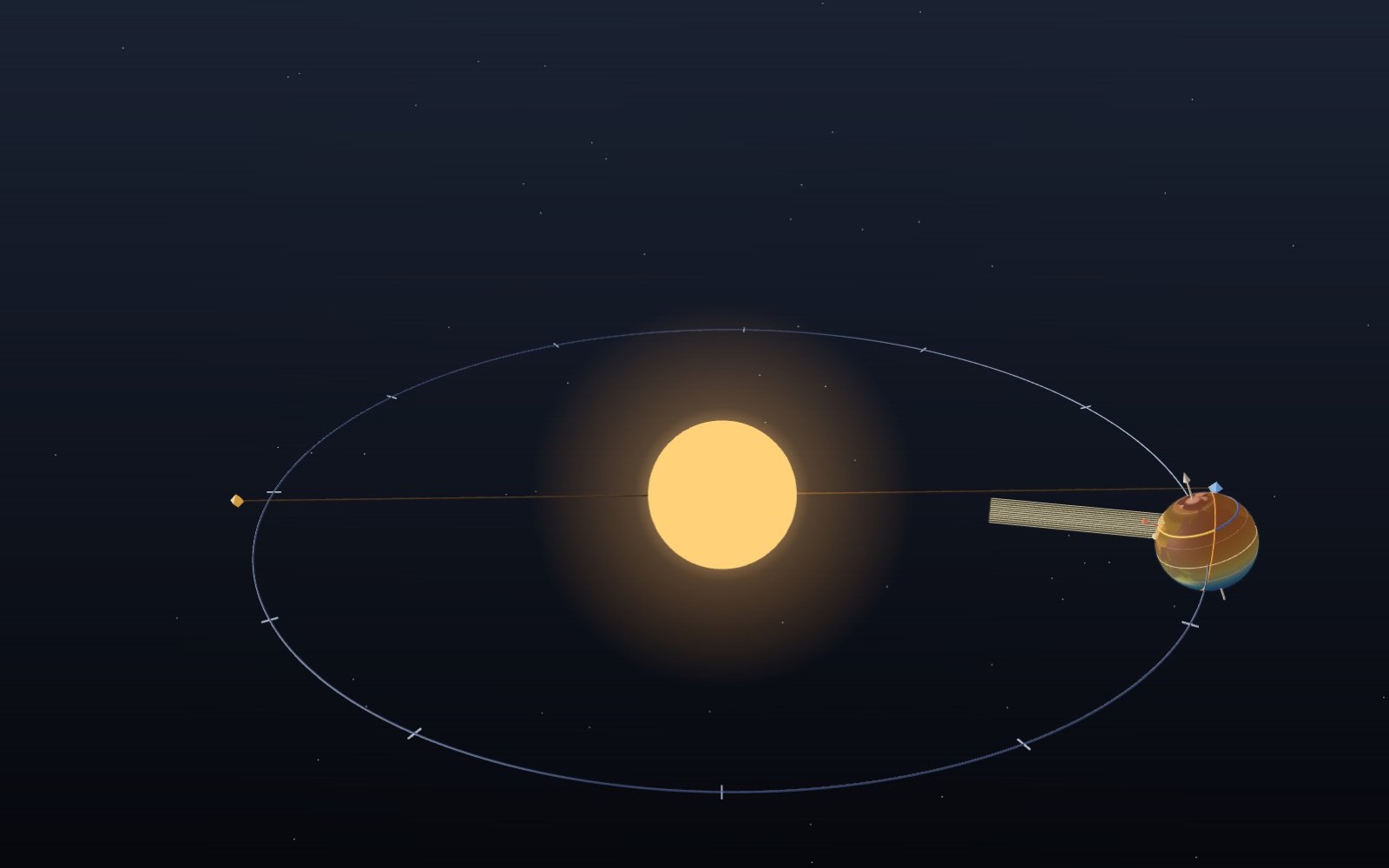
The Earth is closest to the Sun in the first week of January, in the middle of the northern winter.