FIG. 64Walk-throughs
Walk the Apollo landing sites
Standing on the Moon with your eyes 1.6 m up, the horizon is only about 2.4 km away. All six Apollo landing sites are here, from Tranquility Base to Taurus-Littrow.
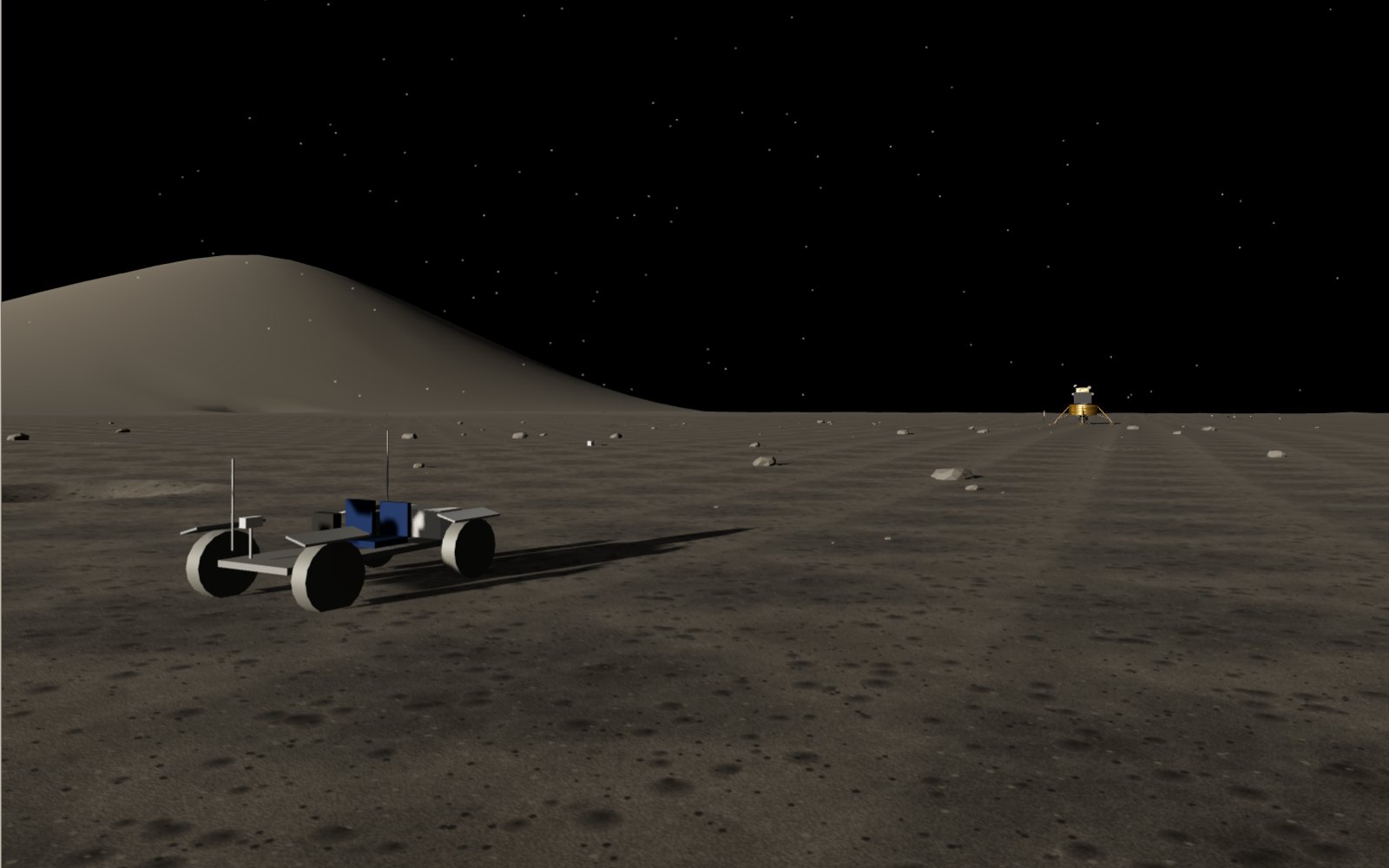
This device cannot show the 3D model. You can read the guide steps below as text.
1 / 17 Tranquility BaseYou stand on the Sea of Tranquility, a few steps from Eagle, at an eye height of 1.6 m. Walk with WASD or the arrow keys and press Space to jump. The Sun is low in the east, so every shadow points west.
Drag to turn. Scroll or pinch to zoom.
Where Eagle came down
Most people know the Apollo 11 landing from a handful of photographs: a boot in grey dust, a flag, a gold-wrapped lander under a black sky. The photographs never show how the pieces sit together. How far was the flag from the ladder? Where did the TV camera stand? Which way did the shadows fall? This exhibit puts the site back together at full size, so you can walk from one thing to the next at the eye height of a standing person, and then does the same for the five landings that followed.
The Lunar Module Eagle landed in the Sea of Tranquility (Mare Tranquillitatis) at 0.67416° N, 23.47314° E, the position NASA's NSSDCA record gives from Lunar Reconnaissance Orbiter images. The plan had been a smooth patch of mare basalt. In the last minutes of the descent the computer was steering for the boulder-strewn flank of West crater, a crater about 190 m across, so Armstrong took over and flew on until he found clear ground. Just before touchdown Eagle passed over a smaller crater, later named Little West. Both names follow the old convention of describing lunar directions as seen from Earth, which is why a crater called "West" lies east of the landing point on a modern map.
The layout in the model comes from three NASA sources. The text and preliminary traverse map of the Apollo 11 Preliminary Science Report (NASA SP-214, 1969) give the craters and the rough positions of the equipment. The NSSDCA records give the size of the Lunar Module and the place of the experiments. The LROC images, taken from orbit about 40 years later, show the tracks, the lander and the instruments still sitting where the crew left them.
The descent stage before and after liftoff
The Lunar Module was two spacecraft stacked on top of each other. The lower half, the descent stage, carried the landing engine, the legs and most of the equipment. NSSDCA describes it as an octagonal prism 4.2 m across and 1.7 m thick, held 1.5 m above the ground by four legs, with 9.4 m between the ends of opposite footpads. The upper half, the ascent stage, was the crew cabin, about 2.8 m high and 4.0 by 4.3 m wide.
When the crew left, the descent stage became a launch pad. The ascent stage fired its own engine and lifted off at 17:54:01 UT on 21 July 1969, after 21 hours 36 minutes on the surface. Everything below the cabin stayed behind: the gold-wrapped stage, the legs, the ladder and the stainless steel plaque on the ladder leg. Switch on After liftoff in the controls to see the site in that state. The cabin disappears, the solar wind foil is gone (it was packed for Earth), and the flag lies on the ground. Aldrin looked out of the window during liftoff and saw the exhaust knock it over.
What the crew set up around the lander
The moonwalk was short. NASA lists the hatch closing at 05:11:13 UT, about two and a quarter hours after Armstrong's first step, and in that time the crew set out the following.
- The flag. SP-214 gives the flag as 36 by 61 inches (0.91 by 1.55 m) on a pole 92.6 inches (2.35 m) long, with a 47 inch bar along the top edge. The crew found the pole would only go 6 to 8 inches (15 to 20 cm) into the ground before the soil got firm.
- The TV camera. It started on the equipment bay beside the ladder and filmed Armstrong coming down. Later it was carried out on a tripod and set up beyond the flag, with its cable lying across the dust. LROC can still pick out the tripod from orbit. In the model it stands about 18 m from the lander.
- The Solar Wind Composition experiment. This was a sheet of aluminium foil with an area of 4,000 cm², hung on a pole and turned to face the Sun. Particles from the solar wind buried themselves in the foil. The crew rolled it up after 77 minutes and brought it home.
- The Early Apollo Scientific Experiments Package (EASEP). This was two instruments. The passive seismometer, with two solar panel wings, went about 17 m south of the lander. The laser ranging retroreflector, a panel of 100 corner cubes, went about 5 m north-northwest of the seismometer.
SP-214 also has an honest note about distance. Seen from the cockpit, the flag, camera and experiments "appeared to be immediately outside the window", though they were set a reasonable distance away. With no haze and no familiar objects, the eye has nothing to judge distance by.
Why the flag looks as if it is flying
On Earth a flag only spreads out when the wind holds it. The Moon has no wind, so the flag was built with a horizontal bar sewn into its top hem. The bar holds the top edge straight out from the pole. The cloth hangs from it with the ripples it kept from being folded in its tube, and those ripples make it look as if it is moving in still photographs.
The model draws the flag that way: a fixed bar and a rippled cloth that never moves. If you stand still next to it you will see that nothing stirs.
Walking and jumping at one-sixth g
Lunar gravity is 1.62 m/s², according to the NASA Moon fact sheet, against 9.81 m/s² on Earth. That is 9.81 / 1.62 = 6.06 times weaker, the "one-sixth g" of the Apollo reports. Everything you carry weighs a sixth as much, but it has the same mass, so it is just as hard to start and stop.
A jump shows the difference best. If you leave the ground at speed v, you rise to a height h = v² / 2g and stay in the air for t = 2v / g. The model gives each jump a take-off speed of 1.4 m/s:
- On the Moon: h = 1.4² / (2 × 1.62) = 1.96 / 3.24 = 0.60 m, and t = 2 × 1.4 / 1.62 = 1.73 s.
- On Earth: h = 1.96 / (2 × 9.81) = 0.10 m, and t = 2 × 1.4 / 9.81 = 0.29 s.
The same push lifts you six times as high and keeps you in the air six times as long. The readout at the top left of the stage measures each jump you make and prints the height and the time in the air. Turn on Earth gravity in the controls to try the same jump at 9.81 m/s².
Why not a bigger push? An astronaut in a pressurised suit and backpack could not bend his knees much, and the suit pushed back against every movement. Moonwalkers covered ground with a loping run rather than long leaps, and SP-214 notes that suited movement on the Moon felt much like unsuited movement on Earth. The model keeps the walk at 1.1 m/s and the run at 2.3 m/s, slow enough to stay in step with that description.
Why the horizon is so close
Stand on a ball of radius R with your eyes a height h above the ground. Your line of sight just grazes the surface at a distance d, which forms a right triangle with the centre of the ball: (R + h)² = R² + d². Solving for d gives d = √(2Rh + h²), and because h is tiny compared with R, d ≈ √(2Rh).
For the Moon, R = 1,737.4 km (NASA's volumetric mean radius) and h = 1.6 m:
d = √(2 × 1,737,400 × 1.6) = √5,559,680 ≈ 2,358 m.
So the horizon is about 2.4 km away. For Earth, with R = 6,371 km, the same eye sees √(2 × 6,371,000 × 1.6) ≈ 4,515 m, about 4.5 km. The ratio of the two is the square root of the ratio of the radii, √(1,737.4 / 6,371) = 0.52.
The model does not cheat this. The ground is a single surface that runs out to 3.2 km, and every point on it is lowered by x² / 2R, the drop of a sphere below a flat plane. At 1 km that drop is 1,000² / (2 × 1,737,400) = 0.29 m, and the ground past about 2.4 km sinks out of sight on its own. Look west in step seven and you are looking at a curve, not a painted edge.
Black sky and hard shadows
On Earth the sky is blue because air scatters sunlight in every direction, and the same scattered light fills in shadows. The Moon has no air. Sunlight comes from one small, very bright disc, and nothing bends it into the shadows, so the sky is black at noon and shadows are close to black too.
The light that does reach a shadow comes back up from the ground. The grey soil reflects only around a tenth of the light falling on it, but in full sunlight even that is enough to show the shaded side of the lander. The model lights the scene the same way: one hard light for the Sun and a weak glow from below, with no blue sky light at all.
The landing was timed for a low Sun. SP-214 gives the Sun elevation as about 10°, so the shadows are long. A 3.2 m descent stage throws a shadow 3.2 / tan 10° = 18 m long, and a person 1.8 m tall throws one about 10 m long. Move the Sun height slider to see how much flatter the ground looks with the Sun higher, which is why the planners wanted the low morning light: the long shadows show every bump and crater.
The timeline in NASA's records
The times below are from the NSSDCA Apollo 11 Lunar Module record and SP-214. GET is ground elapsed time, counted from launch at 13:32:00 UT on 16 July 1969.
| Event | Time (UT) | Source |
|---|---|---|
| Eagle lands | 20:17:40, 20 July 1969 | NSSDCA |
| Footpads settle | 102:45:42 GET (20:17:42) | SP-214 |
| Armstrong's first step | 02:56:15, 21 July 1969 | NSSDCA |
| Hatch closed, moonwalk over | 05:11:13, 21 July 1969 | NSSDCA |
| Ascent stage lifts off | 17:54:01, 21 July 1969 | NSSDCA |
The two landing times differ by two seconds because NSSDCA gives the moment of landing that the crew called, while SP-214 worked out from the film when the footpads themselves settled. Between landing and first step was 398 minutes, about six and a half hours, spent checking the spacecraft and getting into the suits. Aldrin followed Armstrong down 19 minutes after the first step.
Six sites, and how each one is laid out
Apollo 11 was the first of six landings. Between July 1969 and December 1972 twelve astronauts walked at six places on the near side of the Moon, and every crew stayed longer and went further than the one before. The Sites button at the top of the stage takes you to any of them. Each site is a separate area with its lunar module at the centre, and it is built the first time you go there, so the page does not load five landscapes you may never visit.
The layouts follow one rule. Wherever NASA gives a measured position, the model uses it. NASA's NSSDCA keeps a table of coordinates for each lunar module, each Apollo Lunar Surface Experiments Package (ALSEP) and each laser reflector, worked out on one lunar map grid. One degree of latitude on a Moon of radius 1,737.4 km is π × 1,737,400 / 180 = 30,323 m, and a degree of longitude is that times the cosine of the latitude. Subtracting the coordinates gives the offsets used here:
| Site | What | Offset from the LM | Distance |
|---|---|---|---|
| Apollo 12 | ALSEP central station | 159 m west, 90 m north | 183 m |
| Apollo 14 | ALSEP central station | 186 m west, 29 m north | 188 m |
| Apollo 14 | Laser reflector | 224 m west, 37 m north | 227 m |
| Apollo 15 | ALSEP central station | 114 m west, 56 m north | 127 m |
| Apollo 15 | Laser reflector | 153 m west, 33 m north | 157 m |
| Apollo 16 | ALSEP central station | 63 m west, 72 m south | 95 m |
| Apollo 17 | ALSEP central station | 193 m west, 38 m north | 197 m |
Everything else comes from the mission narratives in the Apollo Lunar Surface Journal and NASA's mission pages: "about 200 meters", "nearly five kilometers to the south", "within about 30 meters of the rim". Those positions are good to a few metres near the lander and to about a hundred metres at the far stations. The instruments around each central station are set out in the usual ALSEP pattern, a few metres to a few tens of metres from the box, rather than surveyed one by one. The site check that runs before the page is built recomputes the NSSDCA offsets and the distances quoted in the narratives, and fails if a model position drifts.
Apollo 12: landing next to a robot
Apollo 12 came down on the Ocean of Storms on 19 November 1969. Its job was to show that a lunar module could land on a chosen spot, and the chosen spot was Surveyor 3, a robot lander that had touched down in a crater there in April 1967. Pete Conrad set Intrepid on the north-west rim of that crater, about 535 ft (163 m) from the robot and about 120 ft (37 m) north-east of Head crater, the "head" of a pattern of craters called the Snowman that he had used to steer.
Conrad and Alan Bean made two moonwalks totalling 7.75 hours. On the first they set up the first full ALSEP, about 183 m north-west of the lander, with its plutonium power unit, seismometer, magnetometer, solar wind spectrometer and ion detector. The station came on at 14:21 UT that day and ran until 30 September 1977. The new colour TV camera did not last as long: Bean pointed it at the Sun while moving it, and it burnt out.
The second walk was a loop of about 5,200 ft that reached about 1,300 ft (400 m) from Intrepid. It skirted Head crater, passed Bench crater, went round Sharp crater (12 m across and 3 m deep, the freshest crater on the walk), came back south of Halo crater and went down into Surveyor crater, about 650 ft (200 m) across. At Surveyor 3 the crew cut off its TV camera, its sampling scoop and pieces of tubing so engineers could study what two and a half years on the Moon had done to them. Walk into the crater and you can do the same visit; one of the Challenges asks you to.
Apollo 14: the handcart, Cone crater and the golf shot
Apollo 14 landed at Fra Mauro on 5 February 1971, about 30 m from its target, on ground that tilted about eight degrees. Alan Shepard and Edgar Mitchell had two walks totalling 9.38 hours and covered 3.45 km on foot. They took the Modular Equipment Transporter, a two-wheeled handcart for tools, cameras and sample bags.
The second walk climbed the ejecta of Cone crater, a young crater whose rim rocks were dug up from deep below. Station A was about 200 m out. After an hour they were about 650 m out and on Cone's ejecta. The ground rose and rolled, the rim kept hiding behind the next ridge, and with time running out they turned back at Station C1 beside a boulder now called Saddle Rock. LROC images later showed that they had been within about 30 m of the rim. In the model, stand at Station C1 and walk a little further east: the ground drops away into the crater they never saw.
At the end of that walk Shepard fixed a six-iron head to the handle of the contingency sample tool and hit two golf balls one-handed in front of the TV camera, just west of the lander. No still photograph was taken; the TV picture is the only record. After the walk Mitchell photographed a small crater out of his window with one golf ball and the "javelin" (the pole of the solar wind collector, which he had thrown) lying in it. Both are in the model. Finding the exact spot where Shepard swung is one of the Challenges.
Apollo 15: the first rover and Hadley Rille
Apollo 15 began the three long J missions. Falcon landed on 30 July 1971 at Hadley, between the Apennine mountains and a winding channel called Hadley Rille, and stayed almost three days. It carried the first Lunar Roving Vehicle. NASA's figures for the rover: a mass of 210 kg, room for 490 kg more, a frame 3.1 m long with a 2.3 m wheelbase, wheels 81.8 cm across with woven steel tyres, and a ground clearance of 36 cm. On Apollo 15 it was driven 27.8 km in just over three hours of driving, and went as far as 5.0 km from the lander.
David Scott and James Irwin drove south to Station 1 at the Elbow, where the rille bends, and up onto the slope of Hadley Delta. On the second drive they found the Genesis Rock at Spur crater, about 60 m above the lander and nearly 5 km south of it: a white anorthosite, a piece of the Moon's early crust. On the last drive they stood on the east rim of the rille at Station 9A and photographed the layers in the far wall. In the model the rille is about 1.4 km across and 300 m deep, with the west rim about 30 m lower than the east rim, as the Journal describes.
The ALSEP here added a heat flow experiment, and the laser reflector has 300 corner cubes instead of 100. Before leaving, Scott dropped a hammer and a falcon feather together in front of the TV camera; they landed at the same moment. He also left the Fallen Astronaut, a small aluminium figure, with a plaque naming 14 astronauts and cosmonauts who had died, next to the rover's last parking place.
Apollo 16: the only highland landing
Apollo 16 landed in the Descartes highlands at 02:23 UT on 21 April 1972 (still 20 April in Houston), the only Apollo landing in the central highlands. The geologists expected volcanic rock and found breccias, rocks made of broken fragments welded together by impacts. John Young and Charles Duke drove 26.7 km and spent 20.23 hours outside.
The first drive went west to Flag and Plum craters, where Big Muley was collected: at 11.7 kg, the largest rock Apollo brought back. The second climbed Stone Mountain to the south. The third went 4.5 km north to North Ray, a crater about a kilometre across. From its rim the crew looked down into a hole about 230 m deep and sampled House Rock, the largest boulder at the site, and Shadow Rock, under whose overhang the soil never sees the Sun. Near the lander stood the far ultraviolet camera built by George Carruthers, the first telescope on the Moon. The heat flow experiment did not work: Young caught his foot in its cable and pulled it out of the central station.
Apollo 17: the longest stay
Apollo 17 landed on 11 December 1972 in the valley of Taurus-Littrow, ringed by the South Massif, the North Massif and the Sculptured Hills. Eugene Cernan and Harrison Schmitt, a geologist, stayed about 75 hours, the longest of any crew, made three walks totalling 22.07 hours, and drove the rover 35.9 km. Station 2 at the foot of the South Massif was 7.6 km from the lander, the farthest any Apollo crew went.
At Station 4 Schmitt saw orange soil on the rim of Shorty crater. It turned out to be tiny beads of volcanic glass from a fire fountain about 3.6 billion years ago. At Station 6 they sampled a boulder that had rolled down the North Massif and broken into pieces, now called Tracy's Rock. The ALSEP here was all new: a gravimeter meant to sense gravitational waves, an atmosphere spectrometer, a dust detector, a seismic line with eight explosive charges fired after the crew left, a heat flow experiment and a neutron probe in the deep core hole. The plaque on the ladder leg says "Here man completed his first explorations of the Moon, December 1972 A.D."
Driving in one-sixth gravity
The rover is the same walk controls with a bigger step. Its speed limit is the Rover speed slider, 12 km/h at the start (NASA quotes 10 to 12 km/h on smooth level ground), and holding the run key gives 18 km/h, the fastest any rover was driven. Steering follows the direction you look.
The interesting part is the suspension. The model follows the height of the ground under the rover, and on Earth gravity would keep the wheels on it. On the Moon gravity is 1.62 m/s². If the ground under the rover falls away faster than that, the rover leaves it and flies on a short arc. Over a bump of height A and length L taken at speed v, the ground under the rover curves downward at up to A × (2π / L)² × v². For a 3.5 cm bump 3.7 m long at 12 km/h (3.33 m/s) that is 0.035 × 2.88 × 11.1 = 1.1 m/s², less than 1.62, so the wheels stay down. At 18 km/h (5 m/s) it is 2.5 m/s², more than 1.62, and the rover goes light at every crest. A crater rim does it at any speed. The readout shows how long the last hop lasted; keeping all four wheels off the ground for 0.3 s is one of the Challenges.
Long shadows in the far distance
The landings were all made with the Sun low in the east, between about 5° and 15° above the horizon, so that shadows would show the shape of the ground. Near you, shadows come from a shadow map that follows you around. That only reaches about 50 m, so for the rest of the ground each point of the mesh looks towards the Sun along the ground and is darkened if the ground in between rises above the line to the Sun. That is what makes the floor of Hadley Rille and the inside of North Ray dark. At 12° a wall 300 m high casts a shadow 300 / tan 12° = 1,410 m long, which is why the whole near half of the rille floor is in shade.
How the model differs from the real site
- The equipment positions are read off SP-214's map and the NSSDCA text and are good to a couple of metres.
- The ascent stage is a simplified shape. Its antennas and thrusters are in the right places but not detailed.
- Earth is drawn twice its true width. From the Moon it spans 1.9°, nearly four times the Moon's width in our sky, which would be only a few pixels on a phone.
- Earth's position, about 66.5° up and just south of west, comes from the site's latitude and longitude. The Moon's slow rocking (libration) moves it a few degrees, and the model ignores that.
- The bootprint trails are drawn along the main paths only. The real ground was trampled much more widely around the ladder.
- The other five sites use a ground mesh centred on you that reaches 30 km, so the massifs of Hadley and Taurus-Littrow stand at the right distance. The hills and the rille are smooth shapes with the right height and distance, not elevation models, and the small craters and loose rocks away from the named ones are random.
- Far stations are placed to about a hundred metres, from the distances in the Journal narratives. The rover tracks follow the order of the stops, not the exact path driven.
- The rover's dish antenna sits on the right front so it does not block the driver's view; on the real rover it was on a mast at the front centre.
- The stars are shown faintly. In the crew's photographs they do not show at all, because exposures set for sunlit ground are far too short to catch them.
Questions
How long were Armstrong and Aldrin outside?
About two and a quarter hours. NASA's records put the first step at 02:56:15 UT and the hatch closing at 05:11:13 UT. Apollo 11 had only one moonwalk.
How far from the lander did they go?
The longest trip was Armstrong's run to Little West crater, about 60 m east. NASA SP-214 says it was the most distant single traverse of the mission.
Is the flag still standing?
Not at this site. Aldrin saw the exhaust of the ascent engine knock the flag over during liftoff, and the model shows it lying down when After liftoff is on.
Why are there no stars in the photos?
The ground and the suits were in full sunlight, so the cameras used short exposures. Stars are far too faint to register at those settings.
Does the laser retroreflector still work?
Yes. Observatories on Earth still fire laser pulses at it and time the echoes to measure the distance to the Moon, as NASA's laser ranging service describes.
Could you really jump 60 cm on the Moon?
The model's take-off speed would lift you 10 cm on Earth and 60 cm on the Moon. In a stiff pressurised suit it was hard to push off any faster, so real hops were low and long.
Where is the seismometer now?
It is still there, about 17 m south of the descent stage. It returned data for 21 days before it stopped responding to commands in August 1969.
Which crew stayed the longest?
Apollo 17. Challenger stayed about 75 hours, and Cernan and Schmitt spent 22.07 hours outside on three walks. Apollo 11 stayed 21.6 hours with one walk of about two and a half hours. The Sites panel shows all six side by side.
Where are the laser reflectors?
At three sites: Apollo 11 and Apollo 14 each left a panel of 100 corner cubes, and Apollo 15 left one with 300. Observatories still range to all three. Apollo 12, 16 and 17 did not carry one.
How fast could the rover go?
NASA gives 10 to 12 km/h on smooth, level ground. The Apollo 17 crew saw 18 km/h going downhill. In the model the slider sets the normal limit and the run key gives the 18 km/h record.
Are the rovers and the instruments still there?
Yes. Everything except the samples, the film and the cabins was left behind. LROC images taken from orbit show the descent stages, the rovers at their last parking places, the ALSEP stations and the dark paths the crews wore between them.
Did Shepard's golf ball really go "miles and miles"?
No, that was a joke. After the walk Mitchell photographed one of the balls lying in a small crater close to the lander, together with the "javelin" he had thrown. The model puts the ball there.
Why did Apollo 12 land next to Surveyor 3?
To show that a lunar module could come down on a chosen spot. Surveyor 3 was an easy target to check, and the crew could bring home parts of it to see how materials had aged on the surface.
Why is there no heat flow data from Apollo 16?
Young caught his foot in the instrument's cable and pulled it out of the central station. The probes were already in the ground, but nothing could reach Earth.
Terms
- Ascent stage: the upper half of the Lunar Module, holding the crew cabin and its own engine for leaving the Moon.
- Descent stage: the lower half, with the landing engine and legs, left behind as a launch pad.
- EASEP: Early Apollo Scientific Experiments Package, the seismometer and retroreflector left at the Apollo 11 site.
- Retroreflector: a set of corner cubes that reflect light straight back towards its source.
- GET: ground elapsed time, counted from the moment of launch.
- Mare: one of the dark, flat plains of the Moon, made of old lava flows.
- Regolith: the loose layer of broken rock and dust that covers the lunar surface.
- Libration: the small rocking of the Moon as seen from Earth, which moves Earth slightly in the lunar sky.
- ALSEP: Apollo Lunar Surface Experiments Package, the set of instruments with a central station and a nuclear power unit left at Apollo 12, 14, 15, 16 and 17.
- LRV: Lunar Roving Vehicle, the electric rover used on Apollo 15, 16 and 17.
- MET: Modular Equipment Transporter, the two-wheeled handcart of Apollo 14.
- Station: a planned stop on a moonwalk or drive where the crew sampled and photographed.
- Rille: a long channel on the Moon. Hadley Rille was probably cut by flowing lava.
- Breccia: rock made of broken fragments welded together, mostly by impacts.
- Anorthosite: a light rock made mostly of plagioclase feldspar, part of the Moon's early crust.
Sources
- NASA NSSDCA, Apollo 11 Lunar Module / EASEP. https://nssdc.gsfc.nasa.gov/nmc/spacecraft/display.action?id=1969-059C (checked 16 October 2026)
- NASA NSSDCA, Laser Ranging Retroreflector (Apollo 11). https://nssdc.gsfc.nasa.gov/nmc/experiment/display.action?id=1969-059C-04 (checked 16 October 2026)
- NASA, Apollo 11 Preliminary Science Report, NASA SP-214 (1969). https://www.hq.nasa.gov/alsj/a11/as11psr.pdf (checked 16 October 2026)
- NASA NSSDCA, Moon Fact Sheet. https://nssdc.gsfc.nasa.gov/planetary/factsheet/moonfact.html (checked 16 October 2026)
- NASA NSSDCA, Earth Fact Sheet. https://nssdc.gsfc.nasa.gov/planetary/factsheet/earthfact.html (checked 16 October 2026)
- NASA, Apollo 11. https://www.nasa.gov/mission/apollo-11/ (checked 16 October 2026)
- Apollo Lunar Surface Journal, The First Step. https://apollojournals.org/alsj/a11/a11.step.html (checked 16 October 2026)
- Apollo Lunar Surface Journal, The Landing. https://apollojournals.org/alsj/a11/a11.landing.html (checked 16 October 2026)
- LROC (NASA/GSFC/Arizona State University), A Stark Beauty All Its Own. https://lroc.im-ldi.com/images/484 (checked 16 October 2026)
- LROC, Apollo 11: Second look. https://lroc.im-ldi.com/images/22 (checked 16 October 2026)
- LROC, What Armstrong Saw. https://lroc.im-ldi.com/images/1115 (checked 16 October 2026)
- NASA Scientific Visualization Studio, A New Look at the Apollo 11 Landing Site. https://svs.gsfc.nasa.gov/4185/ (checked 16 October 2026)
- NASA Science, Apollo 11 Seismic Experiment. https://science.nasa.gov/resource/apollo-11-seismic-experiment (checked 16 October 2026)
- NASA ILRS, Lunar Laser Ranging: Lunar Science. https://ilrs.gsfc.nasa.gov/science/scienceContributions/lunar.html (checked 16 October 2026)
- NASA SVS, CGI Moon Kit (LRO colour map used for the ground). https://svs.gsfc.nasa.gov/4720 (checked 16 October 2026)
- NASA NSSDCA, Apollo Tables: landings and coordinates of the Apollo sites (archived copy). https://web.archive.org/web/20061001125211/http://nssdc.gsfc.nasa.gov/planetary/lunar/apollo_tables.html (checked 18 October 2026)
- NASA NSSDCA, Apollo Landing Site References. https://nssdc.gsfc.nasa.gov/planetary/lunar/lunar_sites.html (checked 18 October 2026)
- NASA NSSDCA, The Apollo Lunar Roving Vehicle. https://nssdc.gsfc.nasa.gov/planetary/lunar/apollo_lrv.html (checked 18 October 2026)
- Apollo Lunar Surface Journal, ALSEP: Apollo Lunar Surface Experiments Package. https://www.nasa.gov/wp-content/uploads/static/history/alsj/HamishALSEP.html (checked 18 October 2026)
- NASA, Apollo 12: The Pinpoint Mission. https://www.nasa.gov/missions/apollo/apollo-12-the-pinpoint-mission/ (checked 18 October 2026)
- Apollo Lunar Surface Journal, Apollo 12 summary. https://apollojournals.org/alsj/a12/a12.summary.html (checked 18 October 2026)
- Apollo Lunar Surface Journal, Apollo 12: Surveyor visit. https://apollojournals.org/alsj/a12/a12.surveyor.html (checked 18 October 2026)
- NASA NSSDCA, Surveyor 3. https://nssdc.gsfc.nasa.gov/nmc/spacecraft/display.action?id=1967-035A (checked 18 October 2026)
- Apollo Lunar Surface Journal, Apollo 14 summary. https://apollojournals.org/alsj/a14/a14.summary.html (checked 18 October 2026)
- Apollo Lunar Surface Journal, Apollo 14: EVA-2 closeout (the golf shot). https://apollojournals.org/alsj/a14/a14.clsout2.html (checked 18 October 2026)
- LROC, Trail of Discovery at Fra Mauro. https://lroc.im-ldi.com/images/105 (checked 18 October 2026)
- Apollo Lunar Surface Journal, Apollo 15 summary. https://apollojournals.org/alsj/a15/a15.summary.html (checked 18 October 2026)
- Apollo Lunar Surface Journal, Apollo 15: EVA-3 closeout. https://apollojournals.org/alsj/a15/a15.clsout3.html (checked 18 October 2026)
- NASA NSSDCA, Apollo 15 Lunar Module Falcon. https://nssdc.gsfc.nasa.gov/nmc/spacecraft/display.action?id=1971-063C (checked 18 October 2026)
- Apollo Lunar Surface Journal, Apollo 16 summary. https://apollojournals.org/alsj/a16/a16.summary.html (checked 18 October 2026)
- Apollo Lunar Surface Journal, Apollo 16: EVA-3 closeout. https://apollojournals.org/alsj/a16/a16.clsout3.html (checked 18 October 2026)
- Apollo Lunar Surface Journal, Apollo 17 summary. https://apollojournals.org/alsj/a17/a17.summary.html (checked 18 October 2026)
- Apollo Lunar Surface Journal, Apollo 17: EVA-3 closeout. https://apollojournals.org/alsj/a17/a17.clsout3.html (checked 18 October 2026)
- Apollo Lunar Surface Journal, Lunar Roving Vehicle documents. https://apollojournals.org/alsj/alsj-LRVdocs.html (checked 18 October 2026)
More exhibits
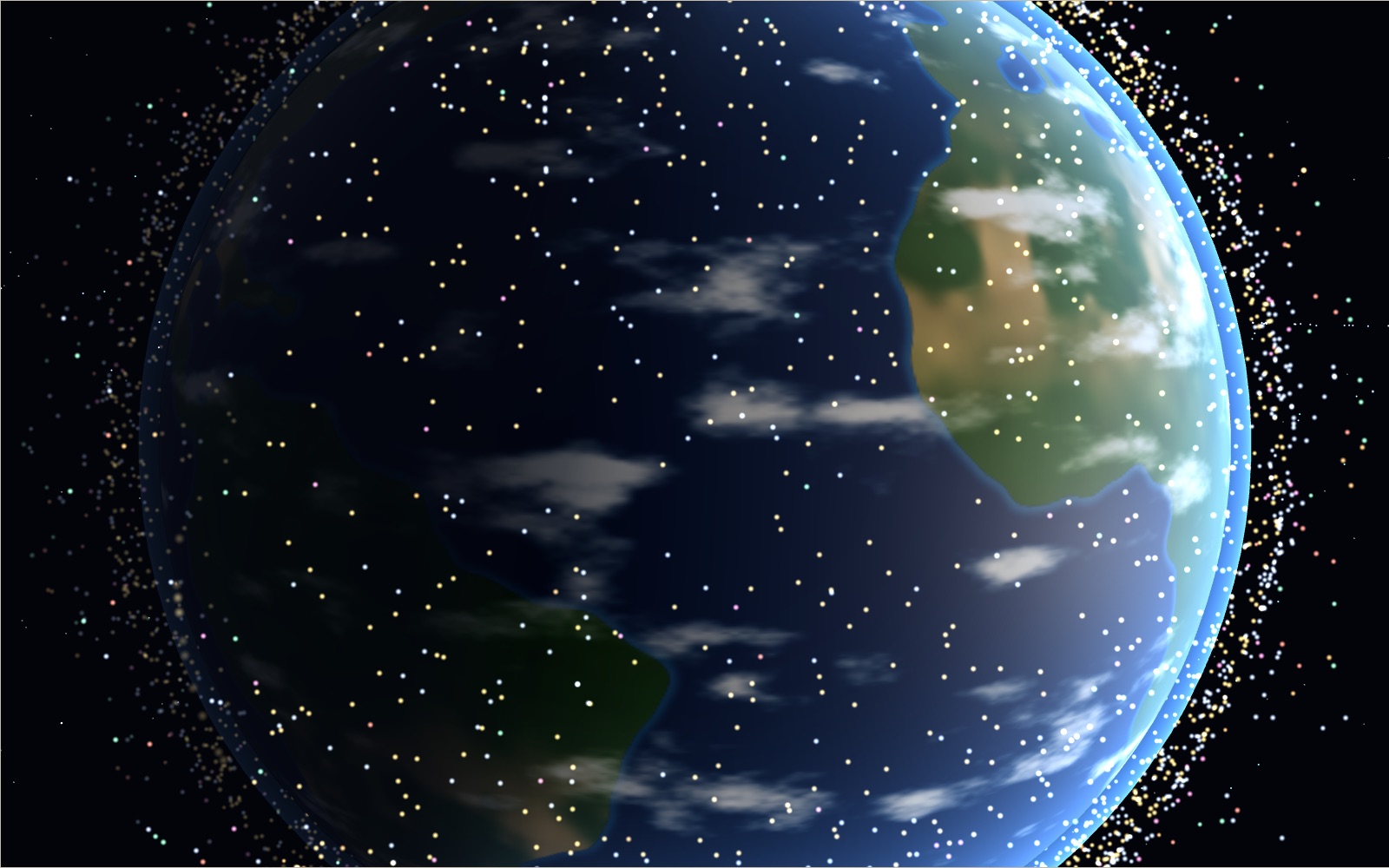
Satellites orbiting Earth right now
On 20 October 2026 the public catalogue listed 16,768 working satellites, and two in every three belonged to one company's internet network.
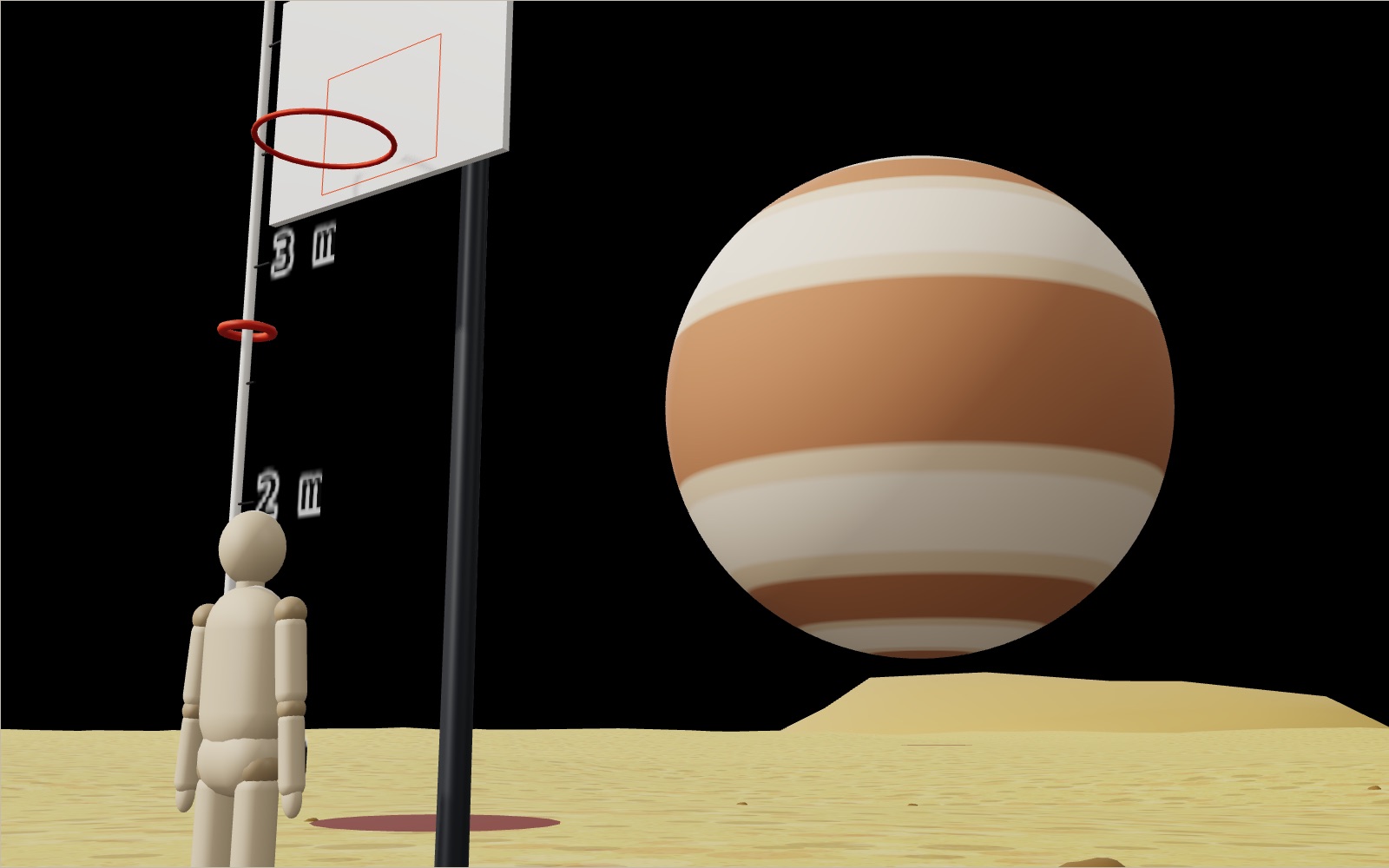
Your weight and jump height on other planets and moons
A 50 cm jump on Earth becomes a 3 m leap on the Moon, 18 m on Ceres and a one-way trip off asteroid Bennu.
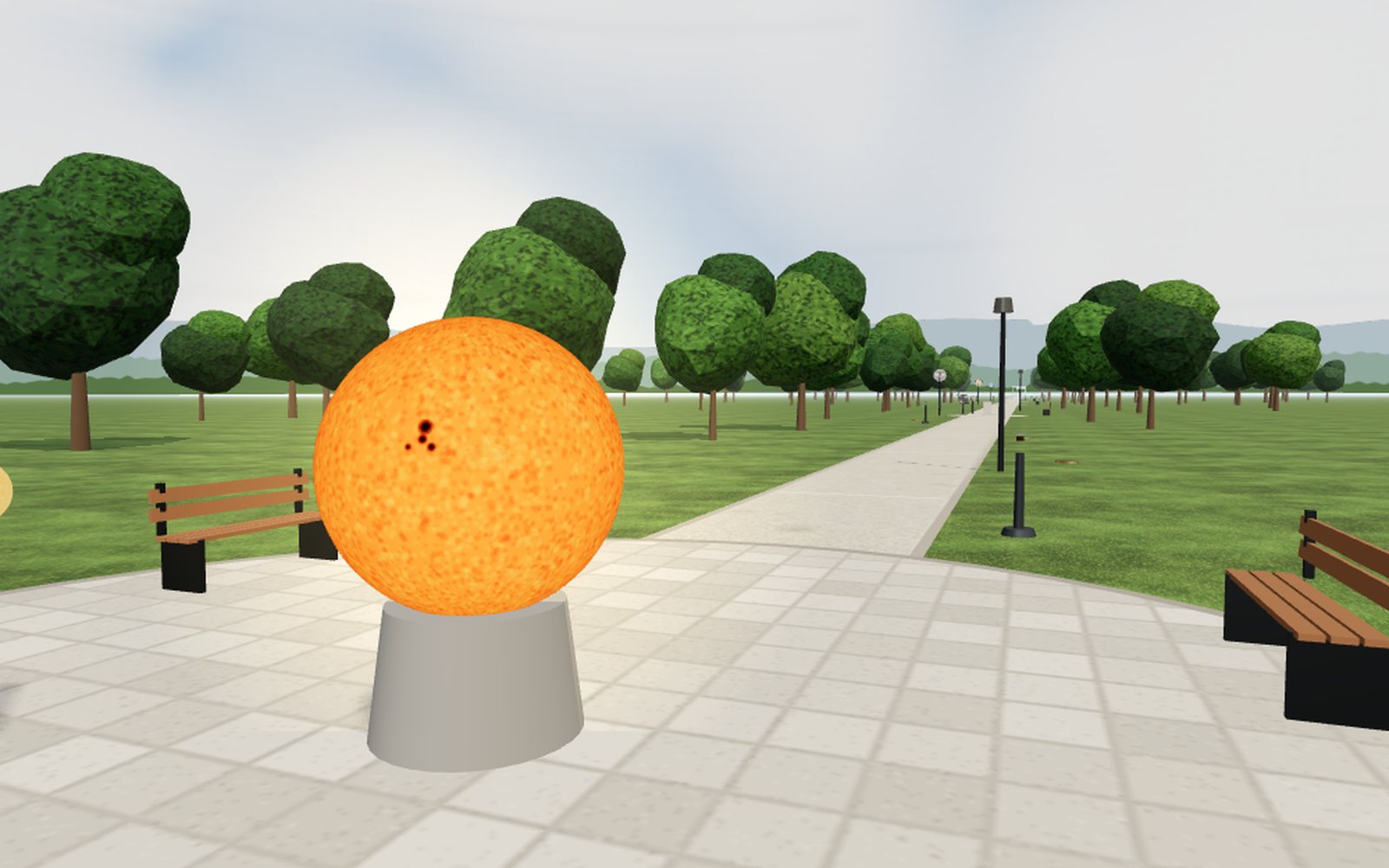
Solar system scale model measurements along a park walk
Shrink the Sun to a ball 1.39 m wide and Earth becomes a 1.27 cm marble 150 m down the path, Neptune is 4.5 km away and Voyager 1 would be 25.7 km.
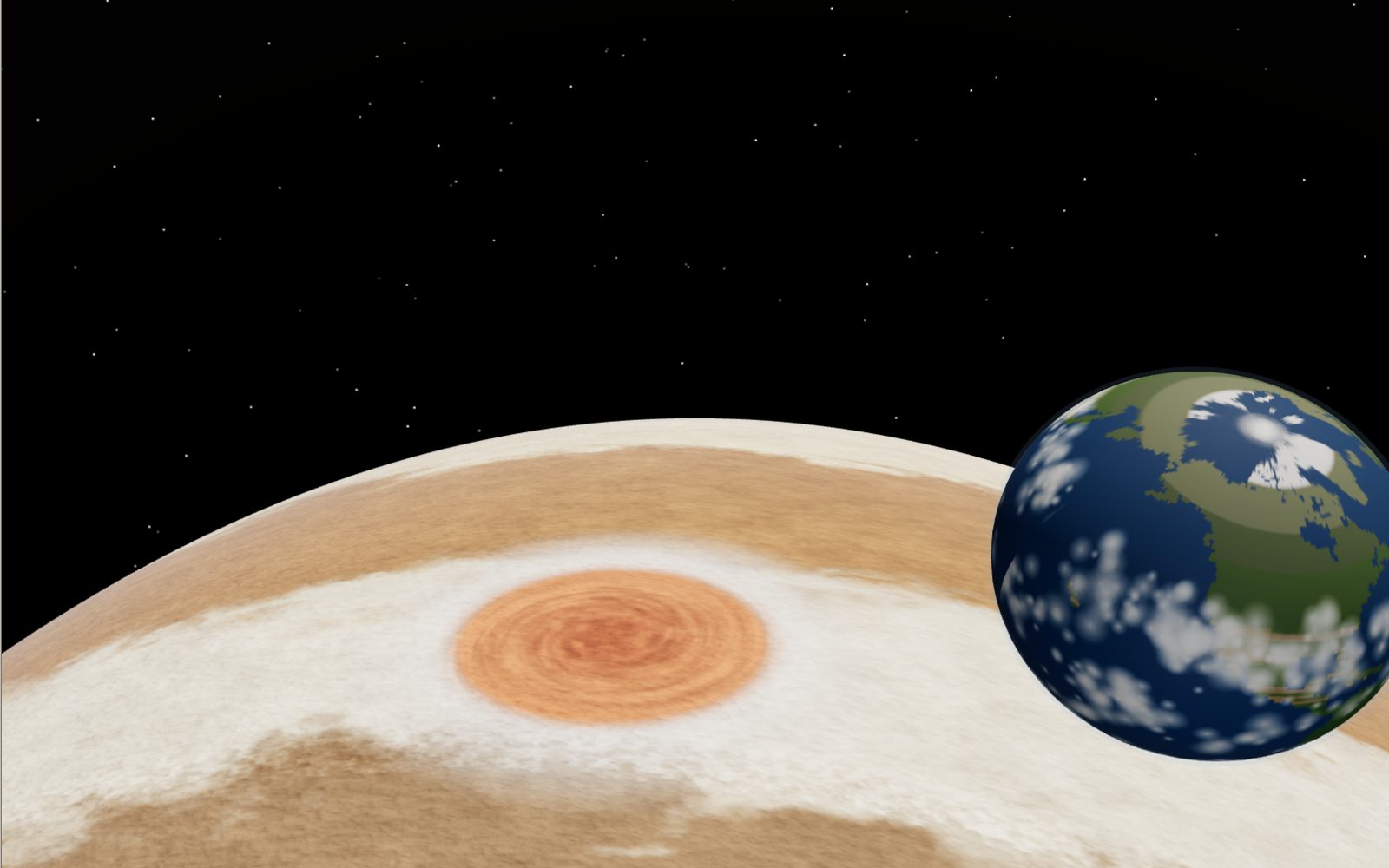
Fly over Jupiter's clouds and the Great Red Spot
In the late 1800s the Great Red Spot was about three Earths long; Hubble now measures it at about one. Float over it with Earth beside you, then sink 132 km into the clouds with the Galileo probe.
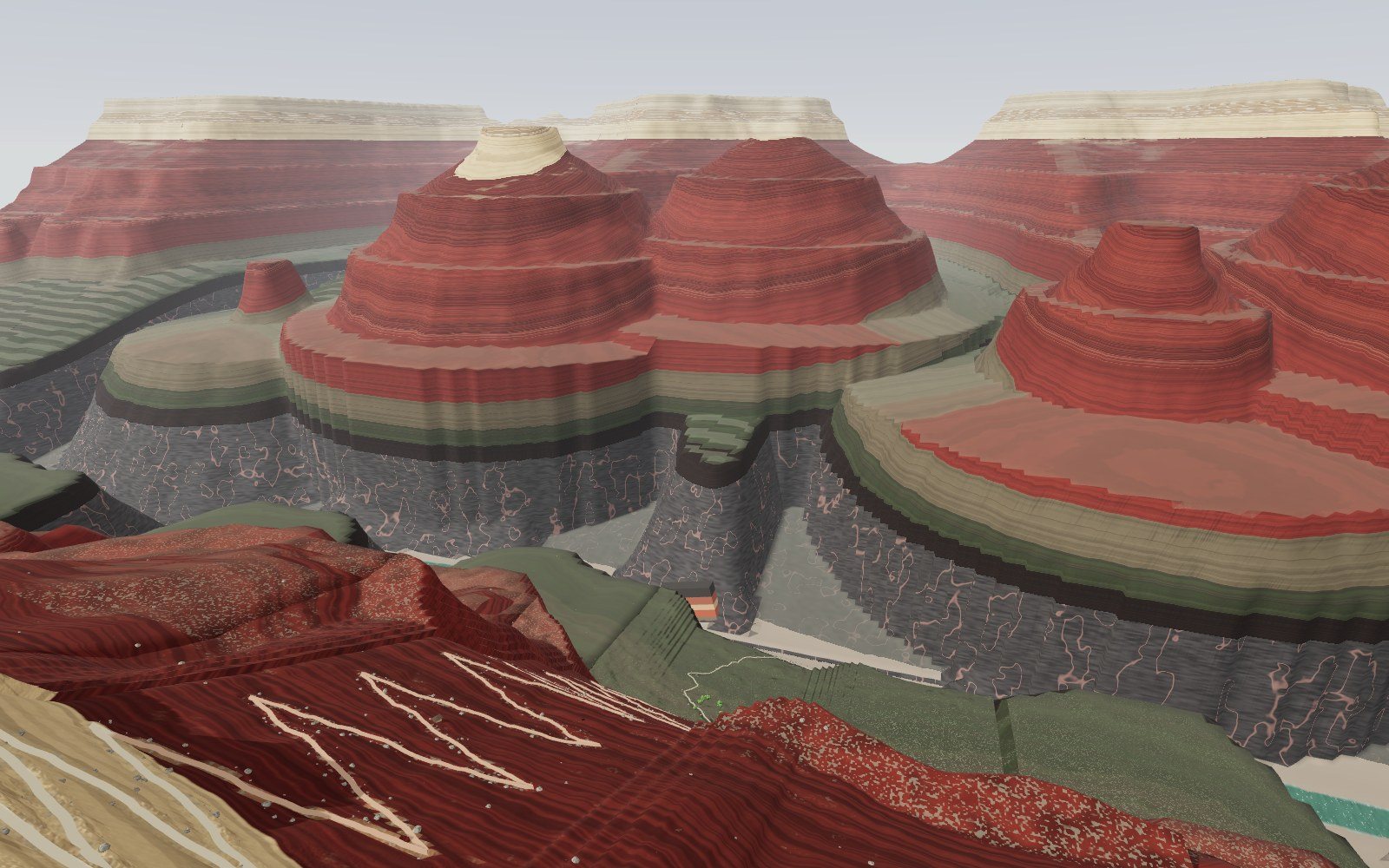
Walk down the Grand Canyon rock layers
Walk 1,360 m down the Bright Angel Trail through 13 rock layers, from a 270-million-year-old sea floor on the rim to 1.75-billion-year-old schist by the river.
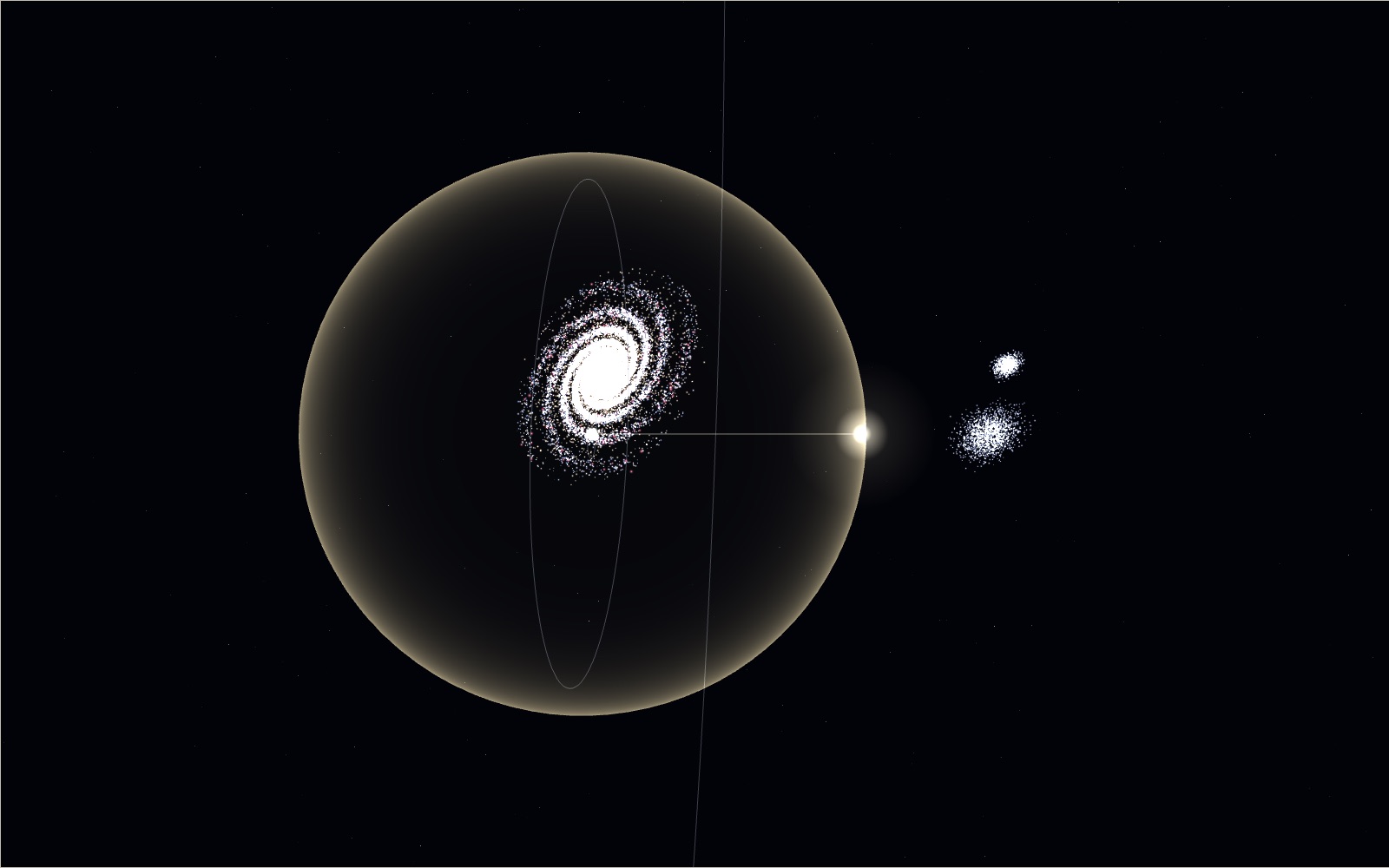
Travelling at the speed of light
Light goes round the equator 7.5 times in a second, yet the same light needs 2.5 million years to reach the Andromeda galaxy.