FIG. 75Walk-throughs
Walk around a Mars base
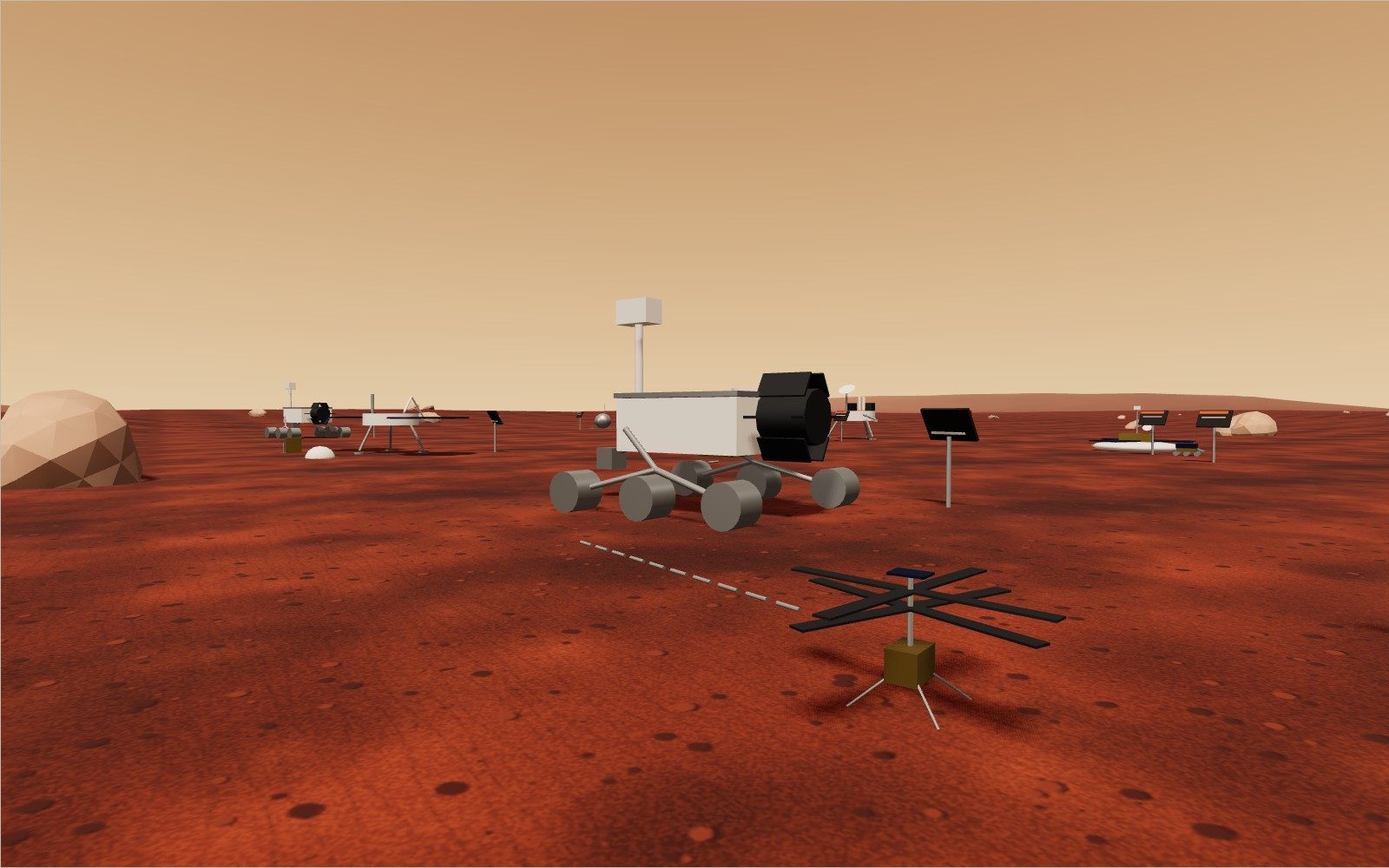
On Mars an eye 1.6 m up sees the horizon 3.3 km away. Walk ten areas of a concept base and stand beside every lander and rover that has worked there, at full size.
This device cannot show the 3D model. You can read the guide steps below as text.
1 / 18 A base that exists only on paperThis base is a concept drawn from NASA studies, and none has been built. You stand on the graded pad south of the habitat at an eye height of 1.6 m. Walk with WASD or the arrow keys and press Space to jump.
Drag to turn. Scroll or pinch to zoom.
A base that nobody has built yet
Pictures of a future Mars base usually show a dome, a rover and a red sky. They rarely say how big anything is, how far apart the pieces stand, or what it would feel like to walk between them. This exhibit lays out a small base at full size so you can walk around it at the eye height of a standing person, 1.6 m.
Start with the most important fact: this base does not exist. No crew has landed on Mars, and NASA has not picked a final design for a Mars habitat. What NASA has published are studies. Its Mars Design Reference Architecture 5.0 (2009) describes a long-stay mission of about 500 days on the surface, with cargo landed ahead of the crew, oxygen made from the Martian air and a pressurized rover for long trips. A 2023 NASA concept study of a Mars Surface Habitat looks at a dedicated living module paired with an open terrain vehicle, as an alternative to living in a large pressurized rover. The model borrows the main pieces from these studies. The sizes, the layout and the colours were chosen for the model.
The numbers on the screen are a different matter. Gravity, air pressure, temperature, the length of the day, the distance to the horizon and the delay of a radio message all come from NASA data, and each one is worked out in the sections below.
Why the habitat stands on legs behind an airlock
The habitat in the model is a round module 8 m across, standing on six legs with its floor 1.3 m above the ground. Raising the floor follows from the way NASA's 2009 plan delivers a habitat: it arrives already built, on top of its own lander, rather than being assembled on the ground. Height also helps against Martian dust, which is fine enough to drift with the wind and pile up against anything sitting on the surface.
On the south side a short tube sticks out. That is the airlock. The crew steps in, closes the inner door, and pumps the air back into the habitat before opening the outer hatch. Without that step, every trip outside would dump the whole airlock's worth of air into space. On a planet where all the air you breathe has to be made or carried, that matters.
The pressurized rover parked to the east shows a second way out. Its back wall carries two suitports, rings that a spacesuit clamps onto from the outside. A crew member climbs into the suit through its back from inside the cabin and then steps away, leaving the dusty suit outside. The model shows them because they solve the same problem as the airlock with less lost air.
Solar panels in weaker sunlight
Mars is about 1.52 times as far from the Sun as Earth on average. Sunlight spreads out with the square of the distance, so each square metre gets less. The NASA Mars fact sheet gives 586.2 W/m² at the average distance of Mars, against 1,361 W/m² for Earth. That is 586.2 / 1,361 = 0.43, or 43%.
The array in the model has 15 panels in three rows, tilted towards the noon Sun. At this made-up site, 22° north of the equator, the noon Sun stands in the south. Dust is the other enemy. It settles on the glass and cuts the power further until wind or a crew member clears it. Solar-powered landers on Mars have lost power this way over the years.
The model shows solar power because it is easy to see and walk around. NASA's 2009 reference architecture actually preferred nuclear fission for surface power, because a reactor gives steady power through the night and through dust storms, and because making oxygen takes a lot of electricity. A real base could use either, or both.
What MOXIE showed on Perseverance
The air on Mars is 95.1% carbon dioxide by volume, according to the NASA fact sheet. Oxygen is only 0.16%. That makes the air useless for breathing, but the carbon dioxide itself carries oxygen. Split each CO₂ molecule and you get oxygen and carbon monoxide.
NASA tested this on Mars with MOXIE, the Mars Oxygen In-Situ Resource Utilization Experiment, which rode on the Perseverance rover. NASA describes it as roughly the size of a microwave oven. It pulled in Martian air, compressed it and used an electrochemical process to strip one oxygen atom from each CO₂ molecule. Between the 2021 landing and its final run on 7 August 2023, it made oxygen 16 times. NASA's figures are these:
- 122 g of oxygen in total, about what a small dog breathes in 10 hours.
- At its best, 12 g of oxygen an hour, twice NASA's original goal for the instrument.
- Purity of 98% or better.
- 9.8 g of oxygen on the 16th and last run.
MOXIE was a demonstration and nothing more. NASA says the next step would be a full-scale system that can also liquefy and store the oxygen. In mission plans, most of that oxygen is rocket propellant for the vehicle that lifts the crew back off Mars. The oxygen plant in the model stands for such a full-scale system. The gold box inside it is a nod to MOXIE, and the two white spheres next to it are storage tanks.
Walking and jumping at 0.38 g
The NASA fact sheet gives the mean surface gravity of Mars as 3.73 m/s², against 9.82 m/s² for Earth. That is 3.73 / 9.82 = 0.38, so you weigh 38% of your Earth weight. Your mass does not change, so starting and stopping take the same effort as at home.
The jump button gives you a take-off speed of 2.0 m/s, a modest hop. Rising against gravity g, you reach a height h = v² / 2g and stay up for t = 2v / g:
- On Mars: h = 2.0² / (2 × 3.73) = 4 / 7.46 = 0.54 m, and t = 2 × 2.0 / 3.73 = 1.07 s.
- On Earth: h = 4 / (2 × 9.82) = 0.20 m, and t = 4 / 9.82 = 0.41 s.
The heights differ by 9.82 / 3.73 = 2.63 times. Turn on Earth gravity in the controls and jump again to see the difference. The readout at the top left prints the height and airtime of your last jump, and the model checks the peak exactly even if a frame skips past it. One honest caveat: a real spacesuit adds a lot of mass, and the same legs would launch a suited person more slowly. The model leaves the suit out.
Thin, cold air and a slightly longer day
The weather mast near the habitat stands for the weather stations that Mars landers carry. Its readings sit in the box at the top left.
- Pressure. The fact sheet gives 6.36 mb (6.36 hPa) at the mean radius, varying from 4.0 to 8.7 mb with the seasons. Sea level on Earth is 1,013 hPa, so Mars has about 0.6% of it. Unprotected, a person's body fluids would start to boil at that pressure, so suits and pressurized rooms are not optional.
- Temperature. At the Viking 1 landing site the air ran from about −89 °C just before dawn to −31 °C in the afternoon. The fact sheet gives an average of about −59 °C for the planet. The model follows a simple daily curve between the Viking 1 extremes as you move the time slider.
- Day length. A Martian solar day, called a sol, lasts 24.6597 hours, which is 24 h 39 min 35 s. Mission teams split the sol into 24 "Mars hours", each 24.6597 / 24 = 1.0275 Earth hours, or about 61.65 minutes. The clock in the readout uses those hours.
Why the sky turns blue at sunset
By day the Martian sky in rover photographs has a butterscotch or rusty colour. At sunset the sky right around the Sun turns blue. NASA's Curiosity rover photographed this from Gale crater on 15 April 2015, its 956th sol.
NASA's caption for that image (PIA19400) explains it. The dust in the Martian air has fine particles that let blue light pass through the atmosphere more easily than longer wavelengths. The blue part of the sunlight therefore stays close to the Sun's part of the sky. Yellow and red light scatter all over the sky. So by day the rusty colour of the dust fills the sky, and at sunset, when the light passes through much more air, the blue near the Sun stands out.
The sky in the model is painted by a small shader that follows that description. Most of the dome has the dust colour, brighter near the horizon. A glow gathers around the Sun. As the Sun gets low, the glow shifts from pale yellow to blue and the far side of the sky darkens to brown. Drag the time slider to around 17:50 and look west.
How far away the horizon is
Mars is a smaller ball than Earth, so the ground curves away sooner. For an eye at height h above a sphere of radius R, the distance to the horizon is d = √(2Rh + h²). With the NASA volumetric mean radius of Mars, R = 3,389.5 km, and h = 1.6 m:
- d = √(2 × 3,389,500 × 1.6 + 1.6²) = √10,846,402.56 = 3,293 m, about 3.3 km.
- On Earth (R = 6,371 km) the same eye sees about 4,515 m, or 4.5 km.
- On the Moon (R = 1,737.4 km) it is about 2,358 m.
The terrain in the model is a single mesh that drops below a flat plane by x² / 2R, so the horizon sits where the formula says. Low mesas 1 to 3 km away rise above it.
Talking to Earth with a delay
Radio travels at the speed of light, 299,792.458 km/s. The NASA fact sheet gives the distance between Earth and Mars as anywhere from 54.6 to 401.4 million km. Dividing distance by the speed of light gives the one-way delay:
- Closest: 54,600,000 / 299,792.458 = 182 s, or 3.0 minutes.
- At an average opposition (78.34 million km): 261 s, or 4.4 minutes.
- Farthest: 401,400,000 / 299,792.458 = 1,339 s, or 22.3 minutes.
At the far end, a question and its answer take about 45 minutes. Live conversation is impossible, so a crew would work through problems on their own and send messages more like letters. The Earth to Mars slider in the controls changes the distance, and the readout recalculates the delay. About every 780 days (the synodic period in the NASA fact sheet, roughly 26 months) the Sun passes between the two planets, an arrangement called solar conjunction. NASA then stops sending commands to its Mars spacecraft for a few weeks (two weeks in November 2023), because the Sun's hot, charged gas can corrupt radio signals.
Ten areas, one walk
The base spreads over ten areas on the same graded plain. The habitat on its legs, the airlock and the first solar array are where you start. To the south stand a cutaway of the inside of a habitat, a suit room and a greenhouse. To the west is a power field with a small reactor behind an earth berm; to the east are the oxygen plant and an ice mine, then the rover garage. The landing pad lies off to the south-east, an outlook with signposts and rock samples to the north, and a long field of spacecraft models to the south-west.
Open Areas to jump to any of them, Field guide to search all 144 things by name or kind, or the small map at the top right. A click on the map makes it bigger; a second click takes you to the spot. Every area is built the first time you come near it, so the page does not pay for what you have not visited.
The base areas are concepts. Each one borrows from a real NASA or ESA study, a test on the International Space Station, or a test site on Earth, and its card names the source. The spacecraft field is different: those are models of real machines, at their real sizes, with landing dates and places from NASA's and CNSA's records.
Inside the habitat: a 3D-printed building in Houston
The cutaway south of the yard is laid out after NASA's CHAPEA habitat, Mars Dune Alpha, at Johnson Space Center in Houston. It is a single-storey building of 1,700 square feet, about 158 m², printed in layers from a cement-like material. From June 2023 to July 2024 four volunteers lived in it for 378 days as if they were on Mars, with message delays, limited supplies and simulated walks outside.
NASA lists what the building holds: four private crew quarters, workstations, a medical station, shared living space, a galley and a food-growing station. The model puts them in the same kinds of places. Walk in through the south door and you are in the shared space with the round table. The crew rooms are along the west wall, the galley and food store along the north, and the gym and the plant rack to the east. The roof is left off so the Sun lights the rooms and you can see over the walls.
Some of the pieces carry numbers that matter for a Mars base. The storm shelter in the corner is walled with water containers and supplies, because Curiosity's radiation detector measured an average dose of about 0.67 millisieverts a day from cosmic rays on the surface. The water recycler and the air scrubber stand for systems already used on the space station; a person breathes out about 1 kg of carbon dioxide a day, and NASA's life support baseline gives 0.82 kg of oxygen breathed in.
The suit room and why air is expensive
The air inside a habitat is close to Earth's sea-level pressure, 1,013 hPa. Outside it averages 6.36 hPa. Every time an airlock fills and empties, the air in it is lost unless a pump pushes it back into the habitat first. The pump in the suit room does that, down to a few hectopascals, and only the last thin remainder goes outside. That is also why airlocks are kept small.
Suitports are the other answer. A suit hangs on the outside wall with its back hatch sealed to a ring. The wearer climbs in through the back from inside and then steps away. No chamber has to be emptied, and the dusty suit never comes indoors. NASA's pressurized rover studies use suitports for the same reason.
Dust matters as much as air. Mars dust is very fine and clings to fabric, and Phoenix found perchlorate salts in the soil at about half a percent. Perchlorate is harmful to people, so the suit room has a brushing station, and soil samples are handled in a sealed glovebox in the habitat.
Turn Suit on off in the controls to see what the bare air would do. At 6 hPa the pressure is far below the point where water boils at body temperature, and a person would lose consciousness in about 15 seconds. The warning links to the exhibit about standing in space without a suit.
Growing food under red and blue light
Plants use mostly red and blue light. Chlorophyll absorbs strongly in the red, around 630 to 660 nanometres, and in the blue, around 450 nm, and reflects much of the green. Plant lamps on the space station are therefore mostly red and blue LEDs, with a little green added so that the leaves look normal to the crew and problems are easier to see.
NASA's Veggie unit on the space station grew red romaine lettuce that astronauts ate in August 2015, zinnias that flowered in 2016, and later the larger Advanced Plant Habitat grew radishes and, in 2021, chile peppers. On Earth, the German Aerospace Center ran the EDEN ISS greenhouse in Antarctica from 2018 to 2023, 400 m from the Neumayer III station. In its first season it produced 268 kg of food on 12.5 m² of growing area, kept at 330 to 600 micromoles of light per square metre per second, 21 °C and about 1,000 ppm of carbon dioxide.
The greenhouse in the model holds six beds: the leafy racks, lettuce, zinnias, peppers, radishes and dwarf wheat. A tray of Martian soil stands at the far end with a note that it would need its perchlorate washed out first. Mars has one advantage here: its air is almost all carbon dioxide, which plants need, so a greenhouse can draw from outside.
How many panels a dust storm needs
The readout adds up how much sunlight one flat panel collects over a whole sol, using the season, the latitude of the site and the dust in the air. The steps are simple enough to follow:
- Sunlight at the top of the air. Mars's distance from the Sun changes from about 1.38 to 1.67 times Earth's. The flux is 1,361 W/m² divided by the square of that distance, so it swings between about 715 and 490 W/m². The Season slider moves Mars round its orbit; perihelion falls at Ls 251°.
- The Sun's height. For each moment of the sol, the model finds the Sun's height from the site latitude (22° N) and the season's declination, and multiplies by the sine of that height for a flat panel.
- Dust. The direct beam is cut by a factor e^(−τ/μ), where τ is the dust optical depth and μ the sine of the Sun's height. Some light still arrives scattered by the dust; in the model that share fades as the dust gets very thick. This last step is a model value, chosen so that very thick dust cuts a sol's sunlight by more than ten times.
- The panel. Each panel is 2.5 m × 1.5 m, 3.75 m², and turns 25% of the light into electricity (a model value).
With clear air (τ 0.5) at Ls 0°, one panel collects about 2.6 kWh in a sol. The base in the model draws 5 kW all the time, 5 × 24.66 = 123 kWh a sol, so it needs about 48 panels. At τ 5 the same panel collects about 0.67 kWh and the base needs about 184. In a storm like June 2018, when Opportunity's site reached an estimated τ of 10.8, it would need more than 400. That is the first task, and it is the reason NASA's plans keep coming back to fission.
Fission power when the Sun fails
NASA's Kilopower project tested a small reactor called KRUSTY, the Kilopower Reactor Using Stirling Technology, at the Nevada National Security Site from November 2017 to March 2018. A uranium-235 core heated sodium heat pipes, which carried the heat to Stirling engines that turned it into electricity. The test included a full-power run of 28 hours. The work has passed to NASA's fission surface power project, which is aiming at a 10-kilowatt-class demonstration on the Moon.
A reactor does not care about night or dust. Its drawbacks are mass, radiation and heat. The model's reactor stands behind an earth berm on the far side of the power field, with radiator fins to shed the heat the engines cannot use. A real one would stand much farther away; plans talk of hundreds of metres to a kilometre.
Curiosity and Perseverance already run on nuclear power of a different kind. Their multi-mission radioisotope thermoelectric generator, the finned cylinder on the back, turns the heat of decaying plutonium dioxide into about 110 W at the start of a mission, day and night.
Oxygen for breathing and oxygen for rockets
MOXIE showed that a machine on Mars can make oxygen from the air. To turn its numbers into a base, start with what people breathe. NASA's life support baseline gives 0.82 kg of oxygen per crew member per day. A crew of four over one sol (24.66 hours) needs 4 × 0.82 × 24.66 / 24 = 3.37 kg.
At its best rate, 12 g an hour, one MOXIE-size unit makes 12 × 24.66 = 296 g in a sol. Dividing 3.37 kg by 0.296 kg gives 11.4, so twelve units would keep four people breathing. That is the oxygen task in the exhibit.
Breathing is the small part. In NASA's plans most of the oxygen goes into the tanks of the ascent vehicle that takes the crew back to orbit, because oxygen is most of a rocket's propellant mass. That is tonnes, not kilograms, and it is why the oxygen plant in the model is a whole container and why the landing pad has a fuel line running to the rocket.
Ice under the plains
Water is drink, radiation shielding, and the raw material for oxygen and rocket fuel. Mars has a lot of it, frozen. The SHARAD radar on NASA's Mars Reconnaissance Orbiter found a buried ice deposit in Utopia Planitia that holds about as much water as Lake Superior. The HiRISE camera on the same orbiter found steep slopes in the mid-latitudes where layers of nearly pure ice show under a thin cover of dust, in places only one or two metres down. NASA's Subsurface Water Ice Mapping project combined data from several orbiters into maps of where ice lies close to the surface.
The ice area of the model has a drill, a water tank, an electrolysis unit that splits water into hydrogen and oxygen, a Sabatier reactor that combines carbon dioxide with hydrogen to make methane and water, a small digger and an oven for soils that hold water in their minerals. The cliff is a model of one of those ice scarps.
Rovers, wheels and real top speeds
Every rover on Mars has been slow on purpose. Driving is planned on Earth, hazards are checked by onboard cameras, and wheels are precious. The Rover speed control sets the base rover to one of these top speeds on flat, hard ground:
| Rover | Top speed | Time to cross the 40 m yard |
|---|---|---|
| Sojourner (1997) | about 1 cm/s, 0.036 km/h | about 67 minutes |
| Spirit, Opportunity (2004) | about 5 cm/s, 0.18 km/h | about 13 minutes |
| Curiosity (2012) | about 4 cm/s, 0.144 km/h | about 17 minutes |
| Perseverance (2021) | 0.152 km/h | about 16 minutes |
| Zhurong (2021) | about 200 m an hour, 0.2 km/h | about 12 minutes |
| Crew rover concept | 10 km/h | about 14 seconds |
Stand next to the rover in the yard and press R or tap Drive. Then try Curiosity's speed and see how far you get in a minute.
The garage holds a crew rover concept with suitports, an open rover for short trips, and two wheels. Curiosity's aluminium wheels, 50 cm across with a skin about 0.75 mm thick, began showing holes and tears in 2013 from sharp rocks, and drivers now plan routes to spare them. NASA Glenn's answer is a tire of shape-memory alloy wire that bends over rocks and springs back.
Landing pads and flying gravel
A rocket landing on loose ground blasts soil and stones outwards at high speed. Apollo 12 landed 163 m from the Surveyor 3 probe on the Moon, and the returned Surveyor parts were pitted by the blast. NASA's plume surface interaction work studies exactly this for the Moon and Mars. The answer in the model is a paved pad, a berm of piled soil to catch what flies, and distance. Real plans put pads about a kilometre from the habitat; the model brings it to about 190 m so you can walk there.
The lander on the pad is generic, a cone on legs that stands for the many crew lander studies. It is not modelled on any company's ship. Next to it is an ascent vehicle of the kind NASA has studied, fuelled on the surface with locally made oxygen.
Every lander and rover that has worked on Mars
The probe field shows each spacecraft that landed and sent back data, at full size, with its plaque:
| Spacecraft | Landed (UTC) | Where | Last contact |
|---|---|---|---|
| Mars 3 (Soviet Union) | 2 December 1971 | Ptolemaeus crater, 45° S | the same day, after about 20 seconds |
| Viking 1 (NASA) | 20 July 1976 | Chryse Planitia, 22.27° N | November 1982 |
| Viking 2 (NASA) | 3 September 1976 | Utopia Planitia, 47.67° N | April 1980 |
| Mars Pathfinder and Sojourner (NASA) | 4 July 1997 | Ares Vallis, 19.33° N | September 1997 |
| Spirit (NASA) | 4 January 2004 | Gusev crater, 14.57° S | March 2010 |
| Opportunity (NASA) | 25 January 2004 | Meridiani Planum, 1.95° S | June 2018 |
| Phoenix (NASA) | 25 May 2008 | Vastitas Borealis, 68.22° N | November 2008 |
| Curiosity (NASA) | 6 August 2012 | Gale crater, 4.59° S | still working |
| InSight (NASA) | 26 November 2018 | Elysium Planitia, 4.5° N | December 2022 |
| Perseverance and Ingenuity (NASA) | 18 February 2021 | Jezero crater, 18.44° N | rover still working; helicopter until January 2024 |
| Tianwen-1 lander and Zhurong (CNSA) | 14 May 2021 (15 May, Beijing time) | Utopia Planitia, 25.1° N | rover asleep since May 2022 |
Mars 3 was the first to land softly, but it fell silent within a minute, so Viking 1 is usually counted as the first to work on the surface. Sizes follow the published figures: the Viking landers are about 3 m across their legs, Curiosity and Perseverance 3 m long, InSight about 6 m across its two round solar arrays, Phoenix 5.5 m. Details are simplified; the cards say what each machine found.
Ingenuity's first flights
Ingenuity weighs 1.8 kg and has two rotors 1.2 m across that spin in opposite directions. It made the first powered, controlled flight on another planet on 19 April 2021, rising 3 m and hovering for 39.1 seconds. The flight task lays its next steps out on the ground at their true distances from its spot: flight 3 went 50 m out and back, flight 4 went 133 m out and back, and flight 5 flew 129 m one way to a new landing spot called Airfield B. Walking it takes a few minutes, which is a fair way to feel what "133 m" means for a 1.8 kg aircraft in air at 1% of Earth's density. It went on to fly 72 times before a rotor was damaged in January 2024.
What you see from the outlook
The outlook north of the yard has signposts and samples of the ground that rovers have studied.
- Gale crater is 154 km wide and has Mount Sharp, a pile of layered rock about 5 km high, in its middle. Curiosity climbs it layer by layer. The layered block at the outlook stands for that kind of rock.
- Jezero crater, 45 km wide, once held a lake fed by a river that left a fan-shaped delta. Perseverance works there.
- Blueberries are small grey balls of the iron oxide hematite that Opportunity found scattered at Meridiani Planum. They formed in water seeping through the rock. Stand on the patch to solve a task.
- Dark dunes of basalt sand creep a little each year. Dust devils, whirlwinds of warm rising air, wander across the plain; Spirit filmed many of them in Gusev crater.
- Olympus Mons is about 600 km across and about 22 km high. The model places the base 330 km west of its summit (an invented placement) and draws the shield as a plain cone without its edge cliffs. Over 330 km the ground falls away by d² / 2R = 330² / (2 × 3,389.5) = 16 km, so the summit would sit only about 1° above the horizon. The nearer slope, about 120 km away, rises higher, about 2°, and hides it. You see a long low ridge on the eastern horizon and never the top.
Phobos, Deimos and the evening star
Mars has two small moons. Phobos, 27 × 22 × 18 km, orbits only about 6,000 km above the surface and goes round in 7 hours 39 minutes, faster than Mars turns. So it rises in the west and sets in the east, crossing the sky in about four hours, twice a sol. From the ground it looks about a third as wide as our Moon does from Earth. Deimos, about 12 km across and much farther out, looks like a bright star. Move the time slider to watch both cross the sky.
Earth, seen from Mars, is an inner planet, the way Venus is for us. It never strays more than about 47° from the Sun, so it shows as a blue evening or morning star. The model places it from the Earth to Mars distance: at 172 million km it stands about 41° from the Sun, high enough to see for a couple of hours after sunset. Turn on Today's distance to use where the two planets actually are today, worked out from NASA JPL's approximate orbital elements. Curiosity photographed Earth and the Moon from Gale crater on 31 January 2014.
Where the model differs from a real base
- The layout and every size of the base are made up for the model. NASA has studies but no final design.
- The pieces are drawn close together so you can walk between them. Real plans put the landing pad and the reactor hundreds of metres to a kilometre from the habitat.
- The habitat cutaway follows the list of rooms NASA gives for CHAPEA, not its floor plan.
- The site latitude (22° N), its place 330 km west of Olympus Mons and the land around it are invented.
- Solar output uses a 25% panel efficiency and a simplified dust model; real output also depends on panel tilt, temperature and dust on the glass.
- The temperature follows a smooth curve between the Viking 1 extremes; real temperatures depend on season, place and dust.
- The spacecraft models are full size but simplified, and they stand together, while the real ones are spread across the planet.
- Jumps ignore the mass of a spacesuit.
Questions
Has anyone built a base on Mars?
No. No person has been to Mars, and no habitat has been sent there. NASA has published architecture studies and concept designs, and it runs a year-long analog mission called CHAPEA in a 3D-printed habitat of 1,700 square feet (about 158 m²) at Johnson Space Center in Houston. That habitat is on Earth.
How much oxygen did MOXIE make?
MOXIE made 122 g of oxygen over 16 runs between 2021 and 2023. At its best it produced 12 g an hour at 98% purity or better. That is far less than a crew would need, which is why NASA describes the next step as a full-scale system.
Why would a Mars base make oxygen instead of bringing it?
Mostly for the trip home. The rocket that lifts the crew off Mars needs a large amount of oxygen as propellant, and NASA's plans call for making it on the surface instead of carrying it from Earth. Some of the oxygen could also go to breathing air.
Could you breathe the air on Mars for a moment?
No. It is 95% carbon dioxide and only 0.16% oxygen, and the pressure is about 0.6% of Earth's sea level. A person outside without a pressure suit would lose consciousness within seconds.
How high could you jump on Mars?
With the same push, about 2.6 times as high as on Earth. In the model a 2.0 m/s take-off gives 0.54 m on Mars and 0.20 m on Earth. A heavy suit would reduce both.
Why is the Martian sunset blue?
Fine dust in the Martian air lets blue light through slightly more easily and scatters it close to the direction of the Sun. Near sunset, when sunlight crosses the most air, that blue glow around the Sun becomes easy to see.
How long does a message to Earth take?
Between 3.0 and 22.3 minutes one way, depending on where the two planets are in their orbits. During solar conjunction, about every 26 months, NASA pauses commands to its Mars spacecraft for around two weeks.
Which was the first spacecraft to land on Mars?
The Soviet Mars 3 lander made the first soft landing on 2 December 1971, but it stopped transmitting after about 20 seconds. Viking 1, which landed on 20 July 1976, was the first to work on the surface, and it kept working for more than six years.
How fast do Mars rovers drive?
Slowly. Curiosity's top speed on flat, hard ground is about 4 cm a second and Perseverance's is 0.152 km/h. Sojourner moved about 1 cm a second. The rovers spend most of their time stopped, taking pictures and planning the next move.
Could a Mars base run on solar power through a dust storm?
Only with a very large field and big batteries. In the model's numbers, a base drawing 5 kW needs about 48 panels in clear air and about 184 at a dust opacity of 5. In the 2018 storm, with an estimated τ of 10.8, Opportunity lost power and never woke again. That is why NASA studies fission reactors for surface power.
Where is the water on Mars?
Mostly frozen. There is ice in the polar caps and buried ice in the mid-latitudes, sometimes only a metre or two below the surface. Radar found a deposit in Utopia Planitia holding about as much water as Lake Superior, and Phoenix scraped ice a few centimetres below the soil near 68° N.
Can you see Earth from Mars?
Yes, as a bright blue point in the evening or morning sky, never more than about 47° from the Sun. Curiosity photographed Earth and the Moon from Gale crater in 2014. In the exhibit, set a middle distance, move the time past sunset and look for it.
How big is Ingenuity?
It weighs 1.8 kg, stands about 49 cm tall and has two rotors 1.2 m across. It flew 72 times between April 2021 and January 2024.
Why do Mars habitats get printed?
Printing walls from local material would save carrying building material from Earth. NASA's CHAPEA habitat in Houston was printed to test how such a building works for a crew, but it is on Earth and uses Earth materials.
Terms
- Sol: a Martian solar day, 24 h 39 min 35 s.
- ISRU: in-situ resource utilization, using materials found at the destination, such as making oxygen from Martian air.
- MOXIE: Mars Oxygen In-Situ Resource Utilization Experiment, the oxygen test unit on Perseverance.
- Airlock: a chamber between a pressurized room and the outside, emptied of air before the outer door opens.
- Suitport: a ring on a vehicle wall that a spacesuit attaches to, so the wearer can climb in from inside.
- Pressurized rover: a vehicle with a cabin holding breathable air, driven without suits.
- Solar conjunction: the time when the Sun lies between Earth and Mars and blocks reliable radio contact.
- hPa: hectopascal, a unit of pressure equal to one millibar.
- Optical depth (τ): how much dust in the air dims the Sun overhead; sunlight straight through falls as e^(−τ).
- Ls: solar longitude, the angle that marks the Martian season. Ls 0° is northern spring; perihelion falls at Ls 251°.
- Hydroponics: growing plants with their roots in nutrient water instead of soil.
- Perchlorate: a salt of chlorine and oxygen found in Martian soil; harmful to people and plants in large amounts.
- Kilopower: NASA's small fission reactor project, tested as KRUSTY in 2017 and 2018.
- MMRTG: multi-mission radioisotope thermoelectric generator, the plutonium power source of Curiosity and Perseverance.
- Sabatier reaction: CO₂ + 4 H₂ → CH₄ + 2 H₂O, making methane fuel from carbon dioxide and hydrogen.
Sources
- NASA NSSDCA, Mars Fact Sheet. https://nssdc.gsfc.nasa.gov/planetary/factsheet/marsfact.html (checked 17 October 2026)
- NASA NSSDCA, Earth Fact Sheet. https://nssdc.gsfc.nasa.gov/planetary/factsheet/earthfact.html (checked 17 October 2026)
- NASA NSSDCA, Moon Fact Sheet. https://nssdc.gsfc.nasa.gov/planetary/factsheet/moonfact.html (checked 17 October 2026)
- NASA, NASA's Oxygen-Generating Experiment MOXIE Completes Mars Mission (6 September 2023). https://www.nasa.gov/missions/mars-2020-perseverance/perseverance-rover/nasas-oxygen-generating-experiment-moxie-completes-mars-mission/ (checked 17 October 2026)
- NASA Science, Sunset in Mars' Gale Crater (PIA19400). https://science.nasa.gov/photojournal/sunset-in-mars-gale-crater/ (checked 17 October 2026)
- NASA, Mars Design Reference Architecture 5.0, Executive Summary (2008). https://www.nasa.gov/wp-content/uploads/2015/09/373669main_2008-12-04_mars_dra5_executive_summary-presentation.pdf (checked 17 October 2026)
- NASA NTRS, Mars Surface Habitat Concept Design (2023). https://ntrs.nasa.gov/citations/20230013240 (checked 17 October 2026)
- NASA, CHAPEA. https://www.nasa.gov/humans-in-space/chapea/ (checked 17 October 2026)
- NASA, NASA's Mars Fleet Will Still Conduct Science While Lying Low (2023). https://www.nasa.gov/solar-system/planets/mars/nasas-mars-fleet-will-still-conduct-science-while-lying-low/ (checked 17 October 2026)
- NASA, NASA's Mars Fleet Lies Low With Sun Between Earth and Red Planet (2021). https://www.nasa.gov/solar-system/nasas-mars-fleet-lies-low-with-sun-between-earth-and-red-planet/ (checked 17 October 2026)
- NASA NSSDCA, spacecraft catalogue entries for Mars 3, Viking 1 and 2 landers, Mars Pathfinder, Spirit, Opportunity, Phoenix, Curiosity, InSight and Perseverance. https://nssdc.gsfc.nasa.gov/nmc/spacecraft/display.action?id=1975-075C (checked 18 October 2026)
- NASA Science, Mars Science Laboratory: Curiosity Rover. https://science.nasa.gov/mission/msl-curiosity/ (checked 18 October 2026)
- NASA Science, Mars 2020: Perseverance Rover. https://science.nasa.gov/mission/mars-2020-perseverance/ (checked 18 October 2026)
- NASA Science, Ingenuity Mars Helicopter. https://science.nasa.gov/mission/mars-2020-perseverance/ingenuity-mars-helicopter/ (checked 18 October 2026)
- NASA Science, NASA's Opportunity Rover Mission on Mars Comes to End (2019). https://science.nasa.gov/missions/mer/nasas-opportunity-rover-mission-on-mars-comes-to-end (checked 18 October 2026)
- NASA JPL, Opportunity Hunkers Down During Dust Storm (2018). https://www.jpl.nasa.gov/news/opportunity-hunkers-down-during-dust-storm (checked 18 October 2026)
- CNSA, Tianwen-1 mission marks 1st year on Mars (2022). https://www.cnsa.gov.cn/english/n6465652/n6465653/c6840321/content.html (checked 18 October 2026)
- Li, C. et al., Layered subsurface in Utopia Basin of Mars revealed by Zhurong rover radar, Nature 610 (2022). https://doi.org/10.1038/s41586-022-05147-5 (checked 18 October 2026)
- NASA, Kilopower. https://www.nasa.gov/directorates/stmd/tech-demo-missions-program/kilopower-hmqzw/ (checked 18 October 2026)
- NASA NTRS, Kilopower Reactor Using Stirling Technology (KRUSTY) Nuclear Ground Test Results and Lessons Learned (2018). https://ntrs.nasa.gov/citations/20180007389 (checked 18 October 2026)
- NASA, Fission Surface Power. https://www.nasa.gov/directorates/stmd/fission-surface-power (checked 18 October 2026)
- NASA, Growing Plants in Space. https://www.nasa.gov/exploration-research-and-technology/growing-plants-in-space/ (checked 18 October 2026)
- NASA, Chile Peppers Start Spicing Up the Space Station (2021). https://www.nasa.gov/missions/station/iss-research/chile-peppers-start-spicing-up-the-space-station/ (checked 18 October 2026)
- Zabel, P. et al., Biomass Production of the EDEN ISS Space Greenhouse in Antarctica During the 2018 Experiment Phase, Frontiers in Plant Science 11 (2020). https://doi.org/10.3389/fpls.2020.00656 (checked 18 October 2026)
- ESA, Melissa. https://www.esa.int/Enabling_Support/Space_Engineering_Technology/Melissa (checked 18 October 2026)
- Hecht, M. H. et al., Detection of Perchlorate and the Soluble Chemistry of Martian Soil at the Phoenix Lander Site, Science 325 (2009). https://doi.org/10.1126/science.1172339 (checked 18 October 2026)
- SwRI, SwRI scientists publish first radiation measurements from the surface of Mars (2013). https://www.swri.org/newsroom/press-releases/swri-scientists-publish-first-radiation-measurements-the-surface-of-mars (checked 18 October 2026)
- NASA NTRS, Life Support Baseline Values and Assumptions Document. https://ntrs.nasa.gov/citations/20180001338 (checked 18 October 2026)
- NASA JPL, Mars Ice Deposit Holds as Much Water as Lake Superior (2016). https://www.jpl.nasa.gov/news/mars-ice-deposit-holds-as-much-water-as-lake-superior/ (checked 18 October 2026)
- NASA JPL, Steep Slopes on Mars Reveal Structure of Buried Ice (2018). https://www.jpl.nasa.gov/news/steep-slopes-on-mars-reveal-structure-of-buried-ice/ (checked 18 October 2026)
- NASA JPL, NASA's Treasure Map for Water Ice on Mars (2019). https://www.jpl.nasa.gov/news/nasas-treasure-map-for-water-ice-on-mars/ (checked 18 October 2026)
- NASA, Pressurized Rover. https://www.nasa.gov/moonbase/pressurized-rover/ (checked 18 October 2026)
- NASA, Plume Surface Interaction (PSI). https://www.nasa.gov/general/plume-surface-interaction-psi/ (checked 18 October 2026)
- NASA Technology Transfer, Superelastic Tire (LEW-TOPS-99). https://technology.nasa.gov/patent/LEW-TOPS-99 (checked 18 October 2026)
- The Planetary Society, Curiosity wheel damage: The problem and solutions (2014). https://www.planetary.org/articles/08190630-curiosity-wheel-damage (checked 18 October 2026)
- NASA Science, Radioisotope Power Systems. https://science.nasa.gov/planetary-science/programs/radioisotope-power-systems/ (checked 18 October 2026)
- NASA Science, Phobos and Deimos. https://science.nasa.gov/mars/moons/phobos/ (checked 18 October 2026)
- NASA JPL, Curiosity Rover Sees Earth and Moon From Mars (2014). https://www.jpl.nasa.gov/news/curiosity-rover-sees-earth-and-moon-from-mars/ (checked 18 October 2026)
- NASA JPL, Opportunity Rover Finds Strong Evidence Meridiani Planum Was Wet (2004). https://www.jpl.nasa.gov/news/opportunity-rover-finds-strong-evidence-meridiani-planum-was-wet/ (checked 18 October 2026)
- NASA JPL, Dust Devil on Mars, Spirit Sol 543 (PIA07253). https://www.jpl.nasa.gov/images/pia07253-dust-devil-on-mars-spirit-sol-543/ (checked 18 October 2026)
- NASA Science, Mars Facts. https://science.nasa.gov/mars/facts/ (checked 18 October 2026)
- E. M. Standish, Keplerian Elements for Approximate Positions of the Major Planets, NASA JPL Solar System Dynamics. https://ssd.jpl.nasa.gov/planets/approx_pos.html (checked 18 October 2026)
More exhibits
Why we have seasons: tilted Earth, changing daylight
The Earth is closest to the Sun in the first week of January, in the middle of the northern winter.
Moon phases: why a crescent is not Earth’s shadow
The Moon passes between the Earth and the Sun every 29.5 days, so why is there no solar eclipse every month?

Satellites orbiting Earth right now
On 20 October 2026 the public catalogue listed 16,768 working satellites, and two in every three belonged to one company's internet network.
Your weight and jump height on other planets and moons
A 50 cm jump on Earth becomes a 3 m leap on the Moon, 18 m on Ceres and a one-way trip off asteroid Bennu.
Walk the Apollo landing sites
Standing on the Moon with your eyes 1.6 m up, the horizon is only about 2.4 km away. All six Apollo landing sites are here, from Tranquility Base to Taurus-Littrow.

How GPS works: why your phone needs four satellites
A GPS signal takes about 70 thousandths of a second to fall 20,200 km to your phone, and a millionth of a second of error moves you 300 m.