FIG. 08How It Works
Moon phases: why a crescent is not Earth’s shadow
The Moon passes between the Earth and the Sun every 29.5 days, so why is there no solar eclipse every month?
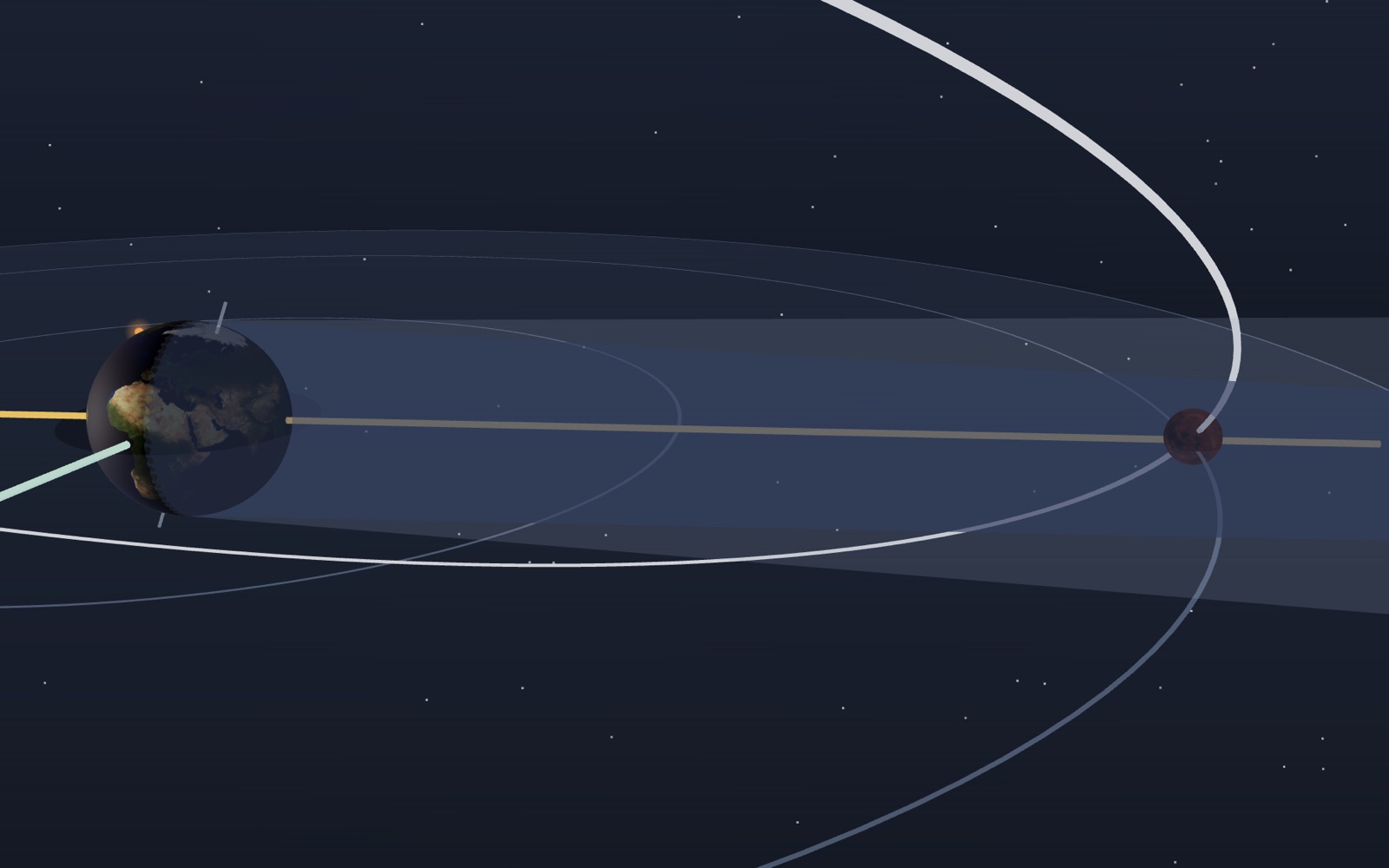
This device cannot show the 3D model. You can read the guide steps below as text.
1 / 8 Sun, Earth and MoonThe Sun is on the left and stays there: this frame turns with the Earth around the Sun. The date slider on the Controls tab moves time forwards, up to 900 days from today. The Moon is to scale with the Earth, but the distance between them is shrunk about six times.
Drag to turn. Scroll or pinch to zoom.
What the model shows
Moon phases happen because we see different portions of the Moon’s sunlit half as it orbits Earth. The dark part of a crescent is the Moon’s own night side, not Earth’s shadow. Earth’s shadow reaches the Moon during a lunar eclipse, which can only occur at full moon.
Look at the Moon a few evenings in a row and its shape changes: a thin curve low in the west after sunset, a half disc a week later, a full circle rising at dusk a week after that. The Moon does not change at all. What changes is the angle between the Sun, the Earth and the Moon, and this page lets you move that angle with a date slider.
The model is drawn in a frame that turns with the Earth as it goes around the Sun, so the Sun always sits on the left. The Earth is turned to the right hour and season: its axis leans 23.44°, and the side facing the Sun is the side where it is daytime at the date shown. The Moon goes around the Earth in the same direction as the Earth spins, anticlockwise when seen from above the north pole.
The small window in the bottom right corner shows the Moon as someone in the northern hemisphere sees it, north up. It is drawn from the same Sun direction and the same Moon position as the 3D model, so when you drag the date slider the two change together. The table in the top left gives the date, the phase name, the Moon's age in days, the fraction of the disc that is lit, how far the Moon is above or below the plane of the Earth's orbit, and whether the nearest new or full moon makes an eclipse.
Why the Moon has phases
The Sun always lights one half of the Moon. That stays true on every day of the month, including the day of the new moon, when the lit half faces away from us. The phase is only a question of how much of the lit half we can see from the Earth.
When the Moon is between the Earth and the Sun, we look at its night side. That is the new moon, and the Moon is lost in the Sun's glare. A week later the Moon has moved a quarter of the way around. We now see the lit half side-on, so half of the disc looks bright: the first quarter. Another week and the Moon is on the far side of the Earth from the Sun, and we look straight at the lit half: the full moon. The last quarter follows a week later, with the other half of the disc lit.
The angle that matters is the elongation, the angle between the Moon and the Sun as seen from the Earth. If the elongation is E, the fraction of the disc that is lit is
k = (1 − cos E) / 2
At E = 0° that gives 0, at 90° it gives 0.5, and at 180° it gives 1. The table in the corner of the stage uses this formula.
Two months: 27.32 days and 29.53 days
Turn on the star direction and the green arrow points at a fixed spot among the stars. Start the clock and count. The Moon comes back to the arrow after 27.32 days. That is the sidereal month, the time for one turn against the stars.
The Moon does not look the same at that moment, though. During those 27.32 days the Earth has moved about 27° along its own orbit, so the Sun now lies in a different direction. The Moon has to go about 2.2 days further to line up with the Sun again. That is the synodic month, 29.53 days, from new moon to new moon. The two numbers are tied together by the length of the year:
1 / 27.3217 = 1 / 29.5306 + 1 / 365.2564
Working it through gives 27.3217 days, the value in the NASA Moon fact sheet. The phase calendar runs on the synodic month, because the phase depends on where the Sun is.
How the phase on this page is worked out
The model starts from one known new moon, 6 January 2000 at 18:14 UTC (Julian Date 2451550.2597), and counts mean synodic months of 29.530588853 days from it. The Moon's age in days is
age = (JD − 2451550.2597) mod 29.530588853
and the elongation is E = 360° × age / 29.530588853. The Sun's direction comes from the US Naval Observatory's short formula for the mean longitude of the Sun, L = 280.459° + 0.98564736° × D, where D is the number of days since 1 January 2000 at 12:00. The Moon's longitude is L + E.
Here is today's check. At 12:00 in Korea on 16 October 2026 (03:00 UTC, JD 2461329.625), 331.16 synodic months have passed since the reference, so the age is 4.74 days. E is 57.8° and k is 23%. NASA's hourly Moon table for 2026 gives 26.9% lit and an age of 5.47 days for the same hour. The US Naval Observatory puts the real new moon at 15:50 UTC on 10 October 2026, and the Korea Astronomy and Space Science Institute (KASI) calendar lists 16 October 2026 as day 6 of the ninth lunar month, with a Moon age of 5.8 days. The model is about 17 hours behind today.
That is the size of error to expect. Over the 99 new moons, quarters and full moons the Naval Observatory lists from September 2026 to August 2028, the model's times differ from the real ones by between 14 hours early and 22 hours late. New moons fall within 10 hours early and 17 hours late. Across all 8,760 hours of 2026 the lit fraction differs from NASA's table by 2.6 percentage points on average and by 8.6 at most.
The reason is that neither orbit is a circle. The Moon's orbit has an eccentricity of 0.0549, so it runs faster near perigee and slower near apogee, and its true position can lead or trail the mean one by more than 6°. The Earth's orbit adds up to 1.9° more for the Sun. At 12.2° a day of relative motion, a few degrees is half a day. For a calendar, a sky app or a photo plan, use the published tables. For seeing why the phases follow the shape they do, the mean month is enough.
Why there is no eclipse every month
If the Moon passes between us and the Sun every 29.5 days, why is a solar eclipse rare? Switch on True tilt 5.14° and look at the orbit almost edge-on. The Moon's orbit is tilted 5.145° to the ecliptic, the plane of the Earth's orbit. At most new moons the Moon slips past above or below the Sun, and at most full moons it passes above or below the Earth's shadow.
The orbit crosses the ecliptic at two points, the nodes. An eclipse needs a new or full moon close to a node. The model checks the angles with mean distances: a solar eclipse is seen somewhere on the Earth when the Moon is less than 1.48° from the Sun at new moon, and a lunar eclipse touches the umbra when the Moon is less than 0.96° from the centre of the Earth's shadow at full moon. Since the Moon's height above the ecliptic is 5.145° × sin F, where F is the angle from the ascending node, those limits become
- solar eclipse of any kind: Sun within 16.7° of a node
- lunar eclipse in the umbra: within 10.8°
- total lunar eclipse: within 4.9°
The Sun moves past the nodes at 1.04° a day, so the window for a solar eclipse is open for about 32 days. That is longer than a synodic month, so each pass brings at least one solar eclipse. The umbral lunar window is open for about 21 days, so a pass can go by with only penumbral eclipses, and 2027 is such a year.
The nodes do not stay put. The line of nodes turns backwards once every 18.6 years, so the Sun meets the same node every 346.62 days, the eclipse year. Eclipse seasons arrive about 173 days apart and drift about 19 days earlier each calendar year. In the model, step 6 shows the full moon of 18 July 2027 with the line of nodes pointing at the Sun.
Solar eclipses: umbra and penumbra
The Sun is about 400 times wider than the Moon and about 389 times farther away, so the two discs look nearly the same size: 0.533° for the Sun and 0.518° for the Moon at mean distances. That near match makes the Moon's shadow a long, thin cone.
The dark core of the shadow, the umbra, is where the whole Sun is hidden. Its length is the Moon's radius times the Sun's distance divided by the difference of the two radii: 1,737.4 × 149,600,000 / (696,000 − 1,737.4) ≈ 374,400 km. At the mean distance of 384,400 km the nearest point of the Earth is 378,029 km from the Moon's centre, so the tip stops about 3,650 km short. Then the Moon looks slightly smaller than the Sun and leaves a ring: an annular eclipse. For a total eclipse the Moon's centre has to be closer than about 380,750 km, which happens in the part of the orbit near perigee (mean perigee 363,300 km).
Around the umbra lies the penumbra, where only part of the Sun is covered. Where it meets the Earth it is about 3,500 km in radius, so a partial eclipse can be seen from a patch thousands of kilometres wide while the total or annular track is at most a few hundred kilometres across. In the model, the dark spot on the Earth marks the central track and is drawn larger than life so you can find it.
Lunar eclipses: the Earth's shadow
The Earth's shadow points away from the Sun, and the Moon can only enter it at full moon. At the Moon's distance the umbra is about 0.70° in radius (4,700 km, or 2.7 times the Moon's radius) and the penumbra 1.24° (8,350 km, 4.8 Moon radii). These sizes include the usual 2% enlargement for the Earth's atmosphere.
A Moon fully inside the umbra does not vanish. Sunlight passing through the Earth's atmosphere is bent into the shadow, and the blue part is scattered away on the way, so the Moon turns a dull copper red. In the penumbra only part of the Sun is blocked, and the dimming is so slight that a penumbral eclipse is easy to miss. A lunar eclipse can be seen from the whole night side of the Earth, while a solar eclipse is seen only where the Moon's penumbra falls. That is why any one town sees far more lunar eclipses than solar ones.
The next eclipses
The table lists every eclipse from today to the end of 2028 in NASA's eclipse tables (times of greatest eclipse in Terrestrial Dynamical Time, TD; UTC is about 69 seconds earlier). The last column is the mean new or full moon in this page's model and the type the model predicts at mean distances.
| Date | Type | Greatest eclipse (TD) | Seen from | Model |
|---|---|---|---|---|
| 2027-02-06 | Annular solar | 16:00 | S. America, Antarctica, w and s Africa | 02-06 12:10, central |
| 2027-02-20 | Penumbral lunar | 23:14 | Americas, Europe, Africa, Asia | 02-21 06:32, penumbral |
| 2027-07-18 | Penumbral lunar | 16:04 | e Africa, Asia, Australia, Pacific | 07-18 22:12, penumbral |
| 2027-08-02 | Total solar | 10:07 | Africa, Europe, Middle East, w and s Asia | 08-02 16:34, central |
| 2027-08-17 | Penumbral lunar | 07:14 | Pacific, Americas | 08-17 10:56, penumbral |
| 2028-01-12 | Partial lunar | 04:14 | Americas, Europe, Africa | 01-12 02:36, penumbral |
| 2028-01-26 | Annular solar | 15:08 | e N. America, C. and S. America, w Europe, nw Africa | 01-26 20:58, central |
| 2028-07-06 | Partial lunar | 18:20 | Europe, Africa, Asia, Australia | 07-07 07:00, partial |
| 2028-07-22 | Total solar | 02:56 | SE Asia, East Indies, Australia, New Zealand | 07-22 01:22, central |
| 2028-12-31 | Total lunar | 16:53 | Europe, Africa, Asia, Australia, Pacific | 12-31 11:25, total |
The mean model finds all ten and gets nine of the types right. The miss is the lunar eclipse of 12 January 2028, which NASA gives an umbral magnitude of only 0.066: the Moon barely grazes the umbra. Times are off by the same few hours as the phases. The total lunar eclipse of 31 December 2028 falls in the early hours of 1 January 2029 in Korea.
What the model changes
The bodies keep their true size ratio: the Moon's radius is 0.2727 of the Earth's. The distance between them is shrunk about 6 times; the real Moon is 60.3 Earth radii away, about 30 Earth diameters. The Sun is the biggest cheat. At this scale it would be a ball 22 units wide about 2,350 units off to the left, so it is drawn small and near just to show where the light comes from.
Because the Moon is drawn 6 times too big for its distance, heights above the ecliptic are stretched by the same factor, and the 5.145° tilt looks like 28°. That keeps the drawn shadow cones honest: at a new or full moon, the Moon touches a cone exactly when the real Moon would. The cost is time. Along its orbit the Moon is still moving at the real angular speed, so in the model it stays inside the Earth's shadow about 6 times longer than in the sky. The Moon's own distance from the Earth is fixed at the mean value, so the model cannot tell total from annular solar eclipses.
The Moon texture is NASA's Lunar Reconnaissance Orbiter colour map from the Scientific Visualization Studio, and the Earth is NASA's Blue Marble. Both are public domain and are reduced in size here.
A short history
Eclipses repeat in a cycle that was known to Chaldean astronomers: 223 synodic months, 6,585.32 days or 18 years 11 days 8 hours. It works because three months nearly line up at that length. 242 draconic months (node to node, 27.2122 days) make 6,585.36 days, and 239 anomalistic months (perigee to perigee) make 6,585.54 days. After one saros the Sun, the Moon and the node are back in almost the same arrangement, and the Moon is at almost the same distance, so the eclipse that follows looks much like the one before. The extra third of a day moves it about 120° west on the Earth.
Calculating the extra days
The two month lengths can be understood as a race between directions, rather than two different clocks inside the Moon. In an ideal circular orbit, the Moon advances 360° / 27.3217 = 13.176° each day against the distant stars. The Earth advances 360° / 365.2564 = 0.986° each day around the Sun. From the moving Earth, the direction towards the Sun therefore advances too. Subtracting the rates leaves 12.190° per day for the Moon to gain on the Sun. Dividing 360° by that relative rate gives 29.53 days. During one sidereal month the Sun direction advances about 26.9°. Recovering that angle takes about 2.2 more days, while the Sun direction continues moving.
This is why simply adding the Earth's angular displacement to the lunar period is not a valid calculation: an angle is not a time. First convert the missing angle into a duration using the relative angular speed. The reciprocal equation above does exactly this. These are average motions, not a prediction that each individual lunation will take precisely that long. Solar gravity and the changing speed along an elliptical orbit alter the interval between actual new moons.
On this page, Star direction separates the fixed stellar reference from the Sun reference. Watch the Moon cross the green arrow, then continue until the same phase returns. The extra interval belongs to the changing viewing geometry. It does not mean the Moon stopped rotating or reversed along its orbit.
Estimating when the Moon rises
A phase also gives a rough observing schedule. In an ideal equatorial sketch, the new moon rises near sunrise, crosses the sky near local noon and sets near sunset. First quarter rises near noon, crosses the sky near sunset and sets near midnight. Full moon rises near sunset, crosses near midnight and sets near sunrise. Last quarter rises near midnight, crosses near sunrise and sets near noon. These are local solar times, not exact civil-clock appointments; latitude, season, orbital tilt and the shape of the horizon all matter.
The average delay can be estimated with the same relative motion. The phase angle grows about 12.190° per solar day. The Sun's daily circuit corresponds to 15° per hour, so 12.190° / 15° per hour is about 0.813 hours, or 49 minutes. That explains the familiar rule that the Moon returns roughly 50 minutes later each day. It is a mean guide to the daily passage, not a universal moonrise increment: actual rises can differ considerably, and at high latitudes the Moon may not rise on a particular date.
A daytime Moon is therefore ordinary. A first-quarter Moon is already above the horizon during the afternoon, and a last-quarter Moon remains visible in the morning. Blue sky can reduce contrast without removing the Moon. The sky panel on the Controls tab gives real rise and set times for eight cities; for other places consult a local ephemeris before an outing. Never search for a thin crescent with binoculars close to the Sun; pointing optical equipment at the Sun can cause permanent eye injury.
What the illuminated fraction measures
The lit fraction is an area on the apparent disc, not the fraction of the whole lunar surface receiving sunlight. Away from eclipses the Sun illuminates approximately half the sphere at every phase. At elongation E = 60°, the model gives k = (1 − 0.5) / 2 = 0.25. At E = 120°, it gives k = (1 − (−0.5)) / 2 = 0.75. Both positions are equally far from a quarter-phase angle, but one is a crescent and the other is gibbous. After full moon, E = 240° also gives 0.75: the same area is bright, on the opposite side of the disc.
The cosine relation comes from projecting the day-night boundary of a sphere onto a flat image. The boundary itself is a great circle in the simple distant-Sun geometry; it looks curved because we see it obliquely. At quarter phase it is viewed edge-on and appears nearly straight. The formula treats the Sun as effectively infinitely far away. For a precise illumination calculation the phase angle is measured at the Moon between the Earth and Sun directions, rather than simply taking the supplement of geocentric elongation.
Nor is a disc with half its area lit necessarily half as bright as a full moon. Surface scattering, shadows cast by rough terrain and the strong brightening near full phase affect the light received. The corner readout reports geometrical area, not a light-meter reading. Turn the camera around without changing Date: the spatial view changes, but Seen from Earth should keep the same phase because its observer has not moved with your camera.
Earthshine and apparent size
A faint complete outline inside a bright crescent is earthshine. Sunlight reflects from the Earth to the lunar night side and then returns to your eye. Near new moon, an observer on the Moon's Earth-facing side would see a nearly full Earth, so the Earth can light the landscape that direct sunlight misses. Clouds and oceans change the strength of the reflected light. The glow does not mean the lunar night side generates visible light, and it is not the Earth's shadow; that shadow matters at a lunar eclipse near full moon. The stage does not simulate this reflected-light brightness, so do not use its texture shading as a measurement of earthshine.
A supermoon concerns distance rather than a different phase mechanism. NASA's comparison of extreme full moons gives up to about 14% more apparent diameter and about 30% more brightness. A diameter ratio of 1.14 gives an apparent-area ratio of 1.14 × 1.14 = 1.30, explaining why the percentage for area is larger. The comparison is with a small, distant full moon, not with every ordinary full moon. A near full moon is not suddenly enormous compared with the one seen a few evenings earlier.
The Moon also often looks huge near the horizon even when its distance has barely changed. That perceptual Moon illusion is separate from the orbital size change. Compare photographs taken with the same focal length and image scale before claiming that a low Moon is physically larger. The 3D model fixes the Earth-Moon distance and shrinks it for display, so the changing angular diameter of a supermoon appears in the size row of the real Moon panel instead.
A phase calendar is not a tide table
A calendar based on lunations follows illumination rather than the stellar orbit. A mean cycle lasts 29.53 days, so whole calendar days cannot divide it exactly; lunar months commonly alternate in length, with actual rules depending on the calendar. The Korean lunisolar calendar also keeps months aligned with the solar year by inserting leap months under its astronomical rules. Do not obtain a legal or festival date merely by rounding the Moon age on this page. Use the KASI calendar conversion source for the actual calendar convention and date.
New and full moon also mark configurations that tend to produce spring tides, when solar and lunar tidal effects reinforce. At quarter phases the effects partly oppose and the tidal range tends to be smaller, called neap tides. This does not mean that a bright Moon pulls harder because more of its surface is lit. The gravitational effect is there at new moon too. Coastline shape, water depth and basin response control the local timing and range, and a spring-tide maximum can lag the astronomical alignment.
For a screen exercise, keep Shadows enabled and move Date from a crescent towards full moon. Observe that the ordinary phase changes continuously while an eclipse requires the orbit to meet the shadow. Then compare the same lit fraction before and after full moon: the illuminated side reverses although the area matches. Finally return to a quarter phase and use the rise-time sketch above to decide whether evening or morning is the better observing period. The page explains the arrangement; it does not supply local tide heights, horizon crossings or a precise religious calendar.
The real Moon next to the mean one
The 3D model moves the Moon at its average rate, which keeps the geometry easy to follow but puts the drawn new and full moons up to most of a day away from the real ones. The Controls tab therefore has a second calculation running beside it, titled The real Moon at this date. It uses the low precision formulae printed in The Astronomical Almanac: the Moon's ecliptic longitude is a steady drift of 481,267.881° per century plus six periodic terms, the largest with an amplitude of 6.29°, its latitude has four terms led by a 5.13° wave, and the horizontal parallax, which gives the distance, has five. The Sun comes from the Naval Observatory's approximate solar coordinates.
That is enough to land close to the official times. Checked against all 149 new moons, quarters and full moons the Naval Observatory lists for 2026, 2027 and 2028, the times found by this panel differ by 9 minutes on average and 29 minutes at worst. Over the same list the mean model is up to 17.4 hours away for new and full moons. The row 3D model vs real shows that gap live, in hours, so you can watch it swing from ahead to behind as the Moon moves between the near and far parts of its orbit, where it travels faster and slower than average.
The panel also gives the next new moon, first quarter, full moon and last quarter in the local time of the chosen city, and a date box. Type any date, a birthday for example, press Go, and the whole exhibit jumps to 21:00 that evening in that city.
Why the crescent leans differently in each city
Everyone on Earth sees the same fraction of the Moon lit at the same moment. What changes from place to place is which way that lit edge points relative to the local horizon. Astronomers describe the bright side with the position angle of the bright limb, measured on the sky from north through east, and the tilt of the local vertical with the parallactic angle. Subtracting one from the other gives the direction of the lit edge as you see it, measured from straight up.
The sky panel draws exactly that. The Moon's disc is taken from the same NASA map as the 3D Moon, turned by the parallactic angle so that lunar north sits where it would really be, and shaded from the Sun's direction. Pick Seoul or London on an evening a few days after new moon and the crescent hangs low in the west with its lit side down and to the right. Pick Sydney or Cape Town for the same moment and it is lit on the left, and the maria are upside down compared with the northern picture, because an observer there faces north to see the Moon. Near the equator, in Quito, an evening crescent lies almost on its back, like a bowl. The Moon has not changed; the observer's vertical has.
Working out moonrise for a city
Rise and set times are found the way an almanac does it. The panel steps through the local day in ten minute steps, computes the Moon's altitude from its right ascension and declination, the sidereal time and the city's latitude and longitude, and looks for the moments the Moon's upper edge crosses the horizon. That edge is at an altitude of 0.7275 times the horizontal parallax minus 0.5667°. The first part combines two effects of the Moon being close: its direction depends on where you stand on the Earth, which lowers it by the parallax, and its radius is 0.2725 of the Earth's, so its upper edge is that fraction of the parallax above its centre. The 0.5667° is the bending of light by the air near the horizon. The highest point of the day is where the hour angle passes zero.
Against 55 rise, set and transit times taken from the Naval Observatory for eight cities, the panel is within 1.8 minutes. A day with no moonrise is normal: the Moon rises about 50 minutes later each day on average, so once a month the rise slips past midnight into the next date. In Reykjavík there are days in winter when the Moon stays up for the whole day and others when it never rises. Hills, buildings and unusual refraction can move a real sighting by several minutes, so treat the times as a horizon at sea level.
Perigee, apogee and the size comparison
The Moon's orbit is an ellipse, and the ellipse itself is pulled around by the Sun, so the closest and farthest points change from month to month. Between 2026 and 2028 the real Moon panel finds a closest distance of 357,382 km and a farthest of 406,018 km, measured centre to centre. The apparent diameter follows: 33.4′ at the closest, 29.4′ at the farthest. Their ratio, 1.136, is the figure behind NASA's statement that the nearest full moon can look up to 14% bigger than the farthest one.
The size row draws the farthest and nearest discs as outlines and the Moon at the chosen date as a filled disc between them. Jump to the supermoon of 24 December 2026 in the catalogue and it nearly fills the larger outline: 357,616 km and 33.4′. The November 2026 supermoon, on NASA's list as well, is a little farther at 361,500 km and 33.0′. The word supermoon has no official threshold; NASA describes it as a full moon close to perigee. This page uses 360,000 km for its challenge so that the target is a fixed number.
Where the catalogue dates come from
Every eclipse in the catalogue of eclipses and special Moons comes from the decade tables of NASA's Goddard Space Flight Center: the time of greatest eclipse, the type, the saros series, the duration and the regions it can be seen from. The supermoons are the ones NASA lists, the blue moons were found in the Naval Observatory's phase tables (two full moons in one calendar month, counted in UTC), and the historic entries link to the same NASA tables or to NASA's mission page for Apollo 11.
Because the 3D model runs on mean motion, choosing an entry moves the stage to the mean new or full moon nearest the listed time, which is why the stage clock can differ from the catalogue by some hours while the alignment still shows the eclipse. Two entries make a pair worth comparing. The total eclipse of 29 May 1919, used to test general relativity, and the long total eclipse of 2 August 2027 belong to the same saros, number 136, six cycles apart: 39,512 days divided by six is 6,585.3 days, the length of one saros. The 2009 eclipse over India and China sits between them in the same series. For Apollo 11 the catalogue shows a waxing crescent about 6.3 days old, 33% lit: the landing was planned for a low morning Sun at the Sea of Tranquility, so that shadows showed the shape of the ground.
Questions
Why do we always see the same side of the Moon?
The Moon turns once on its axis in the same 27.32 days it takes to go round the Earth. The Earth's tides slowed its spin until the two matched. In the model the Moon keeps its near side, with the dark maria, facing the Earth.
Is the dark part of a crescent Moon the Earth's shadow?
No. The dark part is the Moon's own night side. The Earth's shadow only falls on the Moon during a lunar eclipse, and only at full moon. In a crescent you can sometimes see the night side glowing faintly; that is sunlight reflected from the Earth.
Why is the crescent lit on the right in the evening?
After new moon the Moon is east of the Sun, so when you face south after sunset the Sun is down on your right and lights the right side of the Moon. In the southern hemisphere people face north to see the Moon, and the picture is mirrored.
How accurate is the phase on this page?
The page counts mean months from one new moon in 2000. Checked against the US Naval Observatory for 2026 to 2028, new and full moons come out up to about 17 hours early or late, and the lit fraction is within about 9 percentage points. Use published tables for exact times.
How many eclipses happen in a year?
At least four (two solar and two lunar, though some of the lunar ones may be only penumbral) and at most seven. Each eclipse season gives one or two solar eclipses and one or two lunar ones.
Why is a totally eclipsed Moon red?
The Earth's atmosphere bends sunlight into the shadow. On the long path through the air, blue light is scattered out and red light gets through, as at sunset. The amount of dust and cloud in the air decides how dark the Moon gets.
What is a blood moon or a supermoon?
Neither is an astronomical term. "Blood moon" is a popular name for a total lunar eclipse. "Supermoon" usually means a full moon near perigee, when the Moon looks up to about 14% wider than at apogee.
Can I see the Moon during the day?
Yes. First quarter is commonly visible in the afternoon and last quarter in the morning. Phase geometry puts the Moon above the horizon during part of daylight; sky brightness mainly affects contrast.
Does half illuminated mean half as bright?
No. The readout is a projected area fraction. Lunar terrain and surface scattering change the received light, especially close to full moon.
Can I use the model for local tides or moonrise?
For moonrise, partly. The sky panel on the Controls tab works out rise, highest point and set for eight cities to within about two minutes of the Naval Observatory, for a horizon at sea level. For other places use a local ephemeris. There is no tide calculation: use the hydrographic tide table for coastal planning.
Why does the real Moon panel disagree with the 3D model by several hours?
The 3D model uses the average motion of the Moon so that the geometry stays simple. The real Moon speeds up near perigee and slows down near apogee, and the Sun's pull changes its path as well, so the true new and full moons fall up to most of a day before or after the mean ones. The panel shows the gap in hours.
Why is the Moon upside down in Australia?
People in the southern hemisphere face north to see the Moon, while people in the northern hemisphere face south. Turning round by half a circle turns the Moon's face and its lit side over as well. Choose Sydney in the sky panel and compare it with Seoul at the same moment.
What is a blue moon?
In the sense used most often today it is the second full moon in one calendar month. It happens because the 29.53 day cycle is shorter than most months. May 2026 has one, on the 31st, and December 2028 has one on the 31st, which is also a total lunar eclipse. The colour is the usual one.
Terms
- Phase: the shape of the lit part of the Moon as seen from the Earth.
- Elongation: the angle between the Moon and the Sun as seen from the Earth. 0° at new moon, 180° at full moon.
- Synodic month: new moon to new moon, 29.53 days on average.
- Sidereal month: one turn against the stars, 27.32 days.
- Draconic month: node to node, 27.21 days.
- Ecliptic: the plane of the Earth's orbit around the Sun.
- Node: one of the two points where the Moon's orbit crosses the ecliptic.
- Eclipse year: the time for the Sun to return to the same node, 346.62 days.
- Umbra: the part of a shadow where the light source is completely hidden.
- Penumbra: the part of a shadow where the light source is only partly hidden.
- Saros: a cycle of 223 synodic months after which eclipses repeat.
- Julian Date (JD): a running count of days used in astronomy, starting at noon.
- Perigee and apogee: the closest and farthest points of the Moon's orbit from the Earth.
- Parallactic angle: the angle on the sky between the direction to the celestial north pole and the direction straight up, at the Moon's position.
- Blue moon: the second full moon in one calendar month.
Sources
NASA Goddard Space Flight Center, Eclipse Web Site, Solar Eclipses: 2021 to 2030. https://eclipse.gsfc.nasa.gov/SEdecade/SEdecade2021.html (checked 2026-10-16)
NASA Goddard Space Flight Center, Eclipse Web Site, Lunar Eclipses: 2021 to 2030. https://eclipse.gsfc.nasa.gov/LEdecade/LEdecade2021.html (checked 2026-10-16)
NASA Goddard Space Flight Center, Eclipse Web Site, Eclipses and the Moon's Orbit. https://eclipse.gsfc.nasa.gov/SEhelp/moonorbit.html (checked 2026-10-16)
NASA Goddard Space Flight Center, Eclipse Web Site, Periodicity of Solar Eclipses (saros). https://eclipse.gsfc.nasa.gov/SEsaros/SEsaros.html (checked 2026-10-16)
NASA Space Science Data Coordinated Archive, Moon Fact Sheet. https://nssdc.gsfc.nasa.gov/planetary/factsheet/moonfact.html (checked 2026-10-16)
NASA Space Science Data Coordinated Archive, Sun Fact Sheet. https://nssdc.gsfc.nasa.gov/planetary/factsheet/sunfact.html (checked 2026-10-16)
NASA Scientific Visualization Studio, Moon Phase and Libration, 2026 (hourly lit fraction and age). https://svs.gsfc.nasa.gov/5587 (checked 2026-10-16)
NASA Scientific Visualization Studio, CGI Moon Kit (LRO colour map, public domain, used at 512 × 256). https://svs.gsfc.nasa.gov/4720 (checked 2026-10-16)
NASA Science, Blue Marble collection (public-domain Earth image, used at 1024 × 512). https://science.nasa.gov/earth/earth-observatory/collections/blue-marble/ (checked 2026-10-16)
NASA Science, Moon Phases. https://science.nasa.gov/moon/moon-phases/ (checked 2026-10-16)
US Naval Observatory, Phases of the Moon (data service). https://aa.usno.navy.mil/data/MoonPhases (checked 2026-10-16)
US Naval Observatory, Approximate Solar Coordinates. https://aa.usno.navy.mil/faq/sun_approx (checked 2026-10-16)
US Naval Observatory, Computing Greenwich Apparent Sidereal Time. https://aa.usno.navy.mil/faq/GAST (checked 2026-10-16)
Korea Astronomy and Space Science Institute (KASI), Lunar and solar calendar conversion. https://astro.kasi.re.kr/life/pageView/8 (checked 2026-10-16)
Calculations on this page: mean phase from the new moon of 2000-01-06 18:14 UTC and a synodic month of 29.530588853 days; mean longitude of the Moon's node from Jean Meeus, Astronomical Algorithms, 2nd ed. (1998), chapter 47; shadow sizes from mean distances with a 2% atmospheric enlargement.
NASA Science, Supermoons. https://science.nasa.gov/moon/supermoons/ (2026-10-23)
US Naval Observatory, Phases of the Moon (yearly tables, 2026 to 2028, via the Astronomical Applications API). https://aa.usno.navy.mil/api/moon/phases/year?year=2027 (checked 2026-10-27)
US Naval Observatory, Sun and Moon Rise/Set/Transit for One Day. https://aa.usno.navy.mil/data/RS_OneDay (checked 2026-10-27)
The Astronomical Almanac (US Naval Observatory and HM Nautical Almanac Office), Section D, Low-precision formulae for geocentric coordinates of the Moon. https://aa.usno.navy.mil/publications/asa (checked 2026-10-27)
NASA Goddard Space Flight Center, Eclipse Web Site, Solar Eclipses: 1911 to 1920. https://eclipse.gsfc.nasa.gov/SEdecade/SEdecade1911.html (checked 2026-10-27)
NASA Goddard Space Flight Center, Eclipse Web Site, Solar Eclipses: 2001 to 2010. https://eclipse.gsfc.nasa.gov/SEdecade/SEdecade2001.html (checked 2026-10-27)
NASA Goddard Space Flight Center, Eclipse Web Site, Solar Eclipses: 2011 to 2020. https://eclipse.gsfc.nasa.gov/SEdecade/SEdecade2011.html (checked 2026-10-27)
NASA Goddard Space Flight Center, Eclipse Web Site, Lunar Eclipses: 2011 to 2020. https://eclipse.gsfc.nasa.gov/LEdecade/LEdecade2011.html (checked 2026-10-27)
NASA Science, Super Blue Moons: Your Questions Answered. https://science.nasa.gov/solar-system/moon/super-blue-moons-your-questions-answered/ (checked 2026-10-27)
NASA, Apollo 11 Mission Overview. https://www.nasa.gov/history/apollo-11-mission-overview/ (checked 2026-10-27)
NASA Scientific Visualization Studio, CGI Moon Kit (LOLA elevation map ldem_3_8bit and the 2048 × 1024 LRO colour map used on faster devices, public domain). https://svs.gsfc.nasa.gov/4720 (checked 2026-10-27)
More exhibits
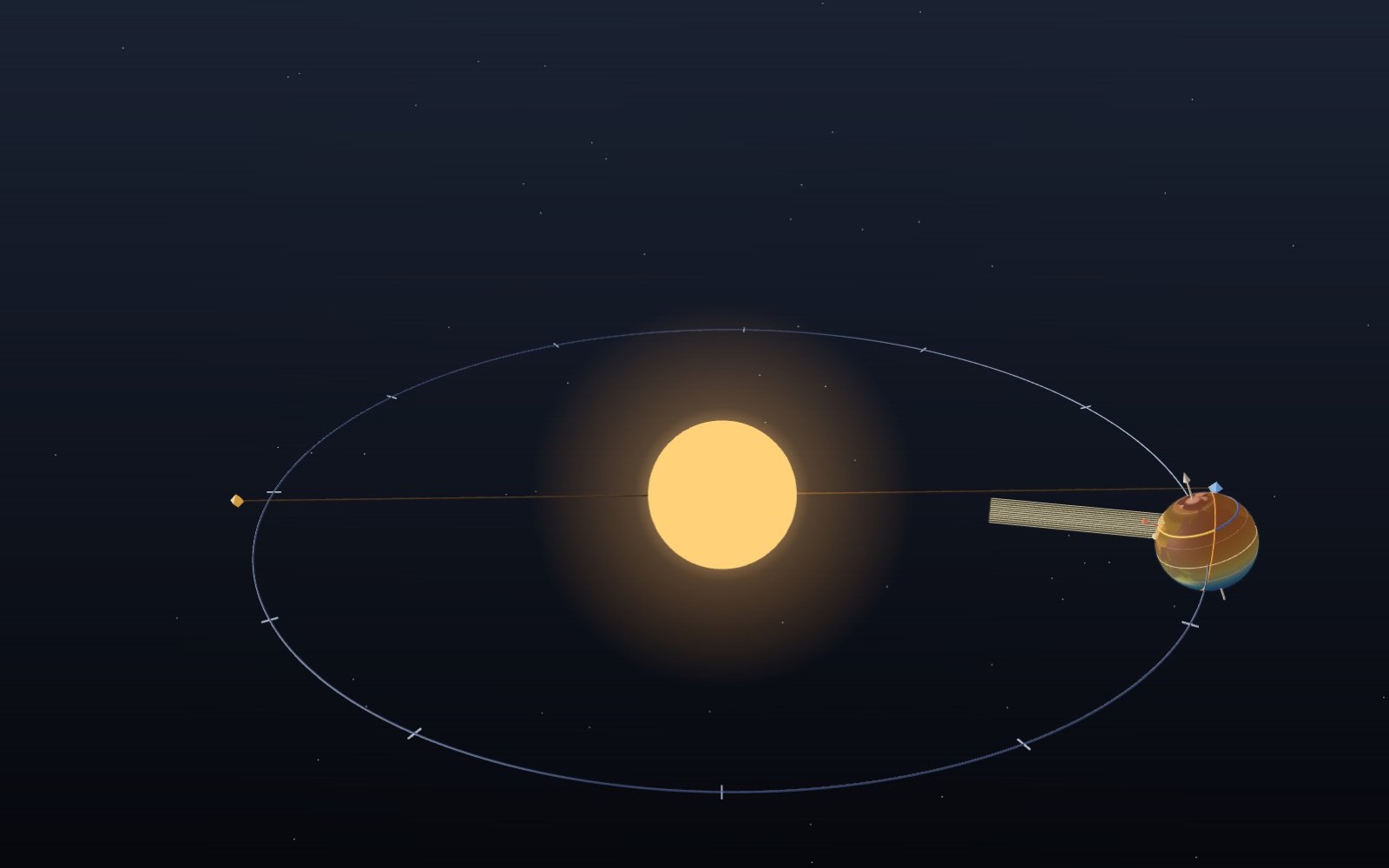
Why we have seasons: tilted Earth, changing daylight
The Earth is closest to the Sun in the first week of January, in the middle of the northern winter.
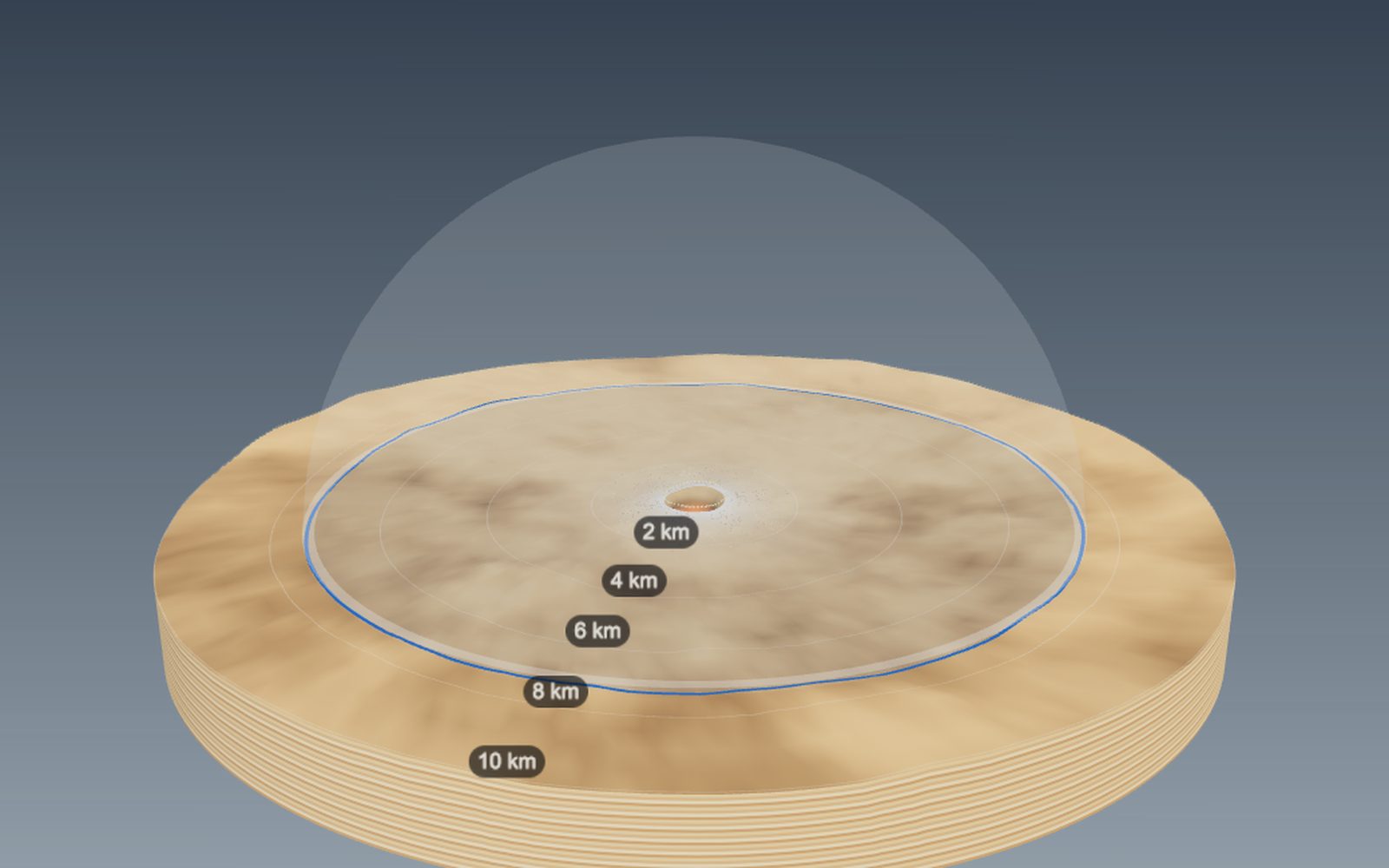
How big a crater would an asteroid make, and how craters form
The 1.2 km wide Meteor Crater in Arizona was dug by an iron asteroid only a few tens of metres across.
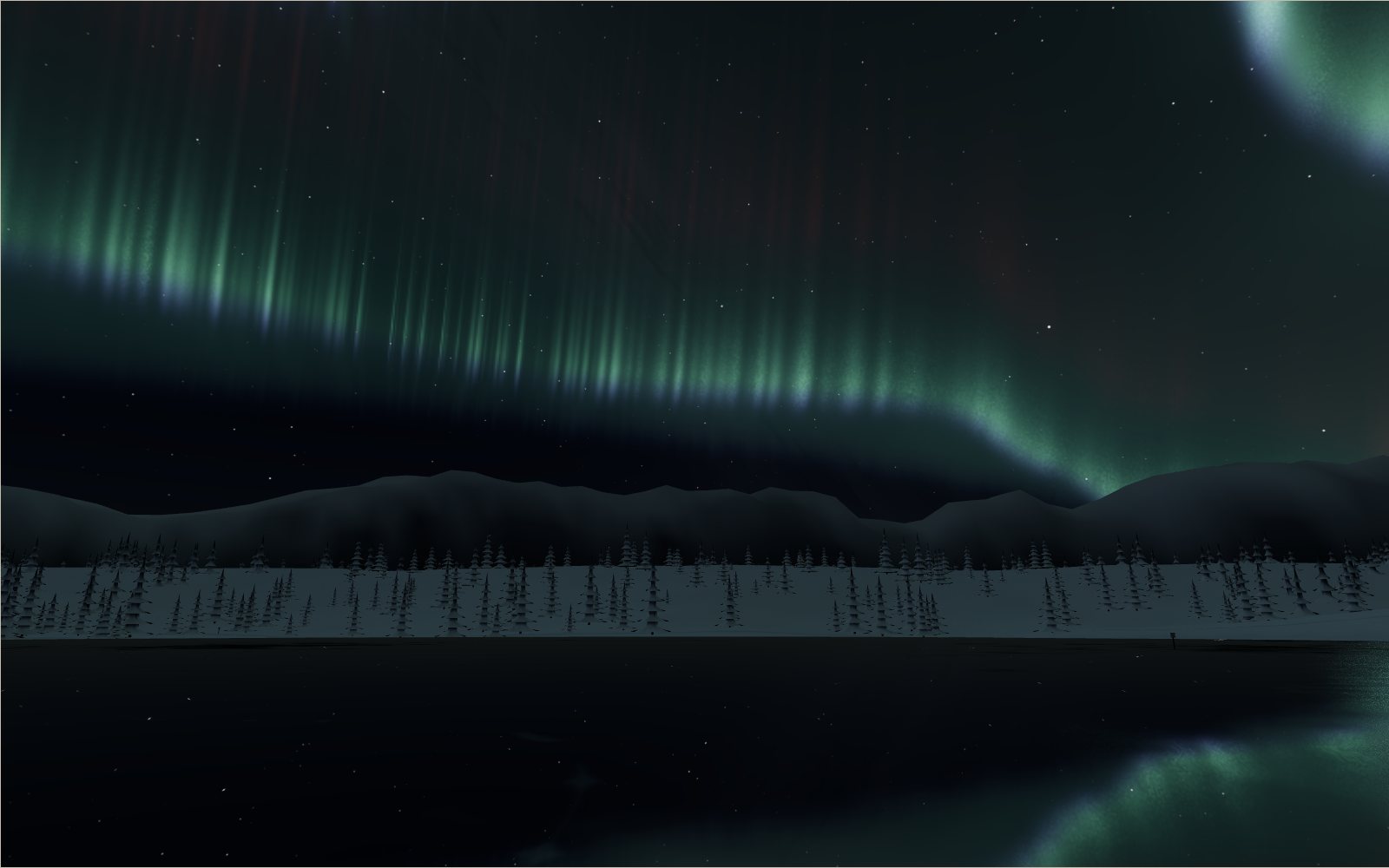
Northern lights over an Arctic village
The green of the northern lights comes from oxygen about 100 km up, and in the biggest storms the red glow above it can be seen as far south as Korea.
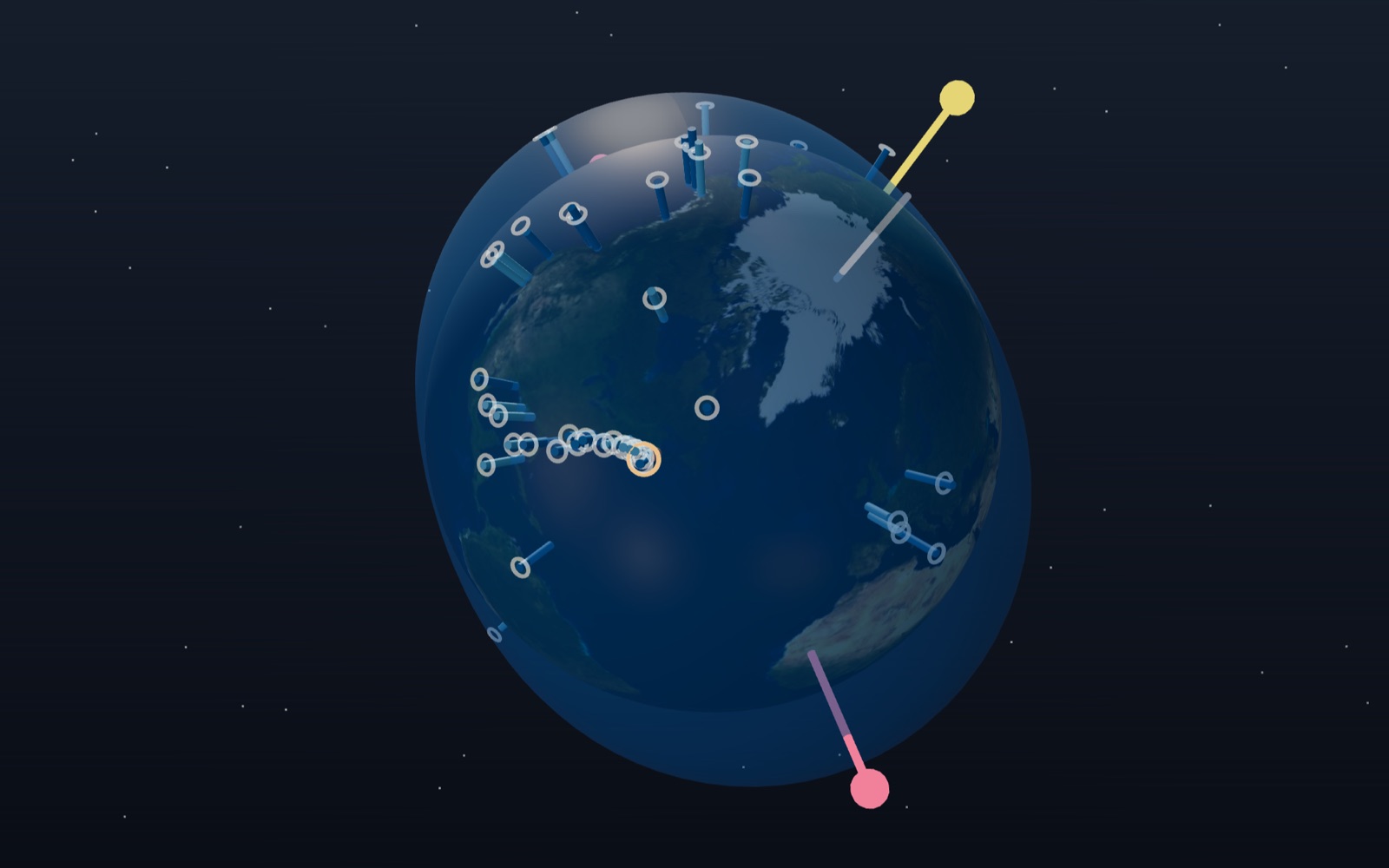
How tides work
The Moon raises the sea on the side of the Earth facing it, so why is there a second high tide on the side facing away?
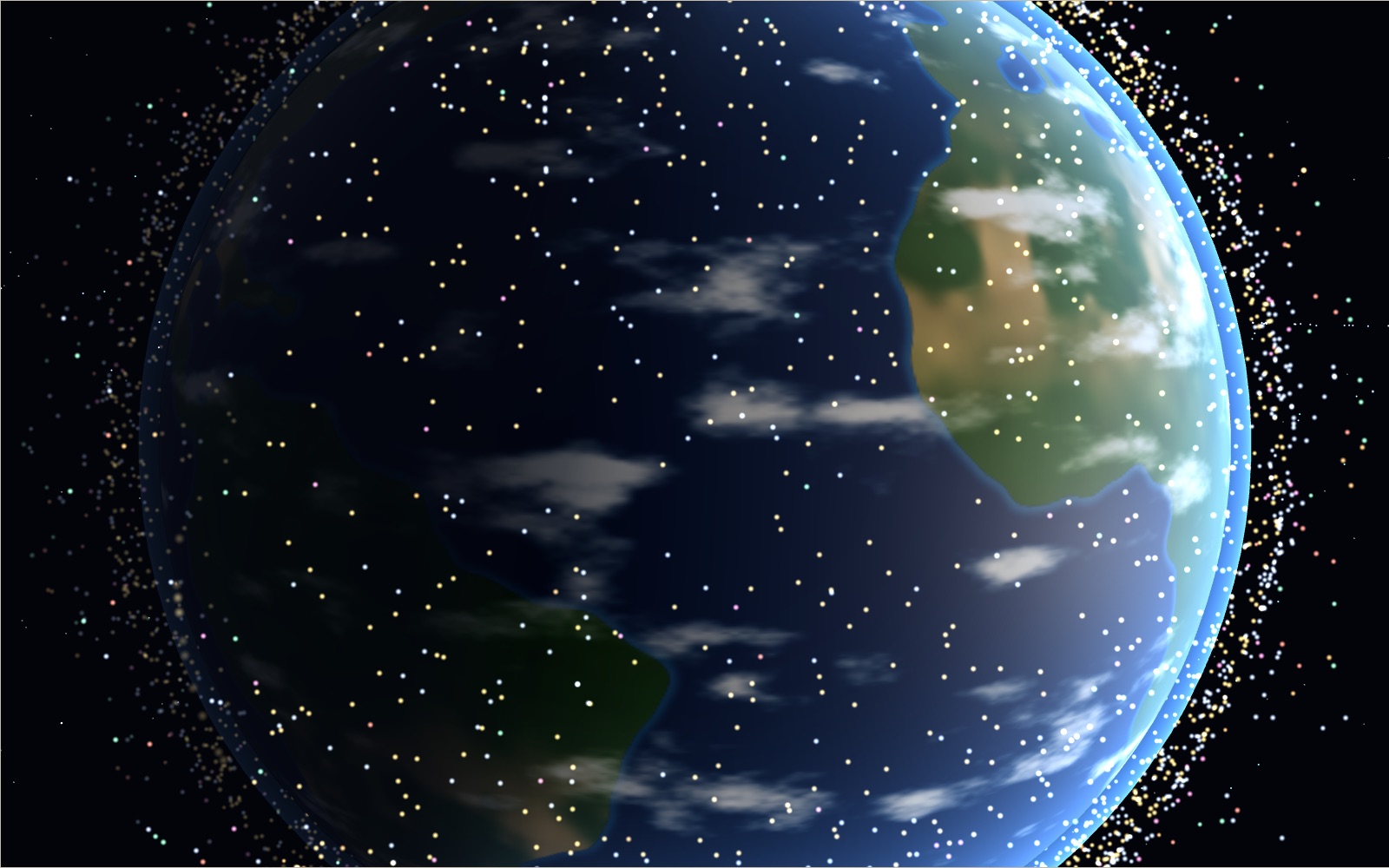
Satellites orbiting Earth right now
On 20 October 2026 the public catalogue listed 16,768 working satellites, and two in every three belonged to one company's internet network.
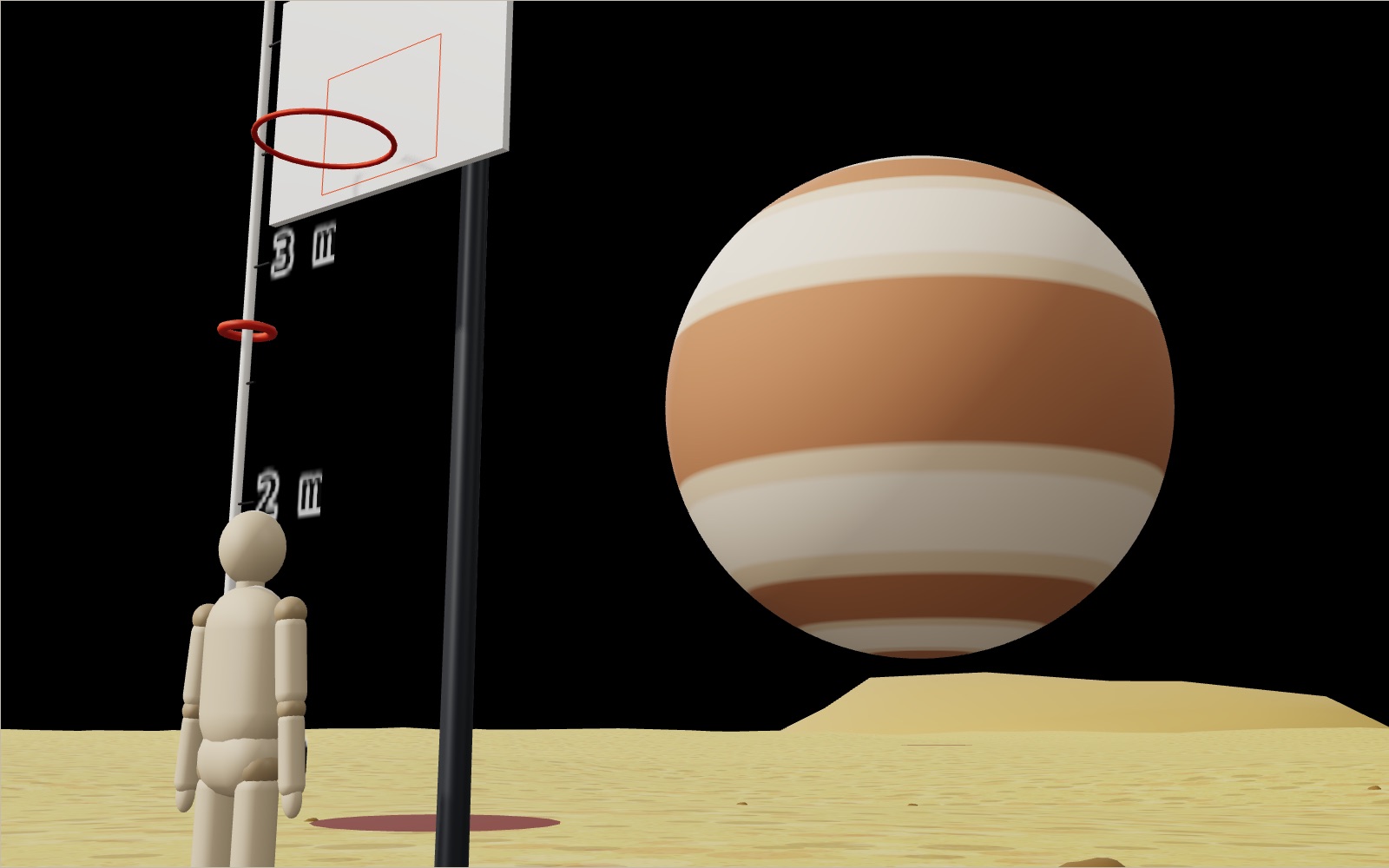
Your weight and jump height on other planets and moons
A 50 cm jump on Earth becomes a 3 m leap on the Moon, 18 m on Ceres and a one-way trip off asteroid Bennu.
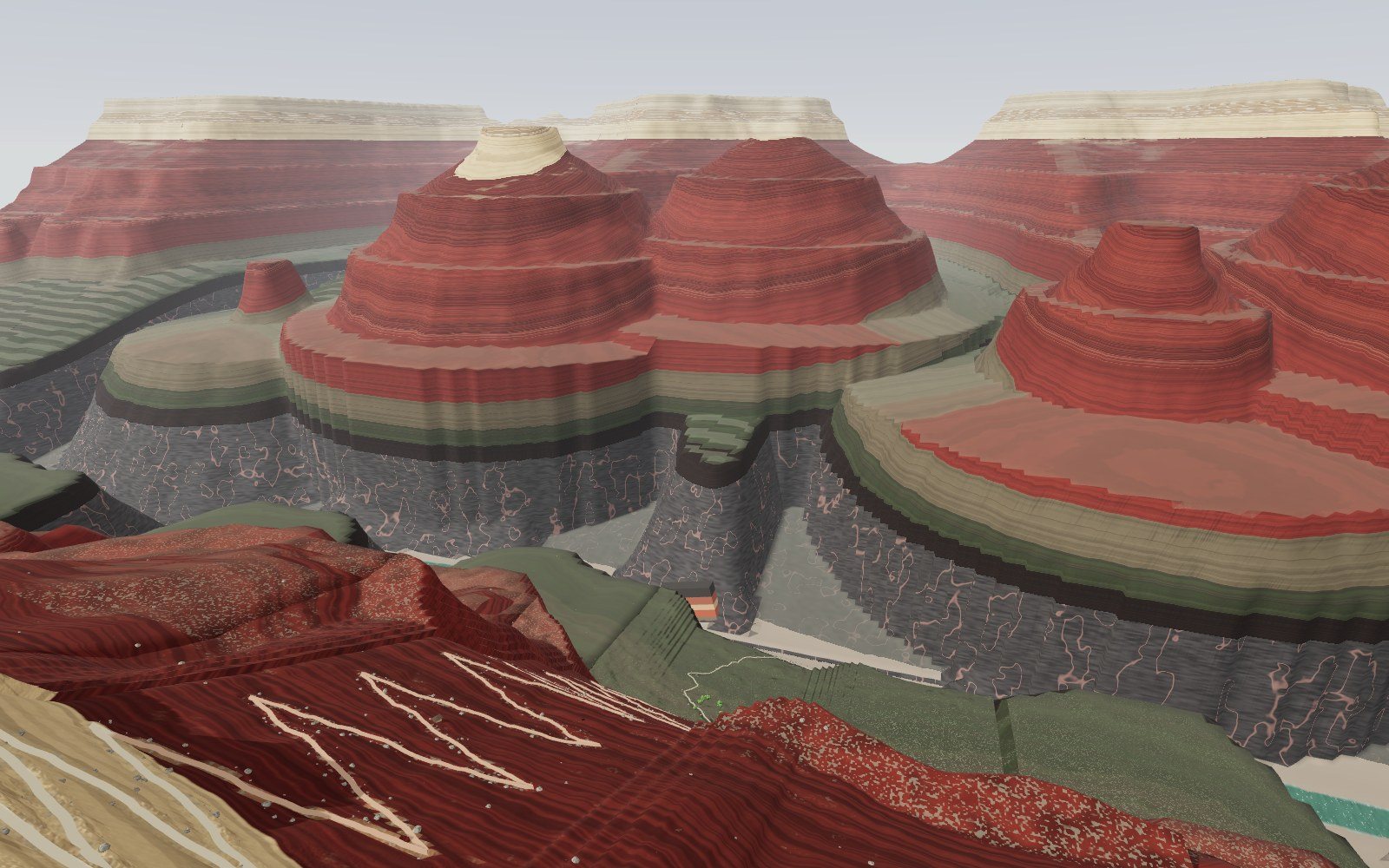
Walk down the Grand Canyon rock layers
Walk 1,360 m down the Bright Angel Trail through 13 rock layers, from a 270-million-year-old sea floor on the rim to 1.75-billion-year-old schist by the river.
How lightning and thunder work
A lightning channel heats the air to about five times the temperature of the Sun’s surface, and its thunder needs about 3 seconds to cover each kilometre to you.
Travelling at the speed of light
Light goes round the equator 7.5 times in a second, yet the same light needs 2.5 million years to reach the Andromeda galaxy.
Walk through Machu Picchu
Most of the work that holds Machu Picchu on its ridge, 60 per cent by one estimate, lies under the ground in foundations and drains nobody sees.
Coral bleaching causes: why warmer water turns reefs white
Corals get most of their food from algae living in their tissue, and when the sea stays more than 1 °C above its usual summer high for weeks, they lose those algae and turn white.
What happens to your body in space without a suit
Without a suit you would have about 10 seconds of useful consciousness, and if air came back within a minute or so you might well recover. You would not explode.