Loading the model
This device cannot show the 3D model. You can read the guide steps below as text.
1 / 8 Sun, Earth and Moon The Sun is on the left and stays there: this frame turns with the Earth around the Sun. The date slider on the Controls tab moves time forwards, up to 900 days from today. The Moon is to scale with the Earth, but the distance between them is shrunk about six times.
Drag to turn. Scroll or pinch to zoom.
Guide Parts Controls
01 Sun, Earth and Moon The Sun is on the left and stays there: this frame turns with the Earth around the Sun. The date slider on the Controls tab moves time forwards, up to 900 days from today. The Moon is to scale with the Earth, but the distance between them is shrunk about six times.
02 Half of the Moon is always lit This is the next first quarter. The Sun lights the half of the Moon that faces it, every day of the month. From the Earth we see that lit half side-on, so the disc in the corner panel is lit on the right and dark on the left.
03 A month of phases Watch the corner panel while the Moon goes round. Near the Sun we see the dark side (new moon), on the far side we see the lit side (full moon). The age counts days since the last new moon, using a mean month of 29.53 days.
04 27.32 days and 29.53 days The green arrow points at a fixed spot among the stars. The Moon gets back to that arrow after 27.32 days. By then the Earth has moved about 27° around the Sun, so the Moon needs about 2.2 more days to line up with the Sun again.
05 An orbit tilted by 5.14° Seen almost edge-on, the Moon's orbit rises above the ecliptic and dips below it. Heights are stretched six times to match the enlarged bodies. Turn on True tilt to see the real angle: the Moon then never seems to leave the shadow, which is the exaggeration warning in action.
06 Nodes and eclipse seasons This is the full moon of 18 July 2027. The line of nodes now points at the Sun, so new and full moons happen close to the ecliptic. Such a window comes round every 173 days, and that is when eclipses happen.
07 A solar eclipse The new moon of 2 August 2027 sits almost on the node. Its shadow falls on the Earth: the pale cone covers a region of partial eclipse and the dark tip marks the central track. NASA lists a total eclipse lasting up to 6 min 23 s.
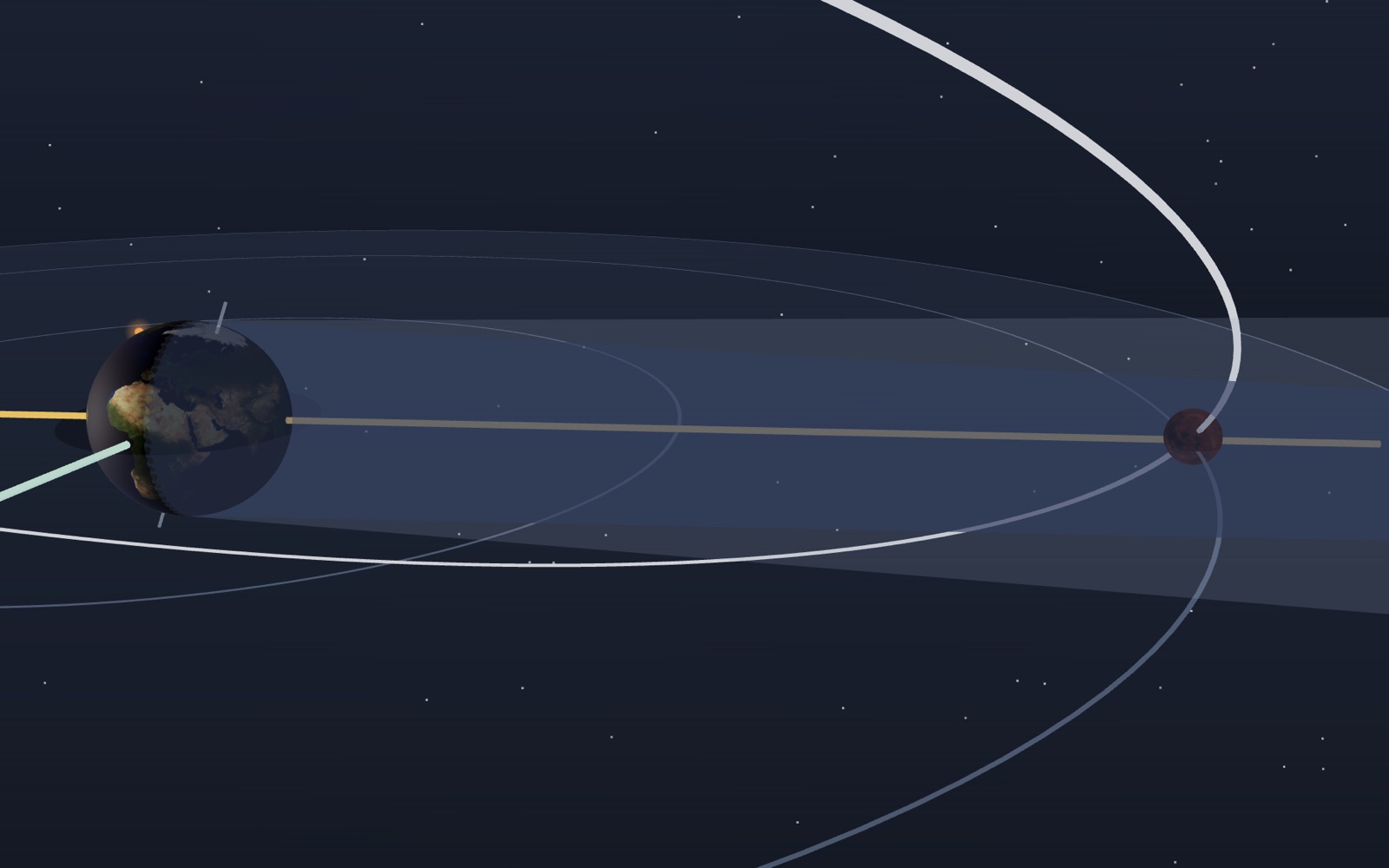
08 A lunar eclipse The full moon of 31 December 2028 passes through the middle of the Earth's umbra. Sunlight bent through the Earth's air still reaches it, so it turns dark red instead of vanishing. In Korea it is the small hours of 1 January 2029, and the whole eclipse is visible.
Sun The light source. Drawn 2.4 units away and half a unit wide. With the Earth and Moon at this size it would be 22 units wide and 2,350 units away. Earth Turned to the right hour and season: the axis leans 23.44° and the day side faces the Sun. Map: NASA Blue Marble. Moon Always keeps the same face towards the Earth. Half of it is lit at every moment; the phase is how much of that half we see. Moon's orbit Tilted 5.14° to the ecliptic. Heights are stretched 6 times here, so it looks like 28°; switch on True tilt to compare. Ecliptic plane The plane of the Earth's orbit around the Sun. The Sun and the Earth's shadow always lie in it. Line of nodes The two points where the Moon's orbit crosses the ecliptic, joined by a line. The line turns backwards once every 18.6 years. Direction of the stars Points at a fixed spot among the stars (the March equinox). The Moon returns to it every 27.32 days. Moon's umbra The dark core of the Moon's shadow. At the mean distance it stops about 3,650 km short of the Earth, which is why many central eclipses are annular. Moon's penumbra Where only part of the Sun is hidden. It is about 7,000 km across when it reaches the Earth: a partial eclipse. Earth's shadow Dark inner cone: umbra, 2.7 Moon radii wide at the Moon. Pale outer cone: penumbra, 4.8 Moon radii.