FIG. 84Senses
How big a crater would an asteroid make, and how craters form
The 1.2 km wide Meteor Crater in Arizona was dug by an iron asteroid only a few tens of metres across.
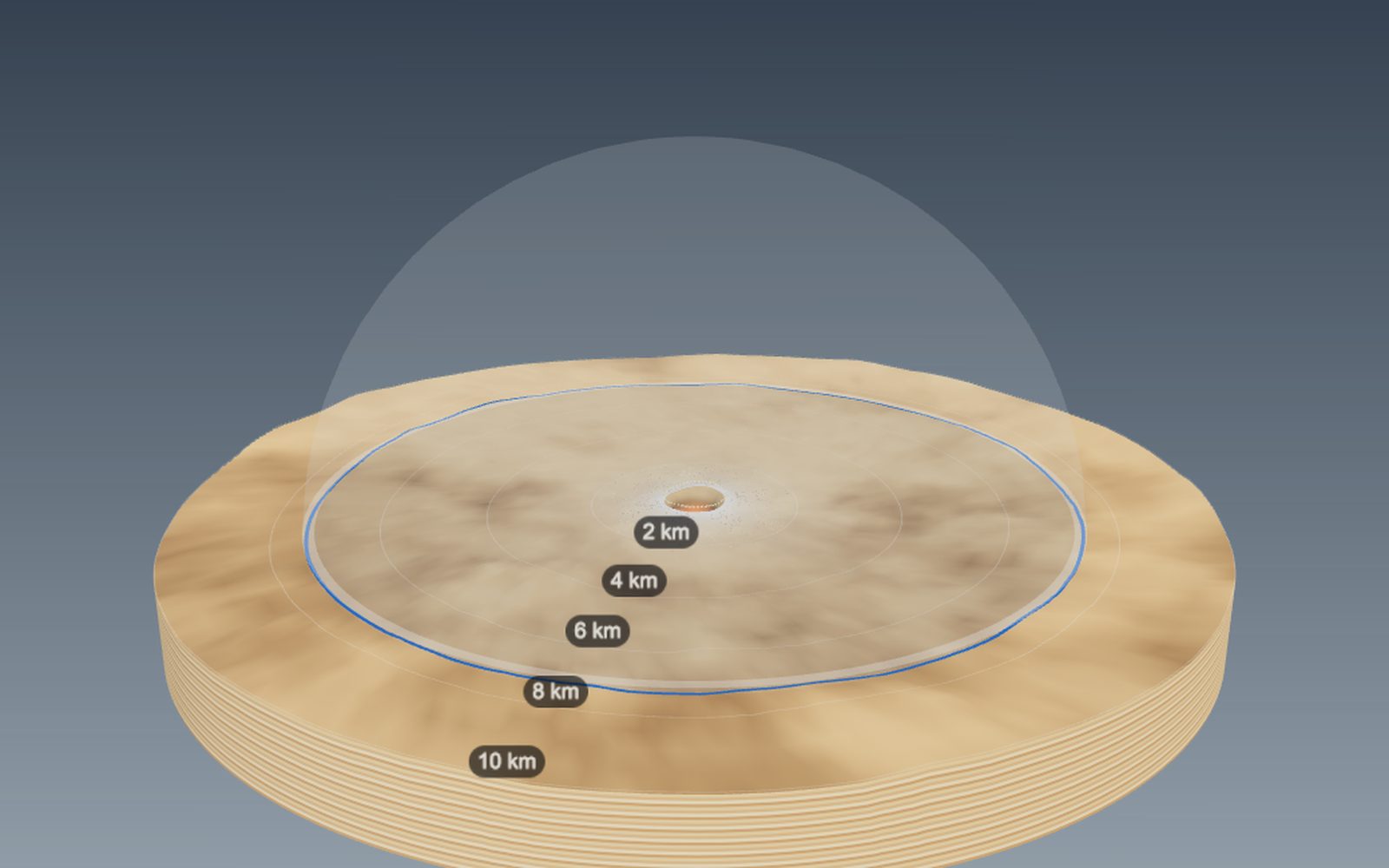
This device cannot show the 3D model. You can read the guide steps below as text.
1 / 10 A round slab of landscapeThe disc is a piece of land seen from above at an angle. Distances on the ground are drawn to scale, and the readout at top left gives the map radius (20 km here) and how much the heights are stretched. A 100 m stony asteroid arrives at 20 km/s and 45°. Change any of these on the Controls tab and the map redraws itself.
Drag to turn. Scroll or pinch to zoom.
A hole in the Arizona desert
How are impact craters formed? An asteroid strikes at many kilometres per second, and a shock wave spreads from the point of contact into the ground, crushing and melting rock and throwing it outward. The bowl that opens is many times wider than the asteroid, and its steep walls then slump into the final crater. Craters on asteroids and moons form the same way when smaller bodies hit them.
Drive east from Flagstaff on Interstate 40 and a low rim rises out of the flat desert. Climb to the edge and the ground drops away into a bowl 1.2 km across and about 170 m deep. For years people argued over whether a volcano had made it. In 1960 Eugene Shoemaker and his colleagues found coesite there, a form of quartz that only appears under pressures far beyond anything a volcano produces. The hole was dug by a piece of iron falling from space about 50,000 years ago.
The odd thing is how small that piece was. Collins, Melosh and Marcus, whose 2005 paper this exhibit follows, use an iron body 40 m across as their Meteor Crater example. A rock the size of a large house left a hole thirty times wider than itself. This exhibit lets you choose the rock and watch where its energy goes: into the air, into a flash of heat, into a shock wave, and into the ground.
Barringer Meteor Crater: what USGS and NASA measured
The crater has two names. Meteor Crater is the common one; Barringer Crater honours Daniel Barringer, whose studies, with Eugene Shoemaker's, the USGS Astrogeology Science Center credits with giving conclusive evidence that an impact made it. The USGS describes a bowl-shaped crater 180 m deep and 1.2 km across in northern Arizona, formed about 50,000 years ago by an iron-nickel meteorite of about 100,000 tons and roughly 30 m across, striking at about 12 to 20 km/s. The pieces are called the Canyon Diablo meteorite, after the small canyon west of the crater, and the USGS puts the explosion at over 2 million tons of TNT.
NASA's Earth Observatory adds that a rim of jumbled boulders, some the size of small houses, rises 50 m above the plain, and that when Europeans first found the crater over 30 tons of meteoritic iron lay scattered across an area 12 to 15 km wide. In the 1960s Shoemaker trained NASA astronauts at the crater before the Apollo missions to the Moon, and the USGS describes it as a long-standing analog site for planetary exploration.
The published sizes do not agree. The iron body is given as about 30 m by the USGS, 50 m by the Earth Observatory article and 40 m in the Collins, Melosh and Marcus example this exhibit follows. Each estimate rests on an assumed speed and density, and the crater only fixes their combination. Press Meteor Crater on the stage to drop the 40 m case and read its final width and depth beside these figures.
How to use the model
Pick a size from 4 m to 20 km, a material, a speed at the top of the atmosphere and an angle from the ground. Choose what it lands on: crystalline rock such as granite, layered sedimentary rock, or an ocean 4 km deep. Press Drop again and the rock falls through the lowest 100 km of air onto a round slab of landscape. The slab grows or shrinks with the event, so a Chelyabinsk-sized fireball is shown over a map 20 km in radius and a Chicxulub-sized impact over a map 1,000 km in radius. Heights are stretched so that a crater a few hundred metres deep still shows; the readout at top left says by how much.
Under the exhibit is a list of real events, 30 in all. Picking one drops a rock with that event's size, speed, angle and ground. There is also a map. Choose your own city and the rings for the current rock are drawn around it, with the distance and direction to every case on the list.
Why speed matters more than size
Everything starts with kinetic energy, half the mass times the speed squared. Take a stony asteroid 100 m across. Rock of this kind has a density of about 2,700 kg/m³, so the ball weighs about 1.4 billion kg. At 20 km/s,
E = ½ × 1.41×10⁹ kg × (20,000 m/s)² = 2.8×10¹⁷ J
That is about 68 megatons of TNT. Doubling the size multiplies the mass, and the energy, by eight. Doubling the speed multiplies the energy by four.
The slowest an asteroid can hit the Earth is about 11 km/s, which is the speed anything gains just by falling in from far away. The fastest, for a comet meeting the Earth head on, is about 72 km/s. The speed slider covers that whole range. Most near-Earth asteroids arrive at around 17 to 20 km/s.
The air is a wall at 20 km/s
Air seems thin, but at these speeds it hits the front of the rock like a hammer. The pressure on the leading face is roughly the air density times the speed squared. At 60 km altitude the model's air is about 1/1,800 as dense as at sea level, yet at 20 km/s that still adds up to about 0.2 MPa. That is already the strength Collins and colleagues give a stony body (their formula puts it at 0.22 MPa). Small asteroids are weak because they are full of cracks, so the rock breaks up high in the sky.
What happens next depends on the size. After breaking up, the pieces keep moving together but spread sideways like a pancake. A wider cloud meets more air, and it slows faster. If the cloud spreads to about seven times its original width before reaching the ground, the paper treats all its energy as released at that height. That is an airburst. The graph at bottom right of the stage shows the speed falling with height for the rock you dropped.
Material changes the story. Iron is about three times as dense as stone and far stronger, so a 40 m iron body survives down to 17 km and reaches the ground at about 10 km/s. The same size in stone bursts at 12 km and leaves no crater at all. Comet ice at 1,000 kg/m³ is the weakest of the four materials; a 100 m icy body bursts at about 6 km.
Airbursts: Chelyabinsk and Tunguska
On 15 February 2013 a rock about 17 to 20 m across came in over the southern Urals at 18.6 km/s on a shallow path. It was brighter than the Sun for a moment. US government sensors put the peak brightness at 23.3 km and the energy at about 440 kilotons. A minute or two later the shock wave reached Chelyabinsk and broke windows across the city, and more than 1,500 people were hurt, mostly by flying glass (NASA's small-bodies group counts more than 1,600).
The exhibit gives a burst at 33 km with 490 kt for those numbers. The energy is close; the height is higher than the sensors saw because the model treats the rock as one body with one strength, while the real one broke in several stages.
Tunguska, on 30 June 1908, was bigger: a body some 40 to 100 m wide (NASA pages give both about 40 m and 50 to 100 m) burst a few kilometres above the Siberian forest and knocked down trees over about 2,150 km². There is no crater, which puzzled the first expedition in 1927. If you drop a 60 m stone at 20 km/s and 45°, the model bursts it at about 6 km, and the blue ring, where wood-frame houses would collapse, reaches 12 km.
How the crater is sized
A rock that reaches the ground does not drill a hole the size of itself. It stops within about one or two of its own diameters, and almost all its energy turns into a shock wave in the ground. The shock pushes rock down and outward and opens a bowl called the transient crater. Collins and colleagues use a scaling law fitted to experiments and explosion craters:
D = 1.161 × (ρi/ρt)^(1/3) × L^0.78 × v^0.44 × g^(−0.22) × sin^(1/3)θ
Here ρi and ρt are the densities of the rock and the ground, L is the rock's diameter, v the speed at the ground, g gravity and θ the angle. The powers are smaller than one. A rock twice as wide makes a crater 1.7 times as wide, and twice the speed widens it by only 36%.
The transient crater does not last. Its steep walls slump inward. On Earth, a bowl up to about 3.2 km across stays a simple crater: the rim widens by a quarter and a lens of broken rock half fills the floor. Meteor Crater is the textbook example. Above that size the floor rebounds upward, like water after a dropped stone, and the walls collapse in terraces. The result is a complex crater, wide and shallow, often with a central peak or a ring of peaks. The model's 400 m stone makes a complex crater 6.4 km across and only about 700 m deep.
Heat and the shock wave in the air
Above about 15 km/s an impact on land vaporises part of the rock and the ground, and the hot vapour swells into a fireball. The paper gives its radius as 0.002 times the cube root of the energy in joules, about 5 km for the 400 m rock. Some of that energy leaves as light. The yellow ring marks where the heat would be enough for second-degree burns on bare skin.
The shock wave in the air is worked out from nuclear test data scaled by energy. The blue ring is 26.8 kPa of overpressure, where wood-frame houses almost completely collapse. The light blue ring is 6.9 kPa, where window glass breaks. These rings are drawn with no hills in the way and no curve of the Earth for the shock, so they are an upper guide rather than a forecast.
Into the sea
About seven-tenths of the surface is ocean, so most rocks land in water. Water is a thick layer of air for a falling rock: it slows it hard. The model opens a cavity in the water with the same scaling law, then works out how much speed the rock keeps on the way to the bottom. A 400 m stone in 4 km of water opens a hole 8.4 km wide but only about 3 km deep and makes only a small dent in the sea floor. A 10 km rock goes straight through to the floor. The Eltanin impact 2.5 million years ago, in the Southern Ocean, left meteorite debris in the seabed mud but no crater that anyone has found.
The model does not work out tsunamis. Their height depends on the shape of the coast and the sea floor, and the paper gives only a rough estimate.
Chicxulub and the end of the dinosaurs
In 1980 Luis and Walter Alvarez and their team reported a thin layer rich in iridium, a metal rare in the crust but common in meteorites, at the boundary between the Cretaceous and Paleogene rocks in Italy. They proposed that an asteroid about 10 km across had hit 66 million years ago. In 1991 Alan Hildebrand and his colleagues showed that a buried ring about 180 km wide under the Yucatán Peninsula, first noticed in oil surveys, was the crater.
Collins and colleagues use an 18 km stone at 20 km/s and 45° as their Chicxulub-sized example, and the model gives 186 km. A 2020 study by Collins and others, which matched computer models to the crater's buried shape, found the most likely angle to be 45 to 60°. Pick Chicxulub in the list to drop that case.
Korea's crater at Hapcheon
The rice fields of Jeokjung and Chogye in Hapcheon, South Gyeongsang Province, lie in a round basin about 7 km across. In 2020 the Korea Institute of Geoscience and Mineral Resources (KIGAM) drilled 142 m into the basin floor and found shatter cones and quartz with planar deformation features, two signs that only an impact leaves. The team estimated a body about 200 m wide and an age of about 50,000 years from charcoal in the lake mud above the broken rock. A 2023 study of a second core used cosmogenic nuclides and found the bottom layers to be about 1.3 million years old, so the age is still being argued over.
With this model, a 7 km crater needs a stone of about 400 m at 20 km/s and 55°. The gap with KIGAM's 200 m shows how loose these estimates are. Crater size grows slowly with the rock's size, so a small change in crater width or in the scaling law gives a big change in the rock.
Planetary defence: what DART showed
Most of the danger is known in advance. NASA and other agencies have found the great majority of near-Earth asteroids bigger than 1 km, and none of them is on a path to hit the Earth in the next century. The harder targets are the rocks of 100 to 300 m, big enough to destroy a region but faint enough to be missed.
On 26 September 2022 NASA's DART spacecraft, weighing about 580 kg, flew into Dimorphos at 6.1 km/s. Dimorphos is a moonlet about 150 m across that circles a larger asteroid, Didymos, every 11 hours 55 minutes. Neither is a threat to the Earth, which made them a safe test. Telescopes on Earth timed the moonlet's orbit before and after: it had shortened by 33 minutes, give or take one minute. The push was 3.6 times bigger than the spacecraft's own momentum, because the rock thrown out of the impact site recoiled the other way, like exhaust from a rocket.
That number matters for planning. A small, early push is enough: a change in speed of a few millimetres per second, made years ahead, adds up to thousands of kilometres by the time the rock comes back. Pick Dimorphos in the list to see what a body that size would do if it did hit. Apophis, about 340 m wide, will pass about 32,000 km above the surface on 13 April 2029, closer than some weather satellites; NASA has ruled out an impact for at least a hundred years. Bennu, sampled by OSIRIS-REx, has about a 1 in 1,750 chance of hitting the Earth before the year 2300.
Worked example: a 1 km rock at 20 km/s
Take a stony ball 1 km across, a size at which the survey goals of NASA and other agencies were set. The exhibit lets you pick it near the top of the size slider. Here is the sum the model does first.
The volume of a sphere is π/6 × d³, so π/6 × (1,000 m)³ = 5.24×10⁸ m³. At 2,700 kg/m³ that is a mass of 1.41×10¹² kg, about 1.4 billion tonnes. At 20 km/s,
E = ½ × 1.41×10¹² kg × (20,000 m/s)² = 2.8×10²⁰ J
Divide by 4.184×10¹⁵ J per megaton and you get about 68,000 Mt of TNT. For comparison, that is roughly 150,000 Chelyabinsk events (440 kt each), or about 1,400 times the 50 Mt Soviet test bomb that was the largest ever fired. Making the rock ten times wider than the 100 m example earlier multiplies the energy by a thousand, from 68 Mt to 68,000 Mt, and nothing in the sum changes except the cube.
Two things are worth noticing. First, the same rock in iron (the exhibit uses 8,000 kg/m³) would carry nearly three times the energy, about 200,000 Mt, because it is nearly three times as heavy. Second, the model treats a rock this size as too big for the air to slow or break: it arrives at full speed. The energy goes into the ground and the air at the impact point, not into a high burst.
A rule of thumb for crater width
Running the crater formula above for this rock on crystalline ground (2,750 kg/m³, gravity 9.81 m/s², 45°), the transient crater comes out about 10.6 km wide. That is already above the 3.2 km limit for simple craters, so the paper's complex-crater correction applies and the final bowl is about 14.5 km across. The rock was 1 km wide, so the crater is about 14 times wider.
That ratio is not a constant. Meteor Crater has a 40 m iron body and a 1.2 km bowl, about 30 times. The 18 km stone for Chicxulub and its 186 km crater give about 10 times. Small rocks make relatively bigger craters because they are lost in the formula's power of 0.78: the bowl grows more slowly than the rock does. A usable quick guess is that a crater is 10 to 20 times the rock's width for rocks from 200 m to 20 km at typical speeds, and more for very small, dense ones. Treat it as the answer to within a factor of two, not as a prediction.
To check it on the stage, set Diameter to 1 km, Material to Rock, 2,700 kg/m³, Speed at entry to 20 km/s, Entry angle to 45° and Ground to Crystalline rock, then compare the Final crater readout with these numbers. The readout and the sum agree to a few per cent, since both use the same equations.
Warning scales: Torino and what the numbers mean
Two scales are used to talk about asteroid danger, and they measure different things. The Torino scale, adopted by the International Astronomical Union in 1999, is an integer from 0 to 10 that combines the chance of a hit with the damage it would do, so that the public hears one number per object. Level 0 means the chance of a collision is zero or so low as to be effectively zero. Levels 1 and 2 are for objects that merit attention from astronomers but not the public; NASA's description notes that new observations will very likely send them back to 0. Level 3 is a close encounter with a 1% or greater chance of a collision that could cause localised destruction, and level 4 the same chance for regional devastation. Levels 8 to 10 mean the collision is certain: localised destruction at 8, regional at 9, global catastrophe at 10.
The Palermo scale is a second, more technical number that compares one object's risk with the background risk from all rocks of that size or bigger over the time left before the encounter. Specialists use it to rank objects that are too low to appear on Torino.
Both depend on two numbers this exhibit shows. One is the energy, which sets what a hit would do. The other is the chance of a hit, which the exhibit does not calculate: that comes from telescope measurements of the orbit, and it usually falls to zero as more observations narrow the uncertainty. NASA's Sentry system lists the objects that cannot yet be ruled out and updates them automatically.
Common misconceptions
"Asteroids burn up in the atmosphere, so only huge ones matter." Rocks smaller than about 10 m usually do. Rocks of 20 m and up arrive with enough energy to produce a damaging blast, as Chelyabinsk showed, and the burning is only a small part of the energy. The pressure on the front of the rock is what breaks it.
"An airburst is harmless because there is no crater." The blast is the damage. Tunguska had no crater and still flattened about 2,150 km² of forest, an area larger than Greater London. Chelyabinsk injured over 1,500 people, mostly through broken windows, from a blast about 23 km up.
"A big crater means a big asteroid." Only in a loose way. The width grows with the rock's size to the power 0.78 and with its speed to the power 0.44, so a slow, small rock and a fast, smaller one can leave craters of similar width. Add the unknown angle and the ground type and a single crater fits a range of rocks, as the Hapcheon example shows.
"We would have no warning." Most large objects are known in advance, and an impact on a known path would be seen years or decades ahead. The real gap is in the 100 to 300 m range and in comets, which arrive faster and with less notice.
"DART moved the asteroid out of the way, so the problem is solved." DART showed that a spacecraft can change the orbit of a 150 m moonlet by 33 minutes. That is a proof of concept on a target chosen to be safe. Deflecting a bigger, harder-to-find rock needs more warning, a heavier spacecraft, or both.
Things to try on the stage
The controls below are named as they appear on the stage: Diameter, Material, Speed at entry, Entry angle and Ground. The numbers quoted were run through the exhibit's own model.
- Keep Material, Speed at entry and Entry angle fixed and raise Diameter to about double. The Energy readout should rise about 8 times and the Final crater only about 1.7 times.
- Set Diameter to 100 m, Material to Rock, 2,700 kg/m³, and move Speed at entry from 11 to 20 km/s. Energy rises about 3.3 times. The In the air readout gives the breakup height, about 50 km at 11 km/s and about 60 km at 20 km/s. This rock does not burst in the air; it reaches the ground at roughly 3.6 km/s and 6.1 km/s.
- Set Diameter to 60 m at 20 km/s and compare Rock, 2,700 kg/m³ with Iron, 8,000 kg/m³. The rock gives an airburst at about 5.7 km. The iron reaches the ground at about 15.9 km/s and digs a crater.
- Press Chelyabinsk in the list of real impacts, then Tunguska. Compare the Houses collapse readouts and the blue ring, and note how much larger Tunguska's is although it left no crater.
- Press Chicxulub, then choose your own city on the map. The rings for that rock are drawn around the city, with the distance and direction to every case on the list.
- Drop a 400 m rock with Ground set to Ocean, 4 km deep, then with Ground set to Crystalline rock, and compare the Final crater readouts. The readout says water crater for the sea and gives a crater size for the land.
What the model leaves out
The model follows the equations of the paper, and the exhibit checks itself against the worked examples in it: the 40 m iron body, a 1.75 km stone and the 18 km stone all match the published crater sizes within a few per cent. Some things are simpler than in the world.
- The rock is a single sphere with one strength. Real asteroids are often loose piles of rubble.
- The landscape is invented, not real terrain, and the shock and heat travel over flat ground.
- Crater shapes are drawn from the paper's diameter and depth; the walls and central peaks are a likeness, not a calculation.
- The paper's entry model only applies below 1 km, so bigger rocks arrive at full speed.
- The ocean has one depth (4 km), and the model counts a sea-floor crater only when the water cavity reaches the floor.
- Earthquakes, ejecta thickness, tsunamis and climate effects are not calculated.
A crater in seven stages
The Timeline control scrubs through one impact, and the Stage line of the table names each step with the model time beside it. Before the impact the clock counts down: the rock crosses the last 100 km of air in a few seconds, and the time comes from the same speed curve as the graph. Contact and compression last about as long as the rock takes to cross its own width, a few thousandths of a second for a 40 m rock. Then the shock wave digs the transient crater, a bowl about 2.8 times as wide as it is deep. The model puts the excavation time at about 0.8 × √(D/g), where D is the transient width and g is gravity, so a 1 km rock at 20 km/s takes about 26 seconds to dig its bowl on Earth.
What happens next depends on size. A small bowl keeps its shape, but loose rock slides down its walls and settles on the floor as a lens of broken rock, the breccia lens. A large bowl cannot hold itself up: the walls slump in terraces and the floor springs back into a central peak, or, in the biggest craters, a ring of peaks. On the stage the slab changes from the deep transient bowl to the wider, flatter final crater during the Collapse stage, and the fresh floor glows while the melt cools. The Rate control slows all of this to a tenth of normal speed.
Looking inside: the cutaway
Turn on Cutaway and the near half of the slab is removed along a line through ground zero. The cut face shows the rock layers at the same height exaggeration as the surface. Under a simple crater the layers bend down and the breccia lens fills the space between the final floor and the bowl that was dug first; at Meteor Crater that lens is about as thick as the visible crater is deep. Under a complex crater the layers are pushed up beneath the centre. Field studies put this structural uplift at roughly a tenth of the final crater width. The speckled half circle under ground zero marks rock that the shock wave squeezed hard enough to change its minerals; shocked quartz and coesite found in such rock are how geologists confirm that a round basin is an impact crater and not a volcano. The cut is a drawing of these zones at the model's sizes, not a survey of any real crater.
Ground, region and globe
The three buttons at the bottom left of the stage change the scale. Ground is the slab chosen to fit the crater and the nearest rings. Region widens the map, from 20 km up to 2,000 km, until the window ring and the ejecta blanket fit. The ejecta reach shown is where the layer of thrown out rock thins to about a millimetre; the paper writes its thickness as D⁴ / (112 r³), with D the transient crater width and r the distance. Globe swaps the slab for the whole Earth. Every crater in the catalogue below is a pin, coloured by age, and the impact you set up is drawn as rings on the curved surface. A Chicxulub-sized impact throws a millimetre of debris more than 4,000 km away, and its window ring wraps around a large part of the planet. Tap a pin to rebuild that crater.
The crater catalogue
The catalogue lists 96 confirmed impact structures, from the 13.5 m pit at Carancas in Peru to the 160 km Vredefort structure in South Africa. Names, positions, rim diameters and ages come from the Earth Impact Database kept by the Planetary and Space Science Centre at the University of New Brunswick, in the copy printed by NASA Johnson Space Center; Hapcheon comes from the 2021 paper that first described it. Ages are given as printed: some are exact to a few hundred thousand years, others are only an upper or lower bound. The Rebuild button runs the crater model backwards. It searches for the rock diameter whose final crater matches the listed width, assuming stony rock (iron for craters under 1.5 km, since small stony bodies break up in the air) at 20 km/s and 45°. That size is a model value. The real impactor may have been faster, slower or steeper, and old craters have lost their rims to erosion, so the listed width is not always the original one.
Near-Earth objects
The second list holds 29 known asteroids that pass near Earth, including Apophis, Bennu, the Didymos and Dimorphos pair that DART visited, and 2024 YR4. Diameters come from the JPL Small-Body Database. Where no measured size exists, the size is estimated from the object's brightness with a typical reflectivity of 0.14, and the card says so. The close approach is the nearest pass between 1900 and 2200 in the JPL close-approach data. Speed far from Earth is not the impact speed: falling the rest of the way, a rock gains Earth's escape speed, so the impact speed is √(v∞² + 11.2²) km/s. Apophis, at 7.4 km/s relative to Earth, would hit at about 13.4 km/s. None of these objects is on a known collision course; the button shows what a hit of that size would do, not a forecast.
The Moon and Mars
The World control drops the same rock on the Moon or Mars. Gravity enters the crater equation as g to the power −0.22, so on the Moon, with a sixth of Earth's gravity, the transient crater is about 1.49 times as wide. There is no air to slow or break the rock and no air blast, so the table shows no fireball, burn or blast rings there. Mars has air about a sixtieth as dense as Earth's at the surface, enough to slow small rocks but far less than on Earth. The switch from simple to complex craters also moves with gravity: about 3.2 km on Earth, about 7 km on Mars and about 15 km on the Moon, which is why lunar craters of 10 km are still clean bowls.
Pushing a rock aside
The Push test row of the table works out how far a small push moves the point where a rock arrives. A change in speed Δv along the orbit, made a time t before the encounter, shifts the arrival point by about 3 Δv t, because the rock drifts ahead of or behind its old position a little more on every orbit. One centimetre per second, ten years ahead, moves it about 9,500 km, roughly one and a half Earth radii. To miss Earth entirely the shift must beat Earth's radius enlarged by gravitational focusing, which is larger for slow rocks. To spare one city it only has to clear that city's house collapse ring. DART showed that a spacecraft can change an asteroid's motion: its 2022 impact shortened the orbit of Dimorphos around Didymos by about 32 minutes. The quest list asks how long ahead a push would have to come to keep an Apophis-sized rock off Seoul.
Questions
How often do asteroids hit the Earth?
Small ones all the time. US government sensors record a fireball of at least a few tenths of a kiloton most months. A Chelyabinsk-sized event happens every few decades. A rock big enough to make a 20 km crater is rare on the scale of human history.
Why do small asteroids explode in the air instead of hitting the ground?
The pressure of the air on the front of the rock rises with the square of the speed. Above about 0.2 MPa a cracked stony body breaks up, and the spreading pieces stop so fast that they release their energy as a blast in the sky. Iron is strong enough to reach the ground in pieces.
Is a bigger asteroid always a bigger crater?
Yes, but slowly. Crater width grows roughly with the rock's size to the power 0.78. A rock ten times as wide makes a crater about six times as wide, though with a thousand times the energy.
Why is the crater so much wider than the rock?
The rock stops within a short distance and its energy turns into a shock wave in the ground. That shock moves a volume of rock far bigger than the asteroid itself, and the walls then slump outward.
Does the angle change the shape of the crater?
Only at very shallow angles. Above about 15° from the ground, craters are still round; the shock spreads from a point. The angle mostly changes the size: a steep hit makes a wider crater than a grazing one. The most common angle is 45°.
What would happen if an asteroid hit the ocean?
The water slows it, so a medium rock may not reach the floor at all. The blast and heat over the sea are much like over land. Waves are a separate danger that this exhibit does not calculate.
Could we stop an asteroid?
DART showed in 2022 that hitting a 150 m asteroid with a spacecraft changes its orbit, and by more than the spacecraft's momentum alone. It works best with years of warning, which is why survey telescopes matter as much as spacecraft.
Is the Hapcheon basin really an impact crater?
Yes. Shatter cones and shocked quartz from the drill core can only form at impact pressures, and further studies in 2023 to 2026 found more of the same evidence. What is still uncertain is its age and the size of the rock.
Why are the heights stretched?
A 1 km crater 200 m deep would be almost flat on a map 20 km wide. The model multiplies heights by a factor shown in the readout so that the bowl, the rim and the central peak can be seen.
How big would a rock have to be to threaten a whole country?
A rock of 100 to 300 m carries 68 Mt to about 1,800 Mt at 20 km/s and could destroy a region or a small country, depending where it lands. Global effects start at around 1 km (68,000 Mt) and above. These are model energies, not forecasts, and the damage depends on the ground, the angle and the speed.
What does the Torino scale measure?
It combines the chance of an impact with the damage it would cause into one number from 0 to 10, to make public statements simple. Nearly every object found so far is level 0, and the few that were raised above it returned to 0 once more observations narrowed the orbit.
How long does it take a crater to form?
Less time than most people expect. A crater 1 km wide is dug in a few seconds, and even the 180 km Chicxulub crater reached its final shape within a few minutes. The ejecta takes longer to land: debris thrown hundreds of kilometres stays in flight for several minutes.
Why does the same rock make a wider crater on the Moon?
Lower gravity. The rock has to lift less weight to throw material out, so the bowl grows wider before it stops. With a sixth of Earth's gravity the transient crater is about 1.5 times as wide, and with no air the rock also keeps all of its speed.
What is a breccia lens?
A layer of broken rock that slides back into a simple crater right after it forms. It sits between the floor you can see and the deeper bowl the impact first dug. Drilling at Meteor Crater found such a lens under the floor.
How far ahead would we need to push an asteroid?
The shift grows with the push and with the lead time. With a push of a few millimetres per second, years to decades are needed to move the arrival point by a few thousand kilometres. That is why finding asteroids early matters as much as the spacecraft.
How big was the meteorite that made Barringer Meteor Crater?
Estimates differ. The USGS gives an iron-nickel body about 30 m across and about 100,000 tons, striking at roughly 12 to 20 km/s about 50,000 years ago. A NASA Earth Observatory article gives 50 m and about 300,000 tons. The exhibit's Meteor Crater case uses 40 m, the example in Collins, Melosh and Marcus (2005). Most of the body melted or vaporised; the surviving pieces are the Canyon Diablo meteorite.
Terms
- Airburst: an asteroid that breaks up and releases its energy in the air before reaching the ground.
- Megaton (Mt): the energy of a million tons of TNT, 4.184×10¹⁵ J. A kiloton is a thousandth of that.
- Transient crater: the bowl opened by the shock in the first seconds, before the walls slump.
- Simple crater: a bowl-shaped crater with a raised rim, under about 3.2 km on Earth.
- Complex crater: a wider, shallower crater with a central peak or peak ring and terraced walls.
- Shatter cone: a cone-shaped fracture pattern in rock made by an impact shock.
- Planar deformation features: thin parallel planes inside quartz grains that need shock pressures above about 10 GPa.
- Overpressure: the pressure of a blast wave above normal air pressure.
- Momentum enhancement (β): how much more push an impact gives than the spacecraft's own momentum. DART's was 3.6.
Sources
All addresses were checked on 2026-10-17.
Gareth Collins, H. Jay Melosh, Robert Marcus, Earth Impact Effects Program: A Web-based computer program for calculating the regional environmental consequences of a meteoroid impact on Earth (Meteoritics & Planetary Science 40, 817 to 840, 2005), with the calculator built on it. https://impact.ese.ic.ac.uk/ImpactEarth/ImpactEffects/
Purdue University, Impact Earth. https://www.purdue.edu/impactearth/
NASA Center for Near Earth Object Studies, Fireballs reported by US government sensors. https://cneos.jpl.nasa.gov/fireballs/
NASA Center for Near Earth Object Studies, Sentry: Earth Impact Monitoring. https://cneos.jpl.nasa.gov/sentry/
Cristina Thomas and others, Orbital period change of Dimorphos due to the DART kinetic impact (Nature 616, 2023). https://www.nature.com/articles/s41586-023-05805-2
Andrew Cheng and others, Momentum transfer from the DART mission kinetic impact on asteroid Dimorphos (Nature 616, 2023). https://www.nature.com/articles/s41586-023-05878-z
R. Terik Daly and others, Successful kinetic impact into an asteroid for planetary defence (Nature 616, 2023). https://www.nature.com/articles/s41586-023-05810-5
NASA, Double Asteroid Redirection Test (DART). https://science.nasa.gov/mission/dart/
NASA, Apophis. https://science.nasa.gov/solar-system/asteroids/apophis/
Gareth Collins and others, A steeply-inclined trajectory for the Chicxulub impact (Nature Communications 11, 2020). https://www.nature.com/articles/s41467-020-15269-x
Peter Jenniskens and others, The impact and recovery of asteroid 2008 TC3 (Nature 458, 2009). https://www.nature.com/articles/nature07920
Jaesoo Lim and others, First finding of impact cratering in the Korean Peninsula (Gondwana Research 91, 2021). https://doi.org/10.1016/j.gr.2020.12.004
Dong Ascience, 200-meter Meteorite Struck Hapcheon, Korea 50,000 Years Ago (14 December 2020). https://www.dongascience.com/en/news/42327
Frontiers in Earth Science, The sedimentary records of the Hapcheon impact crater basin in Korea over the past 1.3 Ma (2023). https://www.frontiersin.org/journals/earth-science/articles/10.3389/feart.2023.1102785/full
Ajay Kumar Singh, Sung Hi Choi, Jeong-Hyun Lee, The Jeokjung–Chogye structure: a buried impact crater on the Korean Peninsula (Episodes 49, 2026). https://www.episodes.org/journal/view.html?volume=49&number=3&spage=433&vmd=Full
University of Freiburg, Terrestrial Impact Craters: crater sizes and ages. https://impact-craters.com/ (2026-10-23)
Don Yeomans and Paul Chodas, NASA Center for Near Earth Object Studies, Additional Details on the Large Fireball Event over Russia on Feb. 15, 2013 (asteroid about 17 to 20 m, peak brightness at 23.3 km, 18.6 km/s, about 440 kt, shallow entry). https://cneos.jpl.nasa.gov/news/fireball_130301.html
Lunar and Planetary Institute, NASA Small Bodies Assessment Group, Chelyabinsk Super Bolide summary, November 2013 (shock wave injured more than 1,600 people). https://www.lpi.usra.edu/sbag/science/Chelyabinsk_summary_Nov26_2013.pdf
NASA History, 115 Years Ago: The Tunguska Asteroid Impact Event (30 June 1908; diameter estimated by some scientists at 130 feet, about 40 m; 830 square miles, about 2,150 km², of forest destroyed; Kulik's expedition reached the site in 1927). https://www.nasa.gov/history/115-years-ago-the-tunguska-asteroid-impact-event/
NASA Earth Observatory, A Cosmic Explosion Over Siberia, 2025 (object estimated at 50 to 100 m across). https://science.nasa.gov/earth/earth-observatory/a-cosmic-explosion-over-siberia-154488
NASA, Asteroid Day and Impact Craters, 2016 (Meteor Crater about 1.2 km across and about 170 m deep, made about 50,000 years ago by an iron-nickel asteroid of 40 to 50 m). https://www.nasa.gov/solar-system/asteroid-day-and-impact-craters
E. C. T. Chao, E. M. Shoemaker and B. M. Madsen, First natural occurrence of coesite, Science 132 (1960), USGS Publications Warehouse record (coesite in sheared Coconino sandstone at Meteor Crater). https://pubs.usgs.gov/publication/70010846
Luis W. Alvarez and others, Extraterrestrial cause for the Cretaceous-Tertiary extinction, Science 208 (1980), 1095-1108 (iridium layer; the publisher page answers scripted requests with 403). https://doi.org/10.1126/science.208.4448.1095
Alan R. Hildebrand and others, Chicxulub Crater: a possible Cretaceous/Tertiary boundary impact crater on the Yucatán Peninsula, Mexico, Geology 19 (1991), 867-871 (publisher page answers scripted requests with 403). https://doi.org/10.1130/0091-7613(1991)019%3C0867:CCAPCT%3E2.3.CO;2
Davide Farnocchia and others, Ephemeris and hazard assessment for near-Earth asteroid (101955) Bennu based on OSIRIS-REx data (Icarus 369, 2021). https://doi.org/10.1016/j.icarus.2021.114594
Rainer Gersonde and others, Geological record and reconstruction of the late Pliocene impact of the Eltanin asteroid in the Southern Ocean (Nature 390, 1997). https://doi.org/10.1038/37044
NASA Center for Near Earth Object Studies, Torino Impact Hazard Scale (adopted by the IAU in 1999; levels 0 to 10 combine impact probability and consequence). https://cneos.jpl.nasa.gov/sentry/torino_scale.html
NASA Johnson Space Center, Astromaterials Research and Exploration Science, Earth Impact Database table (names, positions, ages and diameters from the Planetary and Space Science Centre, University of New Brunswick). https://ares.jsc.nasa.gov/engagement/activities/resources/rocks-soils-and-surfaces/earth-impact-database.pdf (2026-10-26)
NASA Jet Propulsion Laboratory, Small-Body Database API (diameter, absolute magnitude and hazard flag of near-Earth objects). https://ssd-api.jpl.nasa.gov/doc/sbdb.html (2026-10-26)
NASA Jet Propulsion Laboratory, Close-Approach Data API (dates, distances and relative speeds of close approaches). https://ssd-api.jpl.nasa.gov/doc/cad.html (2026-10-26)
NASA Center for Near Earth Object Studies, Asteroid size estimator (size from absolute magnitude and albedo). https://cneos.jpl.nasa.gov/tools/ast_size_est.html (2026-10-26)
NASA, Asteroid 2024 YR4. https://science.nasa.gov/solar-system/asteroids/2024-yr4/ (2026-10-26)
NASA, NASA Confirms DART Mission Impact Changed Asteroid's Motion in Space (orbit of Dimorphos shortened by 32 minutes). https://www.nasa.gov/news-release/nasa-confirms-dart-mission-impact-changed-asteroids-motion-in-space/ (2026-10-26)
NASA Goddard Space Flight Center, Mars Fact Sheet (gravity 3.73 m/s², surface air density about 0.016 kg/m³, scale height 11.0 km). https://nssdc.gsfc.nasa.gov/planetary/factsheet/marsfact.html (2026-10-26)
NASA Goddard Space Flight Center, Moon Fact Sheet (gravity 1.62 m/s²). https://nssdc.gsfc.nasa.gov/planetary/factsheet/moonfact.html (2026-10-26)
Thomas Ahrens and Alan Harris, Deflection and fragmentation of near-Earth asteroids (Nature 360, 1992; the drift of about 3 Δv t). https://www.nature.com/articles/360429a0 (2026-10-26)
H. Jay Melosh and Boris Ivanov, Impact crater collapse (Annual Review of Earth and Planetary Sciences 27, 1999; the publisher page answers scripted requests with 403). https://doi.org/10.1146/annurev.earth.27.1.385
Richard Pike, Size-dependence in the shape of fresh impact craters on the Moon (Proceedings of the Lunar Science Conference 8, 1977). https://adsabs.harvard.edu/full/1977LPSC....8.3427P (2026-10-26)
James Garvin, Susan Sakimoto and James Frawley, Craters on Mars: global geometric properties from gridded MOLA topography (Sixth International Conference on Mars, 2003, abstract 3277; complex craters from about 7 km). https://www.lpi.usra.edu/meetings/sixthmars2003/pdf/3277.pdf (2026-10-26)
Thomas McGetchin, Max Settle and James Head, Radial thickness variation in impact crater ejecta (Earth and Planetary Science Letters 20, 1973). https://doi.org/10.1016/0012-821X(73)90162-3 (2026-10-26)
U.S. Geological Survey, Astrogeology Science Center, Meteor Crater Sample Collection (180 m deep, 1.2 km across, about 50,000 years, 100,000-ton iron-nickel body about 30 m across at 12 to 20 km/s, Canyon Diablo meteorite, over 2 million tons of TNT). https://www.usgs.gov/centers/astrogeology-science-center/science/meteor-crater-sample-collection (2026-10-27)
NASA Earth Observatory, Meteor Crater, Arizona (Image of the Day, 13 March 2002: 50 m rim, over 30 tons of iron over 12 to 15 km, 50 m body of about 300,000 tons). https://science.nasa.gov/earth/earth-observatory/meteor-crater-arizona-2267 (2026-10-27)
More exhibits
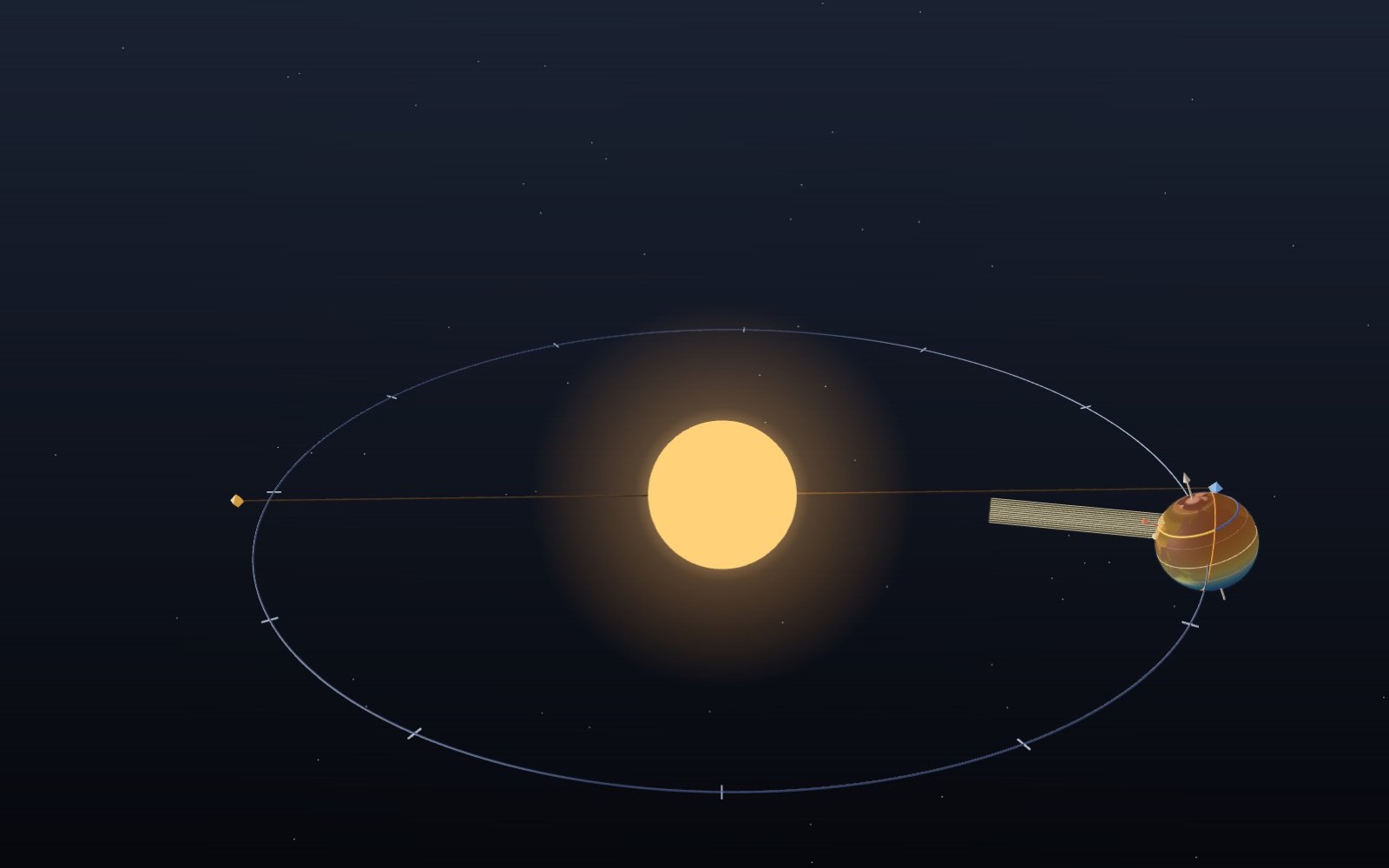
Why we have seasons: tilted Earth, changing daylight
The Earth is closest to the Sun in the first week of January, in the middle of the northern winter.
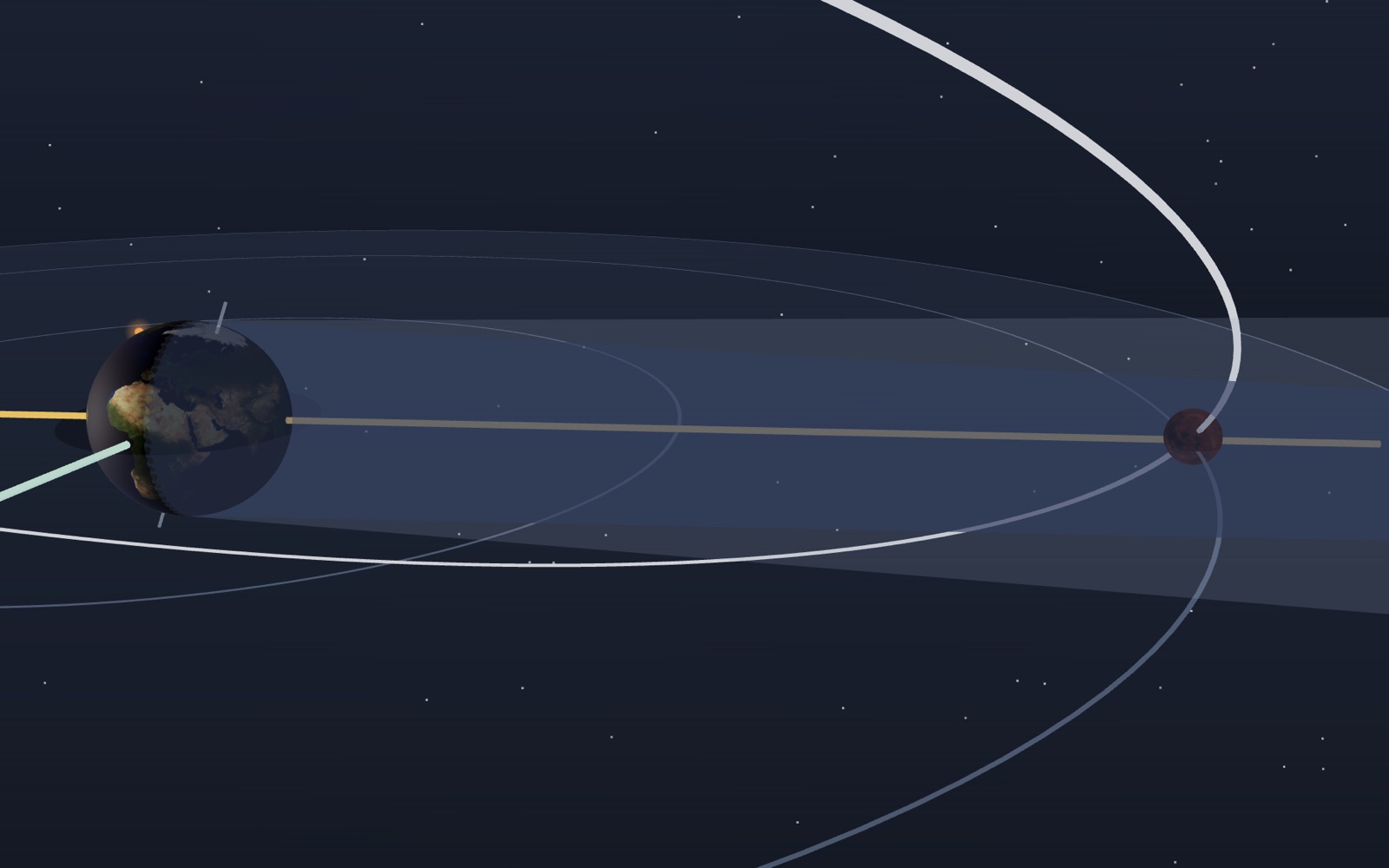
Moon phases: why a crescent is not Earth’s shadow
The Moon passes between the Earth and the Sun every 29.5 days, so why is there no solar eclipse every month?
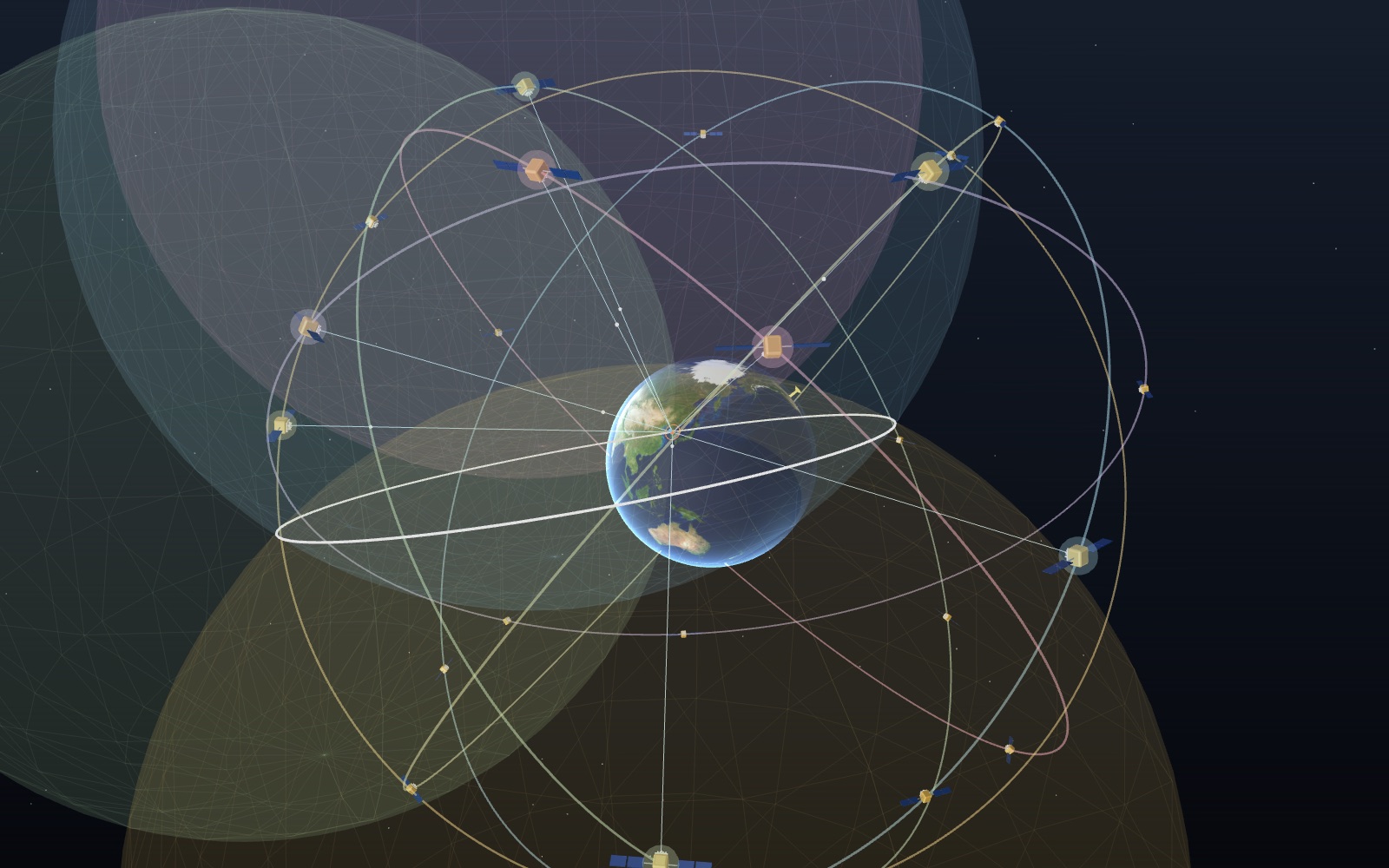
How GPS works: why your phone needs four satellites
A GPS signal takes about 70 thousandths of a second to fall 20,200 km to your phone, and a millionth of a second of error moves you 300 m.
Northern lights over an Arctic village
The green of the northern lights comes from oxygen about 100 km up, and in the biggest storms the red glow above it can be seen as far south as Korea.
Powers of ten: from a proton to the observable universe
From inside a proton to the edge of the observable universe is 42 steps of ten.
Satellites orbiting Earth right now
On 20 October 2026 the public catalogue listed 16,768 working satellites, and two in every three belonged to one company's internet network.
Walk down the Grand Canyon rock layers
Walk 1,360 m down the Bright Angel Trail through 13 rock layers, from a 270-million-year-old sea floor on the rim to 1.75-billion-year-old schist by the river.
How lightning and thunder work
A lightning channel heats the air to about five times the temperature of the Sun’s surface, and its thunder needs about 3 seconds to cover each kilometre to you.
Travelling at the speed of light
Light goes round the equator 7.5 times in a second, yet the same light needs 2.5 million years to reach the Andromeda galaxy.
Walk through Machu Picchu
Most of the work that holds Machu Picchu on its ridge, 60 per cent by one estimate, lies under the ground in foundations and drains nobody sees.
Coral bleaching causes: why warmer water turns reefs white
Corals get most of their food from algae living in their tissue, and when the sea stays more than 1 °C above its usual summer high for weeks, they lose those algae and turn white.
What happens to your body in space without a suit
Without a suit you would have about 10 seconds of useful consciousness, and if air came back within a minute or so you might well recover. You would not explode.