Loading the model
This device cannot show the 3D model. You can read the guide steps below as text.
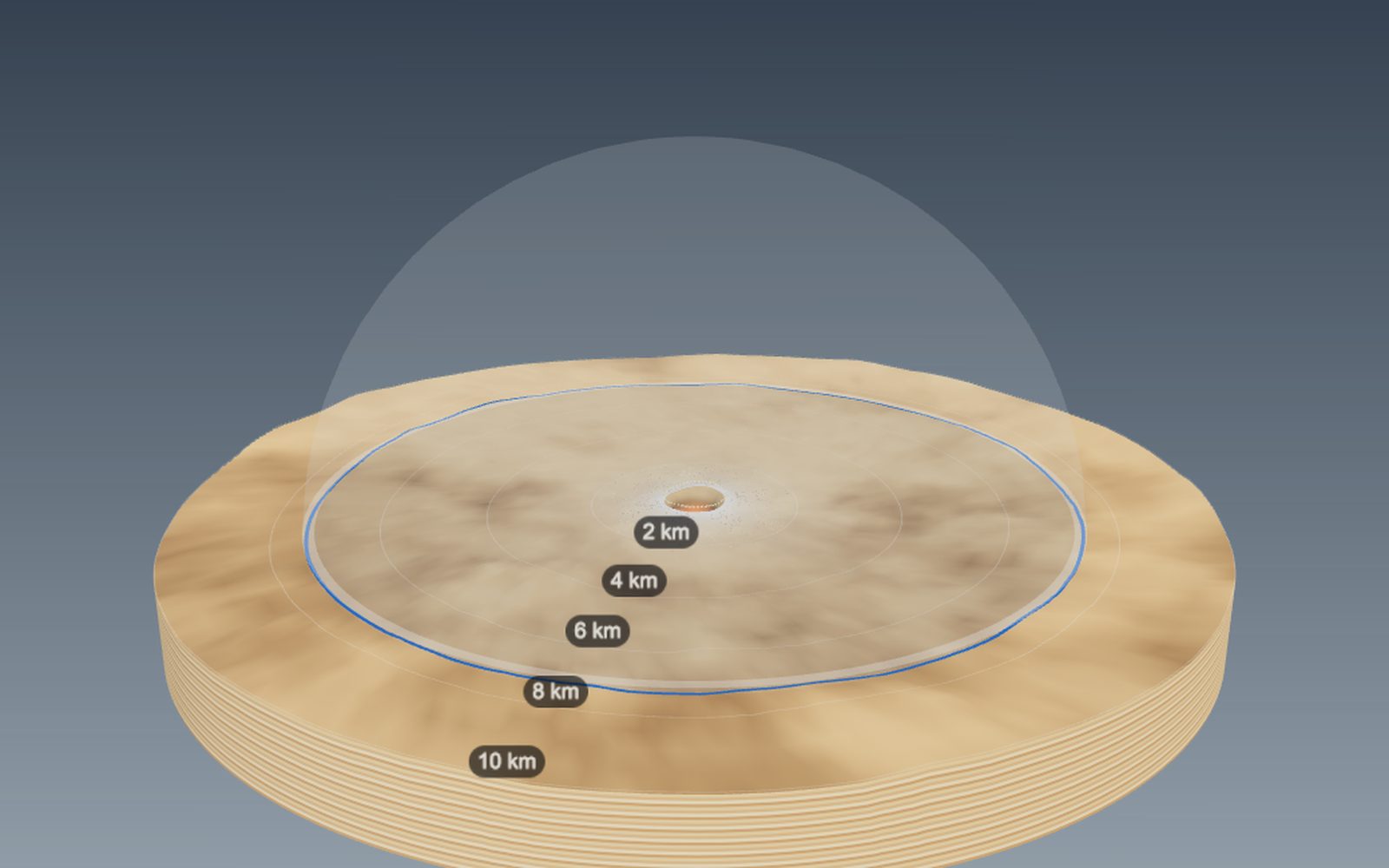
1 / 10 A round slab of landscape The disc is a piece of land seen from above at an angle. Distances on the ground are drawn to scale, and the readout at top left gives the map radius (20 km here) and how much the heights are stretched. A 100 m stony asteroid arrives at 20 km/s and 45°. Change any of these on the Controls tab and the map redraws itself.
Drag to turn. Scroll or pinch to zoom.
Guide Parts Controls
01 A round slab of landscape The disc is a piece of land seen from above at an angle. Distances on the ground are drawn to scale, and the readout at top left gives the map radius (20 km here) and how much the heights are stretched. A 100 m stony asteroid arrives at 20 km/s and 45°. Change any of these on the Controls tab and the map redraws itself.
02 The air pushes back Drag grows as the air gets thicker. At about 60 km the pressure on the front of the rock is greater than its strength, so it breaks up. The pieces spread sideways and slow down much faster. The graph at bottom right shows the speed falling from 20 to about 6 km/s, so nine-tenths of the energy is spent before the ground.
03 Chelyabinsk, 15 February 2013 This rock is 20 m across, moving at 19 km/s on a shallow 18° path, close to the Chelyabinsk fireball. The model breaks it up at 59 km and bursts it at 33 km with about 490 kt of energy. NASA's sensor data put the brightest point at 23.3 km and the energy at about 440 kt. No crater forms.
04 A burst close enough to the ground Make the rock 60 m wide and the burst comes down to about 6 km. Now the shock wave reaches the ground strong enough to flatten wood-frame houses out to 12 km (blue ring) and to break windows out to 29 km (light blue).
05 Iron makes Meteor Crater Iron is about three times as dense as stone and much stronger. A 40 m iron rock at 20 km/s only breaks up at 17 km, keeps half its speed and digs a bowl 1.18 km wide and 250 m deep in layered sedimentary rock. The real Meteor Crater in Arizona is 1.2 km wide.
06 Fireball and heat A 400 m rock hardly slows down. It strikes at 19 km/s with about 4,000 Mt and leaves a complex crater 6.4 km across. Vapour from the impact forms a fireball 5 km in radius. Its heat would cause second-degree burns out to 84 km (yellow ring), and houses collapse out to 80 km.
07 The same rock in the sea In a 4 km deep ocean the water takes the blow first. The model opens a hole 8.4 km wide but only about 3 km deep, so it never reaches the sea floor. Heat and blast are worked out from the energy at the sea surface, which is why those rings match the land impact.
08 Chicxulub scale Collins and his colleagues used an 18 km stony asteroid at 20 km/s and 45° as a Chicxulub-sized example. The model gives a crater 186 km across, next to the dashed 180 km circle of the real one. The map radius is now 1,000 km, and the heat and blast rings run off its edge.
09 Hapcheon, Korea’s crater The rice fields of Jeokjung and Chogye in Hapcheon sit in a bowl about 7 km wide. In 2020 the Korea Institute of Geoscience and Mineral Resources drilled 142 m into it and found shatter cones and shocked quartz. Here a 400 m rock falls at 20 km/s and 55° into sedimentary rock and leaves a crater of 7.0 km. The institute’s own estimate is a 200 m body, so the size you get depends a great deal on the speed you assume.
10 Pushing an asteroid aside In 2022 NASA flew the 580 kg DART spacecraft into Dimorphos, a moonlet about 150 m wide, at 6.1 km/s. Its 11 h 55 min orbit around the larger asteroid Didymos became 33 minutes shorter. Dimorphos was never going to hit us. If a body that size did land on crystalline rock at 20 km/s, the model gives a 2.6 km crater, which is what an early nudge would prevent.
Asteroid The incoming rock. Small ones are drawn at about 2% of the map radius so they stay visible; the real size is on the Diameter control. Entry glow Air in front of the rock is squeezed and heated until it glows. Drag slows the rock, and when the air pressure on its face beats its strength, it breaks up. Fragments Once the rock breaks, the pieces spread sideways in a flattened cloud. The wider cloud meets more air, so it slows much faster than the intact rock did. Atmosphere The pale band is the lowest 100 km of air, drawn to scale. Most of the drag happens in the last 30 km, where the air is thickest. Airburst If the broken rock spreads to seven times its width before it reaches the ground, the model releases all its energy at that height. The dashed line drops to the point directly below. Shock front A pressure wave spreads out from the burst or the impact point. The blue rings mark where it is still strong enough to knock down houses or break glass. Fireball The glowing cloud of vapour from impacts faster than 15 km/s. Its radius is 0.002 × E^(1/3) metres, with the energy E in joules. Crater Rim-to-rim width of the fresh crater. Below 3.2 km it is a simple bowl; larger ones slump into a flat floor with a central peak. On the ocean setting the cyan ring is the hole opened in the water. Crater rim Rock pushed up and folded back at the edge of the crater. The model works out its height from the size of the first, transient hole. Central peak In complex craters the floor springs back and lifts a peak in the middle, rather like the drop that jumps up after a stone hits water. It appears only above 3.2 km. Melt and breccia The dark floor is rock that was melted or smashed into breccia and fell back into the hole. At Hapcheon the breccia begins 72 m below the rice fields. Ejecta Rock thrown out of the growing crater on ballistic arcs. It lands as a blanket that thins quickly away from the rim. Water rings On the ocean setting the hole in the water closes again and sends out rings of waves. The model does not work out tsunami heights; these rings only show where the water moves first. Heat ring Inside this ring the fireball's heat would cause second-degree burns on bare skin. The paper's threshold is 0.25 MJ/m² for a 1 Mt event, raised for bigger events. Blast ring Where the peak overpressure falls to 26.8 kPa. At that pressure wood-frame houses almost completely collapse. Window ring Where the peak overpressure falls to 6.9 kPa, enough to shatter window glass. Known craters Dashed white circles at the same scale: Meteor Crater, 1.2 km across, and Chicxulub, about 180 km. When you pick a real impact from the list, its crater is drawn in gold.