FIG. 70Walk-throughs
Coral bleaching causes: why warmer water turns reefs white
Corals get most of their food from algae living in their tissue, and when the sea stays more than 1 °C above its usual summer high for weeks, they lose those algae and turn white.
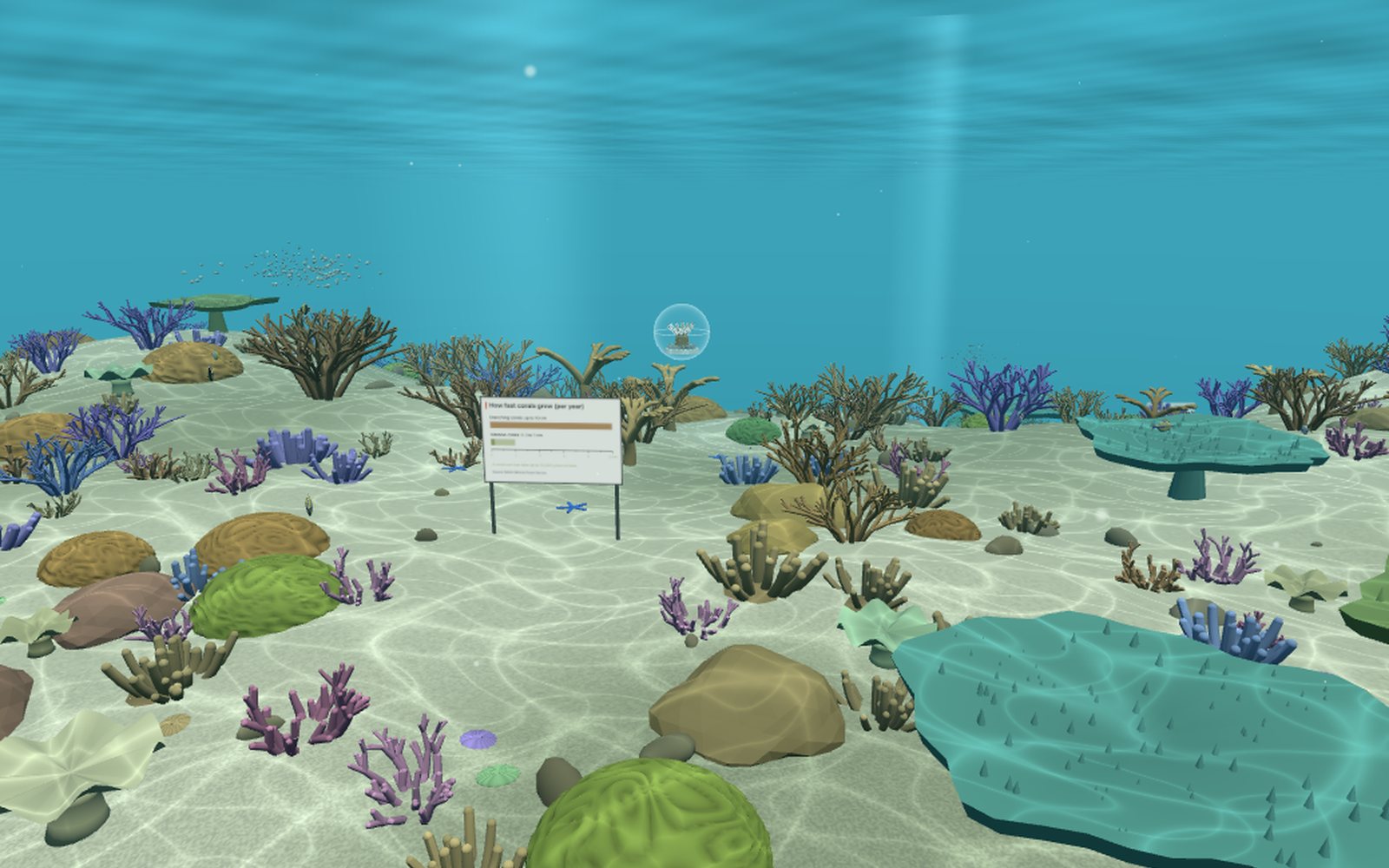
This device cannot show the 3D model. You can read the guide steps below as text.
1 / 10 Over the reef flatYou start 2.6 m under the surface, above a reef flat about 5.5 m deep. Swim with WASD or the arrow keys, rise with R or Space and sink with F or C. The bright net of light on the sand is sunlight focused by the waves.
Drag to turn. Scroll or pinch to zoom.
What you are swimming over
Heat stress can cause coral bleaching when corals lose the algae living in their tissue. This 3D reef shows the change as you raise water temperature and inspect a polyp magnified 100 times. Snorkel over a reef in the tropics and the first thing you notice is light. It wobbles across the sand in a bright net, the water is a clear blue-green, and small fish hang in clouds over the coral. This exhibit rebuilds a patch of shallow reef about 80 m across, from a reef flat 5.5 m deep down a slope to sand at about 19 m. Everything is at real size, so a 1 m turtle is 1 m long and an 8 cm fish is 8 cm.
The question running through the exhibit is a simple one. Why do corals turn white when the sea gets warm? To answer it you need to know what a coral is, how it feeds, and how scientists measure the kind of heat that harms it. The temperature slider under Controls lets you try the answer on the whole reef at once.
A coral is an animal with algae inside it
A coral colony looks like a rock or a plant, but it is a crowd of small animals called polyps. NOAA describes a polyp as a stomach that opens at one end, the mouth, ringed by tentacles. The tentacles carry stinging cells (nematocysts) that catch tiny animals drifting past, and most polyps feed at night.
Feeding by tentacle is only part of the story. Most reef-building corals keep single-celled algae called zooxanthellae inside their tissue. The coral gives the algae shelter and the carbon dioxide they need for photosynthesis. The algae give back sugars and other building blocks, and NOAA says as much as 90% of the organic material they make by photosynthesis passes to the coral. That is why reef corals need clear, sunny water: they are partly solar powered. NOAA notes that most reef-building species live where light reaches, down to about 30 m.
The algae also give corals much of their colour. The browns, olives and golds you see on this reef come mostly from zooxanthellae packed into the tissue. Float up to the polyp in the glass bubble above the brain coral and you can see them as brown dots. The polyp there is drawn 100 times larger than life, since real stony coral polyps average only 1 to 3 mm across.
Why reef corals come in different shapes
Each polyp sits in a small cup of limestone (calcium carbonate) that it builds under itself. Every so often it lifts off the floor of the cup and lays down a new floor above the old one, so the colony rises a little at a time. NOAA counts about 800 species of stony coral, and the way the polyps stack their cups decides the shape of the colony.
Three shapes are built here from code. The staghorn coral grows by splitting: each branch ends in two or three smaller branches, four levels deep. The table coral raises a flat plate on a short stalk and covers it with small upright branchlets. The brain coral is a low dome whose surface is a maze of ridges and valleys. The valleys are rows of polyps sharing walls, and the model draws them by tracing the contour lines of a smooth wavy pattern over a half sphere. Massive boulder corals fill the gaps.
Shape matters for what happens next. A thin branch puts a lot of living tissue onto very little skeleton, so it can grow fast and grab light, but it breaks easily. A dome grows slowly but survives storms.
How fast corals grow
NOAA gives growth rates of 0.3 to 2 cm a year for massive corals and up to 10 cm a year for branching corals. The slate standing on the reef flat draws both to scale. The long bar is 10 cm. The short bar for massive corals runs from a dark 0.3 cm into a pale band that ends at 2 cm.
You can use these numbers to read the reef. The brain coral under the polyp bubble is a dome 1.5 m across, so its radius is 0.75 m. If it added 2 cm a year it needed about 75 / 2 ≈ 38 years. At 0.3 cm a year it needed 75 / 0.3 = 250 years. A staghorn branch 1 m long, growing at the top rate, could be about 10 years old. A whole reef is much slower still: NOAA says a coral reef can take up to 10,000 years to form, and large barrier reefs and atolls from 100,000 to 30 million years.
How much of the ocean is reef
The second slate, on the slope at about 9 m, shows two grids of 100 squares. On the left one square is filled: NOAA's corals tutorial says reefs cover only about 1% of the world's ocean. On the right 25 squares are filled, because the same page says reefs provide habitat for at least 25% of marine life. NOAA Coral Reef Watch puts it as more than 25% of all known marine life. Those two grids side by side explain why bleaching worries people far beyond the reef itself.
Why the reef turns white when the sea warms
NOAA's short answer is that when corals are stressed by changes in temperature, light or nutrients, they expel the algae living in their tissues and turn completely white. Without the brown algae you see straight through the clear tissue to the white limestone skeleton underneath. A bleached coral is not dead. It is starving. If the stress ends soon enough the algae can build back up and the coral recovers. If the stress goes on, the coral can die. NOAA gives an example: in 2005 the United States lost half of its coral reefs in the Caribbean in one year after a massive bleaching event.
Heat is the usual trigger, but not the only one. In January 2010 cold water in the Florida Keys, 6.7 °C below normal for the time of year, also caused bleaching and some coral death.
How NOAA Coral Reef Watch measures heat stress
Corals cope with ordinary summers. What hurts them is water that is hotter than their usual summer for a long time. NOAA Coral Reef Watch turns that idea into numbers from satellite sea surface temperatures, for every 5 km square of the tropical ocean.
The first number is the Maximum Monthly Mean (MMM): the long-term average temperature of the hottest month at that spot. The second is the HotSpot, which is today's sea surface temperature minus the MMM. A HotSpot of 1 °C is the bleaching threshold, based on a 1990 laboratory study by Glynn and D'Croz that found 1 °C above the usual summer maximum is enough to cause stress and bleaching.
The third number is the Degree Heating Week (DHW). It adds up HotSpots of 1 °C or more over the last 12 weeks, so it measures how hot and how long at the same time. Its unit is the °C-week. One week at 2 °C above the MMM gives 2 °C-weeks, and so do two weeks at 1 °C above. Coral Reef Watch says DHW values over 4 °C-weeks have been shown to cause significant bleaching, and values over 8 have caused severe bleaching and significant mortality.
From these two numbers NOAA sets alert levels. A HotSpot between 0 and 1 is a Bleaching Watch. With a HotSpot of 1 or more, a DHW under 4 is a Bleaching Warning, 4 to 8 is Alert Level 1, and 8 to 12 is Alert Level 2. After the extreme heat of 2023, NOAA added Alert Level 3 (12 to 16, risk of multi-species mortality), Level 4 (16 to 20, more than half the corals at risk) and Level 5 (20 and above, risk of near complete mortality).
Running the numbers on the temperature slider
The readout in the top left corner runs the same arithmetic as Coral Reef Watch, one simulated day at a time, with one week passing every second. The MMM is set to 29.0 °C, a round figure for a tropical reef. Real values differ from place to place. The slider starts at 28.0 °C, so the HotSpot is minus 1 and nothing happens.
Move the slider to 30.5 °C. The HotSpot becomes 1.5 °C, and each week adds 1.5 °C-weeks. After about 2 weeks the DHW reaches 3, after about 3 weeks it passes 4 (Alert Level 1), and after about 5.3 weeks it passes 8 (Alert Level 2). Because only the last 12 weeks count, a steady 30.5 °C levels off at 12 × 1.5 = 18 °C-weeks, which is Alert Level 4. At the slider's top, 33 °C, the HotSpot is 4 °C and the DHW can climb to 48.
Each coral colony in the model has its own threshold. Branching and table corals start to pale somewhere between 2 and 6.5 °C-weeks, brain and boulder corals between 4.5 and 10. A colony turns fully white over about 2.5 °C-weeks beyond its threshold. If the DHW stays 8 °C-weeks past a colony's threshold, the colony dies and turf algae turn it a dull green-brown. The bar under the alert level counts the share of colonies that are more than half white. Watch the polyp at the same time: its brown cells leave through the mouth and drift away, and the tissue fades.
Turn the temperature back down to 29 °C or below and the DHW falls as the hot weeks drop out of the 12-week window. Bleached colonies slowly regain colour. Dead ones need 30 calm weeks before a new colony appears in their place.
How the world's reefs have fared
These are not imagined numbers. On 15 April 2024 NOAA and the International Coral Reef Initiative confirmed a fourth global coral bleaching event. Coral Reef Watch reports that between 1 January 2023 and 30 September 2025, bleaching-level heat stress reached about 84.4% of the world's coral reef area, and mass bleaching was recorded in at least 83 countries and territories. The previous record, in the third event of 2014 to 2017, was 68.2%. The first and second global events were in 1998 and 2010. NOAA calls climate change the greatest global threat to coral reef ecosystems.
How a school moves without a leader
The cloud of blue-green chromis over the staghorn coral is not animated by hand. Each fish runs the boids model that Craig Reynolds published in 1987. A fish looks only at neighbours within about half a metre and steers by three rules: move away from fish that are too close (separation), turn toward the average heading of its neighbours (alignment), and move toward their average position (cohesion). The model adds a gentle pull toward a home spot that wanders over the coral, a push away from the sea floor, and a push away from you within 1.6 m. Swim into the school and it parts around you, then closes again. The orange sea goldies near the bommie on the slope use the same code with a wider range and a little more speed. On a phone the schools have fewer fish, because every fish checks every other fish each frame.
The clownfish and the anemone
The anemone on the reef edge has a few hundred tentacles, each armed with the same kind of stinging cells a coral has. Most small fish that touch it get stung. Clownfish live inside it anyway. Research summarised in a 2012 study of clownfish evolution says a protective mucus coat is thought to stop the tentacles from firing. The fish gain a home safe from predators, and they chase away fish that eat anemones. A NOAA sanctuary note adds that the clownfish clean the anemone. The orange clownfish reaches about 11 cm, according to FishBase, and the same 2012 study notes a recorded life span of about 30 years for it, very long for a fish that size. The model's clownfish are 8 to 9 cm.
The green sea turtle
Down the slope a green sea turtle swims a slow loop at about 11 m. NOAA Fisheries describes green turtles as the largest hard-shelled sea turtles, with adults 3 to 4 feet long and weighing 300 to 350 pounds. The model's shell is 1 m long. Unlike other sea turtles, green turtles are mostly plant eaters, grazing on seagrass and algae.
How fast a reef builds: from centimetres per year to millimetres
The growth slate gives rates for single colonies, and a reef grows much more slowly than its fastest branches. A reef is the sum of what the corals and coralline algae build, minus what storms break, fish and worms bore away, and seawater dissolves. A 2013 PeerJ paper by van Woesik and colleagues quotes a classic estimate: an average shallow Indo-Pacific reef with high coral cover makes about 4 kg of calcium carbonate per square metre per year, which equals an upward growth of about 3 mm a year. In the same paper's model, a very productive reef making 10 kg per square metre per year rises about 7 mm a year after losses, and a poor one making 1 kg rises about 0.75 mm a year. These are model inputs for a 50% porous framework, not measurements of one reef.
You can check the conversion yourself. Four kilograms spread over a layer 3 mm thick is 4 / 0.003 ≈ 1,333 kg for every cubic metre of reef. Aragonite, the form of calcium carbonate corals make, has a density of about 2,930 kg per cubic metre. The ratio 1,333 / 2,930 is about 0.45, so the framework is a little under half solid and the rest is pores and cavities. That agrees with the 50% porosity the authors assume.
Now apply it to the slope in this exhibit. The reef flat is 5.5 m deep and the sand at the foot of the slope is about 19 m deep, so the structure spans 13.5 m, or 13,500 mm. At 3 mm a year that would take 13,500 / 3 = 4,500 years. At 7 mm a year it would take about 1,930 years, and at 0.75 mm a year 18,000 years. This is a thought experiment with an assumed constant rate. Real reefs grow on older foundations, and sea level has moved up and down during their lifetime, so the NOAA figure of up to 10,000 years for a reef to form is the better guide. What the arithmetic does show is why a reef cannot be rebuilt on a human timescale. A staghorn branch can grow 10 cm in a year, which is 33 times the reef's 3 mm. But most of that branch will break, rot or be eaten long before it adds to the foundation.
Growth also depends on how quickly the dead skeleton disappears. Van Woesik's team tested whether coral skeletons of different porosity dissolve at different rates at pH 7.8, the value they expect for 2100, because a reef only rises when production outruns dissolution and boring. When production falls behind dissolution and boring, a reef stops rising even if some coral is still alive. Bleaching matters for this reason: dead coral stops adding to the balance, while the erosion side keeps going.
Worked examples with the temperature slider
The slider runs from 26 to 33 °C, and the MMM is set to 29.0 °C. The HotSpot is the slider value minus 29.0, and only weeks with a HotSpot of at least 1 °C add to the DHW. Try these settings and compare your readout with the numbers below.
- 29.9 °C. The HotSpot is 0.9, which is below NOAA's threshold. The readout stays in Bleaching Watch and the DHW stays at 0, even though the sea is almost a degree above its usual summer high. A tenth of a degree (0.1 °C) separates "nothing" from "accumulating".
- 30.0 °C. The HotSpot is 1.0 and the DHW rises by 1 each week. It passes 4 after 4 weeks and 8 after 8 weeks, and it reaches 12 after 12 weeks, at which point the 12-week window is full. A steady 30.0 °C therefore stops at 12 °C-weeks, the start of Alert Level 3.
- 31.0 °C. The HotSpot is 2.0 and the DHW rises by 2 each week. It passes 4 after 2 weeks and 8 after 4 weeks, and the window fills at 24 °C-weeks, deep inside Alert Level 5.
- 33.0 °C. The HotSpot is 4.0. The DHW passes 4 after one week, 8 after two, and ends at 48.
The general rule is simple. For a steady HotSpot h of at least 1, the DHW after t weeks (with t at most 12) is h × t, and it cannot exceed 12 × h. To know how long a reef has before it crosses 4 °C-weeks, divide 4 by h. At 1 °C above the MMM it has 4 weeks. At 2 °C it has 2 weeks. That is why a heatwave that is only a degree or two stronger can matter so much.
Now use the colony thresholds from the model. At 31.0 °C a branching colony with a threshold of 2 °C-weeks starts to pale after one week. It is fully white after 2 + 2.5 = 4.5 °C-weeks, about 2.3 weeks, and by the rule described above it dies when the DHW reaches 2 + 8 = 10, after 5 weeks. A brain coral with a threshold of 10 °C-weeks starts to pale after 5 weeks, turns fully white at 12.5 °C-weeks after 6.3 weeks, and dies at 18 °C-weeks after 9 weeks. By this rule the branching coral goes first and the brain coral holds on a few weeks longer. That echoes the AIMS finding that fast-growing Acropora were among the worst hit in 2024. It is not a measurement: the thresholds in the model are random draws within chosen ranges.
How the Great Barrier Reef has fared
The Great Barrier Reef is the best-documented case. The Great Barrier Reef Marine Park Authority (GBRMPA) lists bleaching in 1998 and 2002, then mass bleaching in 2016 and 2017 (two consecutive summers), 2020, 2022 and 2024. The Australian Institute of Marine Science (AIMS) documents mass bleaching with full-scale surveys in the same years. GBRMPA calls 2024 the fifth mass bleaching event on the reef since 2016, and one that affected all regions. It adds that 2022 was the first mass bleaching caused by heat stress in La Niña conditions, which historically gave cooler summers. A less extensive event followed in 2025, which made 2024 and 2025 the second pair of consecutive bleaching summers after 2016 and 2017.
AIMS measures the effect with its Long-Term Monitoring Program, which tows divers behind a boat on more than 120 reefs (124 in 2025, 121 in 2026) and records the share of the bottom covered by living hard coral. The 2025 report says region-wide hard coral cover on the Southern reef fell from 38.9% in 2024 to 26.9% in 2025, and on the Central reef it fell to 28.6%. That Southern change is 12 percentage points, or 12.0 / 38.9 ≈ 31% of the 2024 coral. AIMS also notes that the fast-growing Acropora corals, which had driven the recovery between 2017 and 2024, were among the most severely hit. This is the growth-rate trade-off from the earlier section: the species that rebuild quickest are also the ones that bleach most easily.
The 2026 report, summarised by GBRMPA on 11 August 2026, shows a start of recovery. Cover rose in the Northern region from 30.0% to 35.1% and in the Central region from 28.6% to 31.6%, and the Southern region slipped from 26.9% to 26.4%. The authority describes this as close to the 40-year averages. The release adds that a late summer monsoon eased heat stress in early 2026. Note what these numbers do and do not say: coral cover is a snapshot of living coral, not a count of species, and a reef dominated by a few tough species can have the same cover as a diverse one.
Ocean acidification: the second problem in the water
Heat is not the only way the sea changes. NOAA says the ocean absorbs about 30% of the carbon dioxide released into the air, and that dissolved carbon dioxide raises the concentration of hydrogen ions and leaves fewer carbonate ions, the building blocks of coral skeletons. The US Environmental Protection Agency reports that ocean acidity has risen about 25% since before the 1700s.
The pH scale is logarithmic, so you can turn that percentage into a pH change. A drop of 0.1 multiplies the hydrogen-ion concentration by 10^0.1 ≈ 1.26, a rise of 26%. A 25% rise is therefore a drop of log10(1.25) ≈ 0.097 pH units, about 0.1. The van Woesik paper uses a present-day pH of 8.2 and an expected pH of 7.8 for 2100. That would be a 0.4 drop and a factor of 10^0.4 ≈ 2.5 in hydrogen ions, a rise of about 150% on today.
For corals the number that matters most is the aragonite saturation state, written Ω(Ar). It is the product of the calcium and carbonate ion concentrations divided by the value at equilibrium. At Ω = 1 seawater is in balance with aragonite, and below 1 aragonite tends to dissolve. Tropical surface water is well above that, but it is falling. Noonan and colleagues (2025, Communications Biology) report that Ω(Ar) in tropical waters is declining by about 0.1 units a decade. Along a natural CO2 gradient at volcanic seeps they found that by Ω(Ar) 3.0 the cover of calcareous red algae halved, and that the more sensitive corals were almost gone at 2.5, the level projected for the end of the century under one high-emission scenario (SSP3-7.0). A separate study on the Great Barrier Reef (Smith and colleagues, 2020) found a tipping point at Ω(Ar) of 3.5 to 3.6 for coralline algae, young corals and non-calcifying seaweed. If Ω fell by 0.1 each decade, going from 3.5 to 2.5 would take about 100 years. This is simple extrapolation, since the rate of change itself depends on future emissions.
The Seawater pH control in this exhibit shows the arithmetic above: the readout gives the rise in hydrogen ions against pH 8.2, which is +26% at 8.1 and +151% at 7.8. Acidification does not cause bleaching, so the pH does not change when corals turn white. It only slows the regrowth in the 10-year fast forward described below, by an amount that is a model value, not a measured rate. On a real reef the two problems add up: warm water makes corals starve, and acid water makes the skeleton harder to build and easier to lose.
How many species live on a reef
The slate on the slope puts one filled square next to twenty-five. Hoegh-Guldberg and colleagues (2017, Frontiers in Marine Science) give a second way to say it: tropical reefs occupy less than 0.1% of the ocean floor yet provide habitat for at least 25% of known marine species. The 1% figure on the slate is NOAA's share of the ocean as a whole, while the 0.1% figure is a share of the sea floor, so the two sources count different things. Either way the ratio is large. 25% divided by 0.1% is 250, so a square metre of reef holds on average at least 250 times its fair share of known species, and with the 1% figure the ratio is still 25. The same review notes that estimates of the total number of species living in and around reefs run from about 1 to 9 million, and that many are undescribed. The count is uncertain, but the conclusion is not. A small area carries a very large part of the ocean's diversity, so a loss of reef is a loss of species as well as of coral.
Five zones on one reef
The reef in this exhibit is laid out as five zones that you can reach from the Map button or the Parts list. The reef flat at about 5.5 m is where you start, crowded with branching, table and brain corals in strong light. West of it lies a seagrass meadow of tape seagrass (Enhalus acoroides) on sand at about 5 m. East of it is a lagoon at 6 to 8 m, mostly sand with coral heads on two rock mounds. South, the reef slope drops from about 9 to 15 m, with schools of fish and the larger reef fish. At the foot of the slope the deep reef sits at 18 to 19 m on two pinnacles. Daylight weakens with depth, so the model dims the sun as you go down, and flat plate corals and large sea fans take over. The Torch control lights the deep reef from your position.
The zones follow the habitats given on each species page in the Guide. Corals of the World lists table coral (Acropora hyacinthus) on upper reef slopes and outer reef flats, Pachyseris speciosa as most common on lower reef slopes, and Leptoseris explanata on vertical or overhung faces of lower slopes. Montipora capricornis grows mostly in lagoons, and Porites cylindrica may dominate lagoons and back reef margins. The layout is a simplified map of those habitats, not a survey of one real reef.
The Guide: 76 species with their sources
The Guide button opens a field guide of 76 species: 28 corals and coral relatives, 33 fish and 15 other animals and plants (invertebrates, two sea turtles and a seagrass). You can search by common or scientific name, filter by group and by zone, and press Go there to swim to the nearest example on the reef. The numbers on each card come from the page it links to. Lengths and depth ranges for fish and invertebrates come from FishBase and SeaLifeBase, with the length type they use: total length for most fish, standard length for some, disc width for rays and shell length for the giant clam. Coral habitats come from Corals of the World. Growth rates come from NOAA by growth form: up to 10 cm a year for branching corals and 0.3 to 2 cm for massive ones.
A few of the numbers stand out. FishBase gives the humphead wrasse a standard length of up to 229 cm and the green humphead parrotfish 130 cm, the largest parrotfish. The pygmy seahorse reaches only 2.4 cm and is only known from sea fans of the genus Muricella, with up to 28 pairs on a single fan. Its knobs match the colour and shape of the fan's polyps so well that the first specimens were noticed only after their fan had been collected. SeaLifeBase gives the giant clam a shell length of up to 137 cm and notes that zooxanthellae in its tissue feed it, the same partnership a coral has.
Which corals bleach first
The bleaching risk on each coral card is a rank by growth form, not a measured threshold for that species. The rank comes from two field studies. Loya and colleagues (2001) surveyed the coral community at Sesoko Island, Japan, one year before and one year after the 1998 bleaching. Temperatures peaked 2.8 °C above average, coral species richness fell by 61% and coral cover by 85%. Finely branched corals were most susceptible, while massive and encrusting colonies survived; branched Acropora and pocilloporid corals were hit hardest, some to local extinction. Afterwards the reef held relatively more massive and encrusting species.
Hughes and colleagues (2018) found the same pattern on the Great Barrier Reef after the record heatwave of 2016. Corals began to die immediately on reefs where accumulated heat stress passed a threshold of 3 to 4 °C-weeks, and after eight months an exposure of 6 °C-weeks or more drove a region-wide shift in the mix of corals. Fast-growing staghorn and tabular corals suffered a catastrophic die-off. In this exhibit the branching and table corals therefore start to pale between 2 and 5 °C-weeks and die about 3 °C-weeks past their own start, plate and soft corals sit in the middle, and massive corals hold on longest. Those numbers are model values chosen to follow the ranking.
Replaying real seasons from satellite data
The Real years button replays five bleaching seasons day by day with the data NOAA Coral Reef Watch publishes for its virtual stations. Each station file gives, for every day since 1985, the sea surface temperature at the station's 90th-percentile HotSpot pixel and the Degree Heating Weeks built from it, plus the station's average maximum monthly mean (MMM). The replay reads those two columns as they are, with no smoothing.
| Season | Station | Station MMM | Peak DHW | Peak date |
|---|---|---|---|---|
| 1998 | Maldives | 29.67 °C | 8.79 °C-weeks | 9 June 1998 |
| 2016 | Far Northern Great Barrier Reef | 28.77 °C | 15.47 °C-weeks | 4 April 2016 |
| 2020 | Northern Great Barrier Reef | 28.70 °C | 10.75 °C-weeks | 14 March 2020 |
| 2023 | Florida Keys | 29.63 °C | 22.30 °C-weeks | 20 September 2023 |
| 2024 | Northern Great Barrier Reef | 28.70 °C | 13.55 °C-weeks | 15 March 2024 |
The temperature slider uses the same rule NOAA describes: every day with a HotSpot of at least 1 °C adds HotSpot / 7 to a 12-week running sum. Applying that rule to each station's published temperatures with the station-average MMM gives peaks within 10% of NOAA's own values (8.04 against 8.79 for the Maldives in 1998, 14.59 against 15.47 for the far northern reef in 2016). The gap is expected, because NOAA works pixel by pixel with each pixel's own MMM. The replay therefore always shows NOAA's published DHW.
The chart draws all five seasons on one axis, with dashed lines at 4 and 8 °C-weeks where NOAA's alert levels change. The 2023 Florida Keys season stands out: its DHW passed 20 °C-weeks, more than twice the 1998 Maldives peak. When a season ends, the list records how far the model reef went: the largest share of colonies bleached at once and the share dead at the end. With all colonies drawn, the model reef ended the 1998 Maldives season with about 39% of its colonies dead, the 2020 season with about 55%, the 2024 season with about 82% and the 2016 far northern season with about 91%, and Florida 2023 killed every colony. These outcomes come from the model thresholds, so they show the order of severity rather than real survey results. AIMS and the Great Barrier Reef Marine Park Authority report the measured coral cover in the section on the Great Barrier Reef above.
Before and after shows the reef's colours from before the season, so you can flip between the healthy reef and what is left.
How fast a reef comes back
The 10-year fast forward runs 120 monthly steps after a season. Bleached colonies that survived regain their colour, and dead ones are replaced by young colonies that grow back over the years, branching corals first. The odds and speeds are model values. The recovery that inspired it is real: Gilmour and colleagues (2013) found that at Scott Reef, an isolated reef system off north-western Australia, coral cover rose from 9% to 44% within 12 years of the 1998 bleaching, even though larval supply fell by 94% for six years. The first gains came from the growth and survival of colonies that had made it through, and juvenile recruitment rose quickly as those colonies matured.
Recovery needs time between heatwaves. Hughes and colleagues (2019) found that after the mass mortality of adult corals on the Great Barrier Reef in 2016 and 2017, larval recruitment in 2018 fell by 89% compared with historical levels. In the exhibit you can replay another season straight after a fast forward and watch the gains disappear.
Hidden finds and challenges
The five zones hide 19 animals, from a cleaning station on the slope and a giant moray in its hole to a pygmy seahorse on a deep sea fan and a reef manta ray gliding over the deep reef. Swim close to one to find it; found ones are kept on your device and appear on the map as stars. The Controls tab lists twelve challenges, such as visiting every zone, comparing three real seasons and fast forwarding ten years after a bleaching.
Common misunderstandings
- "Bleached means dead." A bleached coral is starving, not dead. It can recover if the water cools soon enough. The 2026 survey numbers above show partial recovery after the 2024 event.
- "Corals are plants." Corals are animals that keep algae inside them. The colour you see is mostly the algae, which is why the colour disappears when they leave.
- "A white coral is just another colour." The white on a bleached colony is the limestone skeleton showing through clear tissue. Healthy reef coral is usually brown, olive or gold.
- "Any warm water bleaches coral." Corals live in warm water. Bleaching is triggered by temperature above the local usual maximum, which is why the MMM differs from place to place and the DHW counts only weeks at least 1 °C above it.
- "Fast growth means a strong coral." Branching corals grow up to 10 cm a year, yet they are more fragile in storms and, in the AIMS data, among the first to be lost to bleaching.
- "Reefs cover a large part of the ocean." They cover about 1% of it by NOAA's figure, or less than 0.1% of the sea floor.
- "Bleaching and acidification are the same thing." One is caused by heat and light stress that makes the coral expel its algae. The other is a chemistry change that makes the skeleton harder to build. They are separate processes with a common cause in rising carbon dioxide.
Things to try on the screen
- Set Water temperature to 30.0 °C and watch the DHW. Predict the week it passes 4, then check it. Repeat at 31.0 °C. The times should halve.
- Set 29.9 °C and leave it for 20 seconds, which is 20 simulated weeks. Nothing should accumulate. Then raise it by 0.1 and watch the alert level change.
- Raise the temperature to 31.0 °C until some colonies are white, then return to 29 °C or below. Count how many weeks it takes for the DHW to fall and for the colour to come back.
- Find the growth slate on the reef flat and read the three bars. Using the brain coral, work out the age at 0.3 cm and at 2 cm a year.
- Use the Guide and go to the slope slate. Convert the 100-square grids into percentages and compare them with the numbers above.
- Turn Name tags off and try to identify the staghorn, table and brain corals from shape alone.
- Open Real years and replay 1998 in the Maldives, then 2016 on the far northern Great Barrier Reef. Compare the peak DHW of each with the share of model colonies that died.
- After a season, press Fast forward 10 years and watch which corals come back first. Then set the pH to 7.8 and repeat.
- Swim down to the deep reef, switch on the Torch, and look for the pygmy seahorse on a pink sea fan.
How the model differs from a real reef
- The reef is about 80 m across and much more crowded with famous animals than a real one.
- Colour fades with depth by a simple rule. Light coming down from the surface loses red fastest, then green, then blue.
- The caustic net of light is a pattern computed from the position on the sand, not traced from real waves.
- The zooxanthellae are drawn far larger than they really are, and far fewer of them.
- On a real reef a dead colony is not replaced on a schedule. New corals have to settle as larvae and grow, which takes years at the growth rates above.
- Bleaching thresholds per colony are random within ranges chosen for this model, not measured species values. The ranges follow the growth-form ranking of Loya (2001) and Hughes (2018).
- The real-year replays use real temperatures and heat stress, but the reef that responds is this model reef. Its share of dead colonies is not a forecast for the real reef.
- The 10-year recovery runs on model odds and speeds; the pH effect on regrowth is also a model value.
- Many species from different oceans share this reef. Staghorn coral, elkhorn coral, grooved brain coral, lobed star coral and the common sea fan live in the Caribbean, the rest mainly in the Indo-Pacific.
Moving around
On a computer, swim with WASD or the arrow keys and hold Shift to go faster. R or Space rises and F or C sinks. Drag to look around, and click the sand to swim there. On a phone, the joystick in the bottom left moves you, the arrows in the bottom right take you up and down, and dragging on the right half of the screen turns your head. The Guide steps and the Parts list carry you to each spot.
Questions
Is a bleached coral dead?
No. NOAA points out that a bleached coral is still alive but under more stress and more likely to die. If temperatures fall soon enough, the algae can return and the colour comes back. If the heat lasts, the coral starves.
Why does warm water make corals lose their algae?
When the water stays too hot, the partnership between the coral and its algae breaks down, and the coral expels them. NOAA's heat-stress index treats 1 °C above the usual summer maximum as the point where stress starts to add up.
What does a degree heating week mean?
It is the sum of the HotSpots of 1 °C or more over the last 12 weeks. Two weeks at 2 °C above the usual summer high give 4 °C-weeks, the level at which NOAA expects significant bleaching.
How fast do corals grow?
NOAA gives 0.3 to 2 cm a year for massive corals like brain corals and up to 10 cm a year for branching corals like staghorn.
How much of the ocean do coral reefs cover?
About 1% of the world's ocean, according to NOAA. Yet reefs provide habitat for at least 25% of marine life.
Why don't clownfish get stung by the anemone?
A mucus coat on the fish is thought to stop the anemone's stinging cells from firing. Scientists still debate how much of the coat the fish makes itself and how much it takes from the anemone.
How do fish schools stay together without a leader?
Each fish follows its nearest neighbours. Craig Reynolds showed in 1987 that three local rules (separation, alignment and cohesion) are enough to produce a flock or school, and that is the rule set used here.
How deep do reef corals live?
Most reef-building corals live where sunlight reaches, down to about 30 m. Some corals that need less light live deeper, in the mesophotic zone.
What is the aragonite saturation state?
It is the product of the calcium and carbonate ion concentrations in seawater divided by their value when seawater is in balance with aragonite. Above 1 the mineral can form, and below 1 it tends to dissolve. Tropical surface water is well above 1, but Noonan and colleagues report it is falling by about 0.1 units a decade.
How many times has the Great Barrier Reef bleached?
GBRMPA and AIMS list mass bleaching in 1998, 2002, 2016, 2017, 2020, 2022 and 2024, with a less extensive event in 2025. GBRMPA counts 2024 as the fifth since 2016.
How long would it take a reef to grow from the sand to the reef flat in this exhibit?
At the textbook rate of about 3 mm a year the 13.5 m rise would take about 4,500 years. At 0.75 mm a year it would take 18,000 years and at 7 mm a year about 1,930. These are rough illustrations, and NOAA says a reef can take up to 10,000 years to form.
Does coral recover after a mass bleaching?
Partly. After the 2024 event AIMS recorded hard coral cover on the Great Barrier Reef at 28.6% in the Central region in 2025, and in the 2026 survey it rose to 31.6%. Recovery depends on which species were lost, since fast-growing Acropora were among the worst hit.
Which real years can I replay?
Five: 1998 in the Maldives, 2016 on the far northern Great Barrier Reef, 2020 and 2024 on the northern Great Barrier Reef, and 2023 in the Florida Keys. Each uses NOAA Coral Reef Watch's daily data for that virtual station. The peaks were 8.79, 15.47, 10.75, 13.55 and 22.30 °C-weeks.
Why do branching corals die first?
Field surveys after the 1998 and 2016 bleaching found finely branched Acropora and pocilloporid corals most susceptible, while massive and encrusting colonies survived (Loya and colleagues, 2001; Hughes and colleagues, 2018). The exhibit ranks its corals the same way.
How long does a reef take to recover?
Around a decade if it is left alone. At Scott Reef coral cover went from 9% to 44% within 12 years of the 1998 bleaching. Repeated heatwaves cut that short: after 2016 and 2017, coral recruitment on the Great Barrier Reef fell by 89% in 2018.
Where do the species facts in the Guide come from?
From FishBase and SeaLifeBase for fish, invertebrates, turtles and seagrass, from Corals of the World for stony corals, and from NOAA for growth rates. Each card links its sources, and the bleaching rank cites the two field studies above.
Terms
- Polyp: a single coral animal, a soft body with a mouth ringed by tentacles, sitting in a limestone cup.
- Zooxanthellae: single-celled algae that live inside coral tissue and share the food they make by photosynthesis.
- Nematocyst: a stinging cell in the tentacles of corals, anemones and jellyfish.
- Coral bleaching: a coral turning white after it loses its zooxanthellae, usually because of heat stress.
- Maximum Monthly Mean (MMM): the long-term average sea surface temperature of the warmest month at one place.
- HotSpot: sea surface temperature minus the MMM. A HotSpot of 1 °C is the bleaching threshold.
- Degree Heating Week (DHW): HotSpots of 1 °C or more added up over 12 weeks, in °C-weeks.
- Massive coral: a coral that grows as a ball or boulder, such as a brain coral.
- Boids: Craig Reynolds's model of flocks and schools, built from separation, alignment and cohesion.
- Reef flat: the shallow, fairly level top of a reef behind the reef edge.
- Aragonite saturation state (Ω): the ion product of calcium and carbonate in seawater divided by its value at equilibrium with aragonite. Corals build their skeletons from aragonite.
- Accretion: the net upward growth of a reef, which is what the corals build minus what is eroded or dissolved.
Sources
- NOAA Coral Reef Watch, Methodology, Product Description, and Data Availability of NOAA Coral Reef Watch's Version 3.1 Daily Global 5km Satellite Coral Bleaching Heat Stress Monitoring Products. https://coralreefwatch.noaa.gov/product/5km/methodology.php (checked 16 October 2026)
- NOAA Coral Reef Watch, Daily 5km Satellite Coral Bleaching Heat Stress Degree Heating Week Product (Version 3.1). https://coralreefwatch.noaa.gov/product/5km/index_5km_dhw.php (checked 16 October 2026)
- NOAA Coral Reef Watch, Daily 5km Satellite Coral Bleaching Heat Stress Bleaching Alert Area Product, 7-Day Maximum. https://coralreefwatch.noaa.gov/product/5km/index_5km_baa-max-7d.php (checked 16 October 2026)
- NOAA Coral Reef Watch, Current Global Bleaching: Status Update & Data Submission. https://coralreefwatch.noaa.gov/satellite/research/coral_bleaching_report.php (checked 16 October 2026)
- NOAA National Ocean Service, What is coral bleaching? https://oceanservice.noaa.gov/facts/coral_bleach.html (checked 16 October 2026)
- NOAA National Ocean Service, How does climate change affect coral reefs? https://oceanservice.noaa.gov/facts/coralreef-climate.html (checked 16 October 2026)
- NOAA National Ocean Service, Corals Tutorial: What are corals? https://oceanservice.noaa.gov/education/tutorial_corals/coral01_intro.html (checked 16 October 2026)
- NOAA National Ocean Service, Corals Tutorial: What is Zooxanthellae? https://oceanservice.noaa.gov/education/tutorial_corals/coral02_zooxanthellae.html (checked 16 October 2026)
- NOAA National Ocean Service, Corals Tutorial: How do corals grow? https://oceanservice.noaa.gov/education/tutorial_corals/coral03_growth.html (checked 16 October 2026)
- NOAA National Ocean Service, Corals Tutorial: How Do Coral Reefs Form? https://oceanservice.noaa.gov/education/tutorial_corals/coral04_reefs.html (checked 16 October 2026)
- NOAA National Ocean Service, Corals Tutorial: Where are corals found? https://oceanservice.noaa.gov/education/tutorial_corals/coral05_distribution.html (checked 16 October 2026)
- NOAA National Ocean Service, Corals Tutorial: Why are coral reefs important? https://oceanservice.noaa.gov/education/tutorial_corals/coral07_importance.html (checked 16 October 2026)
- NOAA Fisheries, Green Turtle. https://www.fisheries.noaa.gov/species/green-turtle (checked 16 October 2026)
- NOAA Office of National Marine Sanctuaries, Fagatele Bay NMS: Clownfish and Sea Anemone. https://sanctuaries.noaa.gov/pgallery/pgfagatele/living/living_03_100.html (checked 16 October 2026)
- Litsios, G. et al. (2012), Mutualism with sea anemones triggered the adaptive radiation of clownfishes, BMC Evolutionary Biology. https://pmc.ncbi.nlm.nih.gov/articles/PMC3532366/ (checked 16 October 2026)
- FishBase, Amphiprion percula, Orange clownfish. https://www.fishbase.se/summary/amphiprion-percula.html (checked 16 October 2026)
- Craig Reynolds, Boids: Background and Update. https://www.red3d.com/cwr/boids/ (checked 16 October 2026)
- Australian Institute of Marine Science, Coral bleaching events. https://www.aims.gov.au/research-topics/environmental-issues/coral-bleaching/coral-bleaching-events (checked 22 October 2026)
- Great Barrier Reef Marine Park Authority, Coral bleaching. https://www.gbrmpa.gov.au/learn/reef-health/coral-bleaching (checked 22 October 2026)
- Australian Institute of Marine Science, Annual Summary Report of Coral Reef Condition 2024/25. https://www.aims.gov.au/monitoring-great-barrier-reef/gbr-condition-summary-2024-25 (checked 22 October 2026)
- Great Barrier Reef Marine Park Authority, AIMS Long Term Monitoring Program Annual Summary Report 2025-26 released (11 August 2026). https://www.gbrmpa.gov.au/news/aims-long-term-monitoring-program-annual-summary-report-2025-26-released (checked 22 October 2026)
- van Woesik, R. et al. (2013), Effects of ocean acidification on the dissolution rates of reef-coral skeletons, PeerJ. https://pmc.ncbi.nlm.nih.gov/articles/PMC3840418/ (checked 22 October 2026)
- US Environmental Protection Agency, Understanding the Science of Ocean and Coastal Acidification. https://www.epa.gov/ocean-acidification/understanding-science-ocean-and-coastal-acidification (checked 22 October 2026)
- NOAA National Ocean Service, What is ocean acidification? https://oceanservice.noaa.gov/facts/acidification.html (checked 22 October 2026)
- Noonan, S. H. C. et al. (2025), Progressive changes in coral reef communities with increasing ocean acidification, Communications Biology. https://www.nature.com/articles/s42003-025-08889-w (checked 22 October 2026)
- Smith, J. N. et al. (2020), Shifts in coralline algae, macroalgae, and coral juveniles in the Great Barrier Reef associated with present-day ocean acidification, Global Change Biology. https://pubmed.ncbi.nlm.nih.gov/32048410 (checked 22 October 2026)
- Hoegh-Guldberg, O. et al. (2017), Coral Reef Ecosystems under Climate Change and Ocean Acidification, Frontiers in Marine Science. https://www.frontiersin.org/journals/marine-science/articles/10.3389/fmars.2017.00158/full (checked 22 October 2026)
- NOAA Coral Reef Watch, Virtual Station data: Maldives. https://coralreefwatch.noaa.gov/product/vs/data/maldives.txt (checked 27 October 2026)
- NOAA Coral Reef Watch, Virtual Station data: Far Northern Great Barrier Reef. https://coralreefwatch.noaa.gov/product/vs/data/gbr_far_northern.txt (checked 27 October 2026)
- NOAA Coral Reef Watch, Virtual Station data: Northern Great Barrier Reef. https://coralreefwatch.noaa.gov/product/vs/data/gbr_northern.txt (checked 27 October 2026)
- NOAA Coral Reef Watch, Virtual Station data: Florida Keys. https://coralreefwatch.noaa.gov/product/vs/data/florida_keys.txt (checked 27 October 2026)
- Loya, Y. et al. (2001), Coral bleaching: the winners and the losers, Ecology Letters 4: 122 to 131. https://doi.org/10.1046/j.1461-0248.2001.00203.x (checked 27 October 2026)
- Hughes, T. P. et al. (2018), Global warming transforms coral reef assemblages, Nature 556: 492 to 496. https://doi.org/10.1038/s41586-018-0041-2 (checked 27 October 2026)
- Hughes, T. P. et al. (2019), Global warming impairs stock-recruitment dynamics of corals, Nature 568: 387 to 390. https://doi.org/10.1038/s41586-019-1081-y (checked 27 October 2026)
- Gilmour, J. P. et al. (2013), Recovery of an isolated coral reef system following severe disturbance, Science 340: 69 to 71. https://doi.org/10.1126/science.1232310 (checked 27 October 2026)
- FishBase, Hippocampus bargibanti, Pygmy seahorse. https://www.fishbase.se/summary/Hippocampus-bargibanti.html (checked 27 October 2026)
- FishBase, Labroides dimidiatus, Bluestreak cleaner wrasse. https://www.fishbase.se/summary/Labroides-dimidiatus.html (checked 27 October 2026)
- FishBase, Cheilinus undulatus, Humphead wrasse. https://www.fishbase.se/summary/Cheilinus-undulatus.html (checked 27 October 2026)
- SeaLifeBase, Tridacna gigas, Giant clam. https://www.sealifebase.se/summary/Tridacna-gigas.html (checked 27 October 2026)
- SeaLifeBase, Acanthaster planci, Crown-of-thorns starfish. https://www.sealifebase.se/summary/Acanthaster-planci.html (checked 27 October 2026)
- Corals of the World (Veron, Stafford-Smith, Turak and DeVantier), Acropora hyacinthus. http://www.coralsoftheworld.org/species_factsheets/species_factsheet_summary/acropora-hyacinthus/ (checked 27 October 2026)
- Corals of the World, Pachyseris speciosa. http://www.coralsoftheworld.org/species_factsheets/species_factsheet_summary/pachyseris-speciosa/ (checked 27 October 2026)
More exhibits
How tides work
The Moon raises the sea on the side of the Earth facing it, so why is there a second high tide on the side facing away?
Swim to the bottom of the Mariana Trench in a 3D ocean
By 20 m down, almost all the red in sunlight has gone, and the Challenger Deep is another 10,900 m below that.

Snowflake growth simulator: grow your own crystal
A snow crystal grown at −15 °C sprouts six branching arms, while one grown at −5 °C becomes a needle 2 mm long.
Giants of the sea: megalodon and the blue whale
Swim beside 48 sea giants at their real size, from a 28 m blue whale to megalodon, Livyatan and Mosasaurus, in eight seas from today back to the Triassic.
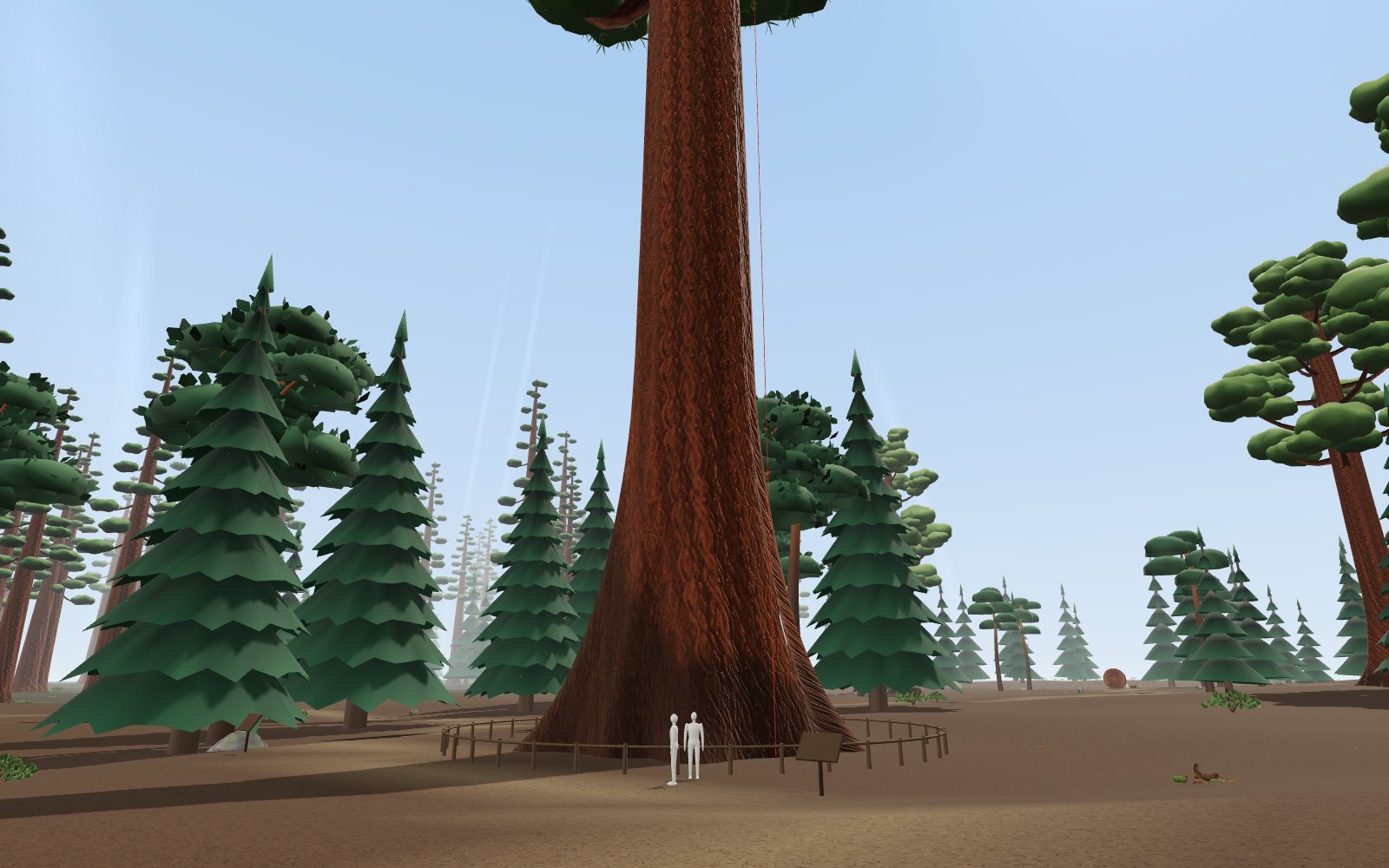
Giant sequoia forest: walk under the largest trees
Stand at the foot of the General Sherman Tree, 83.8 m tall and about 2,200 years old, then climb its trunk and see how hard the water up there is pulled.
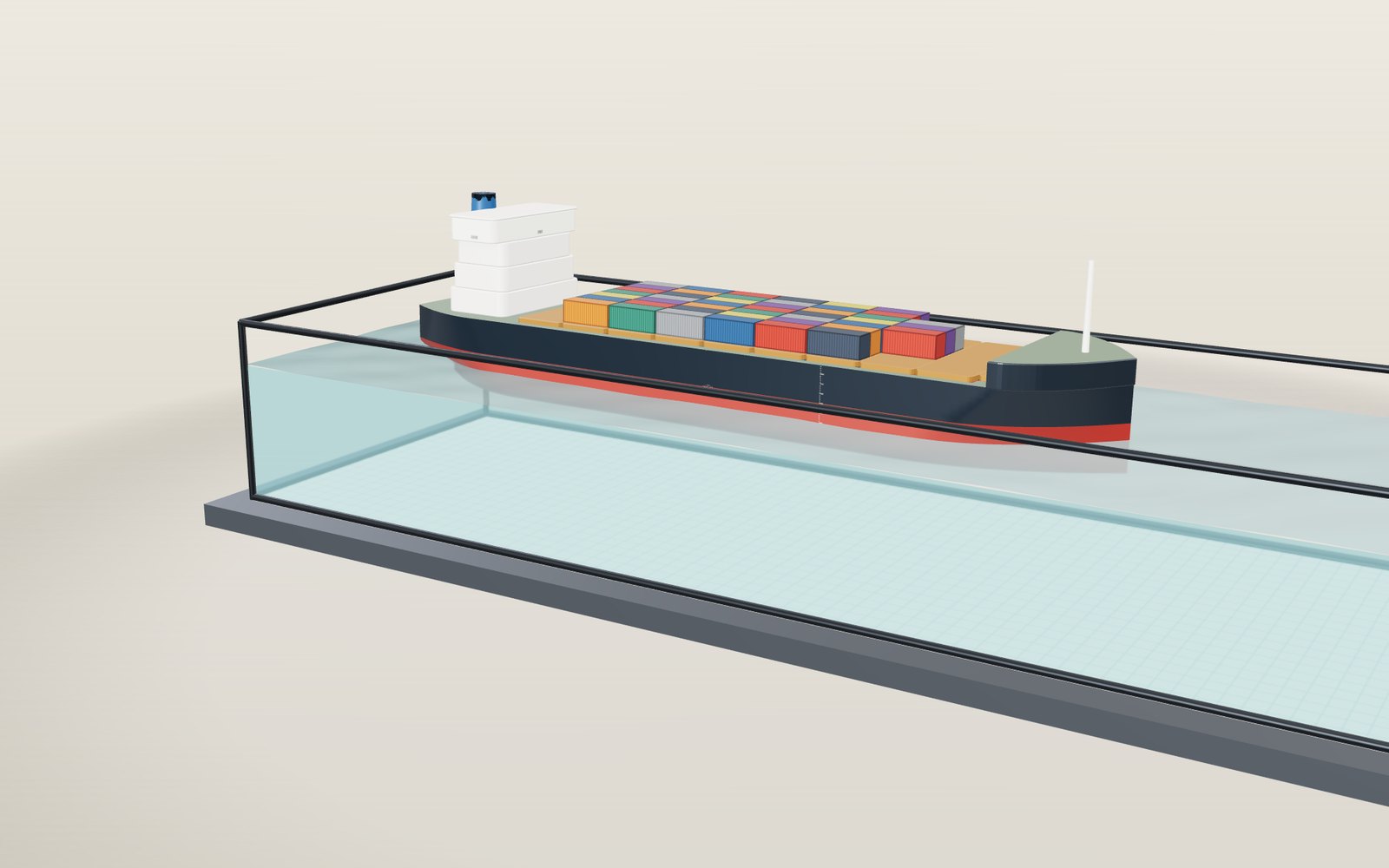
Why do ships float?
A 1,900-tonne steel ship floats, yet the same 1,900 tonnes of steel pressed into a cube goes straight to the bottom.