Loading the model
This device cannot show the 3D model. You can read the guide steps below as text.
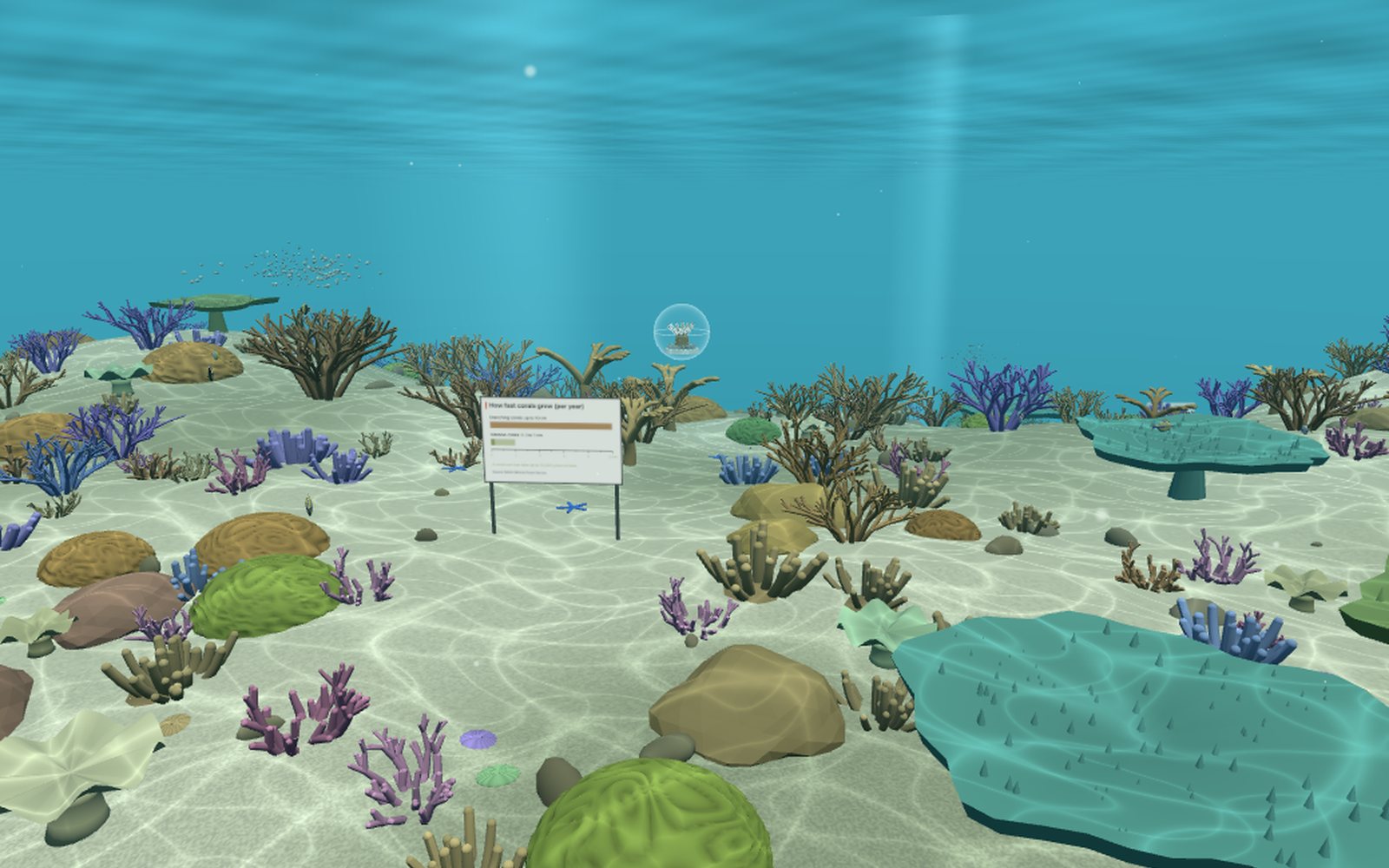
1 / 10 Over the reef flat You start 2.6 m under the surface, above a reef flat about 5.5 m deep. Swim with WASD or the arrow keys, rise with R or Space and sink with F or C. The bright net of light on the sand is sunlight focused by the waves.
Drag to turn. Scroll or pinch to zoom.
Guide Parts Controls
01 Over the reef flat You start 2.6 m under the surface, above a reef flat about 5.5 m deep. Swim with WASD or the arrow keys, rise with R or Space and sink with F or C. The bright net of light on the sand is sunlight focused by the waves.
02 Branching corals grow fastest Staghorn coral is a branching coral, and NOAA gives branching corals up to 10 cm of growth a year. Massive corals add only 0.3 to 2 cm. The table coral nearby spreads a flat plate on a short stalk. The slate behind you draws both rates to scale.
03 A brain coral is a colony Each valley on this brain coral is a row of polyps sharing one skeleton. At 0.3 to 2 cm a year, a dome 1.5 m across took somewhere between about 40 and 250 years to grow.
04 One polyp, 100 times larger Real stony coral polyps average 1 to 3 mm across. A ring of tentacles with stinging cells surrounds the mouth. The brown dots in the tissue are zooxanthellae, the algae that make most of the coral's food.
05 A school with no leader Each chromis steers by its near neighbours only. It keeps a little space, matches their heading and drifts toward their middle. Nobody leads the school. Swim into it and the fish split around you.
06 The clownfish and its anemone Clownfish live among stinging tentacles that would hurt most other fish. A mucus coat protects them, and in return they chase off fish that eat anemones. Come within about 1 m and they duck into the tentacles.
07 A green turtle on the slope At about 11 m a green sea turtle swims a slow loop. NOAA Fisheries gives adults a length of 3 to 4 feet, about 0.9 to 1.2 m. Green turtles feed mostly on seagrass and algae.
08 Raise the water temperature Open Controls and push the water above 30 °C, which is 1 °C over this reef's usual summer high of 29 °C. Each second is one week. Above 4 degree heating weeks the branching corals start to turn white, and above 8 NOAA expects severe bleaching.
09 Down to the deep reef At about 18 m the light is weaker and the reef changes: flat plate corals spread to catch light, and sea fans stand across the current. Switch on the torch in Controls. Open Map at the top right to jump between the five zones, and Guide to search 76 species and swim to them.
10 Replay a real year Open Real years and pick a season, such as 2016 on the Great Barrier Reef. The sea temperature and heat stress come day by day from NOAA Coral Reef Watch station data. Compare three years, then fast forward 10 years to watch the reef recover.
Staghorn coral A branching coral built from code: each branch splits into two or three smaller ones. NOAA gives branching corals growth of up to 10 cm a year, the fastest of the reef builders. In this model they are also the first to bleach. Table coral A flat plate on a short stalk, about 2.5 m across in the model, with small upright branchlets on top. The shape spreads a large area of tissue to the light while using little skeleton. Brain coral A massive coral whose valleys are rows of polyps sharing one skeleton. NOAA gives massive corals 0.3 to 2 cm of growth a year. Here they bleach later than branching corals. Coral polyp (×100) One polyp drawn 100 times larger than life. Stony coral polyps average 1 to 3 mm across. The tentacles carry stinging cells (nematocysts), shown as white dots, and the skeleton cup below has radial plates called septa. Zooxanthellae Single-celled algae living inside the polyp's tissue, drawn far larger than real. NOAA says as much as 90% of the food they make by photosynthesis goes to the coral. When the water gets too warm the polyp pushes them out. Blue-green chromis school Small damselfish, 8 cm in the model, moving as a school by the boids rules of Craig Reynolds (1987): separation, alignment and cohesion. A second school of orange sea goldies uses the same code with other settings. Sea anemone and clownfish A host anemone with a few hundred tentacles and three clownfish about 8 to 9 cm long. A mucus coat keeps the clownfish from being stung. They hide in the tentacles when you swim close. Green sea turtle An adult with a shell about 1 m long. NOAA Fisheries gives adults a length of 3 to 4 feet and a weight of 300 to 350 pounds. It swims a slow loop over the reef slope at about 11 m. Growth slate A survey slate on the reef flat that draws the NOAA growth rates to scale: up to 10 cm a year for branching corals and 0.3 to 2 cm for massive corals. Reef area slate Two grids of 100 squares. Reefs cover about 1% of the world's ocean but provide habitat for at least 25% of marine life (NOAA). The note below gives the reach of the 2023 to 2025 global bleaching event. Seagrass meadow A meadow of tape seagrass (Enhalus acoroides) on the sand about 5 m deep, west of the reef flat. The blades sway with the swell. Green turtles graze seagrass and algae. Lagoon Sand at about 6 to 8 m with coral heads on two rock mounds: massive and brain corals, mushroom corals, leather corals, a giant clam and long-spined urchins. Rays and a stonefish hide on the sand. Deep reef About 18 to 19 m at the foot of the slope. Daylight is weaker here, so the model dims the sun with depth. Plate corals, large sea fans and barrel sponges grow on two pinnacles; switch on the torch to bring back the colours. Cleaning station A leopard coral grouper holds still while two bluestreak cleaner wrasse pick at it. FishBase describes the wrasse staying at stations where other fish come to be cleaned of parasites and mucus.