FIG. 87How It Works
What happens to your body in space without a suit
Without a suit you would have about 10 seconds of useful consciousness, and if air came back within a minute or so you might well recover. You would not explode.
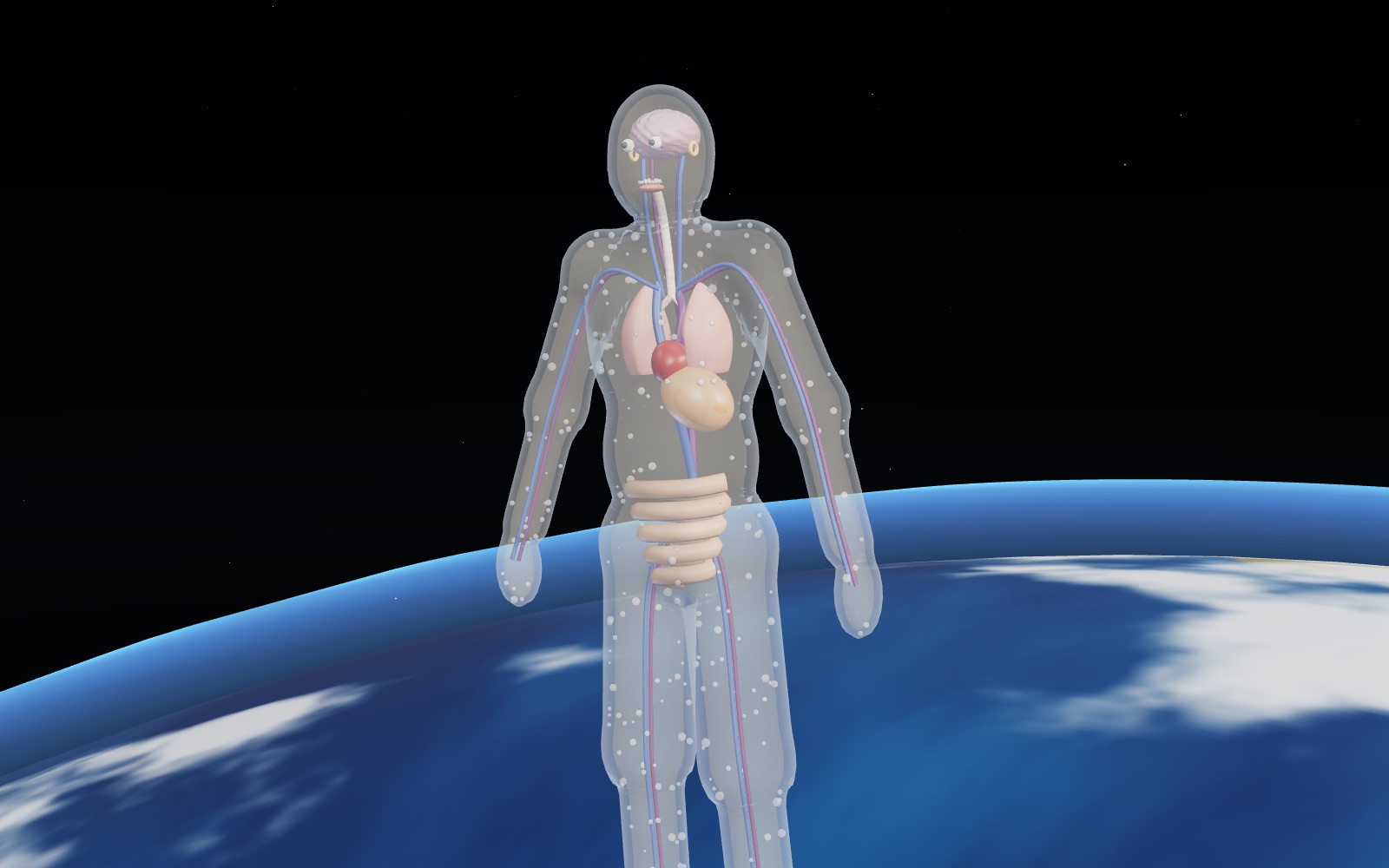
This device cannot show the 3D model. You can read the guide steps below as text.
1 / 8 Two minutes in a vacuumA person in sea-level air is suddenly in a near vacuum. The timeline runs 120 s with a mark every 15 s. Drag it, or press play and watch the readout change second by second.
Drag to turn. Scroll or pinch to zoom.
Would you really explode?
In films, an airlock opens and the person caught outside swells up, freezes solid or bursts within seconds. The records tell a quieter story. In 1965 a test subject at NASA's Manned Spacecraft Center in Houston was in a vacuum chamber when his suit sprang a leak. He stayed conscious for about 14 seconds, and his last memory was of the water on his tongue starting to boil. The chamber was brought back up to pressure and he recovered.
This exhibit follows the first 120 seconds of that kind of exposure, one second at a time, on a diagram of the body. The figure has no face and a see-through skin so you can watch the parts that matter: the lungs, the airway, the tongue, the brain, the heart, the vessels, the gut and the layer of tissue under the skin. The altitude slider lets you try the same two minutes at lower heights, from an airliner cabin to the top of Everest to the Armstrong limit, where body water starts to boil.
This exhibit explains the physics and physiology in general terms, using reports from NASA, the US Air Force and the FAA. It is not medical advice, and nothing here is a guide to what any one person would survive.
The two minutes, in order
The stage starts with a person breathing ordinary sea-level air, 101.325 kPa with 21 % oxygen, which is what the International Space Station keeps. Then the outside pressure drops to the chosen altitude almost at once. In a near vacuum this is roughly what the reports describe:
- 0 to 1 s: the air in the lungs rushes out through the open airway. If the breath is held, the lungs are stretched instead.
- 1 to 5 s: saliva, tears and other surface water start to boil. The skin of the mouth and nose begins to cool.
- About 9 to 11 s: useful consciousness ends, because the blood reaching the brain has lost its oxygen to the empty lungs.
- 5 to 45 s: water vapour forms in the tissue under the skin and in the veins. The body and limbs swell, perhaps to twice their normal volume.
- Within about 60 s: venous pressure rises to meet arterial pressure and the blood stops circulating. The heart slows sharply.
- About 90 s: the limit NASA uses for planning. Animals brought back to pressure before this usually recovered.
The timeline under the model marks these events for whatever altitude you choose, with a tick every 15 s. At sea level it shows nothing at all, and at an airliner's cruising height it shows only the oxygen running short.
Breathe out, do not hold it
The most dangerous thing a person could do in that first second is take a deep breath and hold it. Air trapped in full lungs keeps its pressure while the pressure outside falls to almost nothing. The lung wall is thin, and it cannot carry much of a pressure difference on its own.
NASA's compendium of human responses to the aerospace environment (Roth, 1968) puts the limit at about 80 mmHg across the lung, which is 10.7 kPa. Above that, in experiments and in human accidents, lung tissue tears.
How small is 10.7 kPa? It is about the drop in air pressure between sea level and 928 m. Scuba divers are taught the same rule for the same reason: never hold your breath on the way up. Switch on Hold breath in Controls and the lungs on the stage stretch and flash red, and the readout shows the pressure across them. In a vacuum it is more than 100 kPa, ten times the tearing point.
With the airway open, the air simply leaves. The stage shows a puff of air from the mouth and nose in the first second and the lungs shrinking a little. That loss of air is harmless in itself; the trouble that follows is about oxygen, not about the lungs bursting.
The same law, Boyle's law, explains what happens to every other pocket of gas in the body. At constant temperature, a gas's volume times its pressure stays the same, so if nothing held it back, gas from sea level would grow 3.2 times on Everest and 16 times at the Armstrong limit. The middle ear, the sinuses and the gut all hold some gas. Most of it finds a way out or is held back by the tissue around it, which can hurt but is not what decides survival.
Why saliva boils but blood does not
Water boils when its vapour pressure, the push of molecules escaping from the liquid, equals the pressure pressing down on it. At sea level that happens at 100 °C. Lower the pressure and water boils at a lower temperature, which is why pasta takes longer to cook in the mountains.
At 6.3 kPa (47 mmHg) water boils at 37 °C, body temperature. This pressure is called the Armstrong limit. In the standard atmosphere it is reached at about 19 km, or 63,000 ft. Above that height, water on the body surface boils without any heat being added. That is what the 1965 subject felt on his tongue.
Blood in the arteries is a different case. It is not open to the outside: the heart pushes it at a pressure well above the outside air, and the vessel walls and the tissue around them hold that pressure in. So arterial blood does not boil at once. What happens instead is slower and happens in the places where pressure is lowest: in the tissue under the skin, and in the large veins near the heart.
Working out the boiling point yourself
The stage calculates the boiling point with the Antoine equation, a fit to measured vapour pressures:
log10(P / bar) = A − B / (T + C)
Here T is the temperature in kelvin and A, B and C are constants for water from the NIST Chemistry WebBook. The model uses four of NIST's data sets for water between 255.9 and 373 K. For body temperature, T = 310.15 K and the set for 304 to 333 K gives A = 5.20389, B = 1733.926 and C = −39.485:
log10(P) = 5.20389 − 1733.926 / (310.15 − 39.485) = 5.20389 − 6.40616 = −1.20227
So P = 0.0628 bar = 6.28 kPa, the Armstrong limit. To get the boiling point at a given pressure the same equation is turned round: T = B / (A − log10 P) − C.
The pressure at each altitude comes from the U.S. Standard Atmosphere 1976, which describes the air as a series of layers with a set temperature profile. Up to 11 km the temperature falls 6.5 K every kilometre; from 11 to 20 km it stays at −56.5 °C. Put the two together and you get the boiling points the readout shows:
| Where | Altitude | Pressure | Water boils at |
|---|---|---|---|
| Sea level | 0 km | 101.3 kPa | 100 °C |
| Airliner cabin, highest allowed | 8,000 ft (2.4 km) | 75.3 kPa | 92 °C |
| Summit of Everest | 8,849 m | 31.5 kPa | 70 °C |
| Cruising airliner | 35,000 ft (10.7 km) | 23.9 kPa | 64 °C |
| Armstrong limit | 19.2 km | 6.28 kPa | 37 °C |
| Kittinger's balloon, 1960 | 31.3 km | 0.98 kPa | 7 °C |
| Baumgartner's jump, 2012 | 39.0 km | 0.33 kPa | no liquid water |
Below 0.61 kPa, the triple point of water, liquid water cannot exist at any temperature. It boils and freezes at the same time, and the readout says so. The small chart in the readout draws the whole curve on a log scale with the body temperature line and an orange dot for the pressure you have chosen.
About ten seconds of oxygen
Normally your lungs add oxygen to the blood. In a vacuum they do the opposite. With no oxygen in the lungs, oxygen leaves the blood as it passes through them, so the blood that reaches the brain a few seconds later carries even less than when it left the body. The brain stores only a few seconds' worth.
NASA's Bioastronautics Data Book (1973) expects some degree of consciousness to last 9 to 11 seconds, and says a person suddenly exposed would probably have no more than 5 to 10 seconds to help themselves. Dogs decompressed to below 2 mmHg collapsed after 9 to 10 seconds. The 1965 subject's 14 seconds fit, since his suit probably never reached a hard vacuum.
At lower altitudes there is more time, and the FAA publishes it as the "time of useful consciousness". This is the time a pilot has to act sensibly, not the time to passing out:
| Altitude | Usual | After a rapid decompression |
|---|---|---|
| 18,000 ft | 20 to 30 min | 10 to 15 min |
| 25,000 ft | 3 to 5 min | 1.5 to 2.5 min |
| 30,000 ft | 1 to 2 min | 30 s to 1 min |
| 35,000 ft | 30 s to 1 min | 15 to 30 s |
| 40,000 ft | 15 to 20 s | |
| 43,000 to 50,000 ft | 9 to 12 s |
The model uses the rapid-decompression column, since the stage starts with a sudden drop, and the near-vacuum figure of 9 to 11 s from the Armstrong limit up. Between rows it draws a smooth curve. The orange band on the timeline is this range, and the Awake row turns red when the band starts.
Swelling, not bursting
Below the Armstrong limit the water in the body's tissues begins to turn to vapour, a process called ebullism. It starts where there is least pressure to stop it: in the loose tissue under the skin and in the blood of the large veins. The Bioastronautics Data Book describes marked swelling of the body, perhaps to twice its normal volume, unless a pressure suit holds it in.
It does not burst. Skin is tough and elastic, and the vapour stays under it. In the dog experiments the swelling went down dramatically as soon as the pressure rose above about 50 mmHg. The data book also reports that a tight, well-fitted elastic garment entirely prevented ebullism at pressures as low as 15 mmHg. Even ordinary tight clothing would push back a little.
On the stage the skin moves outward along its surface, most of all in the arms, legs, hands and feet, and the tissue layer beneath it moves less, so the gap between the two is the swelling. Switch on Cut the skin open to see that gap, and Gas bubbles to show the vapour as small spheres. The hands are a separate part because of one real case. In 1960 Joe Kittinger rose to 102,800 ft in an open balloon gondola. The pressure glove on his right hand failed on the way up, and the hand swelled, hurt and became useless. He made the jump anyway, and once he was back at lower altitude the hand returned to normal.
When the circulation stops
The vapour that forms in the large veins is what makes a longer exposure fatal. Roth's compendium describes bubbles forming where the great veins enter the heart and spreading back through the veins, a "vascular vapour lock" that stops blood returning to the heart. The heart has nothing to pump.
The data book gives the timing: the heart rate may rise at first and then falls rapidly, arterial pressure falls over 30 to 60 seconds, and venous pressure meets or passes arterial pressure within about a minute. After that there is virtually no effective circulation. Dogs held for 90 seconds at 2 mmHg had heart rates down to 10 beats a minute from a normal 159.
The model draws the heart rate rising for the first 5 s and then falling, and the circulation running down between 5 and 60 s. These curves are smooth lines through the reported times, not measurements of a person.
How long could someone survive?
Nobody has deliberately tested a human, so the numbers come from animals and from accidents. In 1964, 126 dogs at the USAF School of Aerospace Medicine were decompressed to below 2 mmHg for 5 to 180 seconds. Every dog exposed for less than 120 seconds survived after being brought back to pressure, despite signs of lung damage. Exposures of 120 to 180 seconds killed from about 15 % to more than 80 %. Chimpanzees, tested for NASA in 1965, were held below 2 mmHg for 5 to 150 seconds; all of them were back to their trained task within four hours, and the tests found no brain damage.
From these studies NASA's data book concludes that recompression within 60 to 90 seconds could mean survival and perhaps quite a rapid recovery, with no guarantee: some animals died within seconds and a few had lasting damage. Roth's compendium advises using a maximum survival time of 90 seconds for planning emergency procedures. The If pressure returns now row on the stage follows these bands. It is a statement about what was seen in animals, not a prediction for any person.
The one real case at full vacuum and full length is Soyuz 11. In June 1971 a pressure equalization valve was jolted open when the descent module separated, high above the atmosphere. The cabin air escaped in less than a minute. The three cosmonauts, who were not wearing pressure suits, lost consciousness and died within two minutes. The capsule landed automatically and the recovery team found them in their seats.
Space is not instantly cold
A vacuum has no air, so there is nothing to carry heat away by conduction or convection. The only route out is radiation, the infrared glow that every warm object gives off. With a skin temperature of 33 °C, an emissivity of 0.97 and about 1.5 m² of skin facing open space, the Stefan–Boltzmann law gives:
P = 0.97 × 5.67 × 10⁻⁸ × 1.5 × 306.15⁴ ≈ 725 W
A 70 kg body holds about 243 kJ for each degree. At 725 W the core cools by about 0.36 °C in two minutes. It would take over five minutes to lose 1 degree this way. Being caught in the shade of space for two minutes does not freeze anyone.
The parts that do get cold are the mouth and nose. Water keeps evaporating from the airways, and evaporation takes heat with it. The data book says this cools the mouth and nose to near freezing, while the rest of the body cools much more slowly. The Mouth and nose row shows that fall.
Sunlight changes the balance. At Earth's distance the Sun delivers 1,361 W/m². If half a square metre of the body faces it and absorbs 60 %, that is about 408 W coming in, and the net loss falls to about 316 W. Switch Sunlight off to see the core temperature fall a little faster.
What a pressure suit changes
A spacesuit is mostly a balloon that keeps pressure on the body. It does not need sea-level pressure: if the gas is pure oxygen, a much lower total pressure gives the lungs enough oxygen. NASA lists 25.8 kPa for the Apollo suits, 29.6 kPa (4.3 psi) for the station suit and 39.2 kPa for the Russian Orlan, all with 100 % oxygen. That is well above the Armstrong limit, so no body water boils. Interestingly, 4.3 psi is also roughly the air pressure outside a plane at 30,000 ft.
A lower suit pressure makes the suit easier to bend, especially the gloves, but it brings a different problem. Going from station air at 101 kPa to a suit at 29.6 kPa lets nitrogen dissolved in the body form bubbles, the same decompression sickness divers get. So astronauts first breathe pure oxygen to wash out the nitrogen. In one station protocol that takes 2 hours and 20 minutes from the first breath of oxygen to the spacewalk.
Switch on Pressure suit and the whole timeline stays quiet: no swelling, no boiling, normal lungs and normal oxygen.
Lower than space
You do not need to go to space to meet some of these effects. The altitude slider and the chips above the timeline let you try the same two minutes elsewhere.
- Airliner cabin: US rules require a pressurized cabin to stay at a pressure altitude of not more than 8,000 ft in normal flight. That is about 75 kPa, and nothing on the timeline happens.
- Everest: about 31 kPa in the standard atmosphere. Water boils at about 70 °C, nothing in the body boils, and the time of useful consciousness is many minutes, so the timeline shows nothing within two minutes. Climbers still suffer from the low oxygen over hours and days.
- Cruising airliner: at 35,000 ft, a sudden loss of cabin pressure gives 15 to 30 s of useful consciousness. That is why the oxygen masks drop. US rules require oxygen for the crew above 12,500 ft for longer than 30 minutes and for every occupant above 15,000 ft.
- Armstrong limit: about 19 km. Above this, a pressure suit is needed even for a short exposure.
The cost of ignoring this is clear from the 1999 accident of a Learjet 35, registration N47BA. Radio contact was lost after the jet was cleared to 39,000 ft. The NTSB found that the crew had been incapacitated after the cabin lost pressure and they did not receive supplemental oxygen. The aircraft flew on until it ran out of fuel and crashed in South Dakota.
Cases to try
The list under the stage has 33 cases. Each card sets the model to its pressure and time when you press Show on the model, and the cards with a time in seconds have a bar on the same 0 to 150 s scale so you can compare them. They are grouped in five kinds:
- Accidents: the 1965 chamber test, Kittinger's hand, Soyuz 11, the Learjet in 1999.
- Tests: the dog and chimpanzee studies, the 80 mmHg lung limit, the elastic garment, recompression within 90 s.
- Rules: FAA times of useful consciousness, oxygen and cabin rules, suit pressures and prebreathing.
- Heights: Everest, the Armstrong limit, record balloon jumps, the surface of Mars and unfiltered sunlight.
- Films: scenes that are about right and scenes that are not, each compared with the records.
The surface of Mars is a useful comparison. Its mean pressure is 6.36 mbar, or 0.64 kPa, about what Earth's air has near 35 km. For an unprotected body that is close to a vacuum, which is why a Mars suit has to be a full pressure suit.
What the model leaves out
- The figure is a diagram, not a person. Its shape is built from smooth capsules, and the organs are simple shapes in roughly the right places.
- Arteries are drawn red turning purple as the oxygen falls, and veins are always blue. Real oxygen-poor blood is dark red.
- The curves for oxygen, heart rate, circulation, swelling and mouth temperature are smooth lines drawn through the reported times. They are labelled as model values on the stage.
- The scenario assumes a sudden drop from sea-level pressure. A slow leak gives more time, and a person who was breathing pure oxygen beforehand would have a few more seconds, as the denitrogenated dogs did.
- Real people differ. The FAA notes that times of useful consciousness vary widely with lung size, haemoglobin and how much oxygen the body uses.
- Altitudes are geometric heights in the 1976 standard atmosphere. Real pressure at a place also changes with the weather, the season and the latitude.
- The heat numbers use radiation alone. Evaporation from the skin and airways would cool the surface faster.
A short history
Pressure suits came from high-altitude flying before spaceflight needed them. Joe Kittinger's 1960 balloon ascent to 102,800 ft in an open gondola was partly a test of one, and his unpressurized hand became the best-known example of what happens without it.
In the early 1960s, with spacecraft and large vacuum chambers being built, NASA's Manned Spacecraft Center paid for animal studies to find out what a suit failure would do. Bancroft and Dunn decompressed 126 dogs in 1963 and 1964; Koestler's team at Holloman Air Force Base tested chimpanzees and reported in November 1965. The results went into the Bioastronautics Data Book and Roth's compendium, which set the figures still quoted today: about 10 seconds of useful consciousness and about 90 seconds for planning a rescue.
Since then the human cases have mostly been accidents with good endings, such as the 1965 chamber test. Soyuz 11 in 1971 remains the only time people have died in space itself.
Questions
Would my body explode in space?
No. The water in your tissues would turn to vapour and you would swell, perhaps to twice your normal volume, but skin is strong enough to hold it. In the animal tests the swelling went down as soon as pressure returned.
Would my blood boil?
Not at once. Blood in the arteries is held above the outside pressure by the heart and the vessel walls. Saliva, tears and the water in loose tissue boil first. Vapour does form in the large veins, and that is what stops the circulation within about a minute.
How long would I stay conscious?
About 9 to 11 seconds in a near vacuum, according to NASA's Bioastronautics Data Book. The 1965 test subject managed about 14 seconds. Useful consciousness, the time you could do something sensible like closing a hatch, is shorter still.
How long could someone survive?
Animal studies suggest that recompression within about 90 seconds usually led to recovery, and NASA uses 90 seconds for planning. All dogs exposed for less than 120 seconds survived; longer exposures were often fatal. Nobody knows the exact figure for humans.
Should I hold my breath?
No. Breathe out. Air held in full lungs would tear them, since a pressure difference of only about 10.7 kPa across the lung wall can do that. With your airway open the air rushes out harmlessly.
Would I freeze instantly?
No. A vacuum carries no heat away, so the body only loses heat by radiation, about 725 W here. In two minutes the core would cool by less than half a degree. The mouth and nose get much colder because water evaporates from them.
What is the Armstrong limit?
The pressure at which water boils at body temperature, about 6.3 kPa or 47 mmHg. On Earth it is reached at about 19 km. Above it, a person needs a pressure suit, not only an oxygen mask.
Has anyone actually been exposed to a vacuum?
Yes, by accident. A suited test subject in a NASA vacuum chamber in 1965 had a leak and recovered. Joe Kittinger's right hand was unpressurized at 102,800 ft in 1960 and recovered. The crew of Soyuz 11 died in 1971 when their cabin lost its air.
Why do spacesuits use such low pressure?
A suit with pure oxygen at about 30 kPa gives the lungs as much oxygen as sea-level air, and a softer suit is easier to move in. The price is a long oxygen prebreathe beforehand so that nitrogen in the body does not form bubbles.
Would my eyes pop out?
Not according to the records. The animal reports describe swelling of the body and limbs and short-lived problems with vision afterwards. Tears would boil on the surface of the eye. Eyes bursting out is a film effect.
Terms
- Vacuum: a space with almost no gas. The pressure in low Earth orbit is far below 0.001 kPa.
- kPa, mmHg, psi: units of pressure. Sea level is 101.3 kPa, 760 mmHg or 14.7 psi.
- Vapour pressure: the pressure of vapour in balance with its liquid. A liquid boils when its vapour pressure equals the pressure on it.
- Armstrong limit: about 6.3 kPa (19 km), where water boils at 37 °C.
- Triple point: 0.61 kPa and 0.01 °C. Below this pressure water cannot be liquid.
- Ebullism: formation of water vapour in body fluids and tissue at low pressure.
- Hypoxia: too little oxygen reaching the tissues.
- Time of useful consciousness: the time someone can still act sensibly after the oxygen supply fails.
- Decompression sickness: illness caused by dissolved nitrogen forming bubbles after a pressure drop.
- Prebreathe: breathing pure oxygen before a spacewalk to wash nitrogen out of the body.
- Recompression: bringing the pressure back up after an exposure.
- Boyle's law: at constant temperature, pressure times volume of a gas stays constant.
- Antoine equation: an empirical formula for vapour pressure, log10 P = A − B / (T + C).
Sources
All addresses checked on 2026-10-18.
- NASA Goddard, Imagine the Universe! Ask an Astrophysicist, space travel answers (1965 chamber incident, Kittinger's hand in 1960). https://imagine.gsfc.nasa.gov/ask_astro/space_travel.html
- Parker and West (eds.), Bioastronautics Data Book, 2nd ed., NASA SP-3006 (1973), chapter 1, Barometric Pressure: Survival Under Near-Vacuum Conditions (47 mmHg, 9 to 11 s, swelling, circulation, mouth cooling, elastic garment, recompression within 60 to 90 s). https://ntrs.nasa.gov/citations/19730006364
- Roth, Compendium of Human Responses to the Aerospace Environment, NASA CR-1205 (1968), section 12, Pressure (80 mmHg lung limit, vapour lock, 90 s planning limit, dogs at 10 beats a minute). https://ntrs.nasa.gov/citations/19690003264
- Bancroft and Dunn, Experimental Animal Decompressions to a Near-Vacuum Environment, USAF School of Aerospace Medicine for NASA (1965). https://ntrs.nasa.gov/citations/19660005052
- Koestler (ed.), The Effect on the Chimpanzee of Rapid Decompression to a Near Vacuum, NASA CR-329 (1965). https://ntrs.nasa.gov/citations/19650027167
- NASA History, 50 Years Ago: Remembering the Crew of Soyuz 11 (2021). https://www.nasa.gov/history/50-years-ago-remembering-the-crew-of-soyuz-11/
- National Transportation Safety Board, Aircraft Accident Brief AAB-00/01, Learjet 35 N47BA (2000). https://www.ntsb.gov/investigations/AccidentReports/Reports/AAB0001.pdf
- FAA, Pilot's Handbook of Aeronautical Knowledge, chapter 17, Aeromedical Factors (time of useful consciousness). https://www.faa.gov/sites/faa.gov/files/19_phak_ch17.pdf
- FAA, Advisory Circular 61-107B, Aircraft Operations at Altitudes Above 25,000 Feet MSL (rapid-decompression times, high-altitude training). https://www.faa.gov/documentLibrary/media/Advisory_Circular/AC_61-107B_CHG_1.pdf
- 14 CFR 91.211, Supplemental oxygen. https://www.ecfr.gov/current/title-14/chapter-I/subchapter-F/part-91/subpart-C/section-91.211
- 14 CFR 25.841, Pressurized cabins. https://www.ecfr.gov/current/title-14/chapter-I/subchapter-C/part-25/subpart-D/subject-group-ECFR9b70e0ac7a2e5c4/section-25.841
- NASA, Why Do We Really Need Pressure Suits?, Museum in a Box (2017) (4.3 psi suits, 30,000 ft, prebreathe protocol). https://www.nasa.gov/wp-content/uploads/2023/05/dressing-for-altitude-nov-2017.pdf
- NASA, Surface Vehicle Atmospheric Considerations for Moon to Mars Exploration, ICES 2026 (Apollo, station and Orlan suit pressures). https://ntrs.nasa.gov/api/citations/20260002050/downloads/ICES-2026-324%20Final.pdf
- NASA, Houston We Have a Podcast: Locked In, Pressure Low (2022) (station air at 14.7 psi and 21 % oxygen). https://www.nasa.gov/podcasts/houston-we-have-a-podcast/locked-in-pressure-low/
- NIST Chemistry WebBook, Water, Antoine equation parameters. https://webbook.nist.gov/cgi/cbook.cgi?ID=C7732185&Mask=4&Type=ANTOINE
- NOAA, NASA and USAF, U.S. Standard Atmosphere, 1976. https://ntrs.nasa.gov/citations/19770009539
- FAI, press release on the 10th anniversary of Baumgartner's jump (2022) (38,969.4 m; Eustace 41,422 m). https://www.fai.org/sites/default/files/fai_press_release_anniversary_baumgartner_space_skydive-2012_14oct22_0.pdf
- NASA Space Science Data Coordinated Archive, Mars Fact Sheet (surface pressure). https://nssdc.gsfc.nasa.gov/planetary/factsheet/marsfact.html
- NASA Space Science Data Coordinated Archive, Earth Fact Sheet (solar irradiance 1,361 W/m²). https://nssdc.gsfc.nasa.gov/planetary/factsheet/earthfact.html
More exhibits
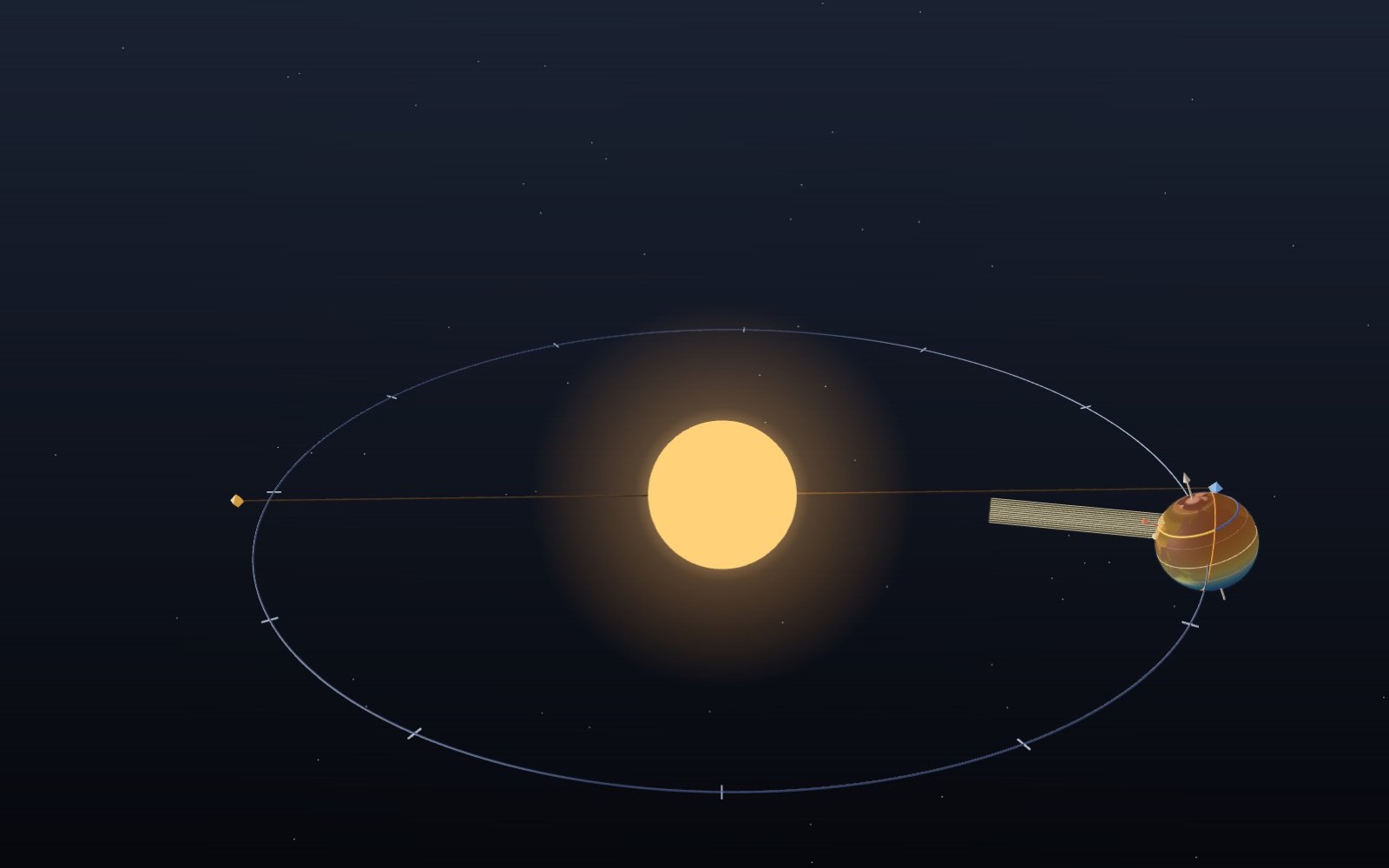
Why we have seasons: tilted Earth, changing daylight
The Earth is closest to the Sun in the first week of January, in the middle of the northern winter.
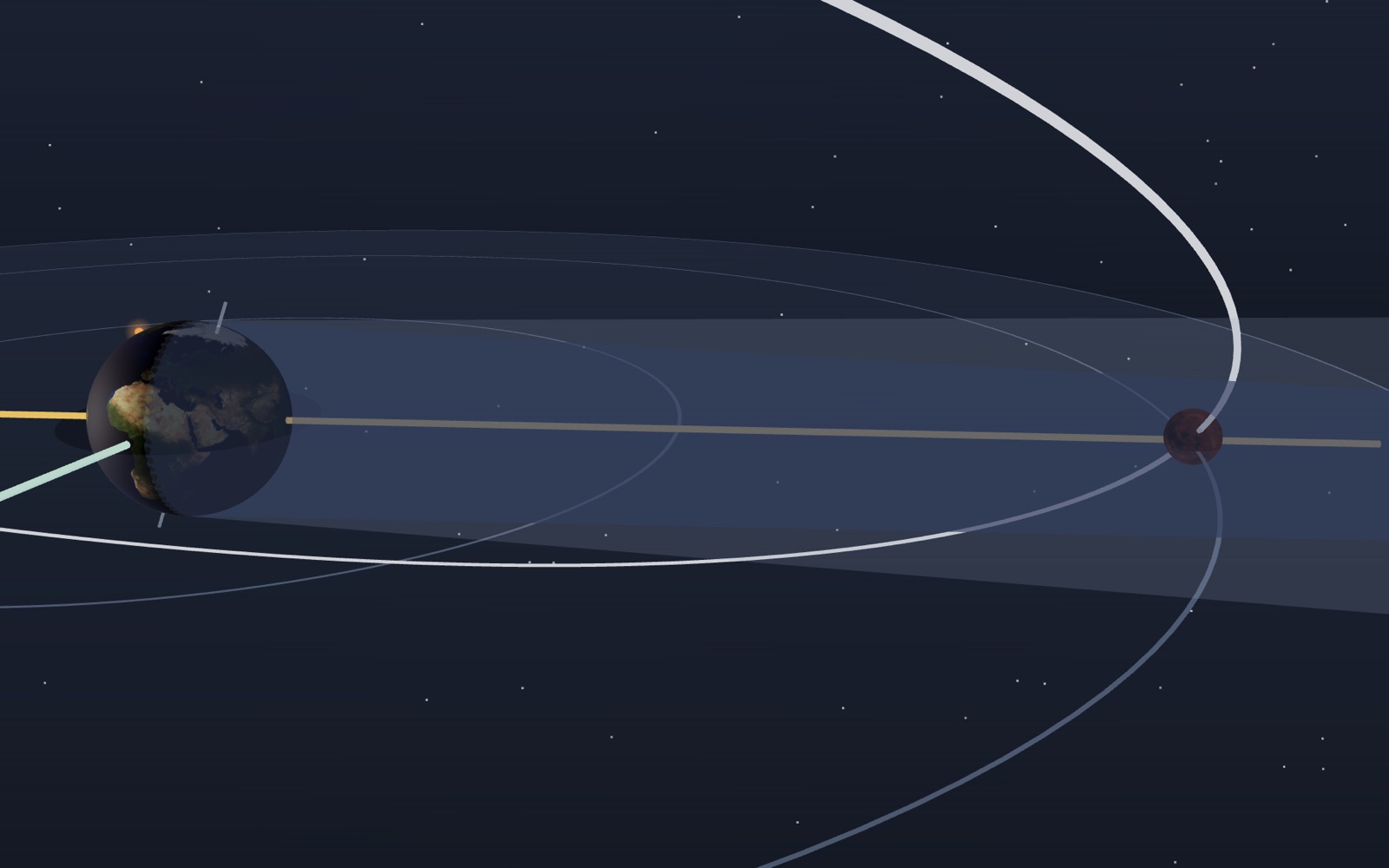
Moon phases: why a crescent is not Earth’s shadow
The Moon passes between the Earth and the Sun every 29.5 days, so why is there no solar eclipse every month?
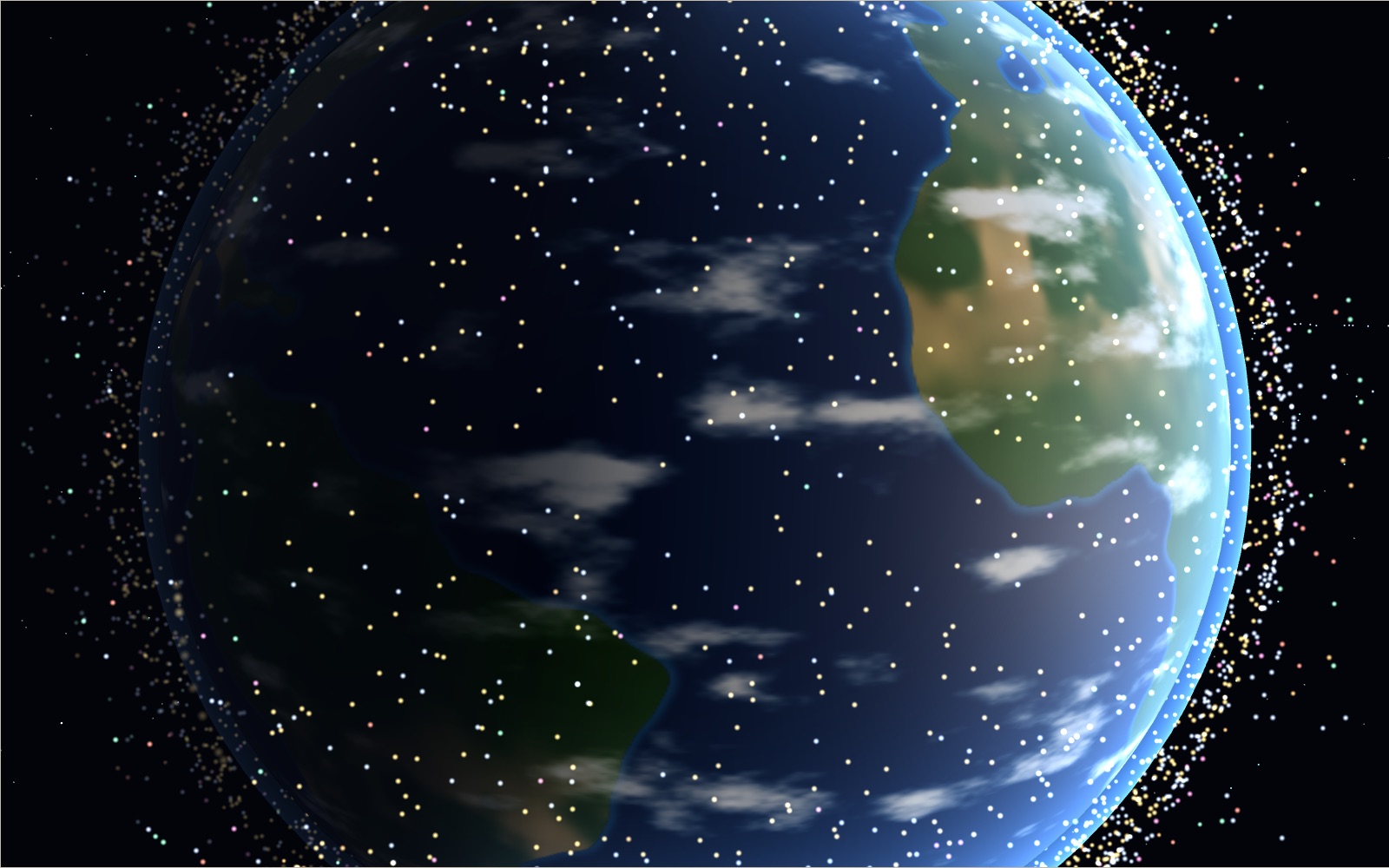
Satellites orbiting Earth right now
On 20 October 2026 the public catalogue listed 16,768 working satellites, and two in every three belonged to one company's internet network.
Your weight and jump height on other planets and moons
A 50 cm jump on Earth becomes a 3 m leap on the Moon, 18 m on Ceres and a one-way trip off asteroid Bennu.
Walk the Apollo landing sites
Standing on the Moon with your eyes 1.6 m up, the horizon is only about 2.4 km away. All six Apollo landing sites are here, from Tranquility Base to Taurus-Littrow.

How GPS works: why your phone needs four satellites
A GPS signal takes about 70 thousandths of a second to fall 20,200 km to your phone, and a millionth of a second of error moves you 300 m.